
 All languages
 Chinese (Simplified)
 Chinese (Traditional)
 English
 Indonesian
 Japanese
 Korean
 Malay
 Thai
 Vietnamese


How Can You Train For Badminton Competitions More Effectively (Competition Guide)
Competition training fails in a familiar way: players train hard for months, then spend the event week cramming fitness, changing technique and sleeping badly, and arrive at the first match tired, unfamiliar with their own game, and surprised by everything. Effective preparation looks almost boring by comparison. It works backwards from the date, gives each week one clear job, copies the event in practice, and tapers so the player arrives fresh with familiar patterns. This page builds that preparation in order: the calendar, match practice, sharpening, the competition week itself, and the review that turns one event into the base for the next. The players who look calm at events are rarely the ones who trained the most in the final week; they are the ones whose preparation finished on schedule.
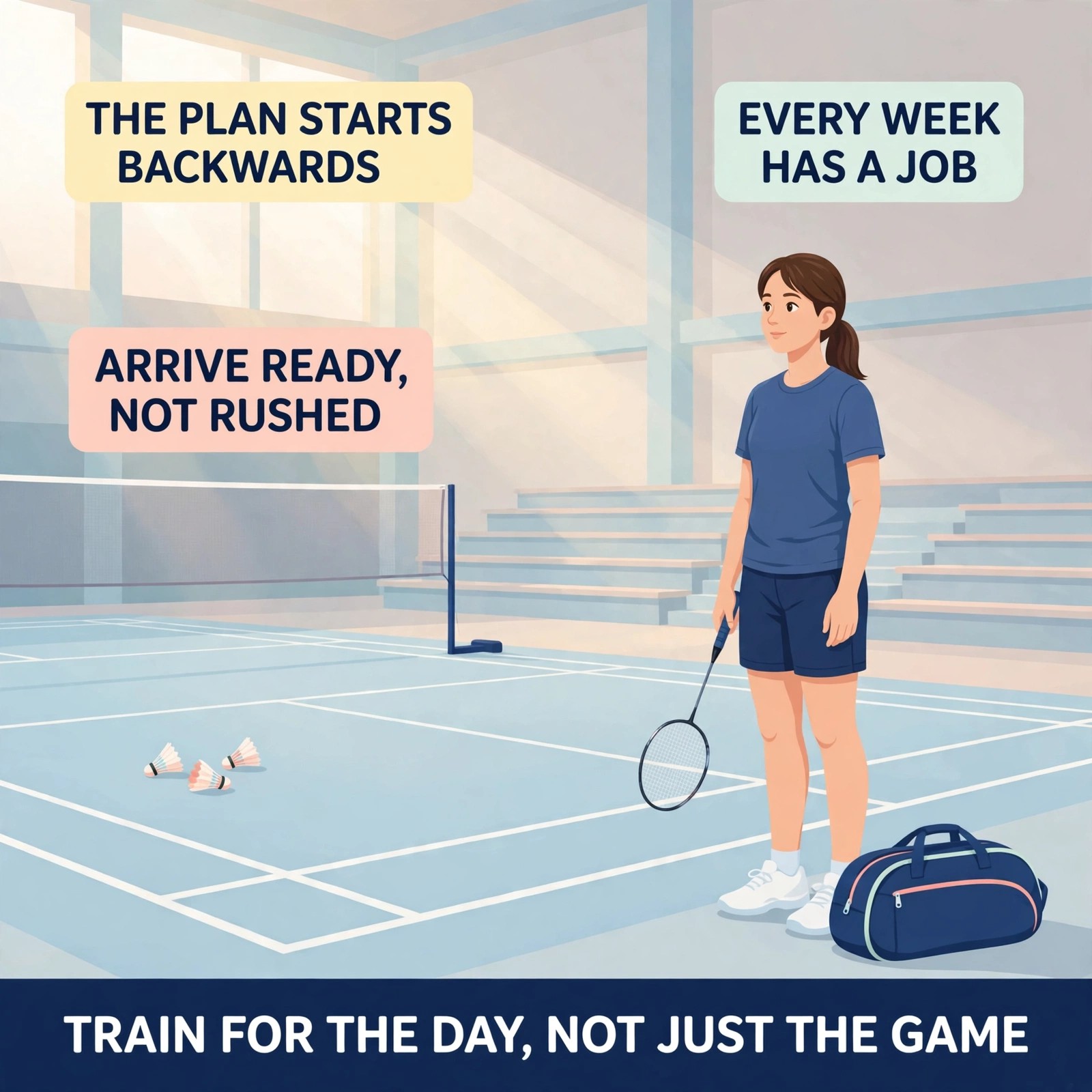
Competition Check #1
Work Backwards: Build The Weeks Around The Date
Start from the event and count backwards. If the competition is eight weeks away, the weeks have jobs in sequence: build the base first, add match practice in the middle, sharpen near the end, taper in the final week. Written down, the plan looks obvious. Unwritten, the same weeks blur into general training, and the player discovers in the last fortnight that nothing was ever aimed at the date. A one page calendar on the wall, with the event circled and each week given one honest job, prevents most competition preparation mistakes before they happen. The calendar also settles arguments kindly: when a player wants to add something late, the wall answers whether there is a week whose job it fits.
Working backwards also protects the base. Fitness and technique built six weeks out have time to settle into your game; the same work attempted ten days out only adds tiredness and doubt. Players ask when they should start preparing, and the honest answer is: earlier than feels necessary, at a pace you can sustain. A calm eight week build beats a heroic three week scramble in almost every case we have coached, because the body and the confidence both need the repetitions spread out, not stacked. Spread work also protects the joints and the mood; a build you can repeat weekly for two months teaches more than a fortnight you survive once.
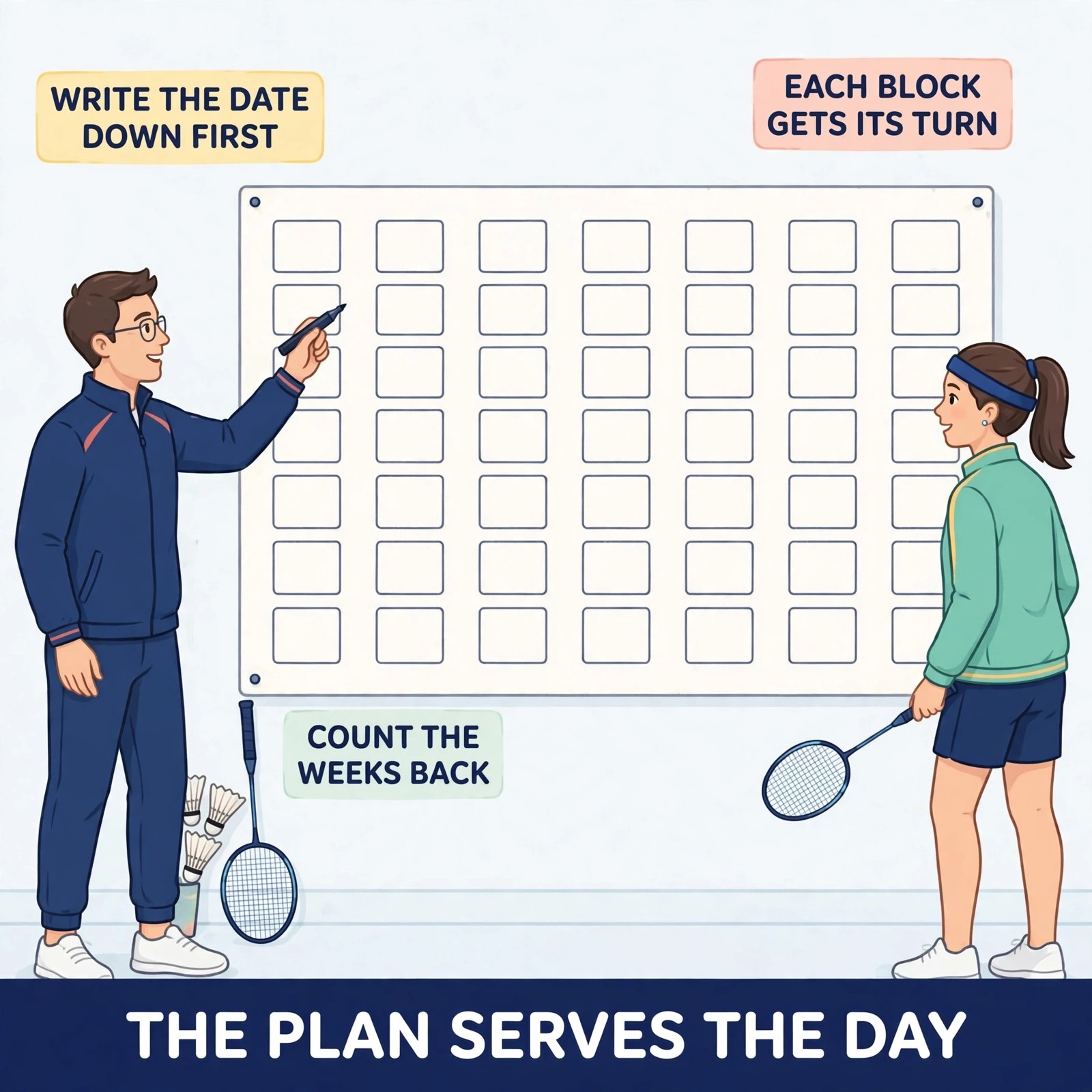
Competition Check #2
Match Practice: Make Training Look Like The Event
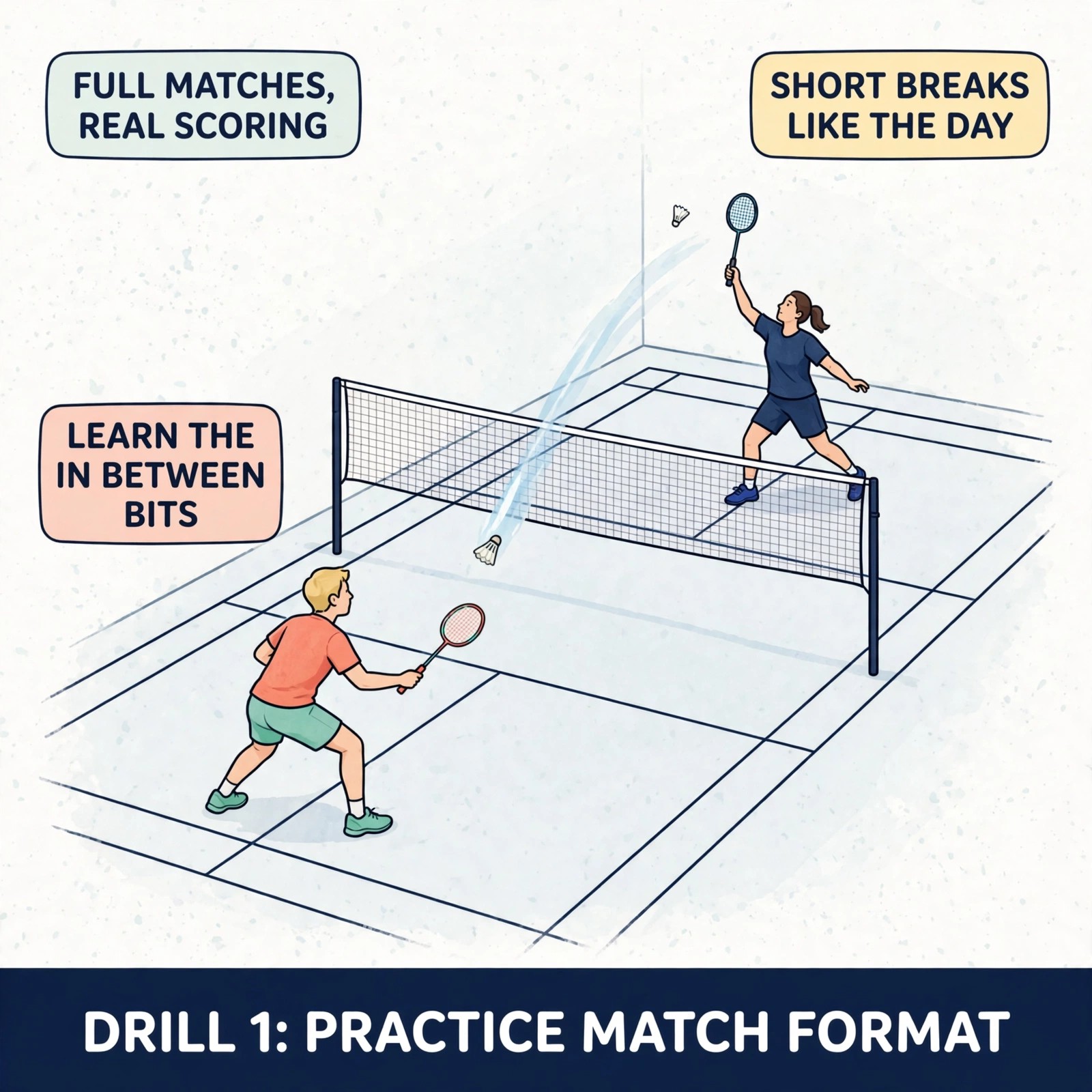
Match practice should copy the event it prepares for. If the competition plays best of three games to 21 with short breaks, training matches should use that scoring, those breaks, and roughly that hall rhythm: warm up, wait, play, wait, play again. Players are often surprised how much of competition difficulty is the waiting and the restarting, not the rallies. Practising the format makes the day feel familiar, and familiar days let your trained game actually appear instead of being crowded out by novelty and nerves. Even the hall can be partly copied: train at the same time of day as your likely match slot, and your body learns when to be awake and ready.
Copy the opposition too, in level if not in person. Training only against weaker partners teaches patterns that stronger defence will return with interest. Training only against much stronger players teaches survival, not finishing. The honest mix is mostly players near your level, some slightly stronger to stretch your reads, and scored games where results are recorded. Enter smaller events or friendly matches during the build if you can; nothing rehearses competition like a small competition, and the lessons arrive while there is still time to use them. Record the results, because memory edits them kindly; a written row of practice scores tells you which patterns are real and which were one good evening.
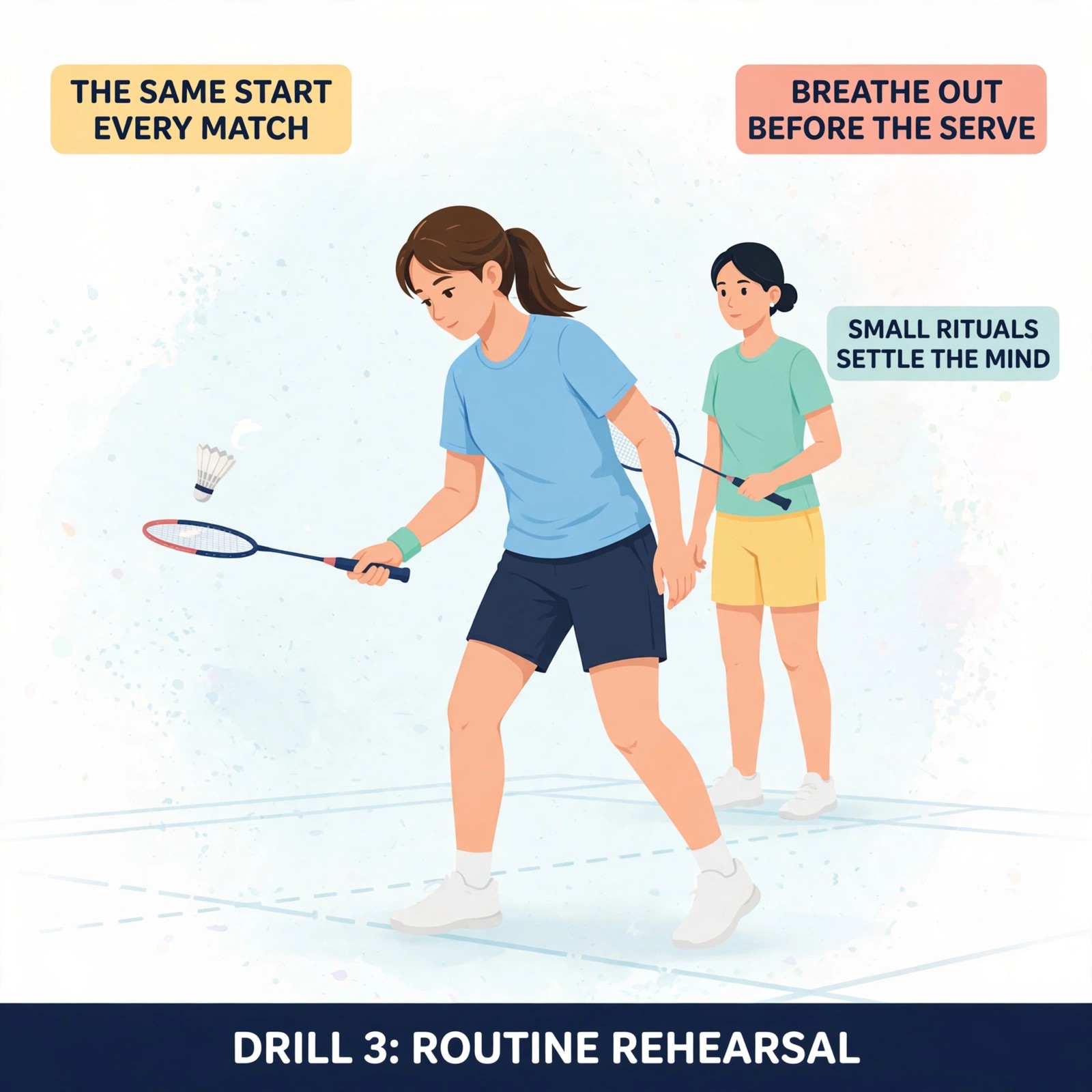
Match practice is also where routines get installed. How you warm up, what you do between games, the first pattern you trust, the words you say to yourself at 15 all: these should be rehearsed until they run without discussion. On the day, decisions are a cost. Every routine already decided is attention saved for the rallies. Coaches watch routines in practice matches as carefully as strokes, because in close events the routines are often what hold a player’s game together between the good rallies. Routines are personal but never mysterious: two or three actions, always in the same order, short enough to run in the minutes before a match starts.
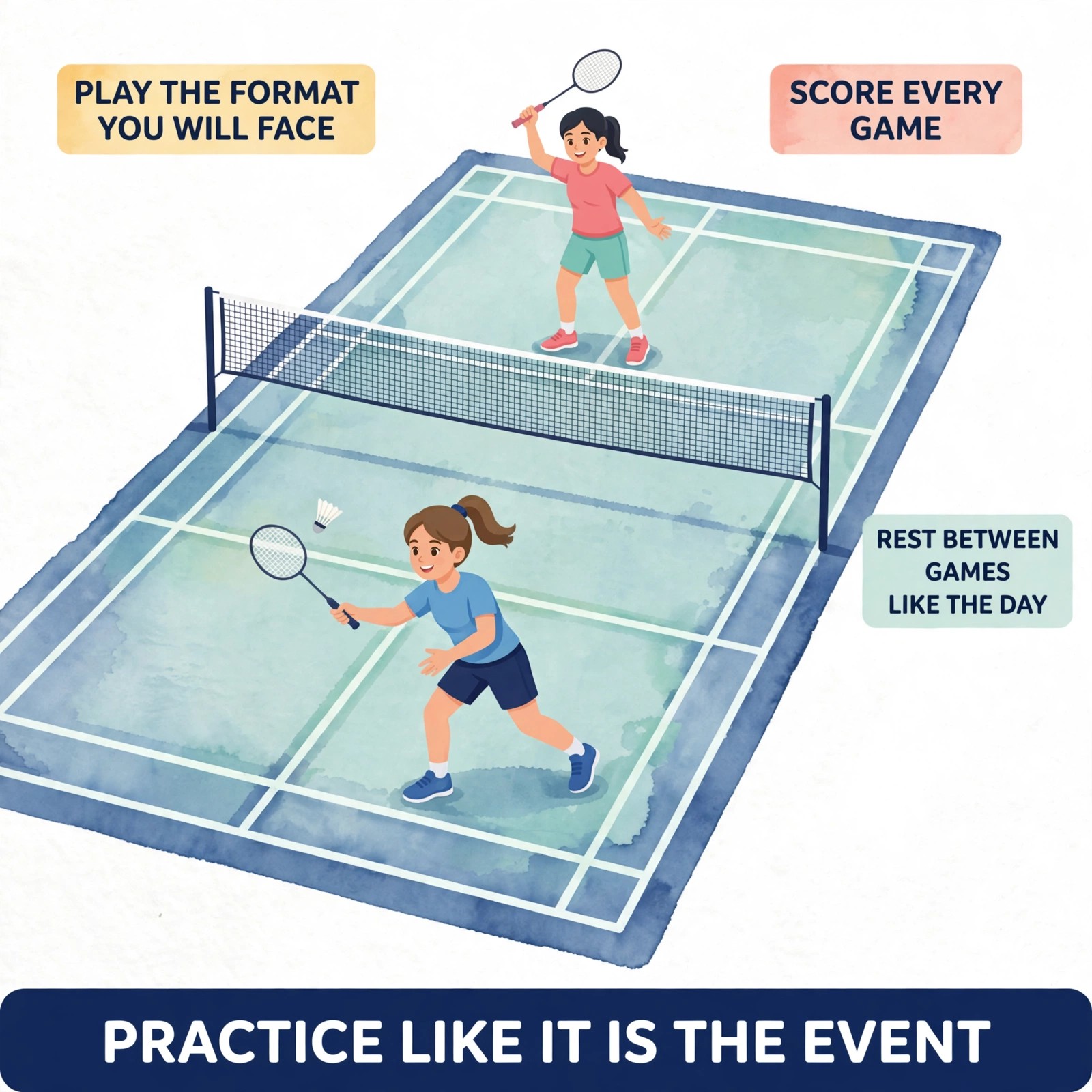
Competition Check #3
Sharpen, Do Not Rebuild: Skills In The Final Weeks
The final weeks are for sharpening, not rebuilding. A technique change needs hundreds of repetitions to survive pressure; an event in fourteen days offers none of them. So the technical menu narrows to what already works: the serve and the first three shots, your best pattern, your most reliable reply under attack. Reps get cleaner and shorter, success rates get counted, and confidence is built from evidence. Players find this stage almost suspiciously pleasant after the heavy weeks. That is correct. Sharpness feels like ease, because the work underneath was done earlier. Counted confidence is the point: a serve that landed nineteen times from twenty in practice asks for no faith at all on the day itself.
Sharpening includes deciding what you will not do. The risky cross court from deep defence, the flick serve you land twice in five, the pattern that only works when you are fresh: an honest preparation names them and parks them for after the event. Matches punish experiments kindly but consistently. A short list of trusted shots, each one counted in practice, beats a long list of possibilities when the score tightens. After the event there will be months to widen the menu again, with the review telling you exactly what to add first. Parking a shot is not deleting it; it is a promise to build it properly when the calendar has room, which is after the event, in the base block.
Physical work sharpens the same way. Heavy conditioning steps back; short, fast, badminton shaped work steps forward: six corner movement at match pace, short rally sets with full rest, reaction feeds. The aim is speed that feels available, not fitness that feels earned. If a session in the final fortnight leaves you sore for two days, it was the wrong session, whatever it did for your fitness in theory. Freshness is a performance quality in its own right, and it is built by restraint as much as by effort. Short work also sharpens the mind’s picture of speed, so the first real rally of the day does not arrive as a surprise to your eyes.
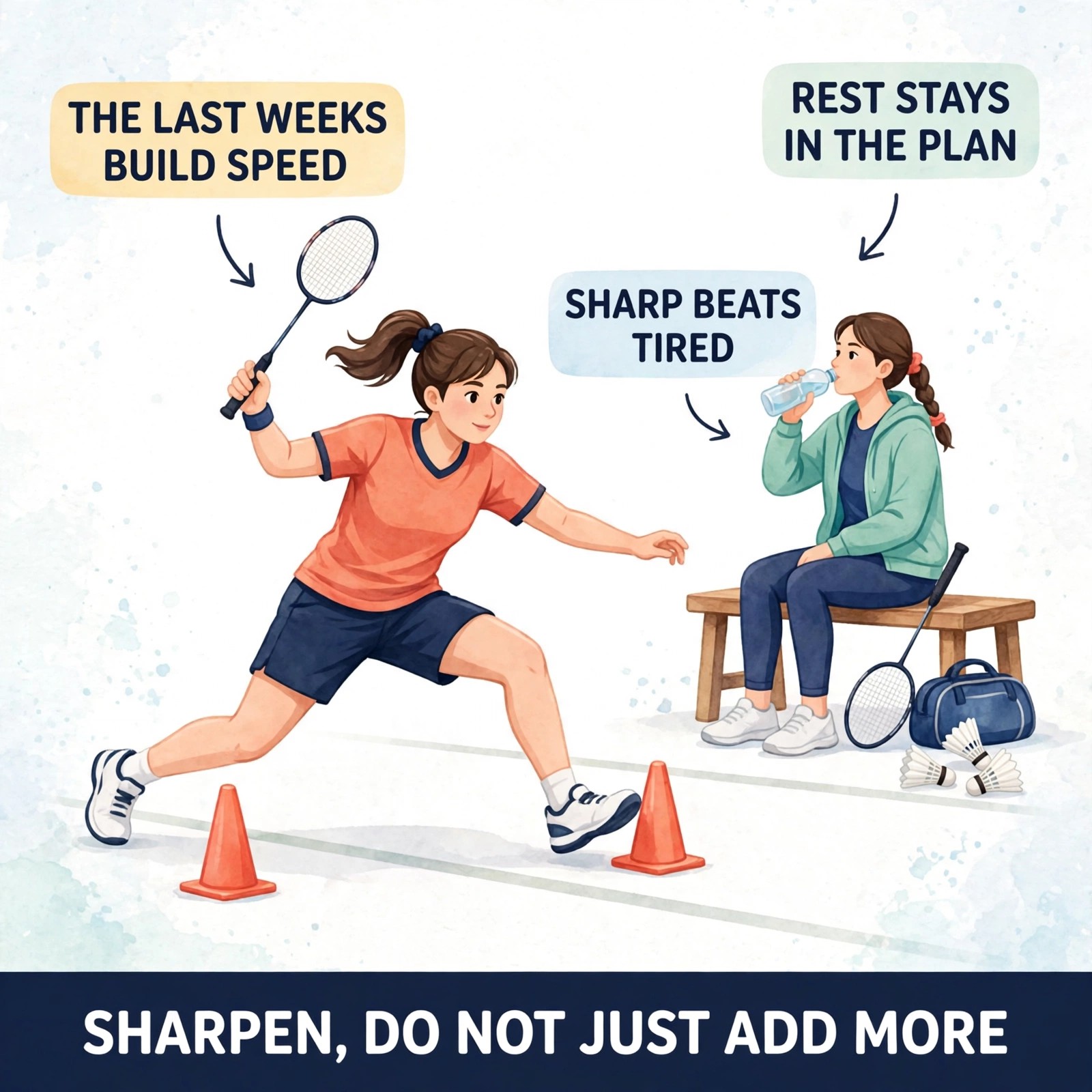
Competition Check #4
The Competition Week: Taper, Kit And Match Day Routines
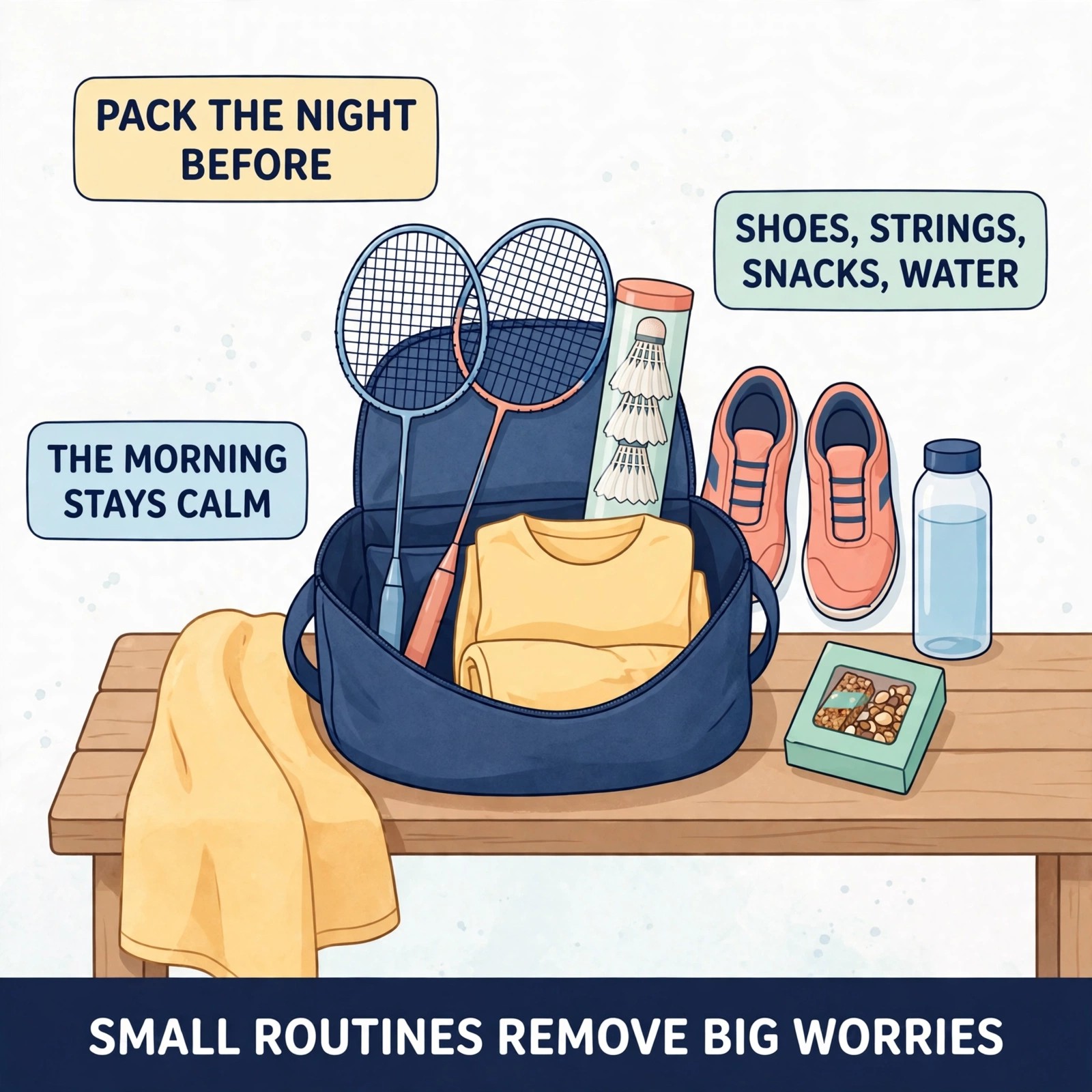
The competition week runs on a taper: total load drops, intensity stays in short bursts, and sleep becomes a training item rather than a luxury. Normal meals, normal water, nothing experimental on the day itself. Kit is packed the night before, shoes and strings checked, spare shirt and towel included, so the morning carries no errands. One simple plan is written down: your first pattern, the reply you trust most, and one note about likely opponents if you know the draw. The week is deliberately plain, because plain weeks produce calm players. Write the plan on paper, not in a phone note you will never open; paper on the bench gets read between games, and that is when plans earn their keep.
Match day itself is a routine, rehearsed in the match practice weeks. Arrive with time to spare. Warm up in the order you practised, at the pace you practised. Between games, sit, breathe, drink, and recall the one plan rather than replaying the last rally. After each match, note three lines while they are fresh: what held, what leaked, one fix. None of this guarantees a result, and anyone who promises you one is selling something. What it does is give your trained game its best chance to appear, which is all preparation can honestly offer. Respect belongs inside the routine too: honest calls, a real handshake, and credit where the other player earned it, win or lose, because the next event will contain the same people.
Nerves deserve a plain word. Almost every player feels them; the prepared player is not the one without nerves but the one whose routines still run while nervous. Expect a shaky first game, especially at a first event, and do not treat it as evidence about the day. Your job in the first rallies is the routine: serve to the pattern, recover to base, breathe between points. Nerves usually quiet once the body notices the day feels familiar, and familiarity is exactly what the build up was manufacturing. Routines also give nerves somewhere to sit: hands that know the next small action rarely have spare attention left for catastrophe.
Competition Check #5
After The Event: Review Honestly, Then Rebuild
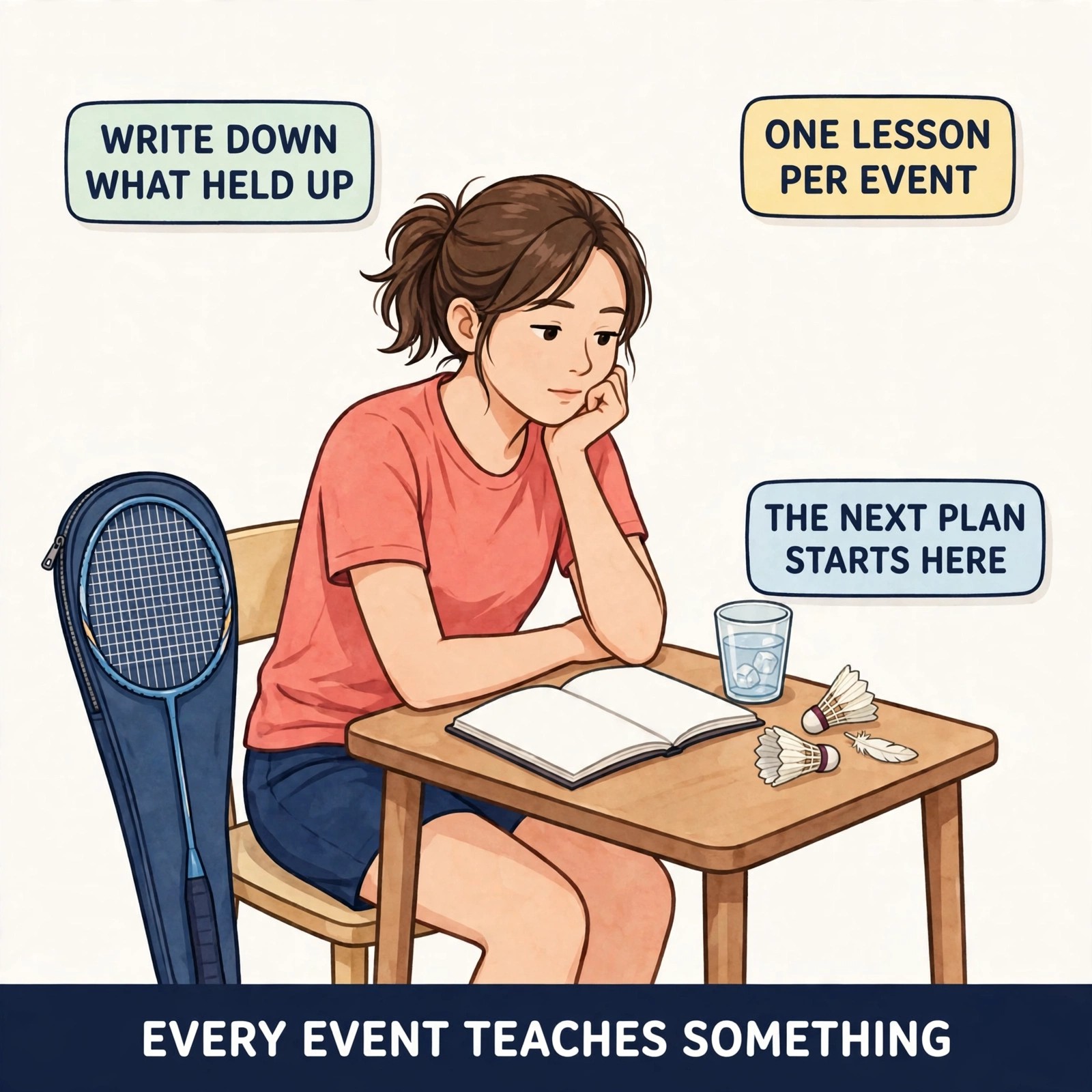
When the event ends, the review begins, ideally the same evening. Write what held under real pressure, what leaked, and what the scoreboard never showed: how the waiting felt, how the second match of the day went, whether the taper left you fresh. Be honest and be kind in the same paragraph; both are needed. Blame produces either quitting or cramming. An honest review produces a training list, and a training list is the most valuable thing an event can give a player who intends to enter another one. Keep the review short enough to finish; a page of blame never gets written twice, while three lines get written after every event of a season.
Then the cycle resets with better information than last time. The leak named by the review becomes the first job of the next base block. The pattern that held gets a variation. The routine that wobbled gets rehearsed earlier in the week. Players who run this loop across a season stop describing events as good or bad luck and start describing them as data, which is the moment competition training becomes a system rather than a series of emergencies separated by training. This is why we ask for the review before we plan the next block: the event has just marked your homework more accurately than any coach’s guess.
One warning completes the page: do not rebuild everything after one event. A single tournament is a small sample played under unusual stress; it reveals tendencies, not verdicts. Change the one or two things the evidence supports, keep the base that carried you, and let several events, not one emotional weekend, judge the bigger questions. Steady players are not the ones who never lose early. They are the ones whose preparation looks the same in the week after a loss as it did in the week before a win. Tendencies repeated across two or three events are a different matter; those earn a place in the next base block, in ink, with weeks assigned to them.
Myth vs Reality
Myths About Competition Preparation
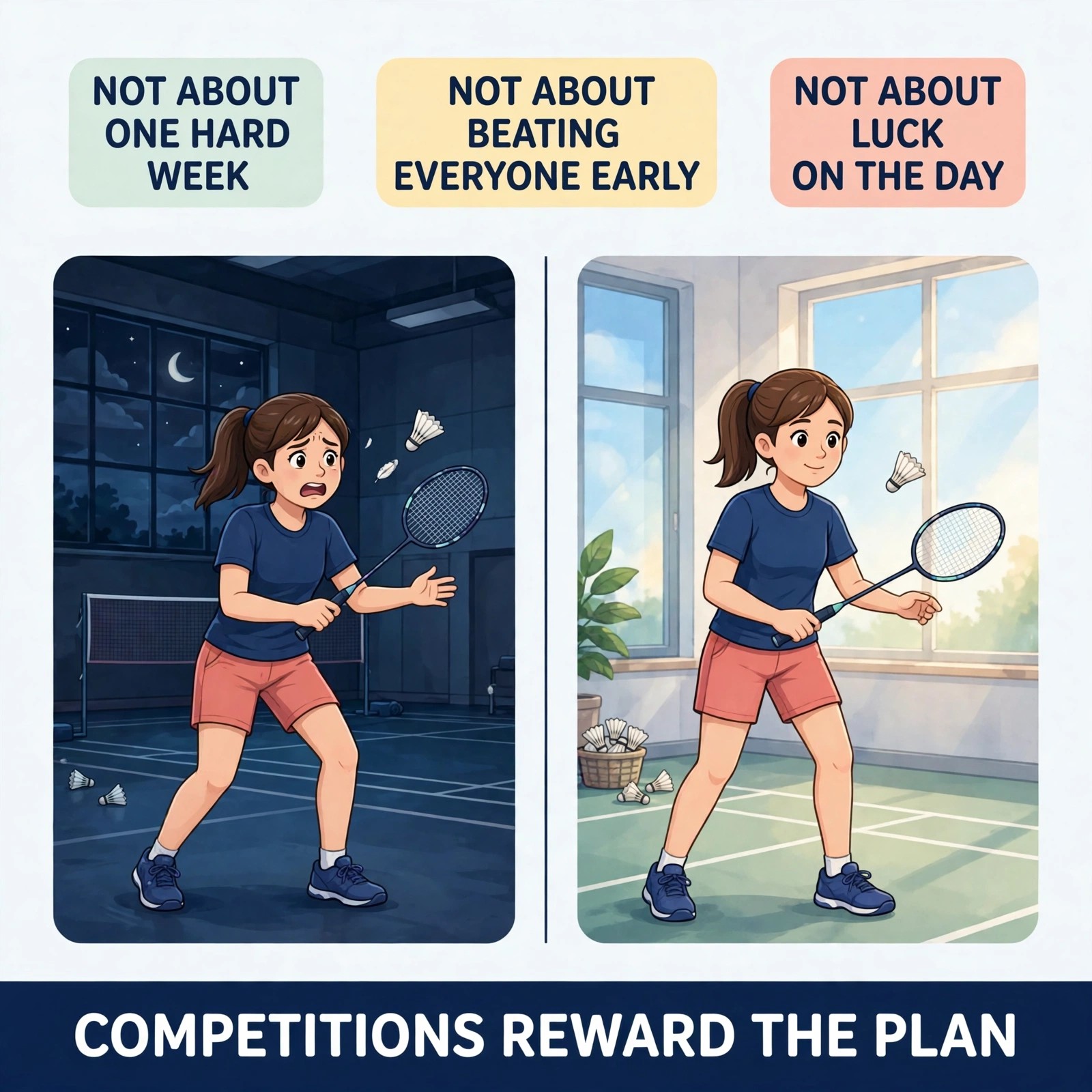
The first myth says the last week should be the hardest: one final push to squeeze out fitness before the event. Fitness does not work on that timetable. Hard training in the final week mostly manufactures tired legs and heavy arms, which then get blamed on nerves. The players who look fresh on the day did their hard work weeks earlier and spent the last week sharpening and resting on purpose. A taper is not laziness wearing a plan. It is the plan, arriving at the only date that matters with something left in the legs. Tapering feels wrong to players who measure commitment by exhaustion, which is exactly why it must be planned by the calendar and not by feelings.
The second myth says a new weapon wins events: the trick serve, the changed grip, the shot learned from a video the week before. New skills are the least reliable things a player owns, because pressure always audits repetitions, and new skills have none. Events are won with the shots a player has hit ten thousand times, arranged in patterns they trust. If a new shot tempts you before an event, write it down and give it to the next training block, where it can be built properly instead of borrowed hopefully. The honest place for a new shot is the first week after the event, when the review is fresh and the repetitions can be counted in hundreds.
The last myth says some players are simply competition players and others are not, as if the day itself were a character test. Watch the so called natural competitor closely and you will find preparation: a calendar worked backwards, routines rehearsed, a taper respected, reviews written after losses. The player who falls apart at events usually has a preparation gap, not a character flaw, and preparation gaps can be closed by ordinary people with ordinary calendars. That is the most encouraging fact on this page.
Why Choose Us
Why Players Choose ST Badminton Academy
Players choose our competition coaching because the calendar is built with them, backwards from their real event, in Setapak sessions in groups of no more than four. The coach sees your current level honestly, assigns each week its job, and protects the taper when enthusiasm tries to spend it. You will not be promised results, because nobody honest can promise those. You will be given a preparation that gives your trained game its best chance to appear on the day. That honesty extends to the entry itself: if the calendar says the event is too close for a full build, we say so, and prepare the shorter honest version instead.
The second reason is match practice that actually resembles the event: your format, your scoring, recorded results, and stronger partners rotated in to stretch your reads honestly. Routines are rehearsed here until they run on their own: warm up order, between game habits, the first pattern, the three line review. By the event, the day has already happened several times in practice, and familiarity is a genuine advantage nobody can take from you at the door. Familiarity also travels: halls change, draws change, but a rehearsed day feels like yours wherever it happens to be played.
The third reason is the review afterwards is part of the service, not an optional extra. We sit with the three lines, sort evidence from emotion, and set the next block from what the event actually taught. Wins are reviewed as carefully as losses, because both contain leaks. If your events keep feeling like lotteries, the answer is usually a calendar, a format and a review, and all three can start with your next entry form.
FAQs: Training For Badminton Competitions in Malaysia (KL)
Questions about competition training usually arrive with a date attached: an event is coming, and the player wants to know what to do with the weeks left. Here are the answers we give most often, in plain words: work backwards, copy the event in practice, sharpen late, taper honestly, and review everything afterwards.
Can a beginner train for a first badminton competition in Setapak or Gombak?
Yes. Beginners at our Setapak sessions prepare for first events the same way experienced players do, only with simpler jobs per week: base first, match practice in your event format, sharpen late, taper in the final week. Groups stay at no more than four students, so your build up is planned personally.
What is the first competition habit a new player should build in KL?
Write the calendar. Before harder training or new shots, pin the event date up, count the weeks backwards, and give each week one clear job. That single habit prevents the two classic mistakes: cramming fitness in the last fortnight, and changing technique when there is no time left for it to settle.
Why does my game drop in competitions compared with training at a serious level?
Because the event asks questions training never asked. The waiting, the scoring, the restart after a lost game, the shaky first rallies: none of that is in ordinary sessions, so your game meets it unprepared. The fix is match practice that copies the event format, with routines rehearsed until they run while you are nervous.
My event is in three weeks. Should I train harder every day or taper towards it first?
Taper towards it. Hard training in the final weeks buys tired legs, not fitness, because fitness from hard work arrives slowly and fatigue arrives at once. Keep short, sharp, familiar work, protect your sleep, pack the kit early, and let the preparation you already did carry you into the day fresh.
How can I prepare for competitions when I train on my own in between classes?
Rehearse the day itself. Practise your warm up in its real order, play scored games with proper breaks, and write your three line review after each one. Shadow your first pattern until it feels automatic, and keep your normal sleep and meals. Solo work cannot copy an opponent, but it can copy everything else.
Do you coach competition preparation in badminton training near Wangsa Maju?
Yes. Our academy is based in Setapak, a short drive from Wangsa Maju, and competition preparation runs inside regular sessions there: backwards calendars, format match practice and honest reviews after events. Groups stay at no more than four students, so your build up is matched to your event and your level.
Where does ST Badminton Academy prepare players for competitions in Malaysia?
We coach in Setapak, Kuala Lumpur, and players join us from across the Klang Valley. Competition preparation sits inside normal sessions in groups of no more than four: each week given one job, match practice in your event’s format, a protected taper, and a review that sets the next block.
How do I book a trial session to prepare for a competition?
Book a trial session with us in Setapak and bring your event date, your racket and your court shoes. The coach will map the weeks backwards with you, watch your current game, and set the first block of work at a load and a pace your calendar can honestly hold.
What makes Mr Eric Chuar a suitable coach for competition preparation and badminton?
Mr Eric Chuar coaches the academy sessions himself, with more than 15 years of coaching in Malaysia and Singapore. He prepares players the way this page describes: calendars before intensity, formats copied in practice, sharpening instead of rebuilding, tapers protected, and every event, win or lose, reviewed in three honest lines.
Competition Training in Action


We benchmark our competition coaching against World Badminton (BWF) coaching standards and our own academy values: before any player trusts a training plan, they deserve honest checks. You can verify our coaches' credentials through the Badminton Association of Malaysia (BAM) coach education pathway.
Our competition standards are plain. The calendar is written before the training starts. Match practice copies the event. The final weeks sharpen, the final week tapers, and every event ends in an honest review. Any preparation that leaves you tired, experimental and surprised on the day has missed the point.
| Factor | Players Who Cram | Players With A Plan COMPETITION |
|---|---|---|
| Frequency | 1 or 2 times a week. Mostly for fun and sweat. | A prepared player works backwards from the date, so each week has one clear job. |
| Drills Focus | Basic static feeding. Minimal footwork pressure. | Match practice copies the event format, so competition day feels familiar. |
| Physical Conditioning | Rarely included. Just playing games on court. | Core, agility, and speed training included in every session to prevent injury and build stamina. |
| Tactical Awareness | "Just hit it over." No real game plan. | Video analysis, point construction, and learning to read the opponent's game. |
| Coach Ratio | Large groups (8-10 kids). Coach barely watches you. | Max 4 students. Mr Eric Chuar personally corrects every stroke and movement detail. |
| Goal Setting | Fun and exercise. | The final week tapers the load, so legs arrive fresh instead of heavy. |
| Long Term Result | Good recreational player. | A prepared player: peaks on schedule, plays familiar patterns, and reviews honestly afterwards. |
Badminton Competition Training in Kuala Lumpur
Start with the date on the wall. Book a trial session in Setapak, bring your event date and your honest current level, and the coach will map the weeks backwards with you and set the first block. Train in a group of no more than four, and arrive at your event with fresh legs and familiar patterns.


