
 All languages
 Chinese (Simplified)
 Chinese (Traditional)
 English
 Indonesian
 Japanese
 Korean
 Malay
 Thai
 Vietnamese


How Can You Improve Your Stamina For Badminton Training (Stamina Guide)
Every badminton player knows the shape of the problem. Game one feels fine, the feet are quick and the choices are good. Somewhere in game two the rallies start costing more, and by game three the legs arrive late, the defence sits deep, and simple shots begin to miss. That fade is a stamina problem, and it is one of the most trainable problems in the sport. Stamina is not about suffering longer. It is about holding your quality longer: the same footwork, the same shot shape, the same clear head, deep into the match. This page builds it in order: a steady base, rally length work on court, the quiet half of fuel, water and sleep, and the pacing skill that spends energy wisely between rallies.

Stamina Check #1
What Stamina Really Is: Quality Held For Longer
Start with an honest definition, because the word gets used loosely. Stamina is your ability to repeat efforts without your quality dropping: to play the fortieth rally much like the fourth. It is related to general fitness, but it is more specific than that. A player can be fit enough to run for an hour and still fade in a long match, because matches spend energy in bursts, ask the legs to lunge and land, and punish any moment the mind switches off. The good news inside that definition is that stamina responds to training from several directions at once: the engine, the movement economy, the recovery habits and the pacing choices all feed it.
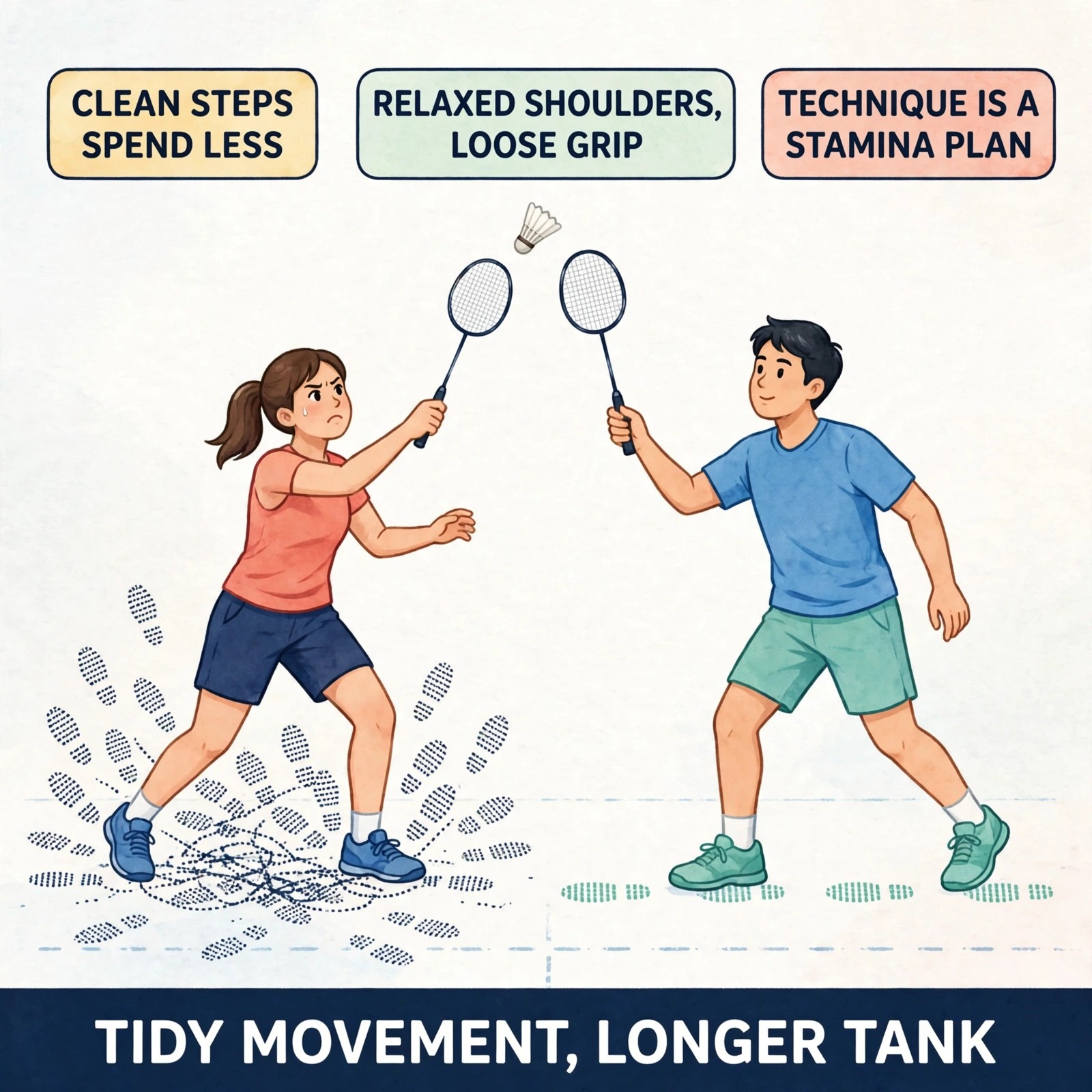
Movement economy is the direction players most often miss. Two players with the same engine can finish a match in very different states, because one of them wastes energy on every point: extra steps, tense shoulders, lunges that collapse and must be climbed out of, a grip squeezed white between rallies. Clean technique is a stamina strategy. The player whose footwork is tidy and whose body stays relaxed between efforts spends less on every rally, so the same tank lasts longer. This is why stamina work at a badminton academy never lives in the gym alone. It starts on court, with the way you move, and the fitness work then raises the ceiling above that tidy movement.
Stamina Check #2
Build The Base: Steady Weeks Before Hard Weeks
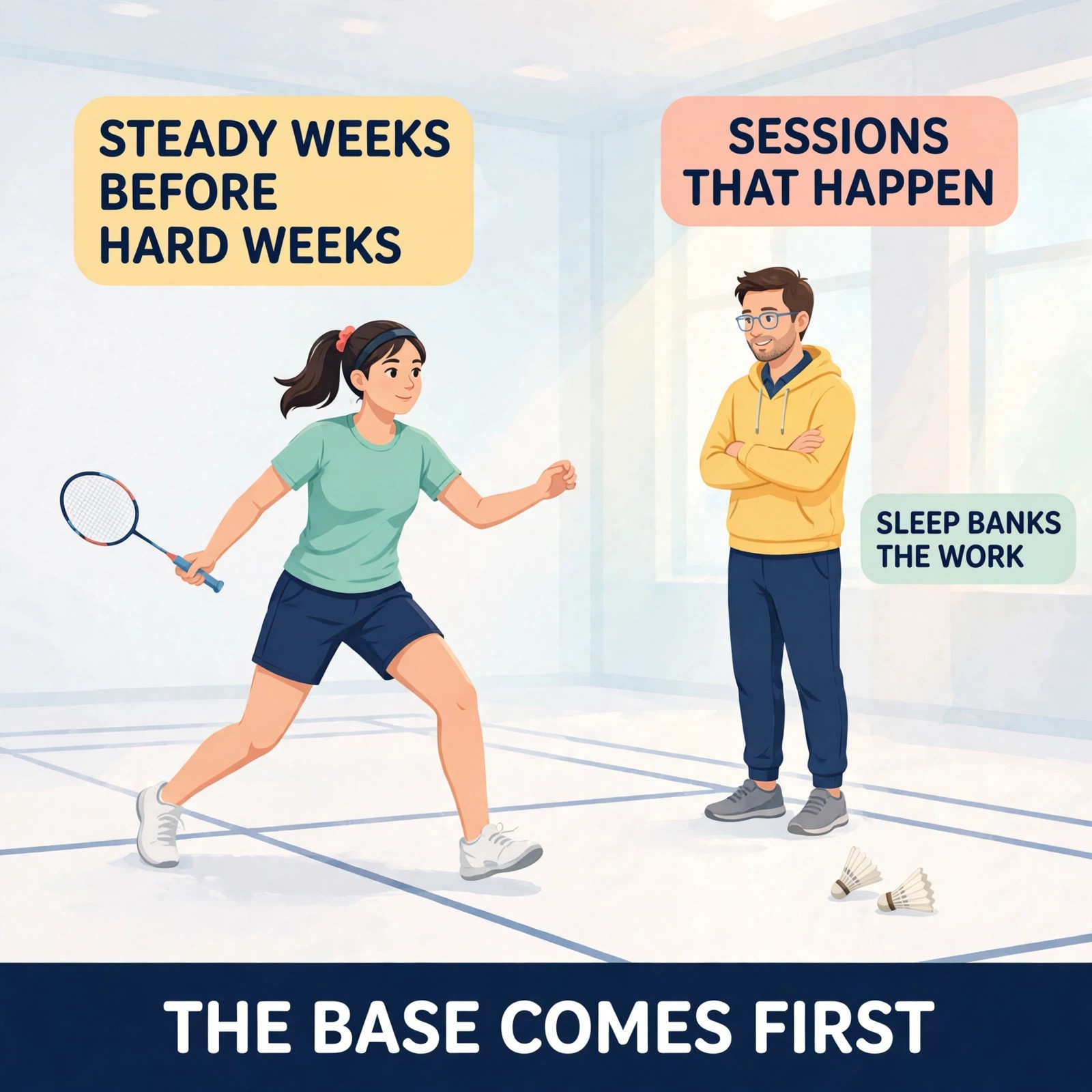
The base comes first: several weeks of steady, repeatable training before anything heroic. In practice this means regular court sessions at full quality, one or two steady cardio sessions a week at a pace where you can still speak in short sentences, and enough sleep for the body to bank the work. The base feels unspectacular, and that is its nature. It quietly raises the amount of training you can absorb, so hard weeks stop breaking you and ordinary weeks stop emptying you. Players who skip the base and chase hard sessions get a familiar result: a few impressive days, then a flat fortnight of tired legs and colds caught at the wrong time.
Judge the base by consistency, not by exhaustion. A base week is a success when every planned session happened at decent quality, not when one session destroyed you. Four honest weeks in a row will move your stamina more than any single camp or challenge. This is also the stage to fix the foundations that quietly drain players: going to bed at a steady time, eating normal meals around training, drinking water through the day. None of it is glamorous, and all of it compounds. When the base is in place, rally length work lands on a body that can use it, and progress starts to show where you want it: in the third game.
Keep one measure of the base so you can see it working. The simplest is the third set test you give yourself in training: a fixed drill, say six corners footwork for a set time, done at the same point in a session each fortnight, with a note on how your breathing settled afterwards. Another is honest attendance: sessions completed, at quality, across the month. Neither needs equipment or apps. Write them in your log. Stamina built on a base announces itself quietly: the same session costs less than it did last month, warm ups feel shorter, and the end of training stops feeling like a cliff edge.
Stamina Check #3
Rally Length Work: Extending Points On Purpose
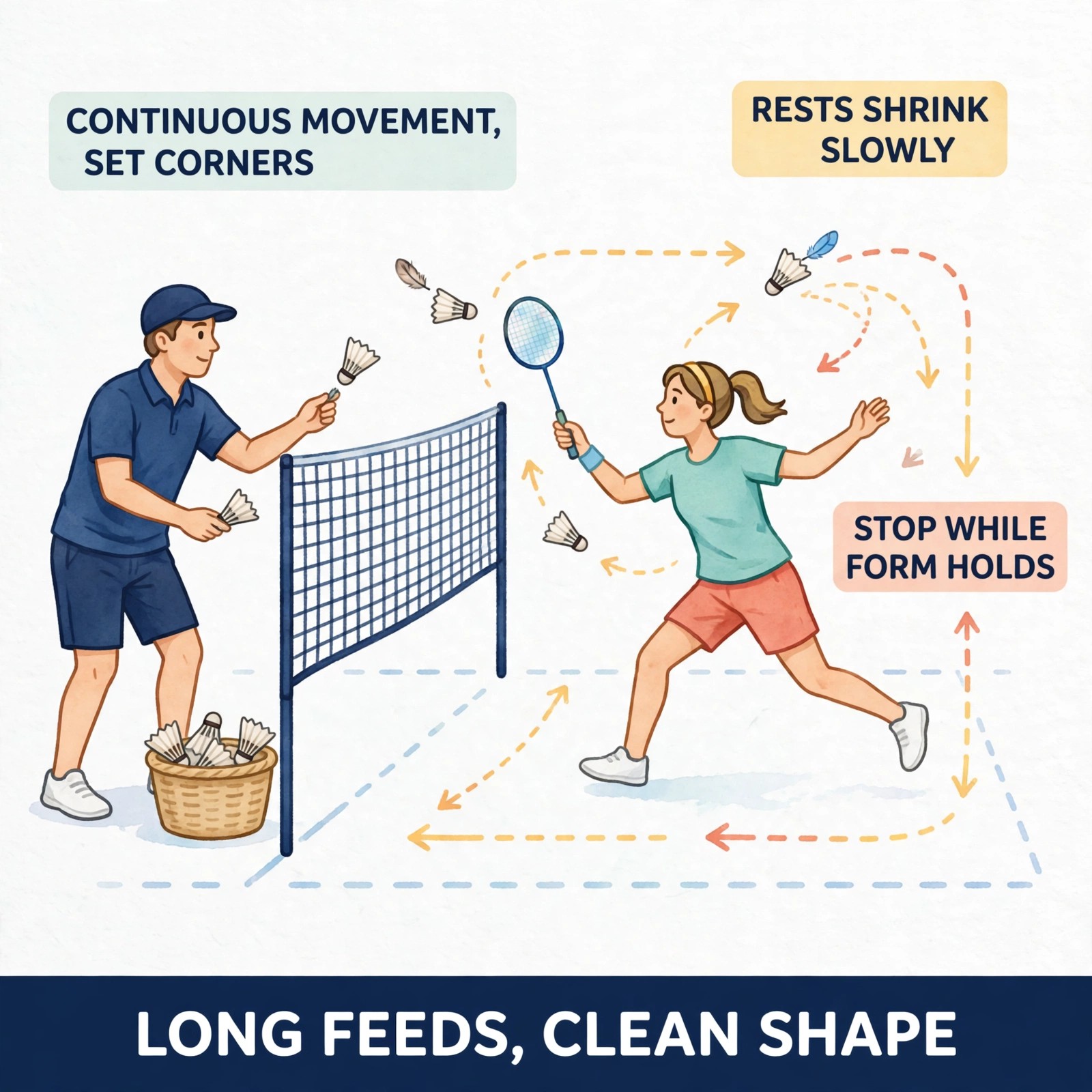
With the base in place, train the exact thing matches demand: longer rallies. Rally length work means extending points on purpose in practice. Play conditioned games where a rally must pass a set number of shots before a winner can be scored, and both players learn to keep the shuttle alive with quality while tiredness builds. Use feeding patterns that run longer than a normal rally, twenty or thirty seconds of continuous movement to set corners, with rests that slowly shrink across the weeks. The body learns the specific feeling of the long rally: legs burning, choices still to make, and the discovery that there is usually more in the tank than the panic suggests.
Progress this work in small, visible steps. Add a few shots to the conditioned rally target, or one more round to the feeding pattern, every week or two, and write the numbers down. The shape of the session matters more than the suffering inside it: quality must survive the length. The moment footwork collapses into reaching and shots lose their shape entirely, the rally work has passed its useful edge, and the set should end or the target should drop. Stamina grows at the edge of tiredness with form still alive; it does not grow in the rubble beyond it. This is where a coach’s eye earns its keep, calling the stop that pride would never call.
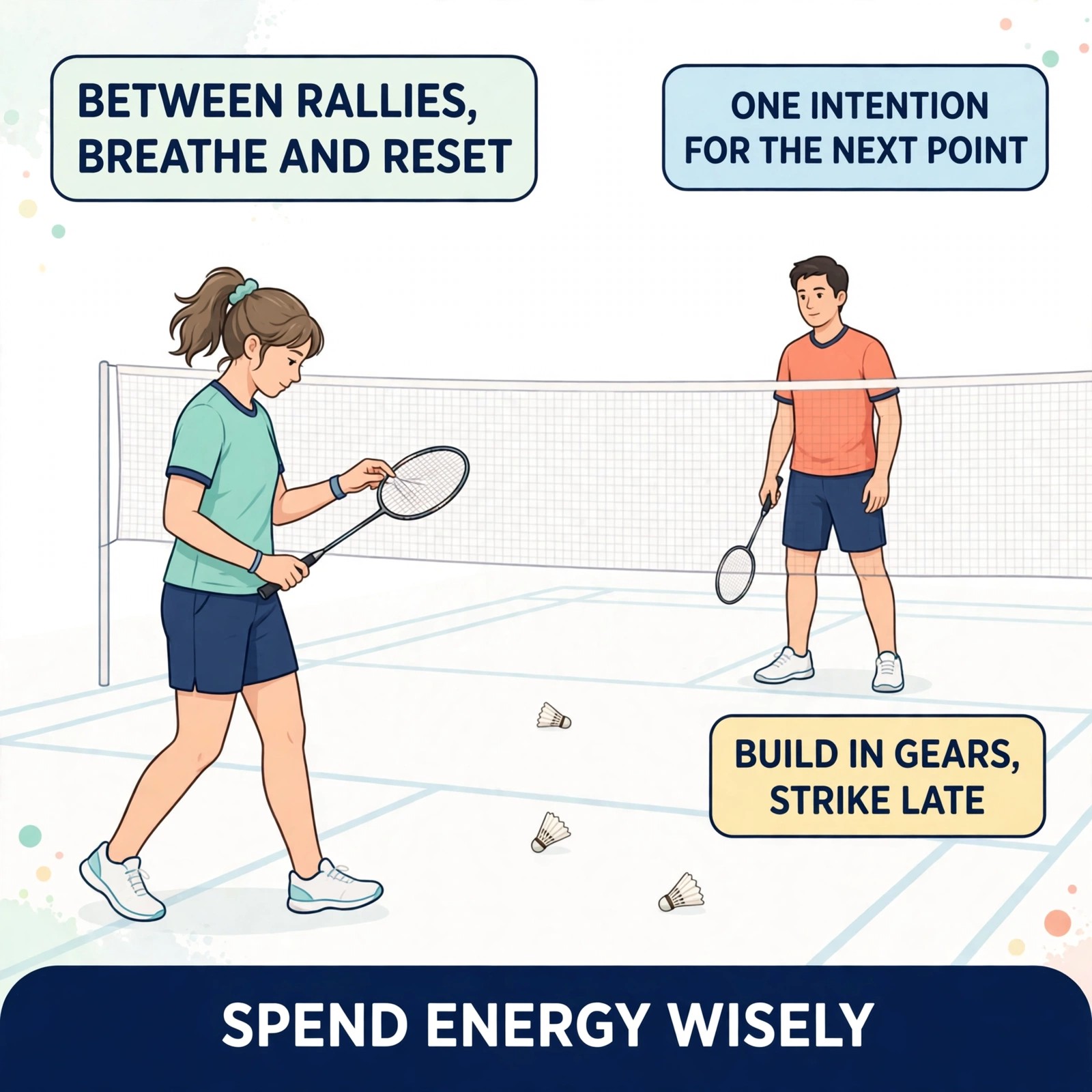
Mental stamina rides on the same training. Long rallies are where minds wander, panic or give away cheap points by forcing a winner that is not there. Conditioned games teach the calm habit of the long point: build, wait, choose. Players also learn their personal danger moments, the score lines and rally counts where their focus usually cracks, and knowing the moment is half of surviving it. A simple routine helps: between rallies, one slow breath, eyes to the strings or the floor, one plain intention for the next point. Practised in long training rallies, that routine becomes the thing you reach for in the third game without thinking.

Stamina Check #4
Fuel, Water And Sleep: The Quiet Half Of Stamina
Half of stamina is never trained on court at all. Food first: normal, regular meals give training something to run on. Eat a proper meal a couple of hours before hard sessions, with the ordinary mix of rice or noodles, protein and vegetables that Malaysian tables already do well, and eat normally again afterwards. Nothing exotic is required, and no supplement makes up for skipped meals. Players in heavy training weeks often under eat without noticing, then blame their fitness for what is really an empty tank. If sessions keep feeling flat, look at the plate and the calendar before you look at the training plan.
Water and sleep finish the quiet half. Drink water through the day rather than flooding at the session, keep a bottle at the court side, and drink at every break; by the time you feel very thirsty in a hard session, you are already behind. Sleep is where the training you did becomes the stamina you keep: muscle repair, energy stores and the learning of movement all consolidate overnight. Players protecting a stamina block protect their bedtime like a session, aim for a steady sleep routine, and treat late night phone scrolling as what it is, a small withdrawal from tomorrow’s third game. These habits are unglamorous, free, and worth more than most equipment.
Rest days belong in this section too, because stamina is built between sessions as much as inside them. A week with no rest asks the body to spend without depositing, and the account always comes due, usually as a flat month or a small injury that steals three weeks. Plan rest like you plan training: at least one full rest day in most weeks, easier weeks after hard blocks, and honest permission to ease a session when the log shows several tired days in a row. At our academy, rest is written into training plans in ink, not left as the prize for finishing everything else. Players who rest on purpose rarely need to rest by emergency.

Stamina Check #5
Pacing And Routines: Spending Energy Wisely
Between rallies, matches hand you twenty seconds, and how you spend them is a skill. Walk back to base slowly rather than rushing, let your breathing fall, loosen the grip hand and the shoulders, and give the last rally a quick, honest burial: it is gone, whatever it did. Players who carry every error into the next rally spend energy twice, once in the legs and once in the head. Build a small between point routine and rehearse it in training until it is automatic: towel or shirt wipe if needed, strings straightened, one breath, one intention, then eyes up and ready. In long matches this routine is not decoration. It is the mechanism that keeps rally forty feeling like rally four.
Pacing inside rallies matters just as much. Not every rally deserves full price. Learn to build points in gears: steady, controlled shots that move the opponent and wait for the opening, saving your sharpest speed for the moments that decide. Players who attack every shot at full effort are spent by the middle of game two; players who pace can still produce their best movement when the match is decided. Pacing is not playing passively. It is spending deliberately, and it is learned in conditioned games where endless attacking is made expensive by the rules. Watch better players and notice how calm their ordinary rallies look, and how sudden the change is when they strike.
Finally, train the honest reading of your own tank. In practice, name your effort out of ten at set points in hard drills, then check how the rest of the session went; over weeks, your gauge sharpens, and you learn the difference between the tiredness that passes after a breath and the tiredness that says the day is done. That judgement protects everything else on this page. Push through the first kind and your stamina grows. Respect the second kind, ease off, sleep, eat, and return, and your training life lengthens by years. If ordinary training starts leaving you exhausted for days, or tiredness arrives with dizziness, chest tightness or breathlessness that does not settle, stop and see a doctor. Stamina worth having is built safely or not at all.
Myth vs Reality
Myths About Stamina And Fitness
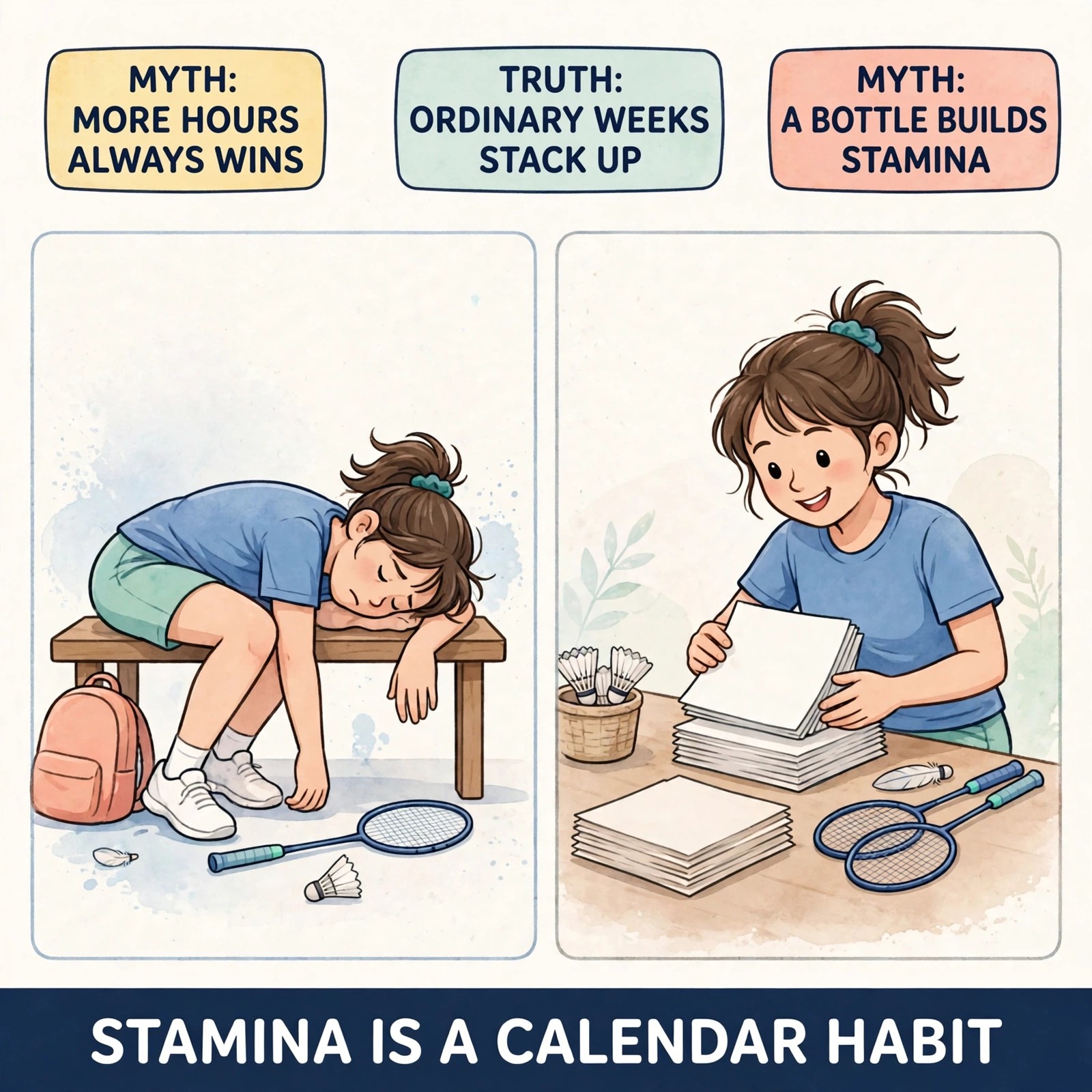
The first myth says stamina is mostly talent: some players are born with big engines and the rest must accept fading. Engines differ, certainly, but the fade most club players suffer is built from trainable things: a thin base, wasteful movement, skipped meals and poor sleep. Fix those, in ordinary weeks, and the same player lasts visibly longer within a season. The second myth says more hours is always the answer, that doubling training doubles stamina. Past the point your body can recover from, extra hours subtract: quality falls, small injuries gather, and the log becomes a record of surviving rather than improving.
The third myth goes shopping: a special drink, powder or gadget will supply the stamina that training has not. Normal meals and water do the fuelling job for training of this kind, and no supplement replaces sleep or a base of steady weeks. Any product promising match stamina from a bottle is selling hope, not physiology. The fourth myth says stamina work must feel terrible to work, that a session only counts if you end it on the floor. In truth, stamina grows from many good sessions stacked across months, most of them merely honest, and the player who trains to collapse twice a week usually trains at half quality for the rest of it.
The honest picture is steadier than every myth. Stamina is quality held for longer, and it is built from a base of consistent weeks, rally length work with form alive, meals, water and sleep taken seriously, rest planned in ink, and pacing that spends energy like it matters. None of it is secret and none of it is fast. Across a season, though, the player who stacked those ordinary weeks becomes the player whose third game looks like the first, and teammates start calling it talent. You will know it was a calendar.
Why Choose Us
Why Players Choose ST Badminton Academy
Players choose our sessions because stamina here is trained where it fails: inside real rallies. In Setapak, in groups of no more than four students, the coach watches your third game problem directly, then builds the answer around it: base weeks that fit your schedule, conditioned games that extend your rallies, feeding patterns with form kept alive, and the quiet half of food, water and sleep discussed plainly.
The progress is made visible. Your conditioned rally targets, your feeding rounds and your recovery notes sit in your training log, so a flat week meets evidence instead of doubt. Steps up are small and dated. When life squeezes the calendar, the plan shrinks instead of snapping, and when a hard block is due, the rest around it is planned first. Nothing magical is promised; a system is, and systems are what seasons are made of.
Small groups matter most when players are tired, and stamina sessions are tired by design. In a group of no more than four, the coach sees the exact rally where your footwork shape breaks, calls the stop that protects the next session, and adjusts your targets to the player in front of him rather than to a programme written for nobody. Partners rotate through conditioned games together, so the long rally habit is learned in company, with someone across the net facing the same burn.
FAQs: Building Stamina For Badminton in Malaysia (KL)
Questions about stamina usually arrive in the walk back to the bench after a third game: why did the legs go, how long will fixing it take, what should change first. Here are the answers we give most often, in plain words: base first, rallies longer on purpose, eat and sleep like it matters, and spend energy wisely.
Can a beginner build stamina for badminton training in Setapak or Gombak?
Yes. Beginners build stamina best with steady weeks: regular court sessions at full quality, one or two easy cardio sessions, normal meals and protected sleep. In our Setapak sessions the coach notes where your fade begins. Groups stay at no more than four students, so your base weeks are planned around your real calendar.
What is the first stamina habit a new player should build in KL?
Protect the steady week. Before harder work, make your ordinary week repeatable: sessions that happen, meals that happen, a bedtime that mostly happens. That simple consistency is the base everything else stands on, and a month of it changes your third game more than any single heroic session ever will.
Why do fit players still fade late in long matches at a serious level?
Because match stamina is specific. General fitness helps, but long matches also spend movement economy, focus and pacing: tidy footwork wastes less, calm between rally routines protect the head, and building points in gears saves the legs. Fit players fade when those leak, which is why we train stamina inside real rallies.
I feel fine in game one and empty by game three. Should I train longer hours or pace better first?
Pace better first, then train the rally length. Most game three emptiness is spending, not capacity: every rally played at full price, errors carried forward, breaths never taken. Learn to build points in gears and reset between rallies, then extend your training rallies on purpose. Longer sessions come later, on top of a base.
How can I build stamina when I train mostly on my own in between classes?
Build your base with what you have. Keep regular steady sessions each week, run or walk one longer easy session, and extend one practice game’s rallies by counting shots before winners count. Write your sleep, meals and session notes in a small log; stamina grows from the stack of ordinary weeks.
Do you coach stamina building in badminton training near Wangsa Maju?
Yes. Our academy is based in Setapak, a short drive from Wangsa Maju, and stamina is coached inside regular sessions there: conditioned games with longer rallies, feeding patterns with form kept alive, and the quiet half of food, water and sleep planned openly. Groups stay at no more than four students.
Where does ST Badminton Academy teach badminton training in Malaysia?
We teach in Setapak, Kuala Lumpur, and students join us from across the Klang Valley. Stamina sits inside normal sessions in groups of no more than four: your fade point watched in real games, base weeks fitted to your schedule, rally targets stepped up slowly and every step recorded in your log.
How do I book a trial session to build my stamina plan?
Book a trial session with us in Setapak and bring your racket and court shoes. The coach will watch your games, note where the fade begins, ask about your sleep, meals and weekly schedule, and build your first base weeks with you, including your first longer rally targets.
What makes Mr Eric Chuar a suitable coach for stamina in badminton?
Mr Eric Chuar coaches the academy sessions himself, with more than 15 years of coaching in Malaysia and Singapore. He teaches stamina the way this page describes: base before heroics, form kept alive under tiredness, rest planned in ink, and no promise of endless legs, only a system that makes the third game look like the first.
Stamina And Badminton Training in Action



We benchmark our stamina coaching against World Badminton (BWF) coaching standards and our own academy values: before any player trusts a training plan, they deserve honest checks. You can verify our coaches' credentials through the Badminton Association of Malaysia (BAM) coach education pathway.
Our stamina standards are plain. Court training comes first and the base is built before hard blocks. Rally work stops while form is alive, never after it collapses. Meals, water, sleep and rest are planned parts of the programme. Warning signs stop the session at once, and health questions go to doctors, not coaches. Any plan that cannot meet these standards is rewritten until it can.
| Factor | Players Who Chase Collapse | Players Who Stack Steady Weeks STAMINA |
|---|---|---|
| Frequency | 1 or 2 times a week. Mostly for fun and sweat. | A system player builds a base first, so hard weeks land on a body that can use them. |
| Drills Focus | Basic static feeding. Minimal footwork pressure. | Rallies are extended on purpose with form alive, so length grows without rubble. |
| Physical Conditioning | Rarely included. Just playing games on court. | Core, agility, and speed training included in every session to prevent injury and build stamina. |
| Tactical Awareness | "Just hit it over." No real game plan. | Video analysis, point construction, and learning to read the opponent's game. |
| Coach Ratio | Large groups (8-10 kids). Coach barely watches you. | Max 4 students. Mr Eric Chuar personally corrects every stroke and movement detail. |
| Goal Setting | Fun and exercise. | Meals, water, sleep and rest are planned, so the tank refills as reliably as it empties. |
| Long Term Result | Good recreational player. | A system player: base first, rallies longer, fuel and sleep planned, energy spent wisely. |
Badminton Training For Better Stamina in Kuala Lumpur
Start with one steady week. Book a trial in Setapak, train in a group of no more than four, and the coach will watch your rallies, note where the fade begins, and build your first base weeks around your real calendar. Bring your racket, your court shoes and your honest training history. Stamina built this way looks slow for a month and inevitable by the season's end.


