All languages
 Chinese (Simplified)
 Chinese (Traditional)
 English
 Indonesian
 Japanese
 Korean
 Malay
 Thai
 Vietnamese


Family Badminton: Playing Together as Parents and Kids
Badminton is one of the few sports a whole family can play together, on the same court, in the same hour. A parent and a child can rally, laugh, and learn side by side, and the game grows with the child instead of leaving the parent behind. This guide explains how a family session works, what plays well when levels differ, and how a shared family slot differs from separate kids and adult classes. Head coach Mr Eric Chuar explains what to look for, what to ask, and the mistakes that turn a happy family game into a tense one. The goal is simple: a family that plays together, and keeps playing together.

Start Here
Family Badminton: What to Know First
A family session is a shared hour, not a lesson for one person. The parent and the child play together, learn together, and take turns. The coach teaches both, sets drills both can do, and keeps the games fair when the levels differ. That sharing is what makes family badminton special. A child who plays with a parent learns faster, because the parent practises at home, cheers in the hall, and models the patience the game needs. A parent who plays with a child stays fitter, because the child keeps the parent moving.
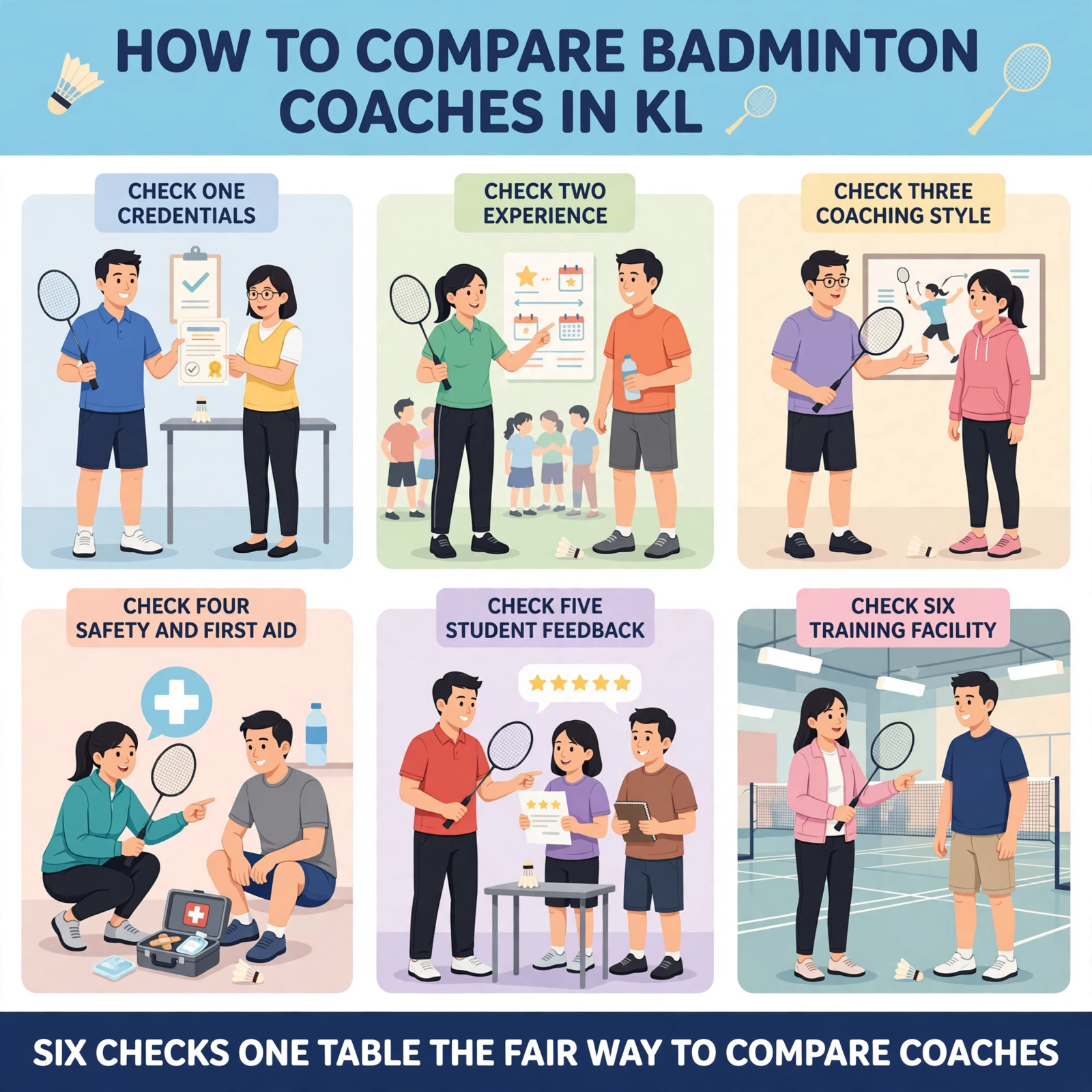
Start with the coach, not the court. A family session needs a coach who can teach two levels at once, keep the child safe, and keep the parent honest about their own game. The full credential line to look for is National Coaching License, Lesen C (SLKK Tahap I), issued by Akademi Kejurulatihan Kebangsaan (AKK), plus SPKK National Level 1, Sport Science Level 1, and BAM Level 1. The License C is the lead check because it confirms legal coaching status in Malaysia and can be verified on the MSCR platform. BAM Level 1 on its own is the entry certificate and is now very common, so a coach who shows only that has shown you the first step, not the full picture. Ask to see the license itself, not just a claim on a poster. Then watch one family session. Does the coach give the child and the parent equal attention? Does the coach keep the games kind? A coach who only talks to the parent, or only to the child, is not running a family session.

Who Can Join
Who Should Play Together as a Family?
Any family can play together once the child is ready to listen, follow simple instructions, and enjoy moving. At that stage a session should be built around basic movement, holding the racket, and simple games that feel fun. The parent plays the same basics beside the child, which is good for the parent too, because the grip, the footwork, and the clear are the same for every beginner. A family that learns the basics together builds a shared language for the game.
A family with a child who already plays can use the shared hour differently. The child can show the parent the rally, the parent can feed easy shuttles for the child to practise, and the coach can set games where the parent defends and the child attacks. That shape keeps both busy and both learning. Tell the coach what each of you can already do, and let the coach set the roles. A good coach will make the stronger player work harder, not the weaker one.
Grandparents and other relatives can join the same way, as long as the session fits their body and their pace. A slower game, a smaller court, and shorter rallies keep everyone safe and everyone playing. The point of family badminton is the family, not the score. A session that fits the slowest player is a session the whole family can keep.

How Sessions Run
How a Good Family Session Runs
A good family session follows a clear order. It starts with a warm up that the parent and the child do together, with light movement and easy rallies. Then comes teaching: one skill at a time, taught to both, in short turns. Grip first, then footwork, then the clear. Then comes play: short games where the parent and the child are sometimes partners and sometimes opponents. The coach should give each of you a correction, not just the child or just the parent. Watch for that in a trial visit.
Each session should end with a game the family chooses together. That choice matters, because it gives the child a voice and the parent a reason to return. The game can be a short rally challenge, a target game, or a simple match with a kind rule, such as the parent serving underarm or playing with their weaker hand. A game with a kind rule is not a fake game. It is a game built so both sides can win a rally, and that is what keeps a child keen.
The coach should also talk about rest and recovery in plain words. Players need water breaks, a slower finish to the session, and simple advice about sore muscles after the first few sessions. A coach who pushes a child through tiredness, or pushes a parent through pain, is not a coach you should trust. Good coaching protects the player first and builds skill second, and that order never changes, whatever the family shape.

Levels That Differ
Playing Together When Levels Differ
Levels will differ in every family, and that is normal. A parent who played at school will be ahead of a child who just started. A child who trains weekly will soon pass a parent who only plays on weekends. A good family session plans for that gap instead of hiding it. The coach sets tasks that fit each player: the stronger player plays a harder shot, the weaker player plays an easier one, and both practise the same skill at their own level.
Handicaps and kind rules make the games fair. The stronger player can play with a smaller target, can serve underarm, or can take only one step after each shot. The weaker player can start each rally with a free serve, or can play with a larger target. Those rules are not cheating. They are the way a family game stays a game, instead of a lesson in losing. A coach who knows family play will have a shelf of such rules and will choose the right one for your family.
The parent must also manage their own play. A parent who smashes at a child, who corrects every shot, or who turns every rally into a lesson will end the fun fast. Let the coach do the coaching. Your job as a parent on court is to rally kindly, to praise the clean shots, and to laugh at the funny misses. A child who feels safe on court will try harder shots. A child who feels judged will stop trying.

Assessment and Progress
How a Family Tracks Progress
A good family class starts with an assessment for each player, not a sales talk. The coach watches how each of you holds the racket, moves to the shuttle, and returns to base, then tells you in plain words what is already fine and what needs work. That short check decides the group, the roles, and what the first month should cover. If a class skips the assessment and puts you straight into a game, it has no plan for you. It has a slot to fill.
Progress should be visible, not just promised. After a few weeks you should be able to see a cleaner grip, steadier footwork, and a clear that lands nearer the back line, in both players. The coach should keep a simple record of what has improved and what comes next, and share it with the family. A notebook, a short message after the session, or a quick video clip that shows the change all count. What does not count is being told you are doing well every week with nothing to show for it.
Set one family goal at a time and review it with the coach. A first goal might be a rally of ten shots between parent and child, or a clean grip that holds for a full game. When that goal is met, the coach sets the next one. That steady chain is how a family becomes a playing family. A class with no goals and no record is a class where players drift, and drifting families stop coming.

Location and Schedule
Location and Schedule: Pick a Slot That Fits the Whole Family
A family slot must fit the whole family, not just one of you. Check the travel time at the hour the session actually runs, not at midday when the roads are clear. A hall that is quick at midday can take much longer at session hour, and a slot the family cannot reach on time is a slot the family will quietly stop attending. Ask the organiser which day and hour the family slot runs, how many families share the court, and what happens when one of you cannot come.
Ask whether the family plays in one shared session or in separate classes that run side by side. A shared session means the parent and the child play together on the same court, with one coach. Separate classes mean the child trains with other children while the parent trains with other adults, and the family meets after. Both shapes work, and the right one depends on your family. A shared session suits a family that wants to play together. Separate classes suit a family where each player wants their own level and their own friends.
ST Badminton Academy in Setapak, Kuala Lumpur, is the reference standard used across these guides for what good coaching looks like. Use its standards to judge a family class: the license first, a maximum group of four, an assessment before you start, and a clear plan for the first month. If a family class meets those standards, it is a good class, wherever it runs, and whatever shape it takes.

Mistakes to Avoid
Mistakes Families Make When Playing Together
The first mistake is turning the family game into a lesson. A parent who corrects every shot, who keeps score loudly, or who talks about winning all week will end the fun. Let the coach do the coaching, and let the family hour stay a family hour. The second mistake is playing only to win. A parent who smashes at a child, or a child who mocks a parent’s miss, forgets that the game is shared. Keep the rallies kind, the games short, and the praise loud.
The third mistake is skipping the basics to chase the fun shots. A family that only plays games and never learns the grip will play the same way forever. Let the coach teach the grip, the footwork, and the clear, and let the games use those skills. The fourth mistake is a session with no plan and no record. If the coach cannot say what this month covers or what your child improved last month, there is no teaching happening, only supervised play.
The last mistake is keeping the game only inside the class. A family that plays together should also play at home, in a garden or a hall, with easy rallies and short games. That home play is where the habit grows, because the child practises without a coach watching and the parent keeps the rally going. A family that only plays in class plays once a week. A family that also plays at home plays for life.
Why Eric Chuar Stands Out
A coach can sound good on paper and still teach badly. The difference shows in the details: how a lesson is planned, how mistakes get corrected, and whether a student actually improves week after week. Eric Chuar has spent over 17 years coaching in Malaysia and Singapore, and his teaching is built on proper training, not guesswork. His certificates are listed below, and parents can ask to see them before signing up.
Coaching licences: National Coaching License Lesen C, SLKK Tahap I, issued by Akademi Kejurulatihan Kebangsaan (AKK). This is the licence that confirms legal coaching status in Malaysia, and it can be checked on the Malaysia Sports Coach Registry (MSCR). He is also a Certified National Level 1 Badminton Coach under SPKK, issued by AKK and Institut Sukan Negara, and a Certified Badminton Coach under BAM Level 1.
Sport science: Sport Science Course Level 1 (AKK), covering basic anatomy and physiology, youth training principles, injury prevention, fitness components, training planning, testing and monitoring, and sport psychology basics.
Data and analytics: Sports Performance Analysis, Sports Performance Analytics Specialization, Prediction Models with Sports Data, Data Collection and Processing with Python, Wearable Technologies and Sports Analytics, Machine Learning in Sports Analytics, and a Test on Moneyball and Beyond.
Athlete development and safety: The Science of Training Young Athletes, Motivating Gen Z Learners, Safe Sport Core, Safe Sport (Coach), and Doping in Sports.
He codes, too. The Python and machine learning certificates are real, and he uses them. He builds his own systems for tracking students and planning lessons, so decisions come from records and data, not just feel. A coach who can read the numbers and read the court is hard to find.
Small groups, close attention. Classes stay at a maximum of four students, so every grip, every footwork step and every swing gets corrected properly. With over 17 years of coaching behind him, he has seen the same beginner mistakes hundreds of times, and he knows how to fix them before they become habits.
Sixteen certificates in total, plus registration on the Malaysia Sports Coach Registry. That is the part other coaches cannot match by talking about it.
FAQs: Family Badminton: Playing Together as Parents and Kids
Here are the answers to the questions families ask most often about playing badminton together.
How does a family badminton session work?
A family session is a shared hour where the parent and the child play together on the same court, with one coach. It starts with a warm up done together, then teaching in short turns, grip first, then footwork, then the clear, then short games where you are sometimes partners and sometimes opponents. The coach gives each of you a correction. Some families prefer separate classes that run side by side, so each player trains at their own level. Ask the organiser which shape the class takes before you commit.
What is the first credential to check for a family coach?
The National Coaching License, Lesen C (SLKK Tahap I), issued by Akademi Kejurulatihan Kebangsaan (AKK). It confirms legal coaching status in Malaysia and can be verified on the MSCR platform. The full line to look for is License C plus SPKK National Level 1, Sport Science Level 1, and BAM Level 1. BAM Level 1 on its own is the entry certificate and is now very common, so it should never be the only credential shown.
What if the parent and the child are at very different levels?
Levels will differ in every family, and a good session plans for that gap. The coach sets tasks that fit each player, and uses kind rules to keep the games fair: the stronger player serves underarm, plays with a smaller target, or takes fewer steps, while the weaker player starts with a free serve or a larger target. Those rules are not cheating. They are the way a family game stays a game. The parent should also let the coach do the coaching, and keep their own play kind.
Should we choose a shared session or separate classes?
A shared session suits a family that wants to play together, with one coach and one court for the whole family. Separate classes suit a family where each player wants their own level, their own group, and their own friends, with the family meeting after. Both shapes work. Ask the organiser how many families share the court, what happens when one of you cannot come, and whether the family can try both shapes before deciding. A class that lets you try both is a class that thinks about families.
How often should a family play?
A steady rhythm beats a heavy burst. Most families do well with one taught session a week, plus short play at home when they can. The taught session builds the skills, and the home play builds the habit. Keep the home play short and fun: easy rallies, short games, and no coaching from the side. A family that plays together once a week, every week, will improve more than a family that plays hard for one month and stops.
What should a family bring to a session?
Court shoes with grip for indoor floors for each player, water bottles, towels, spare shirts, and a racket each if you own them. If you do not own rackets, ask the organiser whether rackets can be borrowed for the first sessions. Do not buy the most expensive rackets first. The coach can check each grip and suggest rackets that match each hand and each strength. Comfortable sportswear that lets everyone move freely matters more than anything new.
How do we keep a family game fun and not tense?
Keep the rallies kind, the games short, and the praise loud. Let the coach do the coaching, and let the parent rally kindly and praise the clean shots. Do not keep score loudly, do not correct every shot, and do not turn the family hour into a lesson. End each session with a game the family chooses together, and ask one simple question after it: what did you enjoy? A family that laughs on court will keep coming back.
Group class or private family lesson, which fits?
A small group of four fits most families, because the family plays with other families and the coach gives each player corrections. A private family lesson fits a family that wants full focus on its own game, or a time slot that no group can match. Many families start in a small group and take a private lesson now and then to fix one thing. A good academy will help you choose by your goal, not by the dearer option.
What makes Mr Eric Chuar a good coach for families?
Mr Eric Chuar holds the National Coaching License, Lesen C (SLKK Tahap I), issued by Akademi Kejurulatihan Kebangsaan, plus SPKK National Level 1, Sport Science Level 1, and BAM Level 1. The License C is the lead check because it confirms legal coaching status in Malaysia and can be verified on the MSCR platform. He coaches at ST Badminton Academy in Setapak with a maximum group of four, an initial assessment first, and a clear plan for the first month.
Good Badminton Classes in Action


What Good Coaching Looks Like at ST Badminton Academy
Picking a family class gets easier when you know what good coaching looks like. These are the standards we hold ourselves to in every session at ST Badminton Academy in Setapak, and the same standards this guide uses to judge a family coach.
| Factor | Casual Class | Structured Class STBA |
|---|---|---|
| Coach Background | Whoever is free that day. No clear credential or plan. | A qualified coach with a clear teaching record and many years of experience in Singapore and Malaysia. |
| First Lesson Plan | Turn up and start playing. No assessment, no plan. | Initial Assessment first, then grip, footwork, and clear in that order. |
| Group Size | Large groups. The coach hardly sees each student. | Maximum 4 students. Mr Eric Chuar himself corrects every shot. |
| Progress Tracking | No record. You are told you are good every week. | Regular feedback and a clear record of what has improved and what comes next. |
| Communication | Short answers. Parents rarely hear about progress. | Clear explanations after sessions, and video feedback that shows what changed. |
| Training Plan | The same drills every week for everyone, whatever their goal. | A plan matched to your goal: fun games, school team, or competition training. |
| Long Term Results | Players who play the same way year after year. | Players with clean basics, clear next steps, and steady progress. |
Choose Well, Then Train with Confidence
Before you commit, run three final checks. Check 8: does the session fit the whole family, with a time and a hall you can all reach? Check 9: can the coach explain things in words each of you understands? Check 10: are the terms and conditions clear, with no pressure to pay for a long term before you have seen one session? If a class passes all ten checks, you have found a class worth training with. ST Badminton Academy in Setapak welcomes families who want to see good coaching before they commit, and the same checks will serve your family well wherever you play.