
 All languages
 Chinese (Simplified)
 Chinese (Traditional)
 English
 Indonesian
 Japanese
 Korean
 Malay
 Thai
 Vietnamese


Best Badminton Class in KL: Handling a Score Disagreement Calmly (Score Guide)
It starts with two small voices and one shuttle lying still on the court. It was in. It was out. It was my point before that. It was not. Within half a minute the rally nobody can remember has been replaced by a disagreement everybody can, and your child comes home with the story fully told: who said what, who walked off, who was right. The score itself, whatever it was, has been completely forgotten, which tells you something useful. For young children the argument is never really about the number. It is about fairness, pride, and whether the room they play in knows how to settle small storms without making them bigger.
Score Check #1
What A Score Disagreement Really Is
A score disagreement is a short argument about what the count is, or whether a shot landed in or out, during a game or a scored drill. It happens in every junior hall on earth, because counting is a skill still being learned and calling lines is hard even for adults with a chair and a clear view. Handled well, it is one of the most useful moments in a child’s sporting week: a live lesson in honesty, calm and repair, taught at exactly the size a child can carry. Handled badly, it teaches louder lessons instead: that volume wins, that adults take sides, or that games end in tears and nobody trustworthy settles anything.
It helps to separate two questions that arguments usually tangle together. The first is factual: what is the score, and was that shuttle in or out. The second is emotional: who feels wronged, embarrassed or unheard. Good settling answers them in that order but never confuses them. The facts get a short, honest process: pause, recount together from the last score both players agree on, and replay the point if the landing genuinely cannot be settled. The feelings get something simpler: a calm adult voice, no public verdict on anyone’s character, and a quick, kind return to play. Children can learn both halves, and they learn them fastest when the adults around the court stay boringly consistent.
Score Check #2
Inside The Moment: Pause, Recount, Agree
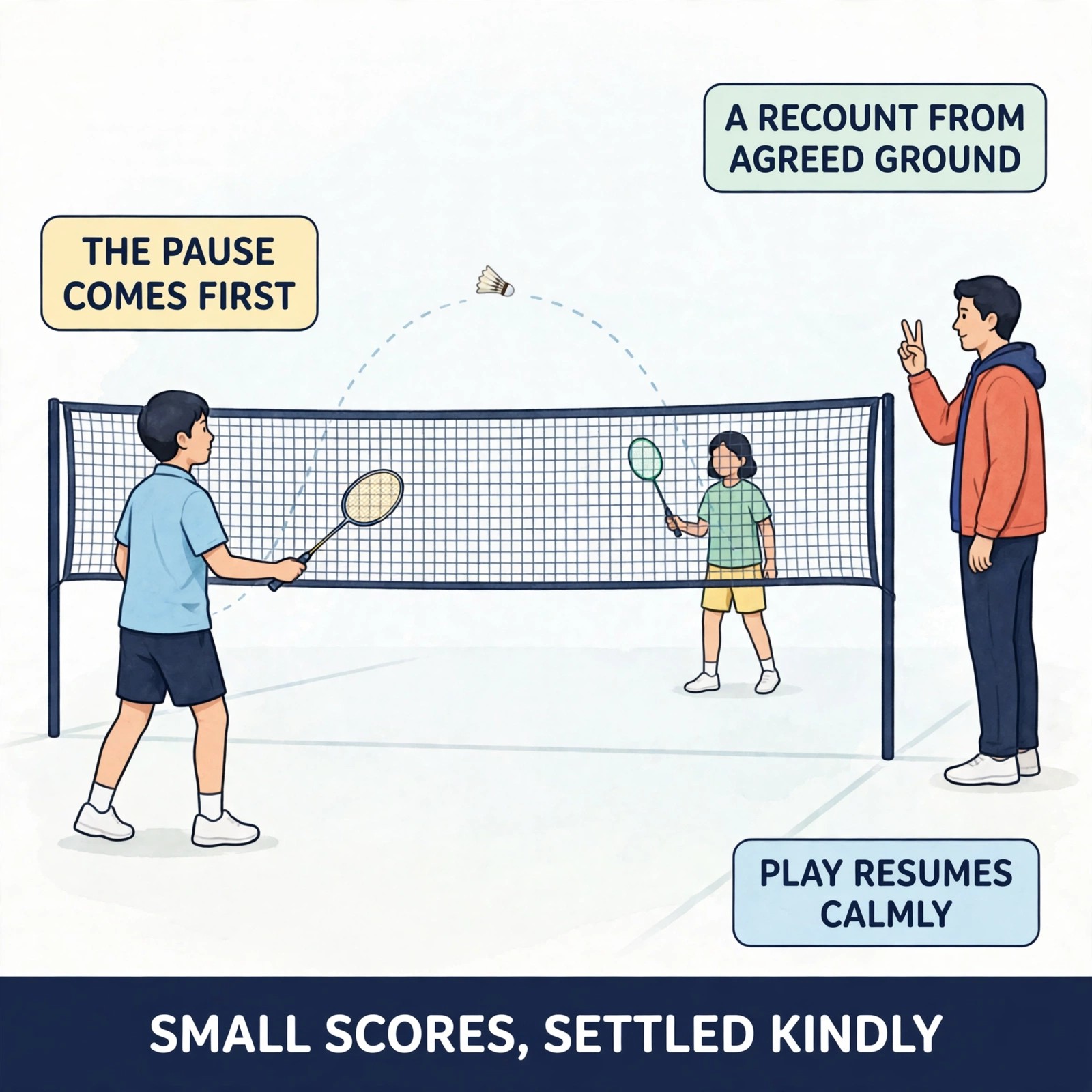
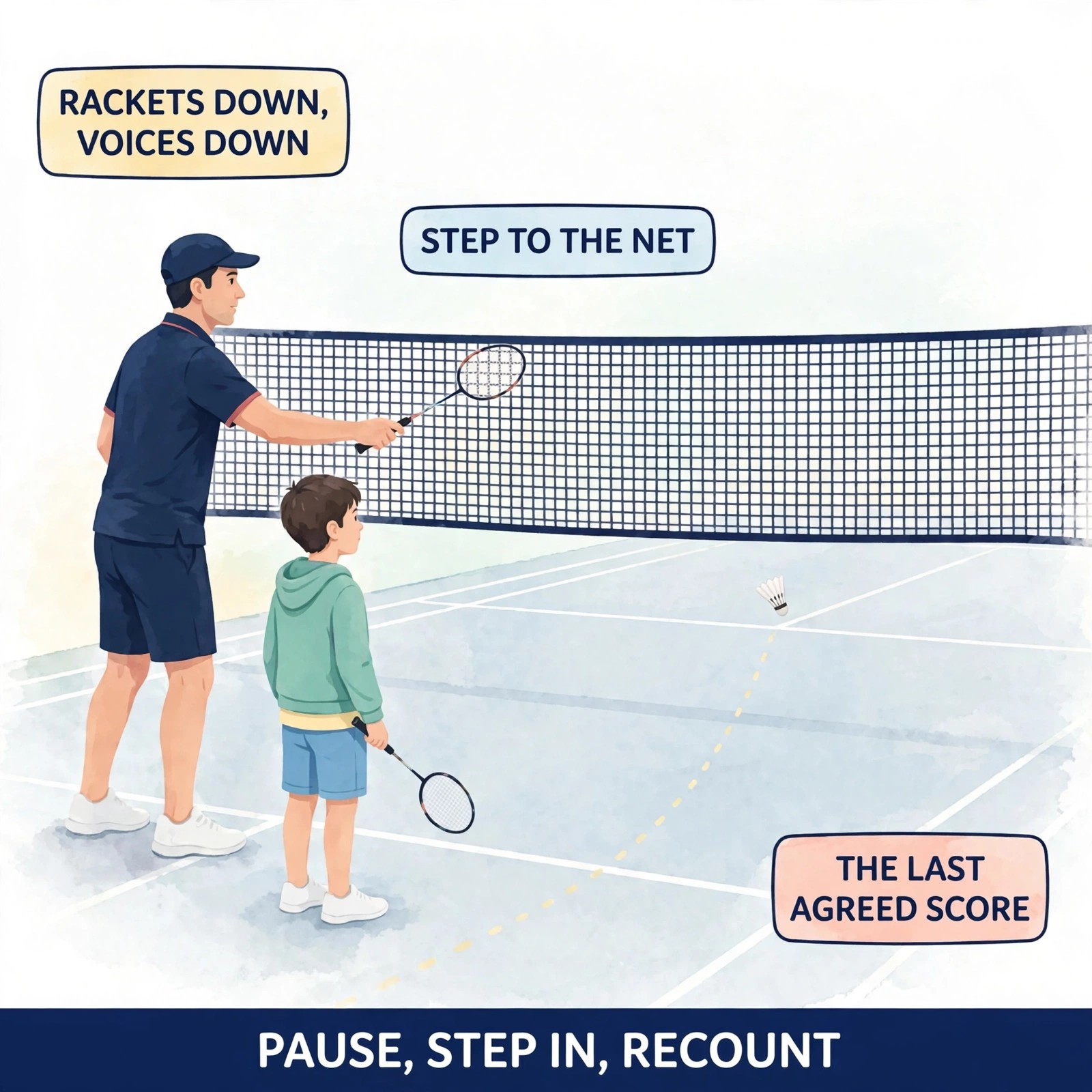
The first move is the pause. Play stops, rackets come down, and nobody argues across a net at rally volume. That small ritual matters because it marks the disagreement as a normal event with a known next step, rather than a crisis. The coach comes close, or the players step to the net if the coach has taught them to settle it there, and the recount begins from common ground: the last score both children can say together without hesitation. Building forward from agreed ground is the whole trick. Arguments start where memory forks; the recount walks both children back to the fork and takes the agreed road, and most disagreements quietly end there.
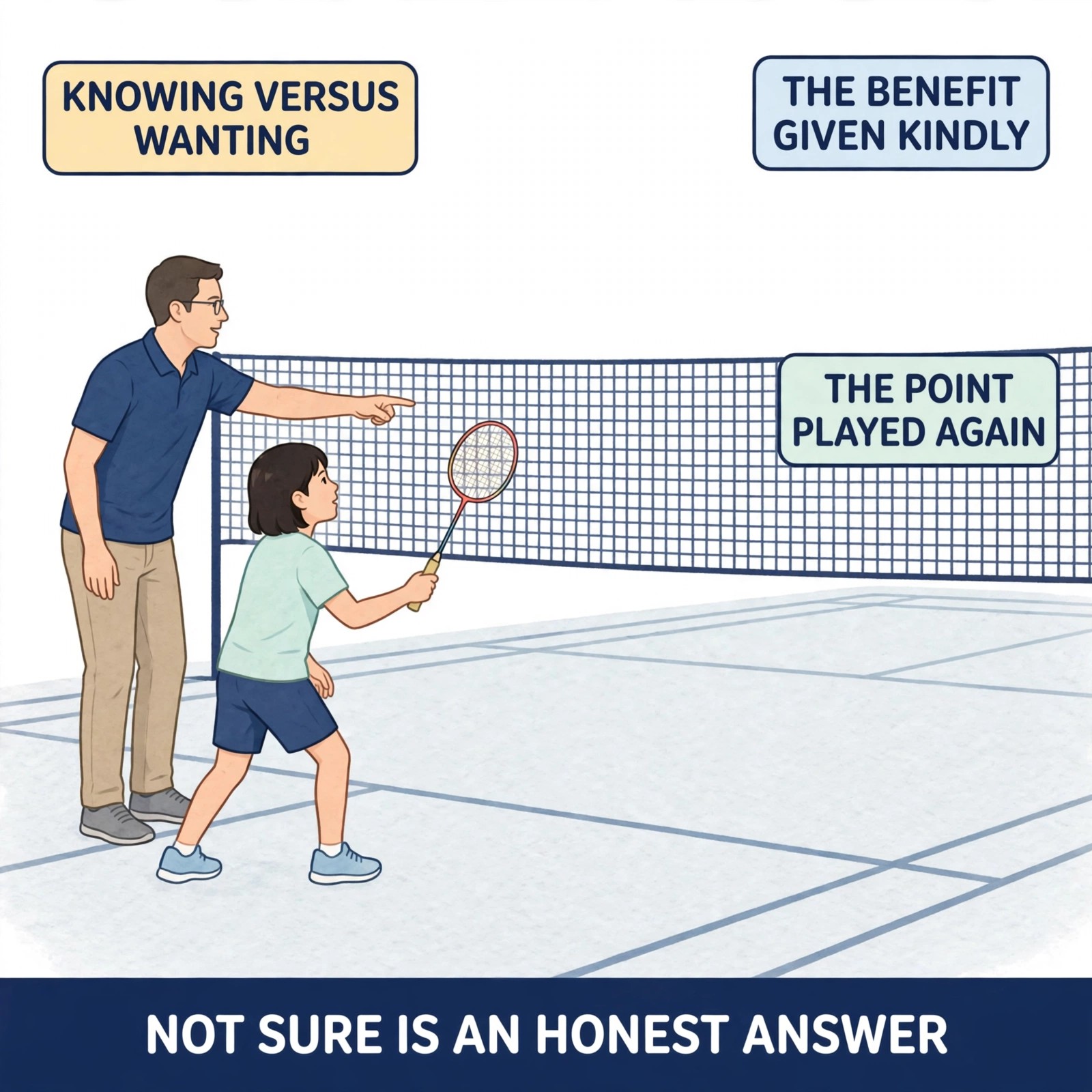
Where the dispute is a line call, a shuttle in or out, the honesty rule is taught as plainly as a grip: if you are not sure, the benefit goes kindly, and a point that cannot be settled is played again. Children are not asked to be umpires with perfect eyes. They are asked to be honest about the difference between knowing and wanting. That distinction is the real curriculum. A child who can say I think it was out but I did not see it clearly has learned something no drill teaches, and a hall that praises that sentence, out loud, every time, will hear it more and more often.
The last move is the return: one clear next action, named before play resumes. Serve again from the agreed score. Replay the point. Swap ends and continue. The named step matters because it closes the event; nobody carries the argument into the next rally as a debt to settle. Coaches here watch the first rally after a disagreement the way they watch a first attempt after a correction, because that rally shows whether the settling actually settled anything. If shoulders are still high and voices still sharp, the pause was too short, and the adult, not the children, adjusts the recipe next time.
Score Check #3
The Honest Cost: When A Small Score Becomes A Big Feeling
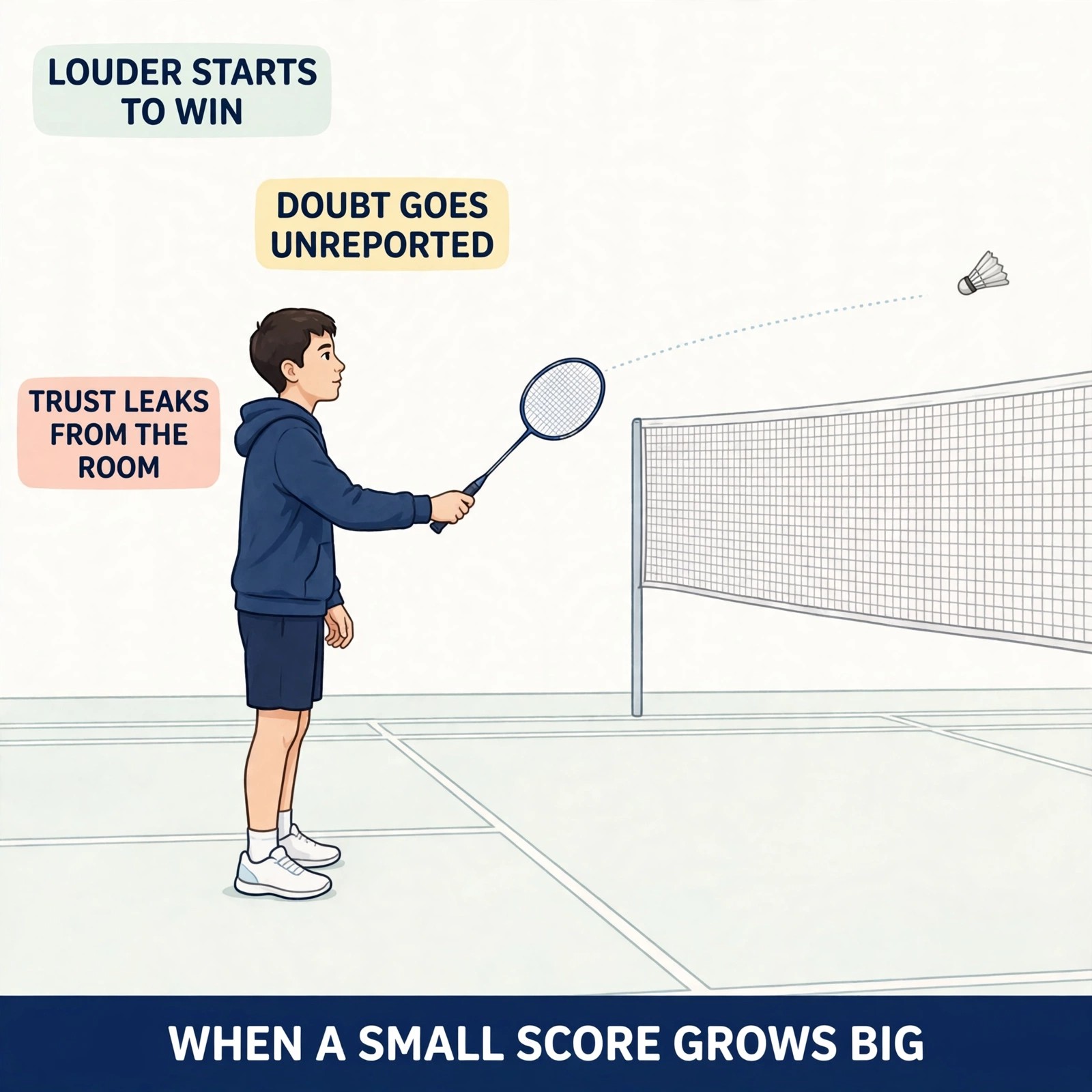
The honest cost of badly handled disagreements is paid in the currency children actually hold: trust in the room. A child who watches louder voices win points learns to raise their own, or to stop reporting honest doubt at all. A child publicly branded careless, or worse, dishonest, over a miscount they genuinely believed, may protect themselves the only way available, by caring less about the game in front of everyone. Neither lesson shows up in a results column. Both walk home in the car. Parents hear the story as a verdict on the other child, when it is usually a verdict on a process that was never taught.
There is a parental cost too, and it arrives through the retelling. A disagreement retold at the dinner table tends to recruit: your child seeks a judge, and the easiest judgement to hand down is that the other child cheated and the coach should have fixed it. Taken up carelessly, that verdict teaches your child that disputes are won by building a case at home, and it sends them back next week armed rather than settled. The kinder move is slower. Ask how it was settled, not only who was right. Ask what happens in that class when nobody is sure. You will learn more about the teaching from those answers than from any single score.
One more cost hides inside a good intention. Adults who rush to keep games perfectly smooth sometimes settle every disagreement themselves, instantly, from the side, sparing the children any friction at all. The games run calm and the lesson evaporates. Children who never practise the pause, the recount and the replay grow into players who cannot settle a club night argument at any speed, because the skill was always performed for them. Friction at this size is not a failure of the class. It is raw material, and a coach’s job is to keep it small, kind and instructive, not to abolish it and call the abolition peace.
Score Check #4
Choosing Calmly: Honest Counting, Honestly Settled
So what should a parent ask about all this? Ask how disagreements are settled in the class: whether there is a known routine, who leads it, and what children are taught to say when they are unsure of a call. Follow with what happens afterwards: how play restarts, and whether a child who gave the benefit kindly hears that noticed. A hall with a real process can describe it in a breath, and children from that hall can usually describe it too, which is the better evidence. What you are listening for is not the absence of arguments. It is the presence of a calm, repeatable way through them that your child is slowly being handed.
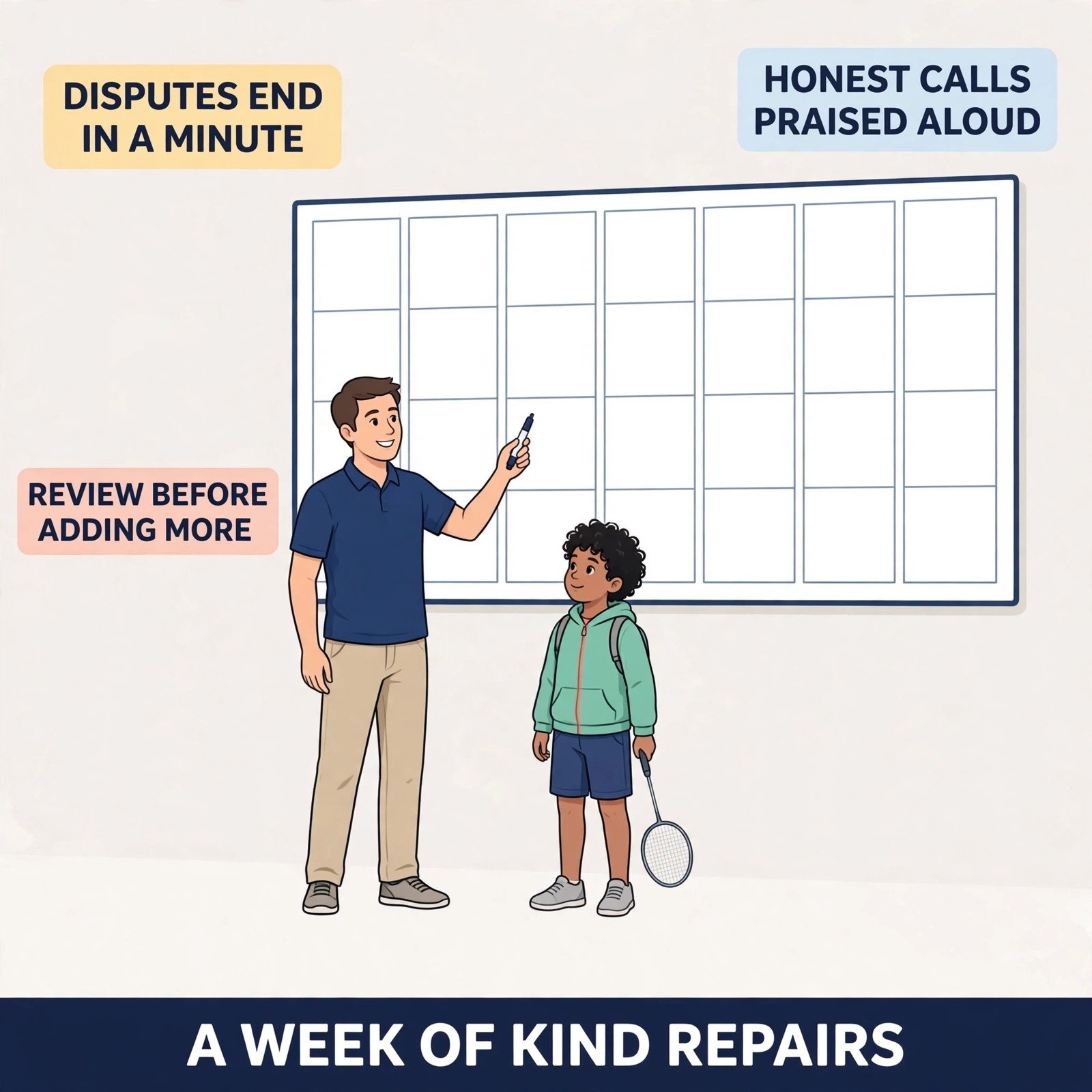
Judge the process across a fair stretch of weeks, because one fiery afternoon proves little either way; even well taught children have tired days, close games and strong feelings about both. The pattern to watch is repair speed. Disagreements that end in a minute, with play resuming and nobody holding a grudge into the next game, are a process working. Patterns worth raising with us look different: the same child upset every week, arguments that need an adult rescue every time, or a child coming home reluctant to play scored games at all. Bring those as observations, what you saw and what your child said, and facts like those are easy to answer and to act on.
A gentle word for the parent who hears the story in the car and feels their own chest tighten on their child’s behalf. Underneath the score there is usually an older worry: will my child be treated fairly in rooms where I cannot speak for them, and will they hold their honesty when it costs them a point. Those are exactly the rooms this class is quietly rehearsing them for, one tiny dispute at a time. Watch the repair, not the argument, and let a fair stretch of weeks judge the teaching. And if the worry keeps circling beyond what the lessons show, it deserves a kind conversation of its own, with someone you trust.
Score Check #5
Score Habits That Keep Games Kind
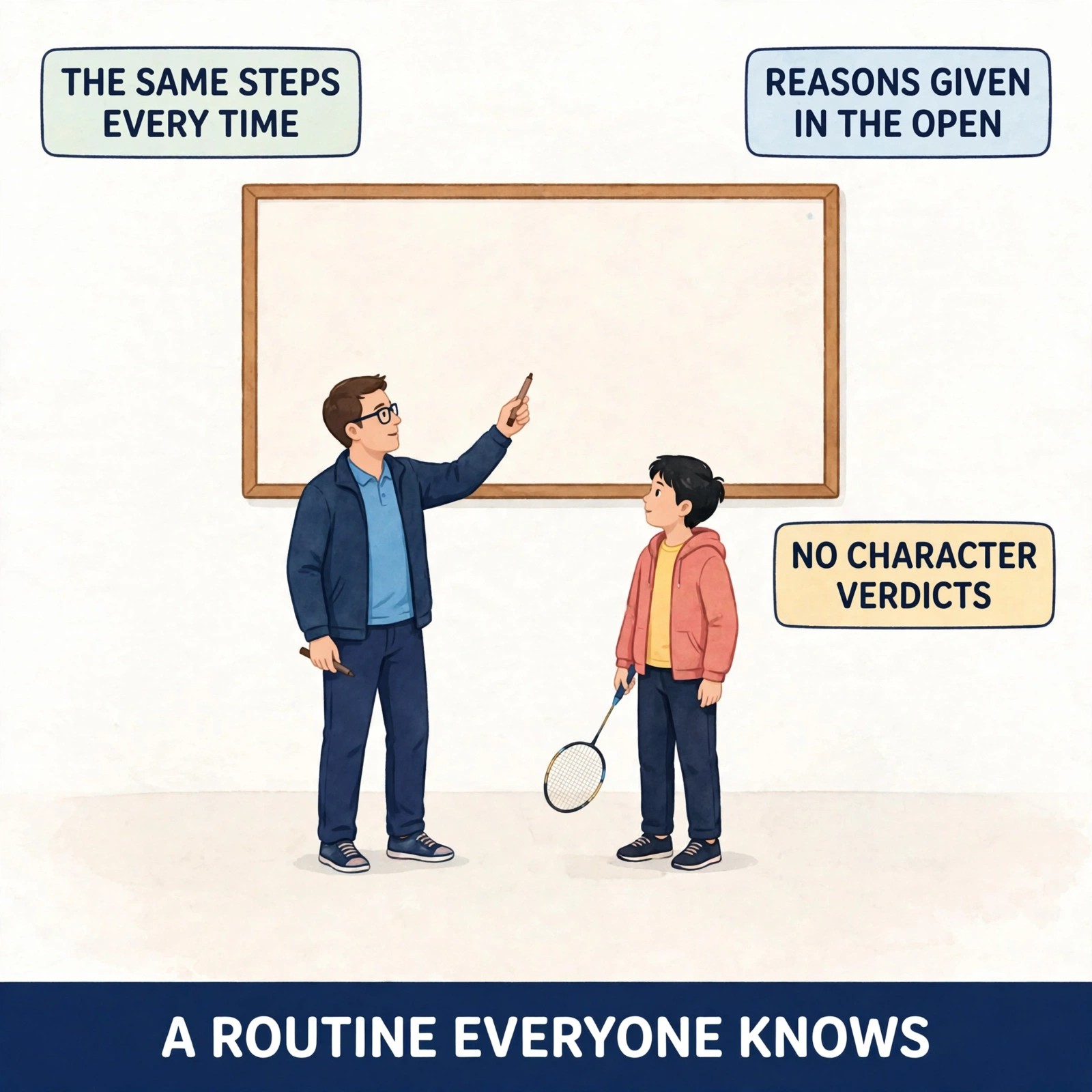
The settling habits in this guide are taught like footwork: named, practised, repeated until they are ordinary. First, the pause and the step in: play stops and the players come to the net, because arguments shrink at close range. Second, the recount from the last agreed score, said aloud together, so both children hear themselves agree about something. Third, the honesty sentence, practised word for word until it is easy to say under pressure: I am not sure, so we play it again. Coaches count these settlements the way they count attempts at a drill, on fingers, in the open, and praise the honest call at least as warmly as the winning shot.
Scored drills are where the habits are built, precisely because the stakes are small and the repetitions are many. A drill with a count gives children a weekly supply of tiny disagreements, each one a rehearsal with a coach close enough to guide it. Parents can protect the habit at home with one light rule: never settle a retold argument by verdict. Ask instead what the routine was and whether it got used. The question teaches your child which part of the story you value: not the point, which is gone, but the repair, which they will carry into every game they ever play.
Notice what these habits are quietly building beyond the court. A child who can pause, recount and concede an uncertain call kindly is practising the exact moves that settle disputes in classrooms, group projects and, one day, workplaces. Badminton just happens to supply the disagreements at a safe size and a kind speed. That is why this guide treats a score argument as curriculum rather than noise. The games will be forgotten by next month. The sentence I am not sure, said calmly while a point hangs on it, will still be available to your child in rooms you will never see.
Myth vs Reality
Myths About Score Arguments
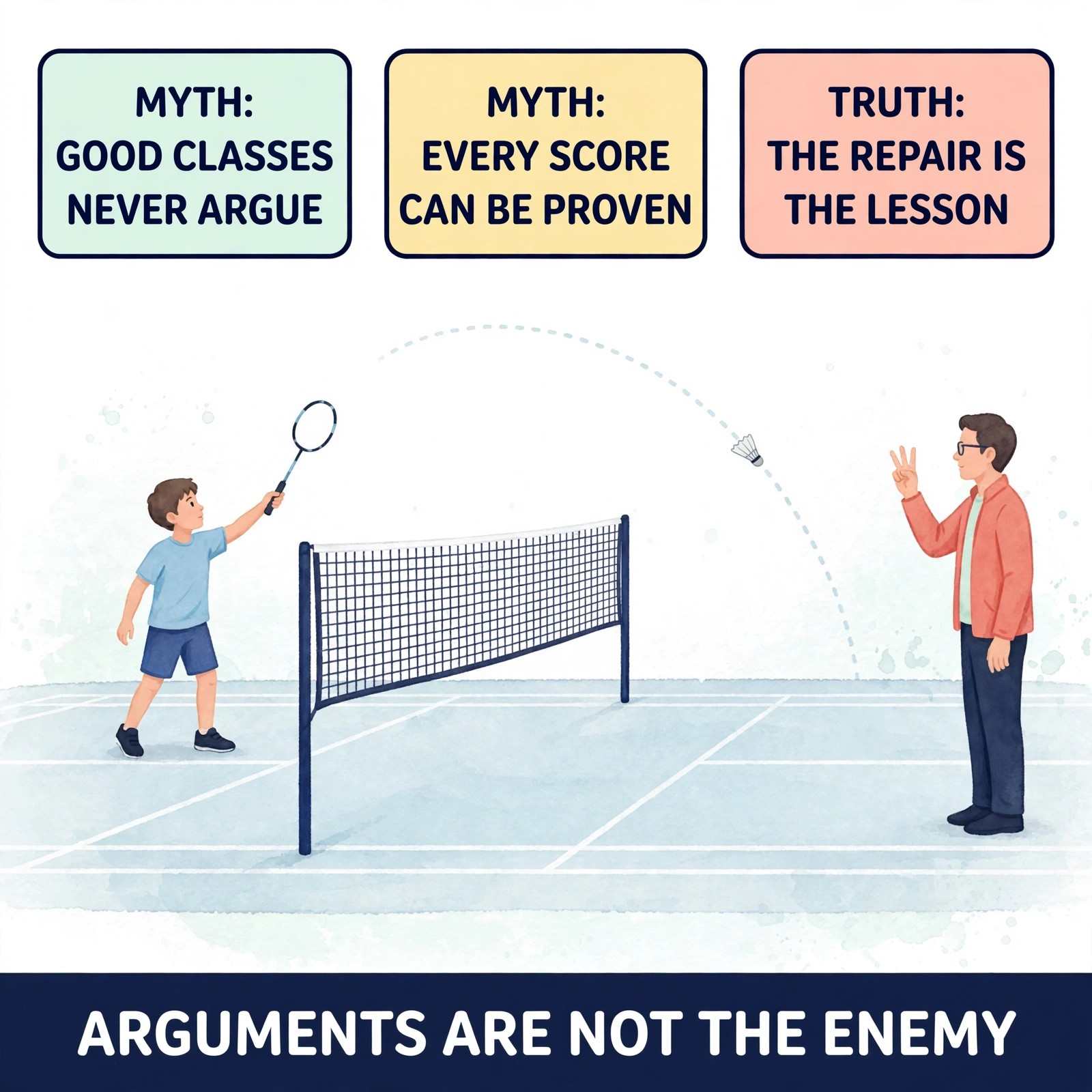
The myths around score disagreements tend to flatter certainty. The first says good classes have no arguments, because the children are well behaved. In truth, a class with no visible disagreements may simply have children who have learned that reporting doubt is unwelcome, which is the opposite of the goal. The second myth says every dispute must end with the correct score found. Some points honestly cannot be reconstructed, and teaching children to hunt certainty that does not exist just lengthens the storm. The replay exists precisely for those points: fairness by agreement, openly reached, beats accuracy nobody can prove.
A third myth claims some children are simply dishonest and should be called out in front of the group. Miscounts at this stage are overwhelmingly memory, eyesight and hope, not character, and a public verdict teaches the room to hide mistakes rather than mend them. Where a pattern of convenient calls genuinely repeats, it is handled as teaching: a private word, closer watching for a while, and the honesty sentence practised again, without an audience. Children rise toward the standard the room praises. A room that praises honest doubt gets honest players, and a room that hunts cheats mostly gets careful liars and quiet quitters.
The truth underneath the myths is modest. Score disagreements are small, normal and useful, and what a class does with them is a fair window into its teaching. Here, the promise is checkable: a known routine, a recount from agreed ground, an honest sentence for uncertain calls, a replay without shame, and play resumed kindly within the minute. No child is blamed for a miscount, no argument is won by volume, and the point itself is treated as the smallest thing in the room. Judge us the next time two small voices rise over a still shuttle. Watch the repair. That is the lesson we are actually teaching.
Why Choose Us
Why Players Choose ST Badminton Academy
Families choose this academy for the teaching first: groups of no more than four students, one coach who knows each child, and games kept small enough that every disagreement is heard by an adult who was actually watching. That smallness is the practical heart of this subject. In a group of four, a score dispute is never a crowd event, nobody performs for an audience, and the recount can be guided by someone who saw the rally too. Parents at the door can watch the whole routine happen, which is how it should be: nothing about how your child’s games are settled here needs to be taken on trust.
Parents also choose the way honesty is talked about here. We praise the sentence I am not sure in front of the group, we count calm settlements as openly as good shots, and we never rank children by their honesty or their results in anything a child can overhear. When a parent raises a pattern from home, it is answered with observations from the court, what we saw, what the routine produced, what we will watch next, rather than with a verdict on any child. Families tell us that this even handedness is what lets their children report doubt early, while it is still small enough to settle in a breath.
There is a final reason that grows on families over a term. Children develop at different rates, in counting and calling as much as in footwork: some read a landing early, some need the replay rule for a long while, and both are ordinary. The teaching here sizes the responsibility per child, closer watching for the one still learning to judge, more independence for the one whose calls have grown steady. Parents tell us the change they noticed first was not a fairer score. It was their child settling a playground dispute the same way, pause, recount, play it again, as if fairness were simply what you do. It is, here.
FAQs: Score Disagreements in Kids Badminton Classes in Malaysia (KL)
These are the questions parents ask us most about score disagreements in junior games, before they book and while a calmer way of settling them is becoming habit. The short version runs through all of them: pause, recount from agreed ground, replay what cannot be settled, and play on kindly. The longer answers follow, including whether arguments mean a class is badly run, and how a first session with us actually works.
Can children learn to settle score disagreements calmly in a badminton class in Setapak or Gombak?
Yes. Children can learn to settle score disagreements calmly with us in Setapak, a short drive from Wangsa Maju, in groups of no more than four students. The routine is taught like footwork: pause, recount from the last agreed score, replay what cannot be settled, and play on kindly.
What should a parent ask first about score disagreements in KL?
Ask how disagreements are settled: whether there is a known routine, who leads it, and what children are taught to say when they are unsure of a call. A hall with a real process can describe it in a breath, and children from that hall can usually describe it too.
Why do score disagreements worry parents at a junior level?
Because a score argument retold at home can sound like a verdict on another child, when it is usually a verdict on a process that was never taught. The worry is fair, and it deserves a steadier reading: how quickly games repair, watched across a fair stretch of weeks.
My child comes home upset about a score argument. Should I take sides or ask how it was settled instead?
Ask how it was settled, rather than taking sides. A verdict handed down at home teaches your child that disputes are won by building a case, and sends them back armed instead of settled. The repair is the story worth hearing: the pause, the recount, and the honest replay.
How can parents talk about scores and honesty at home in between classes?
Never settle a retold argument by verdict. Ask what the routine was and whether it got used, praise the honest sentence when you hear it, and let close games be close without a courtroom afterwards. If the same upset repeats weekly, bring us the pattern as observations, and we will answer with our own.
Do you settle score disagreements calmly beside badminton training near Wangsa Maju?
Yes. We settle score disagreements calmly beside regular training from our base in Setapak, a short drive from Wangsa Maju, and families from that side train with us every week. The pause, the recount and the replay sit inside ordinary junior games, with an adult close enough to guide each one.
Where does ST Badminton Academy teach badminton training in Malaysia?
We teach at our base in Setapak, Kuala Lumpur, and families travel in from across the Klang Valley. Sessions run with no more than four students per group, because a dispute stays small, nobody performs for an audience, and the coach guiding the recount usually saw the rally too.
How do I book a trial session to test my child’s class and its game habits?
Message us to arrange a trial at a time that suits your week. Bring your child’s racket and court shoes, and watch one scored game with us. The first time two small voices rise, watch the routine rather than the score: the pause, the recount, and the shoulders dropping.
What makes Mr Eric Chuar a suitable coach for calm, honest games in badminton?
Mr Eric Chuar coaches the academy sessions himself, with more than fifteen years of coaching in Malaysia and Singapore, so the person who taught the settling routine is the person who answers for it. His style is plain spoken: no blame for a miscount, no argument won by volume, and honesty praised out loud.
Calm Score Coaching in Action


We benchmark our calm score coaching against World Badminton (BWF) coaching standards and our own academy values: before any player trusts a training plan, they deserve honest checks. You can verify our coaches' credentials through the Badminton Association of Malaysia (BAM) coach education pathway.
One standard governs disagreements here: the repair judges the process, never the child's character. A coach here will pause the game without impatience, recount from the last score both players accept, offer the replay for any point that cannot honestly be settled, and restart play with one named next action. We also hold an honesty rule about what settling can do. A kind routine can teach honesty, calm and fairness; it cannot make every call correct or every child enjoy losing a close point, and we will say so rather than promise a hall without arguments. What we promise instead is a hall where arguments end well.
| Factor | The Recount Hall | The Courtroom Hall SCORE |
|---|---|---|
| Frequency | 1 or 2 times a week. Mostly for fun and sweat. | The courtroom hall lets volume and verdicts settle games. Children argue across the net, adults judge character from the side, honest doubt goes unreported because reporting it starts a trial, and the score everyone argues about is the one thing nobody can actually remember. |
| Drills Focus | Basic static feeding. Minimal footwork pressure. | The recount hall teaches a routine the size of a grip: pause, step in, recount together from the last score both players accept, and replay any point that cannot honestly be settled. Honest doubt is praised out loud, and play resumes on one named next action. |
| Physical Conditioning | Rarely included. Just playing games on court. | Core, agility, and speed training included in every session to prevent injury and build stamina. |
| Tactical Awareness | "Just hit it over." No real game plan. | Video analysis, point construction, and learning to read the opponent's game. |
| Coach Ratio | Large groups (8-10 kids). Coach barely watches you. | Max 4 students. Mr Eric Chuar personally corrects every stroke and movement detail. |
| Goal Setting | Fun and exercise. | Because the count is disagreements repaired kindly and play resumed within the minute, real fairness shows up as numbers rather than as silence. The coach sees whether the pause, the recount or the restart was off, the parents see the same rows, and one part of the routine is repaired instead of a child being blamed. |
| Long Term Result | Good recreational player. | The high-performance version produces a child who can say I am not sure while a point hangs on it. The casual version spends the term arguing; the recount version removes the guesswork in a fixed order and counts what each repair produced. |
Calm Score Coaching in Kuala Lumpur
Your start can be watching one scored game with new eyes. Come to a trial, stand where the parents stand, and the first time two small voices rise, watch the routine rather than the score: the pause, the recount, the replay if one is needed, and the shoulders dropping as play resumes. Bring your child as they are, racket and court shoes, and tell us honestly if game arguments have been the sore point at classes before. We will teach the settling habits inside ordinary games from the first session. Message us to arrange a time that suits your week.


