Best Badminton Coach in Malaysia for Teenagers (School Team, Motivation, and Structure)
Teenagers are not children, and they are not adults. They sit in between, and coaching that ignores that fact fails twice: it talks down to them like children, and it loads them like adults. A teenager juggles school, exams, friends, and a changing body, and the coach who wins their trust is the one who respects all of it. This guide explains what the best badminton coach in Malaysia for teenagers actually does: how the coach fits training around school, keeps motivation alive when school gets busy, and builds real skills in training blocks with a pathway toward the school team. Head coach Mr Eric Chuar of ST Badminton Academy in Setapak has coached teenagers for more than fifteen years in Singapore and Malaysia, and he explains what to look for, so parents and teenagers can judge any coach together in a single visit.

The Short Answer
Teenagers Need a Different Kind of Coaching
The short answer is that teenage coaching is adult coaching with school attached. A teenager needs real skills, real structure, and a real pathway, just like an adult competitive player. But a teenager also needs a coach who understands school pressure, changing motivation, and the need to be treated with respect. A coach who talks down to a teenager loses them in a week. A coach who loads a teenager like an adult burns them out by exam season. The best teenage coaches in Malaysia do both: they teach seriously, and they fit the teaching to the teenager’s life.
The three things that matter most are school team, motivation, and structure. School team gives the teenager a goal worth training for. Motivation keeps the teenager coming back when school gets busy. Structure turns the training into real skills instead of random games. This guide walks you through all three, plus what good teenage coaching looks like in one session, how to choose a coach, and how to start. Bring your teenager to the visit. Their opinion matters as much as yours, because they are the one who has to train.
School Team
School Team: Coaching That Fits School Life
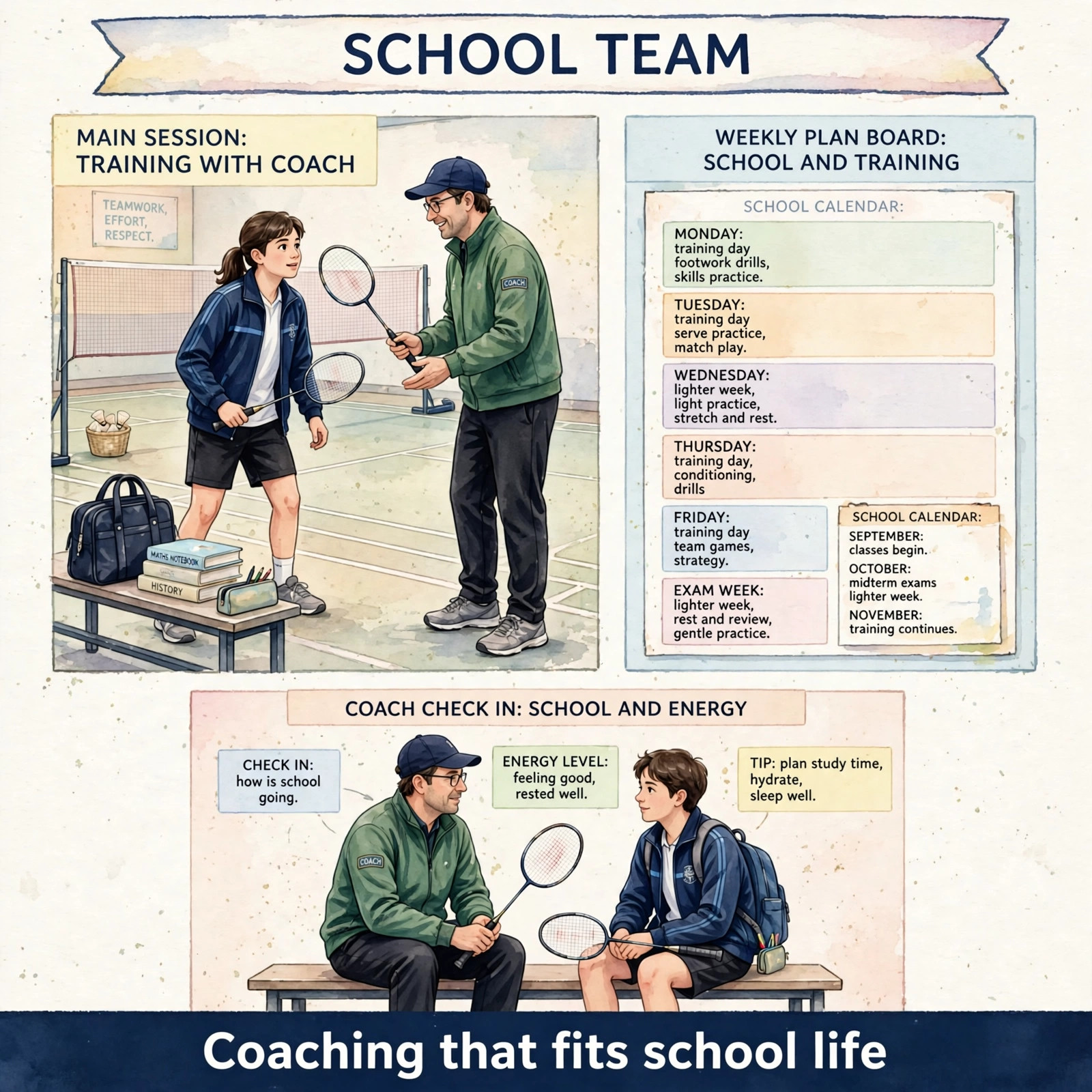
A good coach plans around school, not against it. Training usually runs two or three times a week, with lighter weeks around exams and school events, and the coach checks in about school load before setting the block. The school team is the goal for many teenagers, and the coach should know what the team needs: solid basics, reliable footwork, match play under mild pressure, and the fitness to last a school match. A coach who trains the teenager for the school team, rather than for the coach’s own programme, is a coach who understands the teenager’s world.
The coach should also talk to the teenager about school, not just badminton. A short check-in at the start of the session, how is school, any exams coming, how are you feeling, tells the coach what load the teenager can take that day. A tired teenager needs a lighter session, not a lecture about effort. A coach who ignores school and piles on training when exams are heaviest will lose the teenager fast, and the parent will hear that badminton is too much. Ask the coach how the schedule changes around exams, and how missed sessions are handled. A specific answer means the coach has done this before.
School team selection also needs honest talk. No coach can promise a school team place, because selection depends on the teenager and the field. What a good coach can promise is a plan, honest feedback, and steady progress toward the standard the team needs. The coach should also teach the teenager how to handle selection itself: trying hard, coping with disappointment, and coming back stronger. Those lessons matter as much as the footwork, and they are the reason parents trust a good teenage coach with more than badminton.

Motivation
Motivation: Keeping Teenagers Keen When School Gets Busy
Motivation fades when training feels pointless or when the teenager feels invisible. A good coach keeps motivation alive in three ways: clear goals the teenager chooses themself, visible progress the teenager can see, and a group of friends to train with. Goals work best when the teenager picks them: a cleaner clear, a longer rally, a place on the school team. The coach helps the teenager set the goal, breaks it into small steps, and celebrates each step. That ownership is what keeps a teenager training when school gets busy, because the goal is theirs, not the parent’s.
Visible progress matters because teenagers need proof. A good coach keeps a record: grip fixed, footwork steadier, clear reaching the back line, rally length growing. These small notes add up to a picture the teenager can trust. Video feedback helps too, when it stays private. A short clip of a teenager’s clear, watched together with the coach, shows the improvement faster than ten minutes of talk. We use video feedback this way at ST Badminton Academy, and we never post teenagers’ videos in public. If a coach films students and posts the clips online, ask why, and ask for your teenager to be left out.
The group matters as much as the goals. Teenagers train for their friends as much as for the sport, and a small group of four gives them rally partners at their level and a team to belong to. A good coach builds that feeling on purpose: pairing players kindly, mixing doubles so everyone plays, and making sure no one is left out. If your teenager stops wanting to train, ask the coach what changed before you blame the teenager. Often the training changed, not the child: the group grew, the fun faded, or the coach stopped noticing. A good coach will know, and will fix it.
Structure
Structure: Training Blocks That Build Real Skills
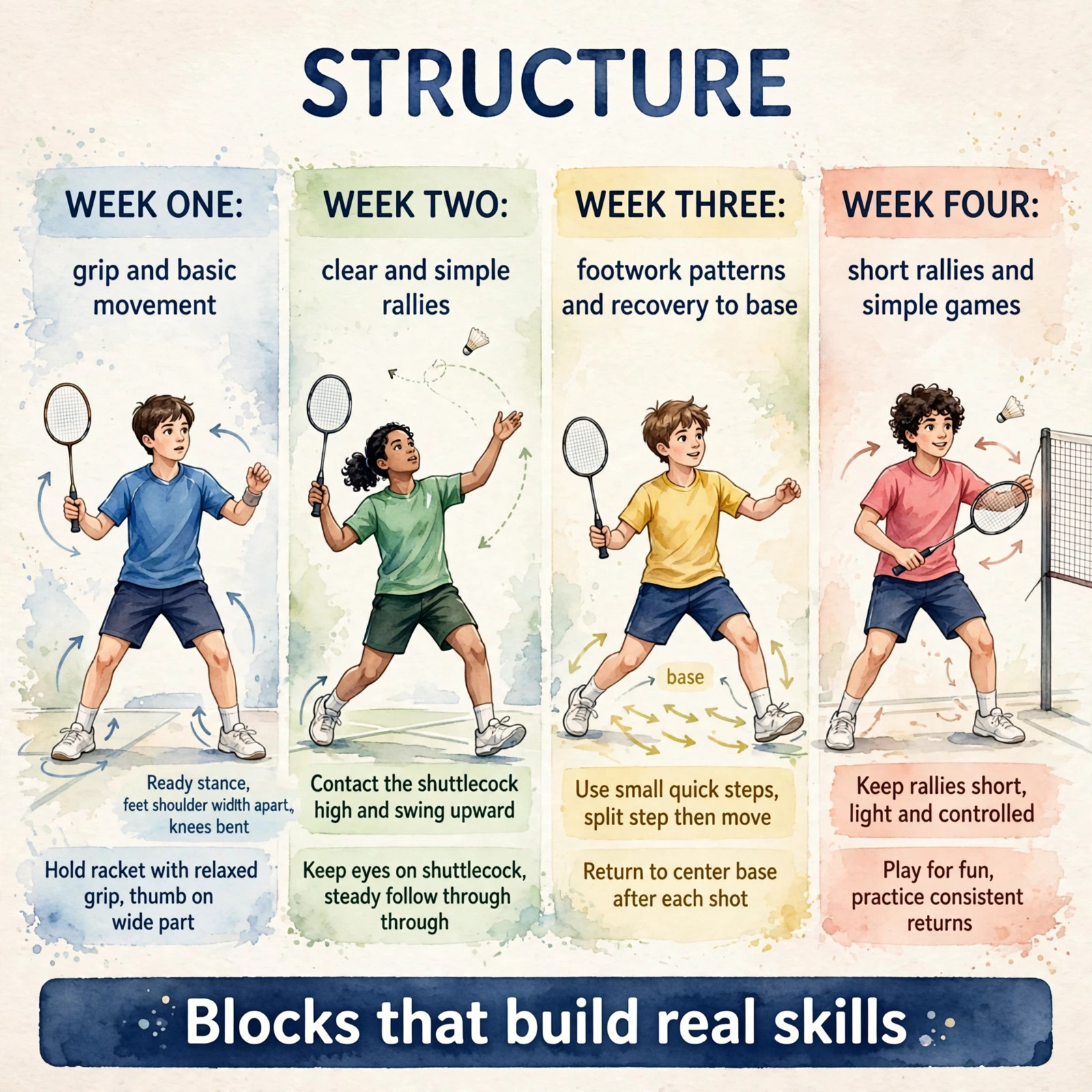
Structure is what turns training into progress. A good teenage coach plans in blocks, not in single sessions. The first month has a shape you can follow. The first week is usually grip and basic movement. The second week adds the clear and simple rallies. The third week builds footwork patterns and recovery to base. The fourth week puts it together in short rallies and simple games. Each block rests on the one before it, so the teenager builds clean habits instead of practising faults. Ask the coach to walk you through the first month before you sign up. If the coach cannot, keep looking.
Training load is planned the same way. Hard weeks are followed by lighter weeks, and the player peaks for matches and trials instead of burning out before them. A coach with Sport Science training watches for tired legs, sore shoulders, and flat footwork, and eases off before a small ache becomes an injury. The load also respects school: lighter around exams, steadier in term time. A coach who trains hard every day and calls it toughness is not building a player. That coach is building an injury, and the injury will cost the teenager months.
Match play is built into the structure, not bolted on. Short games with a clear focus come first, then full matches, then school team preparation as the player copes. Each match has a job to do, and the coach talks through what worked and what to fix after it. That loop, play, review, fix, play again, is how match skills grow. A teenager who only drills never learns to cope with pressure. A teenager who only plays matches never fixes the basics. Structure gives them both, in the right order, and that is the difference between a class and a programme.
What Good Looks Like
What Good Teenage Coaching Looks Like in One Session
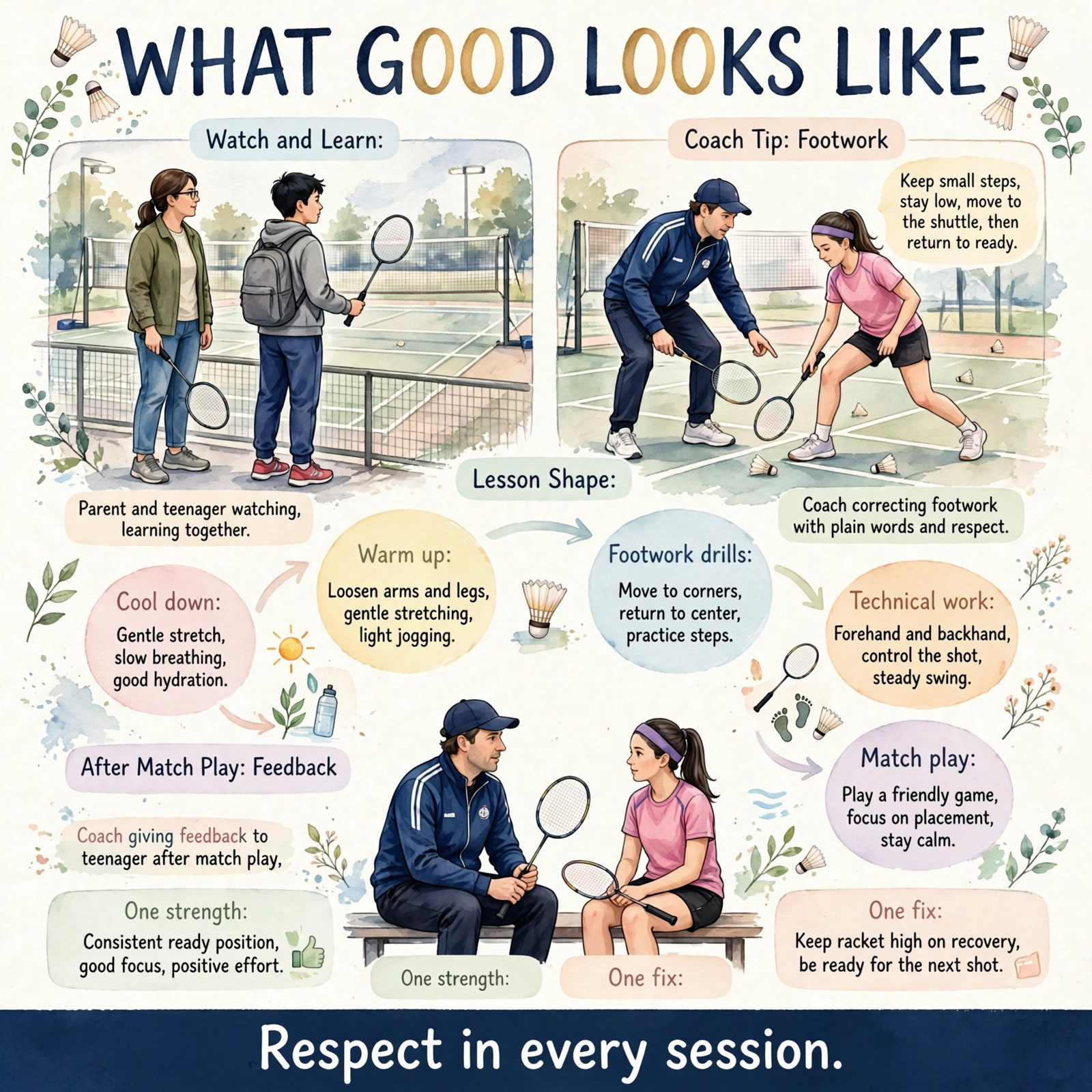
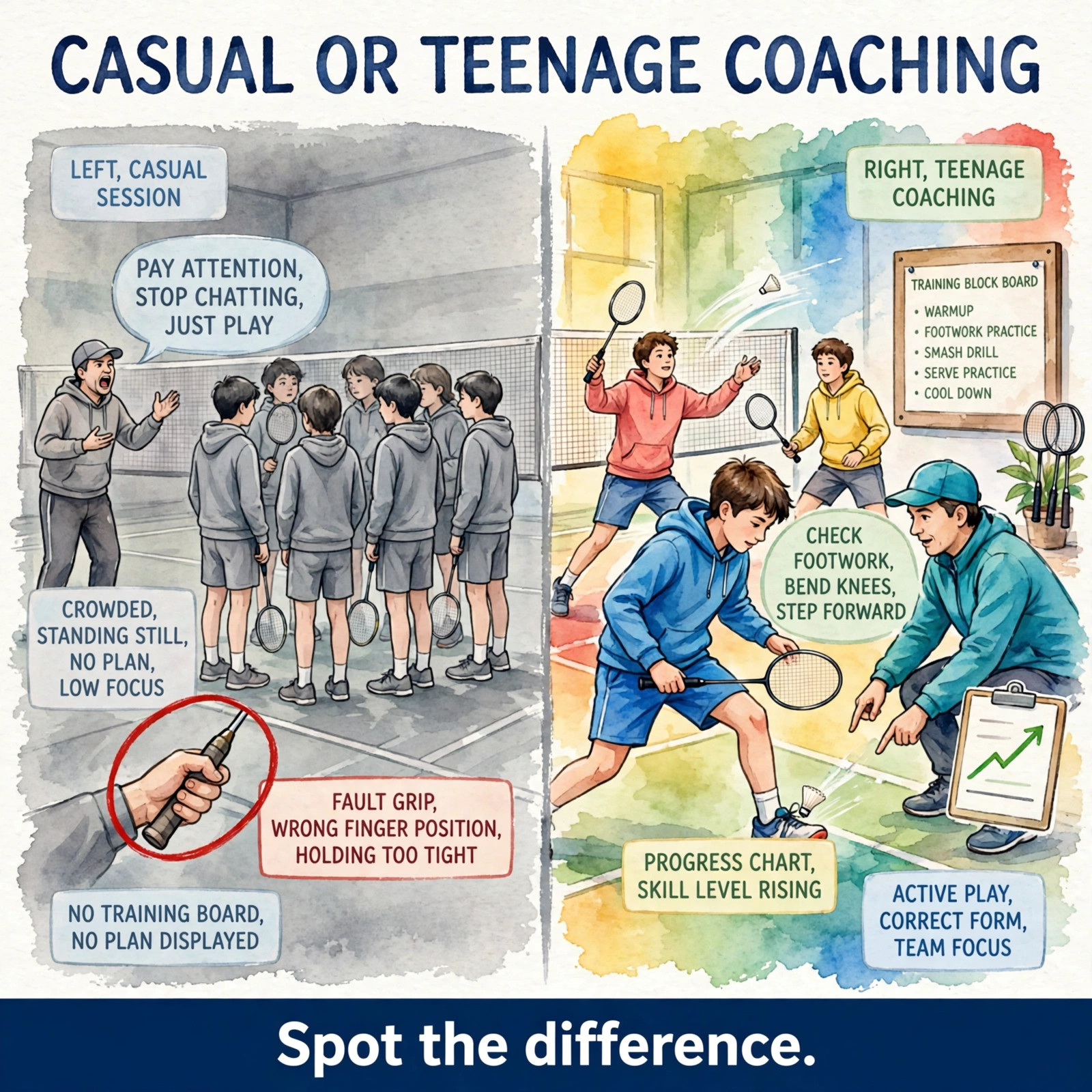
Visit once and watch a full session with your teenager beside you. Count how many times the coach corrects each player by name, and listen to how the coach speaks. In a good session, the coach talks to teenagers like young adults: plain words, real reasons, and respect. The corrections are specific: the split step, the lunge, the recovery, the choice of shot. The coach watches the whole rally, not just the winning shot, and talks to the player between rallies with one clear fix. If the coach shouts, mocks, or talks over the teenagers, walk away. Shouting is not coaching, and fear is not motivation.
Watch the shape of the session too. A good teenage session has a warm-up, footwork drills, technical work, match play with a focus, and a cool-down, in that order. The coach explains the focus at the start, so every player knows what the session is for. The players look busy and sharp, not bored and waiting. The group is small: at ST Badminton Academy, the maximum is four students per coach, so the coach can watch every stroke and correct footwork in real time. In a big group, the coach sees only the loudest player, and the quiet teenager practises the same fault for weeks.
Watch the coach’s honesty as well. After match play, does the coach tell each player what worked and what to fix, in plain words? Does the coach keep a record of progress, so the teenager can see what improved over the block? A good coach gives regular, specific feedback: one thing that improved, one thing to work on next. Ask your teenager after the visit what they thought. Teenagers are good judges of respect: if the coach treated them like a young adult, they will say so. If the coach talked down to them, they will say that too. Trust their read.
Choosing
How to Choose a Teenage Coach in Malaysia
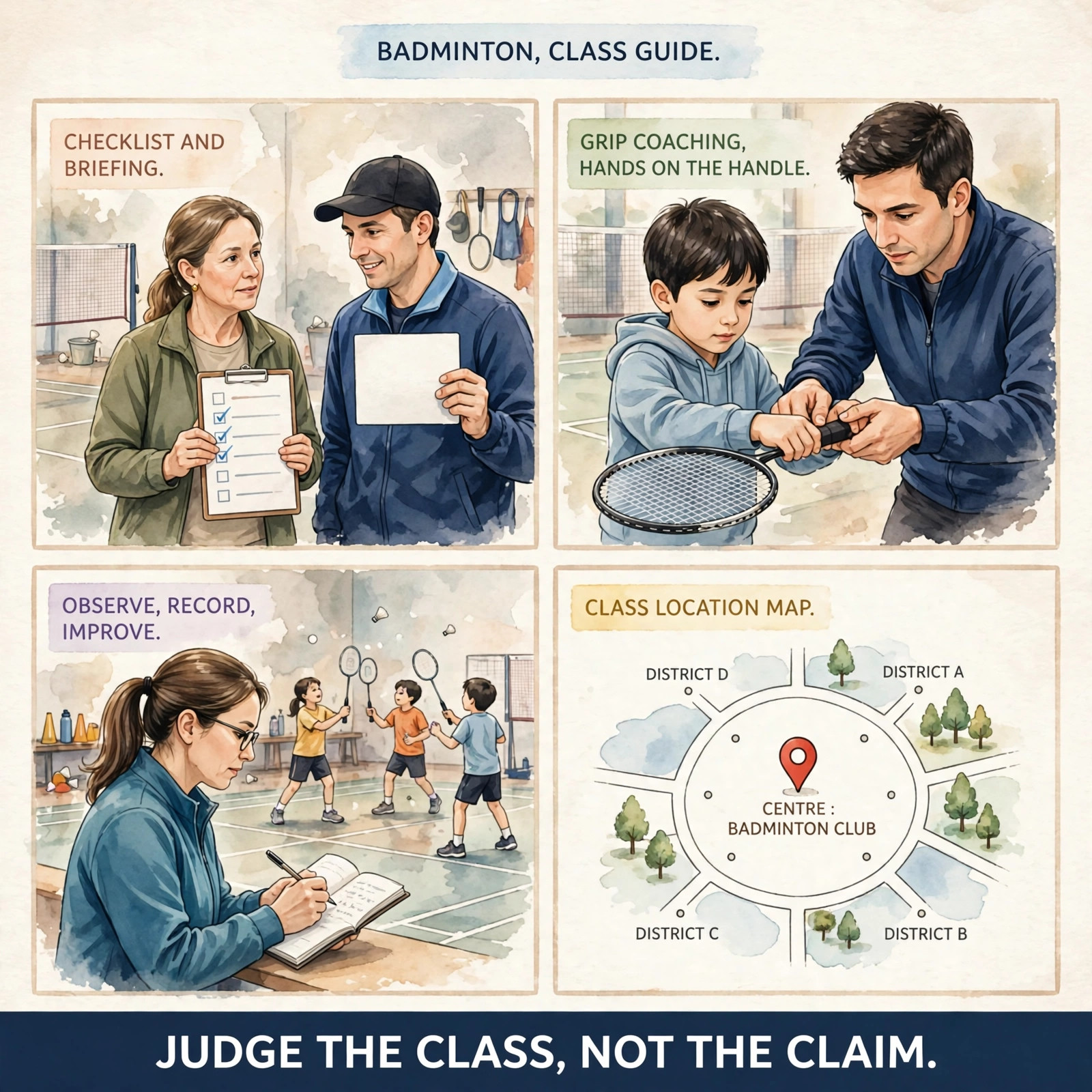
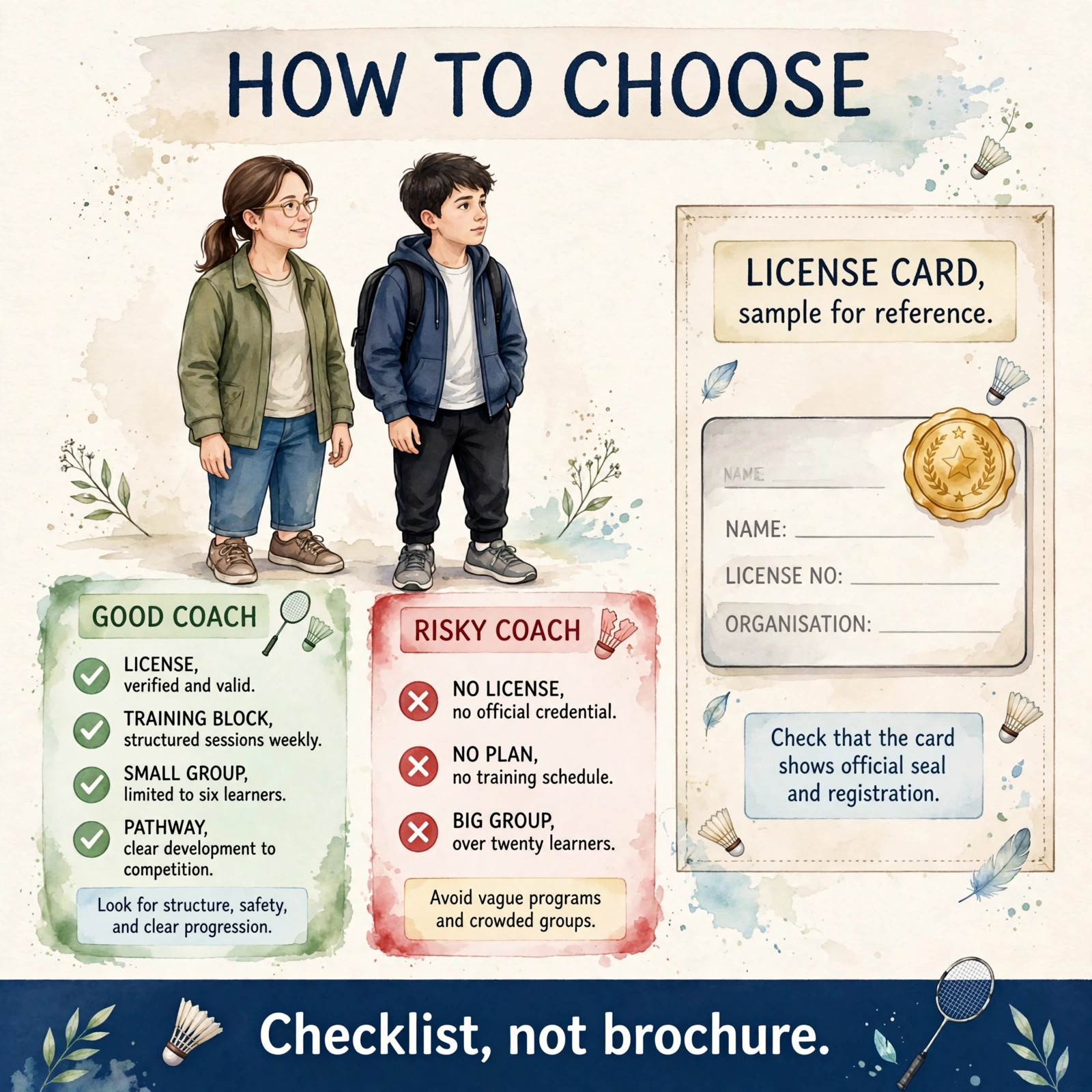
Choose with the checklist, not the brochure. Ask for the license first: a valid National Coaching License, such as Lesen C (SLKK Tahap I), issued by the National Coaching Academy (AKK), verified on the Malaysia Sports Coach Registry. Ask for the training block, not just the session: what does the next block contain, and how is load and recovery planned around school? Ask for the real maximum group size, and look for four students per coach or fewer. Ask how match play is introduced, and what the pathway looks like for your teenager. A coach who answers all of these plainly is a coach worth training with.
Ask who will actually coach the sessions, and how often. Some academies show you the head coach and then hand your teenager to a helper. Experience only counts if the experienced coach is the one on court with your teenager. At ST Badminton Academy in Setapak, head coach Mr Eric Chuar has coached for more than fifteen years in Singapore and Malaysia, founded the academy close to twenty years ago, and still teaches the small groups himself. He holds a valid National Coaching License, Lesen C (SLKK Tahap I), plus a National Level One Badminton Coaching Certificate under SPKK, a Sport Science Level One qualification, and a BAM Level One coaching qualification. BAM Level One is the entry coaching certificate and is now very common, so the license is the check that matters.
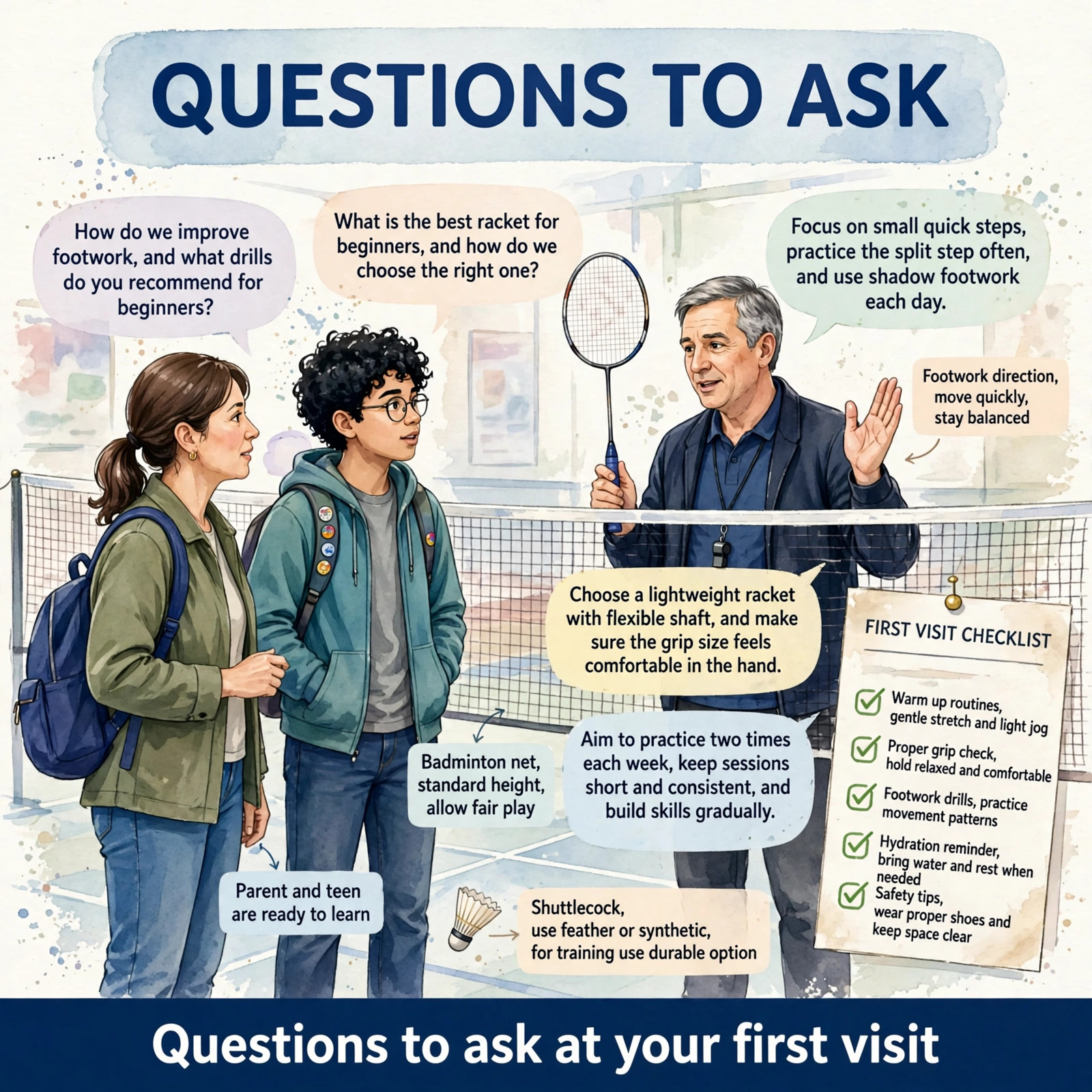
Bring your teenager to the visit, and let them ask questions too. A teenager who helps choose the coach owns the choice, and a teenager who owns the choice trains harder. Ask the coach how they handle a teenager who loses motivation, how they talk to parents about progress, and what happens when school gets heavy. A good coach answers all three plainly, because those are the questions teenage coaching is built on. A weak coach dodges, and the dodge is your answer. Choose together, and the training will hold when school gets busy.
Starting
How to Start: Assessment, Group, and First Month
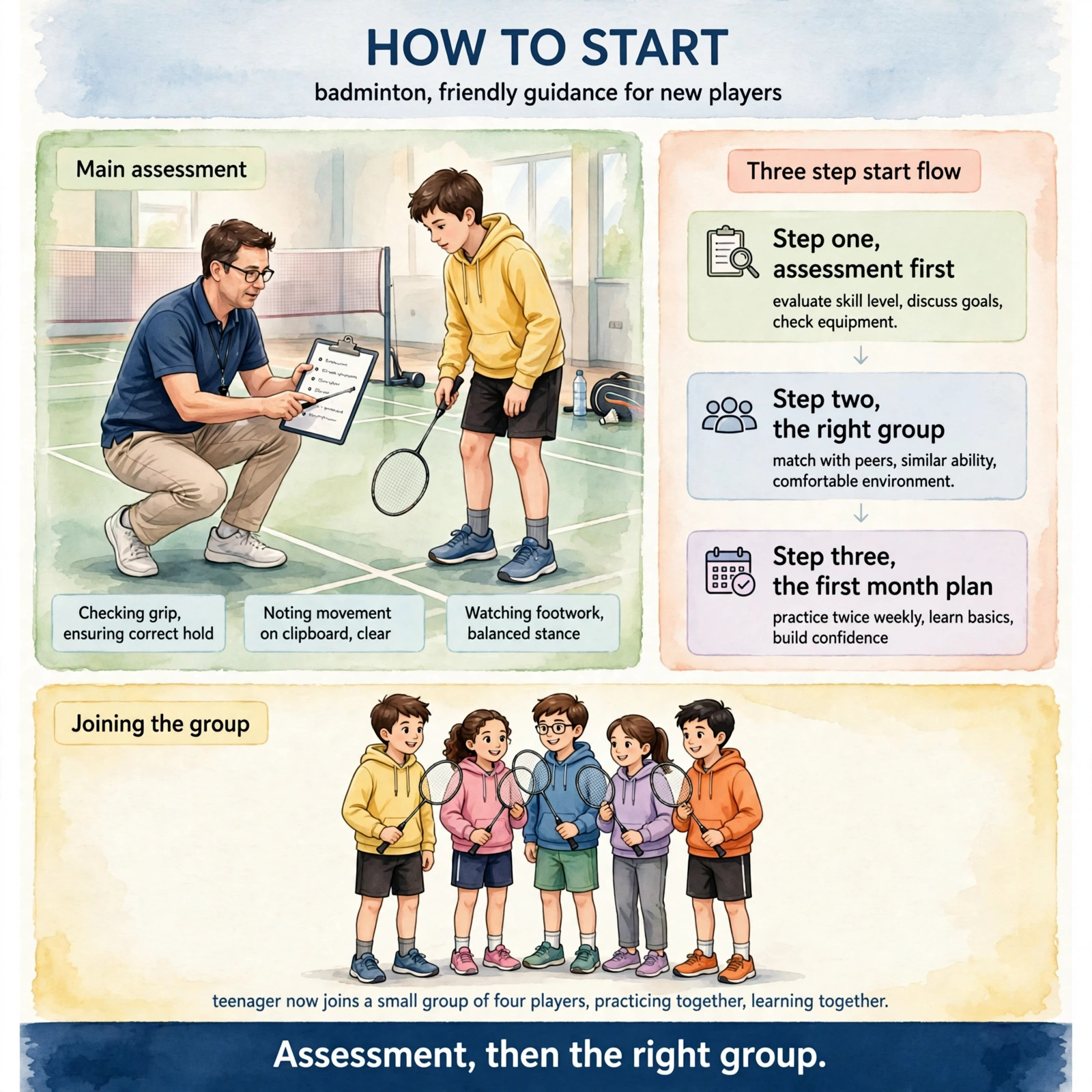
Start with an assessment, not a free trial. At ST Badminton Academy, new students start with a paid Initial Assessment instead of a free trial, because the assessment is real coaching time: the coach checks the grip, the footwork, and the basic movement, then tells the teenager what to work on first and places them in the right group. A free trial tells you nothing about the teenager’s level. An assessment tells you exactly where they stand, and what the plan is from there. Bring the teenager to the assessment, and let the coach meet them properly before any decision is made.
The group matters as much as the assessment. A teenager placed with players at a similar level learns faster and enjoys it more. A teenager placed with much stronger players feels slow and stops trying. A teenager placed with much weaker players gets bored and stops improving. Ask the coach how groups are formed, and how a teenager moves up when ready. A good academy moves players up when the coach says they are ready, not when a place opens. That movement is part of the pathway, and it keeps the teenager challenged without being overwhelmed.
Give the first month a fair chance. One session is enough to judge the coach, but a month is what it takes to feel the change: cleaner basics, longer rallies, and a group of friends to train with. Come every week, practise the one thing the coach asked the teenager to work on, and talk about the sessions at home without pressure. If the month feels good, you have found the right coach. If it does not, the checklist in this guide will help you find a better fit. Either way, starting is the hardest part, and your teenager has already done it by walking onto the court.
FAQs: Best Badminton Coach in Malaysia for Teenagers
Here are answers to common questions from teenagers and their parents in Malaysia about finding the best badminton coach in Malaysia for teenagers.
What makes a coach good for teenagers?
Look for a coach who understands teenagers: school pressure, changing motivation, and the need to be treated with respect. The coach should hold a valid National Coaching License, such as Lesen C (SLKK Tahap I), teach small groups of four at most, and plan training in blocks with match play and a pathway toward the school team. Watch one session: does the coach explain plainly, correct fast, and talk to the teenager like a young adult, not a child? If the answer is yes to all three, you are looking at a teenage coach, not just a coach who takes teenagers.
How does a good coach fit training around school?
A good coach plans around school, not against it. Training usually runs two or three times a week, with lighter weeks around exams and school events, and the coach checks in about school load before setting the block. A coach who ignores exams and piles on training when school is heaviest will lose the teenager fast. Ask the coach how the schedule changes around exams, and how missed sessions are handled. A specific answer means the coach has done this before. A shrug means the coach has not.
How does a good coach keep a teenager motivated?
Motivation fades when training feels pointless or when the teenager feels invisible. A good coach keeps motivation alive in three ways: clear goals the teenager chooses themself, visible progress the teenager can see, and a group of friends to train with. The coach also talks to the teenager, not just at them: asking what went well, what felt hard, and what to work on next. If your teenager stops wanting to train, ask the coach what changed before you blame the teenager. Often the training changed, not the child.
Do teenagers need small groups?
Yes, small groups matter even more for teenagers. In a group of four, the coach can watch every stroke, correct footwork in real time, and give each teenager real attention. Teenagers notice when a coach does not know their name or their weak shot, and they take it personally. In a big group, the coach sees only the loudest player, and the quiet teenager practises the same fault for weeks. At ST Badminton Academy, the maximum is four students per coach, and that number does not change when the class is busy.
When should a teenager start match play?
A good coach introduces match play once the basics are clean: grip, footwork, and clear in place, with rallies that last. Match play starts in small doses, short games with a clear focus, then builds to full matches and school team preparation as the player copes. Match play too early teaches bad habits, because the player muscles smashes to win points. Match play too late leaves the player unprepared for pressure. Ask the coach when match play starts in the plan, and what the player should focus on in each match.
What is the pathway from school team to state level?
The usual pathway runs from school team to district, then state, then national pathways, with selection at each step. A good coach knows the pathway and plans for it: which tournaments matter, when selection trials run, and what standard the player must reach at each stage. No coach can promise a state place or a fixed timeline, because selection depends on the player and the field. What a good coach can promise is a plan, honest feedback, and steady progress toward the next step. Ask the coach to walk you through the pathway for your teenager.
How do I choose a teenage coach in Malaysia?
Start with the license, then watch a session, then check the group size. Ask to see a valid National Coaching License, such as Lesen C (SLKK Tahap I), and verify it on the Malaysia Sports Coach Registry. Visit once and watch a full session: does the coach treat the teenagers with respect, correct small faults fast, and know every player by name? Ask for the real maximum group size, and look for four students per coach or fewer. Start with a paid Initial Assessment, ask the questions in this guide, and only then commit. Bring your teenager to the visit: their opinion matters as much as yours.
My teenager has never played. Where do they start?
A teenager who has never played should start with the basics in a small group: grip first, footwork second, clear third, with short rallies to put it together. A good coach will not throw a beginner into a fast game with experienced players. At ST Badminton Academy, new students start with a paid Initial Assessment instead of a free trial, so the coach can see how the teenager moves and holds the racket before placing them in the right group. The assessment is real coaching time, and it means the first group will fit the teenager, not embarrass them.
Who coaches teenagers at ST Badminton Academy?
Head coach Mr Eric Chuar coaches teenagers himself at ST Badminton Academy in Setapak. He has coached for more than fifteen years in Singapore and Malaysia, founded the academy close to twenty years ago, and holds a valid National Coaching License, Lesen C (SLKK Tahap I), issued by the National Coaching Academy (AKK), plus a National Level One Badminton Coaching Certificate under SPKK, a Sport Science Level One qualification, and a BAM Level One coaching qualification. Groups are capped at four students per coach, and he teaches the groups himself. New players start with a paid Initial Assessment, so the coach can place each teenager in the right group.
Teenage Coaching in Action
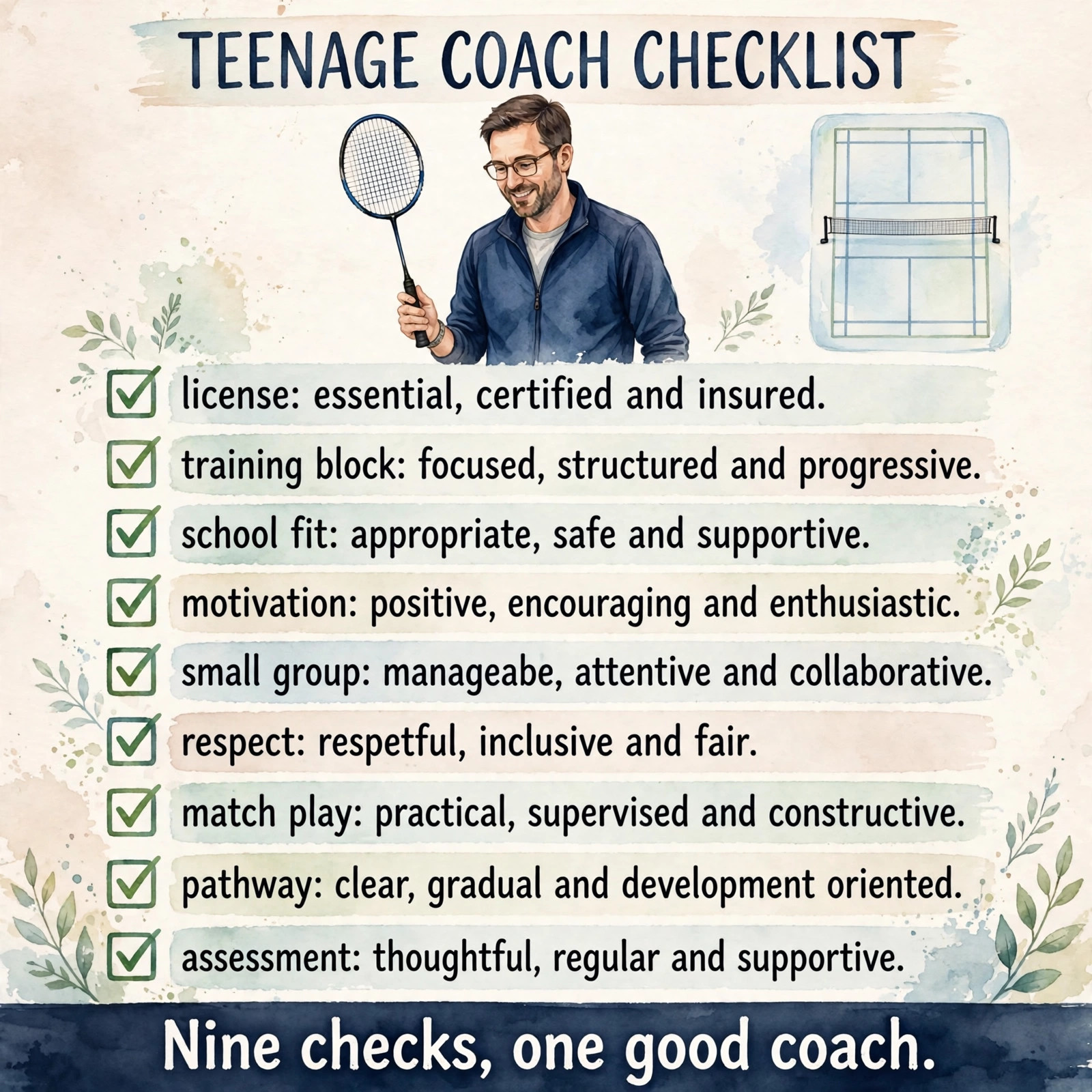

What Good Teenage Coaching Looks Like at ST Badminton Academy
Good teenage coaching is easy to recognise once you know what to look for. These are the standards we hold ourselves to in every session at ST Badminton Academy in Setapak.
| Factor | Casual Coaching | Teenage Coaching STBA |
|---|---|---|
| Structure | Turn up and play games. No block, no plan. | Planned blocks: basics, footwork, match play, pathway. |
| School Fit | One pace for all. School ignored. | Lighter weeks around exams, steadier in term time. |
| Motivation | Fun only. No goals, no record. | Goals the teenager chooses, progress the teenager can see. |
| Group Size | Big groups. The coach barely knows your name. | Four students at most. The coach knows every teenager. |
| Respect | Shouting, comparing players, and rushing. | Plain words, real reasons, and respect for young adults. |
| Match Play | Matches every session, no focus, no review. | Short games with a focus, then full matches, reviewed after. |
| Pathway | No pathway. The same class, year after year. | School team to district to state, with a plan for each step. |
Judge the Coaching, Then Commit With Confidence
Before you commit, run three last checks. Check seven: does the location and schedule fit school and family life without long travel or late nights? Check eight: can the coach explain things in a language your teenager understands and respects? Check nine: are the terms clear in writing, with no pressure to sign a long term before you have seen a single session? If a coach passes all the checks in this guide, you have found someone worth training with. ST Badminton Academy in Setapak welcomes teenagers and their parents who want to see good coaching before they commit.