Best Badminton Coach in KL for University Students (Near Campus, Flexible, and Affordable)
University life in Kuala Lumpur is busy: lectures, assignments, exams, part-time work, and a social life that never quite fits the timetable. Badminton should fit into that life, not fight it. The best badminton coach in KL for university students understands that: a hall near campus, sessions that bend around lectures and exams, and clear terms that fit a student budget. This guide explains what to look for: near campus, flexible times, affordable structure, and coaching that treats you like an adult. Head coach Mr Eric Chuar of ST Badminton Academy in Setapak has taught university students for more than 15 years in Singapore and Malaysia, and many of his students rent rooms near the academy, so he knows student life from the inside. Work through the checks in this guide, and you will find a coach who makes badminton the best hour of your week, not another deadline.

The Short Answer
University Badminton in KL: What Students Actually Need
The short answer is that students need three things: near campus, flexible times, and clear terms. A hall near campus, or near a train line you already use, means you will actually go. Sessions that bend around lectures and exams mean you will keep going when the term gets busy. Clear terms in writing mean you know what you are signing up for, with no surprises. A coach who gives you all three, plus a valid license and small groups, is a student-friendly coach. A coach who gives you none of the three is a coach who has never thought about student life.
The fourth need is respect. University students are adults, and a good coach treats them that way: plain explanations, real reasons, and corrections without shouting. The coach still teaches in order, grip first, footwork second, clear third, with corrections in every session, because basics matter at every level. But the pace fits the student: once or twice a week, with rest days between, and lighter weeks around exams. This guide walks you through what to look for: location, times, terms, learning, and how to choose and start. Work through the checks, and the right coach will stand out in one visit.

Near Campus
Near Campus: Location Matters When Your Week Is Full
Location matters more for students than for anyone else, because a student’s week is already full. Lectures, assignments, part-time work, and a social life all compete for the same hours. A hall that takes an hour to reach will lose to the library, the bed, and the group chat, however good the coaching is. A hall near campus, or near a train line you already use every day, turns training into a small detour instead of a big trip. That short trip is the difference between playing every week and playing once a month.
ST Badminton Academy is based in Setapak, Kuala Lumpur, and many university students rent rooms nearby, so the trip is short for a lot of students in the area. Families and students come from Wangsa Maju, Cheras, Kepong, Gombak, and across Kuala Lumpur for the small groups and the structured teaching. When you shortlist coaches, start with location, then check the coach. Look for a hall near your campus, or near a train or bus line you already use. Then run the checks in this guide: license, session visit, group size, and clear terms. A coach ten minutes away who teaches badly costs you more than a coach thirty minutes away who teaches well, so pick the coaching first, then check the travel.
Check the trip in real life, not on a map. Visit the hall at the time you would actually train, and see how long the trip really takes in evening traffic. Check the walk from the station, the lighting at night, and whether the hall feels safe and welcoming. A good academy will tell you honestly how students usually get there, and what time the sessions run. If the trip feels long on your first visit, it will feel longer in exam season. Choose a hall you can reach easily on a tired evening, because tired evenings are when you need the game most.
Flexible Times
Flexible Times: Training That Fits Lectures and Exams
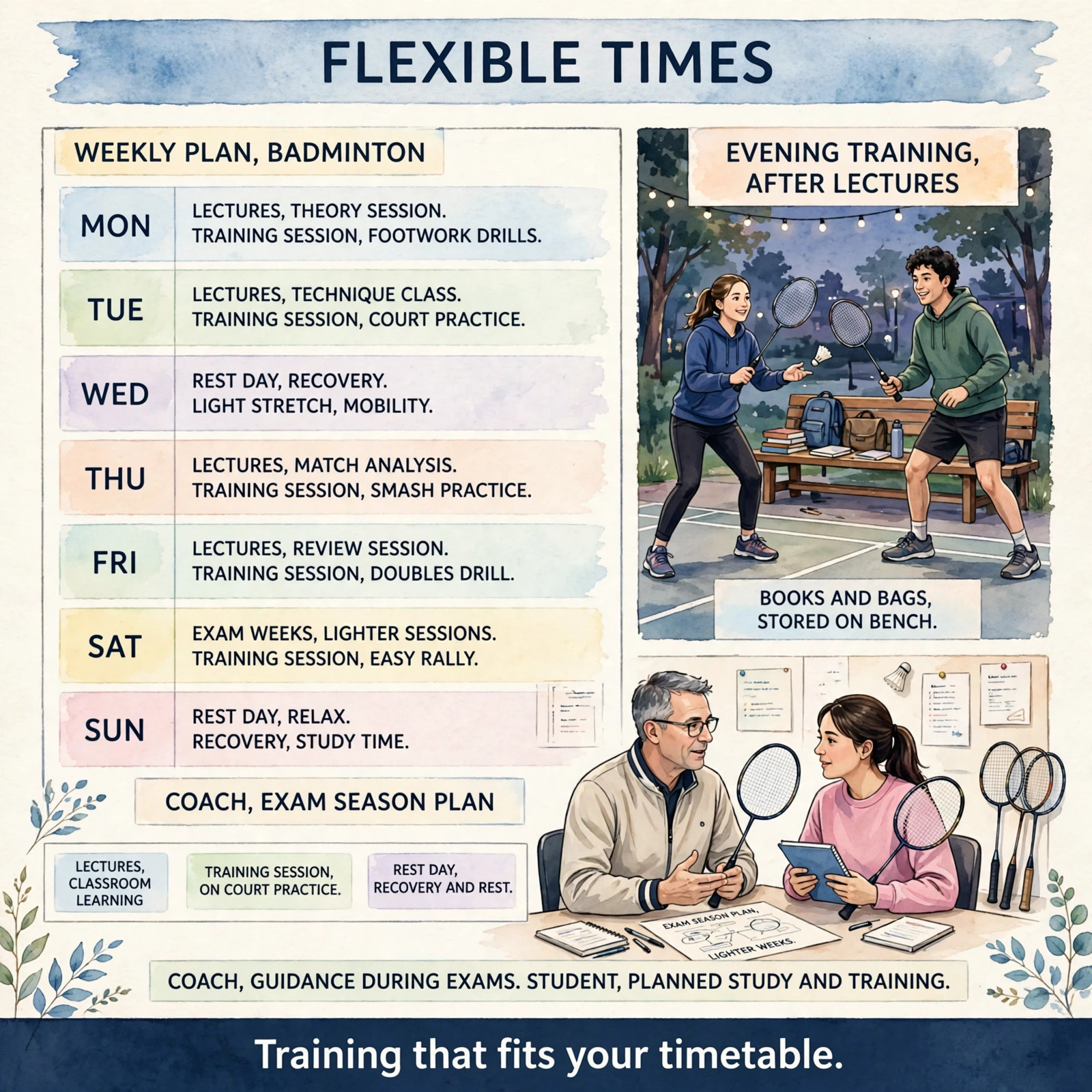
A student-friendly coach offers sessions around student life: evenings after lectures, weekends, and lighter weeks around exams. Most students train once or twice a week, with rest days between, and that is enough to improve steadily and stay fit. The exact number depends on your week: lectures, assignments, and energy all count. A good coach will not push you to train more than your life allows. What matters is regularity: one session every week beats three sessions in one week and none for a month. Tell the coach your timetable honestly, and a good coach will fit the plan to it, not the other way around.
Exams need a plan of their own. Training runs lighter around exams, with fewer sessions and easier drills, so you can focus on study without losing your game completely. Tell the coach your exam dates early, and the coach will shape the block around them. After exams, the coach brings the load back up step by step, so you return without injury. Badminton during exam season should be a break that clears your head, not another source of stress. A coach who piles on training during exams does not understand student life, and a coach who cancels everything for a month does not understand planning either. The right balance is lighter, not absent.
Flexibility also means the coach handles missed sessions fairly. Students miss sessions: assignments run late, group projects meet at odd hours, and life happens. Ask the coach what happens when you miss a session, and how you catch up. A specific answer means the academy has thought about student life. A shrug means it has not. A good coach welcomes you back without a lecture, checks what you missed, and folds it into the next session. That welcome is the difference between a coach who wants your progress and a coach who wants your attendance record.

Affordable Structure
Affordable Structure: Clear Terms, No Surprises
Affordable structure starts with clear terms in writing before you commit: what is included, how long the term runs, and what happens if you miss sessions around exams. Ask the coach to explain the terms plainly, and read them yourself before you sign anything. A fair academy lets you assess first, then decide. Watch for contracts that lock you in for many months, extra charges that appear only after you sign, and answers that dodge direct questions about terms. Clear terms, given in writing before you commit, are a sign of a serious academy. If the academy rushes you, or tells you the place will be gone tomorrow, walk away. A good coach does not need pressure to fill a class.
The assessment is part of the structure. At ST Badminton Academy, new students start with a paid Initial Assessment instead of a free trial, because the assessment is real coaching time: the coach checks the grip, the footwork, and the basic movement, then tells you what to work on first and places you in the right group. A free trial tells you nothing about your level. An assessment tells you exactly where you stand, and what the plan is from there. The assessment also protects your budget: you join the right group first time, instead of paying for weeks in the wrong one.
Affordable also means the group size is honest. At ST Badminton Academy, the maximum is four students per coach, and that number does not change when the class is busy. In a group of four, the coach can watch every player, correct gently, and keep everyone moving. In a big group, you share the coach with many players and get a fraction of the teaching. Ask for the real maximum, not the usual size. If the academy cannot tell you its maximum in one sentence, the maximum is probably bigger than you would like, and the value is worse than it looks.

What Students Learn
What University Students Learn Beyond the Game
Badminton teaches more than badminton. A student who trains regularly learns to manage time: lectures, assignments, training, and rest, all in one week. A student who plays matches learns to cope with pressure: a close game, a bad call, a comeback from behind. A student who trains in a small group learns to work with others: waiting your turn, watching your partner, and cheering a good shot. These are the skills employers ask about, and they are learned on court without a single lecture. A good coach points them out as they happen, so the student sees the learning, not just the game.
Fitness is the most obvious gain. Badminton keeps you moving: short sprints, lunges, jumps, and rallies that lift your heart rate and then let it settle. A good coach builds fitness into the lesson with a proper warm-up, movement drills, and rallies, and finishes with a cool-down and stretching. You will notice the difference in a month: lighter feet, easier breathing, and less stiffness the next day. Tell the coach about any knee, shoulder, or back issue before you start, so the drills can be adjusted for you. The fitness comes from playing, not from punishment, and that is why students stick with it when gym routines fail.
Friends are the gain students mention most. A regular group becomes a habit: same day, same faces, same laughs, and a gentle nudge when you miss a week. That habit is what keeps students playing for years, long after the first burst of enthusiasm fades. University is also a time to meet people outside your course, and a badminton group is a good place to do it. When you visit an academy, look at the group as well as the coach. Do the players talk to each other? Do they stay after the session to chat? A group that stays to talk is a group that will keep you coming back, and that is worth as much as any coaching tip.
Choosing
How to Choose a Student-Friendly Coach in KL
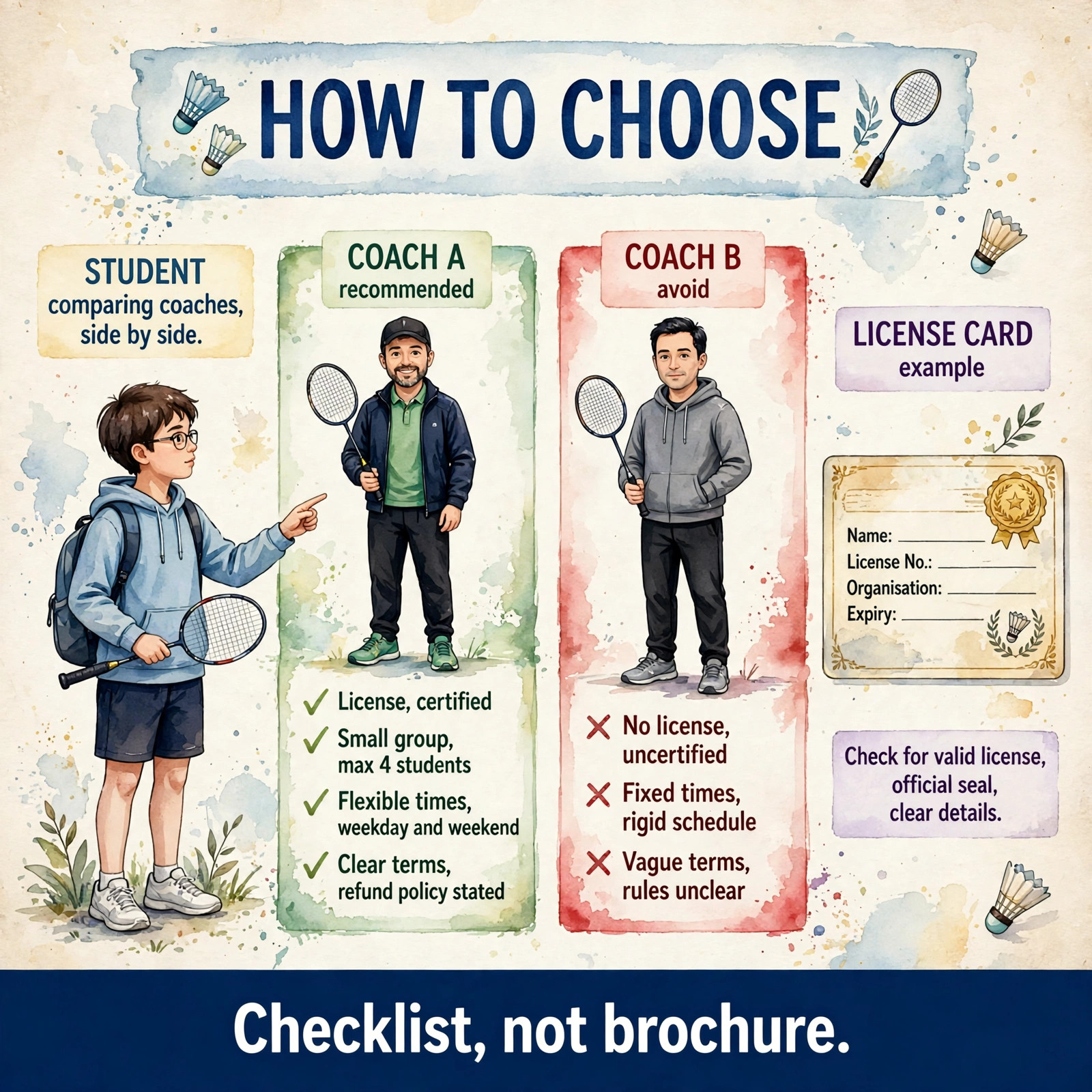
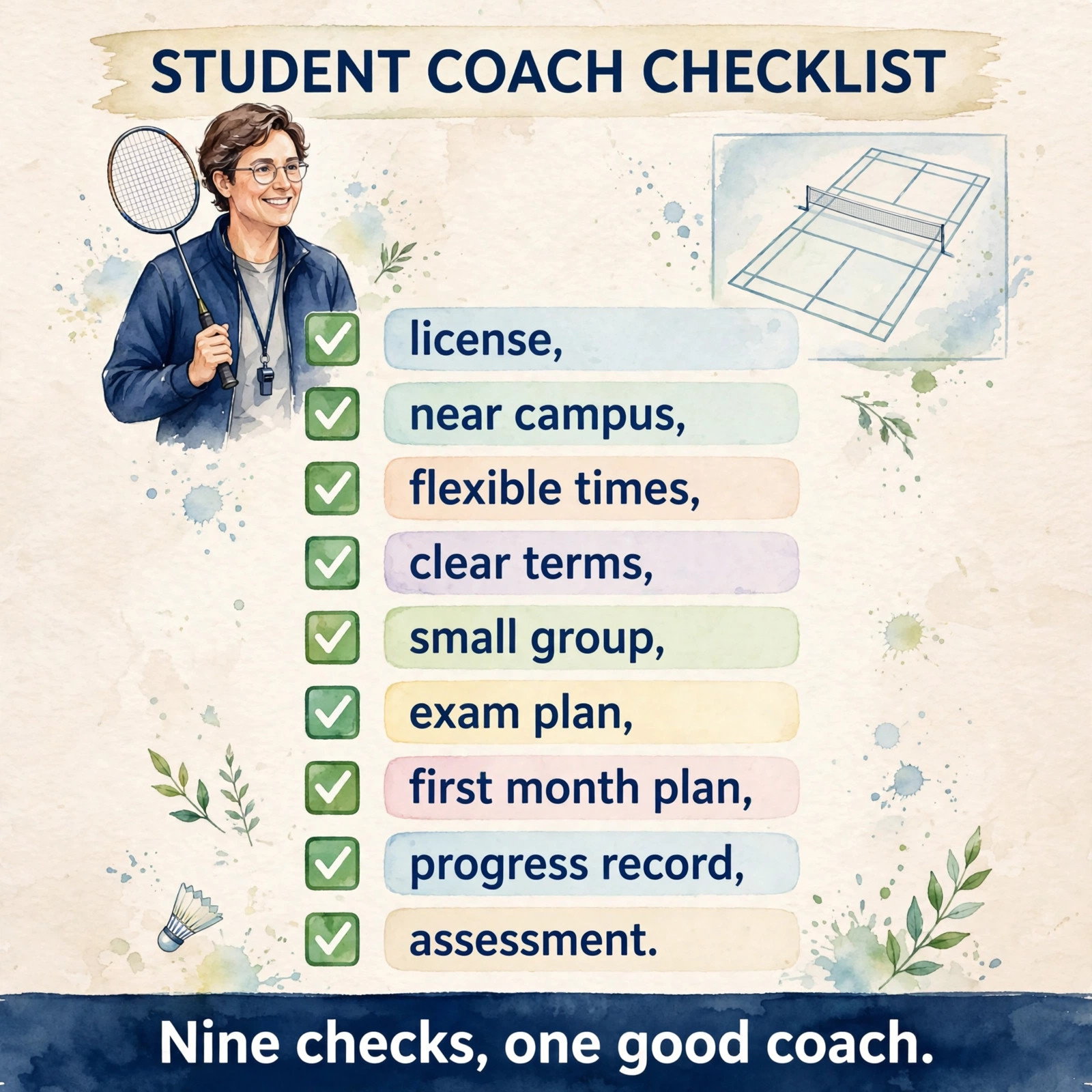
Choose with the checklist, not the brochure. Ask for the license first: a valid National Coaching License, such as Lesen C (SLKK Tahap I), issued by the National Coaching Academy (AKK), verified on the Malaysia Sports Coach Registry. Ask for the real maximum group size, and look for four students per coach or fewer. Ask about session times, and check that at least one regular slot fits your week. Ask about exams, and how the load changes around them. Ask for the terms in writing, and read them yourself. A coach who answers all of these plainly is a coach worth training with.
Ask who will actually coach the sessions, and how often. Some academies show you the head coach and then hand you to a helper. Experience only counts if the experienced coach is the one on court with you. At ST Badminton Academy in Setapak, head coach Mr Eric Chuar has coached for more than 15 years in Singapore and Malaysia, founded the academy in 2007, and still teaches the small groups himself. He holds a valid National Coaching License, Lesen C (SLKK Tahap I), plus a National Level 1 Badminton Coaching Certificate under SPKK, a Sport Science Level 1 qualification, and a BAM Level 1 coaching qualification. BAM Level 1 is the entry coaching certificate and is now very common, so the license is the check that matters.
Finally, trust the feel of the session you watched. Do the players look busy and happy? Does the coach know every player’s name? Does the lesson have a shape, with a warm-up, drills, rallies, and a cool-down? If the answer is yes to all three, you have found coaching worth your time. If the coach shouts, rushes, or ignores the quietest player, keep looking. There are many good coaches in Kuala Lumpur. The right one will welcome your questions, show you a plan, and let the coaching speak for itself. Bring a friend to the visit if you like: a second pair of eyes sees what the first misses.
Starting
How to Start: Assessment, Group, and First Month
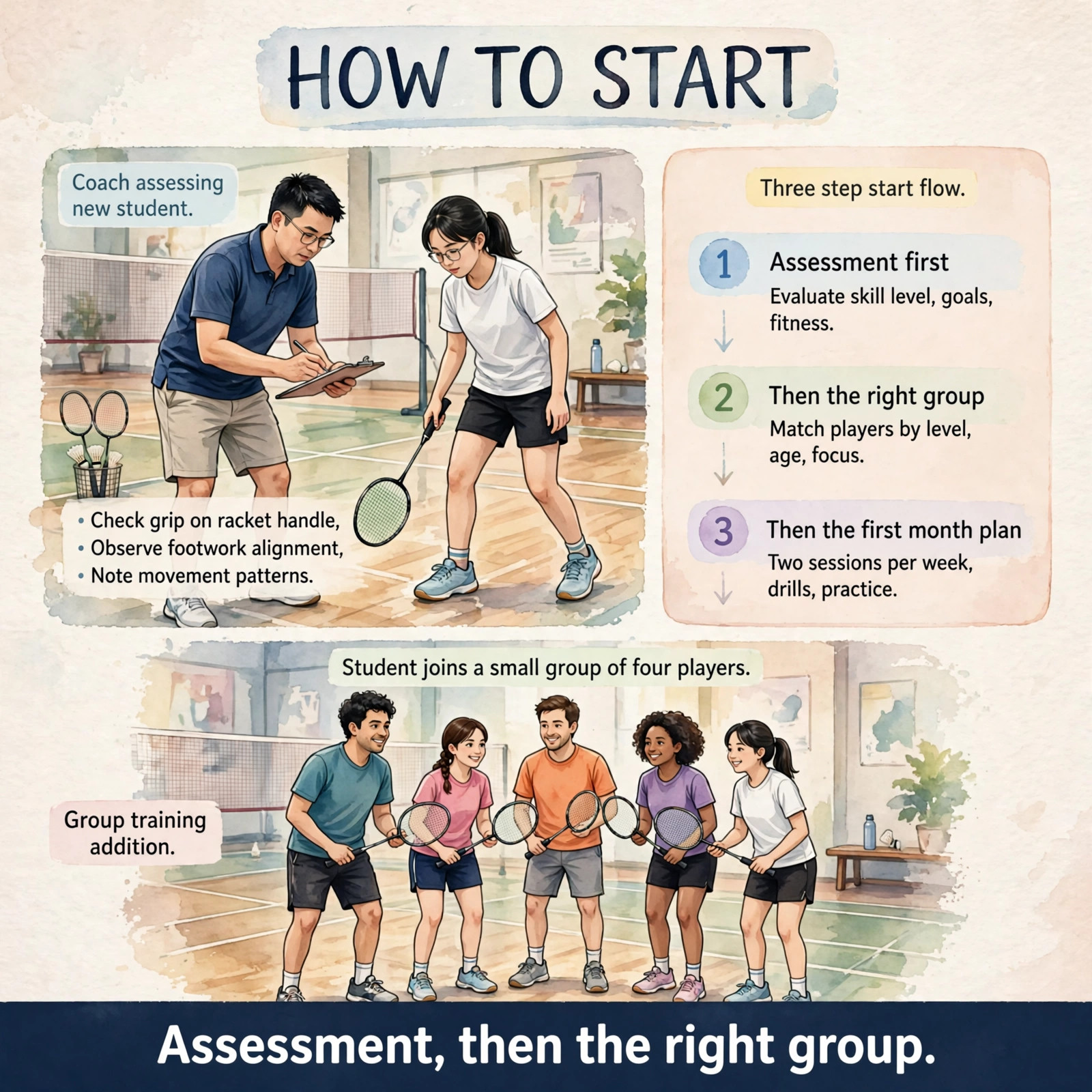
Starting is simpler than most students think. First, shortlist two or three coaches by location and license, and visit one session each. Watch the faces, count the corrections, and ask the questions from this guide: who coaches, what is the group size, what times are available, how do exams change the load, what are the terms, and can we start with an assessment? Write the answers down, so you can compare fairly. Most students know by the second visit: the coach who explains plainly, corrects gently, and keeps the group small stands out at once.
Second, start with an assessment, not a free trial. At ST Badminton Academy, new students start with a paid Initial Assessment instead of a free trial, because the assessment is real coaching time: the coach checks the grip, the footwork, and the basic movement, then tells you what to work on first and places you in the right group. A free trial tells you nothing about your level. An assessment tells you exactly where you stand, and what the plan is from there. Bring comfortable sports shoes with good grip, a water bottle, a towel, and clothes you can move in. If you have a racket, bring it; the coach will check the grip and the strings with you.
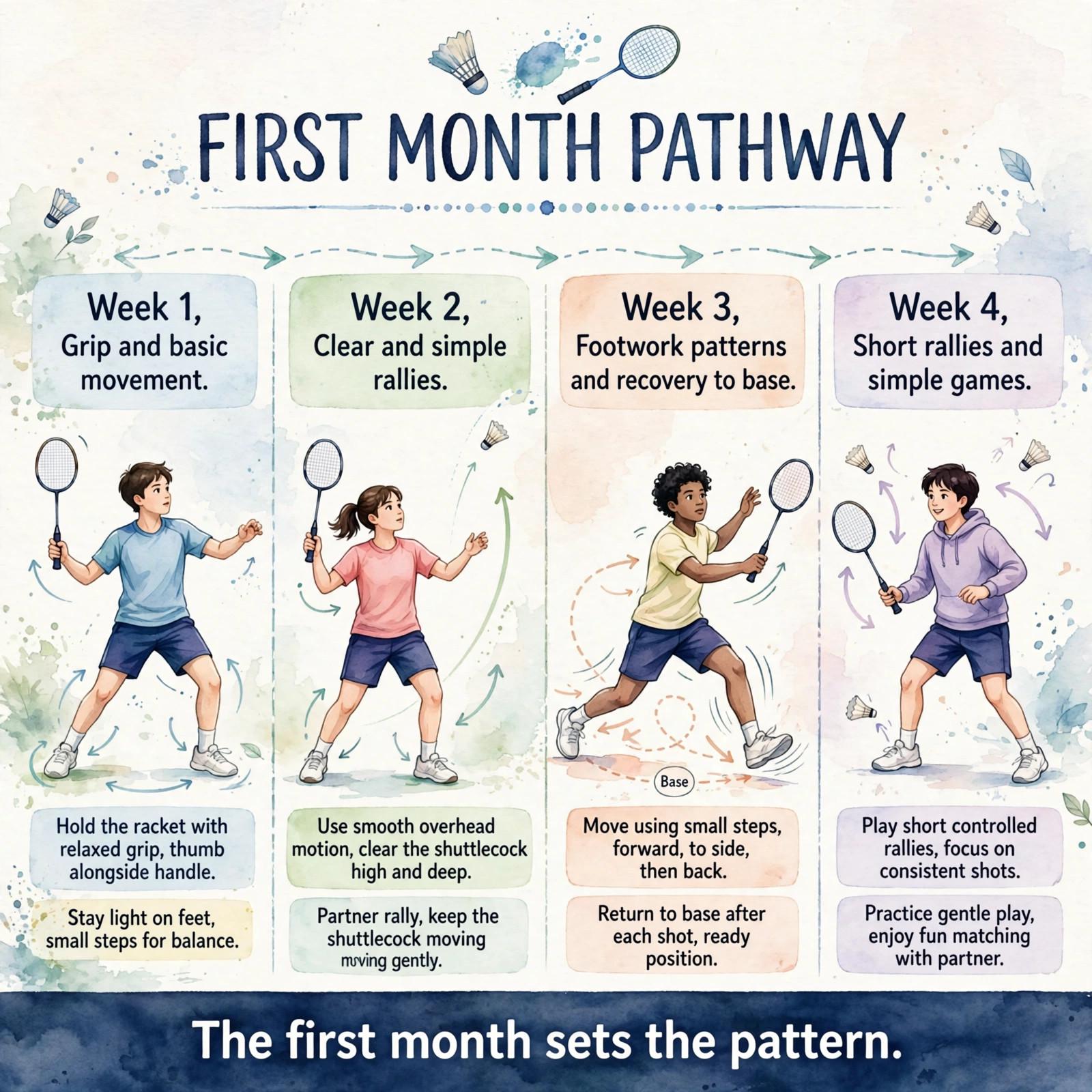
Third, give it a month. One session is enough to judge the coach, but a month is what it takes to feel the change: lighter feet, longer rallies, and a group of friends you look forward to seeing. Come every week, practise the one thing the coach asked you to work on, and tell the coach how it feels. If the month feels good, you have found your game. If it does not, the checklist in this guide will help you find a better fit. Either way, you will have started, and starting is the hardest part.
FAQs: Best Badminton Coach in KL for University Students
Here are answers to common questions from university students in Kuala Lumpur about finding the best badminton coach in KL for university students.
What makes a badminton coach good for university students?
Look for a coach who understands student life: lectures, assignments, exams, and a tight budget. The coach should hold a valid National Coaching License, such as Lesen C (SLKK Tahap I), teach small groups of four at most, and offer flexible times with clear terms in writing. Location matters too: a hall near campus, or near a train line you already use, means you will actually go. Watch one session: does the coach explain plainly, correct gently, and treat students like adults? If the answer is yes to all three, you are looking at a student-friendly coach.
How do I find a badminton coach near my campus in KL?
Start with location, then check the coach. Look for a hall near your campus, or near a train or bus line you already use every day. ST Badminton Academy is based in Setapak, Kuala Lumpur, and many university students rent rooms nearby, so the trip is short. Once you have a shortlist by location, run the checks in this guide: license, session visit, group size, and clear terms. A coach ten minutes away who teaches badly costs you more than a coach thirty minutes away who teaches well, so pick the coaching first, then check the travel.
What times can university students train?
A student-friendly coach offers sessions around student life: evenings after lectures, weekends, and lighter weeks around exams. Most students train once or twice a week, with rest days between, and that is enough to improve steadily and stay fit. Tell the coach your timetable honestly, including exam season, and a good coach will fit the plan to it. If you miss a week for exams, the coach welcomes you back without a lecture. Ask about session times before you commit, and check that at least one regular slot fits your week.
Is badminton coaching affordable for students?
Badminton coaching can fit a student budget when the structure is clear. Look for clear terms in writing before you commit: what is included, how long the term runs, and what happens if you miss sessions around exams. Ask the coach to explain the terms plainly, and be wary of pressure to sign a long term before you have seen a single session. A fair academy lets you assess first, then decide. At ST Badminton Academy, new students start with a paid Initial Assessment instead of a free trial, because the assessment is real coaching time, and the coach can place you in the right group for your level.
I have never played before. Can I join as a university student?
Yes, and student groups are a good place to start. A good coach begins with the grip, shows you the basic footwork, and puts you in short rallies that suit your level. You will not be thrown into a fast game with experienced players. At ST Badminton Academy, new students start with a paid Initial Assessment, so the coach can see how you move and hold the racket before placing you in the right group. The assessment is real coaching time, and it means your first group will fit you, not embarrass you.
Can badminton fit around exams?
Yes, and a good coach plans for it. Training runs lighter around exams, with fewer sessions and easier drills, so you can focus on study without losing your game completely. Tell the coach your exam dates early, and the coach will shape the block around them. After exams, the coach brings the load back up step by step, so you return without injury. Badminton during exam season should be a break that clears your head, not another source of stress. A coach who piles on training during exams does not understand student life.
Do university students play matches or just train?
Both. A good student group trains with drills and rallies, then plays friendly matches with a clear focus, such as keeping the rally going or playing to the back line. Nobody keeps a league table, and nobody is dropped for losing. If you want more competitive games later, the coach can tell you when you are ready, and there is a pathway for that. Some students also join university badminton clubs and play inter-university games, and a good coach will help you prepare for those too. For now, the match is the fun part of the lesson, not a test.
What should I bring to my first session?
Bring comfortable sports shoes with good grip, a water bottle, a towel, and clothes you can move in. If you have a racket, bring it; the coach will check the grip and the strings with you. If you do not have one, ask the academy before your first session: many academies can lend you one for the assessment. Bring a small bag for your things, and arrive a few minutes early so the coach can meet you, hear about any injuries, and show you where to warm up. That is all you need for a good first session.
Where can university students learn badminton in KL?
ST Badminton Academy in Setapak welcomes university students. Head coach Mr Eric Chuar has coached for more than 15 years in Singapore and Malaysia, founded the academy in 2007, and holds a valid National Coaching License, Lesen C (SLKK Tahap I), issued by the National Coaching Academy (AKK), plus a National Level 1 Badminton Coaching Certificate under SPKK, a Sport Science Level 1 qualification, and a BAM Level 1 coaching qualification. Groups are capped at four students per coach, and he teaches the groups himself. Many university students rent rooms near the academy, so the trip is short, and new students start with a paid Initial Assessment.
Student Badminton in Action

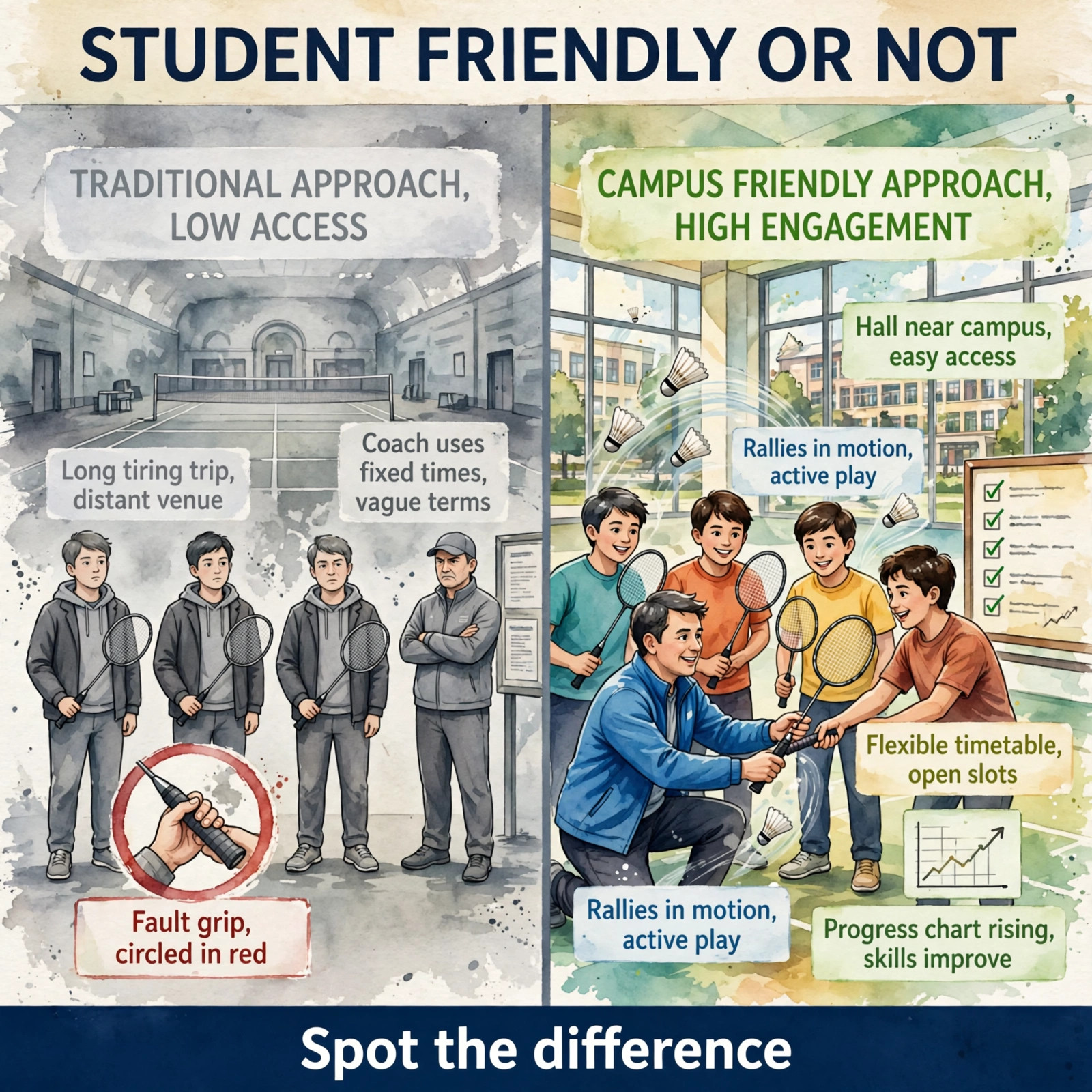
What Good Student Coaching Looks Like at ST Badminton Academy
Good student coaching is easy to recognise once you know what to look for. These are the standards we hold ourselves to in every session at ST Badminton Academy in Setapak.
| Factor | Student-Unfriendly | Student-Friendly STBA |
|---|---|---|
| Location | A long trip across town, in evening traffic. | Near campus, or near a train line you already use. |
| Schedule | Fixed times that clash with lectures and exams. | Evenings, weekends, and lighter weeks around exams. |
| Terms | Vague terms, pressure to sign a long term unseen. | Clear terms in writing before you commit, assess first. |
| Group Size | Big groups. The coach barely knows your name. | Max 4 students. The coach knows every student. |
| Learning | One pace for all. Fall behind and you are left out. | Grip first, footwork second, clear third, at your pace. |
| Community | No community. Players leave as soon as the session ends. | A regular group, friends on court, and a reason to return. |
| Coach Role | Whoever is free that day. No clear qualification. | Licensed head coach Eric Chuar teaches the groups himself. |
Find Your Game, Then Commit With Confidence
Before you commit, run three last checks. Check 7: does the location and schedule fit your lectures, assignments, and exams without long travel or late nights? Check 8: can the coach explain things in plain words, without jargon or pressure? Check 9: are the terms clear in writing, with no pressure to sign a long term before you have seen a single session? If a coach passes all the checks in this guide, you have found a group worth joining. ST Badminton Academy in Setapak welcomes university students who want to see good coaching before they commit.