Badminton And Injury Recovery: Rehabilitation And Returning To Play (Return Guide)
An injury is the part of badminton nobody chooses: the twist in a lunge, the pull in a calf, the ache that refuses to settle after the weekend. What happens next often matters more than the injury itself. This guide explains the general principles of returning to play well: get checked by a doctor or physiotherapist, follow the plan they give you, and build back in steps, fitness first, then drills, then games. It is general information only, not medical advice, and it cannot tell you how long your own recovery will take, because nobody who has not examined you honestly can. At ST Badminton Academy in Setapak, Kuala Lumpur, we coach returning players patiently, inside the limits their clinicians set.

Return Check #1
Step One: Get Checked Before You Guess
Similar pains can come from very different problems. A sore calf might be a simple strain, a problem in a tendon, or something in the bone that no amount of stretching will fix. Guessing from videos and forums means guessing at the one thing you cannot afford to guess. A doctor or physiotherapist examines you properly: they ask how it happened, test the area, sometimes arrange imaging, and give you the map for what comes next: what the problem is, what to avoid, and what to build first. That map is worth more than a month of hopeful rest and random exercises copied from the internet.
Help your clinician help you. Before the visit, write down when it happened, which movement hurts, what has changed since, and what you have already tried. Honest details make better plans, and players reliably forget half the story once they are sitting in the clinic. Bring your questions too: what must I stop, what is safe to keep doing, and when do you want to see me again? Try to leave with a plan rather than a bare instruction to rest. If the next step is unclear, ask what the first step back looks like and what signs should bring you back sooner.

Return Check #2
Follow the Plan Your Clinician Gives You
Once you have a plan, follow the plan. The exercises a physiotherapist gives you are chosen for your injury and your stage of recovery. They can look surprisingly easy, and they are still the work: little and often usually beats one heroic effort at the weekend. Do them as prescribed, on the days prescribed, and keep a simple note of how each one felt. If an exercise hurts in a new way, write it down and ask at the next check before you quietly drop it or double it. Your clinician can only adjust a plan they hear the truth about.
Do not freelance. The internet is full of rehabilitation routines built for other people’s injuries, other stages and other bodies, and adding them can reload exactly the tissue your plan is protecting. The same goes for the well meaning teammate whose own injury healed by playing through it; their story is not your diagnosis. Recovery is one of the few places in sport where obedience beats creativity. If you find something that looks helpful, ask your clinician first. A two minute question is cheaper than a setback that costs you another month.
Rest has a place in almost every plan, usually early, but rest alone is rarely the whole plan. Most returns involve loading the area again gradually, under guidance, so strength, balance and confidence come back with the healing. Sleep and ordinary meals support that process better than any supplement shelf. Ask your clinician what general exercise is safe for you in the meantime: walking, cycling, work for the uninjured side. Keeping the rest of you moving, within the limits you are given, makes the eventual return smaller and far less frightening.

Return Check #3
The Graded Return: Fitness, Drills, Then Games
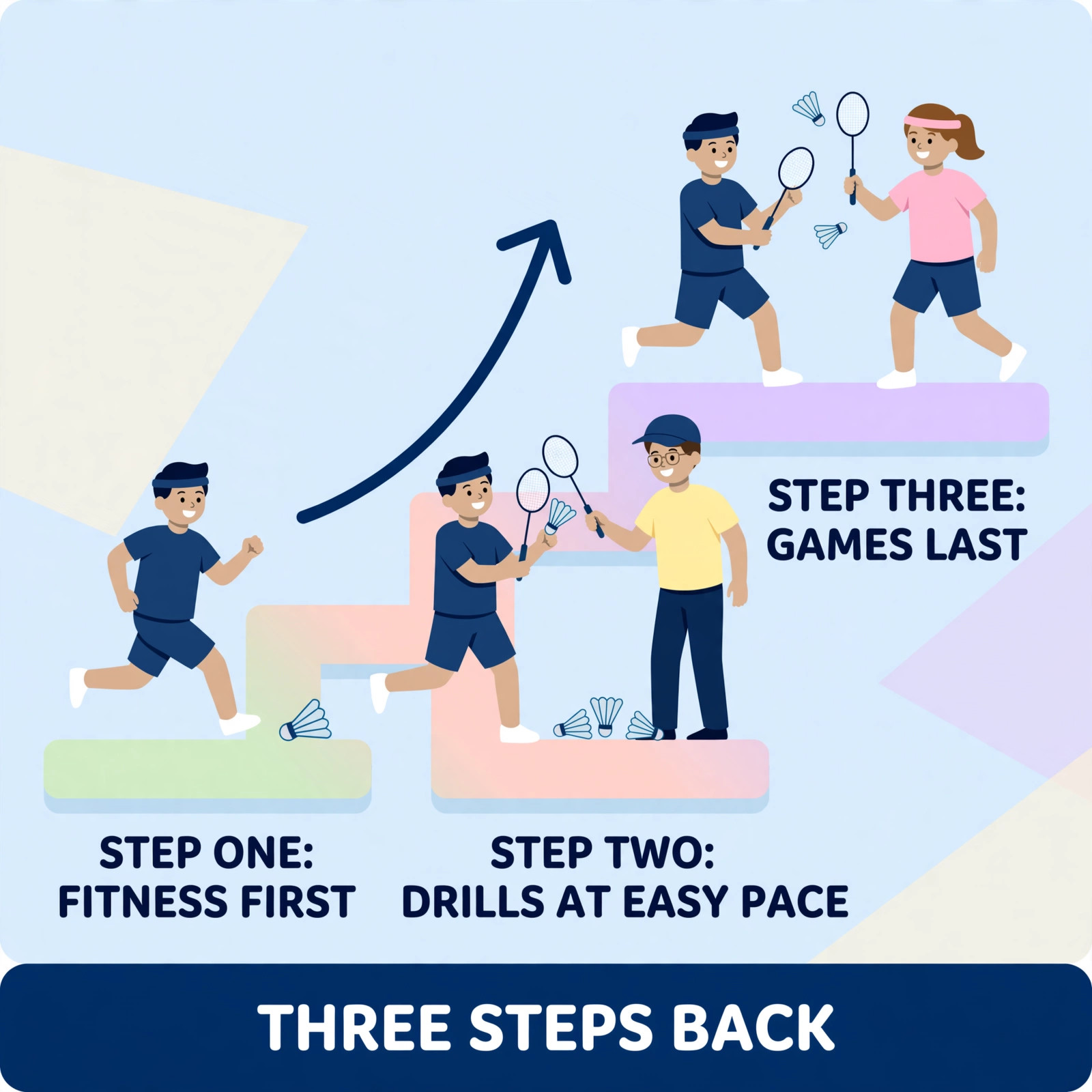
Think of the return as a staircase, not a door. Step one is general fitness that does not stress the injury, done only as your clinician allows, alongside your prescribed exercises. Step two is badminton without games: shadow footwork at an easy pace, controlled feeding drills, shots you can reach without stretching. Step three is games, starting shorter and gentler than your old level. Each step has to be earned by the one before it. Players who try to walk through the door, straight from the sofa into a full match, are the ones their physios see twice.
How do you know a step is passed? Use honest markers. The session itself felt controlled. Any discomfort stayed within the level your clinician told you to expect for your case. And the next day did not flare up beyond what they described as a normal response. If a step goes badly, drop back one step, note what happened, and tell your clinician at the next check. Dropping back is not failure; it is information, and it is exactly how a graded return is supposed to work. The staircase does not mind being climbed slowly. It minds being jumped.
There is a reason games come last: games lie to you. In a drill, you and your coach control the speed, the shots and the stopping point. In a game, instinct takes over: the deep lunge you swore to avoid, the desperate dive, the extra smash at full stretch, all before your brain gets a vote. So when games do return, choose them like you chose the steps: shorter than usual, gentler than usual, and with partners who know you are coming back and will keep the pace kind. Save your pride for later in the season.
Return Check #4
Patience, Honesty and the Pain Signal
Patience is the skill this whole guide is really about. A return feels slow because you compare today with your best day before the injury. Compare instead with last week: a new exercise allowed, a session ten minutes longer, a drill at a slightly higher pace. Those small permissions are the real scoreboard. Players who rush usually make the same return twice: once too early, which fails, and once properly, which finishes later than the patient player’s single return. Slow is not the opposite of fast here. Slow is how fast actually happens.
Pain during a graded return needs a clear rule, and your clinician sets yours. Some discomfort can be part of the process for some injuries, and they will tell you what level is acceptable in your case. Other pain is a stop signal: sharp pain, pain that changes the way you move, new swelling, or discomfort that keeps building across several days. When that signal appears, ease off and report it promptly. Pain is information, not a character test. Hiding it from your coach or clinician to look brave is how small setbacks turn into long ones.
Be honest about the mental side too, because it is real. Many returning players fear the exact movement that hurt them, or feel pressure from a team, a league or a tournament date circled on the calendar. Say it out loud, to your coach and your clinician. A plan can be adjusted around a fear that is spoken; a hidden fear tends to leak out as awkward movement, which loads everything except the spot you are protecting and can create a second injury next door to the first. Steady communication is not softness. It is part of the treatment.

Return Check #5
How a Return Fits Back Into the Training Week
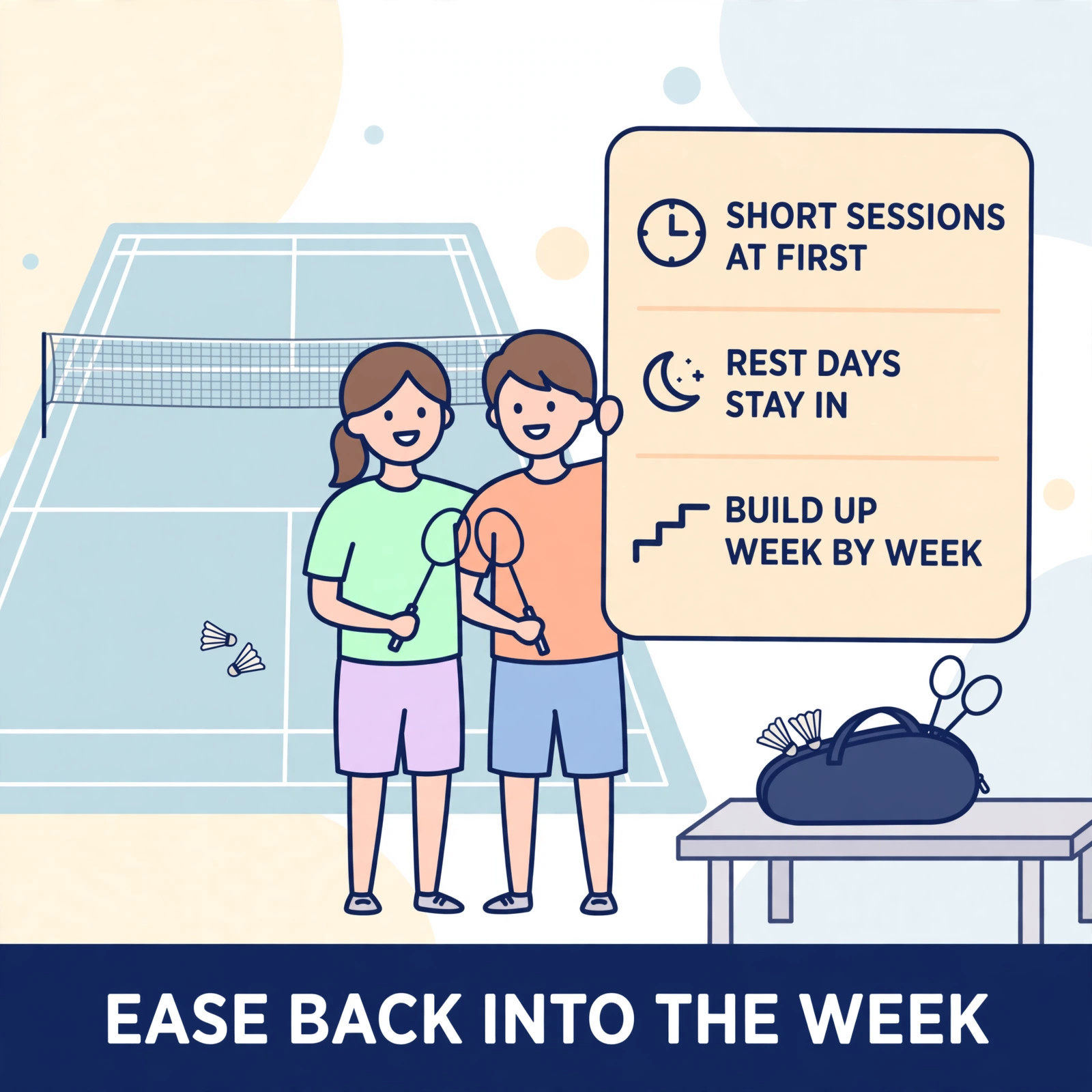
A return week has a shape you can write down. Short court sessions on set days, your prescribed exercises on their days, and real rest days kept in the week rather than spent. Early on, twenty easy minutes can be a complete session, and that is fine. Other training fills the gaps only within the limits your clinician set. Write the week in a diary and tick it off as you go. A written plan is far easier to follow on a tired Friday evening than a plan that lives in your mood.
Tell your group you are returning, and tell them your limits. A good coach programmes your drills at the pace your step allows and keeps you out of the games you are not ready for, even when you ask nicely, especially when you ask nicely. At our academy, returning players train inside the small group with their own progressions: your sets are yours, your stopping points are yours, and patience never means standing in a corner watching. The group gets a teammate who models how a comeback is done properly, which is worth more than it sounds.
The work is not finished the day you play your first full game. Keep the habits the injury taught you for as long as your clinician advises: a proper warm up, the strength and control exercises from your plan, gradual loading when training increases, and early reporting of new aches. Many second injuries happen in the first months back, when general fitness returns faster than the injured area’s capacity. Stay a student of your own body a while longer. The goal was never just to return; it is to stay returned.
Myth vs Reality
Myths About Injury Recovery
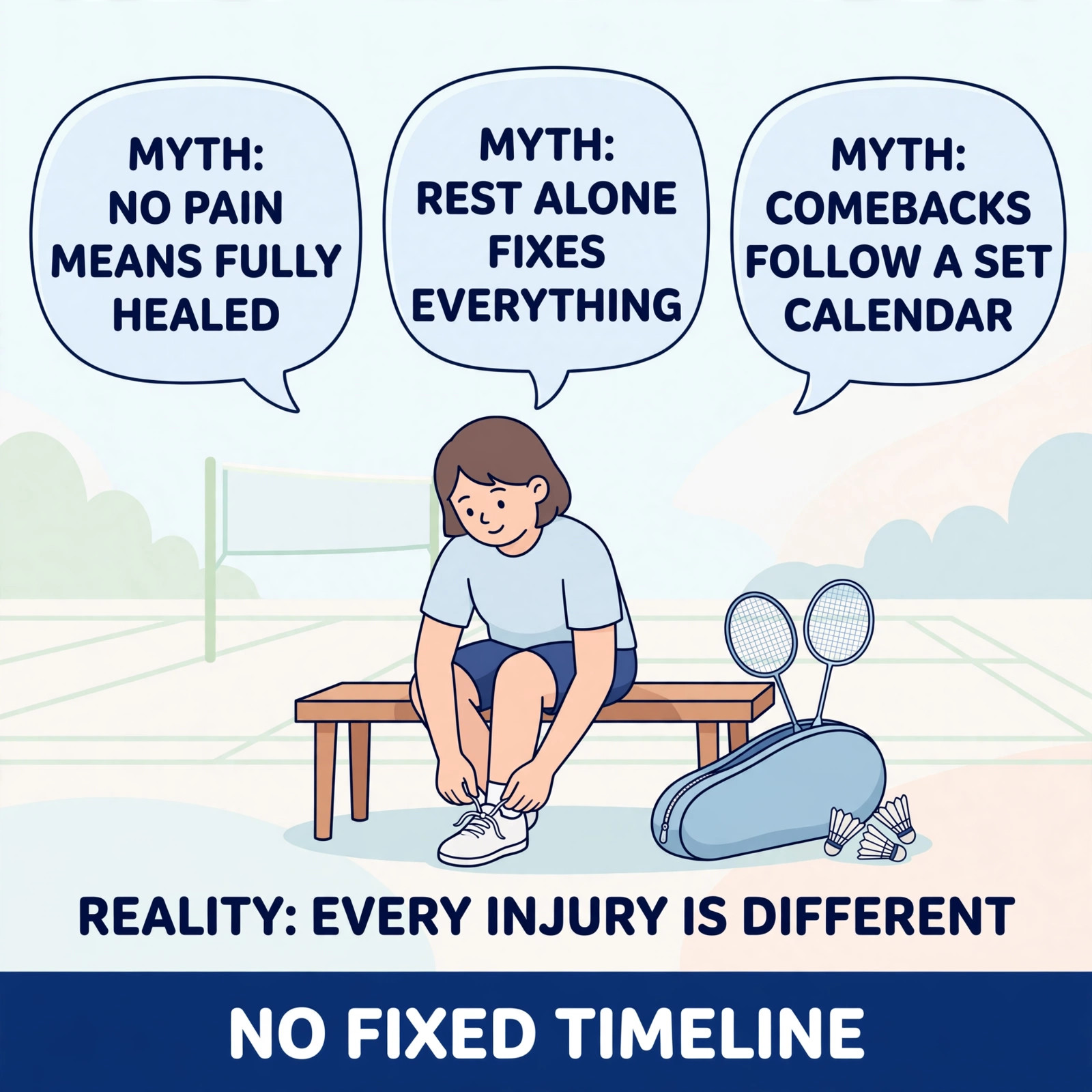
Myth one: no pain means fully healed. Pain can settle before the tissue is ready for full sporting load, and the gap between those two finish lines is exactly where re-injuries live. One pain free morning tells you the area is calm; it does not tell you it can survive a tournament. Your clinician’s checks and your graded steps, passed one by one, tell you far more than the absence of pain on a quiet day at home.
Myth two: rest alone fixes everything. Rest calms an injury down; it does not rebuild the strength, balance and confidence the area lost while you were away. Most returns need guided loading after the calm phase, which is why clinicians prescribe exercises instead of only prescribing the sofa. Doing nothing for months usually means coming back weaker, with the same vulnerable spot waiting for its second chance. The plan exists because healing and rebuilding are two different jobs.
The reality is that every injury is different: different tissue, different severity, a different player carrying it. That is why this guide offers principles and steps, never a calendar. The players who return best are not the fastest or the toughest; they are the ones who got checked, followed the plan they were given, climbed the steps in order, and told the truth about pain along the way. Boring, patient, effective. That is a comeback.
Why Choose Us
Why Players Choose ST Badminton Academy
Returning players are coached at ST Badminton Academy in groups with a maximum of four students, which lets the coach set your pace individually inside the session. Your drills run at the step you have reached, your rest is planned rather than apologised for, and nobody pressures you to match the group. When you are cleared for more, the progression is already written into your sessions. Small groups turn patience from a slogan into a programme.
We work inside your clinician’s limits, and we are clear about that boundary. Bring us the plan your doctor or physiotherapist gave you and we build training around it. When something sits beyond coaching, a new pain, a strange swelling, a setback you cannot explain, we send you back to them rather than guessing. Coaching and medicine have different jobs in a comeback, and a good return needs both, each doing its own.
Our base is Setapak in Kuala Lumpur, and our players come from across the city, including Wangsa Maju and Gombak. Sessions run for kids, teens and adults, and returning players are welcome at every level, whether your injury interrupted a school season or a weekly social game. Whichever group you join, the standard is the same: your steps, your pace, and honest coaching about what you are ready for.
FAQs: Returning to Badminton After Injury in Malaysia (KL)
These are the questions returning players ask us most. The short version runs through all of them: get checked, follow your clinician’s plan, climb the steps in order, and report pain early. Nothing in these answers replaces your own doctor or physiotherapist, who has actually examined you. Think of this page as a map of the process, not a prescription.
Where can I find patient coaching after an injury if I live in Setapak or Gombak?
At ST Badminton Academy in Setapak. Bring the plan your doctor or physiotherapist gave you, and we programme your sessions around it: fitness work and drills at the step you have reached, no games until your plan allows them. Players from Gombak return with us too. Your clinician leads the recovery; we coach inside their limits.
How does a graded return to badminton usually work in KL?
In steps. First, general fitness that does not stress the injury, plus the exercises your clinician prescribed. Next, badminton drills at an easy pace, where you control the speed. Games come last, shorter and gentler than your old level. You move up when a step feels controlled and the next day stays settled.
What should a returning player avoid once they are back at social level?
Avoid full pace games, deep lunges, diving saves and chasing shots you would normally let go. Choose partners who know you are returning and will keep the pace kind, keep sessions shorter than usual, and stop when your clinician’s signals say stop. Social games feel friendly, but instinct still makes players lunge like it is a final.
How long does recovery take, and can anyone tell me an exact number of weeks?
Nobody can give you an exact number, and you should be careful with anyone who does. Recovery depends on the tissue injured, how bad it is, your health and how well the plan is followed. The clinician who examined you can give the closest estimate, and even they will judge it by your progress, not the calendar.
Should I follow rehabilitation exercises I find online, or the plan from my physio?
Follow your physio. Their exercises were chosen for your injury, your stage and your body, after an actual examination. Online routines were made for somebody else’s injury, and the wrong one can reload exactly the tissue that needs protection. If you find something that looks useful, ask your physio before adding it, not after.
Do you coach returning players patiently near Wangsa Maju?
Yes. Returning players train at our Setapak base, a short drive from Wangsa Maju, with their own pace inside the small group. Your drills follow the step you have reached, and we will hold you out of games you are not ready for, even when you ask. Patience is programmed here, not left to willpower.
Does your academy help injured players return step by step in Malaysia?
Yes. We help players return step by step: fitness work first, then controlled drills, then games, always inside the limits set by their own doctor or physiotherapist. Bring us your plan and we build sessions around it. If something sits beyond coaching, we say so plainly and send you back to your clinician.
Where does ST Badminton Academy coach badminton in Setapak?
We coach at our base in Setapak, Kuala Lumpur, in small groups of no more than four students, so a returning player’s pace can be set and watched individually. Sessions run for children, teenagers and adults across the week. Setapak is easy to reach from Wangsa Maju, Gombak and the centre, and trials can be arranged through our WhatsApp line.
What makes Mr Eric Chuar a suitable coach for returning players in badminton?
Mr Eric Chuar has coached badminton in Malaysia for more than fifteen years and has guided many players back after injuries. He programmes sessions around medical limits, keeps returning players out of games they are not ready for, and refers back to doctors and physiotherapists the moment a problem sits beyond coaching.
Badminton Injury Recovery in Action



One Standard for Every Player and Every Session
Our standard for return to play coaching is honesty about roles: clinicians diagnose and prescribe, coaches programme and watch, and players report the truth about pain. We write your steps down, review them with you each week, and change the plan when your body gives us new information. Nobody here will rush you to impress anyone, including yourself.
| Factor | Rushing Back | A Graded Return RETURN |
|---|---|---|
| Frequency | 1 or 2 times a week. Mostly for fun and sweat. | Fitness first, then drills, then games, each step earning the next. |
| Drills Focus | Basic static feeding. Minimal footwork pressure. | The clinician plan followed as written, questions taken back to them. |
| Physical Conditioning | Rarely included. Just playing games on court. | Core, agility, and speed training included in every session to prevent injury and build stamina. |
| Tactical Awareness | "Just hit it over." No real game plan. | Video analysis, point construction, and learning to read the opponent's game. |
| Coach Ratio | Large groups (8-10 kids). Coach barely watches you. | Max 4 students. Mr Eric Chuar personally corrects every stroke and movement detail. |
| Goal Setting | Fun and exercise. | Pain noted and reported early, never hidden to seem brave. |
| Long Term Result | Good recreational player. | A player back for the long run, not just for one brave weekend. |
Badminton Return to Play Coaching in Kuala Lumpur
An injury interrupts your season; handled well, it does not have to end it. Get checked, follow the plan you are given, climb the steps in order, and let patience do its quiet work. When you are ready for the court again, come and train with us in Setapak. We will meet you at whichever step you have reached, and walk the rest of the staircase with you.


