What Are The Best Drills For Improving Defensive Skills In Badminton Training (Defensive Skills Guide)
Every player loves the smash. Nobody posters their wall with a block. Yet matches at every level are quietly decided by the player who keeps returning the shuttle one more time, in control, until the attacker runs out of ideas. Defence in badminton is not hanging on. It is a set of skills with its own stance, its own shots and its own drills: the ready position, the block, the drive and the lift, trained until they hold under real pace. This page works through those drills one by one, and shows how solid defence turns into the counter attacks that win rallies. Everything here is trainable with one feeder, a basket of shuttles and a notebook, which is good news for every club player reading along.
Defence Check #1
Defence First: The Skill Every Rally Visits
Defence comes early in training because it is the skill every rally visits. Attackers choose when to attack; defenders have no such choice, and an untested defence is found within the first three rallies of any match. Solid defence changes the whole shape of a game. Your opponent must hit closer to the lines, take bigger risks, and win every point twice. Meanwhile your own attacking game grows calmer, because a player who trusts her defence does not need to force winners from poor positions. She can wait, build the rally, and take the chance when it is actually there. Attackers feel this within minutes and start pressing, and pressing attackers make the errors defenders live on.
There is also a confidence case for training defence first. Nothing settles a nervous player like discovering that the scariest shot in the opponent’s game comes back. The first time a student blocks a full power smash softly to the net, something changes in the next rally: the stance stays low, the grip stays loose, and the feet stop retreating. Coaches see it every season. Defence is the foundation skill not because it is glamorous, but because every other part of the game is played on top of the belief that you can stay in the rally. That belief also changes practice itself: students with trusted defence attempt more in drills, because a miss no longer feels like the end of the rally.
Defence Check #2
The Ready Position: Low, Light And Split On Time
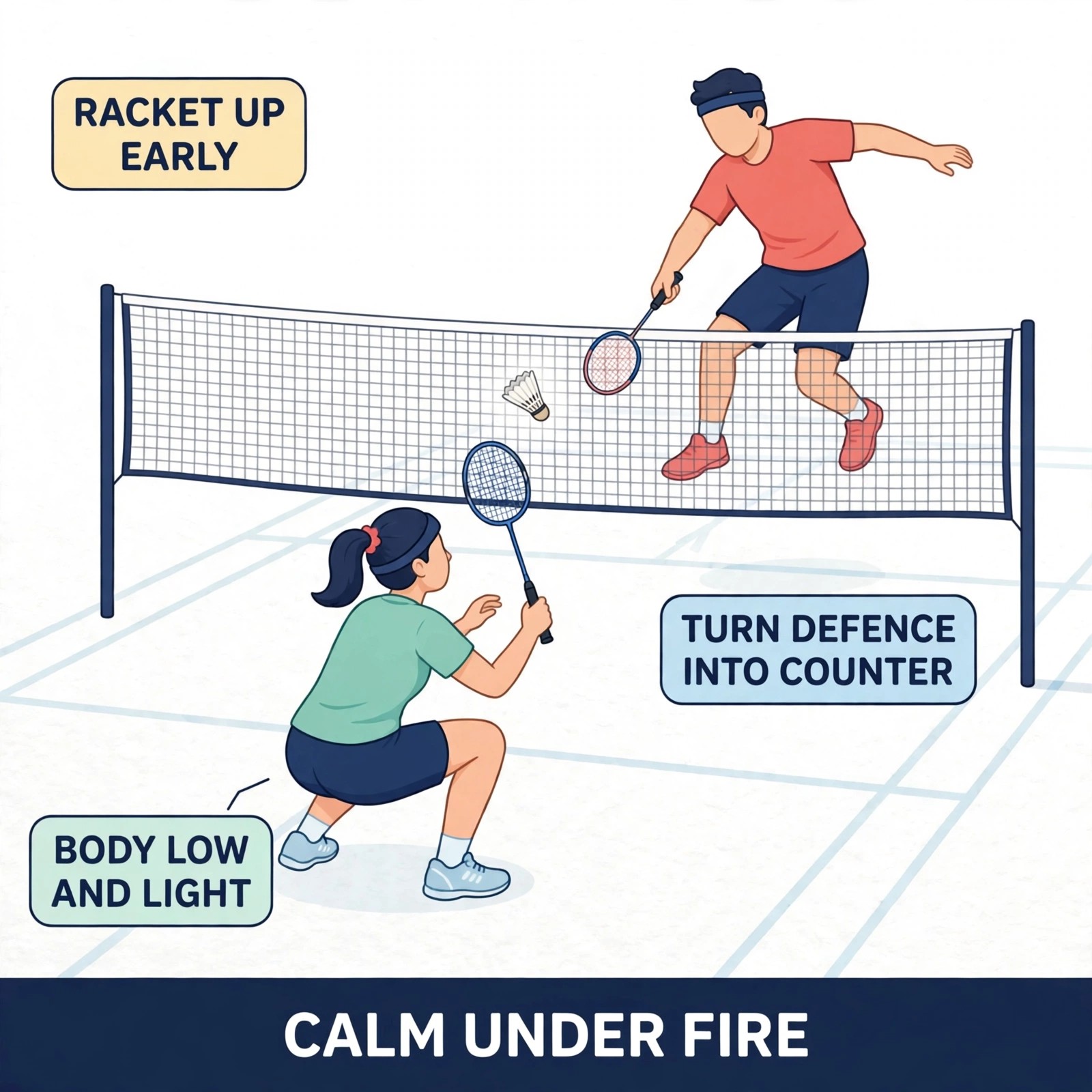
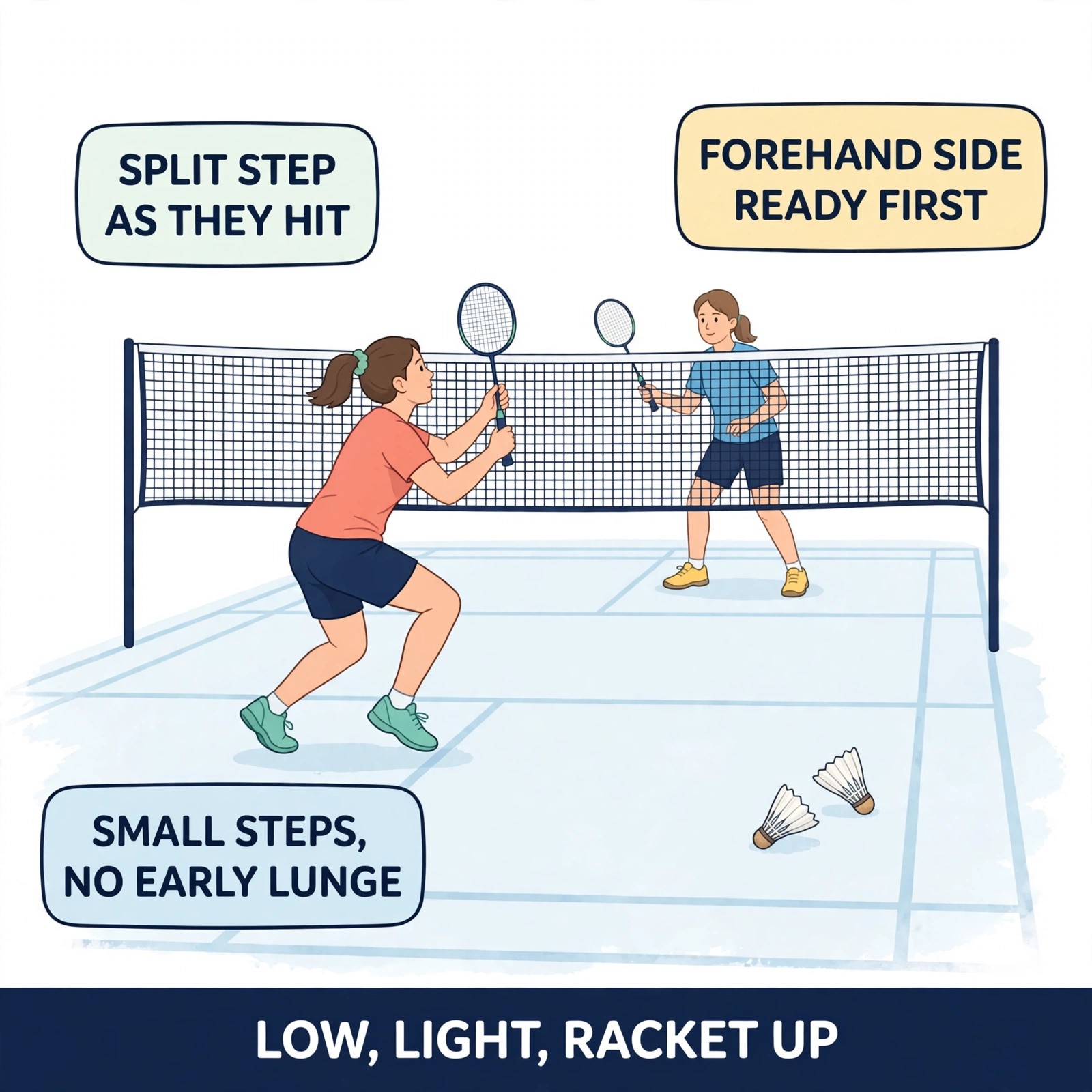
All defence starts from the ready position, and most defensive errors are stance errors that happened before the smash was hit. Stand a step behind the mid court line in singles, feet a little wider than the shoulders, knees soft, weight on the front of the feet. The racket sits up in front of the chest, head at about shoulder height, held with a relaxed grip that can turn either way. As the opponent strikes, make a small split step so you land ready to push off in the instant their contact tells you the direction. Face the shuttle, not the floor. Check the stance in a mirror or on video once: most players are standing far taller than they believe they are.
Two habits ruin the stance more than any others. The first is standing tall: straight knees and a high centre of gravity add a fatal half second to every lunge. Stay low enough that your first move is a push, not a dip. The second is holding the racket down by the hip, the resting pose of casual games. From there the racket must travel up before it can play anything, and against a real smash that delay is the rally. Train the stance in short bursts during every warm up: ten seconds low and ready, racket up, then rest. It should feel like a spring being wound. Build the bursts into shadow footwork too, so the stance and the first step grow together rather than as separate lessons.
Once the stance holds, the split step ties it together. Time the little hop so your feet land a fraction after the opponent’s contact, never before. Land too early and you are standing still again when the shuttle moves. Land too late and you are in the air while it passes you. The step itself is tiny, an inch off the floor, but it loads the legs in the right direction at the right moment. Defenders who split step well look oddly calm against fast attacks. They are not faster than everyone else. They are simply never caught standing flat. Practise the timing against slow feeds first, calling the split silently as the feeder strikes, before the pace makes it automatic or nothing.
Defence Check #3
Three Defensive Answers: Block, Drive And Lift
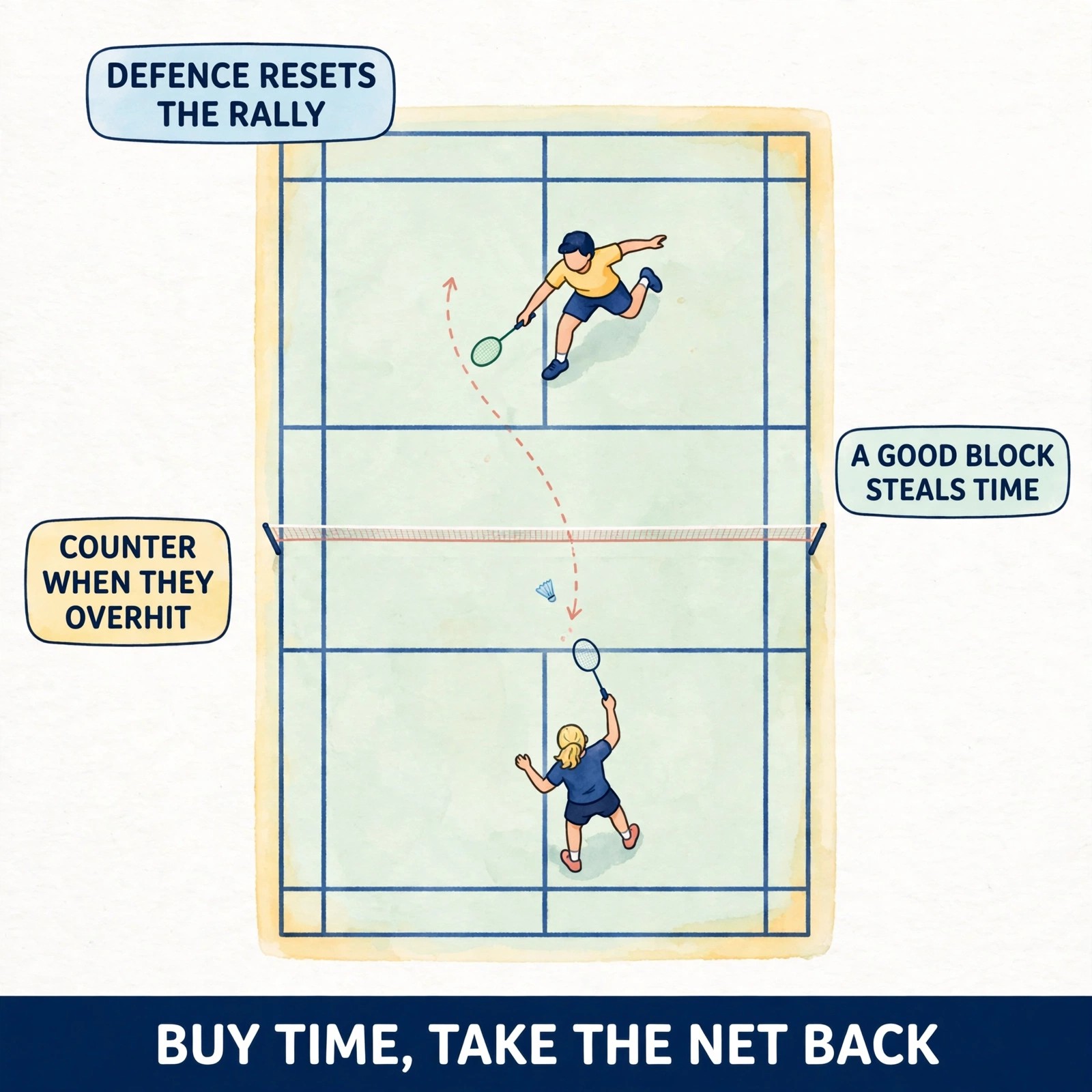
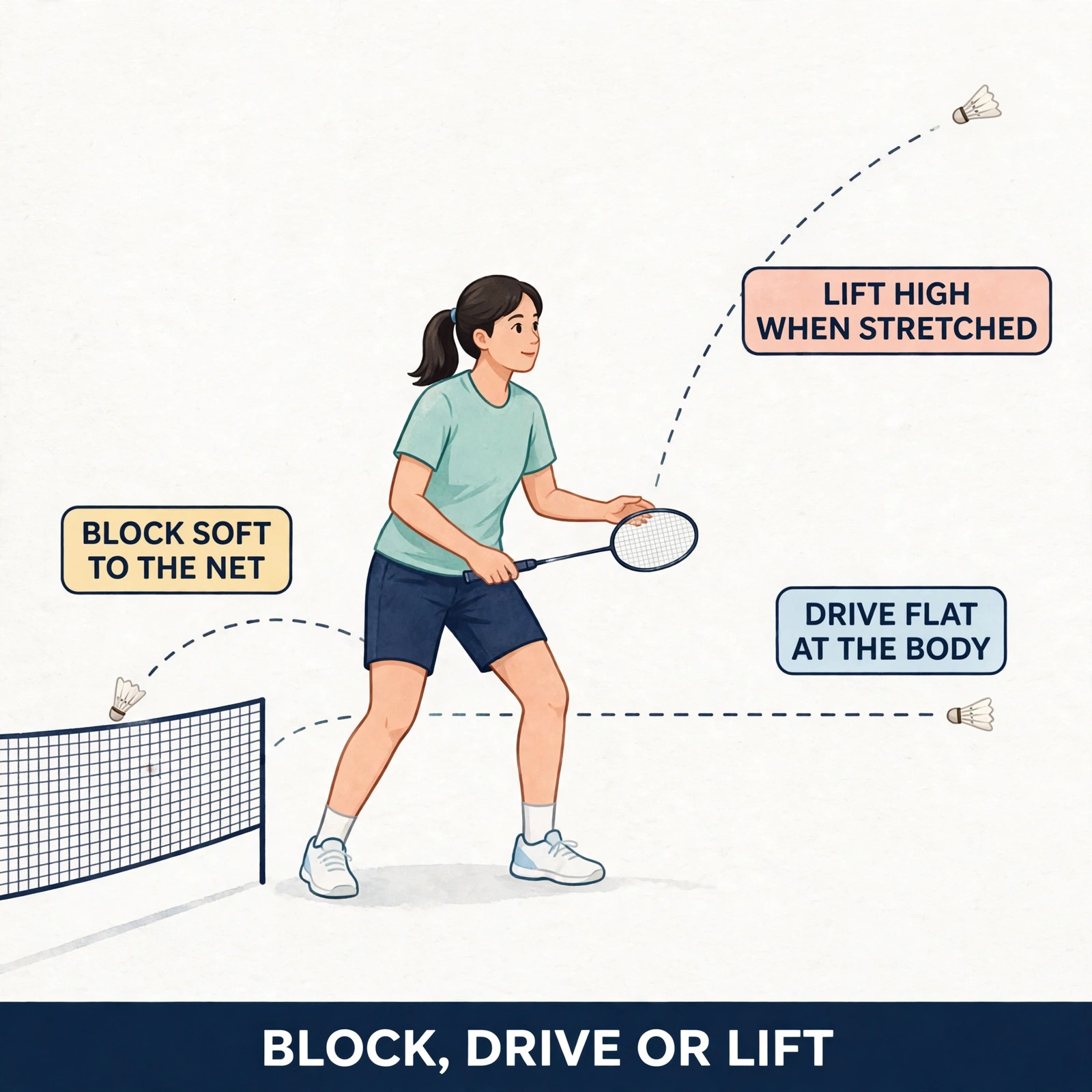
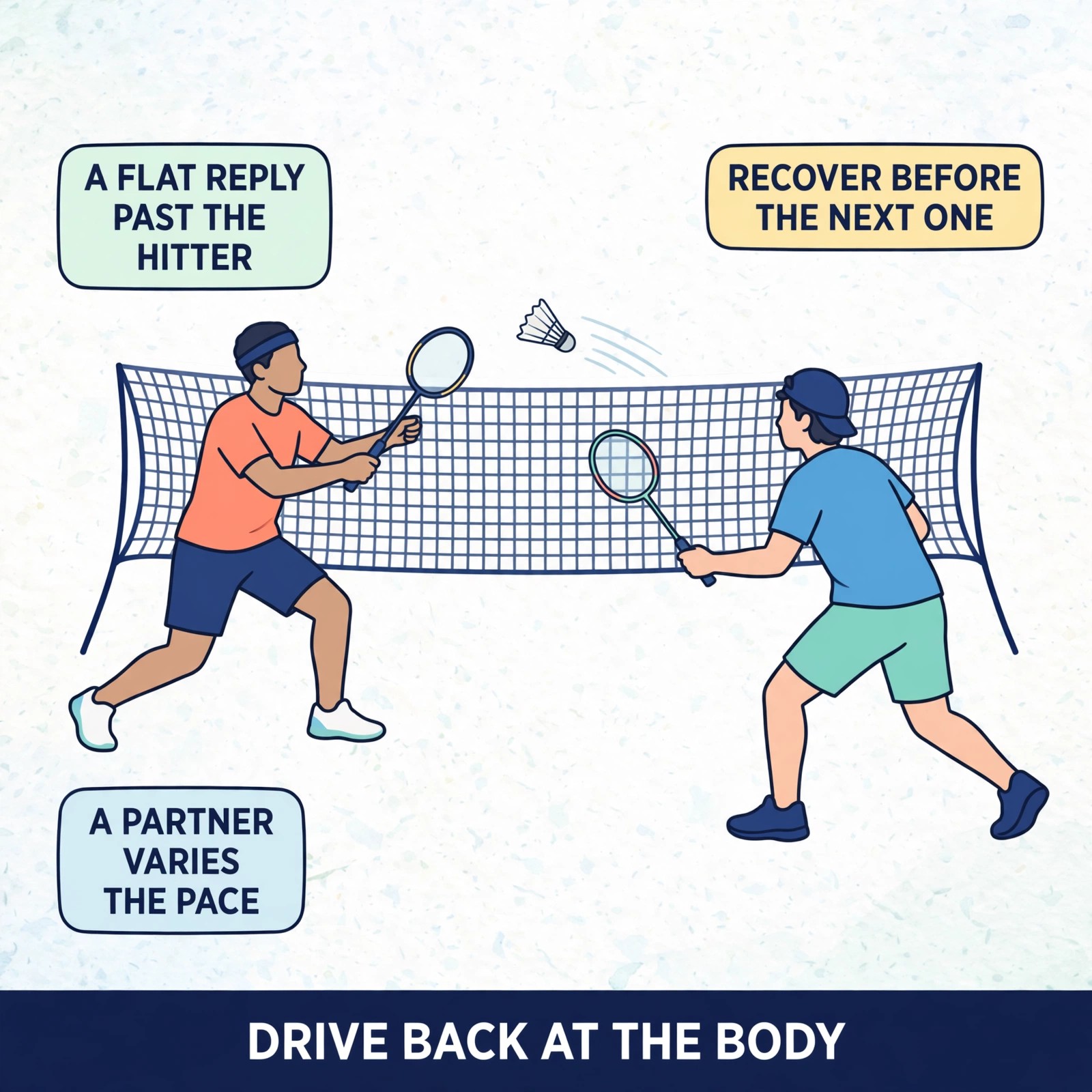
Defence has three main answers, and drills should teach them as a set. The block is the soft one: racket face still, shuttle met in front, rebounding low over the tape to drop at the net. It steals the attacker’s time and makes them run forward again. The drive is the flat one: a punchy reply at the body or past the racket shoulder, turning defence into pressure. The lift is the buying time one: high and deep to the back tramline when you are stretched, resetting the rally on your terms. Same stance, three replies, chosen by how early you reach the shuttle. Early contact earns the drive, on time contact earns the block, and late contact is lifted without apology.
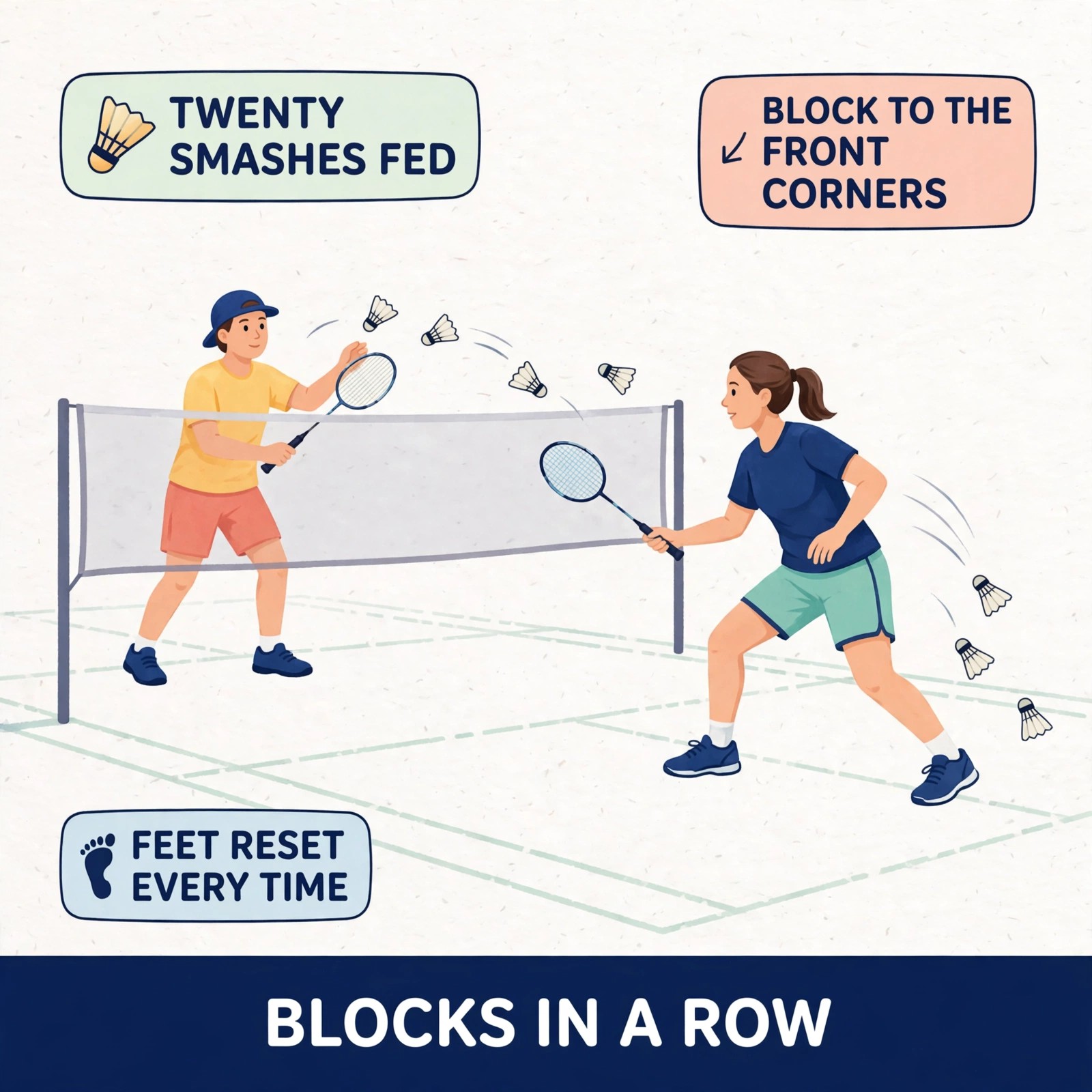
The block deserves the most practice because it asks for the least movement and the most touch. Keep the grip loose, present the racket face early, and let the shuttle’s own pace do the work. A block that is swung at pops up; a block that is simply held drops where you aim it. Aim across the front of the court: straight blocks make the smasher run the short diagonal, cross court blocks make them run the long one. Alternate the target in feeding so the hands learn both without the feet having to rescue a late decision. A good coaching cue is quiet hands: if the feeder can hear your grip squeeze, the block is about to pop up.
The drive and the lift complete the picture at the other two speeds. Drives are played with a short punch from in front of the body, forearm turning, no backswing to read. They answer smashes hit at the body and flat attacks in doubles style exchanges. Lifts are the honest shot of defence: when you are late, wide or off balance, send it high and deep and walk back into the rally. Players sometimes treat the lift as surrender. It is the opposite. A good lift refuses the point, and plenty of rallies turn on the smash that follows a lift the attacker thought was weak. Judge lifts by the tramline, not by pride: a lift a hand’s width short is a smash invitation with better manners.
Defence Check #4
Feeding Drills: Groove Defence Against The Smash
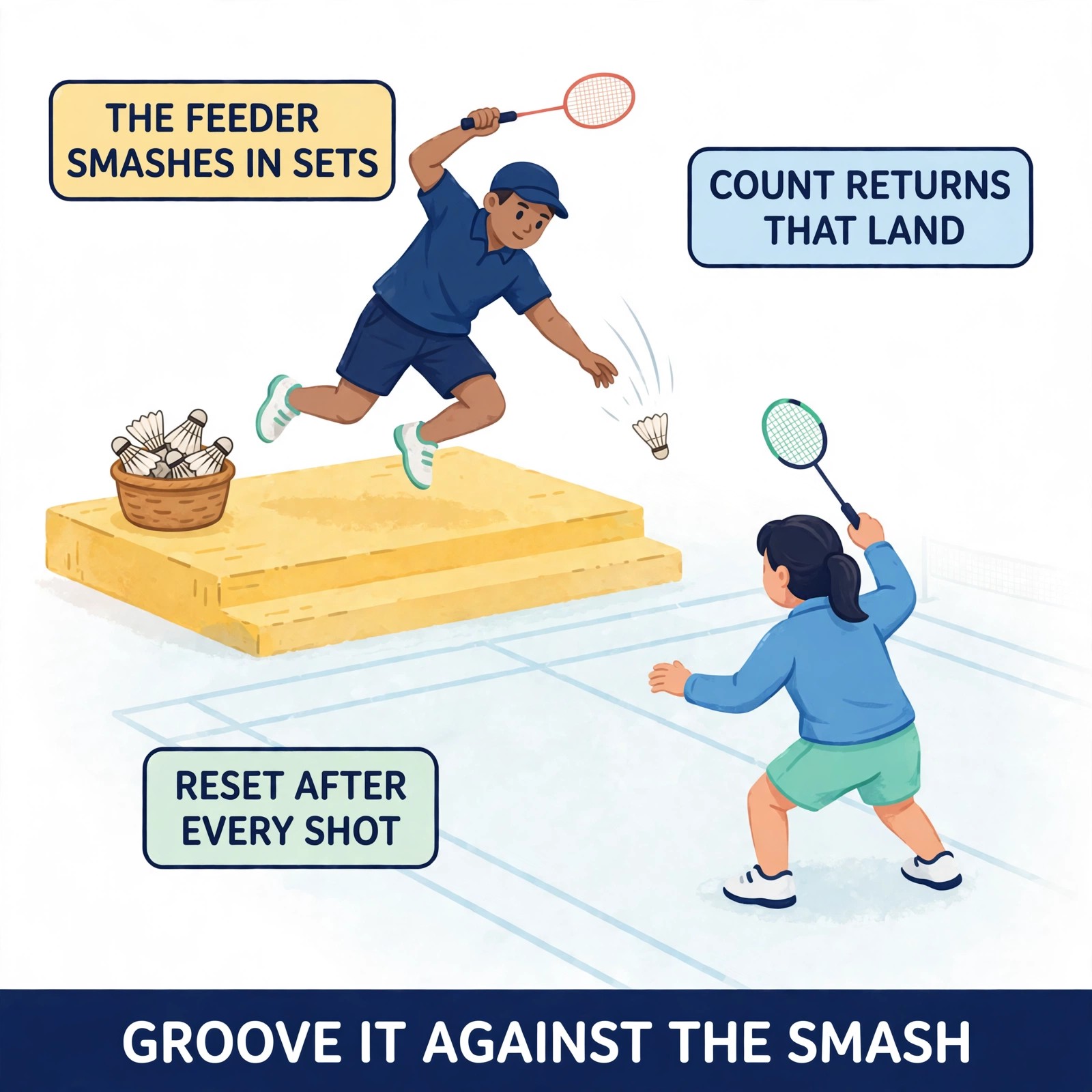
Feeding drills build defence at the speed matches actually happen. The classic set is simple: a feeder smashes in sets from the front or mid court while the defender works on one reply at a time. Twenty smashes, all blocked to the front corners. Twenty more, all driven. Then mixed, called by the feeder’s placement. Count returns that land in the court; that count, not survival, is the score of the set. Rest between sets long enough that the stance stays honest, because grooving a tired, upright defence teaches the wrong skill. Write the count on the log before the next set starts; memory edits bad sets kindly, and the page does not.
Feeding quality matters as much as defending quality. A feeder who smashes at half pace from the wrong place teaches a defence that collapses in real games. Feed from where smashes actually come from, at the fastest pace the defender can still answer with shape, and raise the pace as the counts improve. The defender’s job in the set is narrow: stance, split step, chosen reply, reset. Reset is the word to coach hardest. After every return the feet come back and the racket comes up, because the next smash in a match does not wait for you to admire the last one. Feeders can help by occasionally holding the next smash half a second longer, rewarding defenders who reset early instead of early movers.
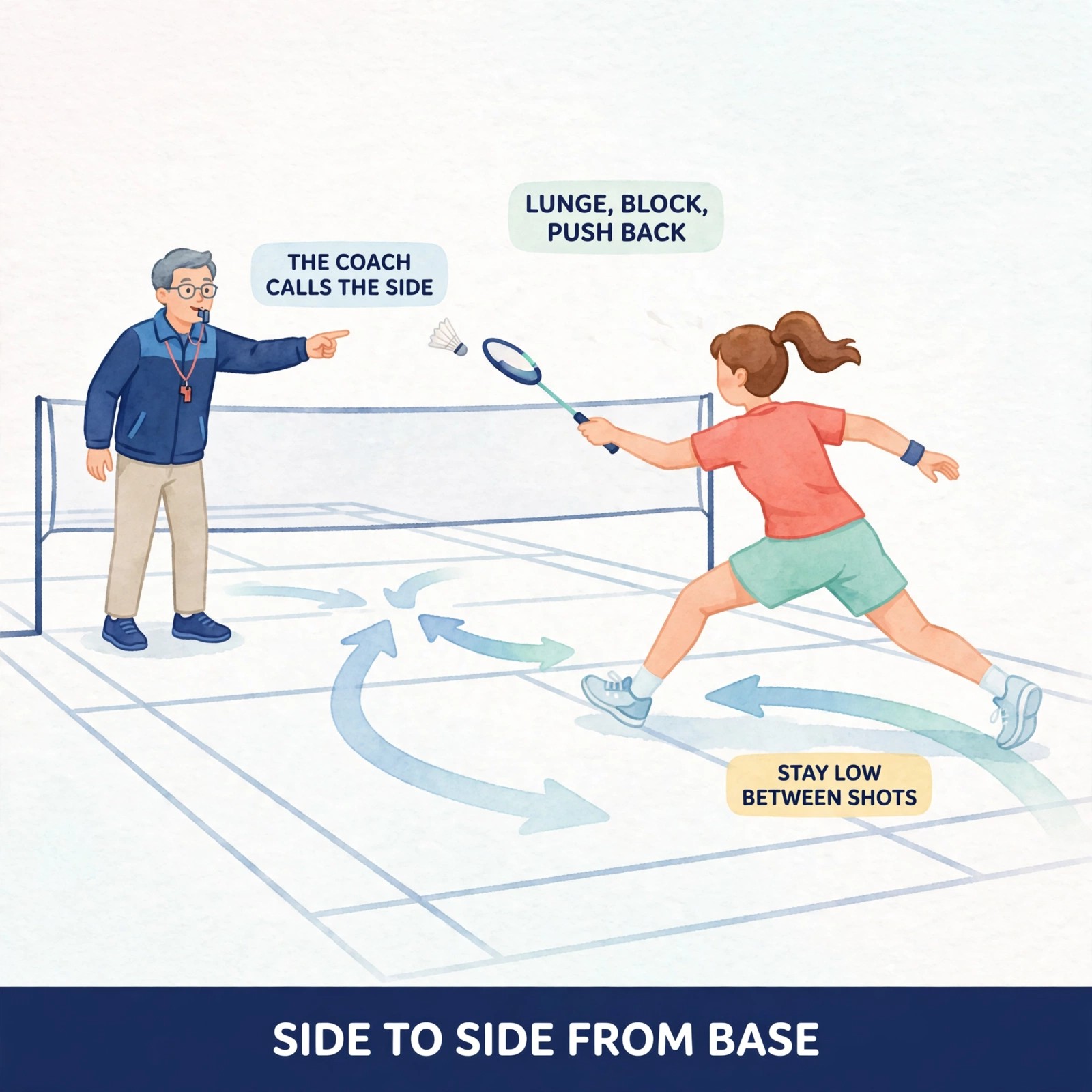
Side to side feeding adds the movement layer. The feeder varies the smash between the forehand side, the body and the backhand side, and the defender lunges, blocks and pushes back to base between every shot. Wide footwork arrows on the floor help at first: out fast, back under control, low the whole way. The set fails the moment the defender starts standing up between shots, so keep sets short, eight to twelve smashes, and let the log show the count rising over weeks. Defence fitness is specific: it is the fitness to stay low, again and again. Between sets, defenders should walk, breathe and shake the legs out rather than sit; the stance has to be rebuildable in seconds, as it is between rallies.
Defence Check #5
Defence Under Pressure: Same Stance, Late In Games
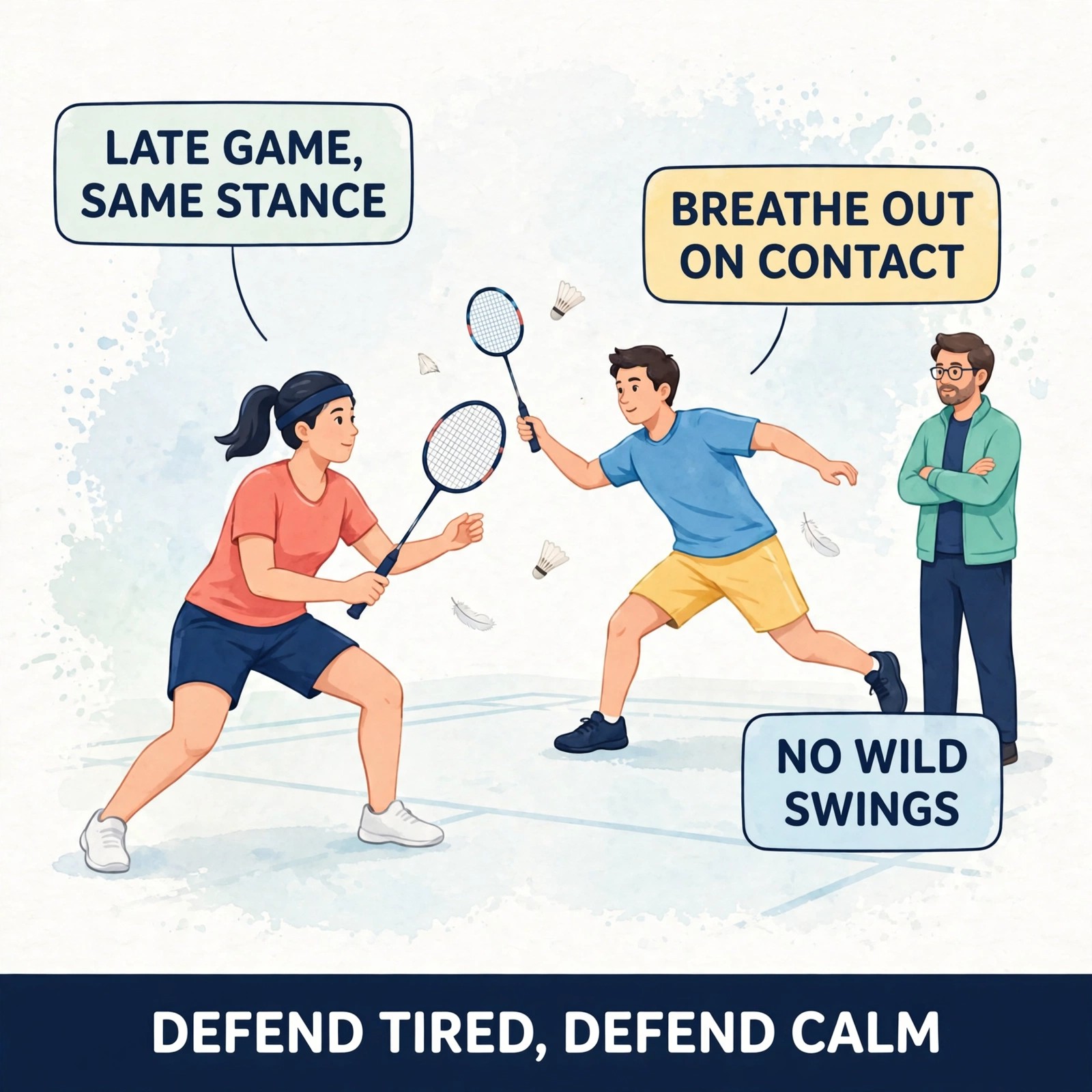
Defence faces its real exam late in games, when legs are heavy and the stance wants to rise. Pressure training recreates that exam in small doses. Defend at the end of hard conditioning sets, play games where you start three points down, or run feeder sets where the last five smashes come faster than the first fifteen. Breathe out on contact to keep the grip soft, and forbid yourself the wild swing: under pressure the reply menu shrinks to the block and the lift, the two shots that cannot hurt you. Calm is a trained response here, not a mood. Keep one honest measure per pressure set, usually blocks that stayed low out of the last ten smashes, and let that number carry the review.
Score pressure deserves its own drill because it changes the body in a specific way: the shoulders climb, the grip tightens, and blocks start popping up exactly when the match can least afford it. Play short games from 18 all where you may only score from rallies in which you defended at least one smash. The constraint forces the stance to stay honest at the tightest score. Review afterwards while the feeling is fresh: which returns floated, and what did the shoulders do. Players learn their own tells quickly once someone names them. Common ones are easy to spot from the bench: a rising heel, a racket dropping to the hip, a first step taken backwards.
Keep pressure sets short enough that technique survives them. The aim is a defence that looks identical in the first rally and the last: same low stance, same racket height, same soft hands. If the set runs so long that the defender is swinging from the floor, the drill has stopped teaching defence and started teaching panic. Three quality sets with honest rests beat one long collapse. Film a set each month if you can; stance creep is invisible from inside and obvious on screen, and it is the first thing tired defenders need to see. If filming is not possible, a training partner counting stance breaks aloud does the same job with less equipment.
Myth vs Reality
Myths About Defensive Skills
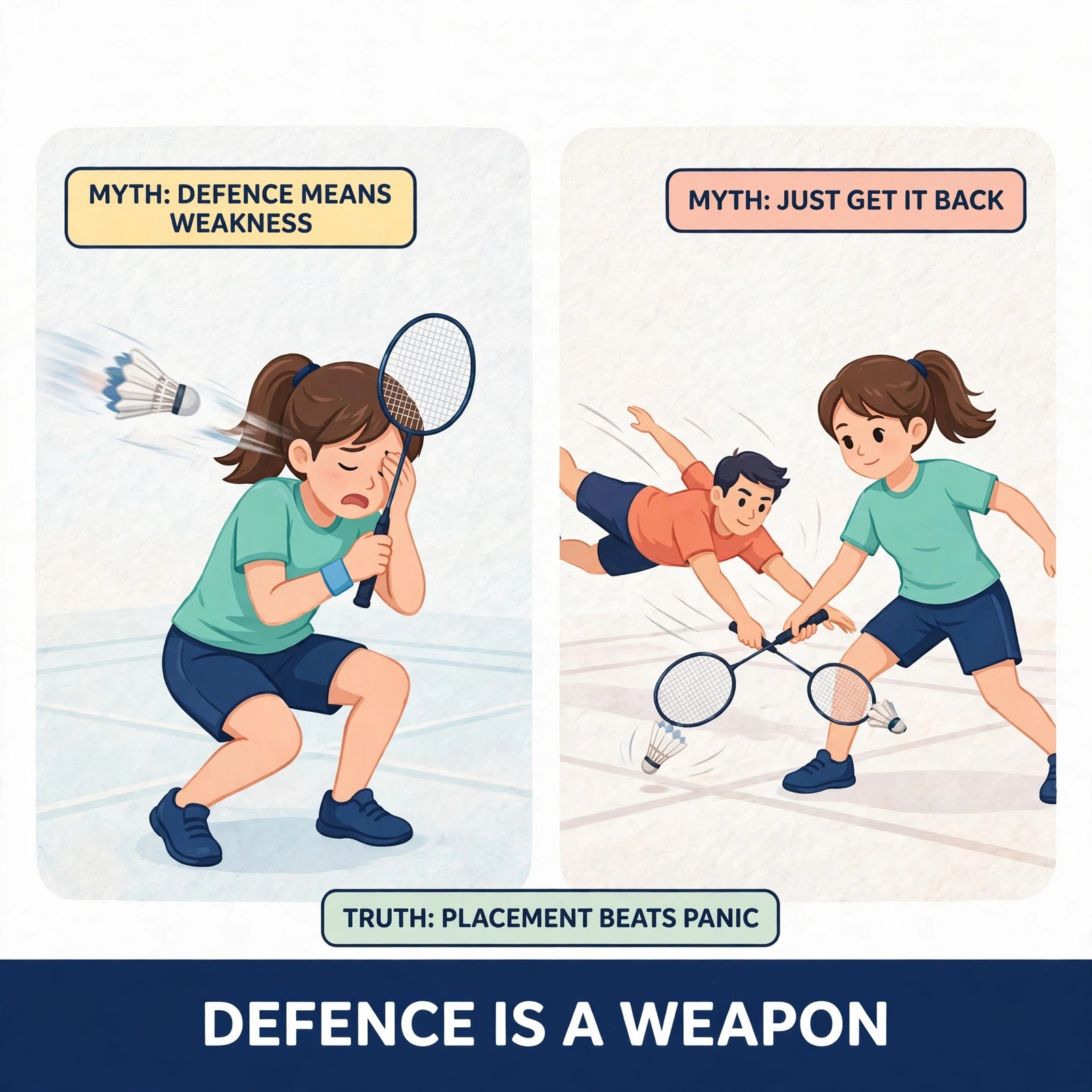
The first myth says defence is what weak players do while strong players attack. It survives because attacking highlights are louder. But watch the full rally, not the clip: the strong player’s winners are built on the opponent’s inability to finish against her defence. At every level, the toughest opponent is the one whose court feels smaller because everything comes back with interest. Defence is not the absence of attack. It is the tax every attacker must pay, and the players who collect it longest usually collect the match as well. Juniors especially should hear this early, before the highlight reels convince them rallies are won in one shot.
The second myth says defence just means getting the shuttle back somehow. A scrambling return that floats mid court is not defence; it is a delayed donation. Real defence is placement: the block that makes the smasher run forward, the drive that rushes their next shot, the lift that lands on the back line and turns their smash into your time. Getting it back is the floor of the skill, not the skill itself. The drills on this page count returns that land in chosen places for a reason. Placement is what separates a wall from a sieve. The difference shows in the opponent’s feet: against a sieve they stand still and swing; against a wall they are always arriving, stretching or turning.
The third myth says some players are simply too slow to defend well. Speed helps, but defence runs mostly on stance, split step timing and reading, all trainable at any age. A defender who starts low, splits on time and reads the smasher’s shoulder will reach smashes that a faster player standing tall will watch pass. What looks like slowness is usually lateness: late stance, late step, late racket. Fix the lateness and the speed argument mostly disappears. The genuinely fast players still win more rallies, but they win them with the same habits taught here. Adult returners take heart from this myth most of all: the defence of their younger years was mostly habits, and habits come back.
Why Choose Us
Why Players Choose ST Badminton Academy
At ST Badminton Academy, defensive training follows the order on this page: stance and split step first, the three replies as a set, feeding sets counted by returns that land, side to side work once the reset is automatic, and pressure games at the end. Groups are capped at four students, so the coach stands close enough to see grip tension and stance height on every return, and feeds at a pace matched to the student rather than the group average. Students log their returns landed each week, which turns a feeling of coping into a number that either grows or explains itself. Trial students usually leave their first session surprised that a defence can be measured at all, and that surprise is a good start.
Sessions run at our Kuala Lumpur halls and are built so beginners are not fed beyond their stance. A new student starts against moderate feeds, one reply at a time, with the reset called aloud by the coach until it becomes habit. Pace rises only when the count says the shape is holding. Adults returning to the game often find defence is where their old timing returns first, because the skills are compact: low, ready, soft hands, reset. That early success matters. A player who trusts her defence walks into rallies taller, in every sense except the stance. The same session plan scales for school players and league adults; only the feed pace and the set sizes change, never the order.
Parents ask how defensive progress shows up in junior matches. The signs are plain: rallies get longer, the child stops backing away from smashes, and the score stays close against stronger hitters who used to blow through. We track it with the feeding counts and with one question in the log: how many smashes did you face this week, and how many came back in court. When the second number grows toward the first, the match results usually follow a few weeks later. Defence is patient work, and the patience pays in public. Opponents notice before spectators do: the smashes get bigger, the margins get thinner, and the errors start arriving in pairs.
FAQs: Badminton Defensive Skills And Drills in Malaysia (KL)
Defensive questions usually start with a smash that felt impossible. Here are the answers we give on the bench.
Can a beginner learn defensive skills in training in Setapak or Gombak?
Yes, and defence is a kind place to start because the skills are compact. In our Setapak groups of no more than four, beginners learn the low ready stance, the split step and the soft block against kind feeds, and count returns that land from the very first month of training.
What is the first defensive habit a new player should build in KL?
Racket up, before anything else. Between every shot the racket returns to the front of the chest and the feet reset low. KL players who build that one habit stop being late to smashes that were never especially fast, because the delay was the low racket, not the legs or the eyes.
Why do smashes keep passing me at club level?
Usually the stance, not your speed. Standing tall, splitting late or holding the racket at the hip adds a half second to every lunge, and fast smashes live inside that half second. Check the three on video: low stance, split as they hit, racket up. Most players gain a step without getting faster.
My blocks keep popping up for easy kills. Should I grip tighter or change my stance?
Change the stance and loosen the grip; do not grip tighter. Popped up blocks come from a raised stance and a squeezed handle that turns the racket face into a trampoline. Stay low, present the face early, and let the shuttle’s pace rebound off a still racket. A coach can spot it in two feeds.
How can I set up defence drills with a partner in training?
One feeds smashes, one defends one named reply at a time: twenty blocks, swap, twenty drives, swap. Count returns that land in court, and reset fully between shots. In training with us the feeder works at the fastest pace the defender can still answer with shape, and the pace rises with the count.
Do you coach defensive skills near Wangsa Maju?
Yes. Our academy is based in Setapak, a short drive from Wangsa Maju, and defensive work is coached inside normal sessions there: stance and split step first, feeding sets counted by returns that land, pressure games at the end. Groups stay at no more than four students, so the coach sees every reset.
Where does ST Badminton Academy teach defensive skills in Malaysia?
We teach in Setapak, Kuala Lumpur, and defence is coached as a set of named skills rather than a scramble: ready position, block, drive and lift, each with its drill and its count. Students join us from across the Klang Valley, and their returns landed are logged and reviewed every week.
How do I book a trial session to test my defence?
Book a trial session with us in Setapak and bring your playing racket. Train in a group of no more than four, and the coach will check your stance, feed your first set of smashes at an honest pace, and count how many returns land. You will leave with one fix and a starting number.
What makes Mr Eric Chuar a suitable coach for defensive skills and badminton?
Mr Eric Chuar coaches the academy sessions himself, with more than 15 years of coaching in Malaysia and Singapore. He teaches stance before speed, counts returns that land instead of praising survival, and raises feed pace only when the shape holds, so the defence students build survives real matches, not just drills.
Badminton Defensive Skills Training in Action

We benchmark our defence coaching against World Badminton (BWF) coaching standards and our own academy values: before any player trusts a training plan, they deserve honest checks. You can verify our coaches' credentials through the Badminton Association of Malaysia (BAM) coach education pathway.
Our standards for defence coaching are plain. Stance before speed, placement before survival, and every feeding set counted by returns that land in court. The reset after each shot is trained as part of the shot itself, because matches are lost between returns as often as during them. We promise no overnight wall; solid defence is built from split steps and soft hands repeated at the right pace. When defence improves here, the student's log shows the count, and their partners feel it first. We would rather a student defend ten smashes in perfect shape than fifty in a crouch that collapses by the weekend.
| Factor | Scrambling | Defending DEFENCE |
|---|---|---|
| Frequency | 1 or 2 times a week. Mostly for fun and sweat. | Defence starts from a low ready stance with the racket up, not from a desperate lunge. |
| Drills Focus | Basic static feeding. Minimal footwork pressure. | Blocks, drives and lifts are placed on purpose, each answering a different kind of attack. |
| Physical Conditioning | Rarely included. Just playing games on court. | Core, agility, and speed training included in every session to prevent injury and build stamina. |
| Tactical Awareness | "Just hit it over." No real game plan. | Video analysis, point construction, and learning to read the opponent's game. |
| Coach Ratio | Large groups (8-10 kids). Coach barely watches you. | Max 4 students. Mr Eric Chuar personally corrects every stroke and movement detail. |
| Goal Setting | Fun and exercise. | Feeding sets are counted by returns that land, and the pace rises only when shape holds. |
| Long Term Result | Good recreational player. | A defending player: returns one more shuttle than expected, stays calm late in games, and turns defence into counter attack. |
Badminton Training With Defence Coaching in Kuala Lumpur
Come and give your defence a structure. Book a trial session in Kuala Lumpur, train in a group of no more than four, and leave with your stance checked, your block counted honestly against real feeds, and one fix chosen for your next month of practice. Bring your playing racket and your hardest hitting training partner in mind. We will feed the first set together, count the returns that land, and show you exactly where the work goes next.


