What Are The Best Drills For Developing Your Badminton Straight Drop Shot Technique (Straight Drop Shot Guide)
The straight drop shot is the most honest deception in badminton. From the rear court, you prepare exactly as if you are about to clear deep, and then, with the swing already committed, you take the pace off and let the shuttle fall just over the tape. Done well, your opponent is still braced for the clear when the shuttle is already dropping on the front court. Done badly, it floats, and floating drops are lifts that arrive gift wrapped. This page works through the drills that build a straight drop properly: the shared swing shape first, feeding sets that mix clear and drop from one start, target work with honest counting, disguise drills, and pressure sets where the shape has to hold while you are stretched and moving backwards.
Drop Check #1
The Straight Drop Shot: Soft Pace, Sharp Purpose
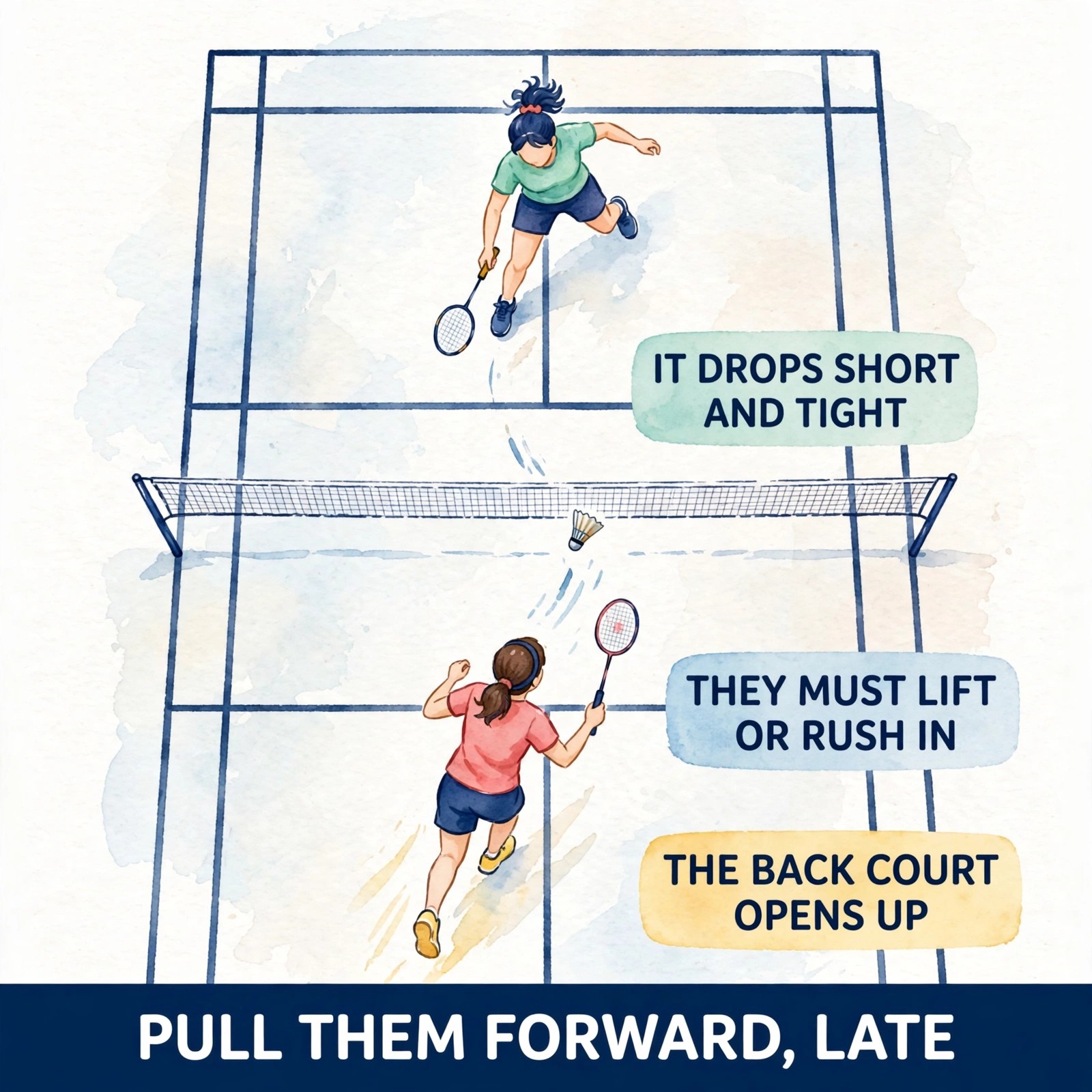
Start with what the drop does to a rally. The clear pushes your opponent to the back line; the drop exists to make that trip cost them. Once your clear is respected, the drop pulls the same opponent forward, late, because they must wait to see which shot is coming. That waiting is the weapon. A player who can only clear gets camped on; a player who can only drop gets rushed. A player with both, from one identical preparation, owns the rear court conversation: every back swing asks the opponent a question they can only answer after contact. The straight drop is the first of those questions to build, because down the line of the court it is the safest version to control.
Coaches judge a drop before the shuttle lands by watching the preparation. Good droppers look boring from behind: same turn, same reach, same swing speed as their clear until the final part of the action. Poor droppers announce themselves, slowing the whole arm early, dropping the elbow, or reaching less, and opponents read the announcement and step in. The landing then confirms the story: the shuttle should cross the tape low and fall inside the front service line area, tight enough that the reply is a lift or a rushed net shot, never a drive. The drills on this page are sequenced to protect the disguise while the touch grows: swing shape first, then mixed feeding, then targets, then pressure.
Drop Check #2
The Drop Shape: Same Swing As The Clear
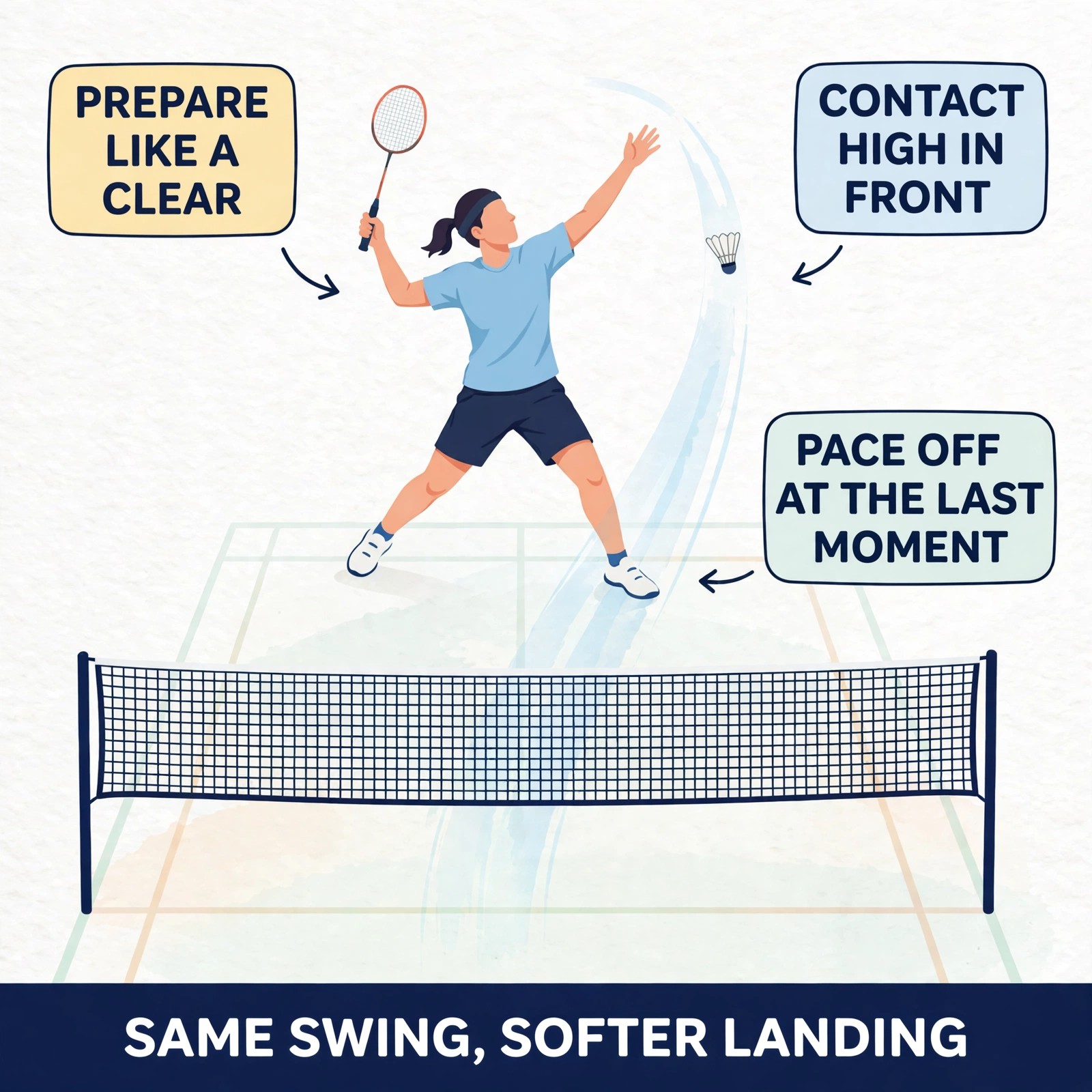
The shape begins behind the shuttle, side on, with the body turned and the racket up early. You meet the shuttle high and slightly in front, the same contact point as the clear, because a drop taken late or beside the head cannot disguise itself and usually cannot control itself either. The legs drive and the trunk turns exactly as they do for the clear. Nothing about the first two thirds of the shot tells the truth about what is coming. This is why drop training starts with clears in the same set: the body has to learn one shared start so well that the choice of finish can be left to the last moment without the shape wobbling.
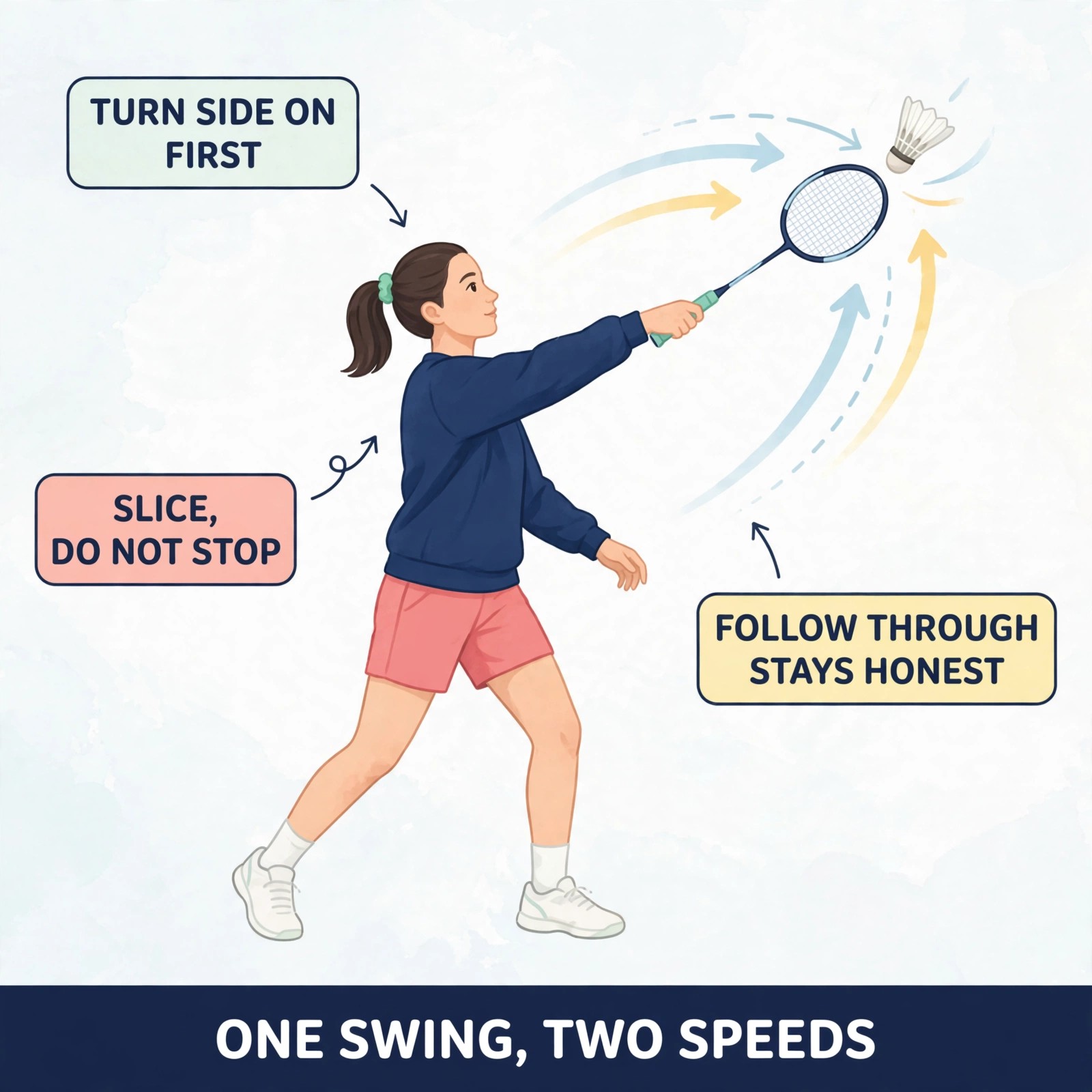
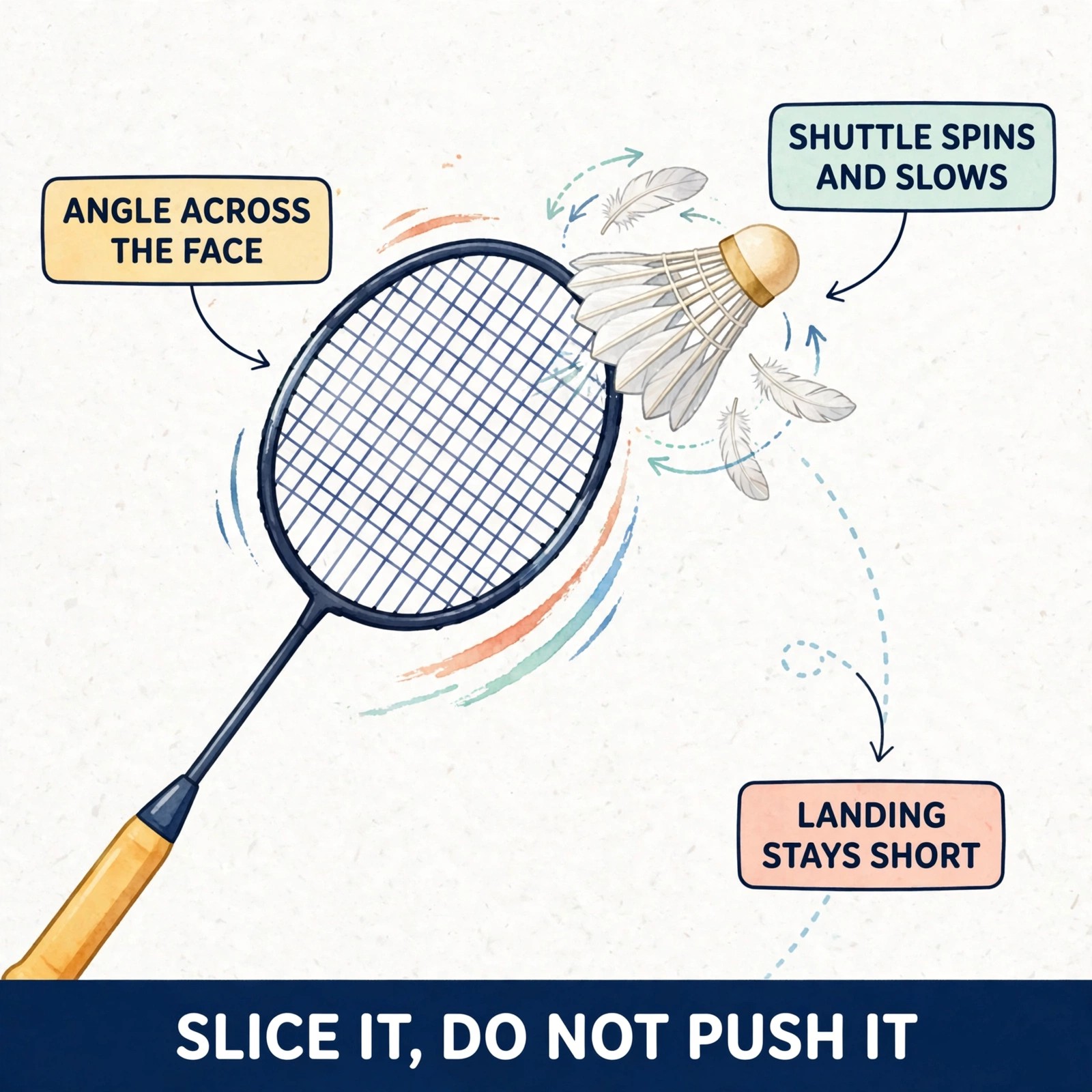
The finish is where the drop lives. Instead of driving through the shuttle, the racket slices gently across it, the face angled so the shuttle leaves slower and with a little spin that helps it fall. The common fault is stopping the swing, checking the action dead at contact. A stopped swing is readable from the cheap seats, and it dumps the shuttle into the net as often as it drops it over, because the shuttle gets no guidance through contact. Slice, do not stop. The follow through stays honest, smaller than a clear’s but in the same direction, so a watching opponent sees one continuous swing that simply happened to produce a slower shuttle.
Touch comes from a grip that can change its mind. A locked grip through the whole swing gives you one speed only, full, and forces the arm to slow down to soften the shot, which is exactly the tell you are trying to remove. Hold the racket softly during preparation, let the fingers work at contact: a firmer squeeze drives the clear, a relaxed hand and the slice take the pace away for the drop. This is also why string players and coaches argue about feel at the net and the rear alike. The shot is decided in the last fraction of the swing, by the hand, while the body performs the same honest shape it always performs.
Drop Check #3
Feeding Drills: Clears And Drops From One Swing
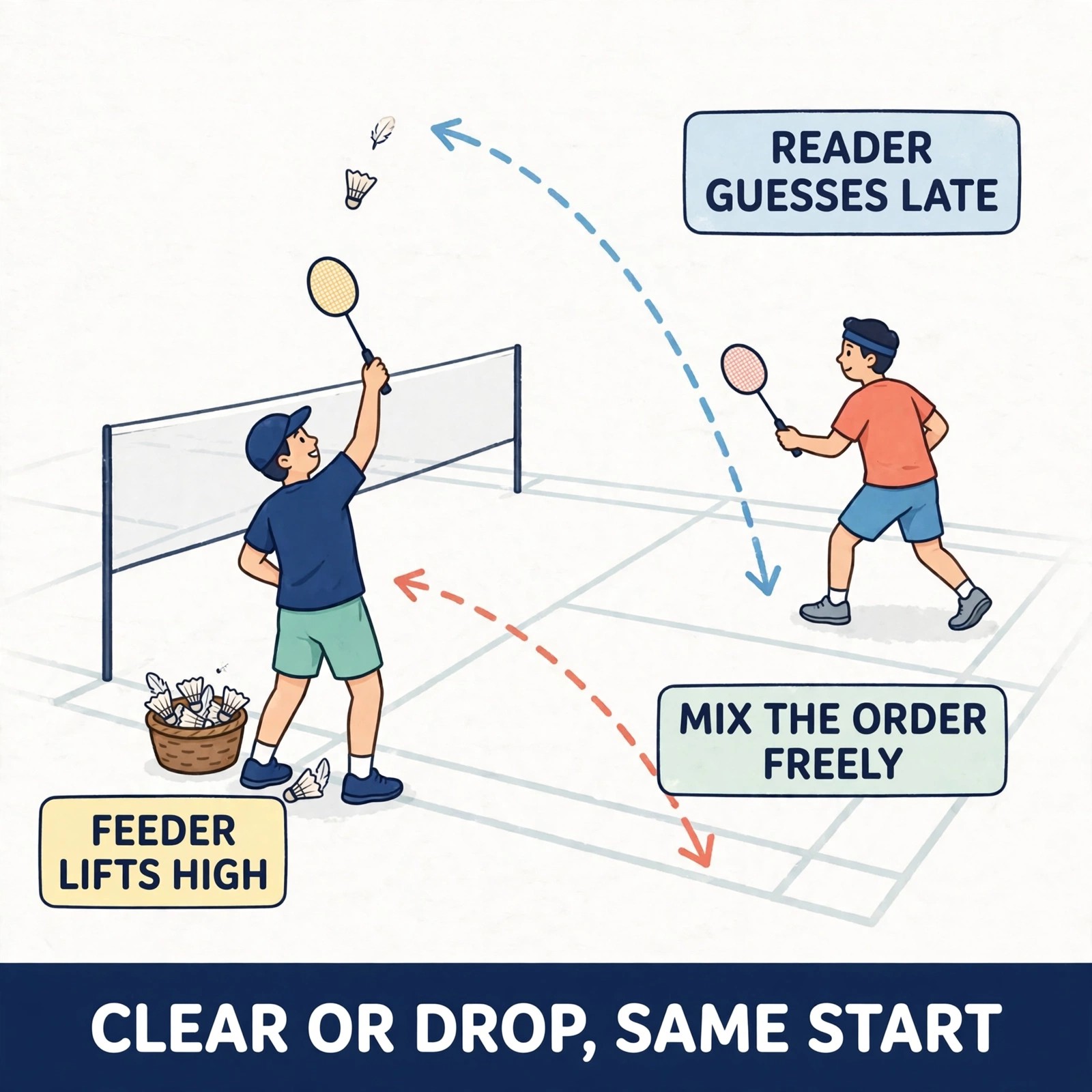
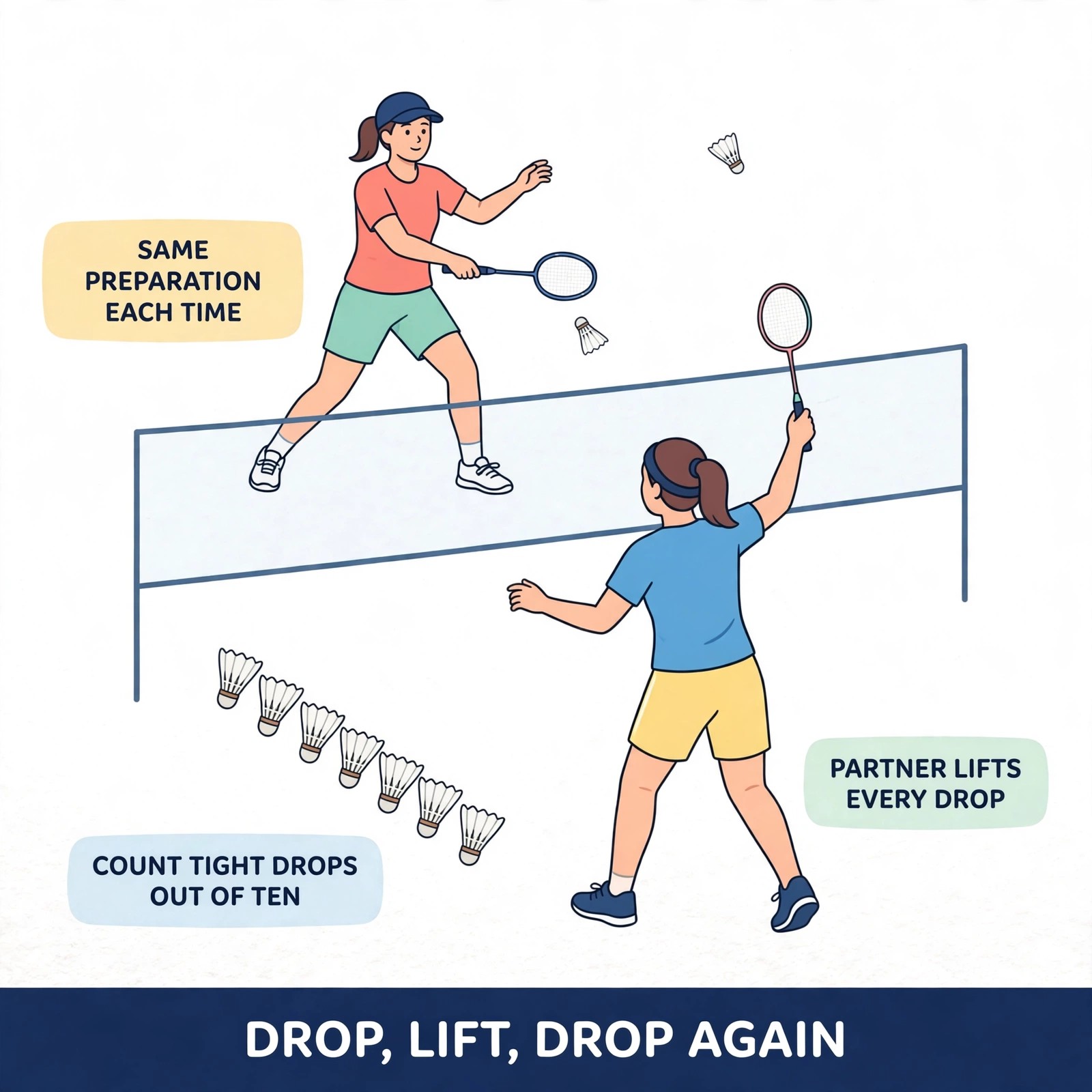
The base drill is mixed feeding from one start. Your partner lifts high to the rear court, and you play clear or drop as you choose, from the same preparation, while your partner calls out what they think is coming before the shuttle crosses the net. Their calls are the real score. When the calls start coming late, or wrong, the disguise is working. Ten shots a set, clears and drops in any order you like, judged by two counts: drops landing tight, and reads your partner got wrong. Run it weekly and both counts climb together, which is how you know the touch and the disguise are growing as one skill rather than two.
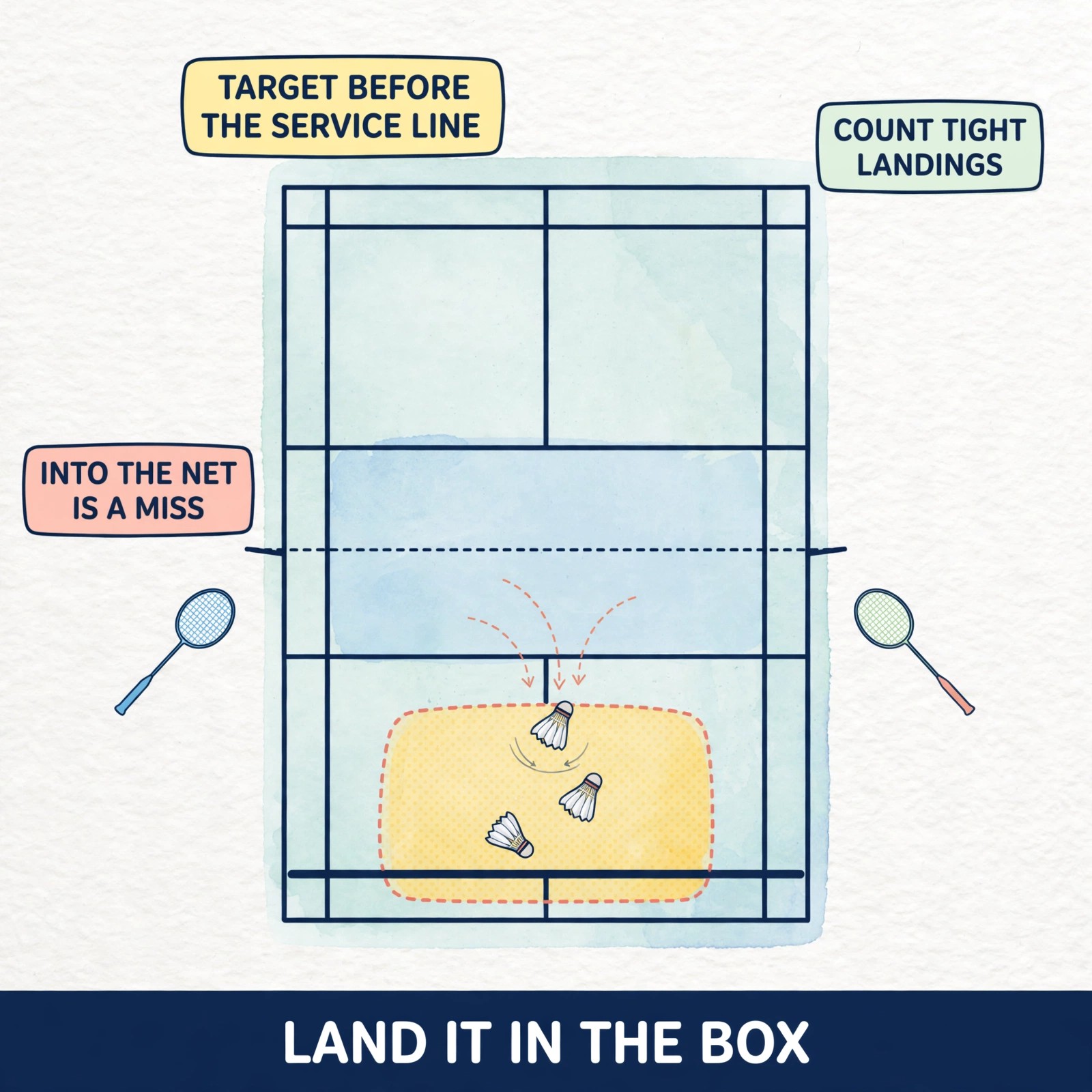
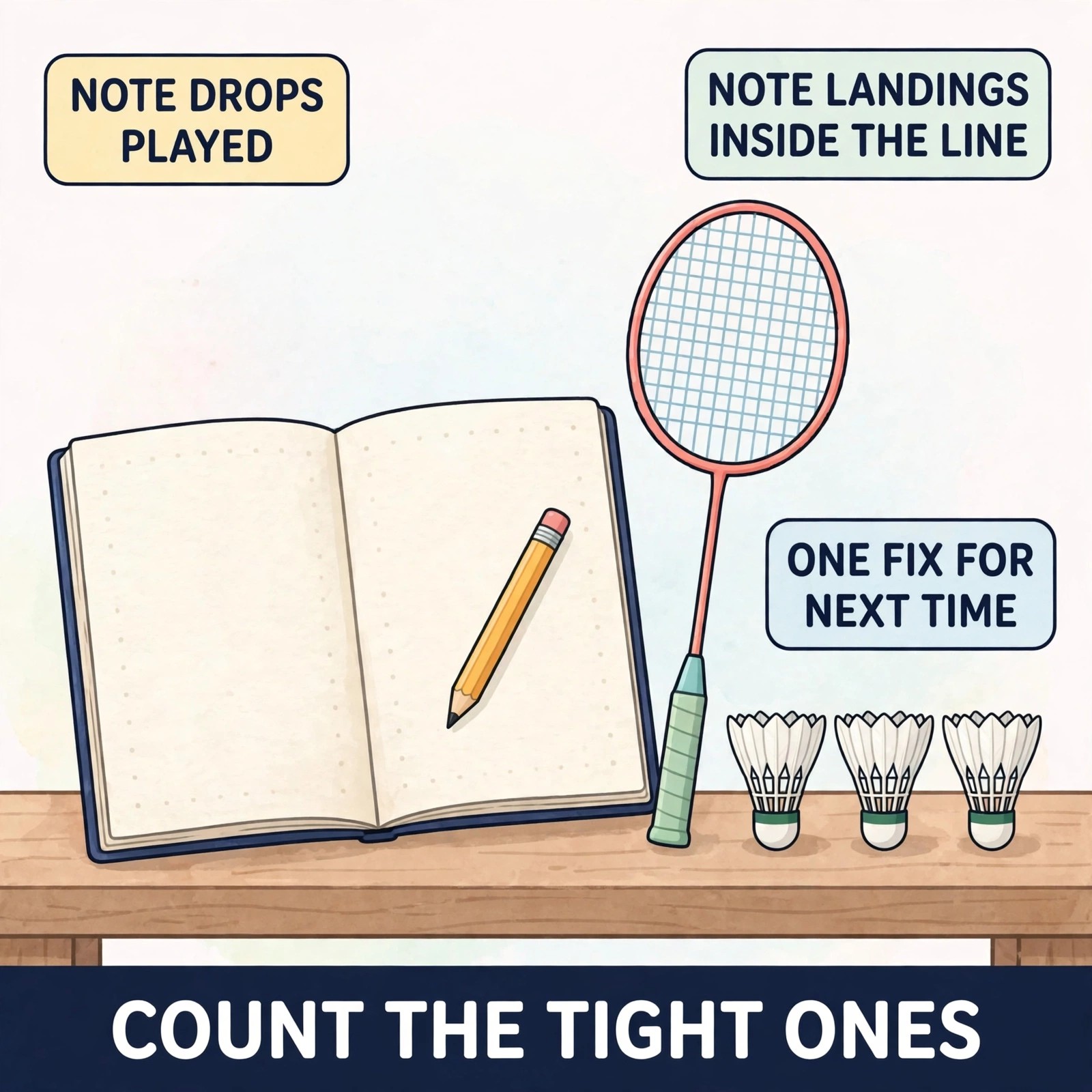
Target work gives the drop its honesty. Mark a landing zone just inside the front service line and play fed drops at it, counting only shuttles that land inside. A drop that clears the tape by a metre and lands mid court is a failed drop wearing a disguise of success, because at match pace it is a drive waiting to happen. A drop into the net is a miss, full stop, not an almost. Ten fed drops, a number out of ten, written down. Players avoid this count because it is unflattering, and then wonder why their match drops float. In training with us the zone stays the same size all season, so the number means the same thing in month one and month six.
The third drill joins the drop to what it creates. Play the fed drop, follow it in, and take the reply at the net, because a good drop earns a lift or a rushed net shot and both need a player arriving ready. Rally shape matters: drop, move in behind it, racket up, own the front, and finish or rebuild from there. Players who drop and then stand at the rear admiring it give the front court away and turn their best shot into a neutral one. In the drill, your partner lifts every drop back so the pattern repeats, and the work becomes the rhythm of the rally itself: threaten deep, drop tight, step in, decide again.
Drop Check #4
Target Drills: Landing Zones And Honest Counting
The slice deserves its own quiet drill. From fed lifts, play drops with the slice exaggerated at first, the racket clearly crossing the cork, and watch how the shuttle spins and shortens its flight. Then reduce the slice week by week until the action is nearly invisible while the effect stays. This progression teaches your hand the dosage: how much slice this shuttle, this hall, this day needs to land tight. Halls differ, shuttles differ, and the hand that has practised dosage adjusts in two shots. The hand that only knows one action spends the first game of every match donating drops to the net.
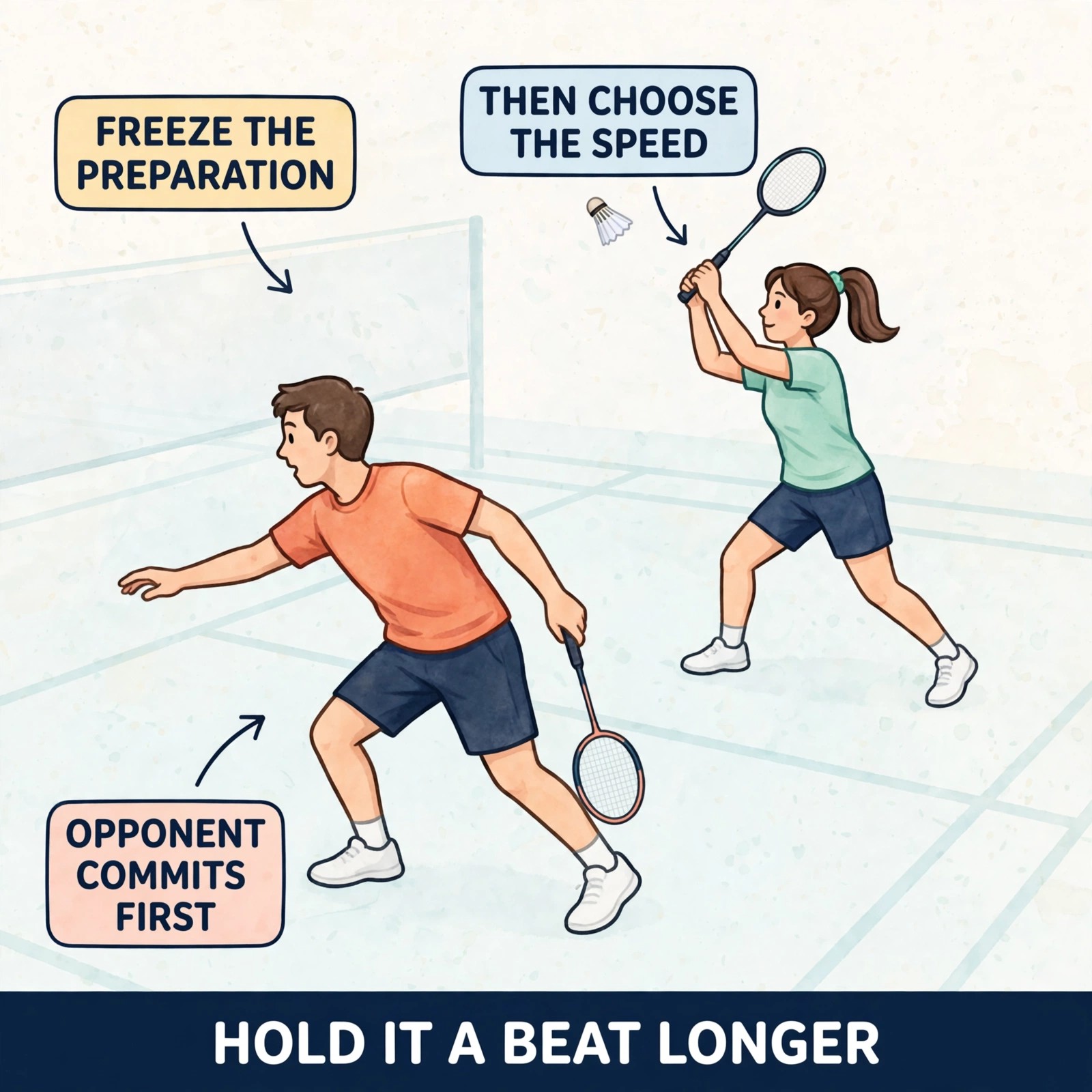
Holding the preparation a beat longer is the second deception drill. Against a live partner, freeze the shape for a moment at the top, racket up, body set, and watch their weight commit before you choose the speed. The drill is not about delay for its own sake; it teaches you to read commitment, the lean, the early step, the racket dropping, and to punish it calmly. Clear behind a player who stepped in, drop in front of a player who leaned back. Two honest options, one read. Players rush this drill and guess instead of reading. Slow it down until your partner’s tells are obvious, then let the pace come back up over the weeks.
A straight drop also has a partner shot that keeps it safe: the clear played from the identical moment. Practise the pair back to back in the same set, five clears and five drops in random order, and check on video if a friend films ten seconds. Freeze the frames at contact and compare. The turn, the reach and the swing should match so closely that the only visible difference is the shuttle leaving. Where the frames differ, that difference is your tell, and it is usually small and fixable: an elbow dropping, a wrist setting earlier, a shorter reach. Finding your own tell on video is worth a month of guessing on court.
Drop Check #5
Drops Under Pressure: Stretched, Late And Moving
Pressure bends the drop in two directions. Stretched at the rear corner, moving backwards, players either float the drop by reaching and poking without the turn, or dump it by slicing a shuttle they never got behind. The drill therefore adds the movement first: a short footwork pattern into the rear corner, then the fed lift, then the drop played while the legs are working. The rule for the set is shape before softness. Turn, reach, honest swing, then the touch. A drop played at eighty percent with the shape intact lands tighter than a desperate soft poke, and it keeps the disguise that protects the next rally too.
Late in games, the second failure is patience. A tired player starts choosing the drop too early in rallies, from positions where the opponent is set and waiting, and the shot that should punish movement becomes a routine feed. Pressure sets therefore include a condition: the drop only counts if the rally pattern has moved the feeder first, a clear to one corner, a clear to the other, then the drop. Building the moment is part of the shot. Coaches call it shot selection, but it is really respect for what the drop needs: an opponent who has been moved, a swing they must honour, and a landing they cannot reach in balance.
Know also when the drop is the wrong guest. Into a fast drift, in a hall where shuttles are flying quick, a straight drop can carry and sit up at the net for a kill. Against a player camping at the front because your clear has stopped threatening, the drop feeds their game. The drills on this page build the shot; the judgement of when to spend it is built by the counting, because a player who logs tight landings also learns the conditions that produce them. Keep the clear deep and respected, keep the drop honest about its landing, and the pair will keep asking questions your opponents cannot answer early.

Myth vs Reality
Myths About Straight Drop Shots
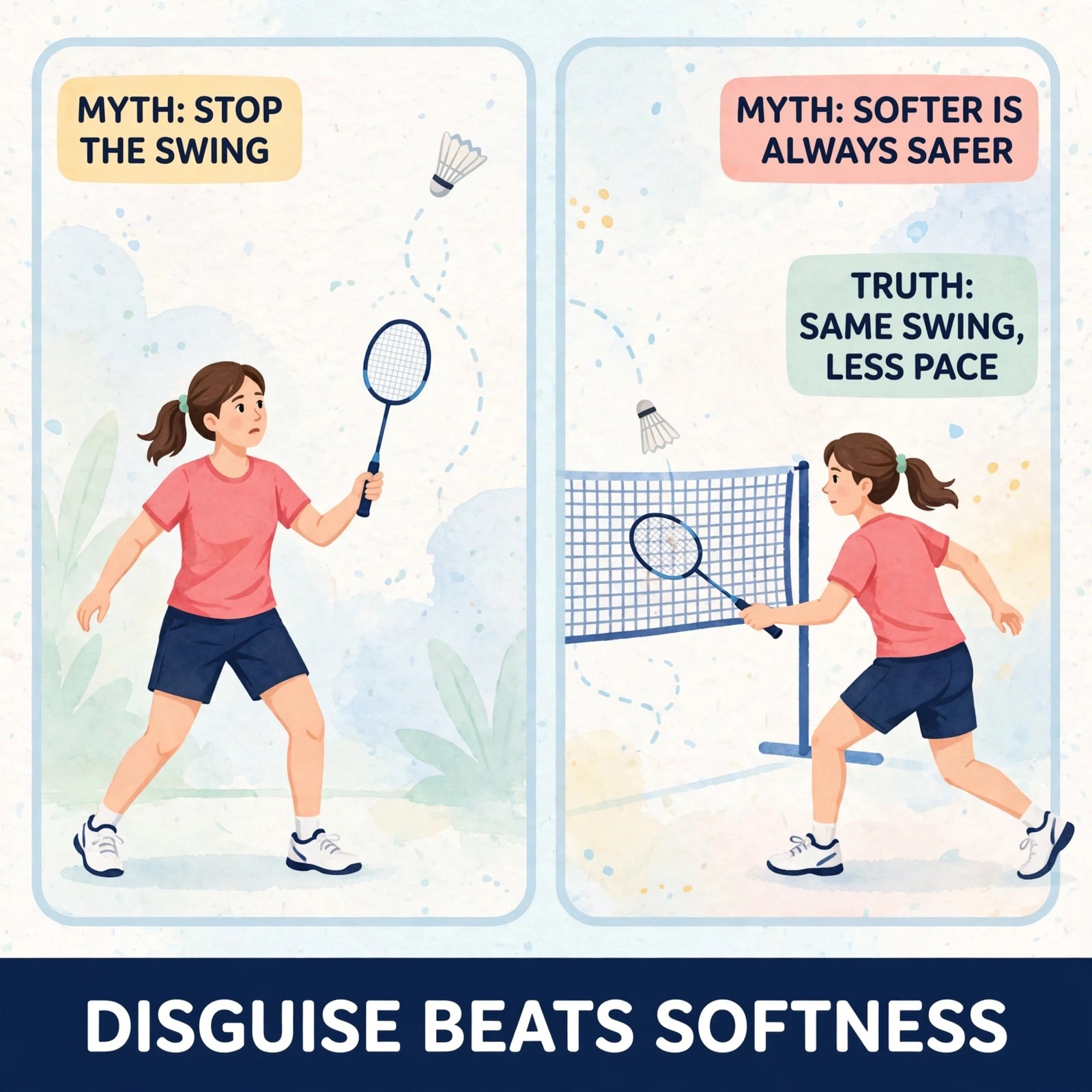
The first myth says the drop is a soft shot played with a soft, stopped swing. The stop is exactly what better opponents are watching for, and it is why so many club drops get read early and rushed. The pace comes off the shuttle through the slice and the hand, while the swing continues. Think of it as the same sentence spoken more quietly, not a sentence abandoned halfway. Players who learn the stopped drop first have to unlearn it against anyone who watches the arm, which at adult club level in KL is nearly everyone by the second game.
The second myth says softer is always safer, that the drop with the least pace is the best drop. A drop can be too soft: it dies into the tape or lands so short and slow that the opponent plays it at leisure from a standing start. The safest drop is the one that crosses low, lands tight inside the line, and arrives while the opponent is still moving. Judged by landing, not by gentleness. Players who chase softness spend a season donating tape height errors and calling them unlucky, when the count would have told them in one session that the shot needed more shape and less fear.
The third myth says the drop is a defensive shot, a way to rest during a rally. Rest is the one thing a good drop never gives the player who played it: it must be followed in, defended at the net, and backed up by the next decision. What the drop rests is the opponent’s legs, briefly, before charging them double for the trip forward and back. Singles players who treat it as a breather lose the front court they just won. It is an attacking shot played slowly, and it is trained that way on this page: paired with the follow in, counted by landings, and respected as half of the clear and drop partnership.
Why Choose Us
Why Players Choose ST Badminton Academy
At ST Badminton Academy, straight drop training follows the order on this page: one shared swing shape with the clear, mixed feeding with a reading partner, target work counted by tight landings inside the line, slice dosage and held preparation drills, and pressure sets where the shape must survive movement. Groups are capped at four students, and the drop needs that closeness: the faults are a dropped elbow, an early wrist, a stopped swing, small things a coach can only correct when he can see every swing. Each player’s counts, tight landings out of ten, reads beaten, and tired set landings, are logged and reviewed every week.
Students join us from across Setapak and the wider Klang Valley: juniors building a rear court game beyond the clear and the smash, school players preparing for selection matches where everyone reads a telegraphed drop, and adult club players whose drops work on Tuesdays and float on Fridays. The work scales. Beginners start with the shared shape and fed drops at a generous pace; experienced players go to reading games, held preparation and pressure sets. The standard stays fixed: the landing judges the shot, the partner’s reads judge the disguise, and no drop is praised for feeling nice off the strings.
If you are not sure where your drop stands, a trial session answers it quickly. The coach feeds ten lifts, counts your tight landings, then reads your preparation aloud for ten more to test the disguise. Most players discover the same surprise: the touch is closer than they feared, and the tell is something small, an elbow, a reach, a grip that locks early. You will leave with your real counts and the one fix that moves both, whether that is the slice dosage, the shared turn, or simply meeting the shuttle higher and earlier.
FAQs: Straight Drop Shot Drills And Disguise in Malaysia (KL)
Drop shot questions usually start with a shuttle that floats when it matters. Here are the answers we give on the bench.
Can a beginner learn straight drop shot drills in training in Setapak or Gombak?
Yes, because the drop shares its swing with the clear you already own. In our Setapak groups of no more than four, beginners learn one shared shape, then take the pace off with a slice against fed lifts, counting tight landings inside the front service line from the first weeks of training.
What is the first straight drop habit a new player should build in KL?
One preparation for clear and drop. Turn side on, reach high and meet the shuttle in front, every time, so your body tells no stories. KL players who build that shared start find the disguise looks after itself, because opponents cannot read a choice your shape has not announced yet.
Why does my straight drop keep landing in the net at club level?
Usually a stopped swing or a late contact. Checking the action dead dumps the shuttle into the tape, and meeting it beside your head removes your control of the angle. Keep the swing moving, slice across the cork, and take it high in front. Bring ten fed drops to a session and we will count the tight landings together.
My drop and my clear look different before I hit them. Should I change my grip or fix my swing shape?
Fix the swing shape first. Two different preparations are a gift to any opponent who watches, and no grip change hides a dropped elbow or a shorter reach. Film ten shots and compare the shape at contact. When clear and drop match until the last moment, your grip only needs to stay soft enough to change the pace.
How can I practise straight drop drills with a partner in training?
Use mixed feeding with a reading partner. Your partner lifts high while you choose clear or drop from the same preparation, and they call what they think is coming before it crosses. Count tight landings and reads beaten. In training with us the feeder varies the lift, so your contact point is found fresh every single time.
Do you coach straight drop drills near Wangsa Maju?
Yes. Our academy is based in Setapak, a short drive from Wangsa Maju, and straight drop work is coached inside normal sessions there: shared shape first, mixed feeding against a reader, target work counted by landings. Groups stay at no more than four students, so the coach sees every swing and can spot your tell.
Where does ST Badminton Academy teach straight drop drills in Malaysia?
We teach in Setapak, Kuala Lumpur, and the straight drop is coached as half of a partnership with the clear: one turn, one reach, two speeds, judged by where the shuttle lands. Students join us from across the Klang Valley, and each player’s tight landing counts are logged and reviewed every week.
How do I book a trial session to check my straight drop?
Book a trial session with us in Setapak and bring your playing racket. Train in a group of no more than four, and the coach will feed ten lifts, count your tight landings, then read your preparation aloud to test the disguise. You will leave with real counts and the one fix that moves both.
What makes Mr Eric Chuar a suitable coach for straight drop shots and badminton?
Mr Eric Chuar coaches the academy sessions himself, with more than 15 years of coaching in Malaysia and Singapore. He builds the drop on top of the clear’s own shape, tests disguise against a reading partner instead of assuming it, and counts landings rather than praising feel, so students gain a drop opponents respect.
Badminton Straight Drop Shot Training in Action
We benchmark our drop shot coaching against World Badminton (BWF) coaching standards and our own academy values: before any player trusts a training plan, they deserve honest checks. You can verify our coaches' credentials through the Badminton Association of Malaysia (BAM) coach education pathway.
Our standards for rear court coaching are plain. One shared shape for clear and drop, counted landings over hopeful volume, and disguise tested against a reading partner rather than assumed. We promise no sudden touch; a reliable drop is built from the same turn and reach repeated weekly until the hand can be trusted at the last moment. Sharp pain in the shoulder or elbow during overhead work is a stop signal, not a badge of effort, and we will say so in the session rather than after it.
| Factor | Floaters | Disguised Droppers DROP |
|---|---|---|
| Frequency | 1 or 2 times a week. Mostly for fun and sweat. | The drop is played with the same preparation as the clear, so the opponent cannot read it early. |
| Drills Focus | Basic static feeding. Minimal footwork pressure. | Contact stays high in front, then the pace comes off with a soft slicing action, not a stopped swing. |
| Physical Conditioning | Rarely included. Just playing games on court. | Core, agility, and speed training included in every session to prevent injury and build stamina. |
| Tactical Awareness | "Just hit it over." No real game plan. | Video analysis, point construction, and learning to read the opponent's game. |
| Coach Ratio | Large groups (8-10 kids). Coach barely watches you. | Max 4 students. Mr Eric Chuar personally corrects every stroke and movement detail. |
| Goal Setting | Fun and exercise. | Drops are judged by landing: tight to the net, inside the front service line, never floated as a free lift. |
| Long Term Result | Good recreational player. | A disguised dropper: holds the rear court threat, pulls opponents forward late, and opens the back court for the next clear. |
Badminton Training With Drop Shot Coaching in Kuala Lumpur
Come and give your rear court a second question. Book a trial session in Kuala Lumpur, train in a group of no more than four, and leave with your swing shape checked, ten drops counted honestly against the line, and your tell named as your first fix. Bring your playing racket and your usual court shoes. Your clear already asks the question; the drop is how you ask it twice.




