What Are The Benefits Of Training With A Badminton Partner (Training Partner Guide)
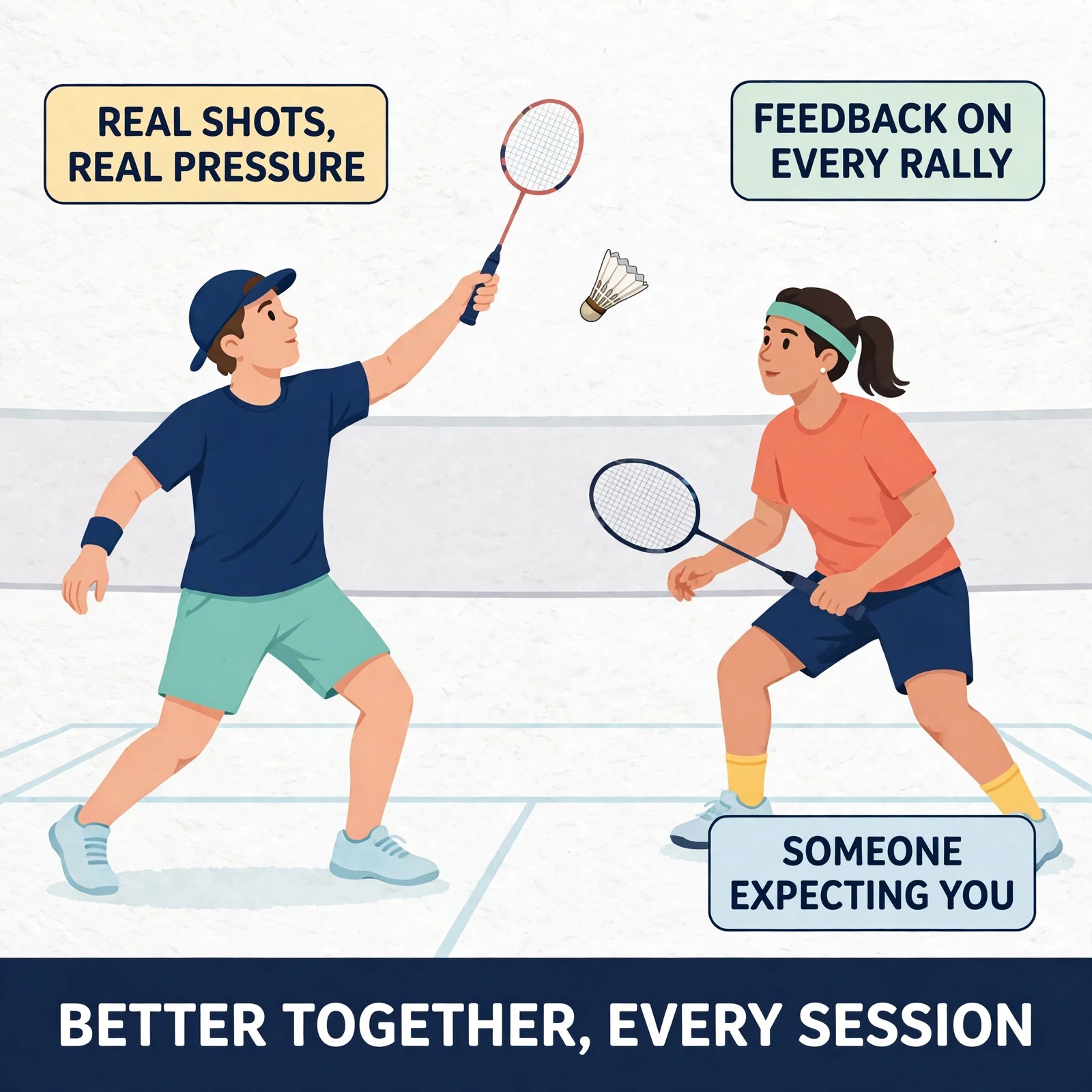
Every strong player you know has a training partner behind them. Not a rival, not a coach: a partner, the person who feeds honestly, counts fairly, shows up on the wet Tuesday nights and makes one more set happen when you would have gone home. Solo drills have their place, but badminton is a game played against a thinking opponent, and only another player can give you real shots, real pressure and real feedback. This page sets out what a good partner actually adds, how to share the roles fairly, and the drills that turn two players hitting into two players training.
Partner Check #1
Training With A Partner: Real Shots And Real Feedback
The first benefit is reality. A partner’s shots do not arrive on rails: the clear drifts a little, the drop sits up an inch, the flick comes off a shape you have to read. That small unpredictability is the difference between practice and training. Shadow work grooves a swing, and feeding grooves a pattern, but only a partner makes you solve a new problem on every shot. Matches are nothing but new problems. Players who train mostly alone often look wonderful in drills and ordinary in games, because the game skill, reading and adapting, was never practised at all.
The second benefit is a mirror. Your partner sees what you cannot: the lift that has been falling short for a month, the backhand you avoid without noticing, the recovery step that vanishes when you tire. Good partners say these things plainly and early, when they are one session fixes rather than habits. They also keep your counts, and a count called by someone else is harder to flatter than one you keep yourself. Over a season, that honesty compounds. Two players who tell each other the truth improve at the speed of their honesty, which is faster than most coaching can manage alone. There is a third benefit nobody lists: a partner makes your progress visible to a witness. When the counts rise, someone else saw it happen, and that shared record carries you through the flat weeks when your own memory insists nothing is improving.

Partner Check #2
Partner Roles: Feeding, Counting And Swapping Fairly
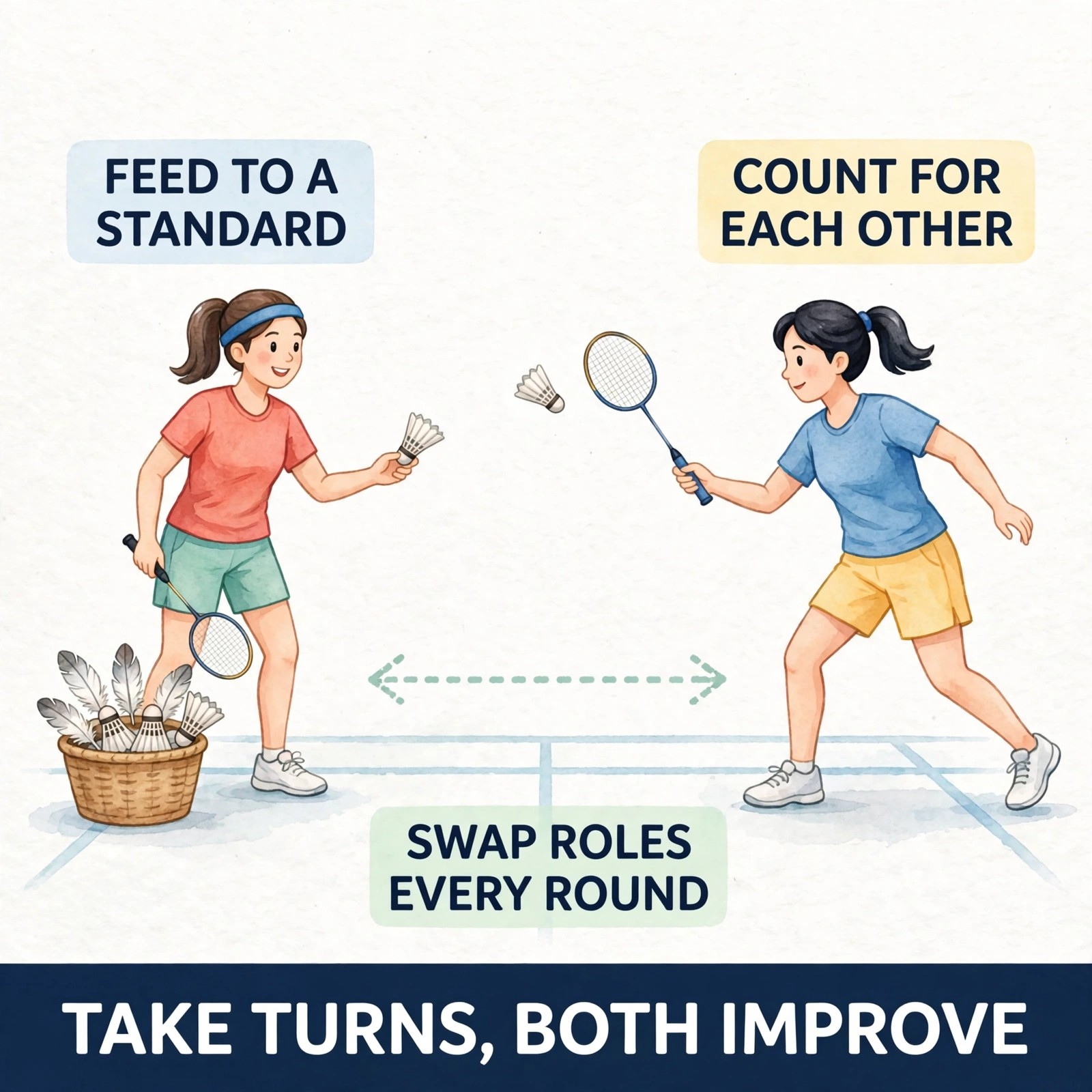
Partner training works when the roles are clear. In every drill one of you is the player and one is the worker: the feeder, the counter, the reader. The worker’s job is not the easy job. Feeding to a standard, at honest pace, into the corner the drill demands, is a skill in itself, and counting fairly while watching technique is real work. Agree the roles before the set starts, set the length of each turn, and swap on time. Pairs fall apart when one player feeds for forty minutes and plays for ten. Fair turns are not politeness; they are what makes both players better.
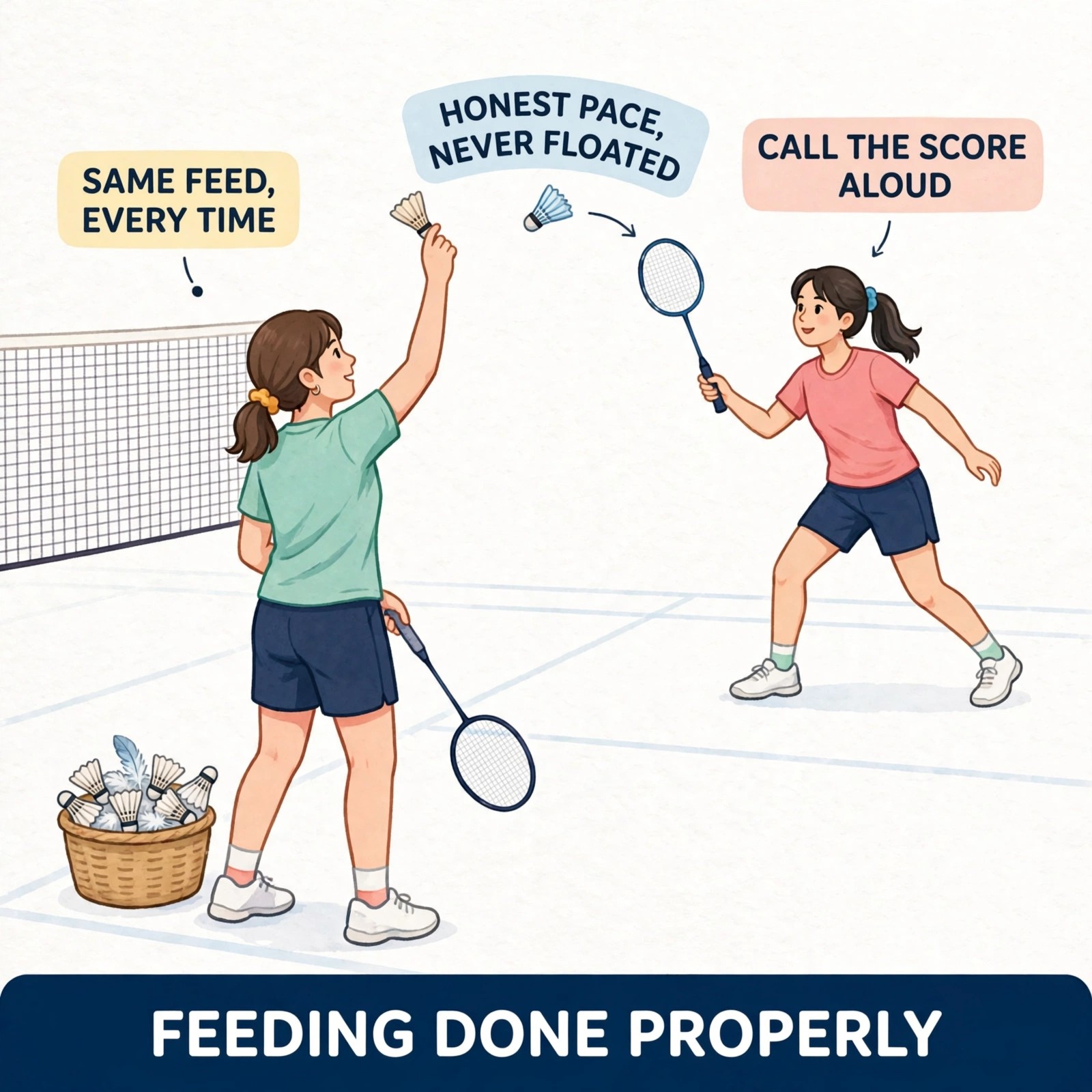
Feeding standards deserve their own conversation. A feed that is floated kindly teaches nothing, and a feed blasted unfairly teaches less. The standard we use: the feed should make the player succeed a little over half the time when their shape is right, and fail when it is not. Feeders say the standard out loud at the start of the set, so both players know what honest looks like today. As the player improves, the standard rises: tighter to the corner, a fraction faster, a little less warning. That rising standard, agreed between two people, is the engine of the whole arrangement.
Counting for each other is the third role, and it is more than arithmetic. The counter watches the rep, not just the landing: was the contact in front, did the recovery happen, was the shape the one being trained? A clean rep is called clean, a lucky one is called lucky, and the difference matters because the log is built from these calls. Partners who count strictly do each other a favour that lasts all season. Partners who count kindly build logs full of flattering fiction, and fiction makes for very confusing coaching when the counts meet a real match.
Partner Check #3
Partner Drills: Counted Sets You Both Trust
The classic partner drill set is feeding with a purpose: lifts answered with drops, drops answered with net shots, one pattern at a time, counted in tens. Each partner takes their turn as the player, and the feeder keeps the pattern honest. Because the same two people run the set weekly, the improvements show in shared language: your drop count against Aiman’s lifts, your net count against his feeds. The set also trains the feeder, whose lifts and feeds get steadier under the same counting. Few solo drills train two skills and two players at once the way a counted feeding set does.
Cooperative rallying is the set pairs skip and should not. The rules are simple: keep the rally going, deep and safe, and count the shots until an error ends it. Then beat your joint best. It sounds gentle, and then the count reaches thirty and both players discover what concentration actually costs. Cooperative rallies build the base consistency every other skill stands on, and they build it together: each player’s error ends both players’ rally, which creates a gentle, constant pressure to take care of the shuttle. Log your joint best weekly and watch it climb like a shared bank balance.
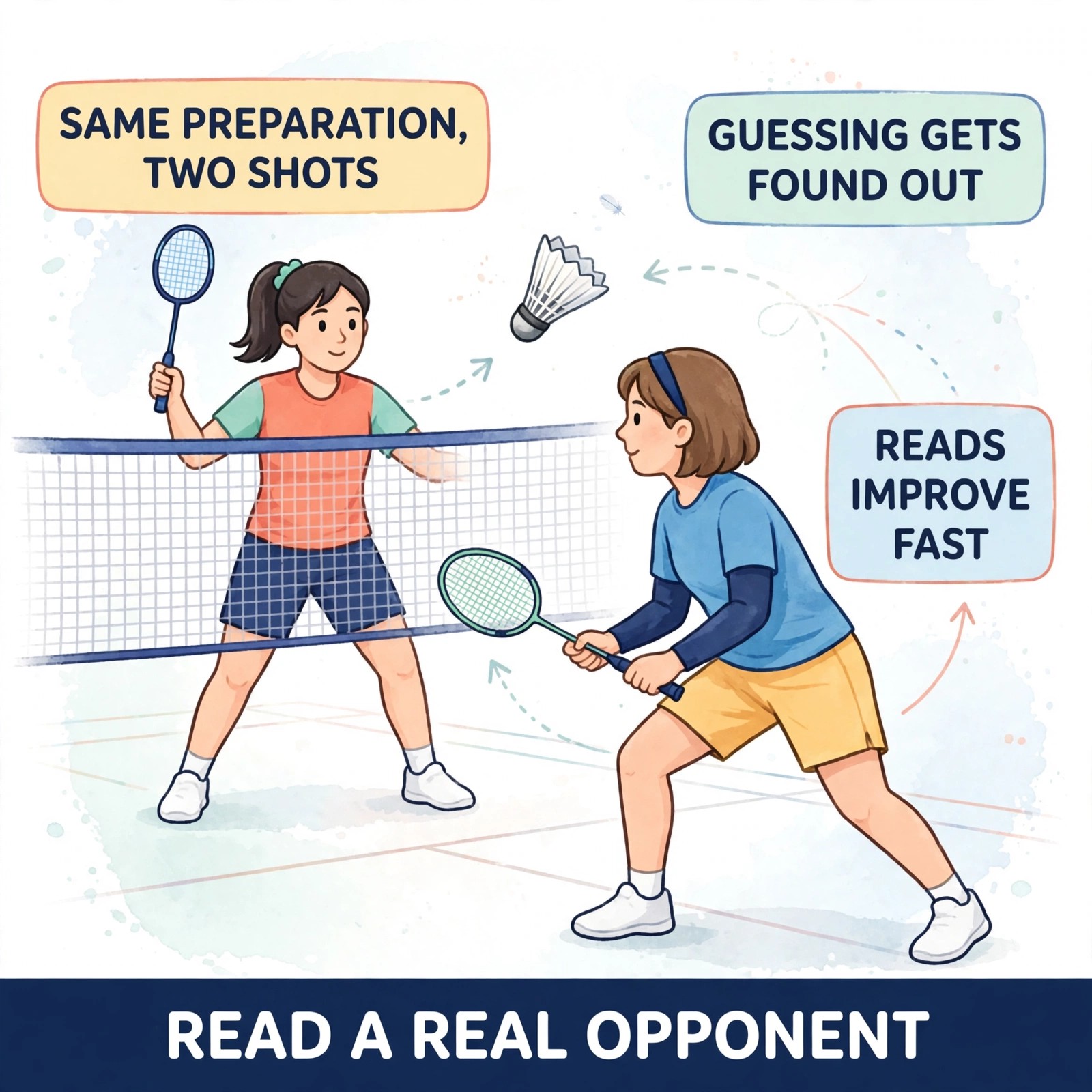
Reading games complete the drill shelf. From one shared preparation, the player chooses between two shots, a tight net or a flick, a straight drop or a cross, and the partner practises reading the choice as late as honesty allows. Then swap. These games train the skill matches are made of: solving a real person’s disguised intentions. They are also, not incidentally, the most fun sets in the week. Pairs who play reading games regularly develop a shared sharpness that shows up against strangers, because a read practised against someone who knows your habits is a read that works on anyone. Swap the roles halfway through every game, because the reader learns as much as the player: watching disguises from the receiving side teaches your own hands how to hide a shot better.
Partner Check #4
Target Games And Scoring Sets With A Witness
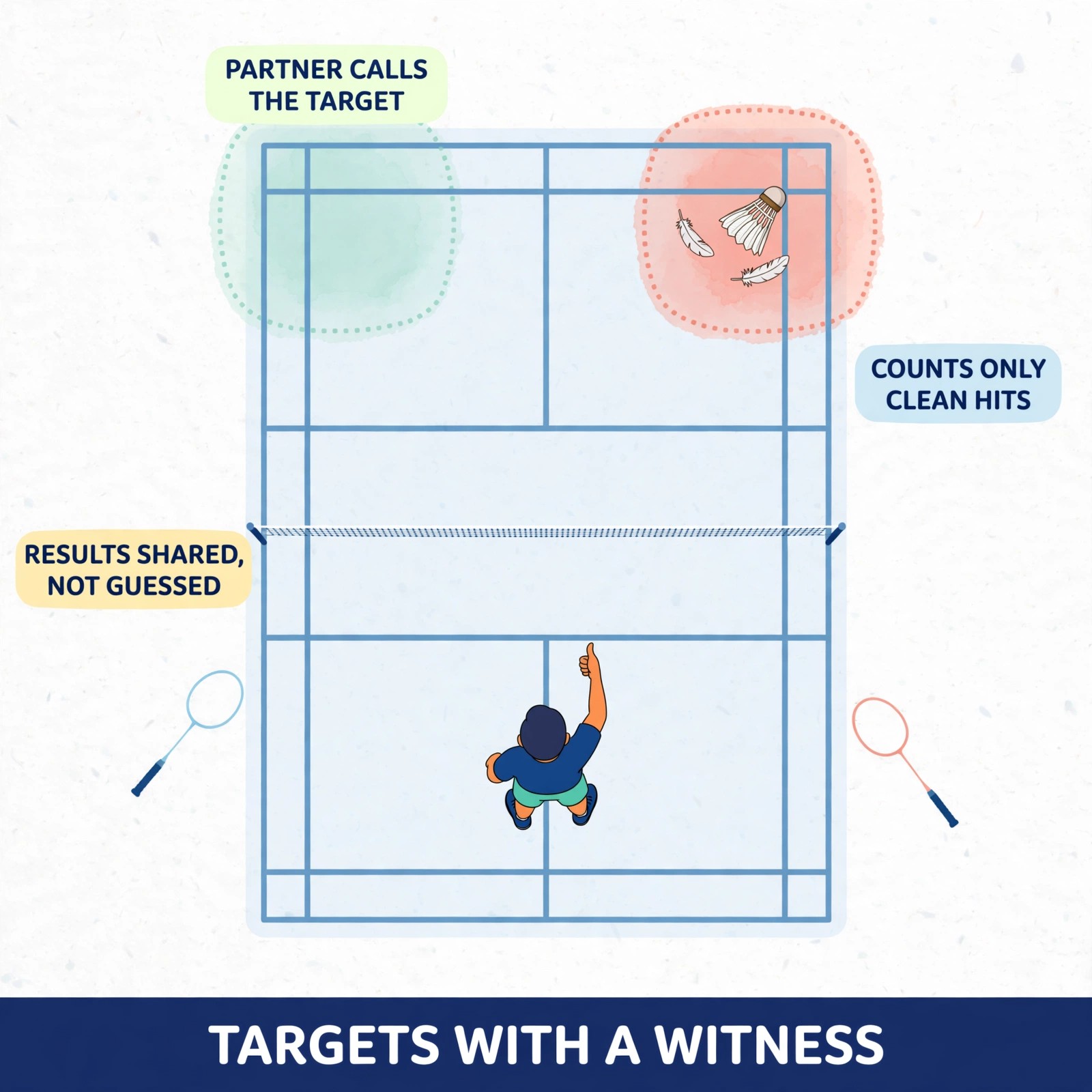
Target games give partner work its scoreboard. Mark zones in the rear corners and the tramlines, take turns feeding and playing, and count only clean target hits, with the partner calling each one. A witness changes everything about a drill: the target suddenly matters, the lucky ones get argued about, and the counts entering the log have been seen by two pairs of eyes. Run the same target set monthly and the pair of you owns a small, honest history of progress. It is hard to feel stuck when the numbers, witnessed and written down, say otherwise.
Scoring sets are where partnership turns into pressure. Play games to eleven with a condition attached: points only count after a four shot rally, or the server loses two points for an unforced error. Conditions force match thinking: shot selection under consequence, patience when the score tightens, courage at the right moments. A partner who knows your game makes these sets honest in a way a stranger cannot, because they attack your real weaknesses instead of random ones. Rotate conditions weekly and keep a running tally across the month. Friendly rivalry, honestly scored, is powerful fuel.
Accountability is the quiet benefit underneath all the others. A session with a partner in it happens. The alarm goes off, the rain starts, the day runs long, and you go anyway, because someone is standing on a court expecting you. Over a year that single fact is worth more than any drill: the consistent player is usually just the player who kept showing up. Partners also plan together, booking courts, setting the week’s focus, reviewing the log. Training stops being a mood and becomes an appointment, and improvement follows appointments far more reliably than it follows motivation. Court bookings, shared lifts to the hall and a standing weekly slot all sound like admin. They are actually the structure that protects the training from busy lives, and partnerships that sort them early rarely miss sessions at all.
Partner Check #5
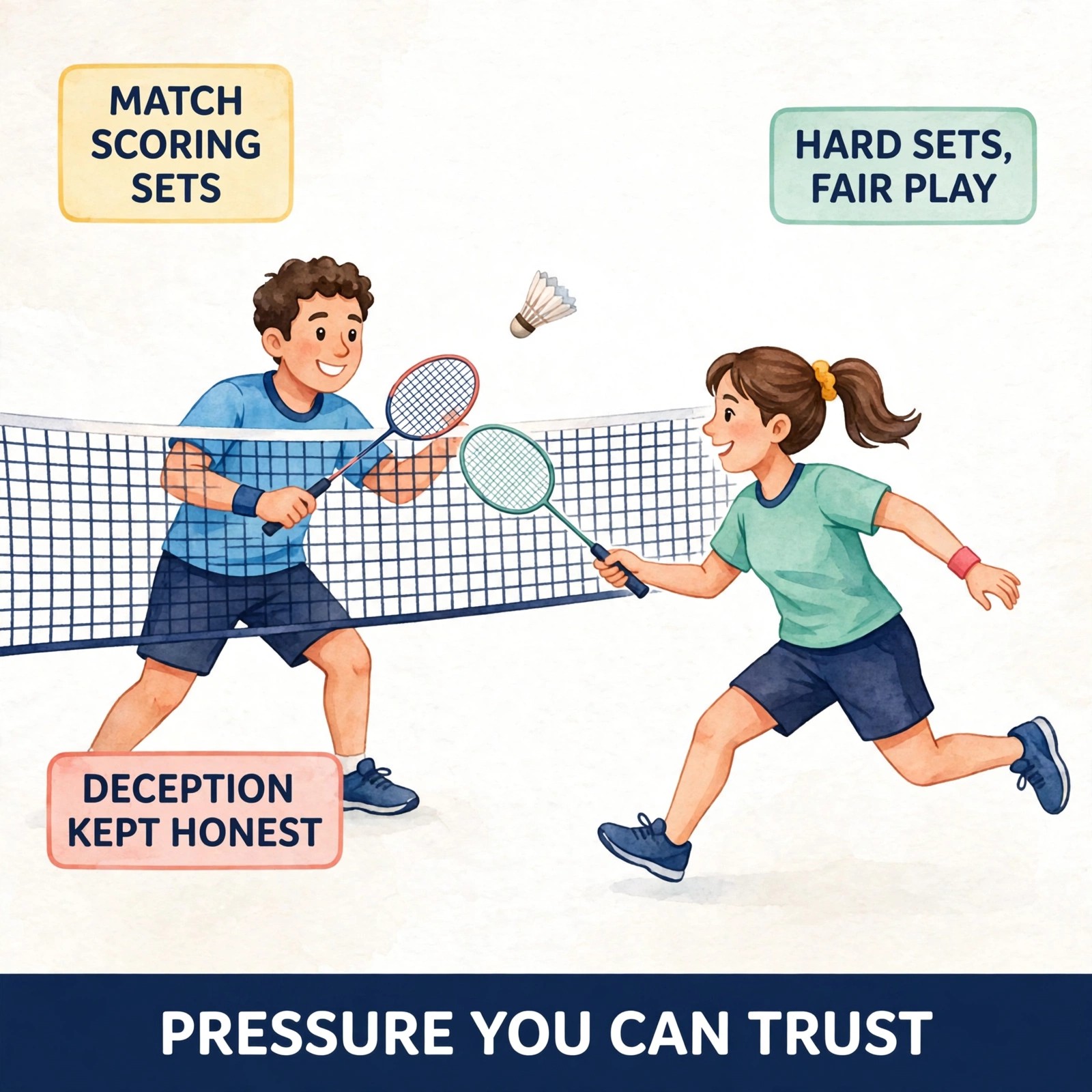
Pressure Together: Match Sets, Shared Goals And Tough Days
Pressure between partners has to be handled with care, because the person pushing you is also your friend. The rules that work: push on effort, never on worth; criticise the shot, never the person; and end hard sets with one honest compliment that is actually true. Pairs that learn this can train at match intensity for years. Pairs that do not either drift into softness, where nothing is ever said, or into spite, where nothing said is kind. Both failure modes are visible early and fixable with one plain conversation, which is itself a partner skill worth practising.
Bad days are shared property. One of you will arrive flat, injured in spirit if not in body, and play like a stranger. A good partner reads the day and adjusts: feeds a little kinder, chooses encouragement over analysis, and keeps the session useful without pretending it was great. The debt gets repaid on the other player’s flat day, which always comes. This is not softness; it is how long partnerships survive long seasons. Players who train alone through a bad month often quietly quit. Players with partners get carried through it, and carry in their turn.
Shared goals turn two players into a small team. Set them together at the start of a training block: a count to reach on the feeding set, a joint rally best to beat, a club tournament to enter as a doubles pair or alongside each other in singles. Write the goals in the shared log and review them monthly. Goals give the week’s drills a reason and the hard sets a meaning beyond the evening itself. They also give the partnership its celebrations, which matter more than players admit: improvement noticed together is improvement that gets repeated. Review the goals out loud, not just in the log, because hearing your partner say what the pair is chasing has a way of making the next hard week feel chosen rather than endured.
Myth vs Reality
Myths About Training Partners
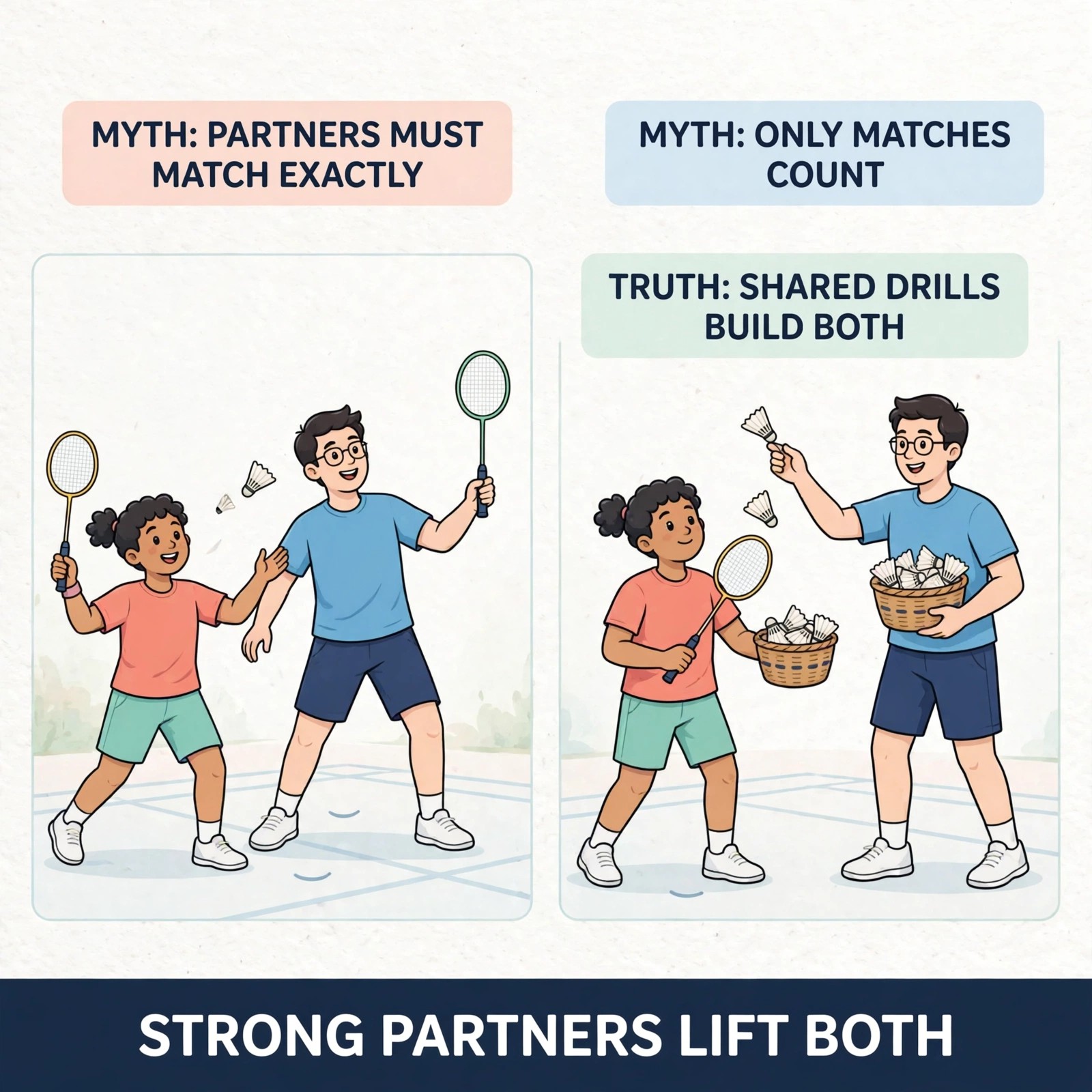
The first myth says partners must be exactly the same level or the arrangement is unfair. In practice, mixed pairs work well when the roles are set honestly. The stronger player feeds at a higher standard and gets their own sets fed by a partner who is learning to feed well, which is itself training. The improving player gains a window into higher level habits at close range. What breaks pairs is not the level gap; it is an unspoken feeling that one side gives more than it gets. Say the arrangement out loud, review it monthly, and level gaps rarely matter at all.
The second myth says only matches count, that drills with a partner are a lesser form of playing. Matches test skills; they do not build them one fault at a time. A match gives you perhaps three chances to practise the shot that is failing you, under pressure, with no pause to fix the shape. A partner drill gives you thirty chances with feedback. Players who only play matches plateau at the level their habits allow, and their habits never get the counted, corrected repetitions that drills exist to provide. Matches are the exam. Partner drills are the study, and exams reward study.
The third myth says a partner is a luxury, nice if your club happens to provide one. Treating it that way leaves your improvement to chance. Partners can be found on purpose: ask at your regular session, agree a trial month with one player whose goals sound like yours, and set the roles and standards from the first evening. It does not need to be your best friend or your exact equal. It needs reliability, honesty and a shared log. Everything else, the drills, the counts, the pressure, follows from those three qualities, and they are commoner than the myth suggests.
Why Choose Us
Why Players Choose ST Badminton Academy
At ST Badminton Academy, partner work is built into normal sessions rather than left to chance. Students are paired for feeding sets with the roles, standards and counts agreed out loud, and pairs rotate often enough that everyone learns to feed, count and read for different partners. The coach sets the standard for the room: feeds at honest pace, counts called strictly, turns swapped on time. New students feel the difference in the first session. Training stops being something done near other people and becomes something done with them, which is the version that survives busy months.
We keep a shared log culture at the academy. Counted sets are called by the partner, written down in front of both players, and reviewed with the coach weekly. When a student’s counts stall, the log plus the partner’s eyes usually find the cause faster than video does: the partner felt the feeds getting easier, or noticed the recovery step going missing on tired reps. That is information no solo player ever gets. It also means progress is a shared pleasure. Your partner watched your seven become a nine; nobody has to be convinced it happened.
Groups of no more than four make natural partner pools. Four players rotate through feeding, playing, counting and reading roles inside one session, so nobody feeds all evening and everybody trains against more than one style. The coach can also match pairs by need: the student whose net game is read too easily spends the month against the group’s best reader. In bigger groups, partner work blurs into crowd hitting and the roles dissolve. Small groups keep the roles sharp, the counts personal and the standards enforced by the people they matter to.
FAQs: Training With A Badminton Partner in Malaysia (KL)
Partner questions usually start with a player training hard alone and wondering why matches feel different. Here are the answers we give on the bench.
Can a beginner find a training partner in Setapak or Gombak?
Yes, and you do not need to find one alone. In our Setapak groups of no more than four, beginners are paired inside normal sessions for feeding and counting from the first week, with the roles and standards explained by the coach, so partner habits grow alongside the shots themselves.
What is the first partner habit a new pair should build in KL?
Agree the roles out loud. Who feeds, who plays, who counts, and when you swap: say it before the first set, every session. KL pairs who install that one habit stop drifting into random hitting, because every set starts with a job for both players, not just the one holding the shuttle.
Why do partner drills fall apart so fast at club level?
Because hitting feels easier than training. Without agreed roles, a standard for the feeds and a count to chase, two rackets and a shuttle turn into entertainment within ten minutes. Reset the session: one pattern, one count, turns swapped on time. The structure is what makes it training.
My partner is stronger than me. Should I find someone my level or keep training together?
Keep training together, and set the arrangement honestly. A stronger partner feeds at a higher standard, reads you like a book and shows you higher level habits at close range. In return they get a reliable feeder and counter. Review the swap monthly and the level gap rarely matters.
How can I practise partner drills in training?
Use counted feeding sets. One partner feeds a pattern to a named standard while the other plays it back to a called target, counting clean reps out of ten, then you swap roles on time. In training with us the coach sets the standard, so both players train and neither just serves shuttles.
Do you coach partner based training near Wangsa Maju?
Yes. Our academy is based in Setapak, a short drive from Wangsa Maju, and partner training is built into normal sessions there: feeding standards, witnessed counts, role swaps and reading games. Groups stay at no more than four students, so pairing is deliberate and the coach sees every set.
Where does ST Badminton Academy run partner training in Malaysia?
We teach in Setapak, Kuala Lumpur, and partner work is coached as a system: roles agreed, feeds to a standard, counts witnessed and logged. Students join us from across the Klang Valley, in groups of no more than four, and pairs rotate so everyone learns to feed, count and read.
How do I book a trial session to test partner training?
Book a trial session with us in Setapak and bring your playing racket. Train in a group of no more than four, and you will feed to a standard, be counted by a partner, and swap roles inside the hour. Bring your own partner if you have one; both of you will work.
What makes Mr Eric Chuar a suitable coach for partner training and badminton?
Mr Eric Chuar coaches the academy sessions himself, with more than 15 years of coaching in Malaysia and Singapore. He sets the feeding standard for the room, keeps counts strict and turns fair, and matches pairs by need, so students gain the partner habits that make practice survive busy months.
Badminton Partner Training in Action


We benchmark our partner training against World Badminton (BWF) coaching standards and our own academy values: before any player trusts a training plan, they deserve honest checks. You can verify our coaches' credentials through the Badminton Association of Malaysia (BAM) coach education pathway.
Our standards for partner training are plain. Roles agreed before sets, feeds at an honest standard, counts called strictly and logged in front of both players. We promise no instant chemistry; good partnerships are built over weeks of fair turns and plain speaking. Book one session and you will be paired, counted and swapped through the roles within the hour, which shows you more about partner training than any description can.
| Factor | Solo Hitters | Training Partners PARTNER |
|---|---|---|
| Frequency | 1 or 2 times a week. Mostly for fun and sweat. | A partner gives real shots with small surprises in them, so reading and adapting get trained too. |
| Drills Focus | Basic static feeding. Minimal footwork pressure. | Roles are agreed out loud: feeder, player and counter, swapped fairly on time. |
| Physical Conditioning | Rarely included. Just playing games on court. | Core, agility, and speed training included in every session to prevent injury and build stamina. |
| Tactical Awareness | "Just hit it over." No real game plan. | Video analysis, point construction, and learning to read the opponent's game. |
| Coach Ratio | Large groups (8-10 kids). Coach barely watches you. | Max 4 students. Mr Eric Chuar personally corrects every stroke and movement detail. |
| Goal Setting | Fun and exercise. | Counts are witnessed and logged, so progress is shared and hard to flatter. |
| Long Term Result | Good recreational player. | Training partners: feed honestly, count strictly, show up for each other, and improve at the speed of their honesty. |
Badminton Training With A Partner in Kuala Lumpur
Come and try training with people in the room. Book a trial session in Setapak, join a group of no more than four, and leave with your first witnessed counts, a taste of feeding to a standard, and a clear picture of what a regular partner would add to your game. Bring your playing racket. If you already have a partner, bring them too: the first thing we will do is put you both to work.


