The Best Badminton Shoes For Optimal Performance And Comfort (Shoe Guide)
On a badminton court, performance and comfort are the same conversation held at floor level. The shoe that grips lets you push off without thinking. The shoe that cushions lets you land three games deep without your heels filing a complaint. The shoe that supports sideways keeps your ankle out of trouble when a lunge goes long. This guide works through the criteria in order: grip and court feel, cushioning that lasts a whole session, lateral support for badminton’s sideways game, and how weight and fit trade off against your playing style, ending with shop tests and honest replacement signs. There are no brand names, no prices and no winner podium here, only checks you can run in a shop in ten minutes.
Shoe Check #1
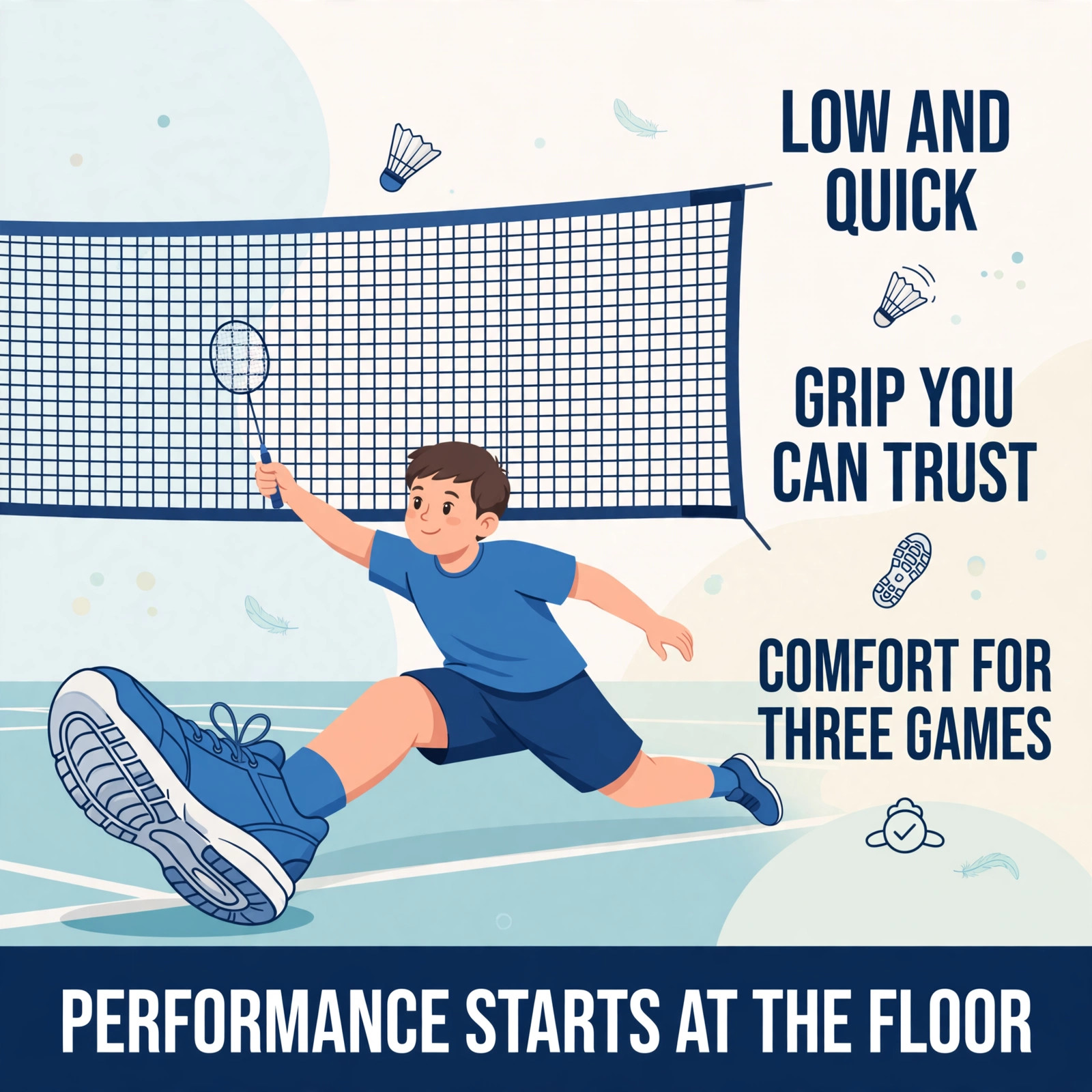
Performance Starts at the Floor: Grip and Court Feel
Grip is where performance starts, and badminton grip comes from gum rubber soles. The soft, pale rubber used on court shoes is made to bite smooth indoor floors, and its tread pattern spreads that bite across the whole foot as you lunge and turn. The enemy is dust: a dusty sole on a dusty court is ice on ice. Players who wipe their soles with a palm or a damp towel between games are not fussy; they are maintaining the one contact patch their whole game stands on. Check grip by pressing and twisting the shoe on a smooth floor: it should resist and squeak, not skate.
Court feel is grip’s partner. A badminton shoe sits low, keeping your foot close to the floor so changes of direction feel direct and the ankle stays in a safer position. Tall, soft running shoes do the opposite: they lift the foot onto a wobbly platform built for straight lines. On court that height turns a wide lunge into a roll risk. When you try shoes, stand on one leg and lean gently sideways; a court shoe should feel planted and honest, telling you exactly where the edge is. That feedback is performance you can feel before you ever play a rally.

Shoe Check #2
Cushioning and Comfort Over Three Games
Cushioning has one job: soften landings without stealing stability. The heel takes jump landings and the back leg of deep lunges. The forefoot takes split step landings and push offs, hundreds of times a session. Modern court shoes use foam midsoles tuned for this, soft enough to absorb, firm enough to push back. Judge cushioning over time, not by the first step in the shop: a shoe that feels like a pillow at minute one can feel like a boat by game three if the foam is too soft to hold your foot steady.
Balance is the honest word for cushioning. Too soft, and the foot sinks and rolls inside the shoe on sideways moves, which tires the legs and worries the ankles. Too hard, and every landing sends its shock into heels, knees and shins, which players feel the next morning. Heavier players and rear court jumpers usually want more cushion under them. Light, fast net players often prefer less, trading softness for speed of response. Neither is wrong. The test is personal: land from a small jump in the shop and notice whether you feel protected, stable, or neither.
Comfort over three games also means temperature and room. Feet swell as a session warms up, so a shoe that is perfect at the first try on may pinch by the third game if it started exact. Leave a thumb’s width in front of the longest toe, and try shoes later in the day when your feet are closer to playing size. In Malaysian halls, breathable uppers matter more than insulation: mesh panels that let heat out keep feet, socks and tempers in better shape by the final game of the night.

Shoe Check #3
Lateral Support: Built for Sideways Movement
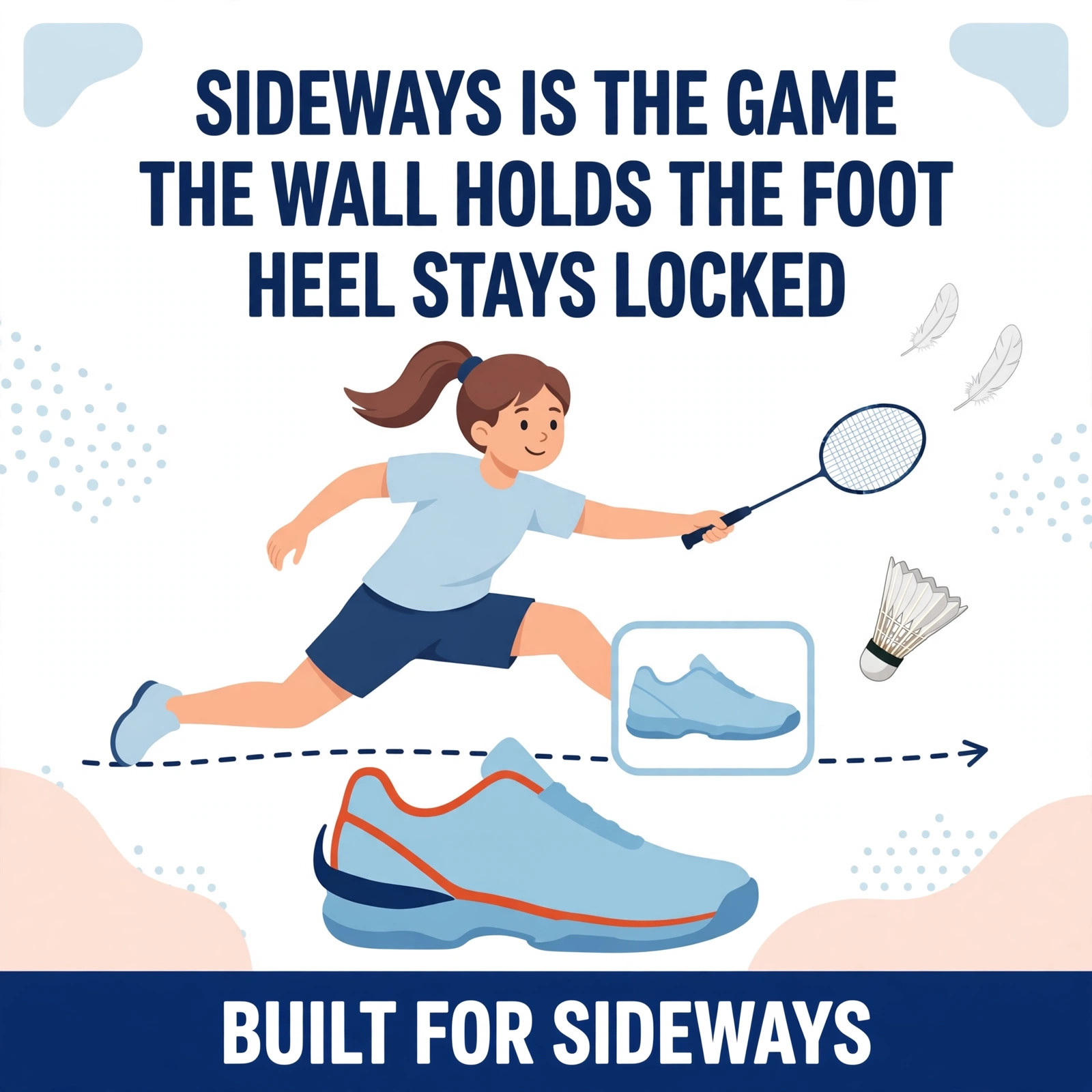
Badminton is a sideways game wearing a forward game’s clothes. The lunge loads the shoe along its outer edge. Side steps and defensive dives drag the toe and the side wall across the floor. Shoes built for this have reinforced side panels, a sturdy drag guard where the toe scrapes, and an upper that holds the foot over the sole instead of letting it spill past the edge. Look at the shoe from above and press the outer wall: it should push back, not fold. That wall is what stands between a long reach and a rolled ankle.
The heel counter and the midfoot do the quiet half of support. A firm heel cup keeps the heel seated so the whole shoe moves as one piece with the foot. Through the middle, the shoe should resist twisting; grab toe and heel and wring gently, and a good court shoe twists a little, not like a towel. When support fades with age, the signs show in play first: the shoe leans outward, the upper stretches baggy, and landings feel vague. Learn to read those signs in your own pair and you will replace shoes on evidence, not on advertising.
Running shoes deserve one clear paragraph, because the mistake is common. A running shoe is engineered for one direction: forward, heel to toe, on a raised cushioned stack. Badminton moves sideways, backwards and diagonally, low to the floor, with the ankle loaded at angles running never asks for. Putting a runner on court borrows its comfort and keeps none of its safety. If budget forces a wait, a plain low trainer with a flat sole is a safer stopgap than a premium runner. Save for the court shoe; it is the one purchase this sport truly insists on.
Shoe Check #4
Weight, Fit and Your Playing Style
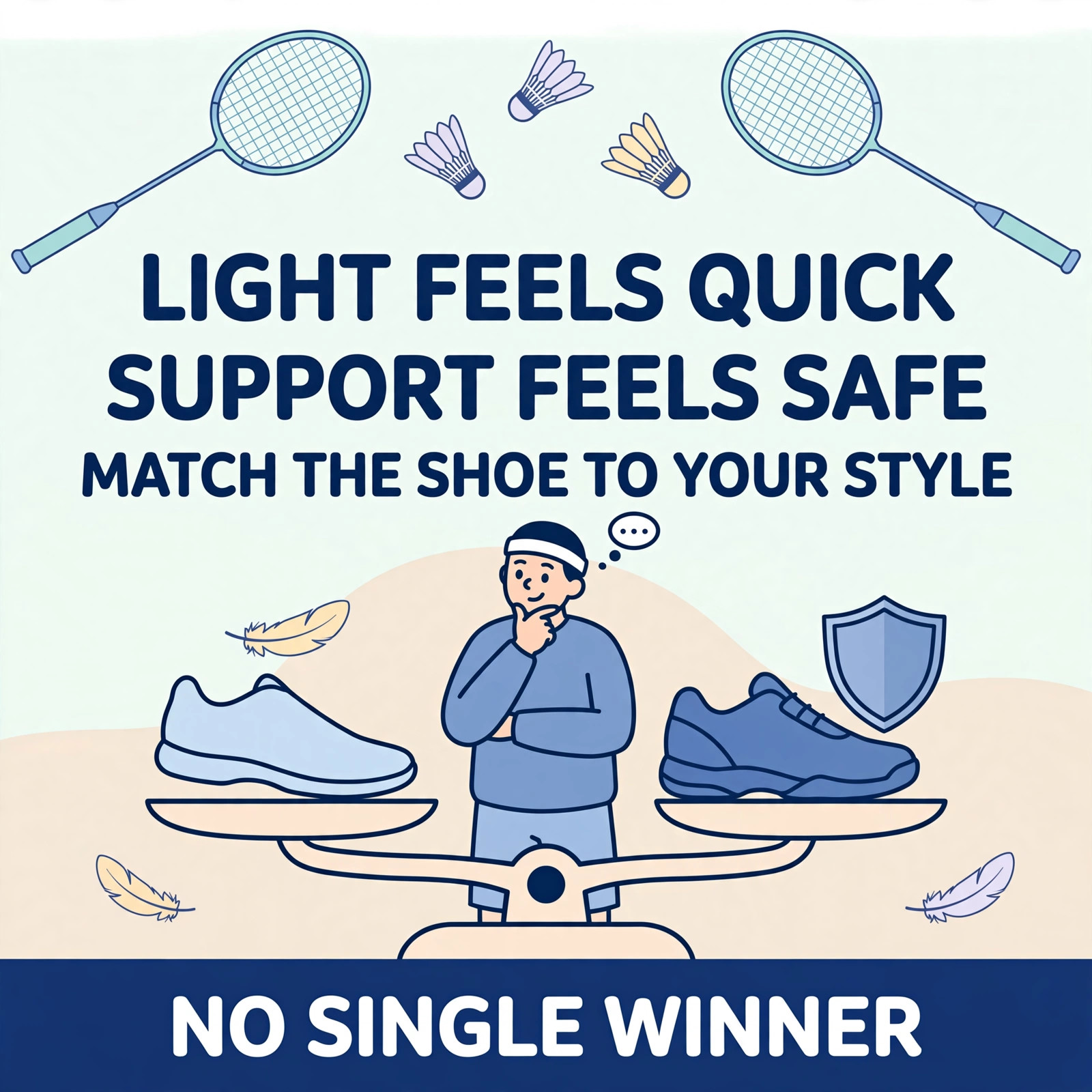
Weight is the trade off players feel most and understand least. A lighter shoe disappears on the foot and suits quick, net heavy play; it usually carries less cushion and less armour, so it can feel bare in a long session and wear faster. A heavier shoe often brings more support and padding, and some players love that planted, protected feel at the back of the court. Neither end of the scale is the performance choice by itself. The question is what your game spends more of: steps or landings, speed or security.
Match the shoe to the player, not the poster. Fast juniors who live at the net often thrive in light, low shoes with sharp grip. Rear court players who jump smash for a living usually want cushion and a locked heel. Heavier adults and players with a history of ankle trouble should weight support higher than the scale does. Growing juniors need fit and support first, because feet and ankles are still forming; the lightest shoe in the shop is rarely the right gift for a child whose game is still being built.
Fit closes the section, briefly, because other guides cover it deeply. Heel locked with no lift when you lunge. Toes free with a thumb of room. No pinch across the widest part of the foot. Try both feet, in your playing socks, and lunge in the shop on both sides. Feet differ, mornings differ, and a shoe fitted to a rested morning foot in thin socks will argue with you by game three. Fit is not a size; it is a test you run, and this guide’s last section gives you the full routine.
Shoe Check #5
Testing Shoes in the Shop and Replacing Them
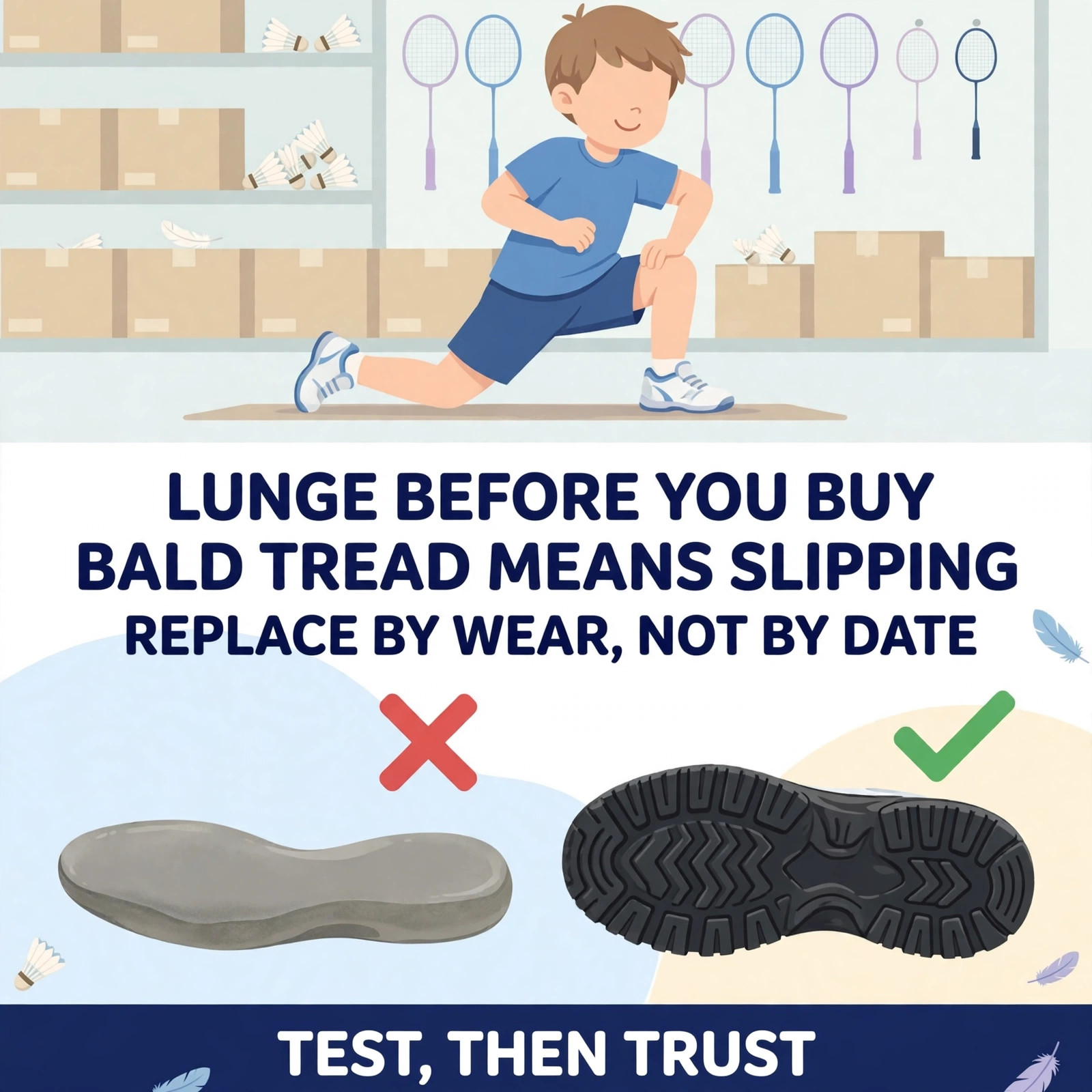
The shop test is four moves. Lunge forward on each leg as deep as class drills demand and feel for heel lift and toe jam. Shuffle sideways quickly and feel whether the foot stays over the sole. Jump and land on both feet, then on one, and judge the cushion honestly. Finally, drag the toe lightly as in a defensive dive and check the side wall holds. Ten honest minutes of this tells you more than any review, because it is your foot, your weight and your movement answering.
Replace court shoes by wear, not by the calendar or the new season’s colours. The tread goes first: when the gum sole is bald or shiny in the lunge zone, grip is gone and no cleaning brings it back. The midsole dies next, creasing deeply and landing flat and dead. The upper retires last, leaning outward and letting the foot drift. For a player training steadily, grip usually gives the first warning inside a year or so of hard use. Play on past all three signs and the shoe stops being equipment and starts being a risk.
Care stretches the honest life of a pair. Court shoes are indoor shoes: wearing them on concrete car parks and rough walkways grinds the gum tread away before its time. Air them after sessions, loosened, out of the kit bag, so the foam and upper dry fully. Keep them out of a hot car boot, where Malaysian heat cooks foam and glue. Wipe soles before play, not after. Small habits, and together they decide whether a pair gives you its full season of grip or half of one.
Myth vs Reality
Myths About Badminton Shoes
Myth one: running shoes are fine for badminton if they are good running shoes. The better the runner, the worse the mismatch, because premium runners are taller, softer and more forward shaped than ever. On a sideways lunge that stack is a lever aimed at your ankle. A court shoe’s low, wide, grippy base is not a marketing category; it is the shape the sport’s movement demands. Wear runners for runs. Your ankles will notice the difference the first time a lunge goes long.
Myth two: more cushioning is always better. Past a point, extra softness costs stability, court feel and push off, and can tire legs faster than it saves them. Cushioning is a balance to strike for your weight, level and style, not a maximum to chase. The shoe that lands you softly and still lets you change direction sharply is the cushioned shoe. The one that feels like standing on a mattress is a sponge with laces, whatever the box promises.
Myth three: the most expensive shoe performs best. Price buys materials and marketing in mixed proportions, and neither guarantees that a shoe fits your foot, your weight and your game. A mid priced shoe that passes the four move shop test will outplay a flagship that pinches, lifts at the heel or wobbles sideways. Criteria first, labels last: grip, cushion in balance, lateral support, fit by test. If a shoe passes all four, its price stops mattering to your badminton entirely.

Why Choose Us
Why Players Choose ST Badminton Academy
Coaches at ST Badminton Academy read feet the way they read grips. A slip in a lunge, a heel lifting out of a shoe, a junior rolling the same ankle twice: these show in class before they show in a shop. With a maximum of four students per group, such details are seen early and said plainly. Most shoe trouble we meet is not exotic: runners worn on court, shoes a season past their grip, or a growing foot still in last year’s size. All three are cheap to fix once someone names them.
The academy does not sell shoes, and that is deliberate. Advice with no stock behind it can be honest: your shoes are fine, wipe the soles and play; or, this tread is finished, replace the pair before the school tournament, whatever the colour of the new models. Parents of juniors hear the same straight approach about growth and fit checks. Trust is the academy’s real product, and it is built in small conversations like shoe advice, where saying do not buy yet costs us nothing and earns everything.
Learning to test and read your own shoes is part of becoming a complete player. A junior who can run the four move test, check tread with a thumb, and say why runners stay off court has learned to manage the base of every movement they will ever make. That judgment protects ankles and wallets for decades. At the academy we teach it openly, because a player standing in the right shoes stops thinking about their feet, and feet that are forgotten are feet that can fly.
FAQs: Badminton Shoes, Performance and Comfort in Malaysia (KL)
Here are the questions players and parents ask us most about badminton shoes, performance, comfort and fit, and how our coaches advise on footwear in Kuala Lumpur and Setapak.
What shoes should a junior wear for classes in Setapak or Gombak?
Court shoes, properly so called: a low shoe with a gum rubber sole, real lateral support and a fit checked by lunging in them. Not running shoes, however good. Juniors grow fast, so check the fit each term, and let support and grip outrank lightness while feet and ankles are still developing.
How much cushioning do badminton shoes need for training in KL?
Enough to land jumps and lunges without jarring, and firm enough that the foot does not sink and roll on sideways moves. Heavier players and rear court jumpers usually want more; light net players often prefer less. Judge it by landing tests in the shop, never by pressing the sole with a thumb.
How long should court shoes last a player training at a steady level?
Grip decides first: when the tread in the lunge zone is bald or shiny, the shoe is done, however young it is. With steady training that often shows inside a year or so. Midsole creasing and an upper that leans outward are the following signs. Replace on wear, not on the calendar.
Are lighter shoes always quicker, or does support matter more?
No. Light shoes feel quick, but they usually carry less cushion and support, and some players land worse and tire faster in them. Support decides how safely you can use your speed over three games. Match the balance to your style: net players may lean light, jumpers and heavier players lean supported.
What should I check before buying badminton shoes for classes?
Check grip by pressing and twisting on a smooth floor, support by leaning sideways on one leg, and fit by lunging both sides in your playing socks, with a thumb of room at the toes. Then jump and land. A shoe that passes all four tests on your own feet is the right shoe.
Do your coaches check footwear for students near Wangsa Maju?
Yes, when the shoes are on court in front of them. Slipping soles, lifting heels and rolls all show in footwork drills. Coaches near Wangsa Maju and Setapak apply the same four checks as this guide and will say plainly when shoes are fine, worn out, or the wrong type for the sport.
Does your academy sell shoes or just advise players in Malaysia?
We advise; we do not sell shoes. Coaches explain the criteria, run the fit checks with the player, and send families to buy wherever suits them, or to keep the current pair if it still passes. The academy earns its living from coaching, which keeps its footwear advice honest.
How long does the grip on court shoes last with regular training?
The tread is the life line: gum rubber worn smooth or shiny in the lunge zone will not grip again, however clean it looks. Dust can be wiped; wear cannot. Steady players usually feel the first real grip loss after months of regular sessions, and hard indoor use shortens the span.
What makes Mr Eric Chuar a good coach for honest shoe advice for badminton?
Mr Eric Chuar has coached for over 15 years and answers shoe questions with criteria, not favourites. He starts with grip, balance and support, runs the same shop tests he teaches juniors, and refuses to call any priced label a shortcut to performance. Players trust advice that stays straight about trade offs.
Badminton Shoes and Court Comfort in Action


One Standard for Every Player and Every Session
The academy's standard for shoe advice matches its coaching standard: say what the item does, say what it does not do, and let the player decide with clear tests. Nobody at ST Badminton Academy will tell a junior that a famous shoe will fix their footwork. We will tell them how to choose grip, cushion and support that fit their game, and how to read the wear that ends a pair's life.
| Factor | Bought on Labels | Tested on Feet SHOE |
|---|---|---|
| Frequency | 1 or 2 times a week. Mostly for fun and sweat. | A shoe chosen by grip, balanced cushion and sideways support. |
| Drills Focus | Basic static feeding. Minimal footwork pressure. | Fit proven by lunging, shuffling and landing in the shop. |
| Physical Conditioning | Rarely included. Just playing games on court. | Core, agility, and speed training included in every session to prevent injury and build stamina. |
| Tactical Awareness | "Just hit it over." No real game plan. | Video analysis, point construction, and learning to read the opponent's game. |
| Coach Ratio | Large groups (8-10 kids). Coach barely watches you. | Max 4 students. Mr Eric Chuar personally corrects every stroke and movement detail. |
| Goal Setting | Fun and exercise. | Wear read honestly and replaced when the grip gives up. |
| Long Term Result | Good recreational player. | A player who trusts the floor under every lunge. |
Badminton Coaching and Honest Gear Advice in Kuala Lumpur
Performance begins where your feet meet the floor. Choose grip you can trust, cushion in balance, support built for sideways, and a fit proven by your own lunges in the shop. If your child trains with us at ST Badminton Academy in Setapak, Kuala Lumpur, ask any coach to watch their feet for one session. We will tell you plainly what the shoes are doing, and whether the pair still earns its place on court.





