
 All languages
 Chinese (Simplified)
 Chinese (Traditional)
 English
 Indonesian
 Japanese
 Korean
 Malay
 Thai
 Vietnamese


How Can You Develop Your Badminton Backhand Net Shot Technique Through Training (Backhand Net Shot Guide)
The backhand net shot is the quietest shot in badminton: played from the front court on the backhand side, struck softly in front of the body, and finished with the shuttle tipping over the tape and dropping close on the other side. Players tend to file it as a wrist trick, something the gifted ones flick in without thinking. That filing is wrong, and it costs points at the net every week. A trained backhand net shot is not a flick. It is a grip, an arrival and a settle, in that order: the backhand grip with the thumb guiding the face, a balanced lunge that arrives early, and a contact so calm the shuttle seems to fall over the tape by itself.
Net Shot Check #1
What A Backhand Net Shot Really Is
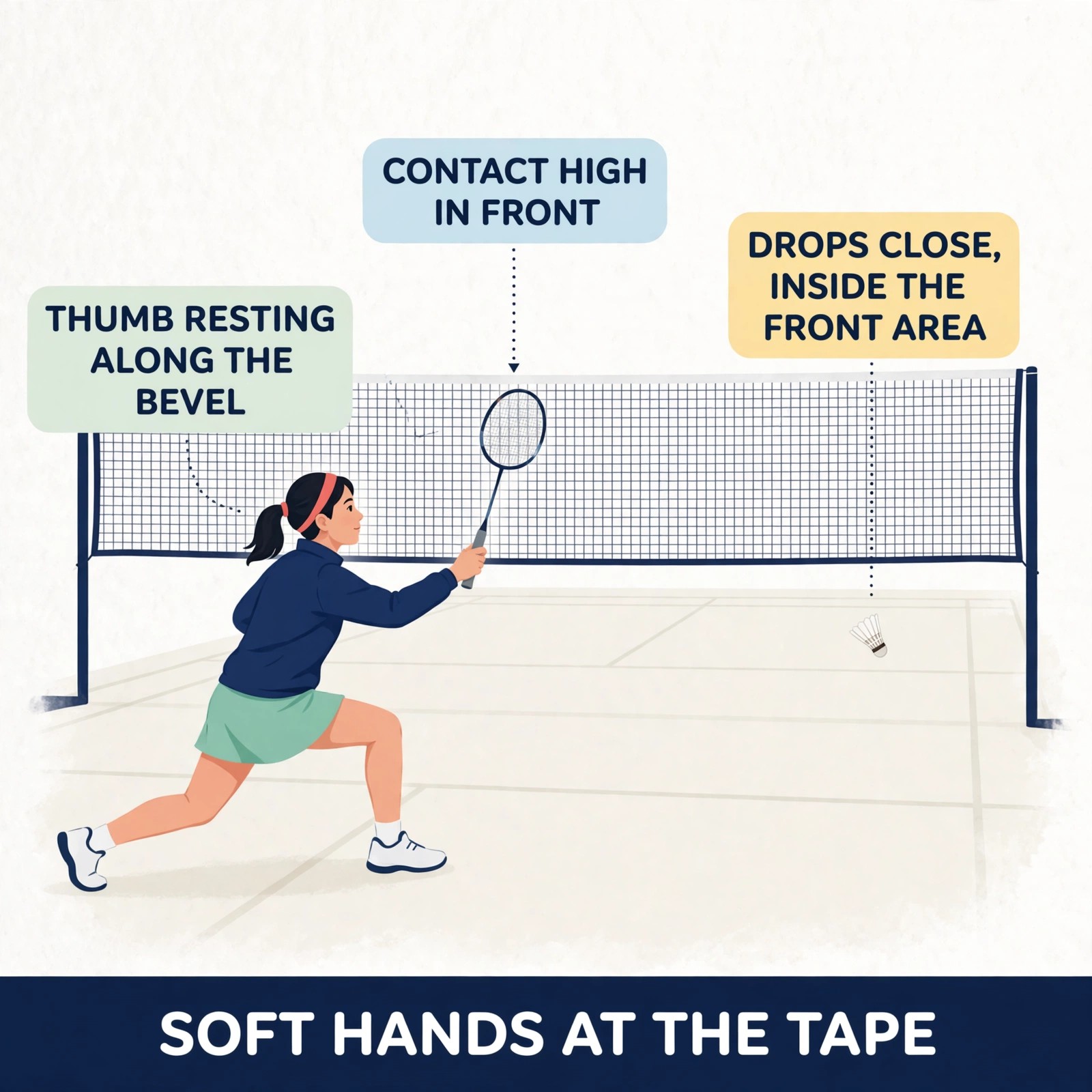
A backhand net shot, in the way this page uses the term, is a soft shot played on the backhand side from the front court, struck in front of the body at or just below tape height and sent tumbling close over the tape into the front area of the far court. Its family is the backhand lift and the backhand crosscourt net shot, which share its grip and its calm shape; the straight net shot is the tightest member. It is graded by two things: how close it crosses to the tape, and where it lands inside the front area, never by how clever it looked or how fast the hand moved.
The cost of a weak backhand net shot is paid at the tape and in the rally that follows. Struck late, with the shuttle already dropping below the tape, the same soft push has to lift the shuttle first, and it arrives high and slow for the net player to kill. Gripped tight, the shuttle bounces off a hard face and flies long, or catches the tape and dies on your own side. Swung at, it sails: a net shot with a swing in it is a lift wearing a disguise. Opponents read all of this within a game and start standing closer to the net on your backhand side, because they know the tight answer is not coming.
Net Shot Check #2
Grip And Contact: The Backhand Net Base
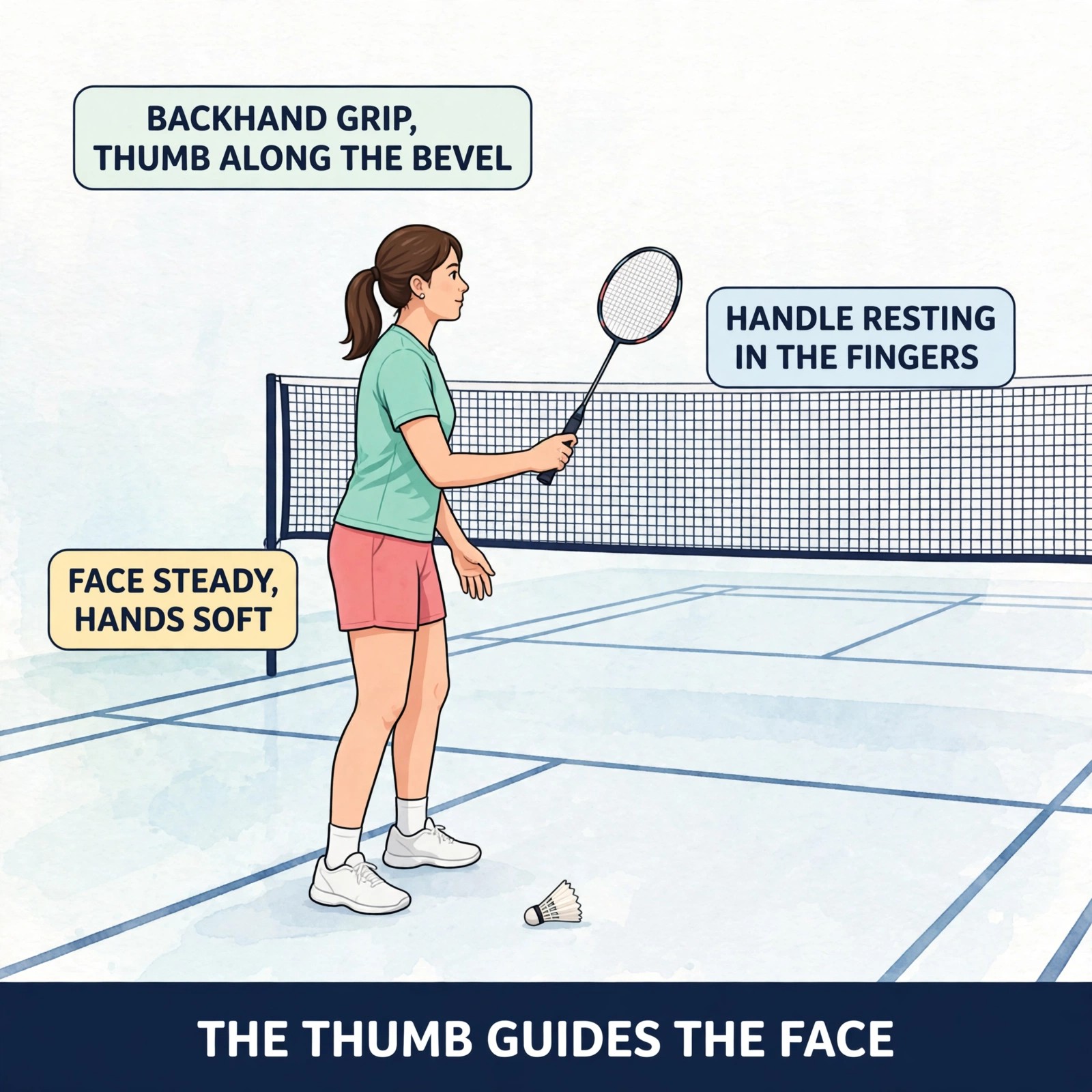
The base of the shot is the backhand grip, and it is specific. The thumb rests up along the wide flat bevel of the handle, the fingers wrap the handle with the hold sitting in them rather than clenched in the palm, and the racket face points the way the thumb points. That thumb placement is what lets the face stay steady while the hand stays soft: the thumb guides, the fingers rest, and the shuttle can be settled rather than struck. Players who squeeze the handle turn the face into a springboard, and the shuttle bounces off it long or into the tape. The grip is checked first here, before any net drill is counted.
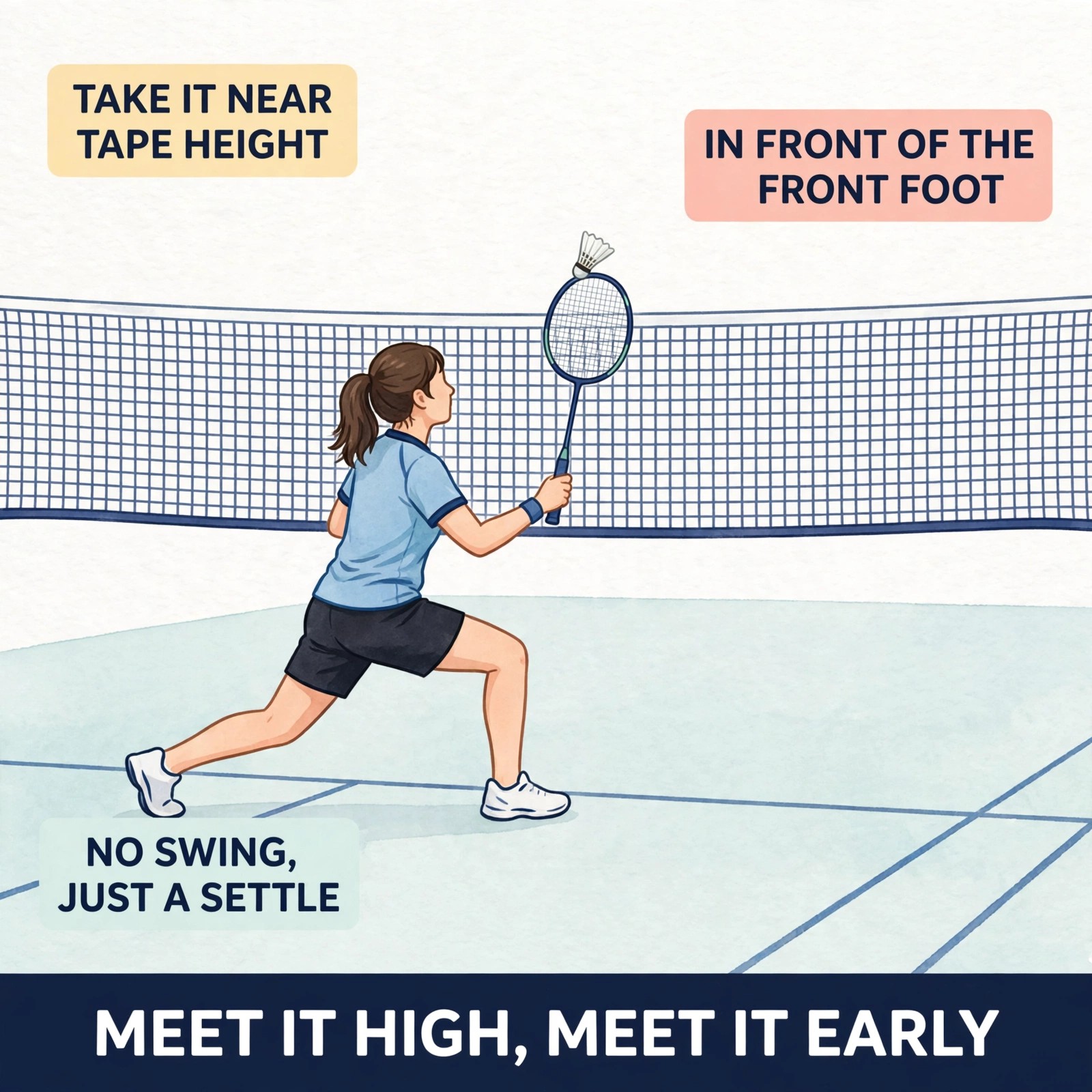
The contact itself is a settle, not a swing. The racket is carried up early and held still in front of the body, the shuttle is met as high as the arrival honestly allows, and the face simply receives it and lets it tip over the tape. There is no flick and no push worth naming; the shuttle brushes off the strings, turns over in the air and drops. That stillness is why the shot is trained at contact speed in feeding before it is trusted in rallies: a hand that wants to help will add a flick under pressure, and the flick is exactly what sends the shuttle long. Soft hands are not a talent. They are what is left when the swing is removed.
Backhand net faults repeat on a short list. The first is the tight grip, the handle squeezed until the face bounces the shuttle away. The second is the late arrival, the feet reaching the front court after the shuttle has dropped below the tape, which turns every net shot into a small lift. The third is the low contact, the shuttle met beside the front foot instead of in front of it. The fourth is the flick, a small wrist swing added at contact that sails the shuttle long. And the fifth is the painted target, net shots aimed at the tape itself until the net errors lead the landings. Each fault maps to a repair in this page’s order: grip first, arrival second, contact third, targets last.
Net Shot Check #3
Reading And Targets: Arc, Height And The Front Area
Choosing the net shot starts with reading what is arriving, and the read is the same three-part read used across this site: the arc the shuttle leaves on, the height it crosses at, the speed it arrives with. A shuttle arriving high and slow at the front gives the striker time to arrive and settle. A shuttle arriving fast and flat gives less, and one already dropping below the tape on your side has quietly changed the question: the tight net answer is gone, and the honest replies are the lift or a softer crosscourt that buys the rally back. The trained net player reads the height first, because height, not nerve, decides whether the net shot exists.
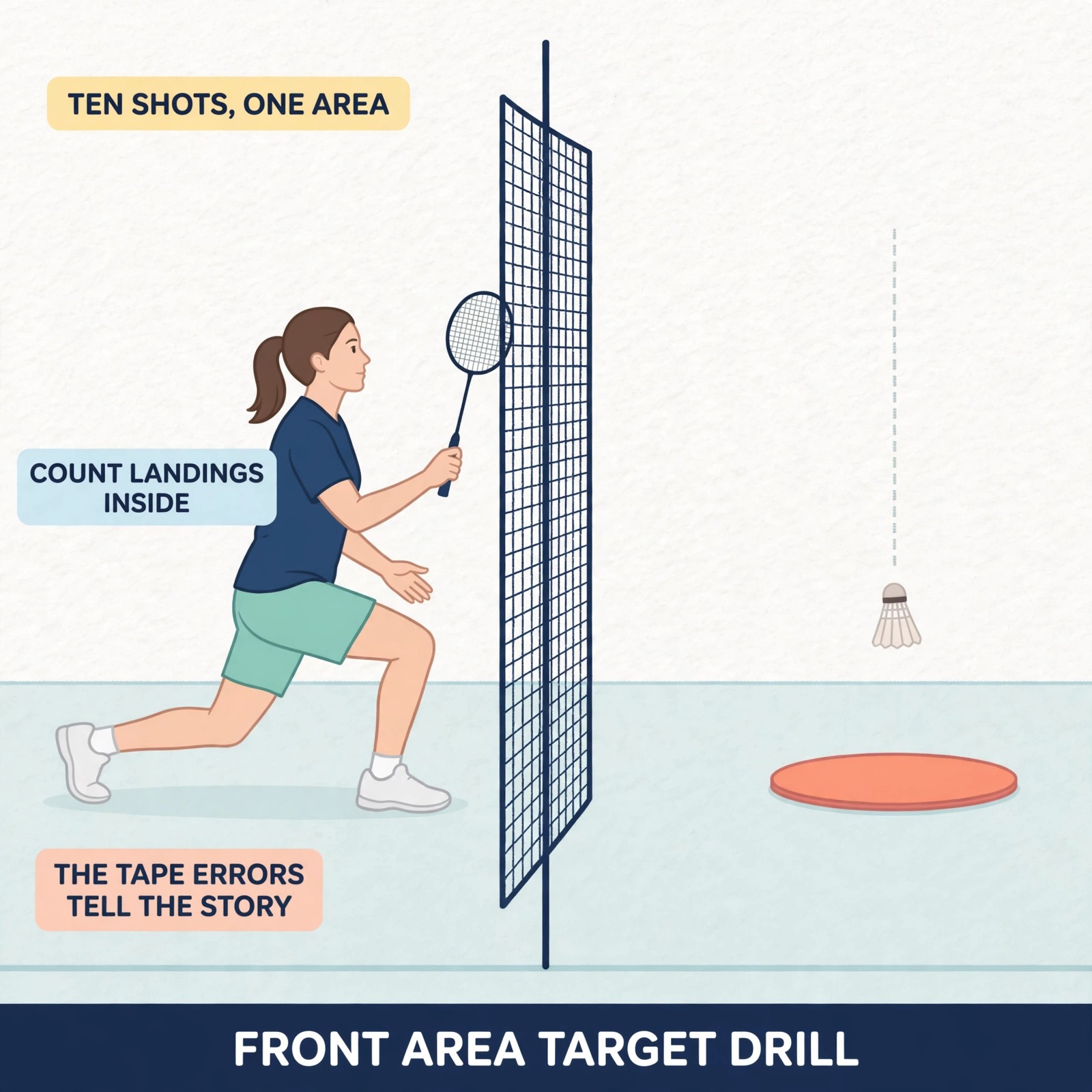
The honest net target is an area, never the tape. Aim at the middle of the far front area, close behind the net with plain court around it, and the shot tolerates the small errors every soft contact carries: a fraction early or late in the settle still lands in, still tight, still ahead of the net player’s racket. Aim at the tape itself and the same errors split between clips that drop in and donations that catch the cord. In training the score is plain: landings inside the front area out of ten, with net errors, the ones that catch the tape, kept as their own separate number, because the net error count is the contact made visible.
Choosing the backhand net shot is a decision with honest borders. It earns its place when you arrive balanced with the shuttle still near tape height: there it forces the lift or the loose reply and takes the front court away from the other side. It does not earn its place from a stretched lunge with the shuttle at your ankles, where forcing it donates the kill, or against a net player already standing on top of the tape, where the crosscourt net shot or the lift is the honest address. The trained pattern is plain: play it tight from balance, rebuild from stretch, and let the counts in training settle where the border sits for you.

Net Shot Check #4
Choosing The Net Shot: Tight Answers, Honest Lifts
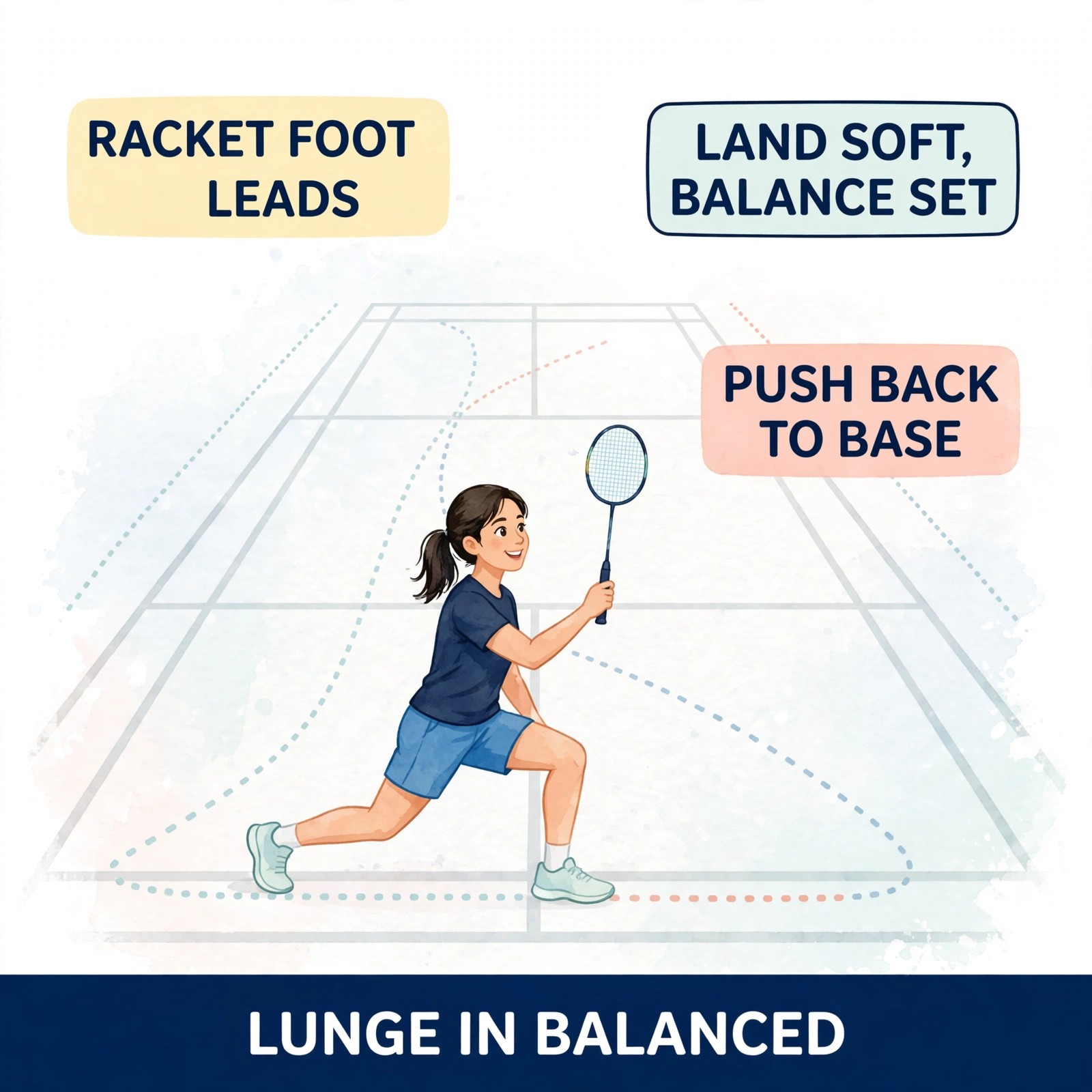
Arrival decides whether the shot exists at all. The lunge is taken early, the racket foot leads, the landing is soft with the balance set, and the racket is already up in front before the shuttle arrives. Arrive a fraction late and the contact drops below the tape, the face has to lift the shuttle, and the tight answer is gone before the hand is involved. Players who look calm at the net are not softer in the hand. They are earlier in the feet, and their contacts all look the same because their arrivals all look the same. In training we score the arrival with the shot: a backhand net shot only counts when the striker is settled, balanced and meeting the shuttle in front.
The recovery from a backhand net shot starts before the shuttle lands. The push back from the lunge begins as the shuttle tips over the tape, the racket stays up in front, and the first step returns toward base while the reply is still being chosen. The classic failure is the admired net shot: the striker watches her tight shot drop while the straight drive or the counter net shot passes the side she has not recovered from. Front court shots are loans taken against your own position, and the trained pattern pays them back at once. In training a net shot only counts when the striker is moving back before the shuttle lands.
Under pressure the backhand net shot fails in two honest ways. The first is the squeeze: behind in the third game, the hand tightens on the handle, and the settle becomes a bounce that flies long. The second is the rush: the lunge arrives late and hurried, the contact drops, and the shot becomes the small lift the net player was waiting for. Both drifts are repaired the same way, by returning to counted hand fed sets until the net shot at 19 all is the net shot from the warm up: same grip, same arrival, same still face. A note on the hand: this shot loads the fingers and forearm lightly but often, good shape and sensible volume lower the risk of strain, and pain during net work is a stop signal, not a milestone. Pain that keeps returning should be assessed by a doctor or a physiotherapist.
Net Shot Check #5
Backhand Net Shot Drills That Groove The Touch
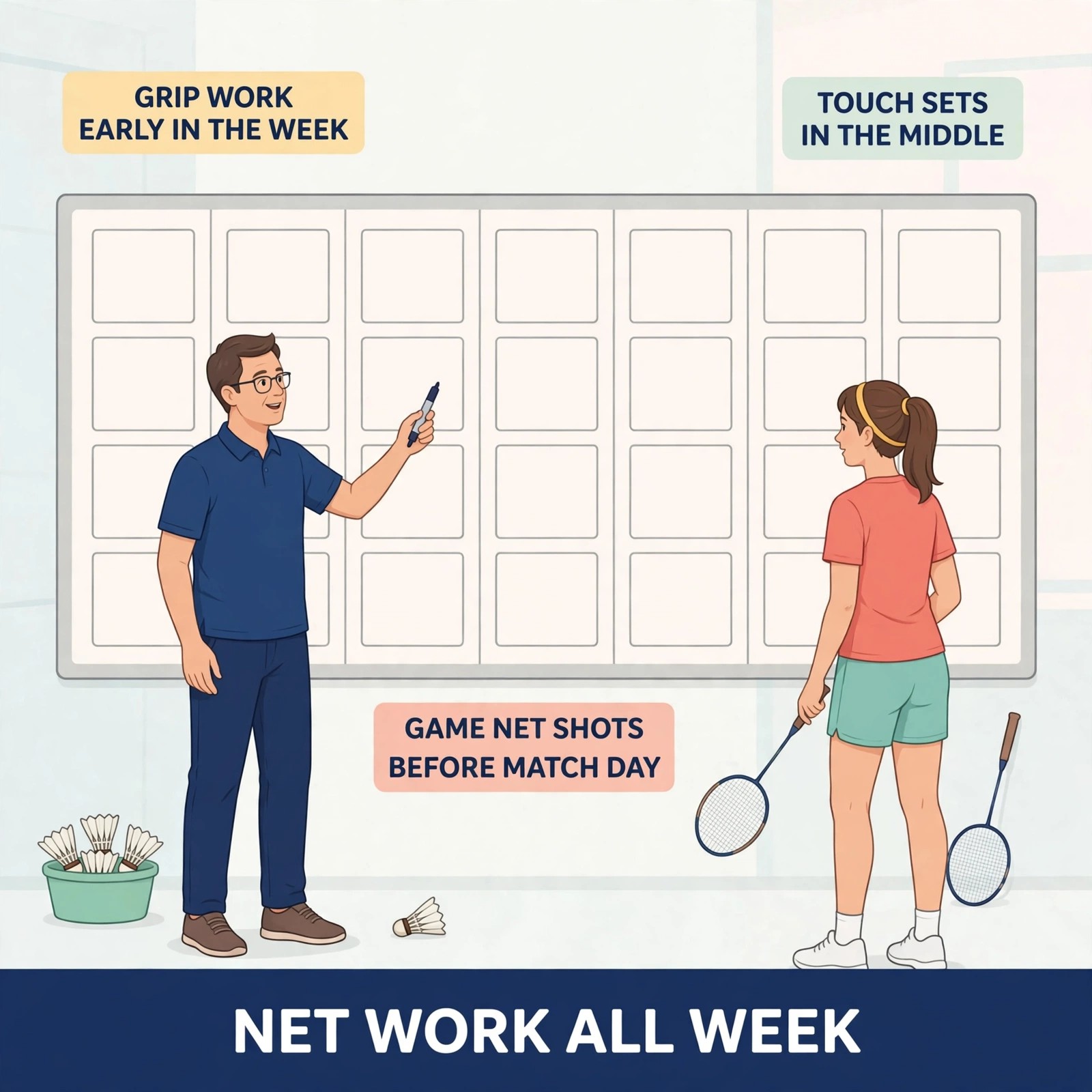
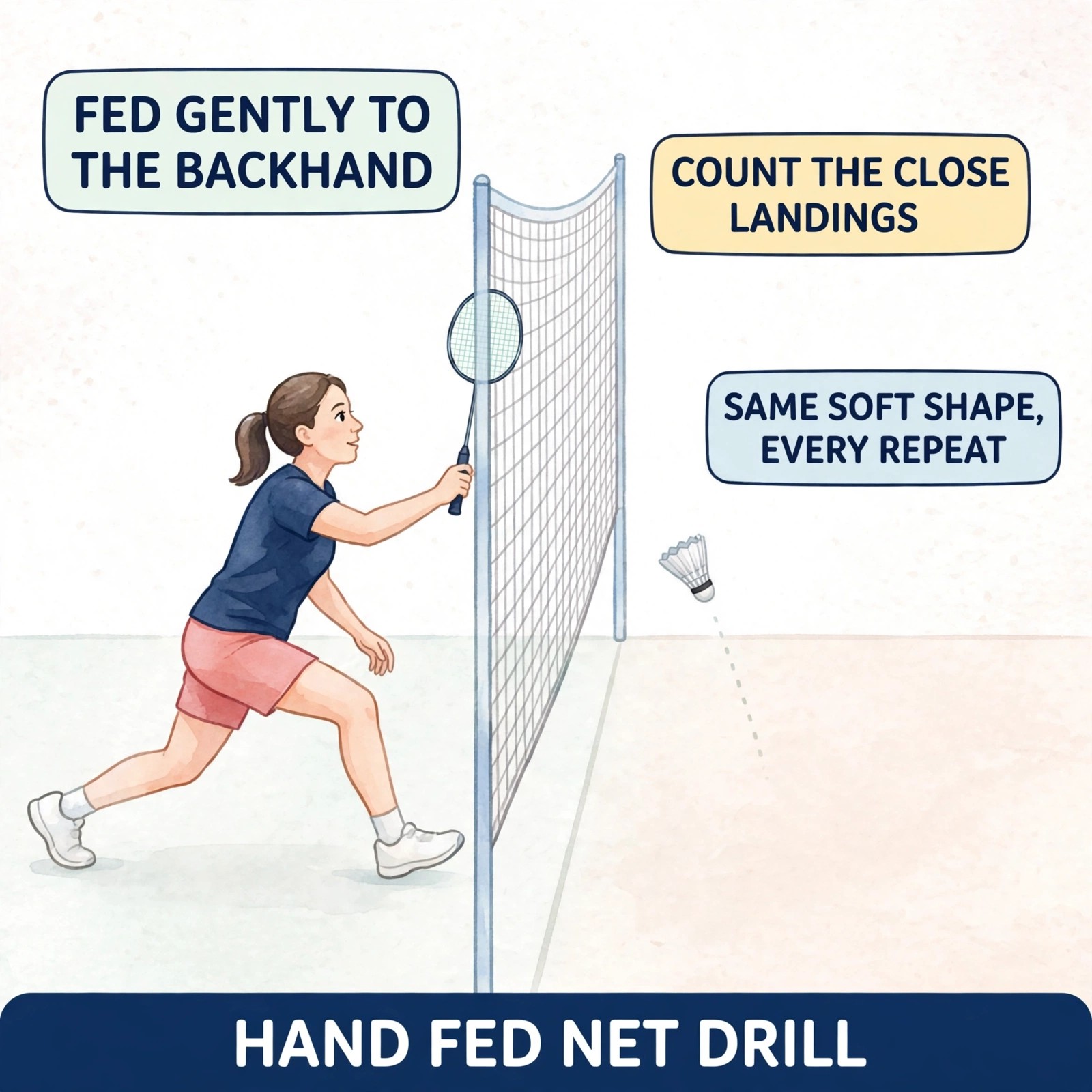
We train the backhand net shot in an order that protects the touch. First, grip sets: the thumb along the bevel grooved without a shuttle until the hand finds the hold itself. Second, settle sets: hand fed shuttles at the front court, landings counted inside the far front area and net errors counted separately. Third, arrival sets: the lunge and the contact trained together, shots counted only when the arrival was balanced. Fourth, choice sets: a caller names net or lift late, so the reading is trained with the shot. Last, game sets: net shots inside rallies against net players allowed to step in, with forced net shots scored against the striker. Each stage removes a hiding place the stage before left standing.
Progress is counted in landings and net errors, not in how delicate the shots looked. Landings inside the far front area out of ten is the headline figure every net player should know about herself. Net errors are the second number, kept separate, because a tape error is a contact fault with a score attached and folding it into a total hides the repair. And the read split: net shots chosen from balance against net shots forced from stretch, graded by a coach watching the rally rather than the shot. Feelings are unreliable witnesses at the net, since a forced one that drops feels like nerve and a plain area landing feels ordinary. The counts strip both stories away. When area landings rise and net errors fall, the touch is genuinely improving.
The signs a backhand net shot has taken hold show up in the opposition first. Net players stop crowding the tape on your backhand side, because the shuttle they used to step into has started dropping at their feet instead, and that half step back is room your lifts and crosscourts spend for the rest of the match. Your own errors change shape: the misses become landings a fraction long of the front area rather than tape donations, the errors of a shot living near its limits. And the lift gets chosen more honestly, because a player who trusts her net shot no longer forces it from stretch. That is when the work widens, to the crosscourt backhand net shot off the same grip and settle, each grooved the same way, grip first and counts beside it.
Myth vs Reality
Myths About Backhand Net Shots
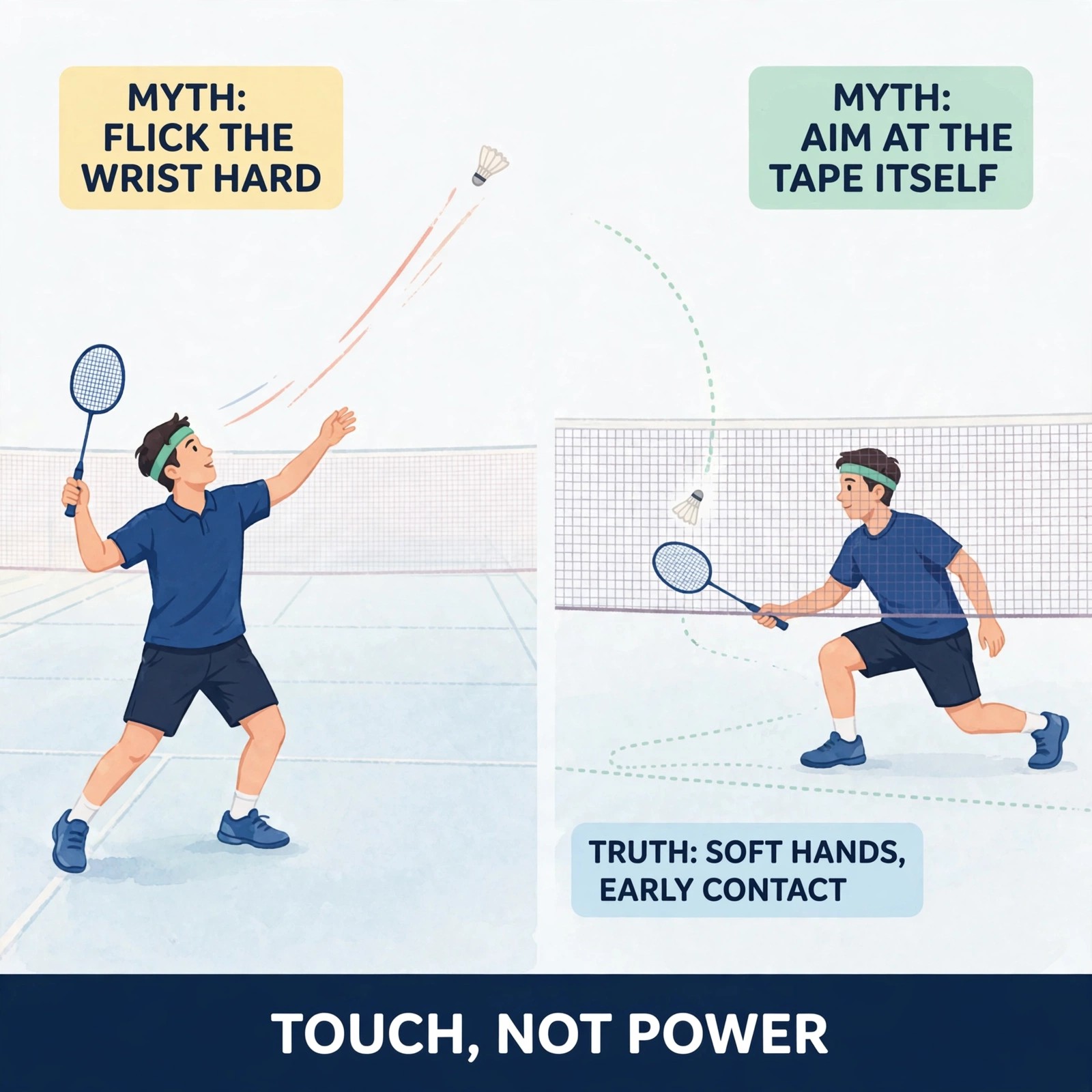
Myth: the backhand net shot is a wrist flick, so players should practise snapping the wrist at the tape. Reality: the flick is the fault, not the technique. A snapped wrist adds speed the shot never asked for, and the shuttle that needed to drop a racket length past the tape sails a court length past it instead. The trained contact is almost still: grip soft, thumb guiding the face, shuttle received and tipped over. Film a good backhand net shot slowly and the surprise is how little happens at contact. The work was all done earlier, by the feet that arrived in time and the grip that stayed loose.
Myth: the tighter a net shot skims the tape, the better it is, so the tape itself is the target. Reality: the tape is the border of the error zone, and aiming at it makes every net shot a coin toss between a clip that drops and a donation that catches. Trained net players aim at the front area just behind the net, an area with plain court around it, and the closeness to the tape comes from the contact height, not from the aim: a shuttle met high and in front crosses close by itself. Over a season, the area player outscores the tape painter at net shots by exactly the distance the net error count explains.
Myth: the backhand net shot is a defensive survival shot, a soft way of staying in the rally until it turns back to the forehand. Reality: played from balance it is a pressure shot. A shuttle dropping tight behind the tape takes the front court away from the other side: their net player cannot kill it, their rear player cannot reach it, and the honest replies are a lift that hands you the attack or a net answer played under pressure of your own. Players who treat the backhand net as a shelter lift from it by default, and a default lift at the front is the attack invitation the other side accepts all match.
Why Choose Us
Why Players Choose ST Badminton Academy
Players choose ST Badminton Academy for backhand net work because we coach the shot in its real order: grip, arrival, contact, choice. Your thumb placement is checked before your touch is admired, your landings inside the front area and your net errors are counted out of ten as separate numbers, and your choice between the net shot, the crosscourt and the lift is graded in rallies against net players who are allowed to step in. In a group of no more than four students, there is time to stand at the side and call your arrival and your contact height shot by shot. Many sessions admire soft hands. We also count tape errors, because the player whose numbers are honest knows exactly what to train next.
The sessions run the way this page describes. Backhand net work sits inside regular training: grip and settle sets early, hand fed sets with landings called aloud and tape errors written beside them, arrival sets where the lunge is graded with the shot, choice sets with the call made late, and game sets against net players reading on purpose. Coaches watch the thumb and the arrival together, since the shot fails when either one goes, and the notebook records area landings out of ten and the net error count for every net block. A student can point to the week her tape errors halved, and to the drill that did it, and that traceability keeps the work honest when a bad match argues otherwise.
We are based in Setapak, Kuala Lumpur, and students join us from across the Klang Valley, some travelling in from Wangsa Maju, Gombak and Setiawangsa for evening sessions. Backhand net coaching sits inside regular badminton sessions, not in a separate net clinic: your grip, your lunge and your choosing are trained in the same hour as your lifts, your defence and your games, because that is where the backhand net shot has to hold, against opponents aiming at the front court on purpose. A net shot grooved only against gentle hand feeds is a rumour about yourself. The game sets in the same hour settle whether it is true.
FAQs: Backhand Net Shots And Badminton Training in Malaysia (KL)
These are the questions players ask us most about developing a backhand net shot, before they book and during their first weeks of working on it. The short version runs through all of them: thumb along the bevel, arrive early and balanced, settle the shuttle in front, and count landings and tape errors. The longer answers follow, including the ones about net shots catching the tape under pressure, practising the grip and the settle alone without a feeder, and how a first session with us actually works.
Can a beginner learn an honest backhand net shot in Setapak or Gombak?
Yes, because the backhand net shot is a grip and an arrival added to front court play you already own, not a new talent. Beginners start with thumb and settle work in our Setapak sessions, in groups of no more than four students, and count landings inside the far front area from the first weeks.
What is the first backhand net shot habit a new player should build in KL?
The first habit is the grip: backhand hold, thumb resting along the wide flat bevel of the handle, the handle sitting in the fingers rather than clenched in the palm. The soft settle hangs on that placement, and the shuttle starts tipping over the tape within one hand fed set.
Why do my backhand net shots keep hitting the tape at a serious level?
At a serious level the squeeze and the rush arrive together: the hand tightens, the settle becomes a bounce that flies long, and the lunge lands late so the contact drops below the tape. The shape has not changed, only the calm around it. Counted hand fed sets with the score announced restore both.
My backhand net shots work in drills but die in matches. Should I flick harder or rebuild the grip and contact first?
Rebuild the grip and the arrival first. Flicking harder at a dropping shuttle only makes the long balls arrive faster. We restore the thumb along the bevel and the early balanced lunge, count ten landings inside the far front area and ten tape errors separately, and only then test the shot against a net player allowed to step in.
How can I practise the backhand net shot when I train mostly on my own in between classes?
Yes, in parts. You can groove the thumb placement and the still settle with a racket and no shuttle until the hand finds the bevel by itself, and tip tossed shuttles over a low line at home. Solo work builds grip and calm honestly; the arrival under a moving rally needs a feeder and a net.
Do you coach the backhand net shot beside badminton training near Wangsa Maju?
Yes. We coach the backhand net shot from our base in Setapak, a short drive from Wangsa Maju, and players from that side train with us every week. The work sits inside regular sessions rather than a separate clinic, so your grip, lunge and choosing are coached beside your lifts and games.
Where does ST Badminton Academy teach badminton training in Malaysia?
We teach at our base in Setapak, Kuala Lumpur, and students travel in from across the Klang Valley. Sessions run with no more than four students per group, because net touch is learned from arrivals and contacts watched shot by shot, and that coaching needs a coach close enough to call your lunge.
How do I book a trial session to test my backhand net shot?
Message us to arrange a trial at a time that suits your week. Bring your racket and court shoes, and we will watch your front court play for the first part of the session, then hand feed to your backhand side and count area landings and tape errors, so your first repair comes from evidence.
What makes Mr Eric Chuar a suitable coach for backhand net shots in badminton?
Mr Eric Chuar coaches the academy sessions himself, with more than 15 years of coaching in Malaysia and Singapore, so the person judging your grip is the person who built the programme. His backhand net coaching is plain spoken: thumb along the bevel, arrive early, settle in front, and the tape errors counted out loud.
Badminton Backhand Net Shot Training in Action
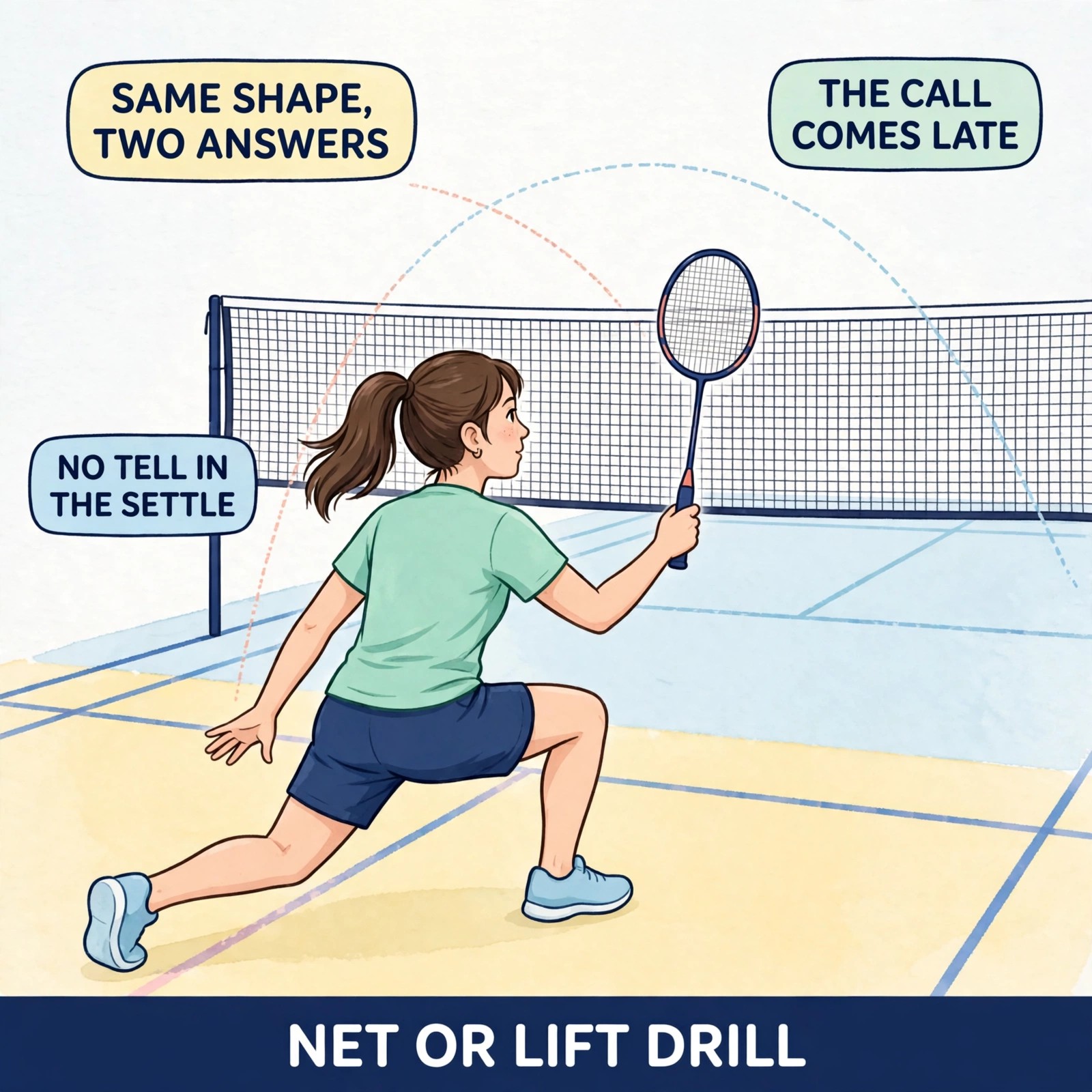
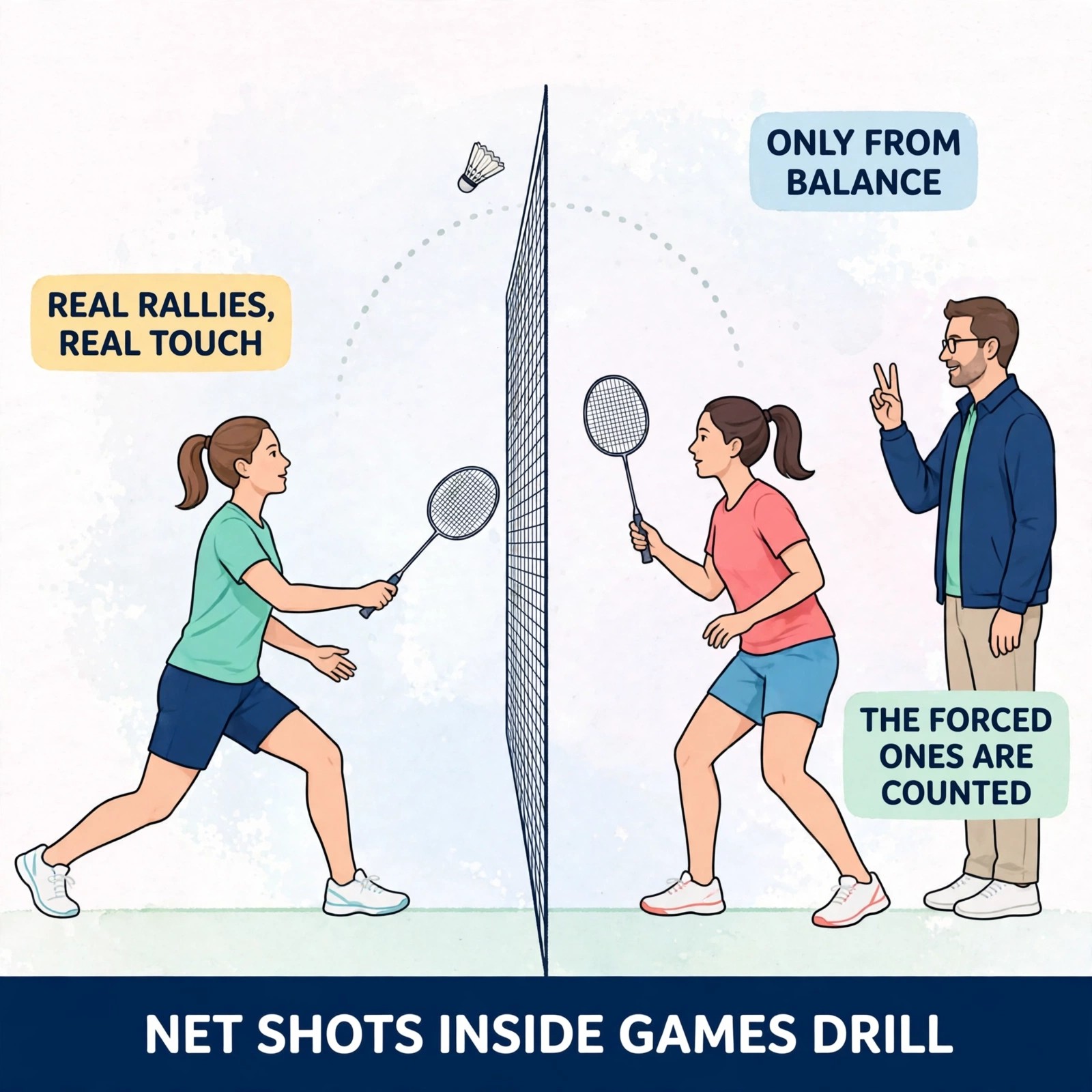
We benchmark our backhand net shot coaching against World Badminton (BWF) coaching standards and our own academy values: before any player trusts a training plan, they deserve honest checks. You can verify our coaches' credentials through the Badminton Association of Malaysia (BAM) coach education pathway.
One standard governs how we coach the backhand net shot: the grip judges the shot first, and the landing area judges it second. A coach here will ask how many of your last ten backhand net shots landed inside the front area and how many caught the tape before asking how tight any of them looked, and will check your thumb before admiring your touch. We also hold an honesty rule about what net coaching can promise: a trained backhand net shot forces more lifts and wins more front court exchanges, and it cannot promise the net will never be attacked again, because opponents train too. What coaching promises is a specific grip, an early arrival and landings counted in the open. Players deserve net shots built on evidence.
| Factor | The Soft Settler | The Tape Donor BACKHAND NET SHOT |
|---|---|---|
| Frequency | 1 or 2 times a week. Mostly for fun and sweat. | The tape donor squeezes the handle, arrives late with the shuttle dropping, and flicks at the tape until the errors pile up: balls into the cord, balls sailing long, and a net player who has stopped respecting the side entirely. Every miss is blamed on touch, as if touch were weather, so nothing in the approach ever changes. |
| Drills Focus | Basic static feeding. Minimal footwork pressure. | The soft settler approach builds the shot in order: backhand grip with the thumb resting along the wide flat bevel, a lunge that arrives early and balanced, a racket held still in front so the shuttle is settled rather than struck, and targets set as the front area inside the court. Landings and tape errors are counted out of ten as two separate numbers. |
| Physical Conditioning | Rarely included. Just playing games on court. | Core, agility, and speed training included in every session to prevent injury and build stamina. |
| Tactical Awareness | "Just hit it over." No real game plan. | Video analysis, point construction, and learning to read the opponent's game. |
| Coach Ratio | Large groups (8-10 kids). Coach barely watches you. | Max 4 students. Mr Eric Chuar personally corrects every stroke and movement detail. |
| Goal Setting | Fun and exercise. | Because the counts separate landings from tape errors, a bad week shows up as numbers rather than as a story about nervous hands. The coach sees which of grip, arrival or contact slipped, the player sees the same rows, and the next block of work is chosen by evidence instead of by whoever hit the tape most. |
| Long Term Result | Good recreational player. | The high-performance backhand net player answers at the tape with a shot that drops where the other side must lift or lose the point: chosen by the shuttle's height, settled in front, aimed at an area and recovered before the reply is played. The casual version sprays effort across a tight grip, a late lunge and a flick; the grooved version removes the waste in a fixed order and counts what is left. |
Badminton Backhand Net Shot Training in Kuala Lumpur
Your backhand net shot starts with one honest set of ten. This week, have a partner hand feed ten shuttles gently to your backhand side at the front court and answer each with a net shot toward the middle of the far front area, then write down two numbers: how many landed inside the area, and how many caught the tape. Then bring those numbers to a session with us and we will check your thumb and your lunge, and rebuild the fault the counts point at. No flick first. Just the grip set, the early arrival, and a shuttle tipping over the tape where you chose.


