
 All languages
 Chinese (Simplified)
 Chinese (Traditional)
 English
 Indonesian
 Japanese
 Korean
 Malay
 Thai
 Vietnamese


Best Badminton Class in KL: Turning a Missed Shuttle into a Useful Question (Question Guide)
The rally ends the way hundreds end every week: the shuttle clips the tape, or sails long, or lands in the net, and a small person looks at it lying on the court as if it owed them an explanation. What happens in the next ten seconds decides what that miss becomes. A shout from the side can turn it into a verdict: late again, wrong grip, not concentrating. Or a calmer voice can turn it into the most useful thing a lesson produces, which is a question. Not a complaint, not an excuse, just a clear, honest question the coach can actually answer. This guide is about that turn, and why it matters more than the miss.
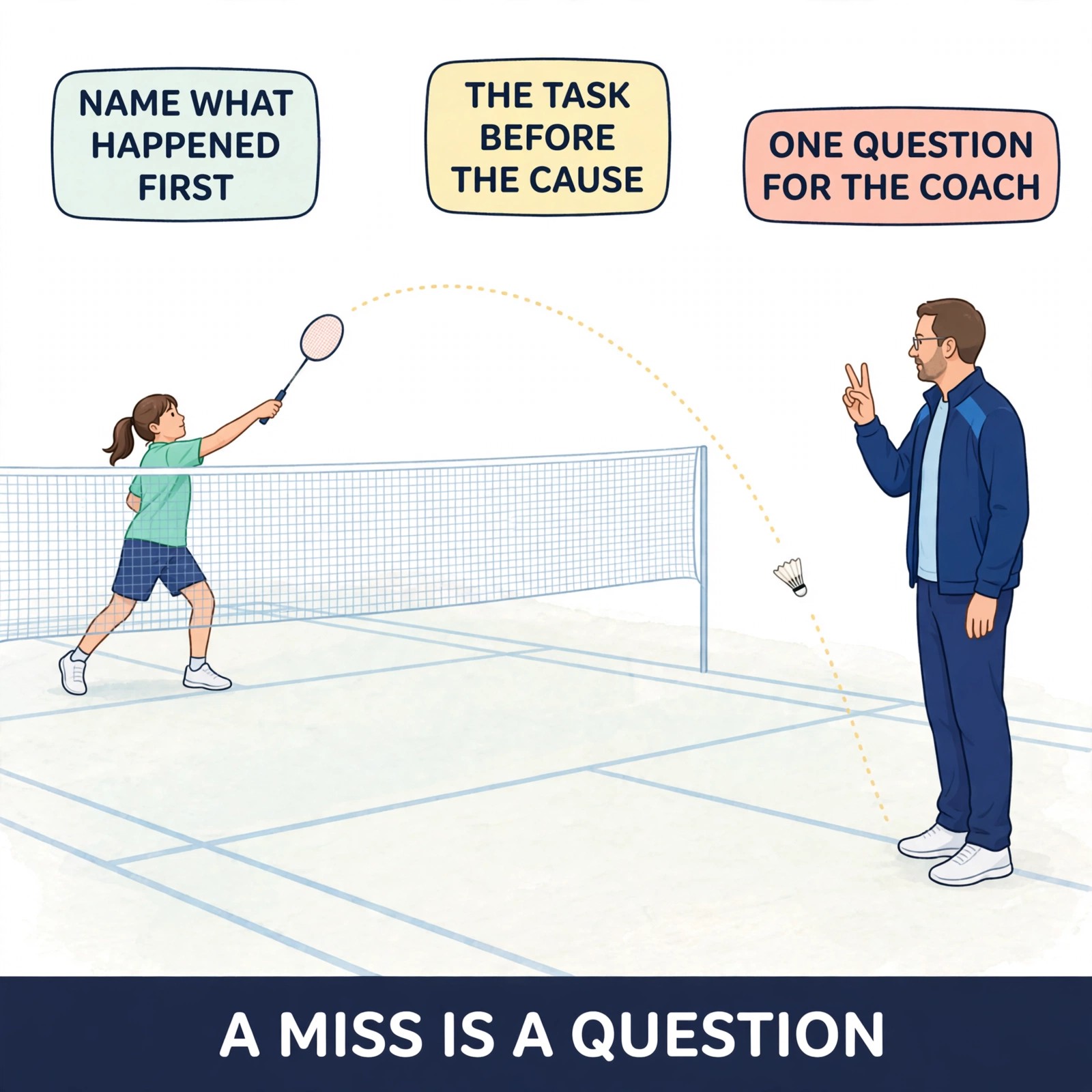
Missed Check #1
What A Missed Shuttle Really Shows
A missed shuttle is simply a shot that did not land where it was meant to. That plain description is worth holding on to, because a single result carries almost no information about its cause. The same netted clear can come from a late start, a rushed swing, a grip that had not finished changing, a shuttle that arrived faster than expected, or a child mid growth spurt whose reach changed last month. One miss cannot tell those apart, and neither can a parent watching from the door. What a miss can do, reliably, is start a good question: what was the task, what did the attempt look like, and what should be tried next.
It helps to say plainly what a miss is not. It is not evidence of carelessness, because careful children miss constantly while they learn; missing is how the edge of their current skill announces itself. It is not a character report, and it is not a coaching failure either, because a lesson where nobody misses is a lesson pitched below the learners in it. And it is not a puzzle a spectator can solve from the side. The honest reading of a miss is smaller and more useful than any of those: something was attempted, the attempt fell short in a particular way, and the pattern across attempts, not the single one, is where the teaching lives.
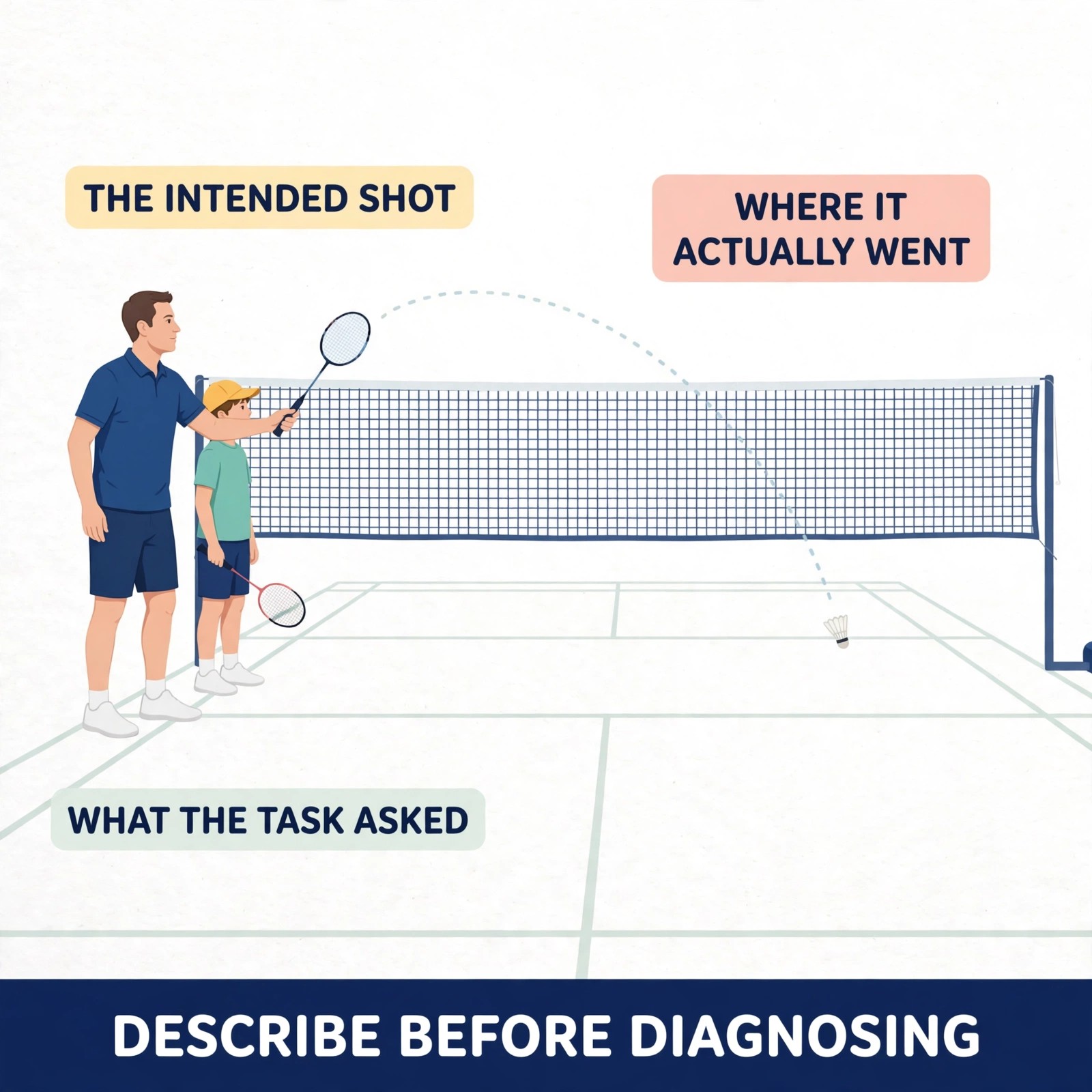
Missed Check #2
Inside The Miss: The Task, The Attempt, The Question
Start by naming what actually happened, before anyone reaches for a reason. The intended shot, and where the shuttle truly went: the clear that died at the net, the drive that floated wide, the drop that landed on the wrong side of the tape. Describe the attempt the way a camera would, without adjectives doing verdict work. Not a lazy swing or a silly error, just the shot, the task it belonged to, and the landing. That plain description is the raw material of a good question, because a coach can work with it. A label cannot be coached. A described attempt can.
Next, ask which observation matters. A rally produces a dozen details a parent could report: the feet, the grip, the timing, the look on a child’s face. Only one or two of them belong to the task being taught this week, and the coach knows which. Asking which observation matters hands the sorting to the person who set the task, and it protects the child from a pile of well meant corrections arriving all at once. The answer is usually short, and it is often not the detail the parent expected, which is exactly why asking beats guessing.
Finish by asking what to try next. Not what went wrong in the abstract, but the next attempt: the one change the child should carry into the following rally. A good next try is small enough to hold in the head while moving, and it turns the miss into an instruction the lesson can use straight away. Watch what happens to a child who leaves a miss carrying one clear try. The shoulders drop, the next rally starts sooner, and the miss shrinks to its true size, which is one shot among hundreds, already being answered by the attempt that follows it.
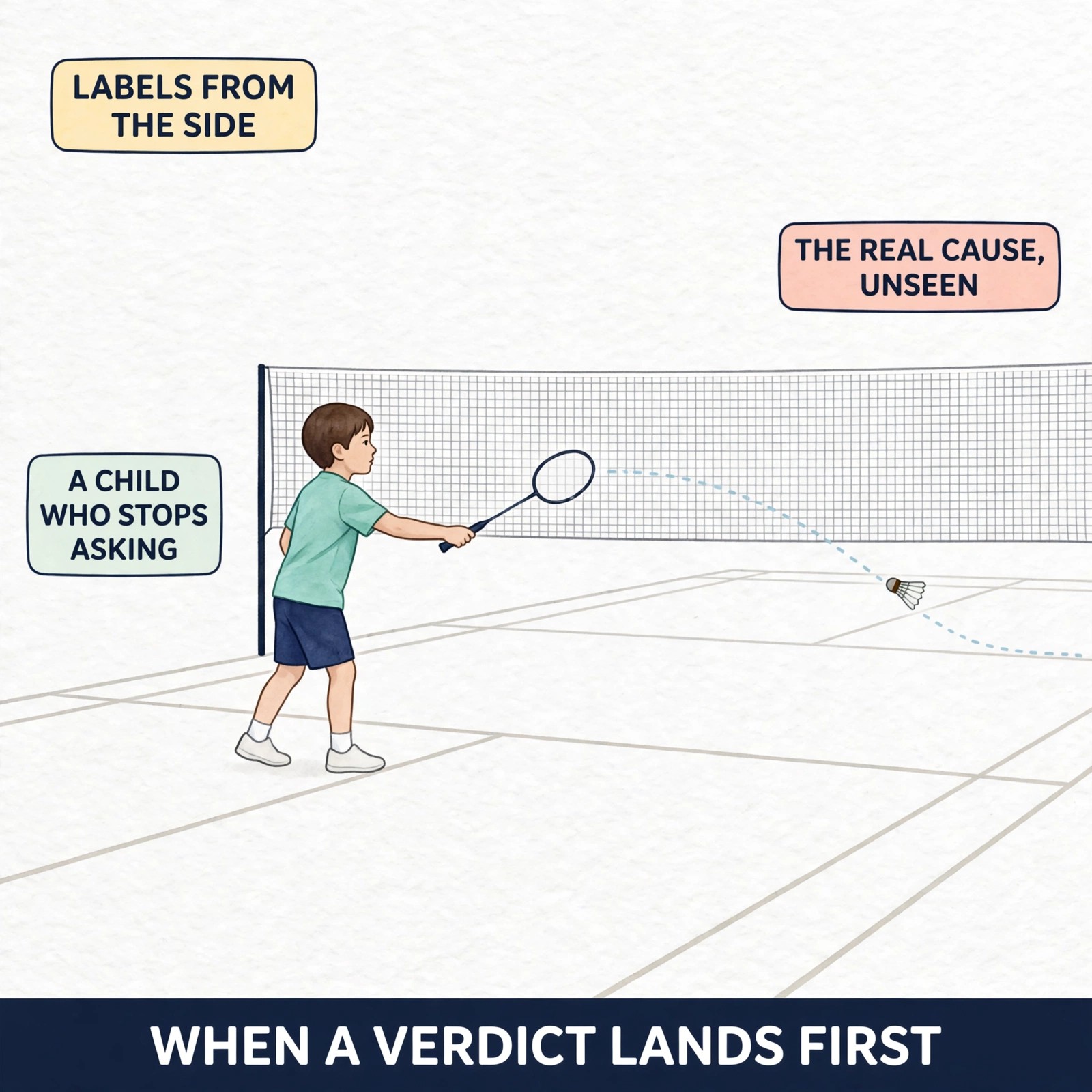
Missed Check #3
The Honest Cost: When A Verdict Lands Before The Question
The honest cost of the instant verdict lands on the asking itself. A child who hears a cause announced from the side every time a shot fails learns that misses are public events with blame attached, and children protect themselves the only way they can: they stop talking about them. Questions dry up first. Then attempts do, because a safe shot never draws a verdict, and a hall full of children playing safe is a hall where learning has quietly slowed to walking pace. The verdict feels like involvement. What it buys is silence, and silence is the one thing a coach cannot teach into.
There is a second cost, and it lands on accuracy. A cause named quickly and confidently from the side is usually wrong, not from carelessness but from distance: the spectator cannot feel the grip, see the starting position, or know what the drill was actually asking. A wrong cause, repeated with love, becomes a second coaching voice the child must reconcile with the first, and young children reconcile badly. They nod at both, follow neither cleanly, and conclude that their body is the problem. The miss was one shot. The wrong explanation can follow them for a term.
The third cost arrives at home, where the miss gets retold and enlarged. A parent who has settled on a cause in the car starts coaching it at the park: the grip lecture, the concentration talk, the replay of the rally nobody can check any more. The child now defends a shot instead of learning from one, and the drive home, which could have carried one good question, carries a small trial instead. None of this comes from not caring. It comes from answering a question that was never actually asked, when asking it, kindly and out loud, takes ten seconds at the hall door.
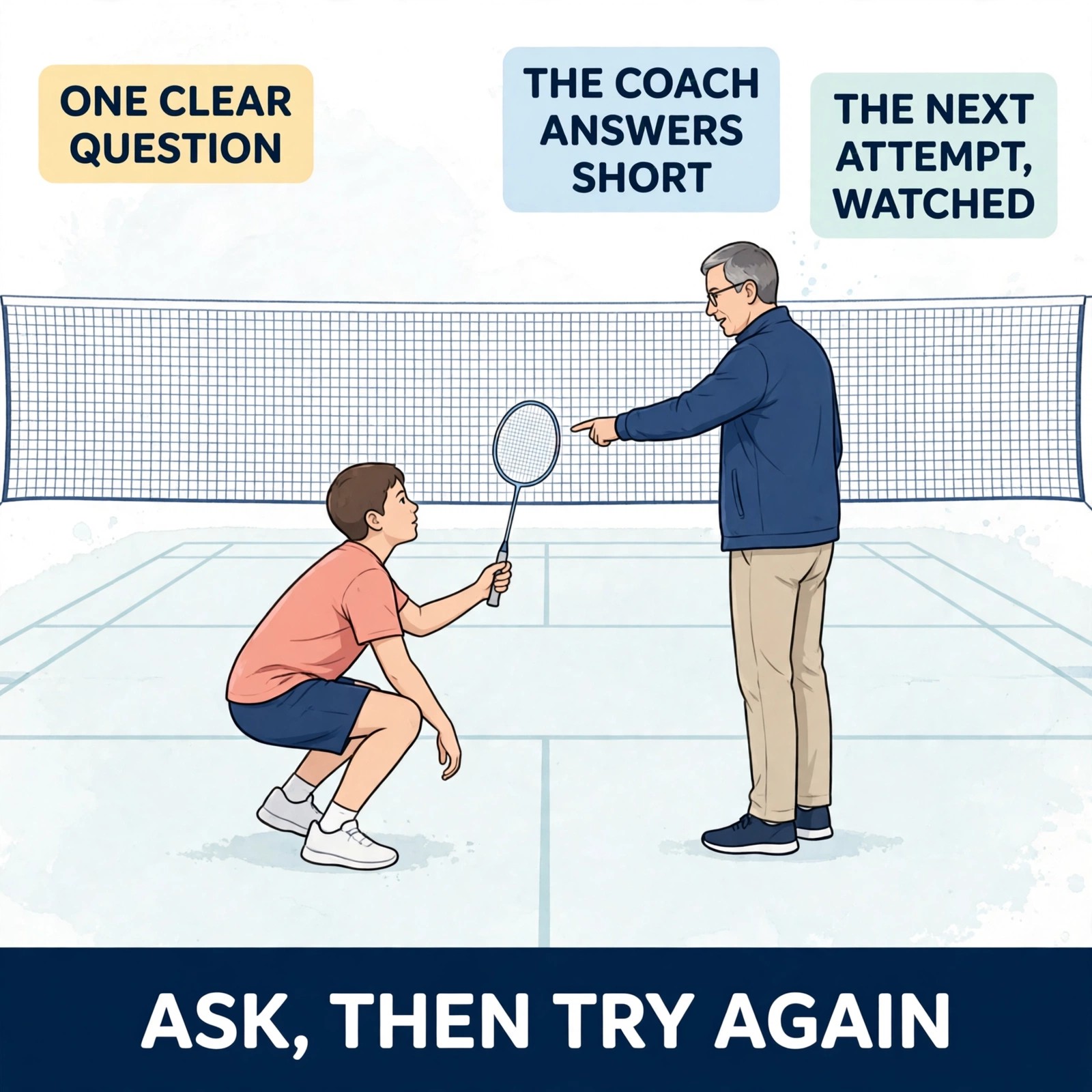
Missed Check #4
Choosing Lightly: Questions That Help, Honestly Asked
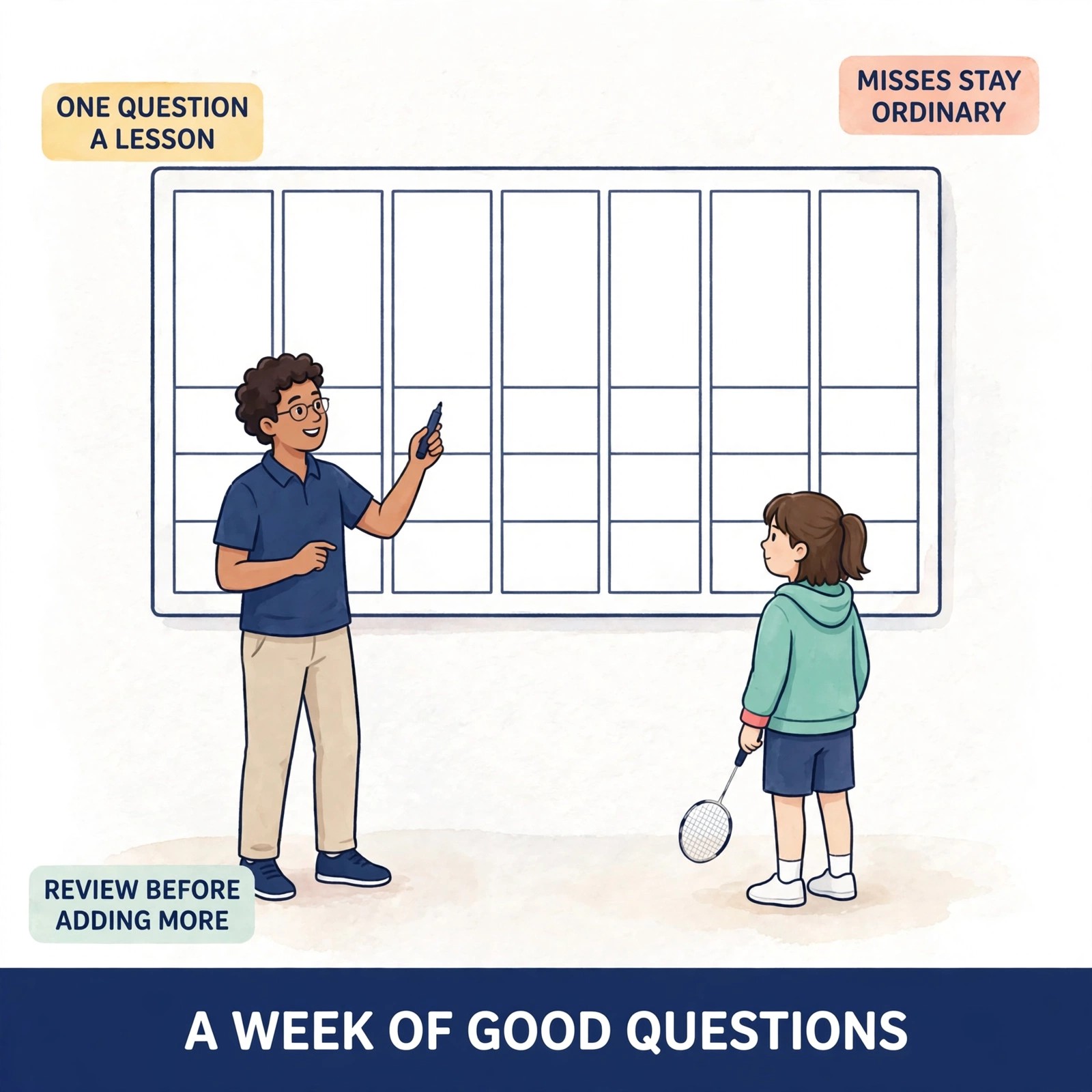
So what should a parent actually ask? Ask about the task before the shot: what was my child practising in that drill. Ask what the attempt showed: which part of it the coach was watching. And ask what comes next: the one try to carry forward. Three small questions, and none of them needs the word miss defended or explained away. Put kindly, they tell the coach exactly where your attention is, they give your child a model of how a learner talks about a hard moment, and they keep the size of the event honest: a shot, a question, a next attempt.
Judge the answers across a fair stretch of weeks, because one afternoon of misses proves little either way. Children learning a new grip will miss in bunches while the shape rebuilds; children growing fast will mistime shots they owned last month. What you are watching for is the pattern: does a question get a clear answer, does the next attempt change in the way the answer described, and does your child ask questions of their own more freely as the weeks pass. If a pattern of unexplained, unanswered misses does repeat, bring it as observations, what you saw and what was asked, and facts like those are easy to answer and easy to act on.
A gentle word for the parent whose chest tightens every time the shuttle hits the net, who lies awake wondering whether the misses mean their child is falling behind, or not suited to this, or being overlooked. Underneath the sting there is usually love doing arithmetic it cannot finish, because a single miss truly cannot be added up into a verdict about a child. Watch the longer pattern instead: questions answered, attempts changing, a child who still walks into the hall willingly. Those are the honest measures. And if the worry keeps circling beyond anything the lessons show, it deserves a kind conversation of its own, with someone you trust.
Missed Check #5
Question Habits That Keep Learning Curious
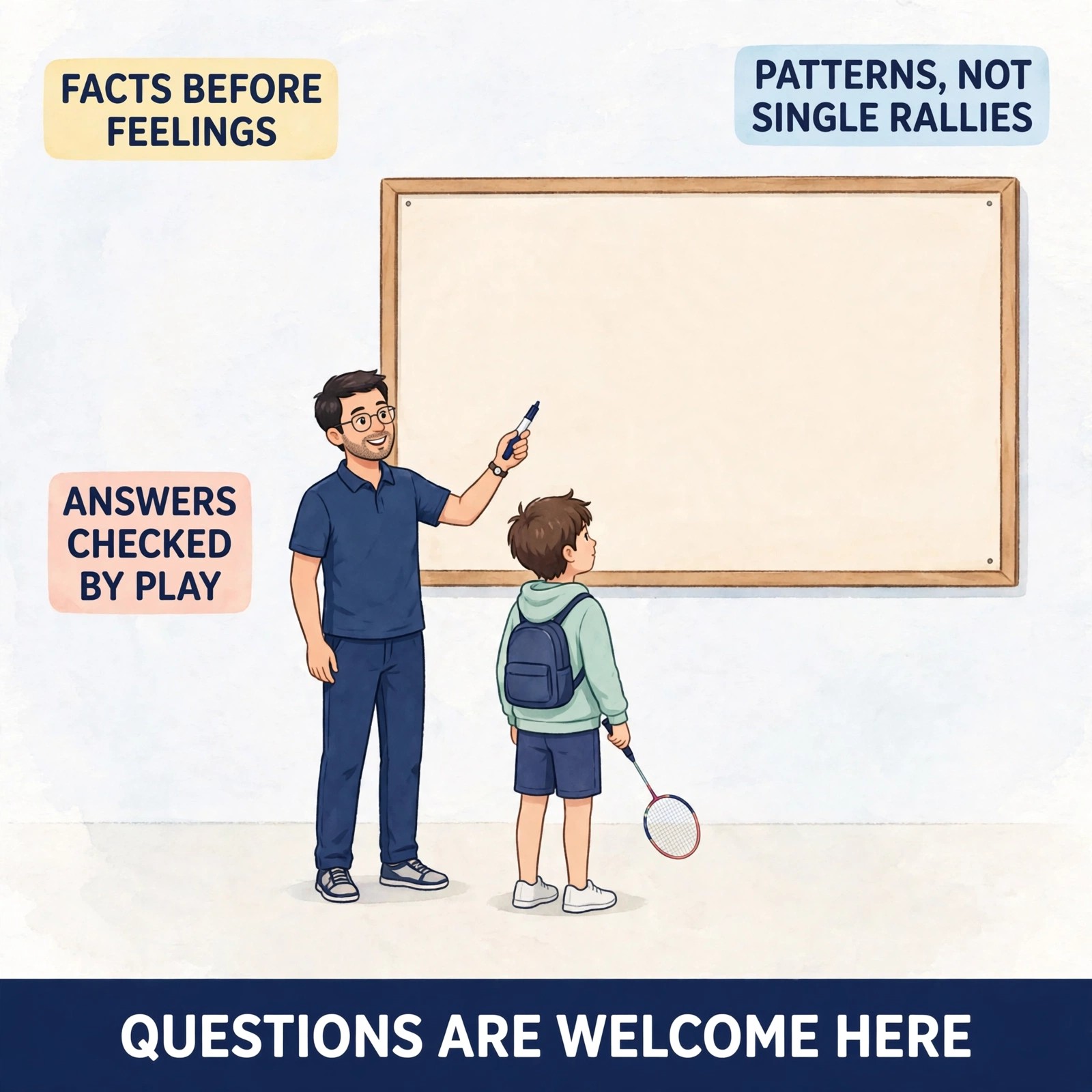
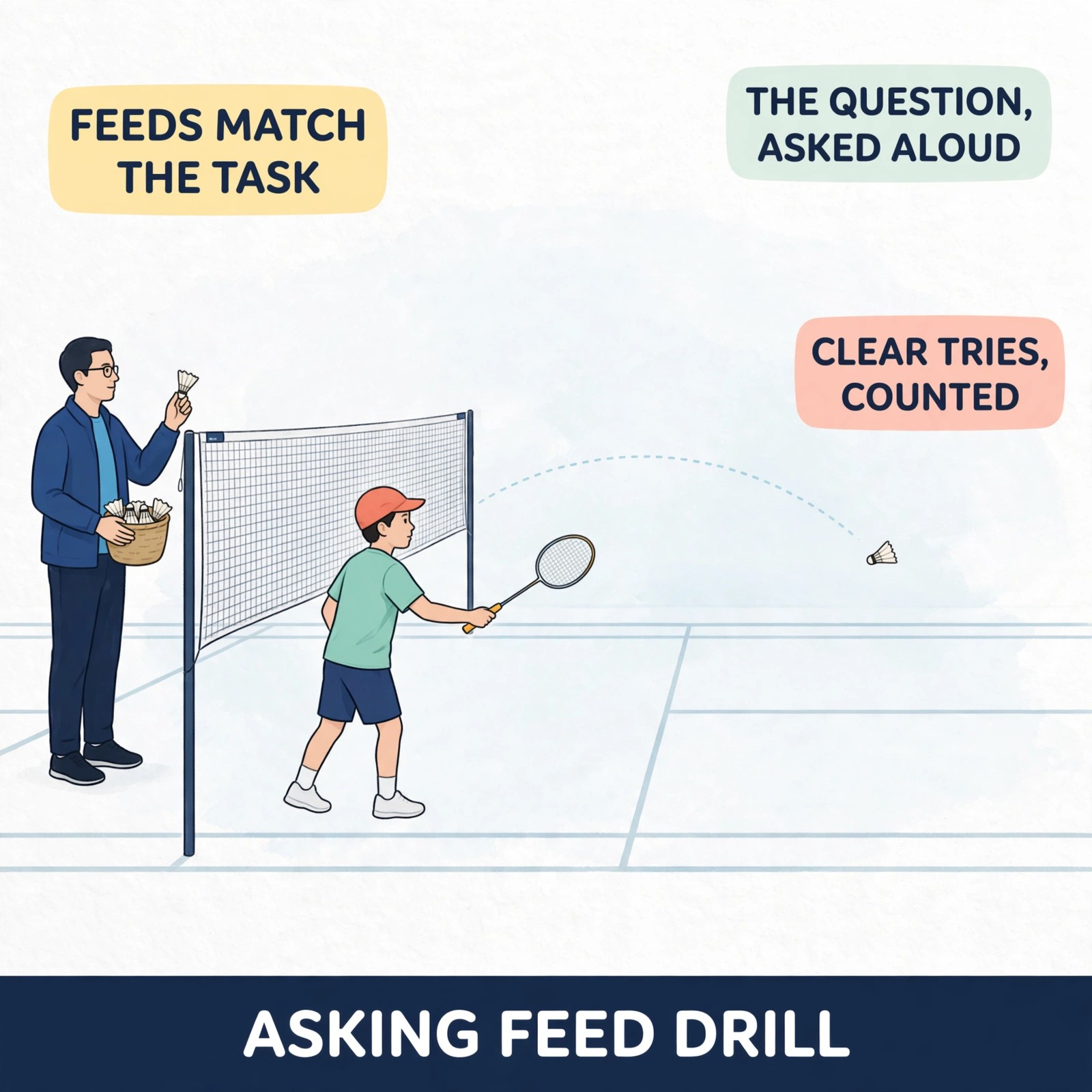
The question habits in this guide are taught, not hoped for. First, describe before diagnosing: the shot and its landing, in camera words, before any cause is mentioned by anyone. Second, one question at a time, aimed at the task being taught, so the answer can be short and the next attempt can use it. Third, the answer is tested by play, not by debate: the child tries the change, and the rally that follows is the reply. Coaches here count good questions the way they count good attempts, on fingers, in the open, because a room that praises asking grows children who ask.
Children take to these habits faster than adults expect, because a question returns something a verdict never does: a job to do. The child who can say the shuttle kept dying at the net, what should I watch, has stopped being the subject of the miss and become its investigator. Parents can protect this at home with one light rule. When a miss is reported in the car, ask what the next try is before asking what went wrong. The order teaches your child which part of the story matters, and it keeps the drive home a conversation instead of a courtroom.
There is a moment in most terms when the habit proves itself: a hard drill arrives, the misses come in a flock, and a child who once would have folded instead walks to the coach with a described attempt and a question already formed. Nothing about the misses changed. Everything about their meaning did. That is the deeper thing this guide is really about. A miss is raw material every learner produces daily. Whether it becomes shame, silence or a useful question is decided by the voices around the court, and those voices can be taught, starting with the ones a child hears at home.
Myth vs Reality
Myths About Missed Shuttles
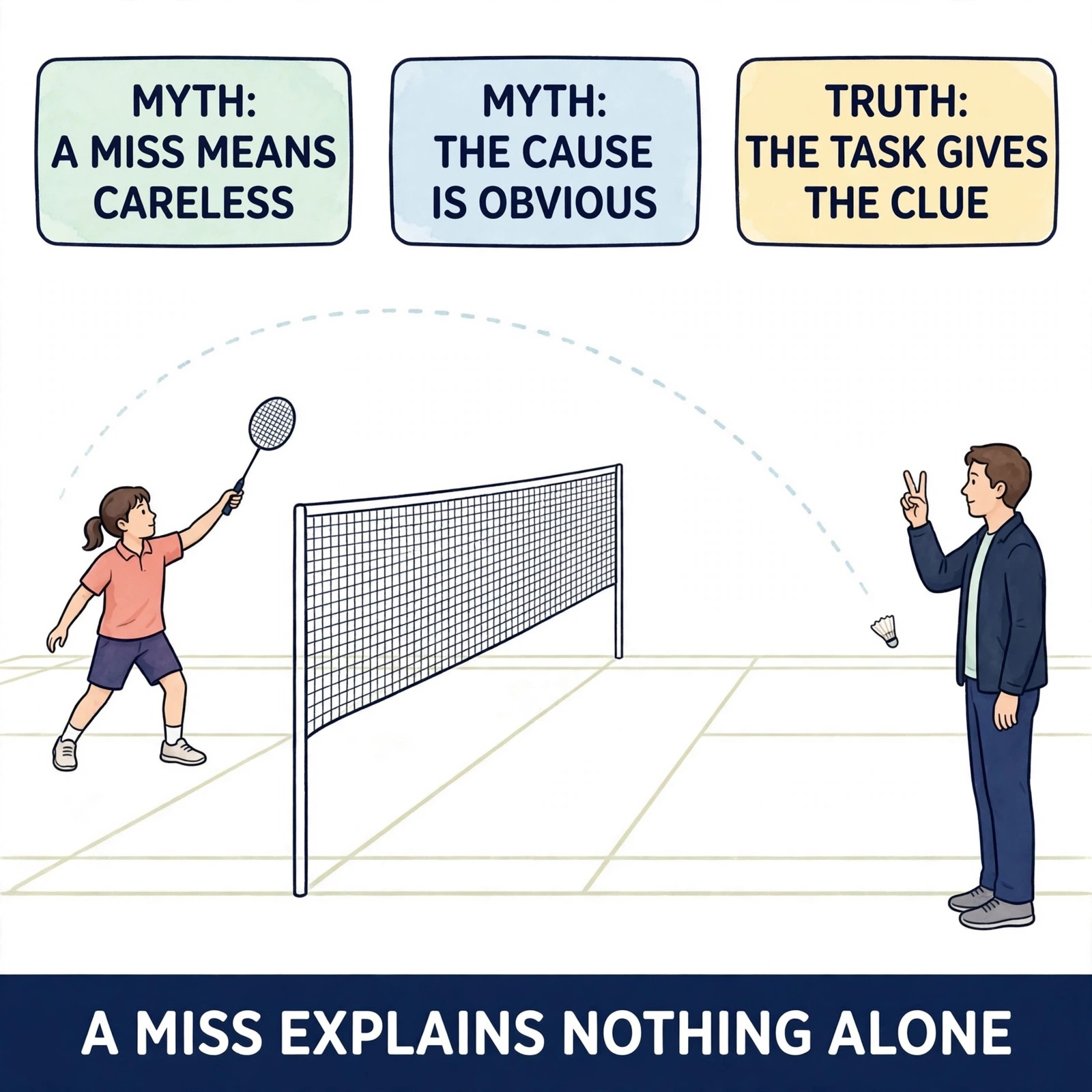
The myths around missed shuttles are brisk and confident. The first says a miss means the child was careless or not concentrating. In truth, misses cluster exactly where learning is happening, at the edge of current skill, and careful children produce them in heaps while a new shape settles. The second myth says the cause is obvious to anyone watching: the grip, the feet, the late start. Causes are rarely obvious from one result, and the confident spectator diagnosis is wrong often enough that acting on it does real harm. A miss is a starting point for a question, not a conclusion wearing one as a costume.
A third myth claims children should be spared all this analysis and simply told to forget the miss and move on. Forgetting is a fine skill for the second after a rally, and players do learn to reset. But a child taught only to forget learns to hide the moments a coach most needs described, and the pattern underneath the misses stays invisible until it is large. There is a kinder middle road: reset quickly in the rally, then, at the right moment, describe the attempt and ask the one question it raises. Forgetting keeps a rally alive. Asking keeps a learner growing.
The truth underneath the myths is modest. A missed shuttle explains almost nothing by itself, and that is precisely its value: it marks the spot where a good question should be dug. Here, the promise is checkable. Your child will be taught to describe an attempt in plain words, to ask which observation matters, and to carry one clear try into the next rally, and no child will be labelled by a landing. Judge us by what happens in the ten seconds after a miss. If those seconds hold a question instead of a verdict, the teaching is working.
Why Choose Us
Why Players Choose ST Badminton Academy
Families choose this academy for the teaching first: groups of no more than four students, one coach who knows each child’s current task, and corrections matched to the stage the child has honestly reached. For question askers, that smallness matters practically. In a group of four, the coach saw the miss, set the task it belonged to, and can say which observation matters without guessing, because the whole rally happened inside their own plan. Your question meets a memory, not a shrug, and the answer is sized to one child rather than broadcast to a crowd.
Parents also choose the way misses are received here. A described attempt is welcomed as exactly what it is: a learner paying attention. It is answered in kind, briefly and plainly, and the answer is checked against the child’s next attempt rather than against a promise. Nobody will announce a cause for your child’s miss from across the hall, nobody will set them extra work as a penance for a landing, and nobody will treat a flock of misses during a rebuild as a problem of attitude. The agreement runs both ways: families describe honestly, and the academy answers honestly.
There is a final reason that grows on families over a term. Children develop at different rates here, and the teaching says so openly: versions of a task are sized per child, questions are welcomed from the quietest voice in the group, and progress is described inside each child’s own line of work. A child who misses at the edge of a harder version is not behind the child succeeding at an easier one; they are both exactly where learning lives. Parents tell us the change they noticed first was not fewer misses. It was their child describing a hard rally at dinner, calmly, and finishing with what they planned to try next.
FAQs: Missed Shuttles and Useful Questions in Malaysia (KL)
These are the questions parents ask us most about missed shuttles and the questions they can become, before they book and while a calmer way of talking about hard rallies is settling in. The short version runs through all of them: describe the attempt, ask which observation matters, and carry one try into the next rally. The longer answers follow, including whether a miss ever means a child is careless, and how a first session with us actually works.
Can a child turn a missed shuttle into a useful question in a badminton class in Setapak or Gombak?
Yes. In groups of no more than four, a miss is met with a described attempt and one honest question rather than a verdict, and children learn the habit quickly. Bring your child to a trial at our Setapak base or a nearby class, and listen to what follows the first miss.
What should a parent ask first after a missed shuttle in KL?
Ask about the task first: what was my child practising in that drill. Then ask which part of the attempt the coach was watching, and finally what the one next try should be. Those three questions, in that order, hand the sorting to the coach and keep the miss at its true size.
Why do missed shuttles worry parents at a junior level?
Because a miss looks like evidence and feels personal, while the cause is usually ordinary: a new grip settling, a faster shuttle than expected, a growth spurt changing reach. One landing cannot name a cause. Watching the pattern across attempts, with the coach’s answers beside it, is the fairer and calmer way to judge.
My child keeps missing the same shot. Should I name the cause or ask what to try next instead?
Ask what to try next. Naming a cause from the side is usually guesswork, and a wrong cause becomes a second coaching voice your child must reconcile with the coach’s. A next try is small, testable in the following rally, and keeps the miss useful instead of turning it into a verdict.
How can parents talk about misses at home in between classes?
Describe before diagnosing. When a miss is reported in the car, ask what the next try is before asking what went wrong, and let the answer arrive from practice rather than debate. If a pattern keeps repeating, bring observations to the coach: what you saw, what was asked, and what changed afterwards.
Do you welcome learning questions beside badminton training near Wangsa Maju?
Yes, gladly. A described attempt and a clear question are treated here as a learner paying attention, and they are answered briefly and plainly in the session, or in a fuller word at the door. You will never be brushed off for asking, and your child will never be labelled by a landing.
Where does ST Badminton Academy teach badminton training in Malaysia?
We teach at our base in Setapak, with classes in the Setapak and Wangsa Maju area and in Singapore. Mr Eric Chuar coaches the academy sessions himself, with more than fifteen years of coaching in Malaysia and Singapore, and groups stay capped at four students so every question is heard clearly.
How do I book a trial session to test my child’s class and our questions?
Message us and tell us a little about your child and what has been happening with misses in lessons so far. We will arrange a trial session, and you can listen for the sequence this guide describes: a described attempt, one honest question, and a next try your child carries into the following rally.
What makes Mr Eric Chuar a suitable coach for children who ask about misses in badminton?
He coaches the academy sessions himself, in groups of no more than four, so he sets the task every miss belongs to and can say which observation matters without guessing. He answers children’s questions in plain words, never labels a player by a landing, and corrects technique at the stage honestly reached.
Useful Question Coaching in Action
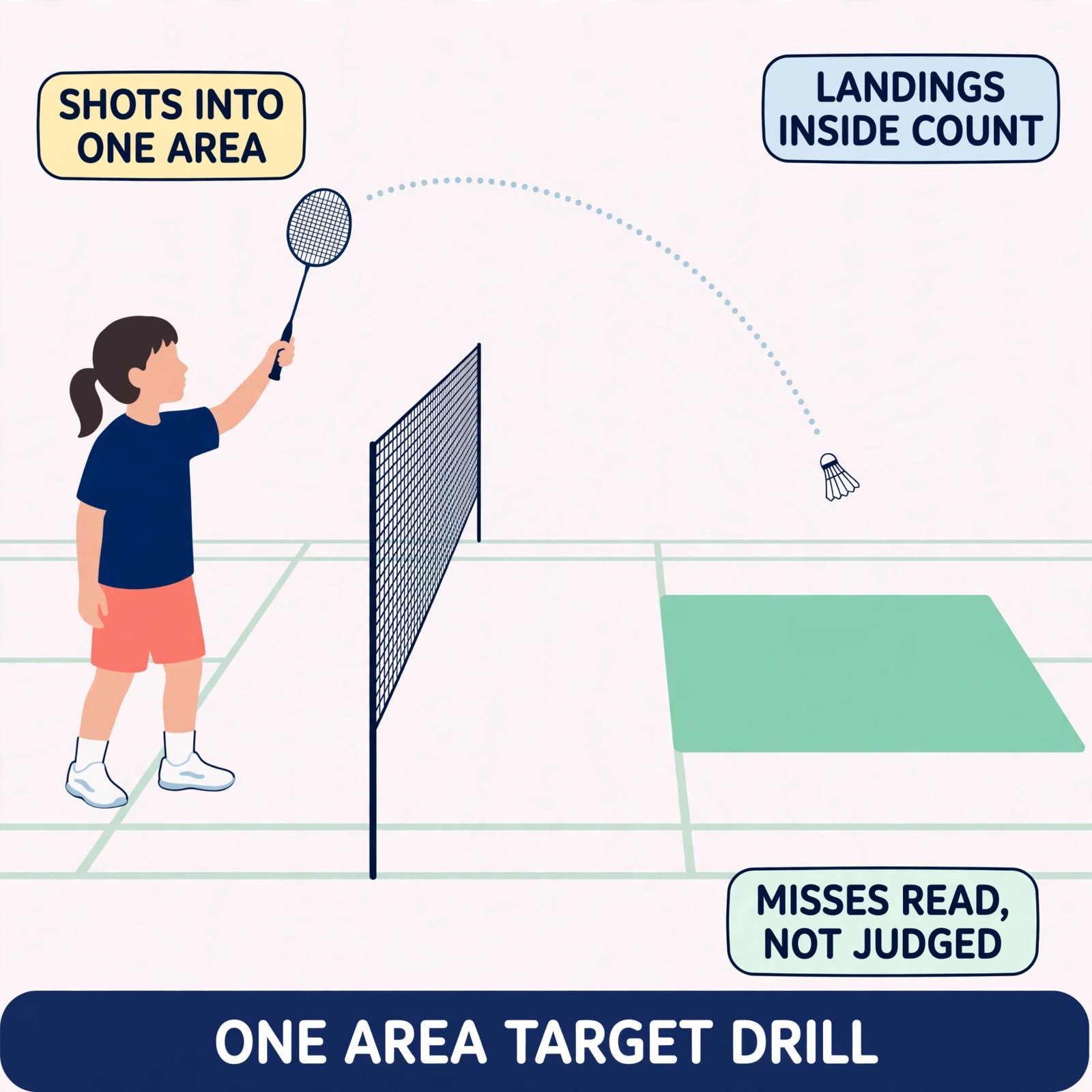
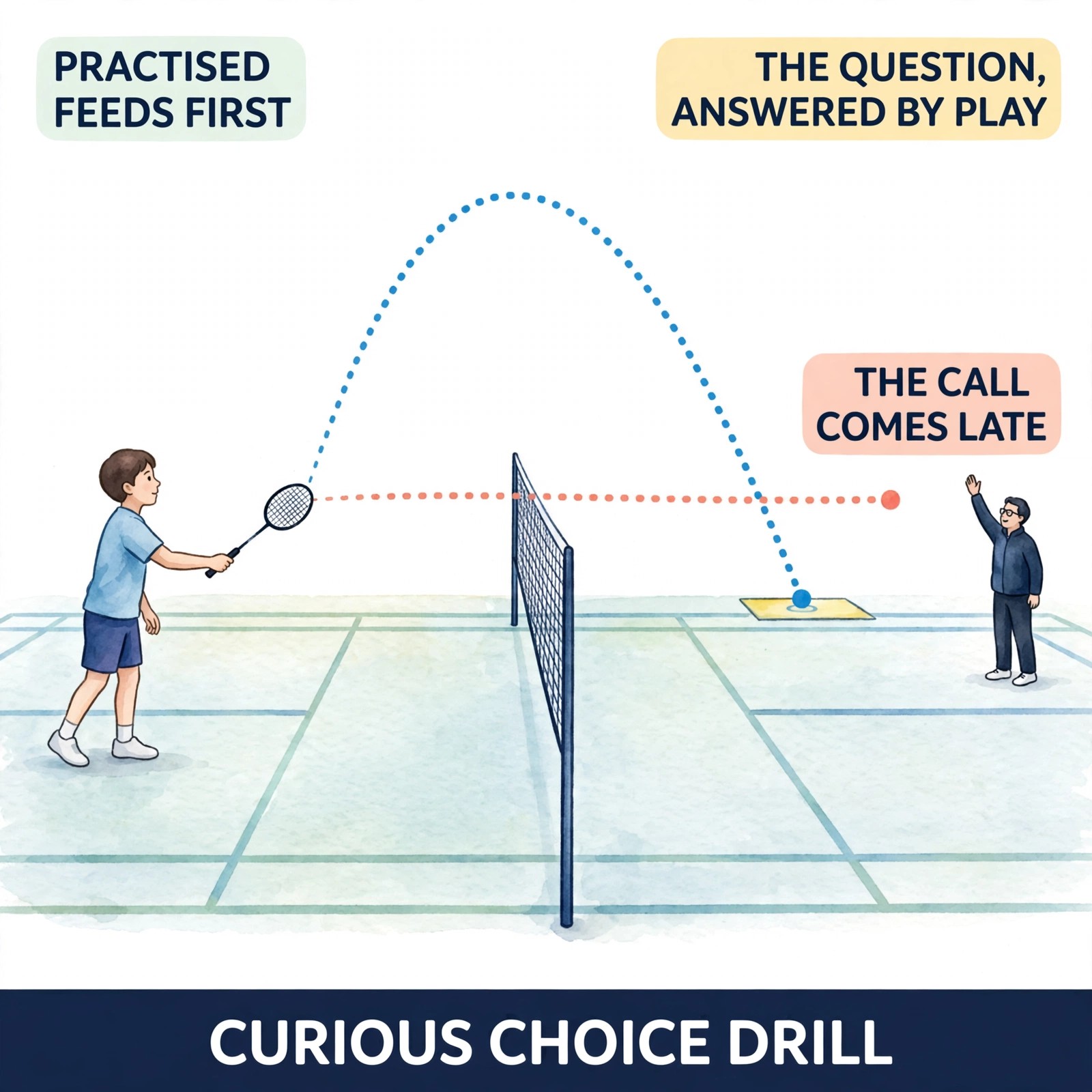
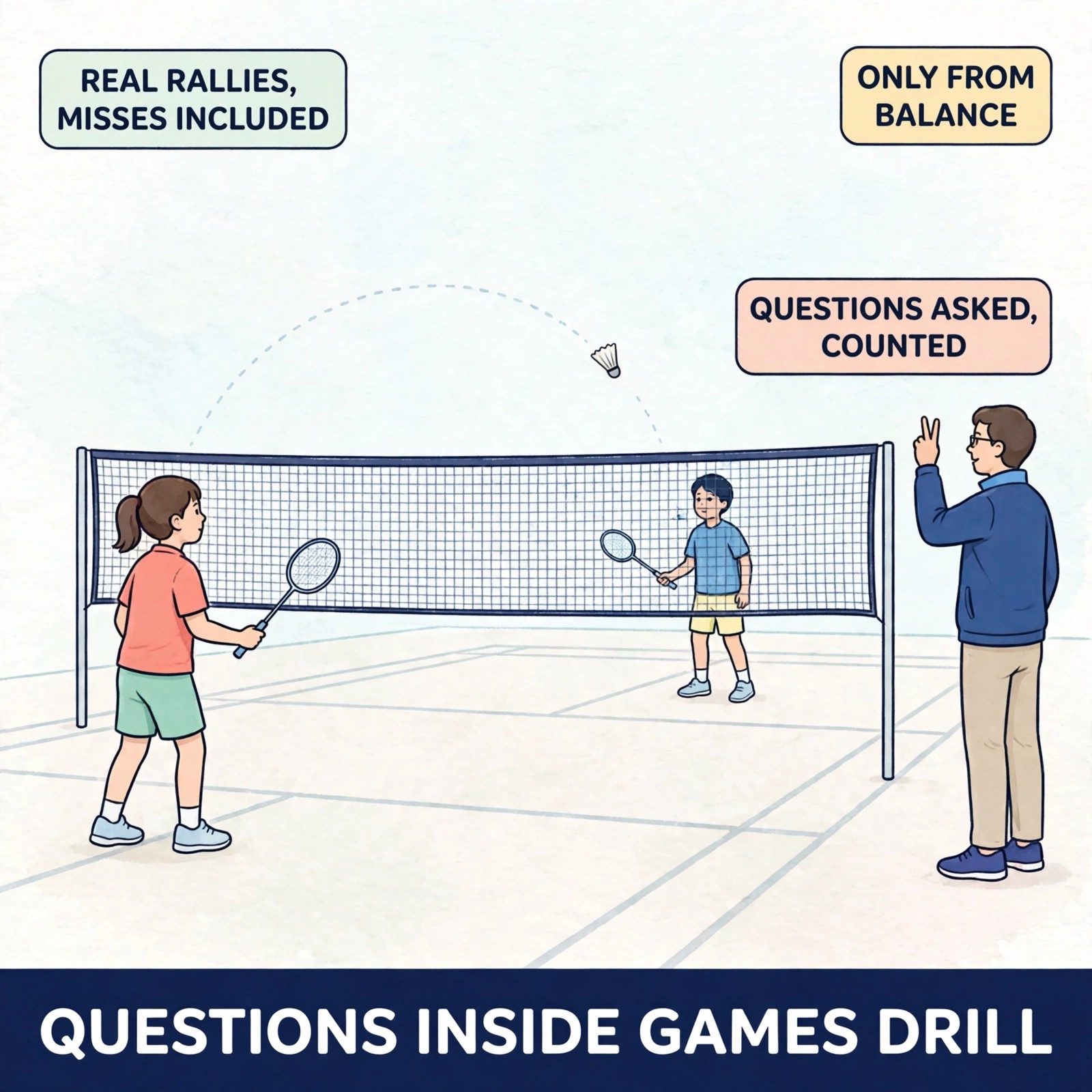
We benchmark our useful question coaching against World Badminton (BWF) coaching standards and our own academy values: before any player trusts a training plan, they deserve honest checks. You can verify our coaches' credentials through the Badminton Association of Malaysia (BAM) coach education pathway.
One standard governs misses here: no child in this academy is ever labelled by a landing. Every miss is met the same way, with a described attempt, one honest question, and a next try small enough to use straight away. We also hold an honesty rule about what questions can do. A good question can find the observation that matters and aim the next attempt; it cannot remove misses from a learning child's week, rank children against each other, or replace the coach's own watching across a term, and we will say so rather than promise a hall without netted clears.
| Factor | The Question Hall | The Verdict Hall MISSED |
|---|---|---|
| Frequency | 1 or 2 times a week. Mostly for fun and sweat. | The verdict hall names a cause for every miss before the shuttle stops rolling. Children learn that mistakes are public events with blame attached, questions dry up, then attempts do, and a room full of safe shots is called a quiet lesson. |
| Drills Focus | Basic static feeding. Minimal footwork pressure. | The question hall teaches a three step habit instead: describe the attempt in camera words, ask which observation matters, and carry one clear try into the next rally. Misses are met in the open, counted kindly, and answered by play rather than by debate. |
| Physical Conditioning | Rarely included. Just playing games on court. | Core, agility, and speed training included in every session to prevent injury and build stamina. |
| Tactical Awareness | "Just hit it over." No real game plan. | Video analysis, point construction, and learning to read the opponent's game. |
| Coach Ratio | Large groups (8-10 kids). Coach barely watches you. | Max 4 students. Mr Eric Chuar personally corrects every stroke and movement detail. |
| Goal Setting | Fun and exercise. | Because the count is misses turned into described attempts and questions answered in the next rally, real learning shows up as numbers rather than as silence. The coach sees whether the describing, the asking or the next try was off, the parents see the same rows, and one part of the habit is repaired instead of a child being labelled. |
| Long Term Result | Good recreational player. | The high-performance version produces a child who walks to the coach with a question already formed. The casual version spends the term judging; the question version removes the guesswork in a fixed order and counts what each miss taught. |
Useful Question Coaching in Kuala Lumpur
Your start can be one rally watched with new ears. Come to a trial, stand where the parents stand, and listen to what follows the first miss: a verdict, or a question and a next try. Bring your child as they are, racket and court shoes, and tell us honestly if misses have been the sore point at classes before. We will teach the describing and asking habits inside ordinary drills from the first session. Message us to arrange a time that suits your week.


