How To Develop A Winning Badminton Mindset: Mental Toughness And Focus (Mindset Guide)
Mental toughness sounds like a gift some players are born with. Up close, it looks much more ordinary: a set of habits that hold when the score turns, the legs get heavy and the errors start arriving together. This guide treats it that way. It covers what toughness actually is, how to handle the losing runs every player meets, how to talk to yourself honestly in a rally, and how a small reset routine after an error gets your head back for the very next point.
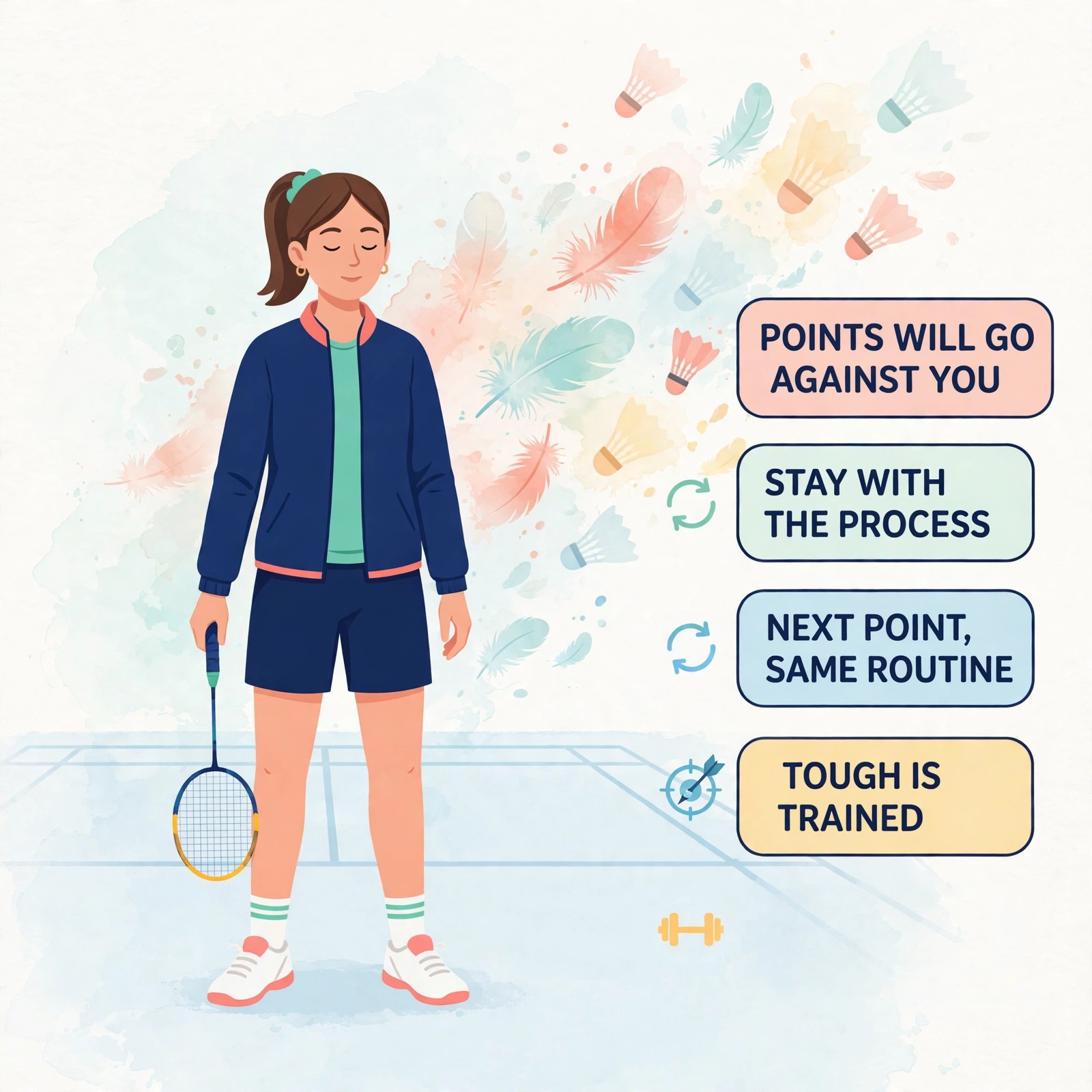
Mindset Check #1
What Mental Toughness Actually Is
Mental toughness is not feeling no pressure. The players who look calm feel the same nerves, the same frustration and the same doubts as everyone else; they have simply stopped letting those feelings choose their next shot. Toughness shows in ordinary moments: serving carefully at 18 all instead of rushing, still moving your feet in the third game, still playing your plan after two mistakes in a row. It is behaviour under pressure, not a mood, and behaviour can be practised.
That is the hopeful part. Because toughness is behaviour, it is built the same way footwork is built: small repeats, done on purpose, until they hold without thinking. Nobody needs a personality transplant. You need a few clear responses, chosen in advance, for the moments that usually undo you: the lost lead, the bad line call, the partner error, the game that slips away. Choose them on a calm day, rehearse them in training, and they are there on the hard day.

Mindset Check #2
Losing Runs: Stopping the Slide Point by Point
Losing runs feel like collapse, but they are usually arithmetic. Badminton scoring is fast, and three or four points can go in under a minute when one player rushes. The run feels enormous from inside it, yet it normally comes from two or three loose shots, played a little early, at targets a little too fine. Naming that honestly is the first step out: you are not suddenly a bad player. You made a few hurried choices, and hurried choices can be changed point by point.
When a run starts, slow the rally down before you try to win it back. Walk to your spot a touch slower, breathe out once, and give yourself one plain job for the next rally: high percentage shots, bigger targets, no hero attempts. One clean rally played properly often stops the bleeding, because it returns the match to the speed your game is built for. Trying to erase five points with one brave smash usually just extends the run to six.
Between games, use the minute properly. Drink, towel off, and review two things only: what is working, and what the first three rallies of the next game should look like. Skip the full replay of every error; it carries the old game into the new one. Players who reset between games like this give the opponent a different problem in game two, even with exactly the same strokes, because the decisions arrive fresh again.

Mindset Check #3
Honest Self Talk: Instructions, Not Verdicts
Self talk is the voice that narrates your match, and it runs whether you train it or not. Harsh, total verdicts, like telling yourself you always choke or you are hopeless today, sound honest in the moment but they predict nothing useful and they tighten the body. The problem is not being hard on yourself; standards are fine. The problem is verdicts about you, instead of information about the rally. One kind sends you spiralling. The other kind sends you adjusting.
Replace verdicts with instructions. Not good enough becomes feet first, one rally at a time. I keep missing that cross becomes aim two feet inside the line for now. The instruction version is not softer; it is more exact, and it gives your hands and feet something to do in the next ten seconds. In training, say your instruction out loud after errors until the habit forms. In matches, it can shrink to two or three quiet words you trust.
Keep the talk honest in the good moments too. A run of winners does not make you unbeatable, and believing it does invites the lunge at a shot that was never on. The same flat, factual voice works at both ends: that worked, same again; or, points are cheap right now, keep the margins. Steady talk keeps a good spell going longer than celebration does, because nothing about your process has to change when the score does.

Mindset Check #4
The Reset Routine: Five Seconds After Every Error
A reset routine is a small, fixed sequence you run after an error, so the next rally starts clean. It takes about five seconds: turn away from the net, adjust your strings or your grip, breathe out slowly, say your cue words, then face up and take your position. The content matters less than the sameness. Done after every error, in training and in matches, it becomes a door between the last point and the next one.
Build yours from things you already do. Most players have fragments of a routine scattered through their game: the strings touch, the walk to the back, the deep breath before serving. Gather the fragments into one order and use it deliberately for a few weeks. The routine should be short enough to fit the natural pause between rallies and simple enough to survive tired legs in a third game, when fancy habits are the first to be dropped.
Test the routine under pressure before you trust it. Use it in conditioned games where errors cost extra, ask a training partner to keep score loudly, or play practice sets starting from 18 all. A routine that only works in gentle rallies is decoration. The tested version does a quiet job in real matches: it slows your heart, clears the last picture from your eyes, and hands the next rally a player who is ready instead of still arguing with the previous one.

Mindset Check #5
Staying With the Plan: Adjust in Small Steps
Staying with a plan is the least glamorous part of toughness. A plan made before the match, based on what you know about the opponent and your own strengths, is usually better than the new plan invented at 14 to 18 down, in a temper. Mid match feelings are poor strategists: they overweight the last two rallies and forget the twenty before them. Give your plan a fair run, a full game if it is close, before you judge it a failure.
Adjusting is not the same as abandoning. If the evidence keeps repeating, the same reply beating you, the same corner costing points, change one thing and give it a few rallies to show its effect. Players who change everything at once never learn which change worked, and they spend the match in a fog of experiments. One change, honestly tested, keeps the mind clear. It also keeps confidence intact, because you are steering the match, not being carried by it.
After the match, write two lines in your phone or say them to your training partner: one thing the plan got right, one thing you would test earlier next time. That tiny review closes the match properly. Without it, losses replay themselves for days and quietly teach the wrong lessons. With it, even a bad defeat leaves something useful behind, and the next training session starts with a purpose instead of a mood.

Myth vs Reality
Mental Game Myths That Hold You Back
Three myths make the mental game harder than it needs to be. The first is that tough players never feel nerves, so feeling nervous means something is wrong with you. The second is that one mental trick, learned this week, fixes years of hurried habits by the weekend. The third is that talking about the mental side is soft, and serious players should just train harder and stay silent about the rest.
Nerves are normal at every level; the shaking hand before a big serve shows up in club halls and in finals alike. What differs is the routine around the nerves, not their absence. And the mental side responds to training like everything else: slowly, with repeats, and with relapses that are part of the process rather than proof it failed. A player who practises a reset routine for a month will not be unshakeable. They will be noticeably harder to rattle, which is the real prize.
One honest boundary belongs here. This guide is about match habits for healthy players who want to compete better. If low mood, heavy stress or anxiety stays with you for weeks, on court and off it, that deserves proper support from a doctor or a counsellor, not a bigger training load. Looking after the person matters more than any match, and asking for that support is itself a strong and sensible move.

Why Choose Us
Why Players Choose ST Badminton Academy
The mental game is coached best inside real pressure, not in a classroom. ST Badminton Academy Malaysia is different because our head coach, Mr Eric Chuar, has over 15 years of coaching experience in Singapore and Malaysia, and he builds pressure into small group training on purpose: scored games, tight starts, honest reviews. Your habits under strain are watched by a coach who has seen the same moments undo hundreds of players before you.
Our small group policy, with a maximum of 4 students, keeps that work personal. Conditioned games start at 18 all so the hard moments arrive often. Reset routines are practised after real errors, in real rallies, not described once and forgotten. And the review afterward is plain and kind: what happened, what the routine did, what to test next session. Players learn that a wobble is information, not a verdict on them.
We focus on long term player development. A young player who learns to lose a run of points without losing the plan carries that steadiness into exams, work and every other pressure life brings. That is built with steady coaching, honest talk and repeated small tests, rather than one motivational speech that feels good on the day and fades by the next match.
FAQs: Badminton Mental Toughness, Focus and Match Habits in Malaysia (KL)
Here are answers to common questions from players in Kuala Lumpur about mental toughness, handling losing runs, honest self talk, reset routines, and how coaching at ST Badminton Academy works.
Can a beginner build match toughness early in Setapak or Gombak?
Yes, and beginners often build the cleanest habits, because nothing has to be unlearned first. A simple reset routine and one or two honest cue phrases can grow alongside your strokes from the early months. Toughness built early stops the hurried, apologetic style of play that many self taught players spend years trying to undo.
What should you do when points start slipping away in KL?
Slow the match down before trying to win it back. Walk to your position a touch slower, breathe out, and give the next rally one plain job: safe targets, high percentage shots, no hero attempts. One clean rally often stops the run, because the points usually came from rushed choices, and rushed choices are changeable.
Should you change your game plan when you fall behind at club level?
Not always. If the evidence repeats, the same reply beating you or the same corner leaking points, change one thing and test it for a few rallies. Abandoning the whole plan after two bad points is the mistake; so is refusing to adjust for a whole game. One change at a time keeps your head clear.
What is a simple reset routine I can use after an error?
Try a five second routine: turn away from the net, touch your strings or reset your grip, breathe out slowly, say your cue words, then face up ready. Use it after every error in training for a few weeks. The sameness is the point; it gives the next rally a clean start instead of a leftover argument.
How do I stop harsh self talk during a match?
Keep it short, flat and useful. Swap verdicts like I always choke for instructions like feet first, this rally. Aim the talk at the next action, not at judging yourself. Practise it out loud in training after errors, and in matches let it shrink to two or three quiet words that you trust under pressure.
Do you coach the mental game near Wangsa Maju?
Yes. ST Badminton Academy is based in Setapak, a short drive from Wangsa Maju, Melati Utama and Danau Kota. Match habits and mindset are coached inside small group training of no more than four students, with scored games and honest review, so your routines are tested in live rallies and corrected personally by the coach.
Where does ST Badminton Academy coach match mindset in Malaysia?
We coach in Setapak, Kuala Lumpur, and the habits travel well: reset after errors, talk in instructions, hold the plan. Players from Gombak, Sentul, Ampang and nearby areas train with us each week in small, focused groups where pressure is built into the games on purpose, so match day feels familiar rather than foreign.
How do I book a trial session to work on my match mindset before training?
Message us on WhatsApp and tell us the mental side of matches is what you want to build. We will place you in a small group session with scored games, where the coach can watch how you handle the hard moments and show you the routines we would practise. One session is enough to leave with a plan.
What makes Mr Eric Chuar a suitable coach for mindset coaching in badminton?
Mr Eric Chuar has coached in Singapore and Malaysia for over 15 years, and he teaches the mental game the way it holds up in matches: routines, instructions, one adjustment at a time. Because he coaches small groups personally, your habits under pressure are reviewed in the session itself, kindly and plainly.
Badminton Mindset and Focus Training in Action


One Standard for Every Session and Every Player
Developing a stronger mindset at ST Badminton Academy KL follows one standard: the mental game is trained inside real rallies, with scored games, practised routines and honest review. Groups stay at a maximum of 4 students, so your habits under pressure are coached personally, not left to chance.
| Factor | Hoping to Hold On | Trained Toughness Habits TOUGHNESS |
|---|---|---|
| Frequency | 1 or 2 times a week. Mostly for fun and sweat. | Pressure is met with behaviour, not mood: feet keep moving, targets stay sensible and the plan survives two mistakes in a row. |
| Drills Focus | Basic static feeding. Minimal footwork pressure. | Losing runs are answered point by point with slower walks, one plain job per rally and a review of two things between games. |
| Physical Conditioning | Rarely included. Just playing games on court. | Core, agility, and speed training included in every session to prevent injury and build stamina. |
| Tactical Awareness | "Just hit it over." No real game plan. | Video analysis, point construction, and learning to read the opponent's game. |
| Coach Ratio | Large groups (8-10 kids). Coach barely watches you. | Max 4 students. Mr Eric Chuar personally corrects every stroke and movement detail. |
| Goal Setting | Fun and exercise. | Self talk gives instructions, a reset routine clears each error, and adjustments change one thing at a time on real evidence. |
| Long Term Result | Good recreational player. | A steadier competitor: same strokes, calmer decisions, and hard moments that pass without taking the whole match with them. |
Badminton Mindset Coaching in Kuala Lumpur
This guide gives you the habits: toughness as behaviour, losing runs slowed down and answered one rally at a time, self talk in instructions, a reset routine after every error, and a plan you steer instead of abandon. If your matches need that steadiness, ST Badminton Academy in Setapak can coach you through it in a small group. Message us to book a trial session.


