Badminton Classes in Rawang: A Guide for Parents and Adults
Parents and adult beginners ask the same question every week: how do I pick a good badminton class in Rawang? The answer is not the most famous name or the nearest court. It is a short checklist that any good class should pass. This guide explains seven points in detail, plus three final checks before you commit, so you can judge any class or academy with confidence. Head coach Mr Eric Chuar explains what to look for, what to ask, and the red flags that mean you should look for another class. The same checks work whether you are choosing a class for your child or for yourself as an adult beginner in Rawang.
Start Here
Badminton Classes in Rawang: What to Know First
Parents and adult beginners in Rawang ask the same question every week: how do I pick a good badminton class? The answer is not the most famous name or the nearest court. It is a short checklist that any good class should pass. This guide explains seven points in detail, plus three final checks before you commit, so you can judge any class in Rawang with confidence. Lim Badminton Academy lists a Rawang branch alongside its Cheras branch. No hall address is given for the Rawang branch, so no hall is claimed for it here. The same checks work whether you are choosing a class for your child or for yourself as an adult beginner.
This guide is written for parents and adult beginners, not for coaches. It explains what happens inside a good class, what to check before signing up, and how badminton classes in Rawang are usually run from the first week to the first month. Head coach Mr Eric Chuar explains what to look for, what to ask, and the red flags that mean you should look for another class. Use this guide on your first visit, and let what you see on court matter more than what any brochure promises.

Who Can Join
Who Should Join a Badminton Class in Rawang?
Children can start badminton while they are still young. At this stage, a class is not about competition or difficult technique. It is built around basic movement, holding the racket the right way, and simple games that make a child enjoy moving. A good coach knows when to teach and when to let a child play. Small groups help here. In a group of four, the coach can see every child, fix that child’s grip, and make sure the child does not practise the wrong way for months without anyone noticing. The readiness signs that matter most are simple: can the child listen to instructions, wait for a turn, and enjoy moving?
Adult beginners are also welcome in badminton classes in Rawang. Many adults arrive having never played badminton before. Some want exercise, some want to learn a new sport, and some want to play with work friends or family. A good adult class starts with the same basics as a children’s class: grip, footwork and clear. The difference is in the pace and in the way the coach explains. Adults usually want to understand why a technique is taught before they repeat it many times. A good coach explains in plain words, shows one example, and lets you try it right away.
Classes in Rawang also suit players returning after a long break. Perhaps you played in school and have not touched a racket for years. Your feet may still remember the rhythm, but your timing and positioning have changed. A good class does not push you to play the way you used to play. The coach will look at how you move now, rebuild your grip, and rebuild your footwork step by step. Many returning players are surprised how fast the old feeling comes back once the basics are fixed the right way.

How Classes Run
How a Good Badminton Class Runs
A good class has a shape you can follow. In the first week, the focus is grip and basic movement. The right grip, a handshake hold for forehand and the thumb behind the handle for backhand, is the basis of every shot. If the grip is wrong, every shot after it is limited. The coach will check the grip of each student, one by one, and fix it before a wrong habit has time to form. Basic footwork is taught together with grip: how to stand ready, small steps forward and back, and how to return to the middle of the court after every shot.
Once grip and footwork start to settle, the class moves to the clear. The clear is a high shot to the back of the court, and it teaches timing, height and court coverage in one shot. The coach will start with short and easy rallies, so students can feel a clean shot before trying harder shots. The smash is not taught in the first week. That shot needs strong basics first. If a class starts with the smash in the first lesson, ask the coach why. The answer will tell you a lot about how the class is planned.
Watch how the coach explains as well. Good explaining uses plain words, one idea at a time, and one short example you can copy. If a coach talks for ten minutes while students stand still, the lesson is a lecture, not training. A good coach also fixes small mistakes right away. One small correction shown in a minute, with a result you can feel yourself, tells you more about the quality of the coach than any brochure.
Group Size
Why a Maximum Group of Four Matters
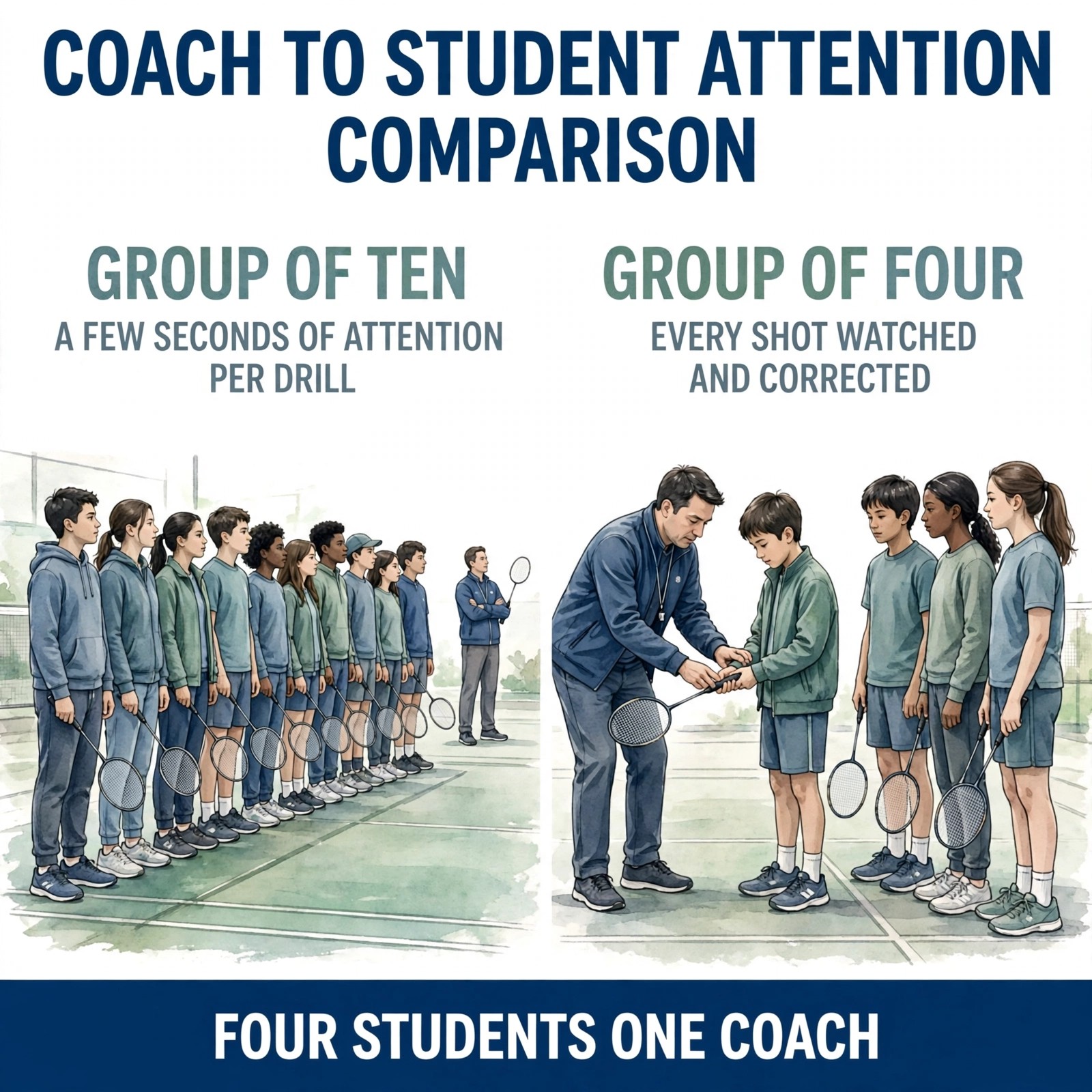
Group size decides how much coaching you actually receive. In a group of ten, the coach can only watch each student for a few seconds in each drill. In a group of four, the coach can watch every shot, fix the grip, adjust the feet, and check the result. The difference shows within a few weeks, not years. Children in small groups learn clean habits from the start. Children in large groups often repeat the same mistake for months before anyone notices.
Ask the academy for the real maximum number, not the usual size. Some academies say small group but run classes of eight or ten when the class is full. At ST Badminton Academy, the maximum is four students per coach, and that number does not change when classes are busy. Head coach Mr Eric Chuar teaches these small groups himself, so the corrections come from the coach you meet, not from an assistant who happens to be free that day.
A small group also changes the feel of the lesson. Students get more turns, more rallies, and more chances to ask questions. They learn to watch each other and wait for their turn without losing focus. Parents can see the difference in one visit: in a small group, the coach knows the name of every student and the weak shot of every student. In a large group, the coach only knows the loudest student.
Assessment and Progress
Initial Assessment and How Your Progress Is Tracked
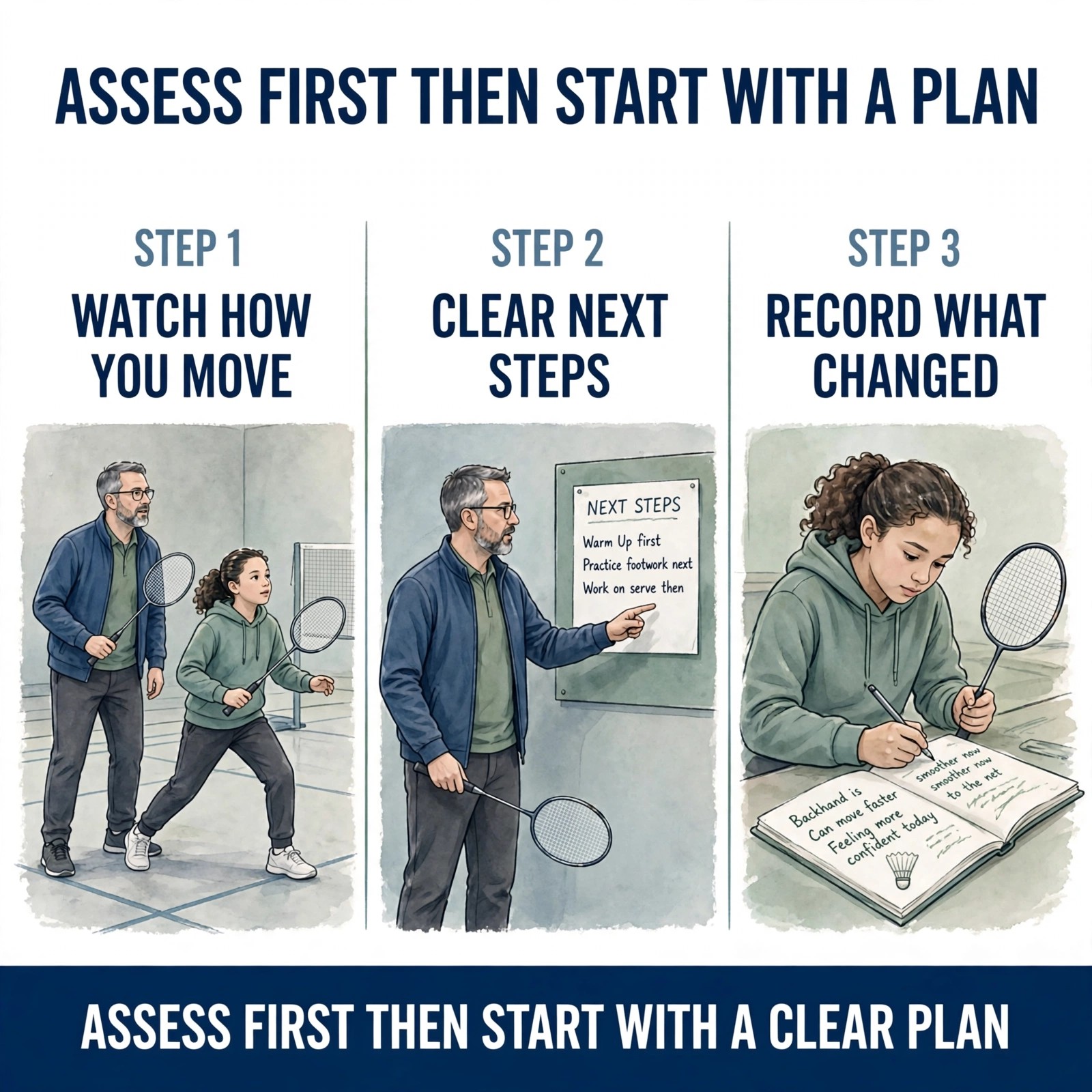
Do not sign up for a long programme before you have seen one session. The Initial Assessment is an honest way to check whether the class fits. In a good assessment, the coach watches how you move, how you hold the racket, and how you follow simple instructions. Then the coach tells you clearly what needs work and what the next steps are. You should leave the session knowing more about your game than when you arrived. At ST Badminton Academy, there is no free trial class. New students start with a paid Initial Assessment. The reason is simple: an assessment is real coaching time, not a sales visit.
Progress in badminton is easy to feel but hard to measure without a record. A good coach keeps a record. It can be short notes after each block of sessions: grip fixed, footwork steadier, clear reaching the back line, rallies longer than five shots growing to ten shots. These small notes add up to a picture you can trust. Without a record, every week feels the same, and parents have no way to know whether their time and effort are paying off.
Feedback should be regular, specific and honest. Saying good job every week is not feedback. A useful comment names one thing that has improved and one thing to work on next. Video feedback also helps, when it stays private. A short clip of a student’s clear, watched together with the coach, shows a mistake faster than ten minutes of talking. At ST Badminton Academy, video feedback is used this way, and videos of children are never posted in public. Ask how often you will hear from the coach, and in what form. A short update after one block of sessions is enough for most families.
Location and Schedule
Location and Schedule: Pick a Class That Fits Your Week
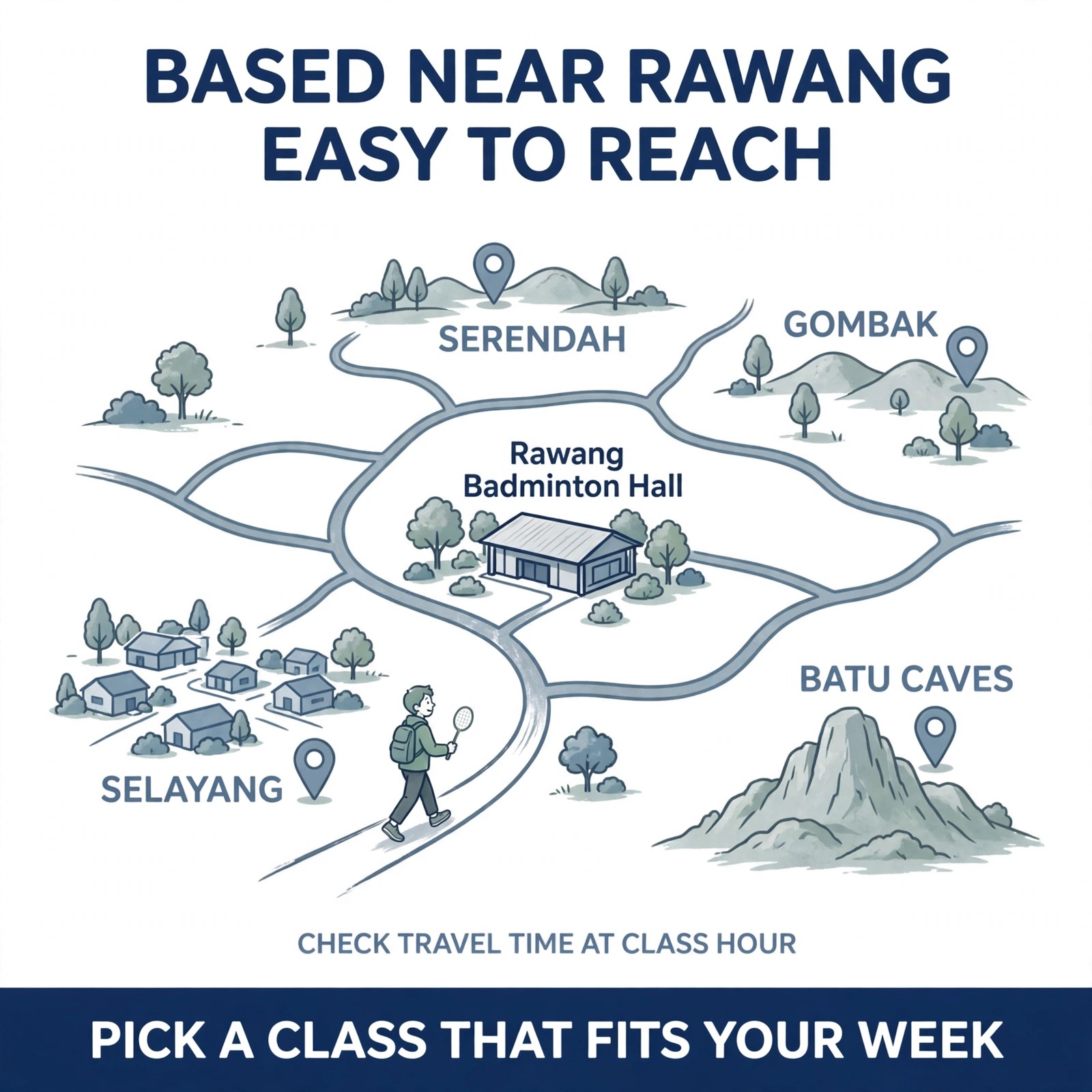
The location of a class should fit your week, not the other way around. ASB Badminton Hall sits above Modern Market in Bandar Baru Rawang and is a Rawang Badminton Club tournament venue. Rawang Badminton Sports Centre is in regular use by 91 Purple Smash Badminton Club. Forum BTP in Bandar Tasik Puteri is a pickleball centre only, not a badminton venue, so it is not listed as a badminton option here. Rawang sits north of Kuala Lumpur, past Selayang and Batu Caves, so families often compare Rawang classes with classes in Selayang, Batu Caves and Setapak before they commit. Before signing up, check the travel time at your class hour, not at a quiet midday hour. A trip that takes twenty minutes on a Sunday can take twice as long on a weekday evening. A class nearby that you attend every week is better than a great class far away that you keep missing.
The schedule also needs to fit your life. Afternoon classes suit children after school, while evening or weekend classes usually suit working adults. Ask how often classes run each week, and how long each session runs. Beginners usually train two or three times a week, with rest days between sessions. That rest matters. Muscles and mind need time to take in what was learned. A class that demands daily training with no rest for a beginner should make you question its planning.
Classes in Rawang should also take school terms and public holidays into account. Ask what happens when a class falls on a holiday, and how replacement sessions are handled. Ask who teaches when the main coach is away. In a well run academy, the replacement knows the student’s plan and knows what has been learned so far, so the class runs without a break. Clear answers about schedule, holidays and replacements show an academy that is well run. Answers that dodge or stay vague are a sign you need to ask more before you decide.
Red Flags
Red Flags: When to Look for Another Class
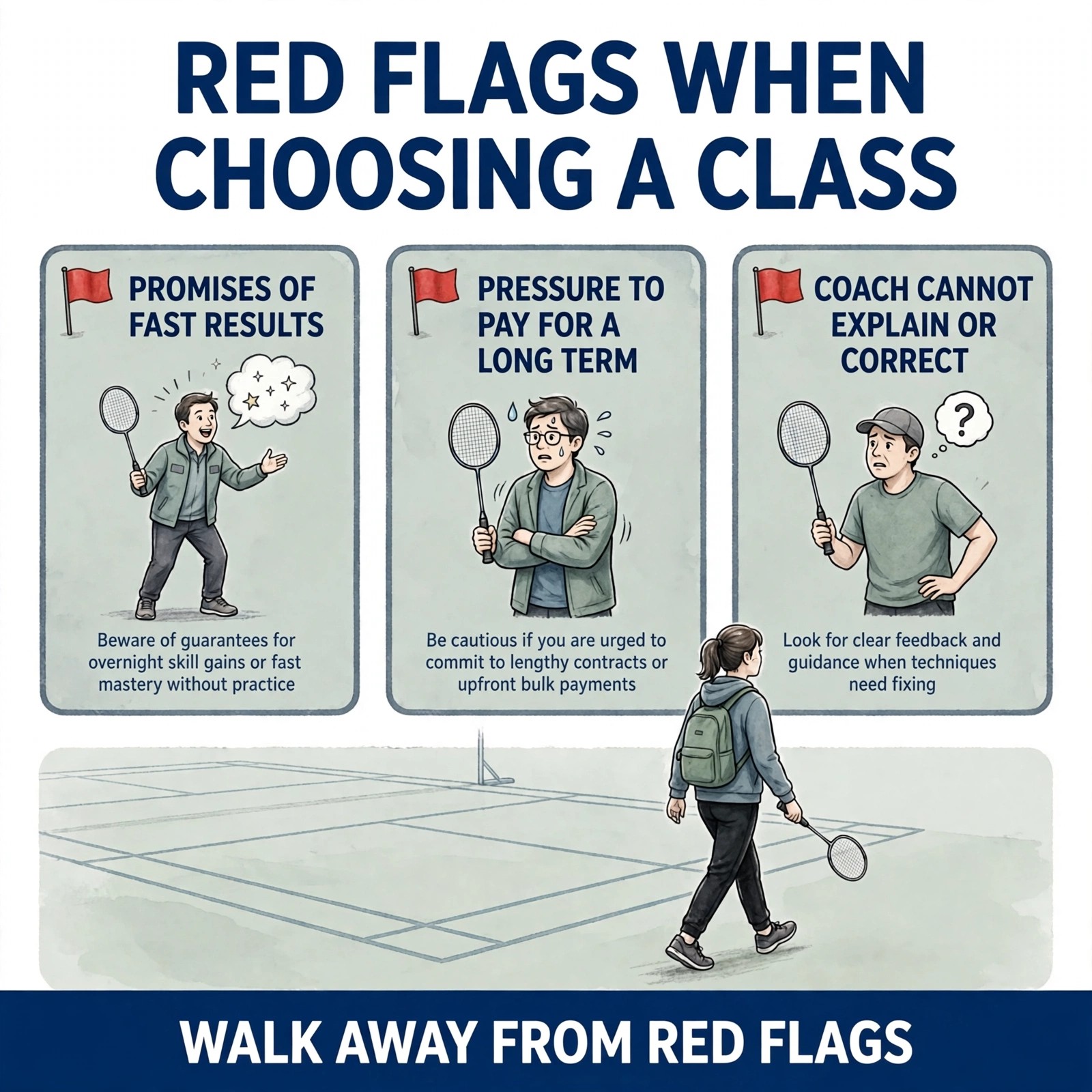
The first red flag is a promise of fast results. No coach can promise a tournament win, a place on a state team, or a fixed timeline for progress. Badminton rewards steady effort over months, and any coach who guarantees results within a few weeks is selling hope, not training. A good coach talks about the work to be done, the plan to be followed, and the signs of progress you can see, and lets the results be decided by the player.
The second red flag is pressure to pay for a long term before you have seen one session. A fair academy lets you assess first, then decide. Watch out for contracts that lock you in for months, extra charges that only appear after you sign, and answers that dodge direct questions about terms and conditions. Clear terms, given in writing before you commit, are a sign of a serious academy. If you feel pushed, trust that feeling and keep looking.
The third red flag is a coach who cannot explain, cannot correct, or will not answer questions. If a coach talks over you, blames the student for every mistake, or runs a group so large that nobody gets attention, look for another class. There are many good coaches in the Klang Valley. The right coach will welcome your questions, show you the plan, and let the coaching speak for itself. Choose a coach who wants you to understand, not a coach who wants you to simply obey.
FAQs: Badminton Classes in Rawang for Parents and Adults
Here are the answers to the questions parents and adult beginners in Rawang ask most often about badminton classes.
How do I find a good badminton coach for a beginner?
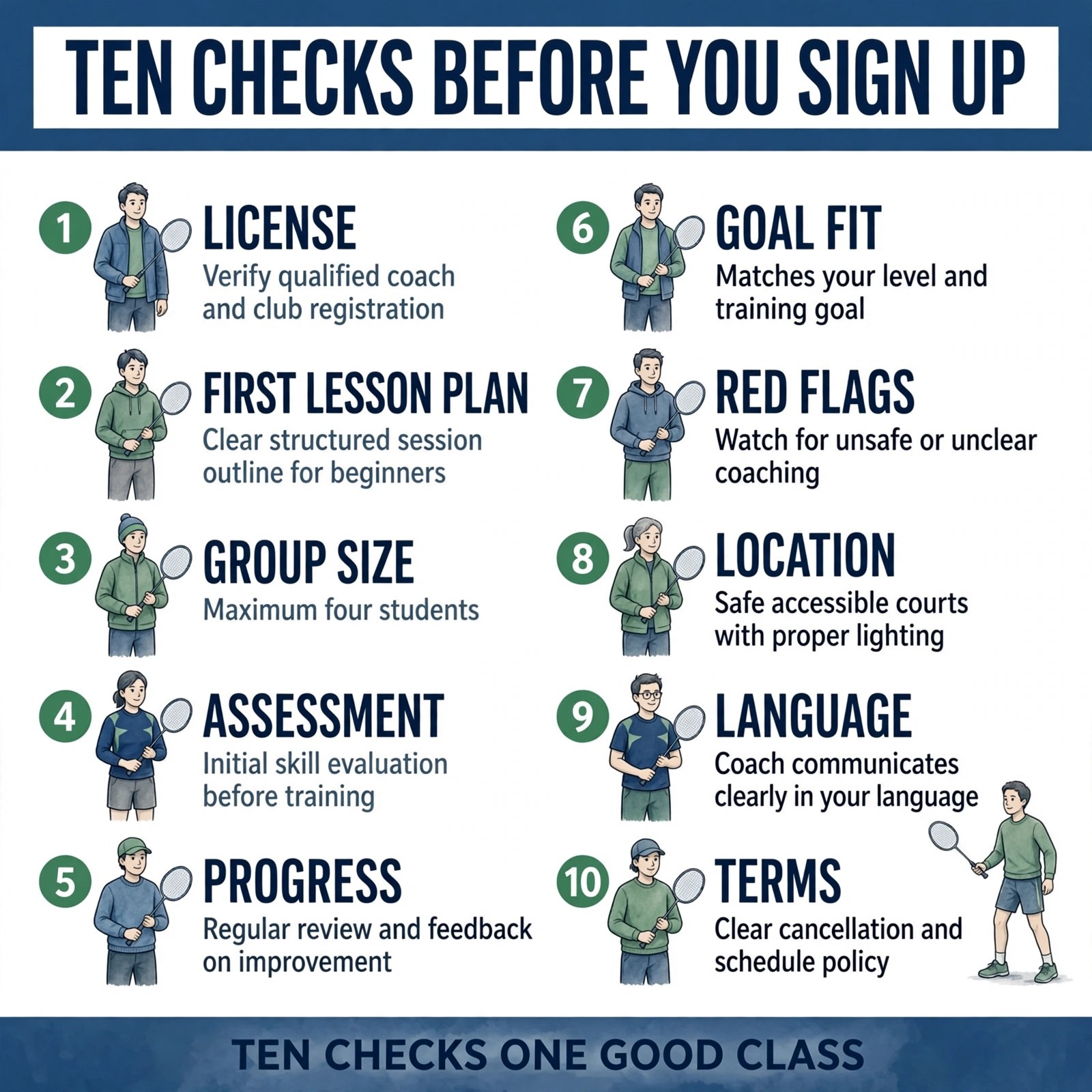
Start with the basics, not the brand name. Look for a coach with real coaching credentials, a clear plan for the first month, and a small group where every student gets corrections. Visit once and watch one session: does the coach explain in plain words, fix small mistakes, and keep every student moving? Ask about the first lesson, group size, and how progress is tracked. A good coach for beginners teaches grip, footwork, and clear first, and keeps the smash for later. The checklist in this guide covers all ten points to check.
When can a child start badminton?
Children can start badminton while they are still young. At this stage, a class should be built around basic movement, holding the racket, and simple games that are fun. More serious structured training usually comes later, once the child is used to the court and can follow instructions in a group. The readiness signs that matter more than any number are whether the child can listen to instructions, wait for a turn, and enjoy moving. If your child shows these signs, an Initial Assessment will show whether a class suits them.
How often should a beginner train?
Beginners usually train two or three times a week. That schedule gives enough time to repeat what was learned, and rest days between sessions give the body time to recover. One session a week can still help, but progress is slower because too much time passes between sessions. Daily training with no rest is not advised for a beginner. Steady training over several weeks works better than a packed few days followed by a stop.
How long before I see progress?
Most beginners see small changes within a few weeks when they train steadily. The grip starts to look neater, the feet return to the middle of the court after every shot, and the clear reaches the back line more often. Rallies grow longer. Bigger progress, like steady footwork and shots you can rely on in a game, usually takes a few months. A good coach can tell you what has changed and what comes next, without vague praise.
Can an adult who starts late still improve?
Yes. Adults who start late can improve well when the basics are rebuilt the right way. The main work is rebuilding footwork and fixing old habits, like a swing that relies too much on the arm. A good coach will teach technique that is kind to the shoulder and set training that fits your current fitness. Many adults start for exercise and find they enjoy it more and more as their rallies grow longer and their shots grow more accurate. Starting late is not a barrier, but the training plan must fit your body.
Does ST Badminton Academy offer a trial class?
No. ST Badminton Academy does not offer a free trial class. New students start with a paid Initial Assessment. In the assessment, the coach watches how you move, how you hold the racket, and how you follow simple instructions, then tells you clearly what needs work and what the next steps are. The assessment is real coaching time, not a sales visit. Other academies do offer free trial classes. Ask first what the trial actually includes before you book it.
Group class or private lesson, which fits?
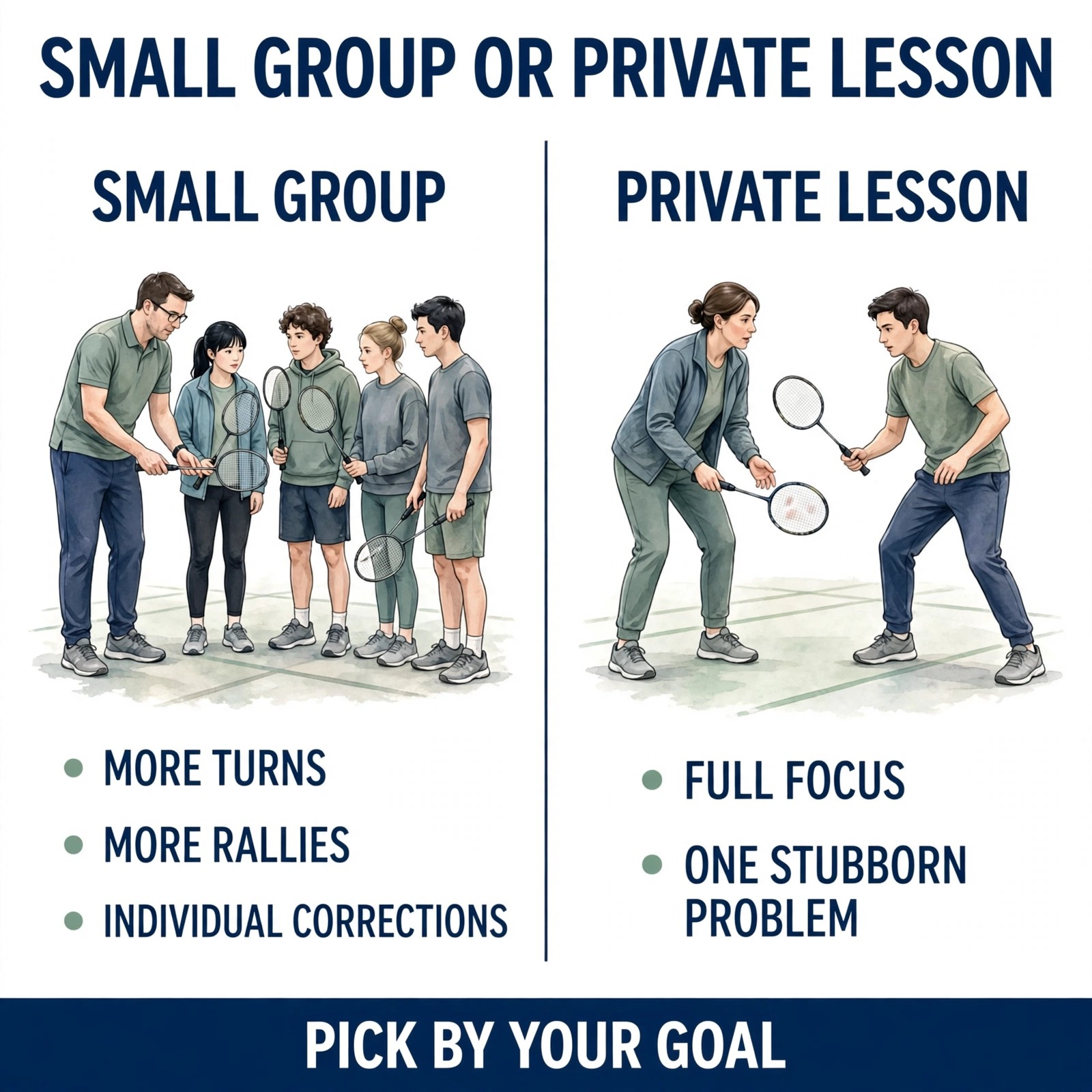
It depends on your goal. A group class gives training partners, games, and a social setting. A private lesson gives full attention to one stubborn problem, like a grip that will not change or a backhand that keeps failing. Many families combine both: a weekly group class for rallies and games, plus a private session when one shot needs fixing. At ST Badminton Academy, group classes are limited to four students, which sits between a large group and a private lesson.
What racket and shoes suit a beginner?
A beginner should pick a light racket that is easy to control, with a flexible or medium shaft. A racket that is too heavy or too stiff will make it hard to learn the right swing. Real badminton shoes also matter, because they are built for side to side movement and sudden stops on court. Ordinary running shoes do not give the same support. Bring your racket and shoes to the Initial Assessment, and the coach will tell you whether your gear suits you, or whether anything should change before you buy new gear.
What makes Mr Eric Chuar a good coach for beginners?
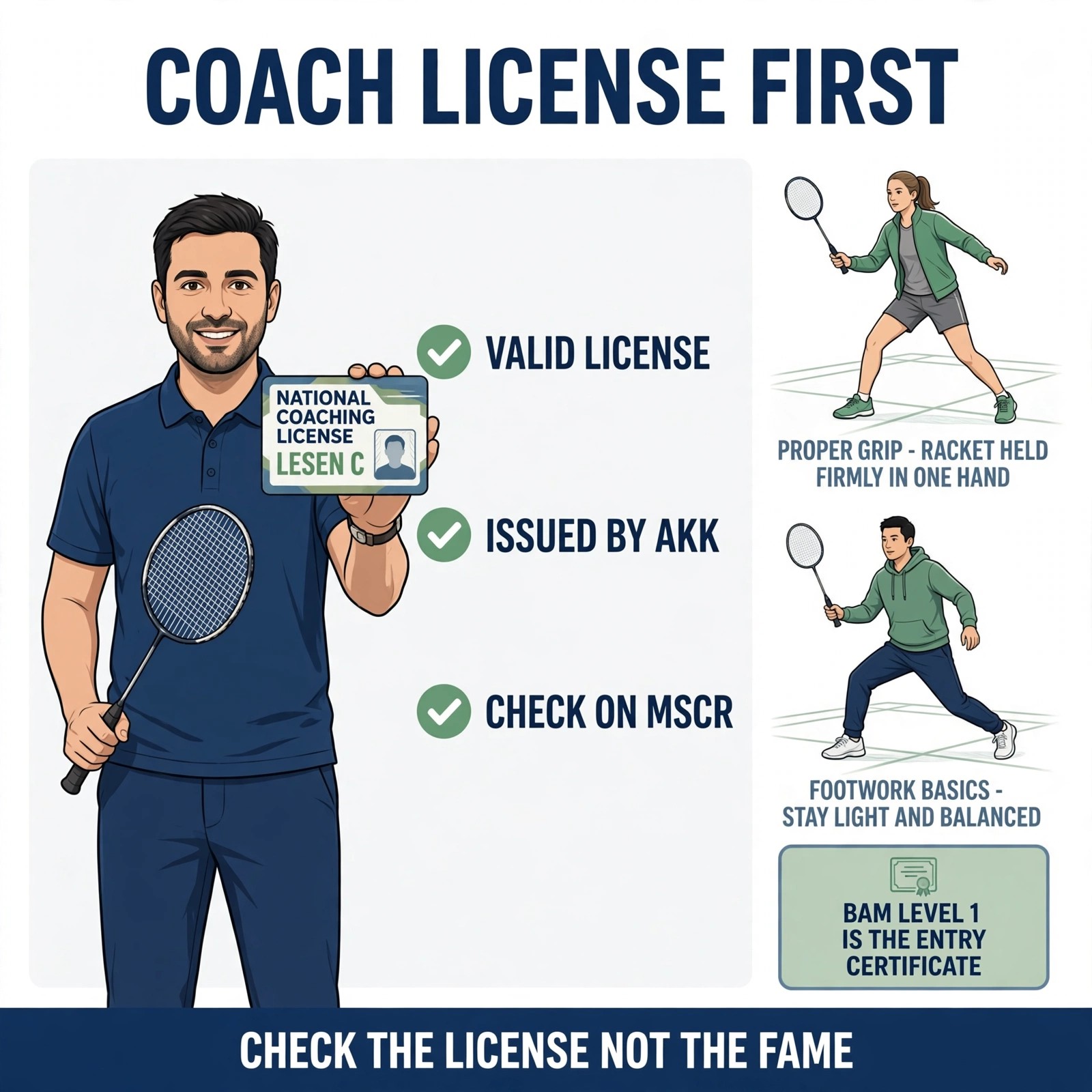
Mr Eric Chuar has coached for more than fifteen years in Singapore and Malaysia, and he still teaches small groups himself at ST Badminton Academy in Setapak. He holds a valid National Coaching License, Lesen C (SLKK Tahap I), issued by the National Coaching Academy (AKK), plus a National Level 1 Badminton Coaching Certificate under SPKK, a Sport Science Level 1 qualification, and a BAM Level 1 coaching qualification. His groups are limited to four students, so every student gets individual corrections. He teaches the basics first, grip, footwork, then clear, and he tracks progress with regular feedback. Parents can watch one session and judge his coaching for themselves.
Good Badminton Classes in Action


What Good Coaching Looks Like at ST Badminton Academy
Picking a class gets easier when you know what good coaching looks like. These are the standards we hold ourselves to in every session at ST Badminton Academy in Setapak.
| Factor | Casual Class | Structured Class STBA |
|---|---|---|
| Coach Background | Whoever is free that day. No clear credential or plan. | A qualified coach with a clear teaching record and more than fifteen years of experience in Singapore and Malaysia. |
| First Lesson Plan | Turn up and start playing. No assessment, no plan. | Initial Assessment first, then grip, footwork, and clear in a fixed order. |
| Group Size | Large groups. The coach hardly sees each student. | Maximum four students. Mr Eric Chuar himself corrects every shot and movement. |
| Progress Tracking | No record. You are told you are good every week. | Regular feedback and a clear record of what has improved and what to work on next. |
| Communication | Short answers. Parents rarely hear about their child's progress. | Clear explanations after sessions, and video feedback that stays private. |
| Training Plan | The same drills every week for everyone, whatever their goal. | A plan matched to your goal: fun games, school team, or competition training. |
| Long Term Results | Players who play the same way year after year. | Players with clean basics, clear next steps, and steady progress over time. |
Choose Well, Then Train with Confidence
Before you commit, run three final checks. Check eight: does the location and schedule fit your week without a long trip or late night sessions? Check nine: can the coach explain things in words you and your child understand? Check ten: are the terms and conditions clear, with no pressure to pay for a long term before you have seen one session? If a class passes all ten checks, you have found a class worth training with. ST Badminton Academy in Setapak welcomes parents and adult beginners who want to see good coaching before they commit.


