Badminton learning in Kuala Lumpur
Can Siblings Join the Same Badminton Class? Matching Levels and Learning Pace
One journey is convenient, but a shared badminton class should work for both children. Use these questions to discuss placement without comparing siblings.
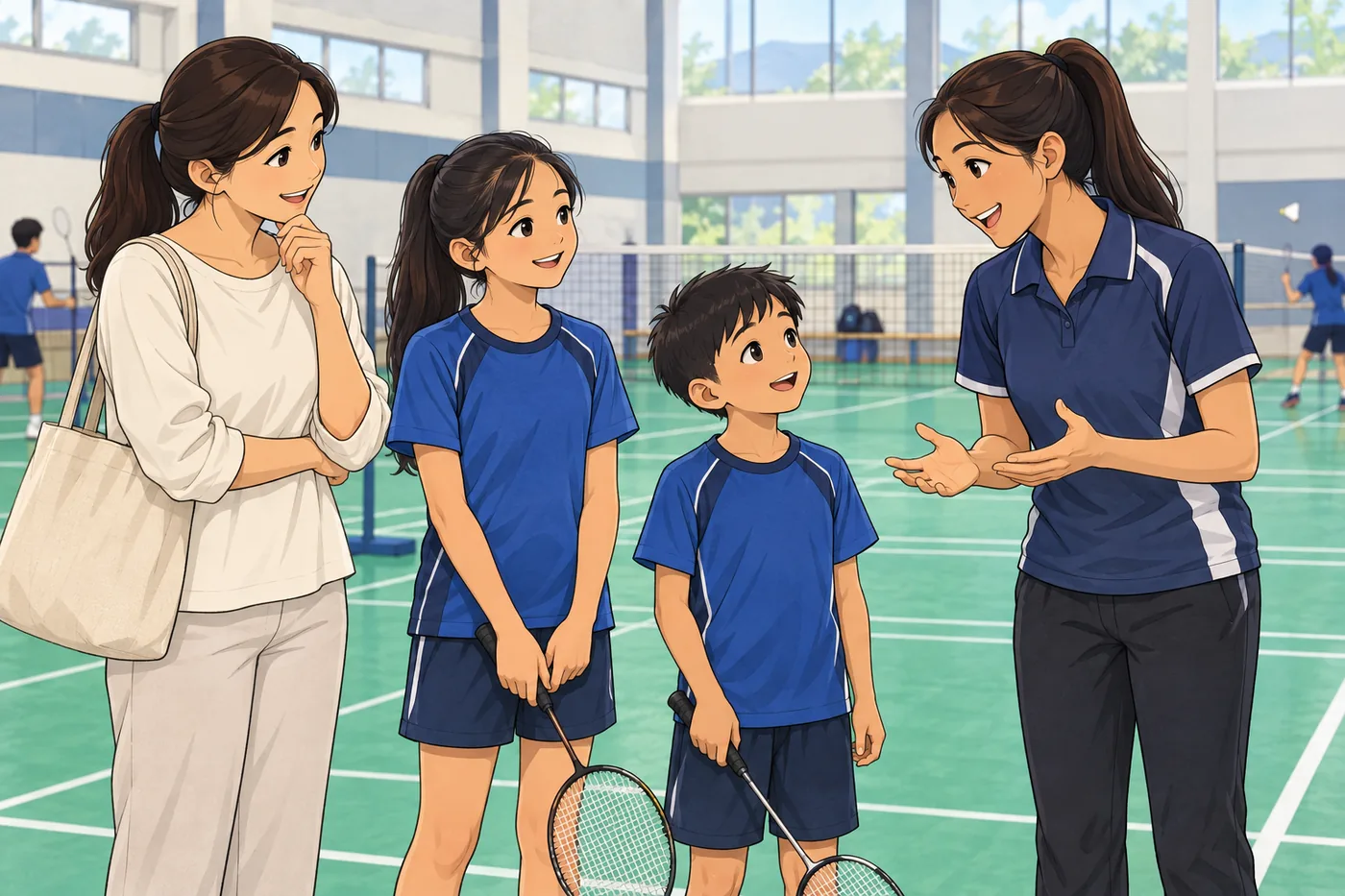
Siblings may be able to join the same badminton class if the group, tasks and coaching arrangement suit both children. Being related, close in age or available at the same time does not by itself establish that fit. Each child needs a chance to be assessed as an individual.
The practical aim is to find an arrangement that supports both children’s learning while remaining manageable for the family. Sometimes that is one shared class. Sometimes it means different groups, even if the siblings attend the same badminton academy. A useful discussion starts with what each child can do and how each responds to practice.

Age gives context, but it is not the whole placement decision
Two children of similar ages can arrive with very different experience. One may have attended regular lessons, while the other has only hit a shuttle during family games. An older sibling may also be the less experienced player.
Tell the coach about each child’s experience separately. Include whether they have followed coached exercises, played with other children and managed basic court routines. Avoid using the older child’s level as the younger child’s starting point.
Likewise, do not assume that a child who wins family games will find every class task straightforward. Familiar opponents and informal games can hide gaps that become visible in a new exercise. The coach needs to see how the child receives instructions, controls the shuttle and responds when the task changes.
Any age or entry requirements for a particular class should be confirmed directly. A general discussion about siblings does not establish eligibility or availability.
Look at task readiness rather than family comparisons
A useful assessment asks whether both children can participate meaningfully in the proposed class. The question is not which sibling is better overall. It is whether the tasks are understandable and appropriately challenging for each.
| Area to discuss | What the coach may observe |
|---|---|
| Following instructions | Can the child understand and attempt the current exercise? |
| Shuttle control | Can they keep the task going at its intended level? |
| Movement readiness | Can they move through the exercise without repeatedly losing its sequence? |
| Partner practice | Can they cooperate with a partner and take turns appropriately? |
| Response to feedback | Can they try a suggested change, with suitable support? |
| Independence | Can they participate without relying on the sibling for every instruction? |
This is a discussion checklist, not an admissions test. Different tasks need different levels of support, and the coach should explain what the observations mean for placement.

When a shared class can be a workable choice
A shared class may work when both siblings understand the group exercises and can practise at a compatible pace. They do not have to perform every shot identically. The important question is whether the class can give each child useful work without one repeatedly waiting or struggling.
For example, two beginners might both be learning controlled contact and simple movement, even if one settles into a new activity more quickly. A coach may be able to adjust a target or simplify part of an exercise while keeping both involved. Whether that is practical depends on the actual class arrangement.
A familiar sibling can make an unfamiliar setting feel easier, but it is helpful for each child to communicate with the coach directly. Ask whether the children will also practise with other partners when suitable, so the shared class does not become a permanent two-person bubble.

Notice when one class is serving only one child
The arrangement deserves another look if the same child is consistently left behind, waiting for the other or acting as an unpaid assistant. An older sibling should not have to replace the coach’s explanation whenever the younger child is unsure.
Another warning sign is a large gap between the current tasks each child needs. One might be learning to keep a cooperative rally going, while the other needs practice making choices in an unpredictable rally. Repeating the easier task may occasionally be useful, but it should not be the only available work for the more experienced child.
Do not judge suitability from one awkward session. A new group, a confusing instruction or an unsettled day can affect participation. Ask the coach whether the difficulty is a temporary adjustment or a repeated mismatch between the class and the child’s needs. Request examples rather than a broad label such as slow or talented.


Make room for different goals within the same family
One child may want to enjoy confident rallies with friends. Another may be interested in school badminton or a more demanding playing environment. Neither goal needs to become the family standard for both children.
Ask each child what they enjoy and what they find difficult. Younger children may answer through simple examples: ‘I like hitting over the net’ or ‘I don’t know where to stand next.’ Those answers can be more informative than asking whether they want to become a serious player.
Share the goals with the coach without promising outcomes to the children. The beginner badminton class information can help parents understand the foundation-stage discussion. A child with more experience may need a different conversation about match situations, consistency or the next suitable group.
Revisit goals as interests change. Siblings do not have to progress through the same activities at the same time.
Ask about scheduling options without assuming they exist
Family logistics are a genuine consideration. Explain the days, travel distance and collection arrangements that are realistic for you, then ask what current options are available.
- A shared group, if both children are suitably placed.
- Different groups at the same venue, if the timetable allows.
- Separate session times that the family can attend reliably.
- A different arrangement recommended after assessment, subject to availability.
These are possibilities to discuss, not a statement that ST Badminton Academy offers every combination. Confirm the timetable, placement process and any applicable terms before making a commitment.
If the journey makes regular attendance difficult, say so early. The badminton training information is a starting point for the discussion; the practical fit still depends on the children and the actual class options.
Keep feedback about each child separate
After class, ask about the task rather than who performed better. ‘What did you try differently today?’ or ‘Which exercise would you like explained again?’ gives each child room to describe their own experience.
When asking the coach for an update, discuss one child at a time. Useful feedback names a skill or behaviour: preparing before the feed, keeping the intended target or asking for clarification. It should not require describing the sibling as the benchmark.
If the children practise together outside class, choose a cooperative task that both understand and that the coach considers suitable. Make it clear that either child can ask to stop the practice. The older or more experienced child should not become responsible for correcting the other at every opportunity.
Friendly games can remain part of family time without becoming a running assessment of who deserves the more advanced class.
Review the arrangement as the children develop
A good placement today does not have to remain unchanged indefinitely. Children can become comfortable with different skills at different times, and their school commitments or interests may change.
Ask the badminton coach what would prompt a placement review. Relevant signs might include one child consistently completing the current tasks comfortably or needing a different kind of practice. Moving groups can be explained as matching the next learning task, rather than a promotion for one sibling and a failure for the other.
Keep the decision tied to what each child needs next and what the family can sustain.
Questions about this badminton training topic
Can an older beginner join a class with a younger experienced sibling?
Possibly, but the age order does not establish the right placement. Each child’s current skills and ability to participate in the class need to be assessed.
Do siblings have to be at exactly the same badminton level?
Not always. Some differences may be manageable within a class. Ask the coach whether the actual tasks and support can give both children meaningful practice.
Should siblings always practise as partners?
No. Suitable partner changes can let the coach observe how each child participates independently. The practical arrangement depends on the exercise and the group.
What if one child is nervous about attending without the other?
Tell the coach before the session and ask how introductions are handled. Comfort matters, but it should be considered alongside whether the class is suitable for the child.
Can both children be assessed together?
Ask about the available assessment process. Even if they attend the same session, the placement discussion should consider each child individually rather than treating them as one booking decision.
Discuss your training
To discuss sibling badminton classes in Kuala Lumpur, contact ST Badminton Academy with each child’s age, experience and available days. Describe the two children separately and mention that a shared journey would help. That gives the academy useful information to discuss suitable options without assuming one class fits both.