What Are The Top Tips For Balancing Skill Development In Badminton Training? (Skills Guide)
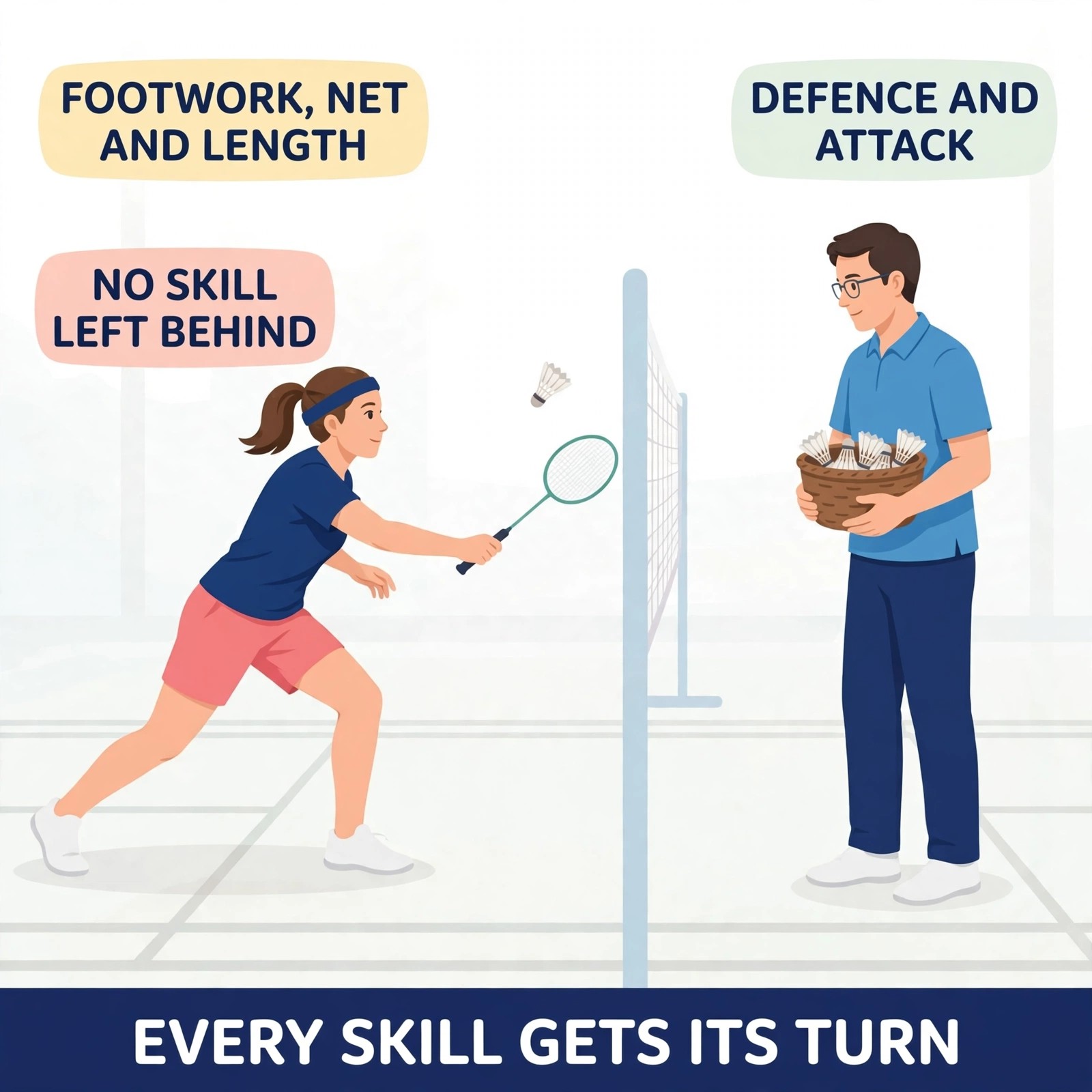
Ask a room of badminton players which skill they trained this week and the answers come fast: smashes, footwork, that favourite feeding drill. Ask which skill they avoided and the room goes quiet, because everyone knows theirs. A backhand that only works in practice. A net game that vanishes under pressure. Defence that holds for two shots and folds on the third. Balanced skill development is the habit of facing that quiet answer on purpose. It means every skill family gets planned time, honest checks and a turn being the focus, so no weakness sits untouched for months while the strengths collect all the training hours.
Balance Check #1
Map the Whole Game: Six Skill Families
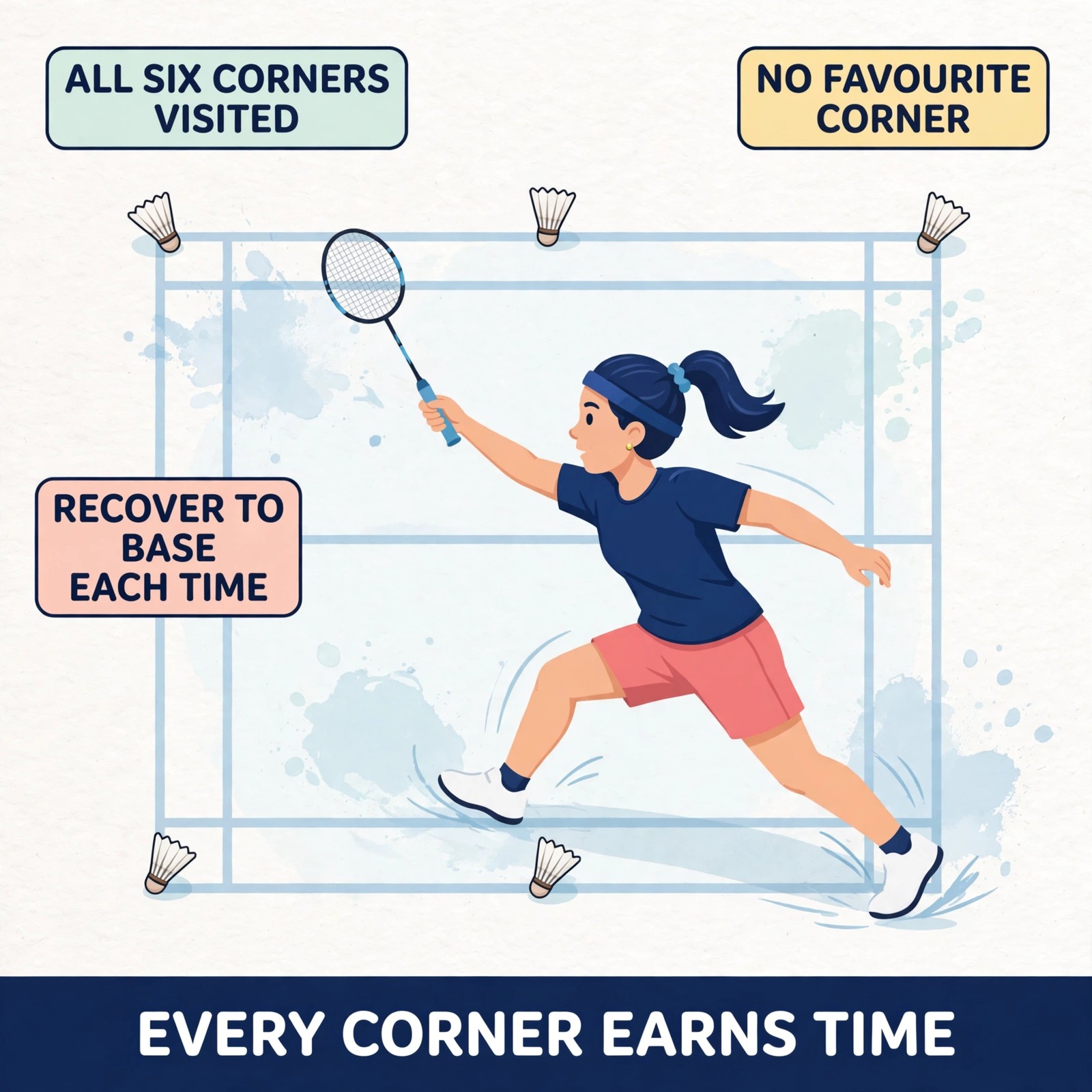
Balance starts with a map. Badminton skills fall into families that behave differently and fail differently. Footwork moves you to the shuttle. Length skills, clears and lifts, buy you time and push opponents back. Drops and net play win the front court. Defence absorbs pressure and turns it around. Attack, smashes and drives, finishes rallies. Serves and returns start every rally and set its shape. Six families is a workable map for most players. Write yours down on one page and rate each family honestly, the way you would describe it to a coach who has never seen you play. That page is now your training conscience.
Rating honestly is the hard part, because drills flatter us. A clear that lands perfectly from a friendly feed may still fall apart in a match when you are late and stretched. Rate each family by match evidence, not drill comfort. Ask three questions. Does this skill hold in the third game, when I am tired? Does it hold against players stronger than me? Do I choose it in rallies, or do I quietly route around it? Routing around a skill is the clearest rating of all. If you never play a backhand clear in matches, its honest rating is low, whatever the drill sheet says. Honest ratings sting for a day and guide you for months.

Balance Check #2
Rotate the Focus: Every Skill Gets Its Turn
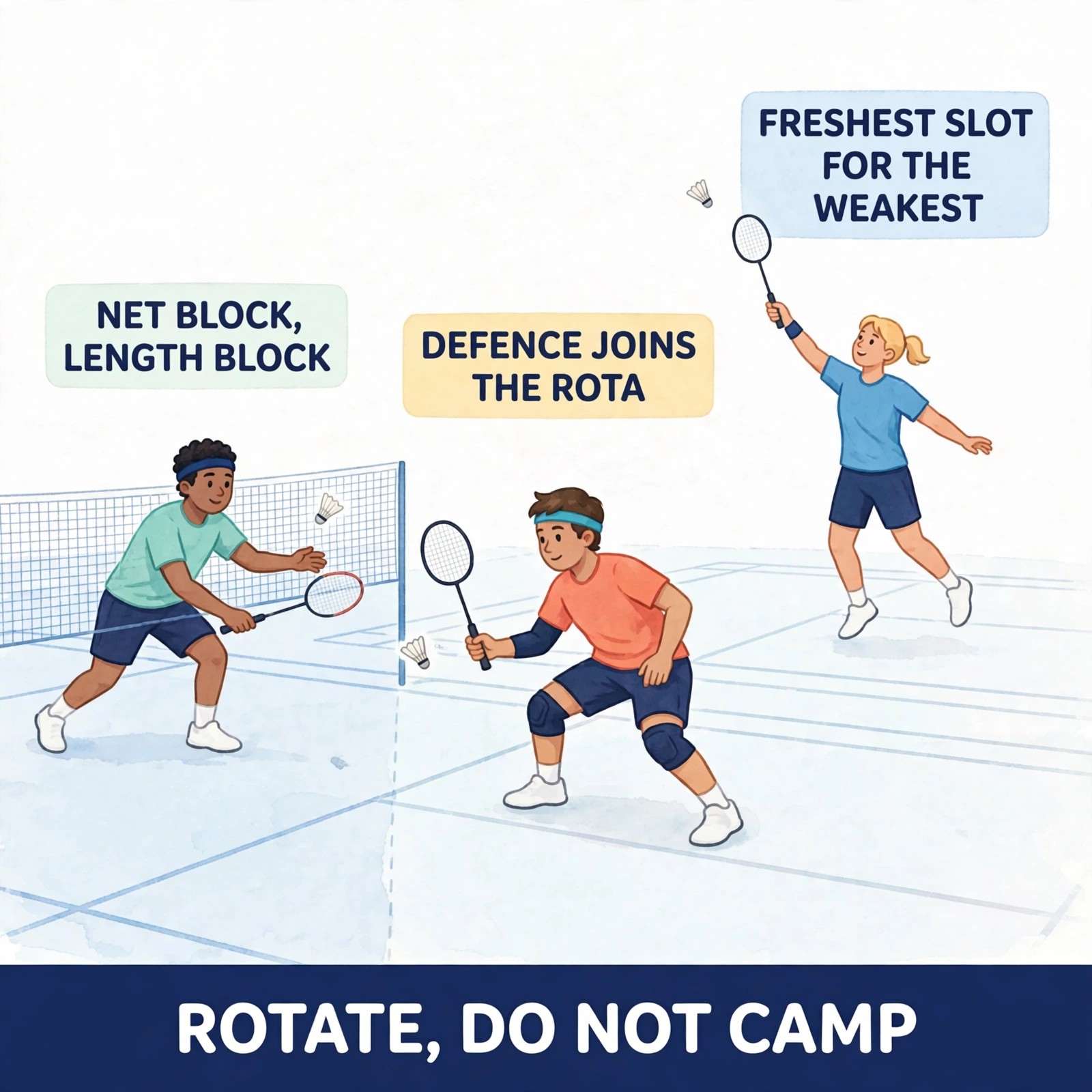
With the map drawn, the week needs a rota, not a mood. Give the training week focus blocks: a block where net play is the main job, a block for length, a block for defence, and so on through the families. Inside each block, that skill gets the freshest minutes and the coach’s closest eyes. The other families do not vanish; they stay warm with short touches inside warm ups and mixed drills. The trap this rota kills is the favourite drill trap: camping on the drills you already enjoy and do well, because they feel like progress. They feel good precisely because they ask nothing new of you.
Order inside the rota matters. Put the weakest family early in the session and early in the week, while legs and mind are fresh. Weak skills need your best attention, not the tired leftovers at the end of a hard day. Strong families can hold their level on smaller, later doses, because skills you own deeply decay slowly. As weeks pass, the rota keeps turning. When the weakest family climbs, another becomes the lowest, and it takes the fresh slot next. Balance is not a finish line you reach once. It is a rota you keep, the way you keep a court booking.
Coaches plan rotas, but players can run a simple one alone. Pick one focus family per week if you train twice, or per session if you train often. Say it out loud to your training partner before the warm up, so the session has a stated job. Feed each other honestly: the focus skill gets feeds at match speed by the end of the block, not gentle lobs that protect feelings. And when the block ends, give the family a one line verdict in your log. Rotas fail when they live only in intentions. On paper, in a notebook, they survive busy weeks and changing partners.
Balance Check #3
Quality Before Quantity: Clean Reps Build Skills
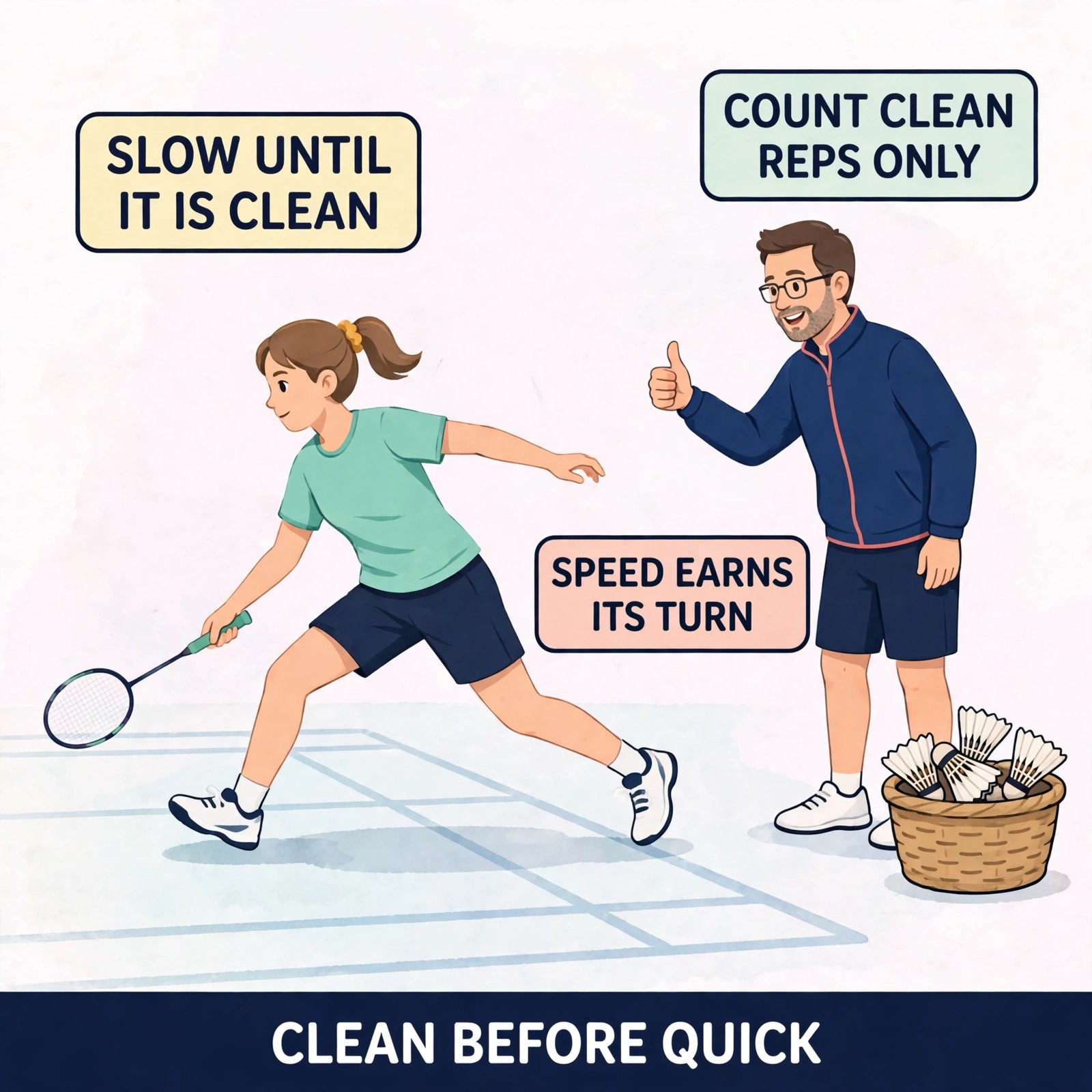
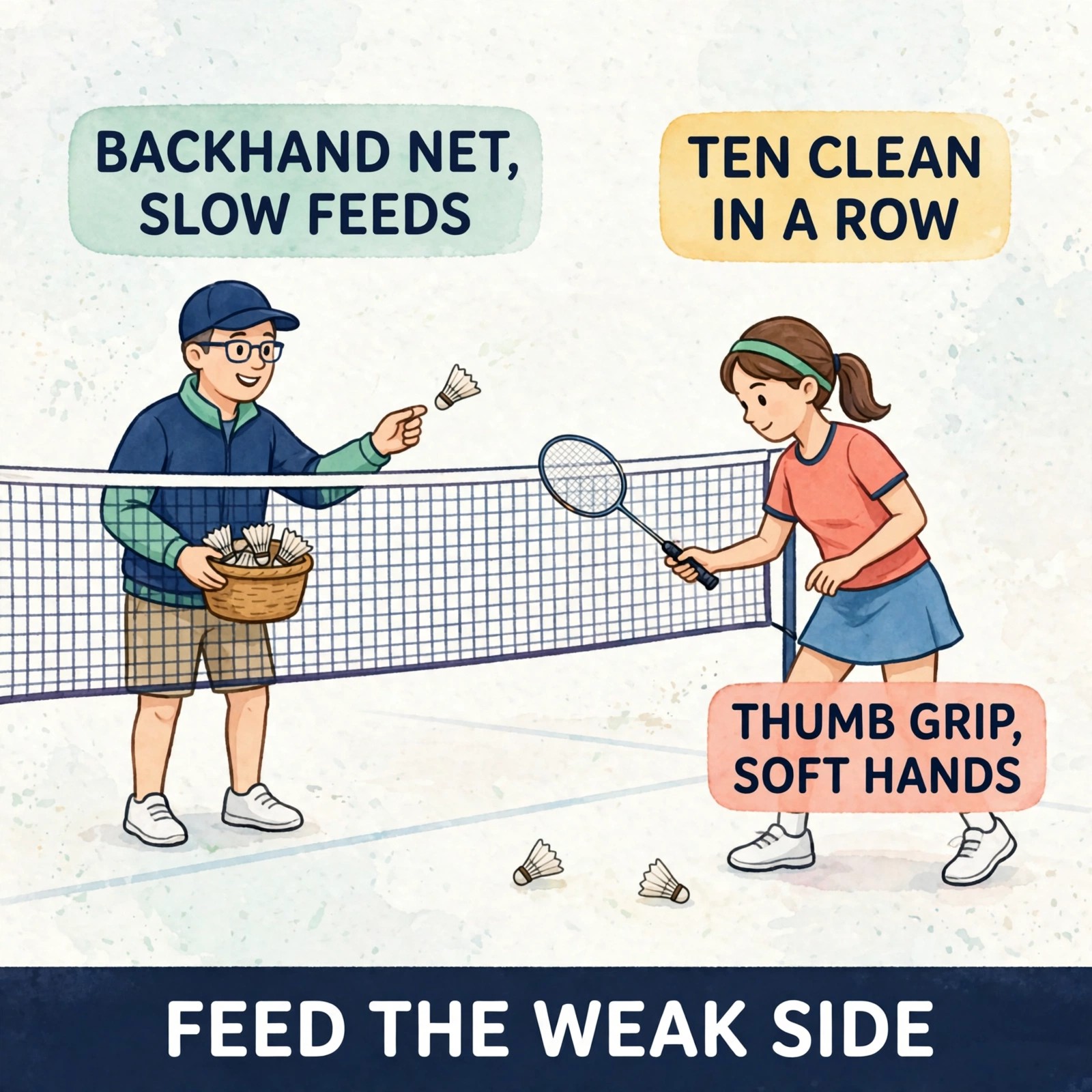
Inside every block, one rule protects the work: quality before quantity. A skill grows from clean repetitions, not from tired ones. When you learn or repair a shot, start slow enough that the shape is right on almost every rep: grip correct, contact in front, recovery steps honest. Count the clean reps, not the total. Fifty swings with a late contact teach lateness fifty times. Fifteen clean ones teach the skill. Speed is earned inside the block: as the clean reps stack up, quicken the feed and the feet, and stop the set when the shape breaks twice in a row. That stop rule is not softness. It is how you refuse to practise the wrong thing.
The source of most lopsided players is not laziness. It is that quantity feels measurable. Courts booked, hours logged, shuttles used: these numbers are easy to report and they say nothing about what improved. Clean reps are quieter to count and they are the ones that transfer to matches. A practical way to hold the line is the ten clean rule for a new or weak skill: the drill ends when you reach ten clean reps in a row, or when form breaks and a short reset is needed. Some days that takes five minutes. Some days it takes the whole block. Both days taught the same lesson, at the speed your body actually learns.
Quality also means the right difficulty. A drill that succeeds every time is entertainment. A drill that fails every time is noise. The learning zone sits between: most reps succeed when you concentrate, and failures show you exactly what to adjust. Good coaches live in that zone, feeding a little faster as you cope, holding back when your shape frays. If you train without a coach, build the zone yourself: slow the feed until you own the shape, then add one small challenge at a time. Balanced development is patient work. Skills built cleanly stay built. Skills rushed into bad shape must later be unbuilt, which costs twice the time.
Balance Check #4
Conditioned Games: Let Matches Audit Your Skills
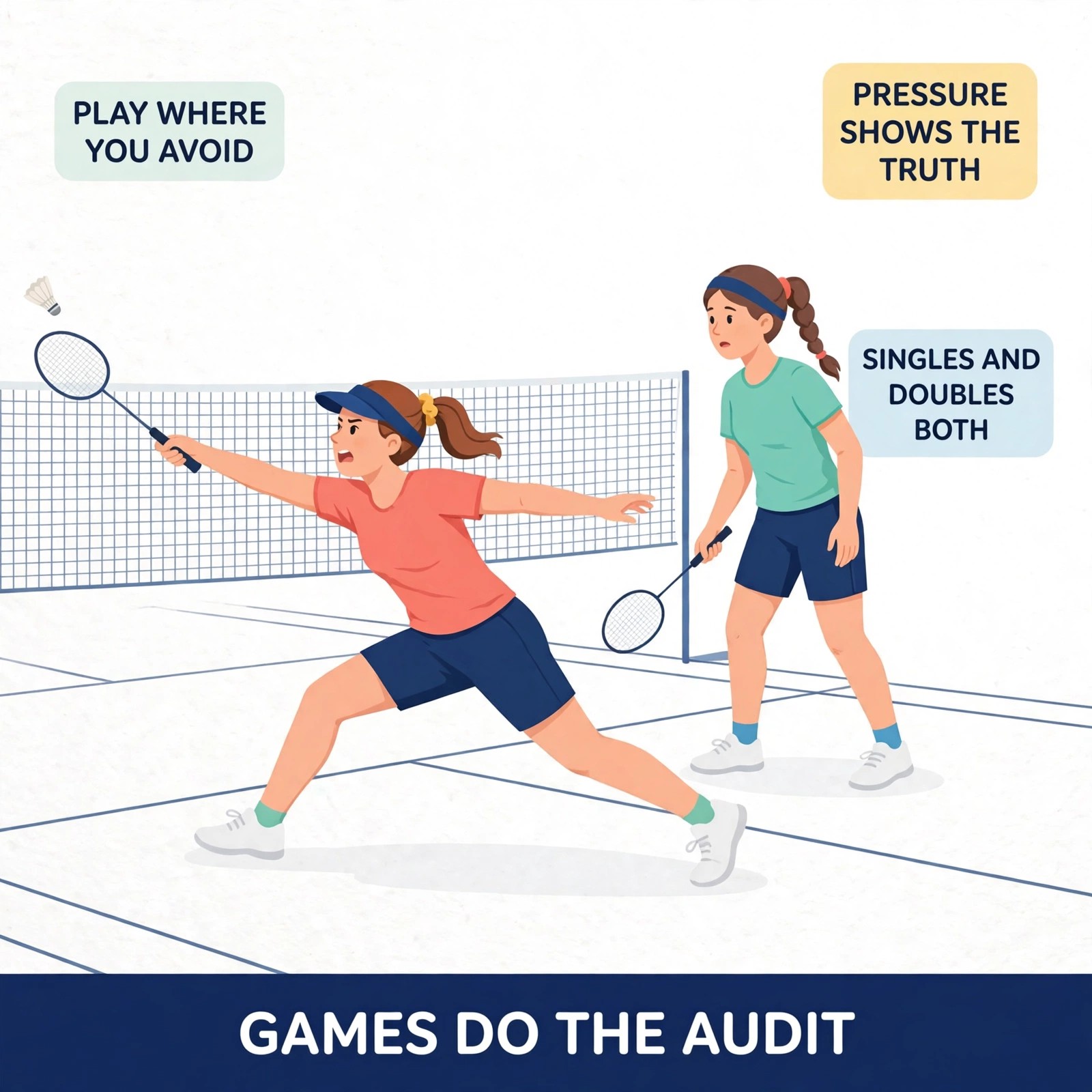
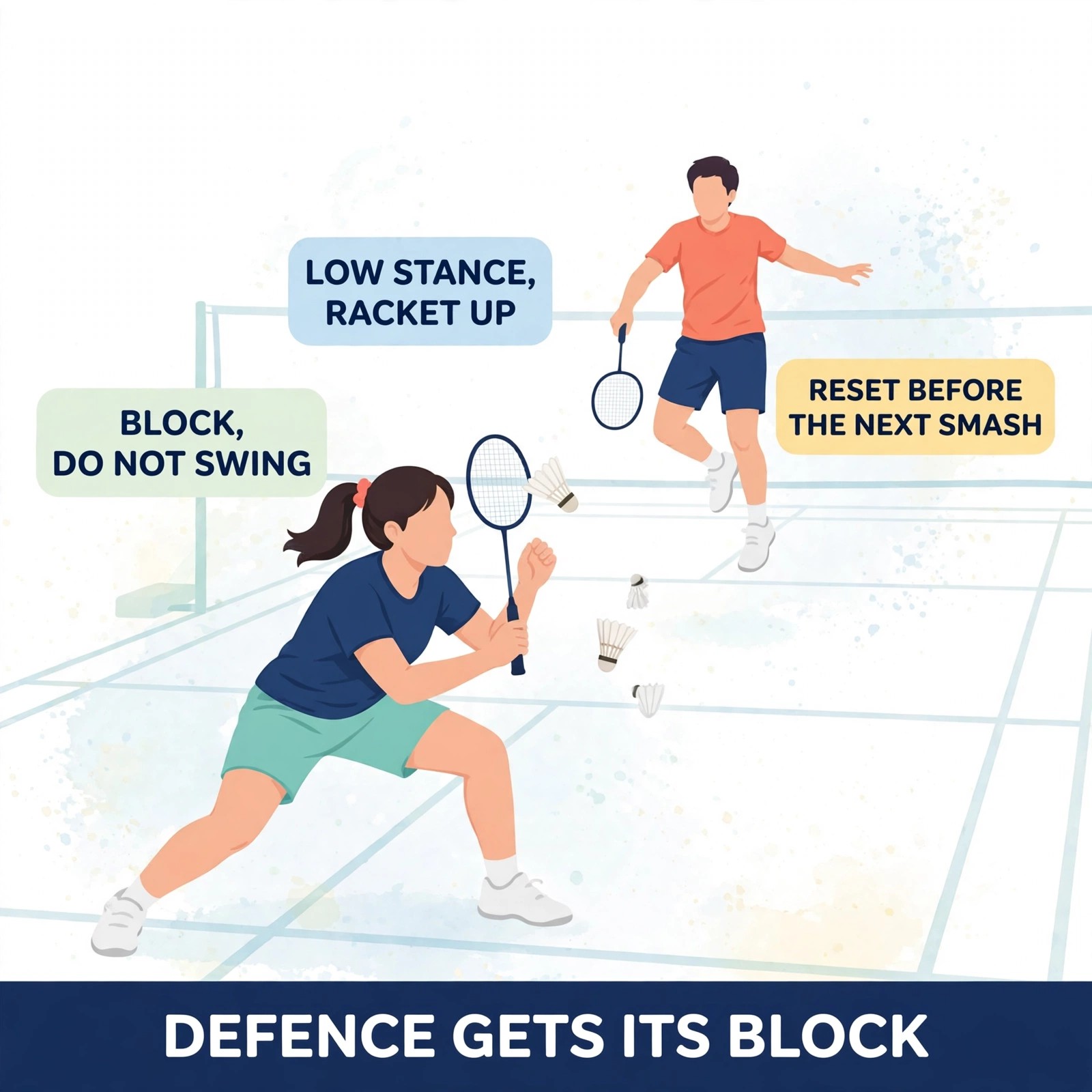
Drills tell you what you can do in comfort. Games tell you the truth. That is why balanced training uses conditioned games as its audit. A conditioned game limits options on purpose so a weak skill cannot hide. Play a game where every rally must start with a backhand serve. Play one where smashing is banned, so length and net play must do the work. Play one where points only count after a defensive block crosses the net. Under these rules, avoided skills get exposed within minutes, and the exposure is the point. You cannot fix what your training keeps allowing you to dodge.
Singles and doubles audit different things, so use both. Singles shows your footwork, length and patience with nowhere to hide. Doubles shows your defence, drives, rotation and net nerve at a faster tempo. A skill can look fine in one format and lost in the other: many players defend well in doubles, where a partner shares the court, and fall apart in singles defence. Note which format exposed the gap, because the repair block should match it. Pressure is the other auditor. A skill that works at 5 to 5 and fails at 19 to 19 is not finished, however clean it looks in drills.
Run the audit on a rhythm, not on a feeling. Once a month or so, play your conditioned games, watch which families crack, and compare with last month’s notes. Then, and this is the step players skip, actually move the rota. The cracked family takes the fresh slot next month, even if it is the one you enjoy least. Especially if it is the one you enjoy least. Enjoyment follows competence more often than it leads it: skills feel fun once they start working. The audit loop is simple enough to write on an index card. Map, rotate, test, adjust. The players who improve for years are usually just the ones who never stopped running the loop.
Balance Check #5
Track and Rebalance: Logs, Video and Honest Ratings
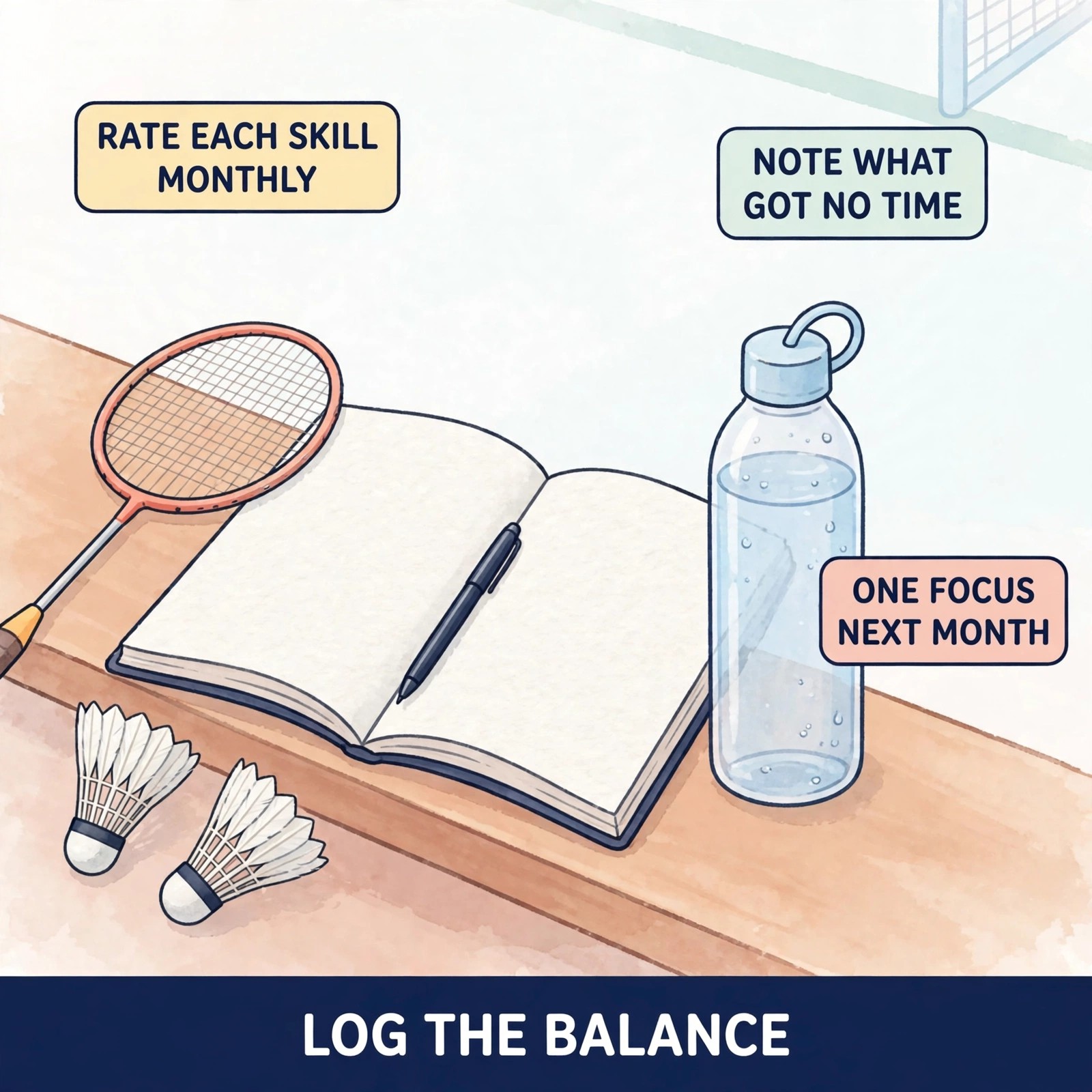
What gets written down gets balanced. Once a month, sit with your log and redo the ratings from the map: six families, honest scores based on matches and audits, not on hopes. Compare with last month. Which family climbed? Which one got no real time, and why? Life happens: a busy fortnight, an injury niggle, a hall closure. Naming the gap beats pretending it did not happen, because next month’s rota can answer it directly. Your log does not need to be long. Six lines a month, honestly written, will steer a year of training better than any single brilliant session.
Video is the log’s best friend, used sparingly. Film one drill a month, maybe two minutes of the focus family, and watch it once with a specific question: does my shape match what I felt? Feel lies kindly; video does not. Pick one fix from the viewing, only one, and write it at the top of next month’s plan. Players who collect ten fixes apply none. Players who apply one fix a month apply twelve a year, and twelve real fixes is a transformation any coach would sign for. Keep the clips. Watching January’s footwork in June is the most honest progress report you will ever get.
Rebalancing also means permission to maintain. Not every family needs to climb every month. A strength that holds its level on a small weekly dose is a success, not a failure, while the rota’s main effort goes to the gap. Balanced development is not six skills rising in a straight line together. It is a rolling promise that nothing is forgotten, the weakest always knows it is next, and time follows evidence instead of preference. Hold that promise for a season and the quiet question from the start of this guide stops being awkward. You will know exactly which skill you trained, including the one you used to avoid.

Myth vs Reality
Myths About Skill Balance
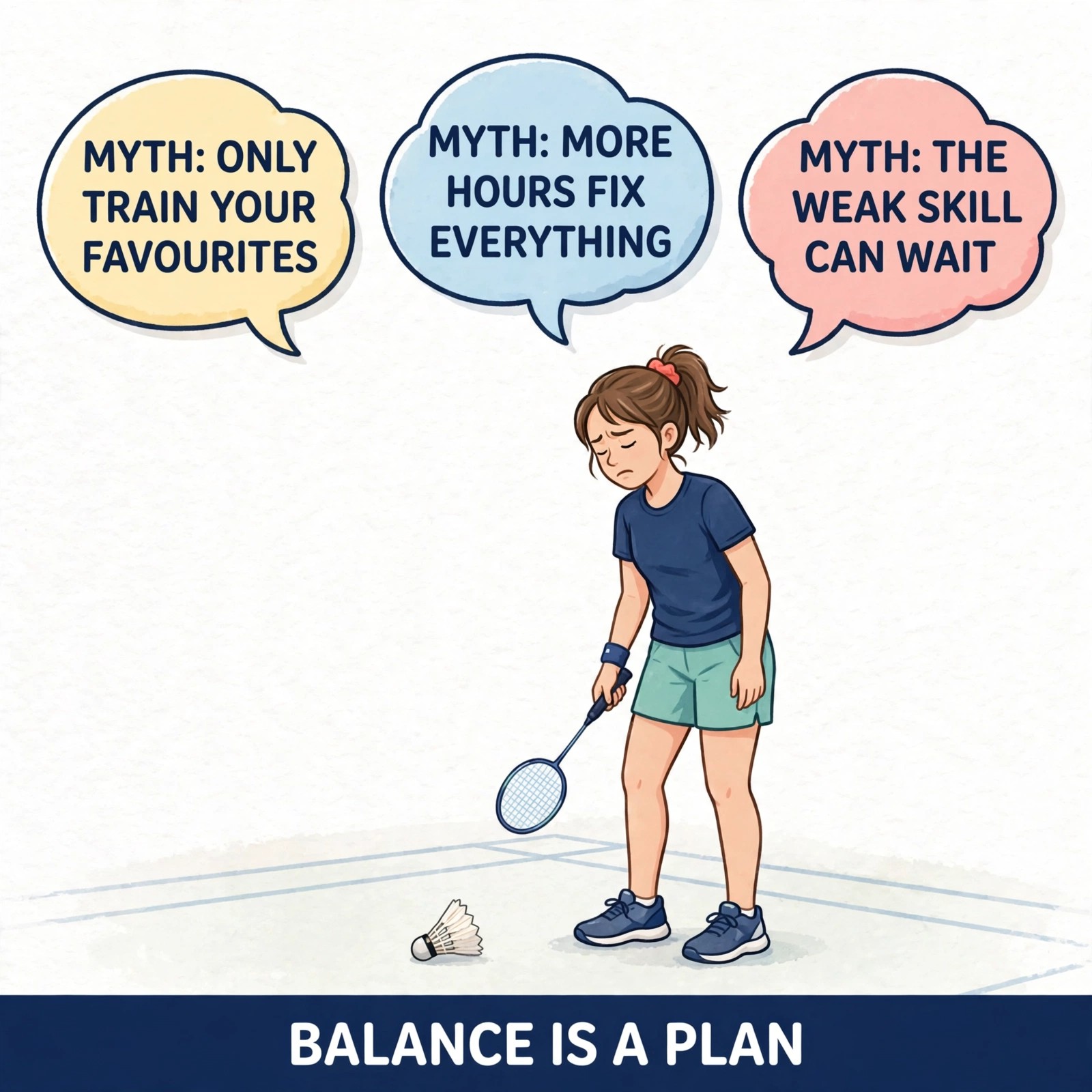
Advice about balance collects myths like any other training topic. The first says only train your favourite skills, because matches are won by strengths. The second says more hours fix everything, so balance takes care of itself if you simply train longer. The third says a weak skill can wait until the strengths are finished, as if strengths ever announce themselves complete. All three sound reasonable in the changing room. All three build lopsided players.
Watch what each myth does over a season. The favourites myth produces a player with a famous smash and a backhand opponents feed on; matches are decided by the weakest link under pressure, not the strongest one at rest. The hours myth adds volume to the same habits, so the gap widens faster, because strengths get more practice at being strong. The waiting myth postpones the weak skill until it costs a tournament, by which point repairing it feels like starting again. Myths survive because each contains a comfort: train what you love, trust the hours, delay the hard part. Comfort is exactly what balance exists to interrupt.
The honest version is less exciting and it works. Strengths win points only when weaknesses stop donating them. Hours help when they are spread by a plan. Weak skills are cheapest to fix early, with small regular doses, long before they become the thing opponents talk about in their warm up. Balanced players are not born more disciplined than anyone else. They just run a rota, audit it in games and let the evidence move their time around. Anyone can start that this week, with a notebook, a map of six families and one honest rating session.
Why Choose Us
Why Players Choose ST Badminton Academy
Balanced development is hard to run alone, and it is exactly what small group coaching is built for. At ST Badminton Academy, groups are capped at four students, so the coach sees your whole game, not just the drills you choose to show. When your net play lags, it gets the fresh block. When your defence cracks in games, the next sessions answer it. The rota lives with the coach, adjusted month by month from what your rallies actually show. Players stop guessing what to work on, because the evidence is watched by someone whose job is to notice.
Our coaches also protect the balance inside each session. Drill time is shared by the plan, not by whoever asks loudest or enjoys a drill most. Conditioned games are part of normal training, so audits happen without drama and gaps surface while they are still cheap to fix. And every player hears the same honest standard: the skill you avoid is the skill we schedule. That sentence, delivered kindly and kept consistently, has repaired more backhands and net games than any single technical tip we teach. Structure does what motivation alone keeps promising to do.
That standard runs across our Kuala Lumpur sessions for kids, teens and adults. Young players build all six families from the start, before favourites harden into habits. Adult players, who often arrive with years of lopsided social games behind them, get a map and a rota that respect their time: the biggest gap first, clean reps over empty hours, games that tell the truth monthly. Bring your honest self rating to your first session. We will test it gently, adjust it where the rallies disagree, and build your training on the player you actually are. Balance is a plan, and plans are what coaching is for.
FAQs: Balancing Skill Development In Badminton Training in Malaysia (KL)
Players ask us the same balance questions whenever a weakness starts costing them matches. Here are the answers we give in the hall.
I am a beginner. Which skill should I train first in Setapak or Gombak?
Start with footwork and length, because they carry every other skill. A beginner who moves well and can clear to the back line has the base that net play, defence and attack all stand on. In our groups of four, your coach maps all six families from your first sessions, then sets the order with you, weakest honest gap first.
What are the six skill families of badminton in KL?
The six families are footwork, length skills like clears and lifts, drops and net play, defence, attack like smashes and drives, and serves with returns. Each family fails in its own way, which is why each needs its own rating. Write them on one page and rate them by match evidence, not by how friendly drills feel.
How do I know which of my skills is weakest at club level?
Watch what you avoid. The skill you quietly route around in matches, the backhand you never trust, the net shot you only play when forced, is usually the weakest, whatever drills suggest. Conditioned games expose it faster: ban your favourite shot for one game and see what cracks. Your coach can run that audit with you in a single session.
Should I train my favourite drills less often in Kuala Lumpur?
Train them smarter, not just less. Favourites keep their place, but they stop eating the whole week. Give them a smaller maintenance dose and hand their old slot to the skill you avoid, while you are fresh. Most players find the avoided skill becomes enjoyable once it starts working, which usually takes a few honest weeks, not months.
What is a conditioned game and how does it test my skills?
A conditioned game limits options on purpose so a weak skill cannot hide. Every rally must start with a backhand serve, or smashing is banned, or points count only after a defensive block crosses the net. Within minutes the avoided skill is exposed under pressure. That exposure is the audit, and the rota for next month is written from it.
Do you rotate skill focus during training near Wangsa Maju?
Yes. Skill focus rotates by plan in our Kuala Lumpur sessions: each family gets the fresh block in turn, and the weakest gets it first while legs and minds are fresh. With no more than four students, the coach watches your whole game in drills and conditioned games, then moves the rota as the evidence changes, month by month.
Where does ST Badminton Academy run badminton training in Malaysia?
The academy coaches in Kuala Lumpur, with our original base in Setapak and players joining from across the Klang Valley. Sessions run for kids, teens and adults in groups capped at four students. Balanced development is the house standard: six skill families mapped, focus rotated, clean reps counted, and conditioned games used to test what drills claim.
Can I book a trial session in Kuala Lumpur and get my skills mapped?
Yes. A trial includes a skills map: your coach watches your footwork, length, net play, defence, attack, serves and returns, rates them honestly with you, and shows you the first rota we would run. You leave knowing your biggest gap and the plan for it, whether or not you continue training with us afterwards.
Is Mr Eric Chuar a suitable coach for players with lopsided skills badminton?
Mr Eric Chuar coaches the academy sessions himself and is known for one sentence: the skill you avoid is the skill we schedule. With over 15 years of coaching in Kuala Lumpur, he builds rotas from match evidence, keeps groups at four so nothing hides, and measures progress by whether last month’s weakness still costs you rallies.
Balanced Badminton Skills in Action
One Standard for Every Session and Every Player
Our standard for skill development is simple and it applies to every player equally: no skill family is left behind. Footwork, length, net play, defence, attack, serves and returns all get planned time, honest ratings and regular tests in games. The rota follows evidence, not favourites, and it is reviewed as the player changes. A beginner and a state level junior are held to the same standard at different depths: map the whole game, train the whole game, check the whole game. That is how complete players are built, one balanced month at a time.
| Factor | Favourite Drills | Balanced Rota BALANCE |
|---|---|---|
| Frequency | 1 or 2 times a week. Mostly for fun and sweat. | Every skill family gets planned time, so the weakest link is repaired before opponents find it in matches. |
| Drills Focus | Basic static feeding. Minimal footwork pressure. | Clean reps are counted instead of empty hours, so skills are built in a shape that survives pressure. |
| Physical Conditioning | Rarely included. Just playing games on court. | Core, agility, and speed training included in every session to prevent injury and build stamina. |
| Tactical Awareness | "Just hit it over." No real game plan. | Video analysis, point construction, and learning to read the opponent's game. |
| Coach Ratio | Large groups (8-10 kids). Coach barely watches you. | Max 4 students. Mr Eric Chuar personally corrects every stroke and movement detail. |
| Goal Setting | Fun and exercise. | Conditioned games audit the plan monthly, so training time follows evidence instead of comfort and habit. |
| Long Term Result | Good recreational player. | A complete player: no skill left behind, strengths maintained, weaknesses scheduled and visibly closing. |
Balanced Badminton Skills in Kuala Lumpur
Bring the skill you have been avoiding, and we will give it its turn. In a group of no more than four, your coach will map your six skill families, set your first rota and show you how clean reps and conditioned games close a gap without drama. Book a trial session in Kuala Lumpur and start training the whole game, not just the parts that already feel good. Your weakest skill has waited long enough.




