The Best Badminton Drills For Improving Your Game (Drill Guide)
Lists of badminton drills are easy to find. What is harder, and far more useful, is knowing how to choose them and how to run them so they actually change your game. A drill is not magic because it has a name. It works when it has one clear job, a feed good enough to practise against, steps that rise in small stages, and rest that keeps the quality honest. This guide teaches that structure: how to pick a drill from the problem in your matches, how feeding decides everything, how progressions are built, how sets and rest protect quality, and how a class drill differs from a game. Learn the structure once, and any drill you meet afterwards can be judged in a minute.

Drill Check #1
One Skill Per Drill: The Rule That Runs Everything
Start with the rule that runs everything: one skill per drill. Before the first shuttle is fed, the drill has a named job. Net shots that tumble close to the tape. Footwork to the backhand rear corner. Defence against a flat drive. One job, said out loud. The moment a drill tries to fix footwork, timing, shot choice and fitness at once, it fixes none of them, because the player cannot tell which part failed when a rep goes wrong. A single job makes every rep readable: the shot either did its job or it did not, and both player and coach can see which. Simple is not basic. Simple is how progress gets measured.
Mixed drills have their place later, for linking skills that are already stable. The mistake is starting there. When everything is practised at once, gaps hide: a weak net shot is covered by strong legs, a late backhand is masked by a kind partner, and the player leaves training feeling busy rather than better. If you have ever trained hard for months and stayed the same in matches, this is the usual reason. Flip the order. Name the job first. Isolate it, repeat it, step it up, and only combine it with neighbours once it holds its shape under pressure. The drill menu matters far less than this discipline.

Drill Check #2
Feeding Quality: The Drill Is Only as Good as the Feed
A drill is only as good as its feed. The feed is the shuttle the player practises against: its height, pace, placement and rhythm decide what the player can learn. A steady feed on the same smooth flight path lets the player groove one movement and feel small corrections land. A wild feed, shuttles sprayed high, low and late, turns the drill into a lottery where good reps happen by luck and bad reps teach nothing. Players blame their shots for what their feed caused. Watch any good training hall and you will notice the quiet truth: the best coaches are the best feeders, because they know the feed sets the level of everything after it.
Feeding is a skill, and it can be practised like any other. A good feeder watches the player, not the shuttle stack: feeds arrive when the player is ready, at a pace that stretches without swamping, and to the spot the drill named. When the player tires, the feeder slows the rhythm rather than letting form collapse. When the player settles, the feeder adds a fraction of pace. Partners can learn this for each other in a few sessions, and it changes the value of every drill they share. If your training partner feeds kindly and steadily, protect that arrangement. It is worth more than a bag of new drills.
The classic feeding drill is multi shuttle work. The feeder holds a neat stack of shuttles in one hand and feeds them one after another in a steady rhythm, so the player moves, plays, recovers and moves again without long pauses. It is the best tool we know for footwork patterns, front court speed and defensive reactions, because the rhythm can be tuned exactly to the player. The counting rule keeps it honest: count good reps only. A rep where the feet tangled or the shot floated does not go on the tally. Ten honest reps teach more than thirty rushed ones, and the tally in the notebook proves the standard is rising week by week.

Drill Check #3
Progressions: Small Steps From Easy to Hard
Good drills climb in small steps, and the steps follow a simple pattern. Step one is slow and wide: movement only or gentle feeds, a big target area, space to learn the shape. Step two is quicker and tighter: the feed firms up, the target shrinks, the recovery matters. Step three is true speed: a partner rallying back, or feeds at match pace, with the skill now surviving contact with reality. Players who jump straight to step three practise panic. Players who never leave step one practise a dance. The staircase is the training, and skipping steps is the most common reason a drill that looks fine in the hall disappears in a match.
One dial at a time is the rule inside each step. A progression can raise feed pace, shrink the target, add a second shot, extend the court area, or shorten the rest, but it should raise one of them, then let the player settle. Change two dials together and a failing rep cannot tell you which change broke it. Coaches watch for the sign that a step is ready to rise: the skill holds its shape for most reps, and the player is bored by success rather than rescued by luck. Boredom at a step is information. It means the level is banked and the next step up will teach something new instead of repeating survival.
Shadow drills belong on the staircase too, usually near the bottom and revisited at every level. The player practises the full movement with no shuttle at all: the split step, the path to the corner, the complete overhead stroke, the recovery to base. With nothing to hit, the feet and the body shape get full attention, and a coach can watch the pattern without the shuttle hiding faults. Slow first, then true speed, always copying the real stroke rather than a vague wave. Shadow work feels easy to skip because nothing is scored. Do not skip it. It is where movement patterns are built before pressure arrives to test them.

Drill Check #4
Sets, Rest and Honest Effort
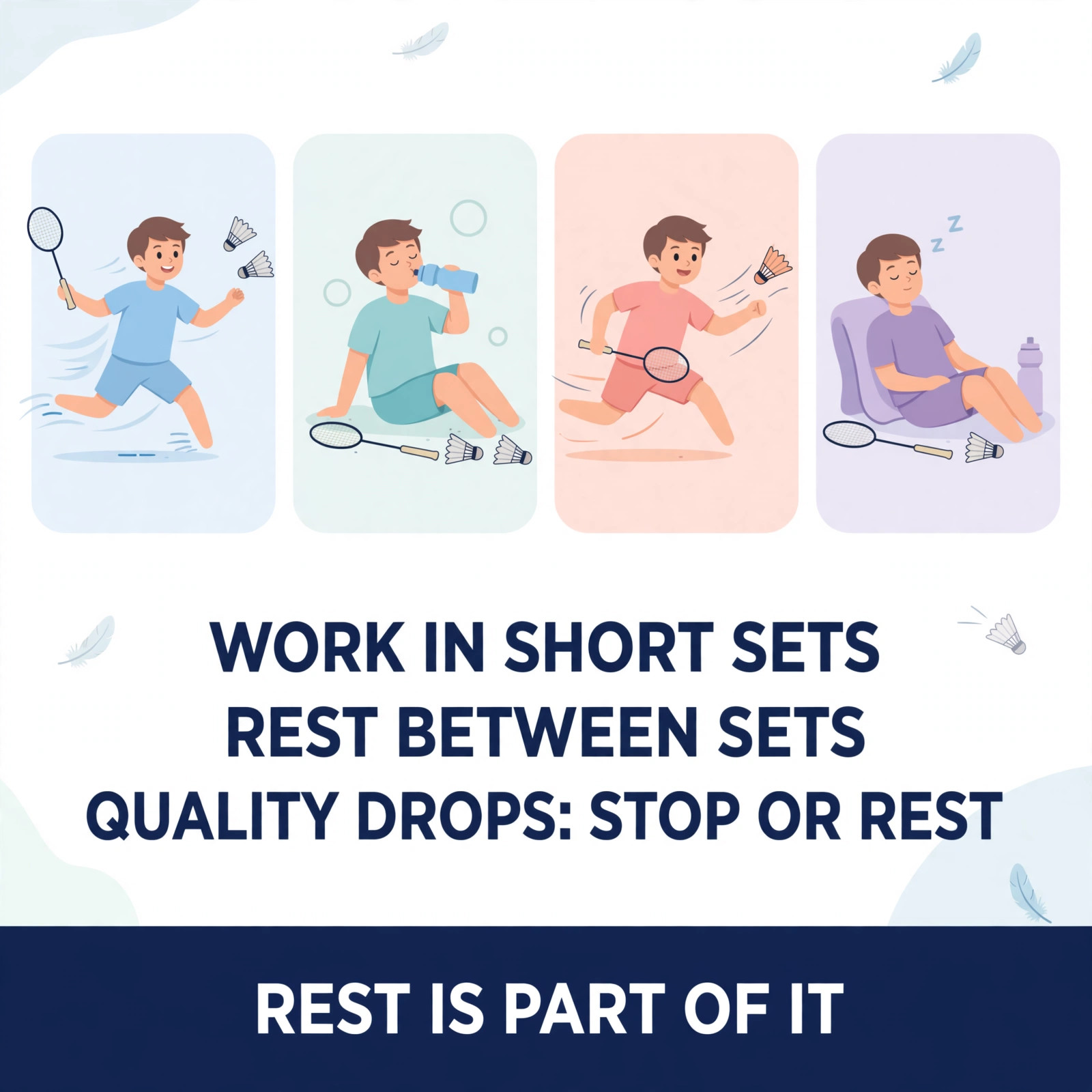
Quality lives in short sets. A drill set should end while the movement is still clean, not when it falls apart. For most feeding and footwork work that means short blocks of hard effort, then a real pause: sit, drink, let the heart rate come down, then go again. The rhythm of work, rest, work, rest is not softness. It is how the body files the pattern being practised. Reps done in deep fatigue file a tired, sloppy version of the movement, and that version is what shows up late in matches. Train the version you want to keep. Short sets, honest rest, and a fresh start each time is the structure that keeps it.
Honest effort needs a stop rule, and the rule is visible: when quality drops and stays dropped, stop or rest. Feet stop splitting, shots float long, the same error repeats three times in a row. That is the body saying the set is over, whatever the plan on paper says. Pushing through sloppy reps is not toughness; it is rehearsal for losing rallies neatly. A coach would rather see four clean sets and an early finish than eight sets where the last four taught the wrong pattern. Players training alone can use the same rule with a tally: when good reps fall below your usual share two sets running, the drill is done for the day.
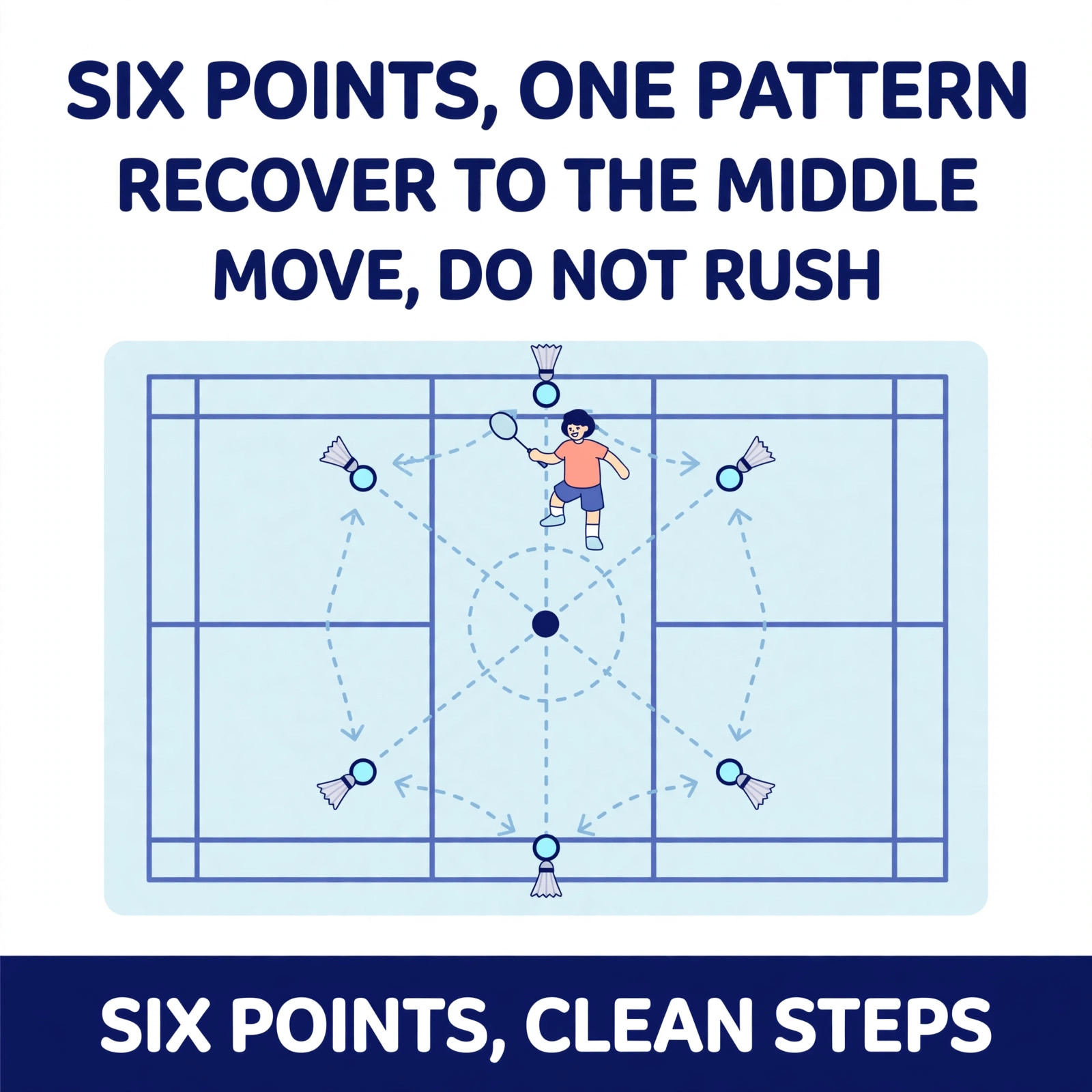
Write it down. A drill log takes a minute: the drill and its job, the level reached, the good rep tally, and the next step planned. Without the log, every session starts from feelings, and feelings lie in both directions after good days and bad ones. With it, progress becomes plain: the six point footwork pattern that took full rest between rounds in March now runs back to back in May. The log also protects against the two classic wastes, repeating a mastered drill for comfort and abandoning a working drill for novelty. Next session’s first drill is decided by the last page of the notebook, not by mood.
Drill Check #5
Class Drills and Games: How They Differ
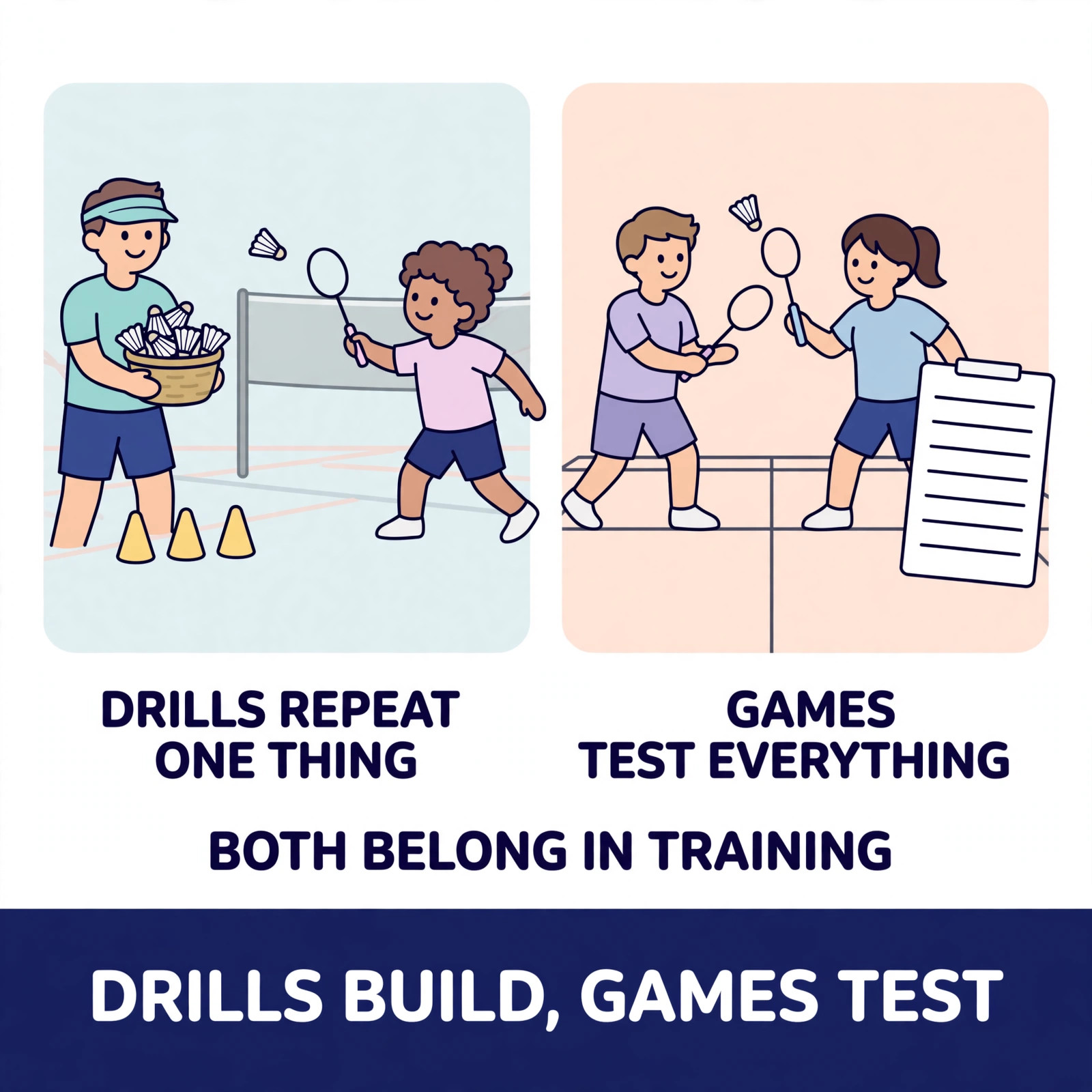
A class drill and a game are different tools, and mixing up their jobs confuses players. A drill repeats one thing under controlled conditions so it can be corrected rep by rep. A game tests everything at once under uncontrolled conditions, with an opponent trying to make your skills fail. Drills build. Games reveal. A session needs both, in that order of purpose: drill the weakness while it can be isolated, then play and watch whether the fix survives. If it survives, the drill did its job and the next weakness gets its turn. If it collapses, that is not failure; it is the test reporting honestly, and the drill goes back on the list at a lower step.
Choosing your own drills starts from your matches, not from a menu. Watch your last few games and find the rally that keeps going wrong: the net shot that sits up, the backhand corner you arrive late to, the drive that catches you standing still. That repeated failure is your drill list, in order. One job per drill, a feeder who can hold a rhythm, a staircase of steps, sets with rest, and a log. Two or three weeks on one honest weakness changes a player more than a tour of every drill on the internet. When the weakness stops appearing in matches, pick the next one. Improvement is mostly this, repeated with patience.
Class sessions add one thing solo practice cannot: eyes. In a small class a coach watches the pattern, not just the outcome, and corrects the cause while the drill is running: the split step that starts late, the racket that drops between shots, the recovery that stops halfway. Group drills also borrow energy from each other; players feed for partners, tally each other’s honest reps, and learn to spot quality in someone else’s movement, which sharpens their own. The structure stays the same as this guide describes. The class simply makes sure the structure is followed when willpower alone would let it slide.
Myth vs Reality
Myths About Badminton Drills
Myth one: more drills means better. A session crammed with ten drills gives each one a few distracted minutes, and nothing is repeated enough to change. Two drills run properly, with named jobs, good feeds and honest tallies, move a player further in a month. Volume feels productive because it is tiring, but tired is not the same as better. The players who improve fastest are usually running a short list with great discipline, not a long list with none. Count what your training is for. If you cannot name the job of the drill you are doing, the drill is doing nothing, however hard it makes you breathe.
Myth two: harder is always better. Difficulty is a dial, not a virtue. A drill set beyond the player’s current step teaches survival habits: rushed feet, snatched shots, a body bracing instead of moving. Those habits then have to be untrained, which costs more time than the patience would have. The right level has a recognisable feel: most reps succeed when the movement is done properly, and failures point at something specific. If every rep fails, the step is too high. If every rep succeeds without thought, the step is too low. Better lives between the two, and finding it is the coach’s real craft.
Myth three: games alone are enough. Games are the test, and tests do not teach the skill they measure. A player who only plays matches practises their strengths against their weaknesses every night: the strong shots get chosen, the weak ones get avoided, and the gap widens while fitness improves. That is why keen social players can stay at the same level for years. Games absolutely belong in training; they are where drills prove themselves and where new weaknesses announce themselves. But the fixing happens in the drill block: one job, isolated, repeated, stepped up. Test, fix, retest. Skip the middle step and the test result never changes.

Why Choose Us
Why Players Choose ST Badminton Academy
At ST Badminton Academy, drills are chosen from the player’s matches, not from a fixed menu. A coach watches games, names the weakness that costs the most rallies, and builds the drill block around it: one job, a staircase of steps, and honest tallies. Because groups are capped at four students, the coach can feed properly for each player, adjust the dials one at a time, and hear the rally report afterwards. Students in Setapak, across KL and at our Singapore classes train the same way, because the structure travels: pick the job, feed it well, step it up, log it.
Feeding quality is guarded jealously in our sessions. Coaches feed most drills themselves, and when students feed partners, they are taught how: stack ready in hand, shuttle arriving when the player is set, pace matched to the step, and only good reps counted. A student who has been fed well learns what a proper feed feels like, and that standard follows them into their own practice. It sounds like a small detail. It is the detail that decides whether the other thirty minutes of the drill block teach the pattern or teach luck.
Every student’s drill work is logged: the job, the step reached, the tally, the next step up. It takes a minute at the end of the block and it runs the whole system. The next session opens the notebook before it opens the shuttle tube, so training continues from the last page rather than restarting from mood. Parents watching a junior’s progress can read the same log: not promises, just steps banked and steps ahead. That is what structured practice looks like when it is written down, and it is available to any player willing to keep a notebook and be honest in it.
FAQs: Choosing Badminton Drills, Feeding and Practice Structure in Malaysia (KL)
Drill questions are practical ones, and we hear them from players who train hard without improving. The answers below cover choosing drills, what makes one worth repeating, how to build practice, whether more is better, what to check before joining classes, and how our sessions mix drills and games in Kuala Lumpur and Singapore.
How should a player choose drills that actually help in Setapak or Gombak?
Start from your matches. Find the rally that keeps going wrong: the net shot that sits up, the corner you arrive late to, the return you keep standing still for. That repeated failure is your first drill, with one clear job, a steady feed, and small steps up. Fix one weakness, then pick the next.
What makes a badminton drill worth repeating in KL?
A drill worth repeating has a named job, a feed you can trust, and a way to tell good reps from lucky ones. It sits at the right step: hard enough to demand the proper movement, not so hard that every rep is survival. If you cannot say what it is for, it is not worth your minutes.
How should a player build drill practice while training at a steady level?
Build in small steps and change one dial at a time: feed pace, target size, a second shot, or less rest. Work in short sets with real pauses, count good reps only, and stop when quality drops and stays dropped. Log the level reached so the next session starts from the page, not from mood.
Are more drills always better, or does one clear job matter more?
One clear job matters far more. Ten drills in a session gives each a few distracted minutes and nothing is repeated enough to change. Two drills with named jobs, good feeds and honest tallies will move you further in a month. Tired is not the same as better. Purpose is what repeats into skill.
What should I check before joining drill based classes?
Check the group size first: a coach cannot feed and correct properly in a crowd. Check whether drills are chosen from your game or from a fixed menu, whether progressions are stepped, and whether anyone watches your movement rather than just counting rallies. Small groups with logged steps are the signs of real structure.
Do your coaches run structured drills for students near Wangsa Maju?
Yes. Coaches run structured drill blocks in every class: one named job, feeding by the coach or a trained partner, progressions stepped per student, and honest tallies kept. In groups of no more than four, there is time to correct the pattern while the drill is running, not after it ends.
Does your academy mix drills and games in classes in Malaysia?
Yes, in that order of purpose. The drill block builds one skill under controlled conditions; the games that follow test whether it survives against an opponent. What collapses in games goes back on the drill list at a lower step. Drills build, games test, and the log connects the two.
How long should a player keep one drill before moving on in training?
Keep it until the skill holds its shape at the current step for most reps across a couple of sessions, then step up one dial. That is usually weeks on a job, not minutes. If it still collapses in games, stay longer. The log, not the calendar, should make the decision.
What makes Mr Eric Chuar a careful coach for honest advice about drills in badminton?
Eric Chuar plans training from the match backwards. He has coached in Kuala Lumpur and Singapore for fifteen years, in small groups where he can feed a drill himself and watch the pattern it builds. Ask him about drills and he asks first what keeps going wrong in your games.
Badminton Drills and Training in Action


One Standard for Every Player and Every Session
One standard runs through every session at ST Badminton Academy: drills are chosen on purpose and run with discipline. In groups of no more than four students, coaches name the job, feed it properly, step it up one dial at a time, and log the level reached. No shortcuts, no drill tourism, and no claim that a long list beats a clear one. Just a weakness named, a staircase climbed, and games that prove the climb was real.
| Factor | Purposeful Drills | Random Drills DRILLS |
|---|---|---|
| Frequency | 1 or 2 times a week. Mostly for fun and sweat. | Sessions crammed with every drill at once, no clear job. |
| Drills Focus | Basic static feeding. Minimal footwork pressure. | One drill with one named job, fed well and repeated. |
| Physical Conditioning | Rarely included. Just playing games on court. | Core, agility, and speed training included in every session to prevent injury and build stamina. |
| Tactical Awareness | "Just hit it over." No real game plan. | Video analysis, point construction, and learning to read the opponent's game. |
| Coach Ratio | Large groups (8-10 kids). Coach barely watches you. | Max 4 students. Mr Eric Chuar personally corrects every stroke and movement detail. |
| Goal Setting | Fun and exercise. | Harder and harder until the movement falls apart. |
| Long Term Result | Good recreational player. | A player who progresses in small steps and logs the work. |
Badminton Coaching and Honest Drill Advice in Kuala Lumpur
A good drill is not a secret and it is not a long list. It is one clear job, fed well, stepped up in small stages, worked in honest sets, and written down. Choose yours from the rallies that keep beating you, and run it with that structure for a few weeks. If you would like a coach to watch your games and name the first job for you, book a trial class with us and bring your notebook.






