All languages
 Chinese (Simplified)
 Chinese (Traditional)
 English
 Indonesian
 Japanese
 Korean
 Malay
 Thai
 Vietnamese


The Best Badminton Wristbands For Sweat Management And Style (Wristband Guide)
A wristband is the smallest item in a badminton bag, and one of the most misunderstood. Players buy them for style, copy them from players they admire, or skip them completely because nobody explained what the band is actually for. This guide does the explaining, plainly and honestly. A wristband has one real job: it catches sweat on the forearm before the sweat reaches your grip hand. Everything else, the colours, the matching kit, the look, is a bonus. We will walk through what the band does, how cotton towelling and synthetic materials differ, how wide and how snug a band should be, whether one band or two makes sense, and how to wash and replace them. There are no brand names and no prices in this guide, because the honest truth is that a cheap band with the right material and fit does the job as well as a famous one. What matters is a short list of criteria any player can check in a shop in two minutes. If you coach juniors, as we do at ST Badminton Academy in Kuala Lumpur, you see the problem the band solves every week: a rally gets long, a forearm gets wet, the racket starts to turn in the hand, and a good shot becomes a mishit. The answer is small and simple. Read on and choose your next band by criteria, not by logo.
Wristband Check #1
What a Wristband Really Does on Court
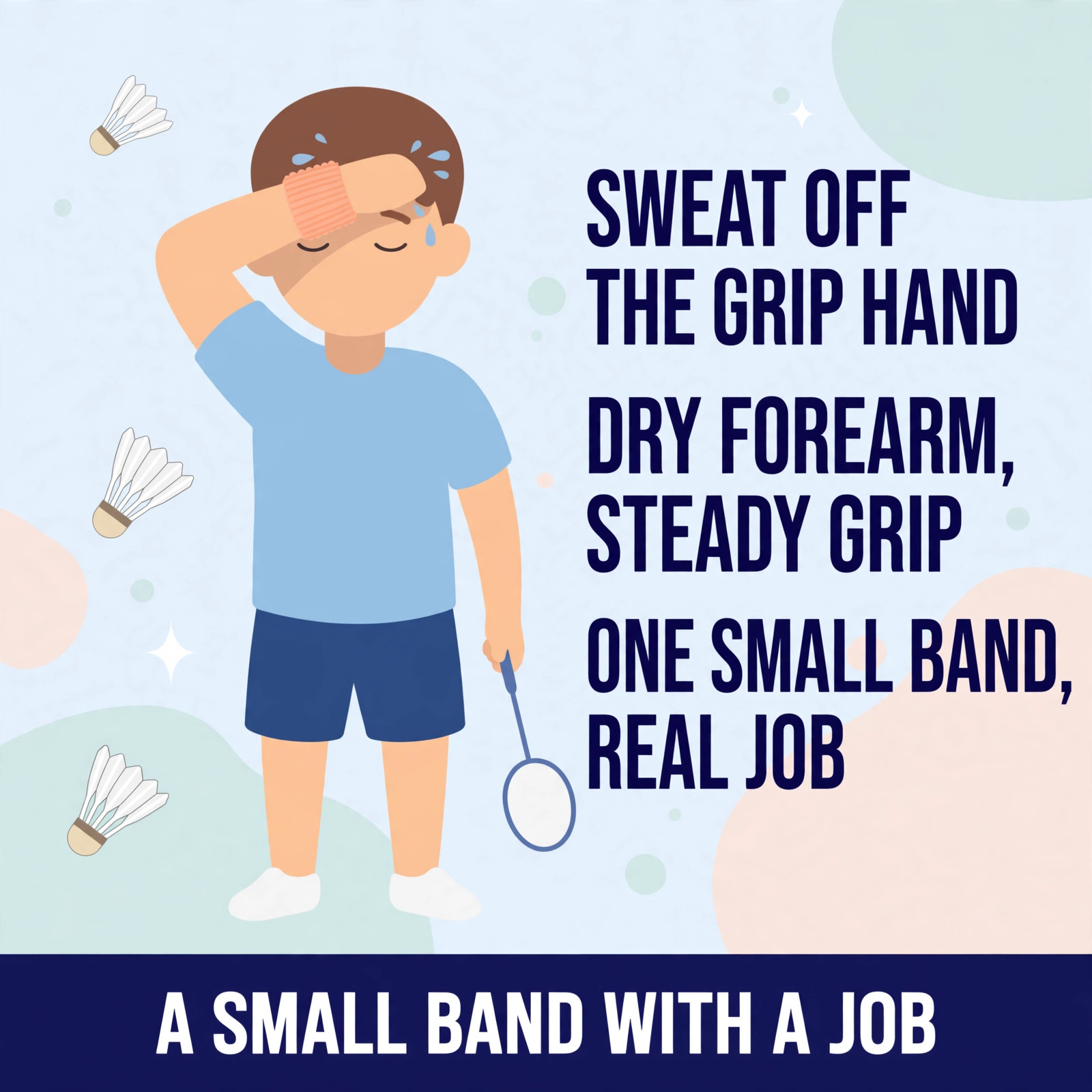
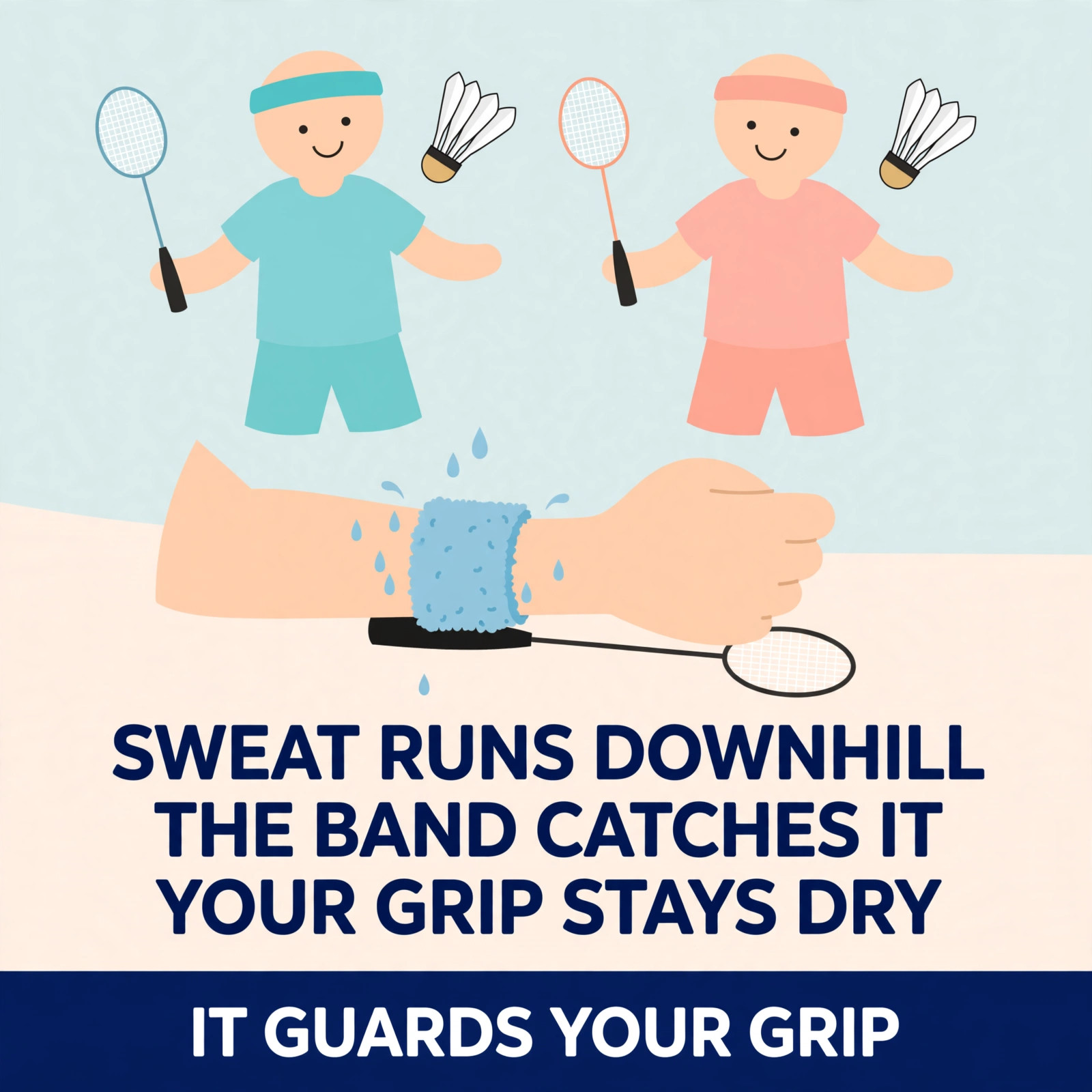
The physics is simple. When you play hard, you sweat, and the sweat on your forearm runs downhill toward your hand. Gravity does not care how important the rally is. By the third game, a steady line of sweat can travel from elbow to wrist to palm, and from the palm onto the grip. A wet grip twists on smashes, slips on drives, and makes players squeeze the racket harder to feel safe. Squeezing harder tires the forearm, and a tired forearm ruins touch at the net. Coaches see the chain every session: sweat, slip, squeeze, tension, error. The wristband breaks the chain at the first link, soaking up the sweat at the wrist before it reaches the hand.
The band has a second job players notice quickly: it is a towel that never leaves your arm. Between rallies you can wipe your forehead, your eyes, and the back of your neck with the forearm, without walking to the side of the court. Sweat in the eyes stings and blurs the shuttle at exactly the wrong moment, usually as a smash arrives. A quick wipe at the interval keeps vision clear. Some players also wipe the grip itself with the band between games. None of this is dramatic, and that is the point. The band quietly removes small distractions, rally after rally, so the player can think about the shuttle instead of the sweat.
Wristband Check #2
Cotton, Towelling or Synthetic: Pick Your Material
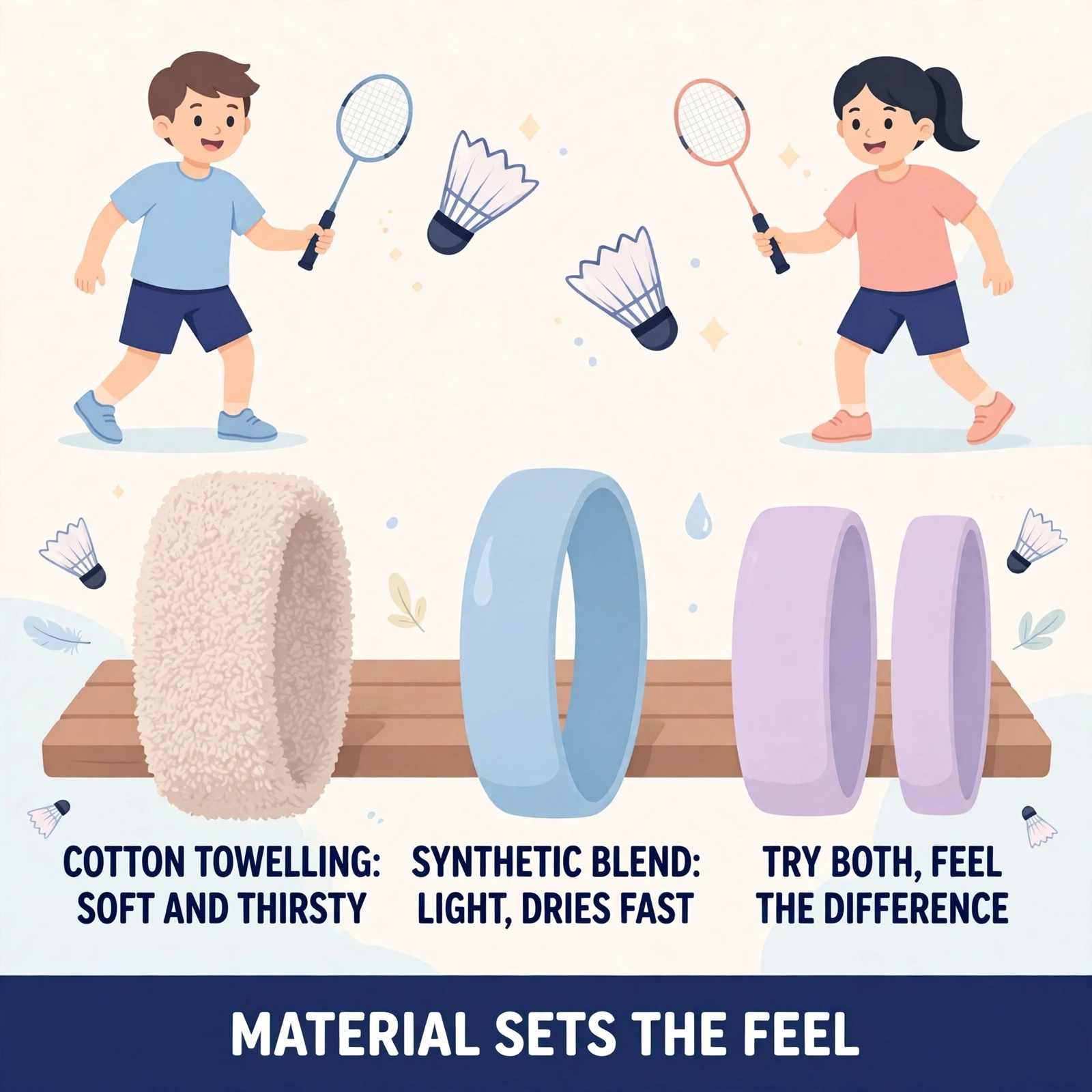
Cotton towelling is the classic material, and the thirstiest. Its looped fibres work like a tiny towel, holding a good amount of sweat before they feel soaked. Cotton feels soft against the skin, which matters for juniors and for players whose wrists rub raw in long sessions. The trade offs are weight and drying time. A soaked cotton band feels heavy, and it dries slowly in a kit bag, which is why it must be aired after play. In Malaysia’s halls, where sessions are sweaty from the first rally, many players still choose cotton for pure absorbency, and keep a spare for the third game.
Synthetic blends, usually polyester or nylon mixed with elastic, behave differently. They soak up less sweat in one wearing, but they feel lighter, stretch more evenly, and dry much faster, sometimes between sessions on the same day. A synthetic band suits players who play several times a week and wash their kit often, because it is ready again quickly. Blends sit between the two: a cotton rich face for soaking, synthetic backing for stretch and drying. None of these materials is the best in general. Each is the best for a certain player, which is why the next section on fit matters as much as this one on fabric.
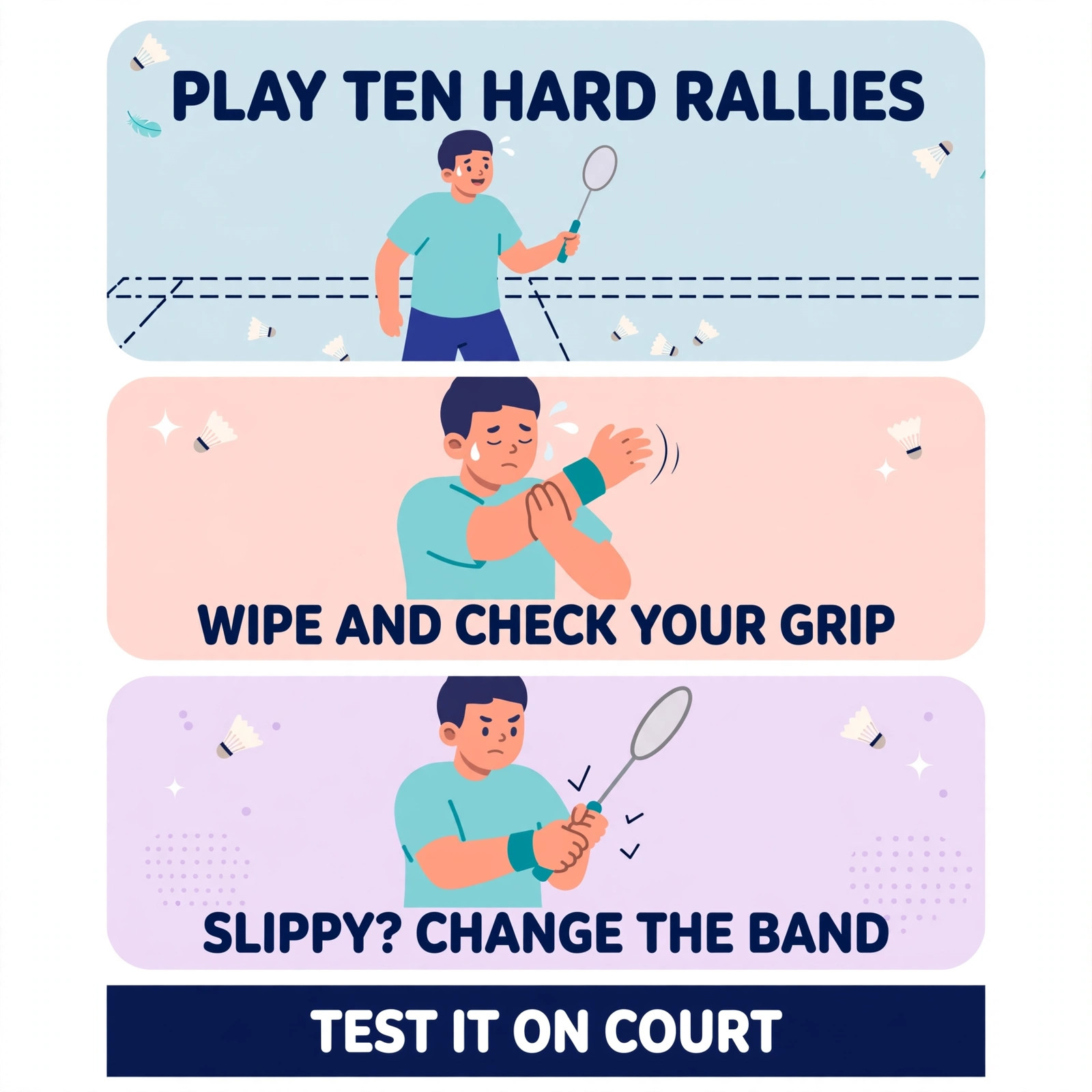
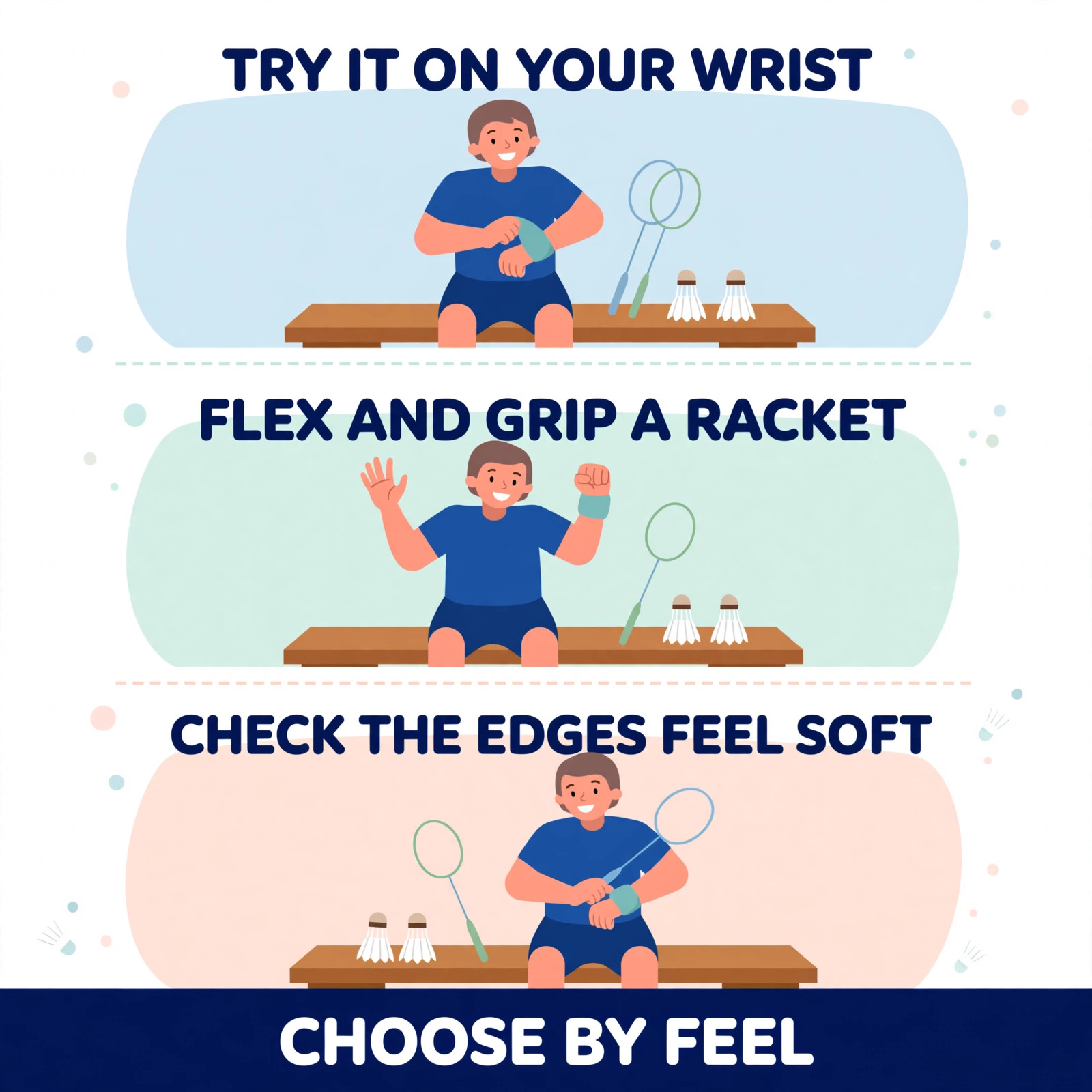
Ignore the magic words on packaging. Claims about special cooling, special wicking, or special performance fibres are marketing first and facts second. What a player can actually test is short and honest: how much water the band holds, how it feels after ten hard rallies, how fast it dries, and whether the edges rub. If a shop lets you, press the band against a wet forearm, or simply buy one of each type and let your own court time decide. Two bands, one cotton and one synthetic, cost little and answer the material question better than any advertisement, for your own skin, your own sweat, and your own hall.
Wristband Check #3
Width and Fit: Snug on the Wrist, Never Tight
Width decides how much sweat a band can catch. A narrow band, about the width of two fingers, is light and barely noticeable, and it suits players who sweat lightly or dislike anything on the arm. A wide band covers more of the forearm, catches more sweat on its way down, and gives a bigger wiping surface for the forehead. Heavy sweaters, players in hot halls, and players whose grip suffers late in matches usually prefer the wide band. There is no rule, only a match between the band and the player’s sweat. Trying both widths for one session each ends the debate for your own arm.
Fit is the criterion players get wrong most often. A wristband should sit snug: it stays in place when the arm swings, it does not slide down onto the hand during a smash, and it does not need adjusting between rallies. The simple test is two fingers: you should be able to slide two fingers under the edge of the band without a struggle. If the band leaves deep marks, feels tingly, or needs pulling up every few points, the fit is wrong. Too tight is a distraction and can leave the wrist sore; too loose turns the band into a bracelet that visits your palm at the worst moments.
Most bands come in one stretch size, and that size fits most adults. Juniors are the exception: a small wrist inside an adult band gets a loose, sliding band, which is worse than none. For young players choose a narrower band with strong elastic, or a junior size where offered. Edges matter too. A band whose edges roll or scratch will be fiddled with all session, and fiddling is the enemy of focus. Run a finger around the inside edge before buying. Smooth edges, even stitching, and elastic that springs back when stretched are the three checks that predict a band you will forget you are wearing.

Wristband Check #4
One Band or Two: The Racket Arm and the Spare
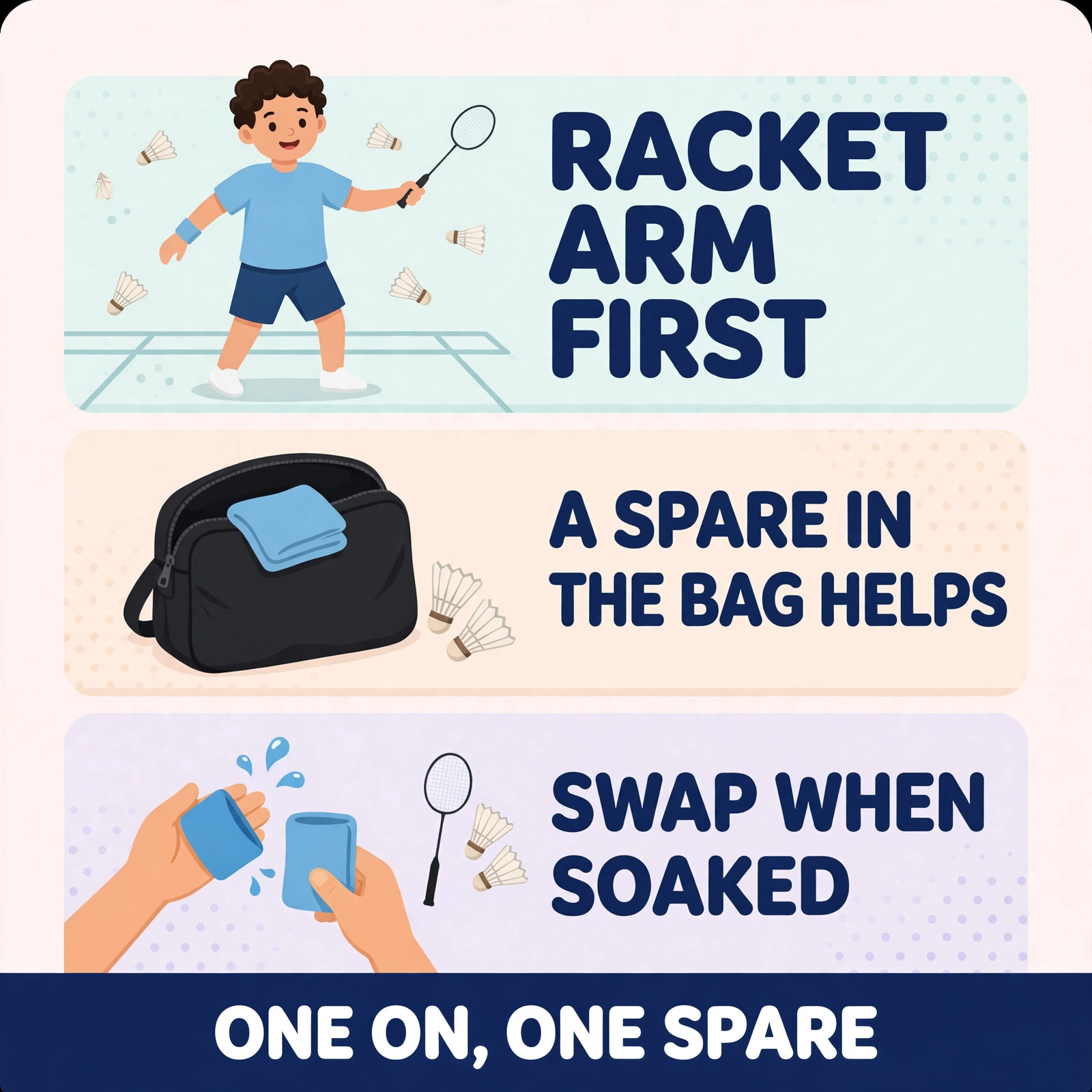
The racket arm comes first. That forearm is the road the sweat takes to your grip, so if you wear one band, it goes on the racket wrist. Some players wear a second band on the other wrist, used mainly for wiping the forehead, and that is a fair choice for heavy sweaters. Two bands do not double the benefit for most players, though; after the racket arm is covered, the second band is comfort, not need. Start with one, on the racket arm. Add the second only if you find yourself wiping your brow with a sleeve or a shirt, which is a clear sign it would earn its place.
A spare band in the kit bag is the habit that separates prepared players from hopeful ones. A band can only hold so much sweat. In a long match or a two hour session, the first band saturates, and a soaked band returns as much sweat as it catches. Swapping to a dry spare at the interval or between games takes ten seconds and resets the whole system. The spare also covers the day the main band is forgotten in the wash. Players who carry a spare stop thinking about sweat entirely, which is the best state a small piece of gear can create.
Style comes last in this guide because it comes last in importance, but it is not banned. A band in a colour you like, matched to your shirt or your team colours, feels good to wear, and juniors especially play happily in kit they chose themselves. Wear the colour proudly. Just keep the order of decisions straight: material first, width second, fit third, colour last. A beautiful band that slides, scratches, or soaks through in one game will live in the bottom of the bag by next month, while an ugly band that fits gets worn for a year. Coaches would rather see a plain band that works than a striking one that does not.
Wristband Check #5
Washing, Drying and Knowing When to Replace
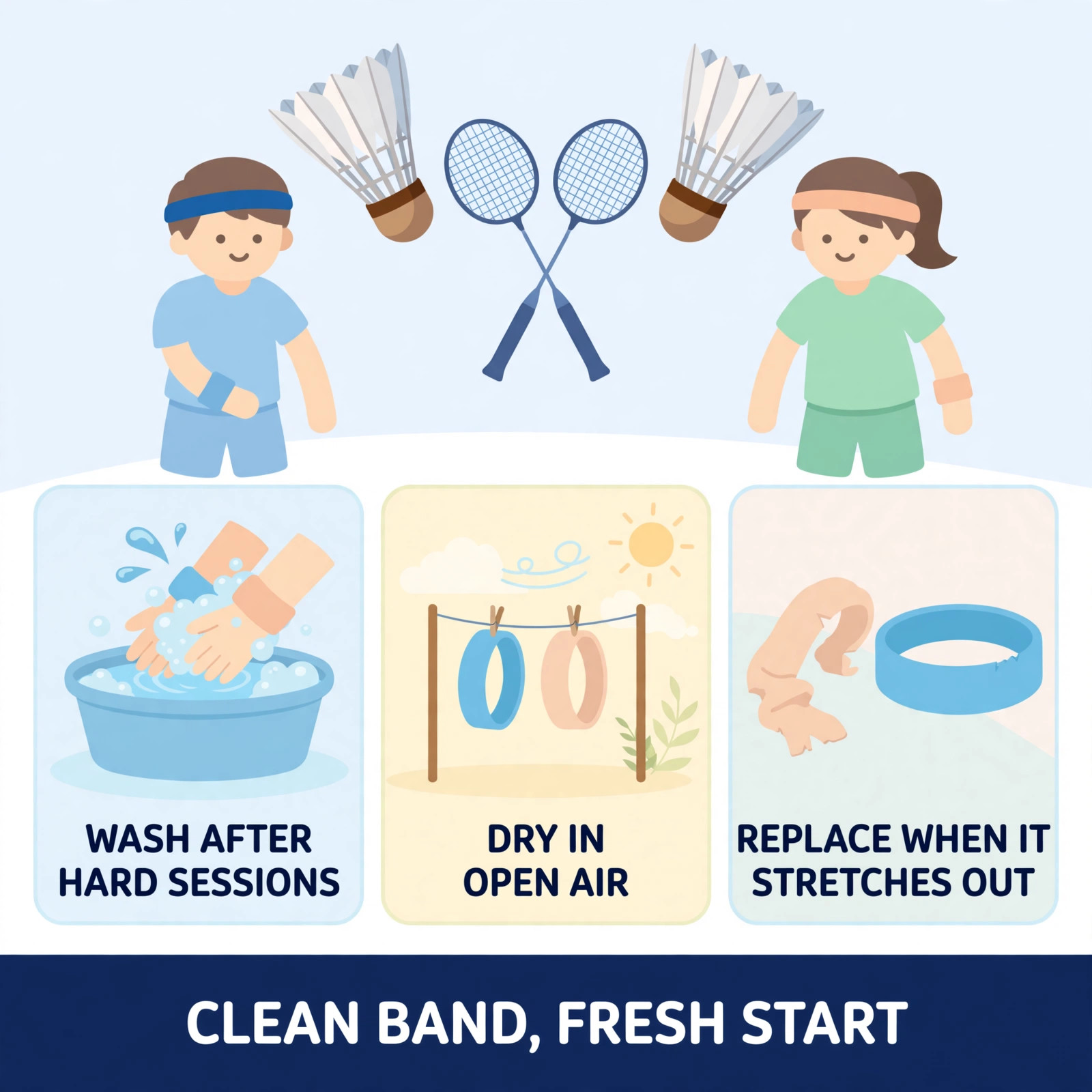
Washing is where wristbands go to die or to live long. Sweat left in the fibres breeds the smell every player knows, the one that survives in the kit bag and greets you at the next session. Rinse or wash the band after hard sessions, with mild soap, and the smell never takes hold. Most bands handle a gentle machine wash; a small mesh bag keeps them from stretching around other kit. Skip the dryer and strong heat, which tire the elastic. A band washed little and often outlasts a band washed rarely and hard, like most things in a sports bag.
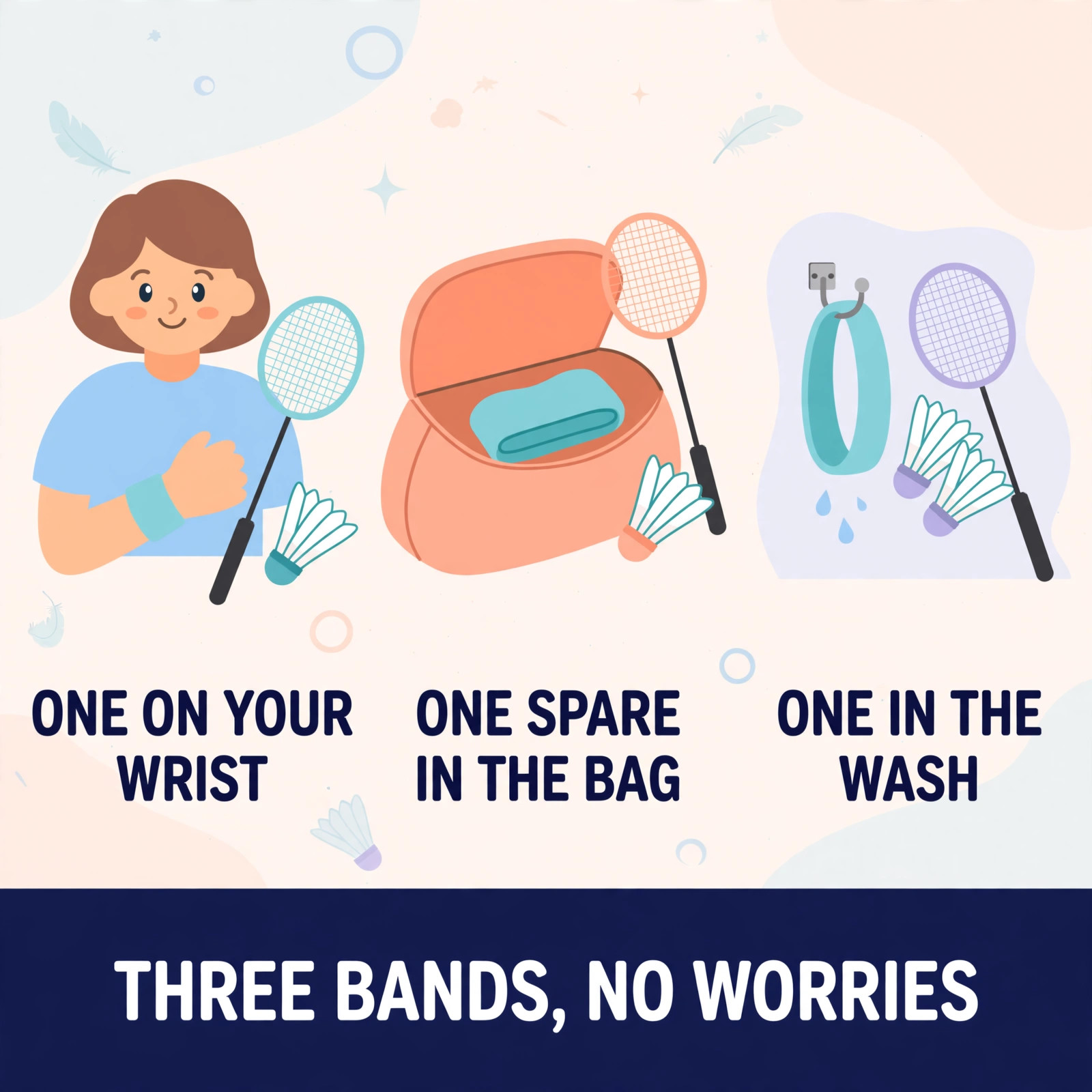
Drying and storage finish the care routine. Air the band in open air after washing until it is fully dry, then store it loose, not balled inside a damp towel or a sealed plastic bag. A band packed away damp will smell by the next session and its elastic will age faster. Many players keep the rotation simple: one on the wrist, one spare in the bag, one in the wash. That little rotation means a clean, dry band is always ready, and no single band is worn into the ground. It is the same system, scaled down, that players use for grips and shirts.
Replacing is decided by feel, not by the calendar. A band is done when it has stretched out and will not stay up, when the elastic crackles or stays stretched after a pull, or when the smell survives a proper wash. For a player training several times a week, that day arrives after some months of honest service; for a once a week player, a band can last far longer. Do not retire a band for its colour fading or a loose thread at the edge. Retire it when it stops doing its one job: staying in place and catching sweat before your grip does.
Myth vs Reality
Myths About Badminton Wristbands
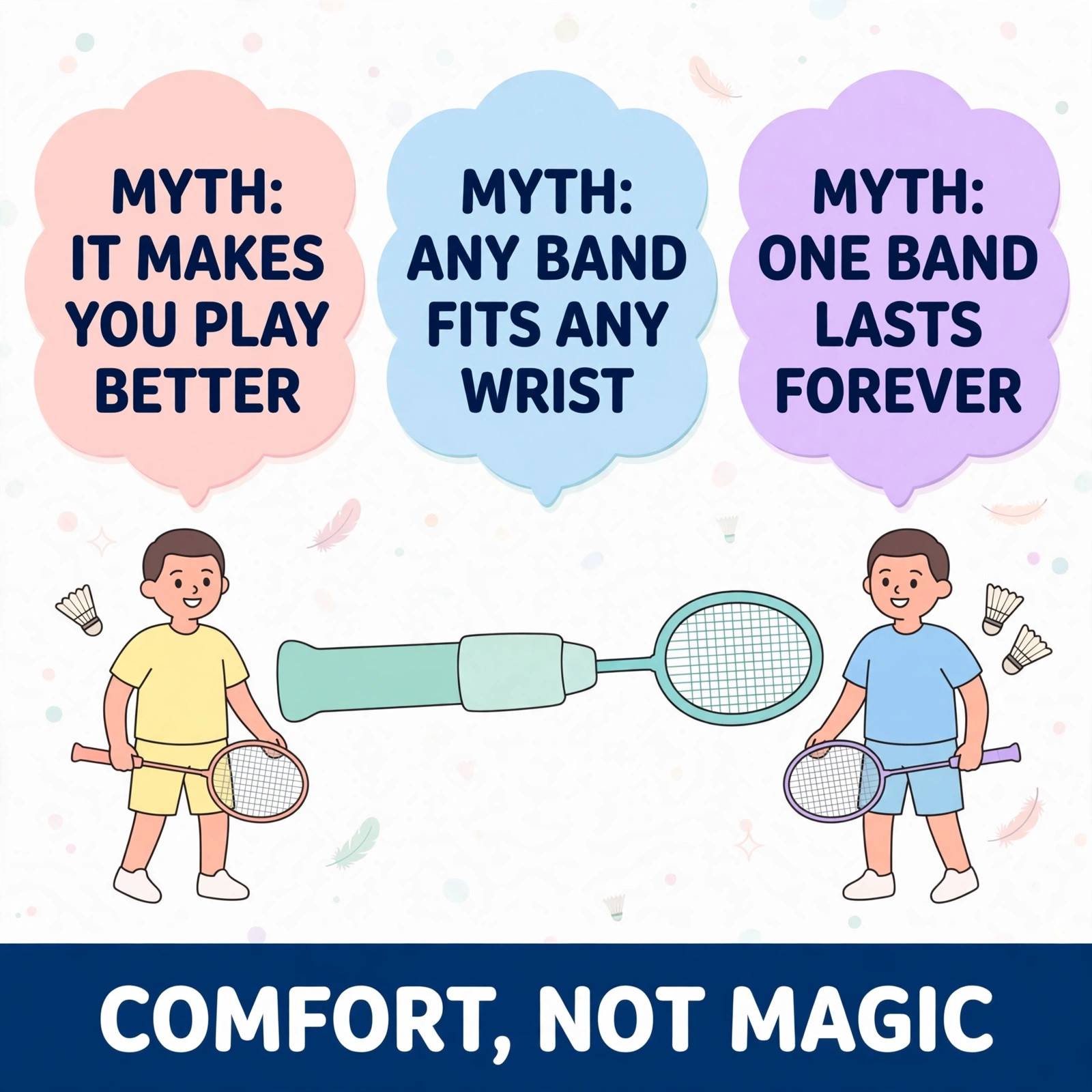
Myth one: a wristband makes you play better. It does not add a single point of skill, power, or speed. What it does is remove a distraction. A player whose grip stays dry stops fighting the racket and can use the skills already trained. That feels like playing better, and over a long match it can protect the score, but the band itself is comfort equipment. Believing otherwise leads players to shop for gear when they should be booking practice. The honest order never changes: training builds the game, and small gear looks after the details.
Myth two: any band fits any wrist. Players believe this because most bands are sold as one size, and one size does fit most adults. But most is not all. A junior with a slim wrist, a player with a broad wrist, and a player who needs wide coverage are three different fits, and a band that slides or squeezes will be adjusted, cursed, and finally left at home. The two finger test and one honest session tell you more than the size label. Fit is personal, like grip size, and it is worth two minutes of checking.
Myth three: one band lasts forever. Elastic is a material with a working life. Heat, sweat, washing, and stretching all age it, and a band that has lost its spring has lost its job, whatever its colour still promises. The good news is that care stretches that life a long way: wash gently, dry in air, rotate two or three bands, and each one serves for months. The bad news is that no care makes a band immortal. Treat the band as a consumable, like a grip or a set of strings: small, cheap, and replaced when it stops working.
Why Choose Us
Why Players Choose ST Badminton Academy
Small gear questions come up in our classes every week, and coaches at ST Badminton Academy answer them the same way this guide does: with criteria, not brands. With a maximum of four students per group, a coach actually sees the details of each player’s game, including a racket turning in a wet hand by the third game. That closeness turns gear advice from guesswork into observation. The coach who watched your grip slip knows exactly why a band, a grip change, or a towel habit belongs in your bag.
The academy gives honest advice because it has nothing to sell you in this area. Coaches will tell a junior when a band would help, and just as quickly tell another that their sweat is light and their money is better kept. That honesty is deliberate. Parents trust advice that sometimes says do not buy, and players learn to judge gear by what it does, not by what it costs or whose logo it carries. In a sport full of marketing, a young player who can say that band works for me, and here is why, has learned something worth more than the band.
Gear care is also part of the discipline we build. Juniors at the academy learn to pack their own bags: racket, shuttles, towel, spare band, water. They learn to air their kit after sessions and to notice when a grip or a band is finished. These tiny responsibilities sound dull beside smashes and trophies, but they are the same responsibility that later keeps a player organised at tournaments: fed, hydrated, on time, with working equipment. Champions are built from boring habits done daily, and the humble wristband is one of the first places a junior practises them.
FAQs: Badminton Wristbands, Sweat and Grip in Malaysia (KL)
Here are the questions players and parents ask us most about badminton wristbands, sweat, grips, and how our coaches advise on small kit choices in Kuala Lumpur and Setapak.
How does your academy advise juniors on small kit choices in Setapak or Gombak?
Coaches give the advice during normal sessions, when they can see the player’s game. A junior whose grip slips late in games is shown the sweat path down the forearm and the simple fix. The advice is a two minute conversation, repeated whenever a new player joins with the same wet grip problem.
What is the real job of a wristband during a game in KL?
A wristband’s real job is to catch sweat on the forearm before it reaches the grip hand, and to serve as a small towel for the brow between rallies. In a hot Kuala Lumpur hall that job matters more, not less. A dry grip keeps shots clean in the third game, when matches are decided.
How tight should a wristband feel if a junior wears one at social level?
Snug, never tight. The band should stay in place through smashes and lunges without sliding onto the hand, and two fingers should slide under its edge without a fight. If it leaves deep marks or the hand tingles, it is too tight. Juniors need narrower bands, because adult sizes slide on small wrists.
Is a cotton wristband or a synthetic one better for heavy sweaters?
Cotton towelling soaks up more sweat in one wearing, so heavy sweaters often start there, accepting the slower drying. Synthetic blends dry much faster between sessions, which suits players who train often. Many heavy sweaters settle on a wide cotton band plus a dry spare to swap at the interval.
How many wristbands should a player carry in a kit bag?
Carry two as a working minimum: one on the wrist and one dry spare in the bag for when the first saturates. A third in the wash completes the rotation many players use. More than three is stock, not need, unless you play every day and laundry day is far away.
Do your coaches check grips and sweat habits near Wangsa Maju?
Yes, grips are part of coaching here. Coaches watch how the racket sits in the hand late in sessions, when sweat shows its effects, and they advise on bands, towel habits, and grip changes as needed. A slipping grip is a technique problem with a gear answer, and coaches treat it that way.
Does your academy sell wristbands or just advise players in Malaysia?
We advise; we do not push products. Coaches explain what a band should do and how to check material, width, and fit, then players buy wherever suits them. The academy earns its trust by having no favourite brand to sell, and players learn to choose by criteria they can test themselves.
Where does ST Badminton Academy help players sort out small gear questions?
At our classes in Setapak, Kuala Lumpur, before or after sessions, or during a water break when a coach can look at the actual problem. Small gear questions get better answers when the coach can see the player’s grip, sweat, and current kit, instead of guessing from a description.
What makes Mr Eric Chuar a good coach for honest gear advice in badminton?
Mr Eric Chuar has coached for over 15 years and still answers small questions seriously, because small problems lose rallies. His advice starts with what the gear must do, names the checks anyone can run, and refuses to dress a simple band up as magic. Players trust advice that stays honest about limits.
Badminton Wristbands and Grip Care in Action

One Standard for Every Player and Every Session
The academy's standard for gear advice is the same as its standard for coaching: say what the item does, say what it does not do, and let the player decide with clear criteria. Nobody at ST Badminton Academy will tell a junior that a band, a grip, or a racket will fix their game. We will tell them how to choose well, how to care for what they own, and when to replace it.
| Factor | Fights the Wrist | Fits the Wrist WRISTBAND |
|---|---|---|
| Frequency | 1 or 2 times a week. Mostly for fun and sweat. | Soaks up sweat on the forearm, so the grip hand stays dry through long rallies. |
| Drills Focus | Basic static feeding. Minimal footwork pressure. | Sits snug without squeezing, and stays put when the arm swings fast. |
| Physical Conditioning | Rarely included. Just playing games on court. | Core, agility, and speed training included in every session to prevent injury and build stamina. |
| Tactical Awareness | "Just hit it over." No real game plan. | Video analysis, point construction, and learning to read the opponent's game. |
| Coach Ratio | Large groups (8-10 kids). Coach barely watches you. | Max 4 students. Mr Eric Chuar personally corrects every stroke and movement detail. |
| Goal Setting | Fun and exercise. | Washes clean, dries fast and keeps its stretch for months of honest play. |
| Long Term Result | Good recreational player. | A player who stops thinking about sweat and just plays the rally. |
Badminton Coaching and Honest Gear Advice in Kuala Lumpur
A wristband will never be the most exciting purchase in badminton, and that is exactly why it makes a good test of how a player thinks about gear. Choose it by material, width, and fit. Wear it on the racket arm. Carry a spare, wash it, dry it, and replace it when the elastic gives up. Then forget it, and go back to thinking about shuttles. If your child trains with us at ST Badminton Academy in Setapak, Kuala Lumpur, ask any coach about the small items in the bag. We are always happy to sort the small gear simply, so the big game gets the attention.