How To Develop A Winning Badminton Smash And Drop Shot Game: Techniques And Strategies (Smash and Drop Guide)
Some shots look after themselves. The smash and the drop shot are not like that: they work as a pair, and each one makes the other dangerous. A smash on its own becomes predictable, and a drop shot on its own gets read early and punished. Put them together behind one shared preparation and the opponent has a real problem, because the same swing can end with the shuttle crashing down or dying softly at the net. This guide builds the pair in order: the shared shape first, then the smash, then the drop, then the combinations that move an opponent front to back.

Pair Check #1
One Shape, Two Shots: The Shared Preparation
The pair starts with one preparation for both shots. The grip stays relaxed, the body turns side on, the racket goes up early and the backswing looks the same whether the shuttle will be smashed or dropped. Your feet do the same work too: get behind the shuttle, load the legs, and arrive balanced with time to choose. If your drop needs a smaller, softer setup than your smash, you are not playing a pair yet. You are playing two separate shots, and a watching opponent can tell them apart.
That sameness is what buys you time. When every overhead shot starts from the same shape, the receiver cannot move until the shuttle leaves the racket. They must respect the smash, so they stand a little deeper, and that small step back is exactly what your drop shot feeds on. Then, because the drop has hurt them, they creep forward again, and the next smash arrives before they have settled. The pair is a loop: each shot protects the other, and the doubt does most of the work.

Pair Check #2
Build the Smash: Power With a Purpose
The smash is the loud half of the pair, but power is not its first job. Its first job is to be believed. Get behind the shuttle early, turn the body, and let the power travel in order: legs, hips, shoulder, arm, then the forearm and fingers at contact. Contact happens high and slightly in front of the body, with the racket face angled down. A smash hit late, from beside or behind the body, loses its angle and floats, and a floating smash teaches the opponent that your threat is empty.
Placement keeps the smash honest. Raw speed impresses once; a smash into the tramlines, at the body of a defender, or steeply into the front of the court keeps scoring. Aim at spaces and at the racket hip of the defender, where the swing gets jammed. Change the target more often than you change the pace. A slightly slower smash into the right empty corner beats a full power blast straight at a set defender, and it costs your shoulder far less over a long match.
Choose your moments. The pair works best when the lift is a little short, a little slow, or when the opponent is already leaning the wrong way. Smashing every lift, including the deep and comfortable ones, wastes energy and hands over information. Let some lifts go: take them as a clear or a drop instead, and keep the smash as the answer they have to respect. A threat used with patience stays a threat for three games, not three rallies.

Pair Check #3
The Drop Shot: Same Swing, Softer Ending
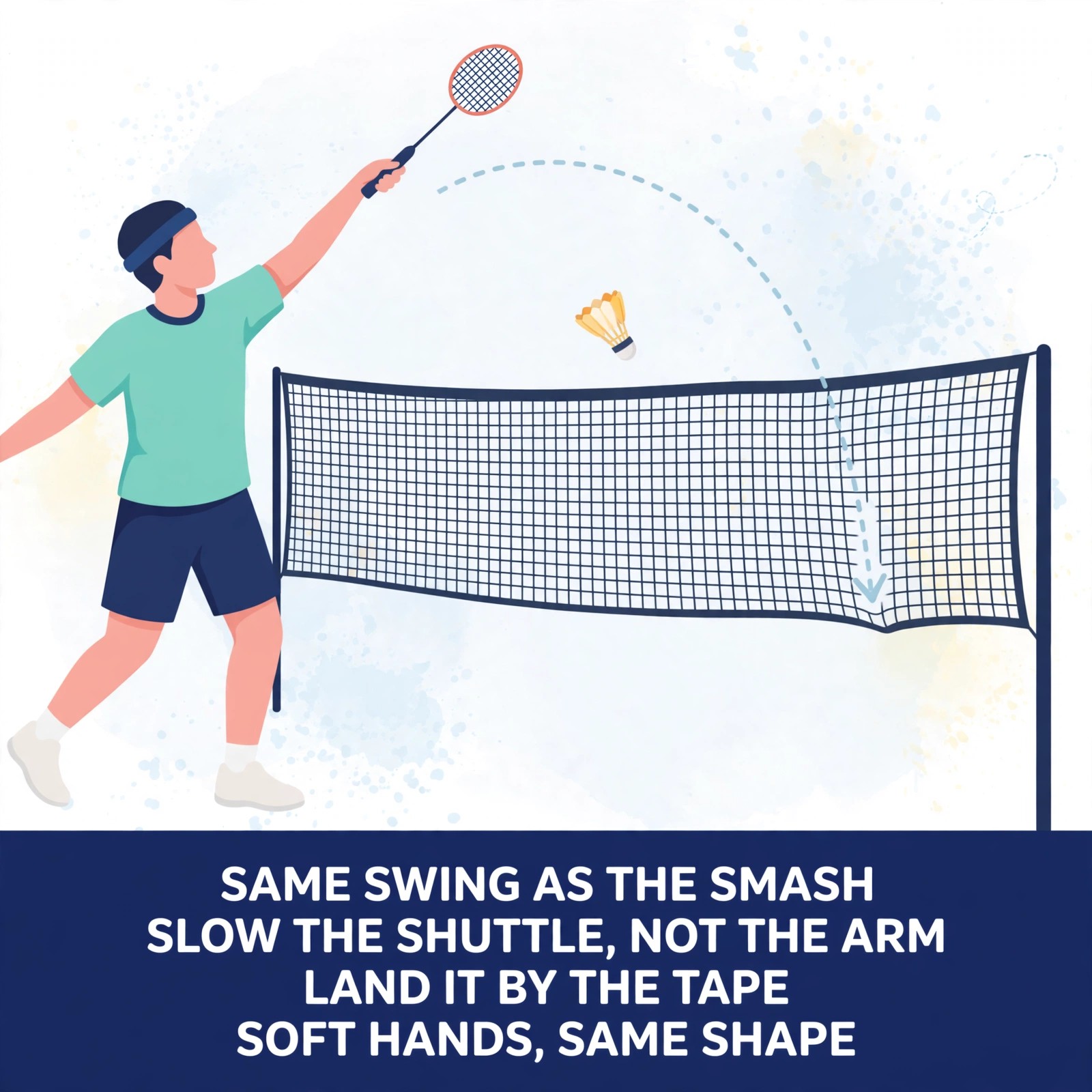
The drop shot is the quiet half of the pair, played with the same swing and a softer ending. The preparation mirrors the smash exactly: same turn, same backswing, same high reach. Only the last part changes, as the racket slows through contact and the shuttle is guided over the tape instead of driven down. Contact stays in front, the touch is gentle, and the shuttle should peak just above the tape and die close to the net on the other side.
You own two drop speeds, and the pair needs both. The slow drop floats down tight to the tape and forces a long, careful lift or a risky net reply. The fast drop travels flatter and quicker, landing further from the net but arriving before the opponent has recovered from defending the smash. Use the slow drop when they are camped deep, the fast drop when they are still travelling backwards. Two speeds from one shape give the receiver two more problems to solve in half a second.
If your drop keeps getting read, do not change the drop. Change the shape. Early reading almost always comes from a preparation that shrinks: a shorter backswing, a slower approach, a racket held lower. Film ten overhead shots or ask a partner to call the shot before contact. When they can call it, the shape is leaking. Groove the shared preparation again at low speed, and let the drop borrow the smash shape until the two are twins at the moment of the backswing.
Pair Check #4
The Combination: Move Them Front to Back
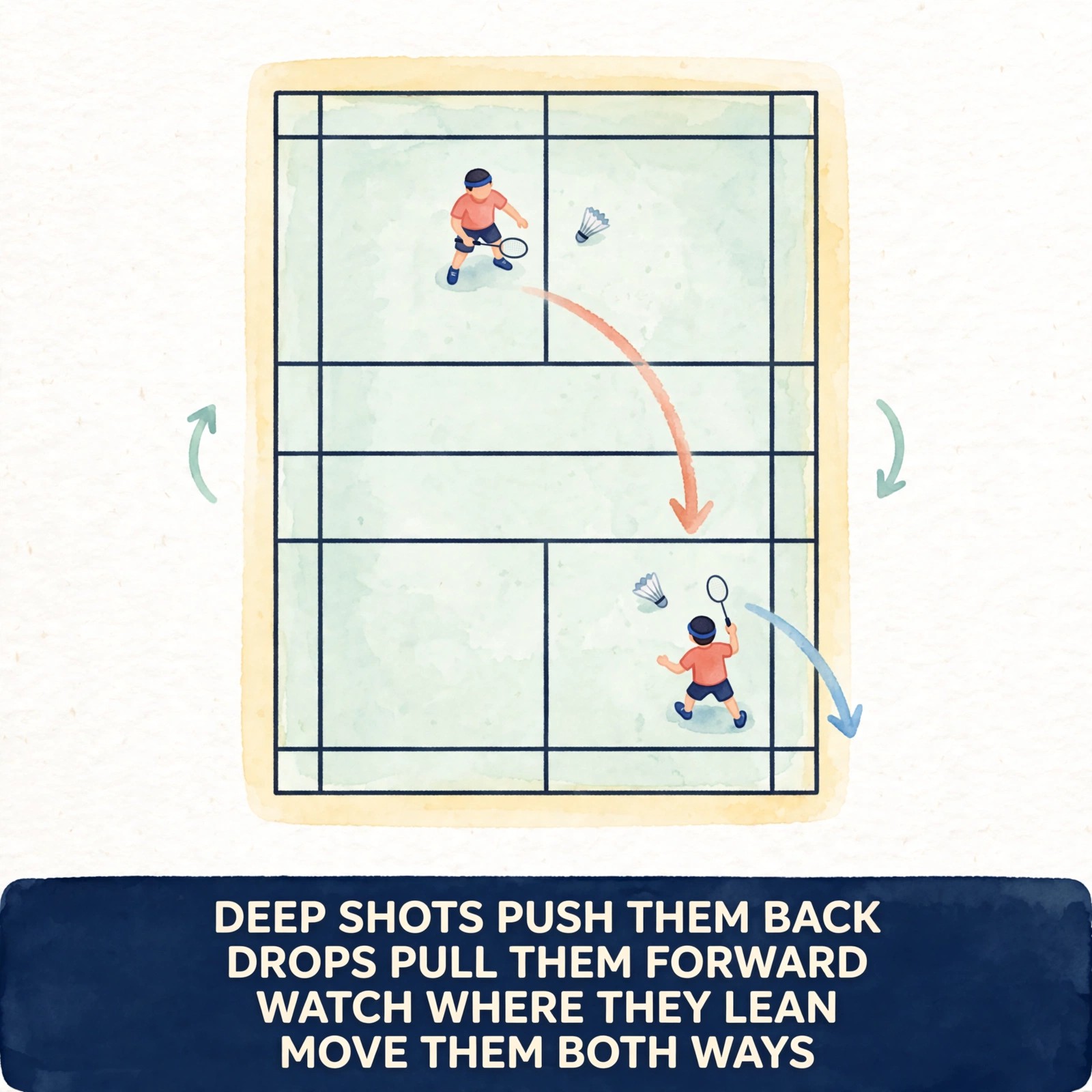
Now join the pair. The basic pattern pushes and pulls: shots to the back, a clear or a smash, drive the opponent deep and make them defend from behind their comfort zone. Then the drop lands at their feet in the front court, a full court away from where they are standing. The distance is the weapon. Every full length trip costs their legs a little more, and late in a match those trips are where points quietly pile up for the player with a plan.
Read the lean and let it choose for you. If the opponent is camping deep, worried about your smash, the drop is open all day. If they creep forward to cut out the drop, the back of the court is empty and the smash, or a fast clear behind them, scores. You are not guessing: you are watching where their weight sits in the half second before you strike, and sending the shuttle to the place they have just left. Their movement becomes your information.
Think in pairs of shots, not single heroes. A drop played to provoke a short lift is already a success before the lift arrives, because the smash behind it was the plan. A smash that forces a panic block is complete when the soft drop kills the next shot at the net. Coaches call this building the rally. Club players can do it too, with two reliable shots and the patience to set one up with the other instead of hunting winners from nowhere.
Pair Check #5
Train the Pair: Feeding, Counting and Games
Training the pair means training the choice. The core drill is simple: a feeder lifts high to the back, the feed looks the same every time, and the player answers with a smash on one rep and a drop on the next. When that holds, the feeder stops nominating and the player chooses, reading a partner who shifts position at the front. Same feed, two answers, one shape. If the shape changes with the choice, slow everything down until it stops changing.
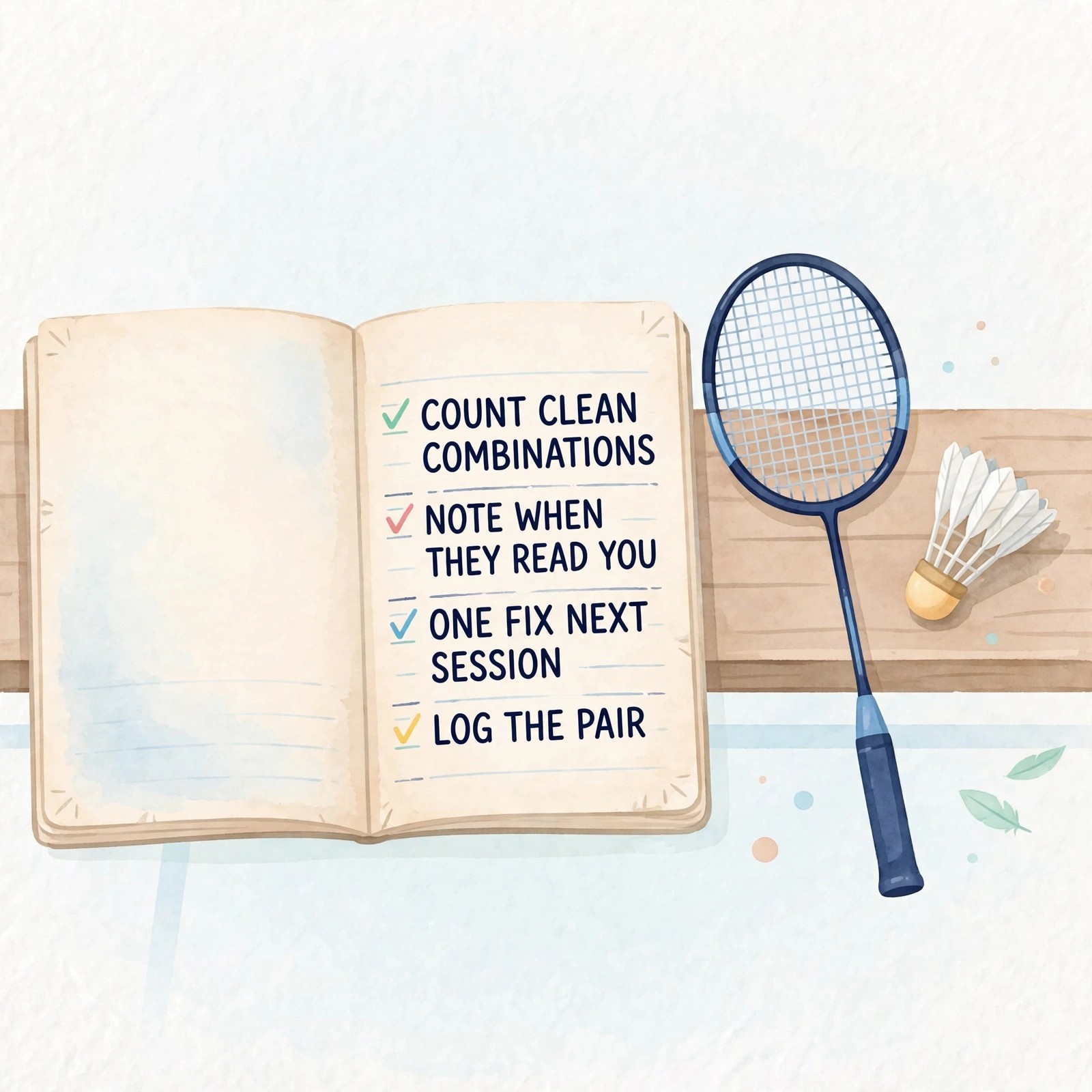
Count what lands, not what feels good. Count clean smashes into the target zones and drops that die inside the front box, and write both counts down. A pair is only real when both halves score on the count, not just the one you enjoy hitting. Stop a set while the preparation is still identical, because tired reps are where a smaller drop backswing creeps in and the disguise quietly dies for the rest of the session.
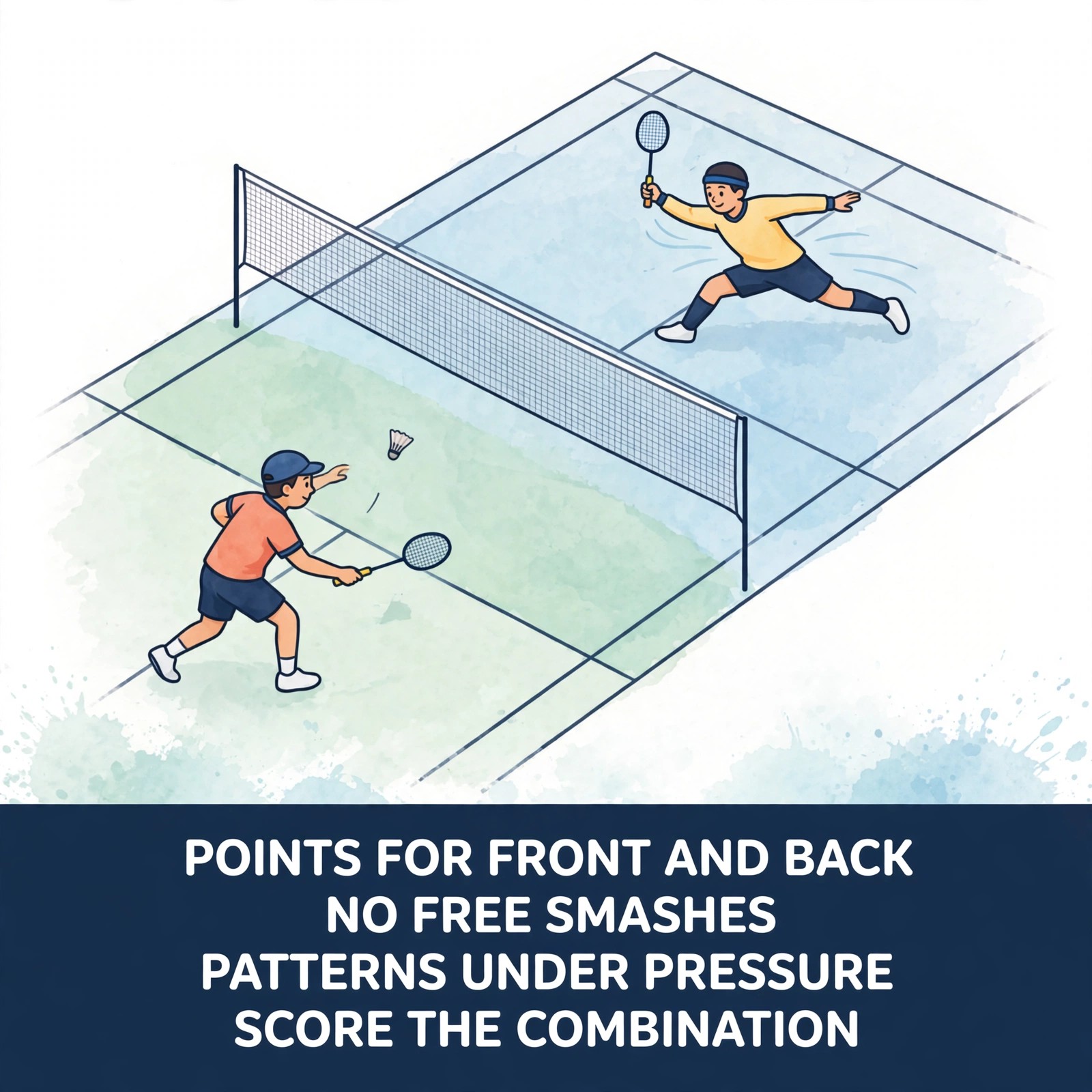
Finish with games that pay the pair. Play conditioned rallies where a point only counts double when it is won with a shot played to the opposite end from the shot before, or where the front player must be moved before any smash is allowed. Games like these punish one shot thinking and reward the push and pull pattern under real score pressure. That is where the pair stops being a drill and starts being your match game.

Myth vs Reality
Myths About the Smash and Drop Pair
Myth: a harder smash makes the whole pair stronger. Reality: the pair runs on doubt, not force. A placed smash that the opponent believes is enough to hold them deep; a wild full power smash that keeps flying out just teaches them to stand still and watch. Power is the garnish on this pair. The shared shape and the placement do the heavy lifting.
Myth: the drop shot is a defensive, passive option. Reality: a good drop is an attacking shot played with soft hands. It drags the opponent the length of the court, forces a lift under pressure, and sets up the very smash that finishes the rally. Players who treat the drop as a rest shot play it from a different, lazy shape, and that is why theirs gets read and attacked.
Myth: you should decide the shot early so you can commit fully. Reality: early decisions are visible decisions. The whole point of the pair is that the choice stays open until the last part of the swing, so the opponent has to cover two endings at once. Decide late, from what their position is telling you, and let the shared preparation hide your answer until the shuttle is already gone.

Why Choose Us
Why Players Choose ST Badminton Academy
We do not just feed shuttles; we build players. ST Badminton Academy Malaysia is different because our head coach, Mr Eric Chuar, has over 15 years of coaching experience in Singapore and Malaysia, and he corrects technique personally in small groups. The smash and drop pair is exactly the kind of skill that needs an outside eye, because the shape leak that gives the drop away is almost impossible to feel from inside the swing.
Our small group policy, with a maximum of 4 students, means your preparation is checked rep by rep. Players building the pair follow a clear order: shared shape, smash placement, drop touch, then combination feeding. The coach watches from the side, where the backswing difference shows, and stops the set the moment the two shapes start to split apart.
We focus on long term player development. A working smash and drop pair changes how opponents have to play you: they cannot camp deep or creep forward, and every rally makes them travel. That is built with honest feeding, counted landings and steady correction, rather than a bag of trick shots learned for one weekend and forgotten by the next.
FAQs: Badminton Smash and Drop Shot Combinations in Malaysia (KL)
Here are answers to common questions from players in Kuala Lumpur about building a smash and drop shot game, combination training, and how coaching at ST Badminton Academy works.
Can a beginner learn the smash and drop pair in Setapak or Gombak?
Yes. Beginners often build the cleanest pairs, because the shared preparation is learned once, for both shots, from the very first week. Start with the shape and a gentle smash, add the drop from the same swing, and let the combination games come later, when both landings are landing where you aim them.
What makes the smash and drop work as a pair in KL?
The shared preparation. When the smash and the drop start from one shape, the receiver must wait, and waiting is what opens both ends of the court. Power helps the smash and touch helps the drop, but the doubt created by the identical start is what turns two ordinary shots into a pair.
Why do my smashes keep coming back at club level?
Usually because the smash is being hit from beside or behind the body, so it leaves flat and arrives without angle. Get behind the shuttle earlier, take contact high and in front, and aim for the tramlines instead of the middle. If deep lifts keep beating you, your footwork to the back corner is the real fix.
My drop shots keep getting read early. Should I change the drop or fix the shared shape first?
Fix the shared shape first. A read drop almost always comes from a smaller, softer preparation than your smash, so the drop itself is rarely the problem. Practise both shots from one frozen start, have a partner call the shot before contact, and only speed up again when they honestly cannot tell.
How can I practise the smash and drop pair alone during training?
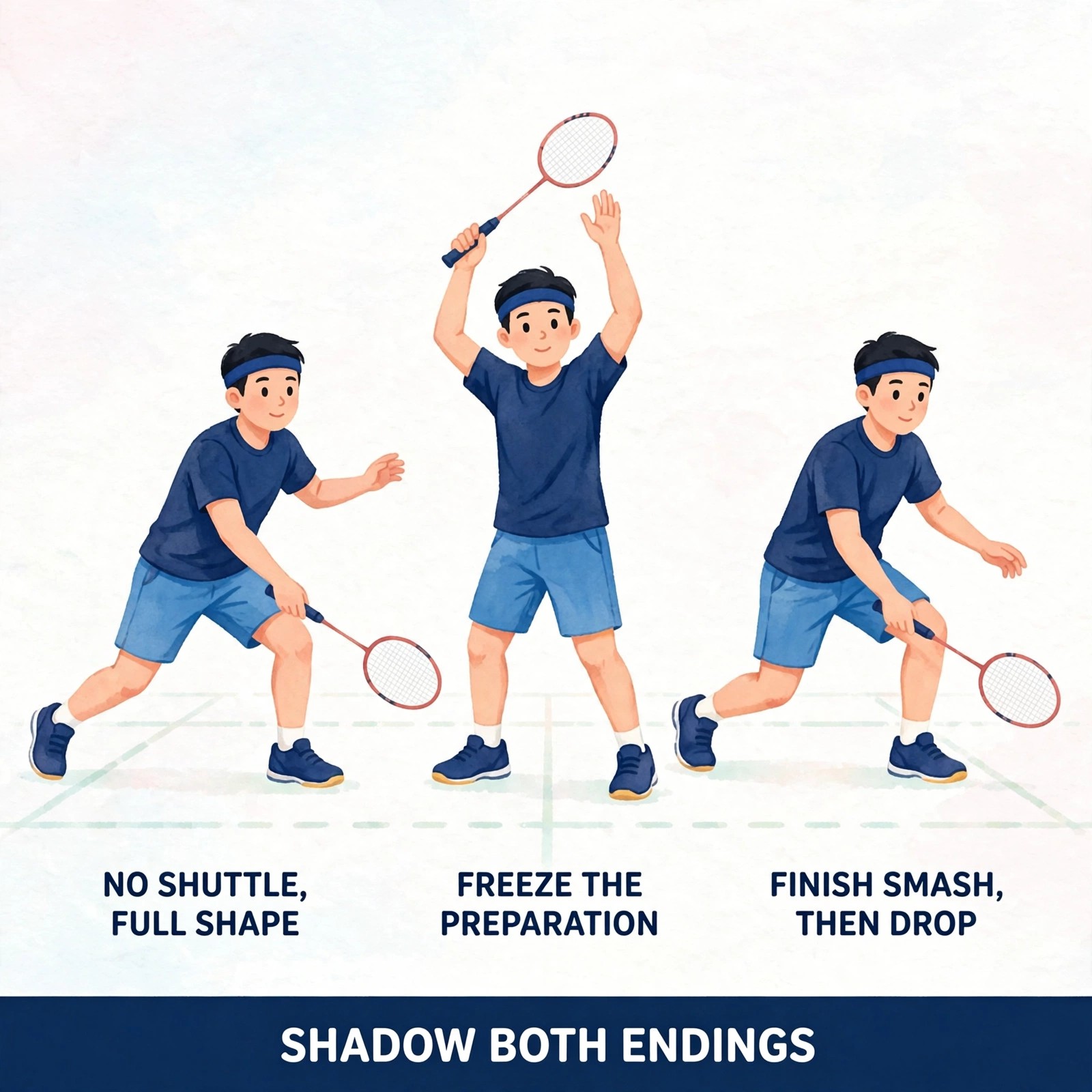
Shadow the pair without a shuttle: same preparation, then finish as a smash on one rep and a drop on the next. Add wall rallies for touch, and borrow a partner once a week for high feeds to the back court. Count how many practice swings a watching friend can read, and drive that number down.
Do you coach smash and drop combinations near Wangsa Maju?
Yes. ST Badminton Academy is based in Setapak, a short drive from Wangsa Maju, Melati Utama and Danau Kota. Combination work is coached in small groups of no more than four students, so your smash shape and your drop shape are compared and corrected personally by the coach in every session.
Where does ST Badminton Academy coach the smash and drop pair in Malaysia?
We coach in Setapak, Kuala Lumpur, and the pair travels well: one shared shape, smash placement, drop touch, then combination games. Players from Gombak, Sentul, Ampang and nearby areas train with us each week in small, focused groups where overhead shots are built properly, not rushed in at the end of a session.
How do I book a trial session to build my smash and drop before training?
Message us on WhatsApp and tell us the smash and drop pair is your project. We will place you in a small group session where the coach can watch your preparation from the side, check whether the two shapes match, and show you the feeding order we would follow. One session is enough to leave with clear targets.
What makes Mr Eric Chuar a suitable coach for smash and drop coaching in badminton?
Mr Eric Chuar has coached in Singapore and Malaysia for over 15 years and teaches the pair the way it survives in matches: one shape, honest counts, disguise checked by a reader. Because he coaches small groups personally, your backswing and contact point are corrected in the session itself, not weeks later.
Badminton Smash and Drop Training in Action

One Standard for Every Session and Every Player
Developing a smash and drop game at ST Badminton Academy KL follows one standard: one shared shape, counted landings and honest disguise. Every combination session works at the step you are actually on, with a maximum of 4 students per group, so technique is corrected while it is being built, not after bad habits settle.
| Factor | Two Separate Shots | One Shared Shape PAIR |
|---|---|---|
| Frequency | 1 or 2 times a week. Mostly for fun and sweat. | The preparation is built once: same turn, same backswing and same reach, so neither shot can be read from its start. |
| Drills Focus | Basic static feeding. Minimal footwork pressure. | The smash is placed, not just pounded, and the drop borrows its shape, so both ends of the court stay under threat. |
| Physical Conditioning | Rarely included. Just playing games on court. | Core, agility, and speed training included in every session to prevent injury and build stamina. |
| Tactical Awareness | "Just hit it over." No real game plan. | Video analysis, point construction, and learning to read the opponent's game. |
| Coach Ratio | Large groups (8-10 kids). Coach barely watches you. | Max 4 students. Mr Eric Chuar personally corrects every stroke and movement detail. |
| Goal Setting | Fun and exercise. | Combinations are planned in pairs of shots: push them deep, pull them forward, then finish into the space they left. |
| Long Term Result | Good recreational player. | A player with a real pair: the opponent waits, guesses, and spends the whole match travelling the full length of the court. |
Badminton Smash and Drop Coaching in Kuala Lumpur
This guide gives you the full route: groove one preparation, build a placed smash, add a drop with the same swing, join them into front to back combinations, and count the landings until the pair holds under pressure. If your overhead game needs that building, ST Badminton Academy in Setapak can coach you through it in a small group. Message us to book a trial session.






