How Can You Improve Your Badminton Tactics Through Training (Tactics Guide)
Every player knows a rally they should have won. The shots were fine, the legs were fine, and yet the points kept going the other way, because the decisions were wrong: attacking from defence, defending from attack, hitting the same ball into the same trap. Tactics is the layer of badminton that decides where the shuttle goes and why. It is not a gift for clever players. It is a set of habits that training can build: reading the opponent, choosing patterns with a purpose, noticing when the plan stops working, and changing one thing at a time. This page shows how we train each of those habits. The good news is that every one of them responds to ordinary training, in ordinary club players, without a single new shot being learned first.

Tactics Check #1
What Tactics Really Are In Badminton
Strip tactics down and it is three choices, made again and again: where to hit, how to hit it, and what you expect to happen next. A clear to the back corner is a tactic when it is played to move a weak backhand player deep. The same clear is just a shot when it is played because you ran out of ideas. Training tactics means attaching a purpose to your shots in practice, so that in matches the purpose is already attached. Players are often surprised how few new shots this requires. Mostly it asks more of the shots you already own.
Technique is how a shot is produced. Tactics is which shot is chosen, at which moment, against which opponent. Confusion between the two wastes a lot of practice. Players drill a new deception when their real problem is choosing the old shots badly, or they study match plans while their clear still cannot reach the back line under pressure. Honest training names the layer that is leaking. If the shot breaks down, fix technique. If the shot is sound and still loses, the choice is the problem, and that is fixed with reading, patterns and reviews, not more repetitions of the same swing. A useful test before any session: name the leak in one sentence. If the sentence is about a swing, train technique. If it is about a choice, train tactics.

Tactics Check #2
Reading The Opponent: Position, Habits And Gaps
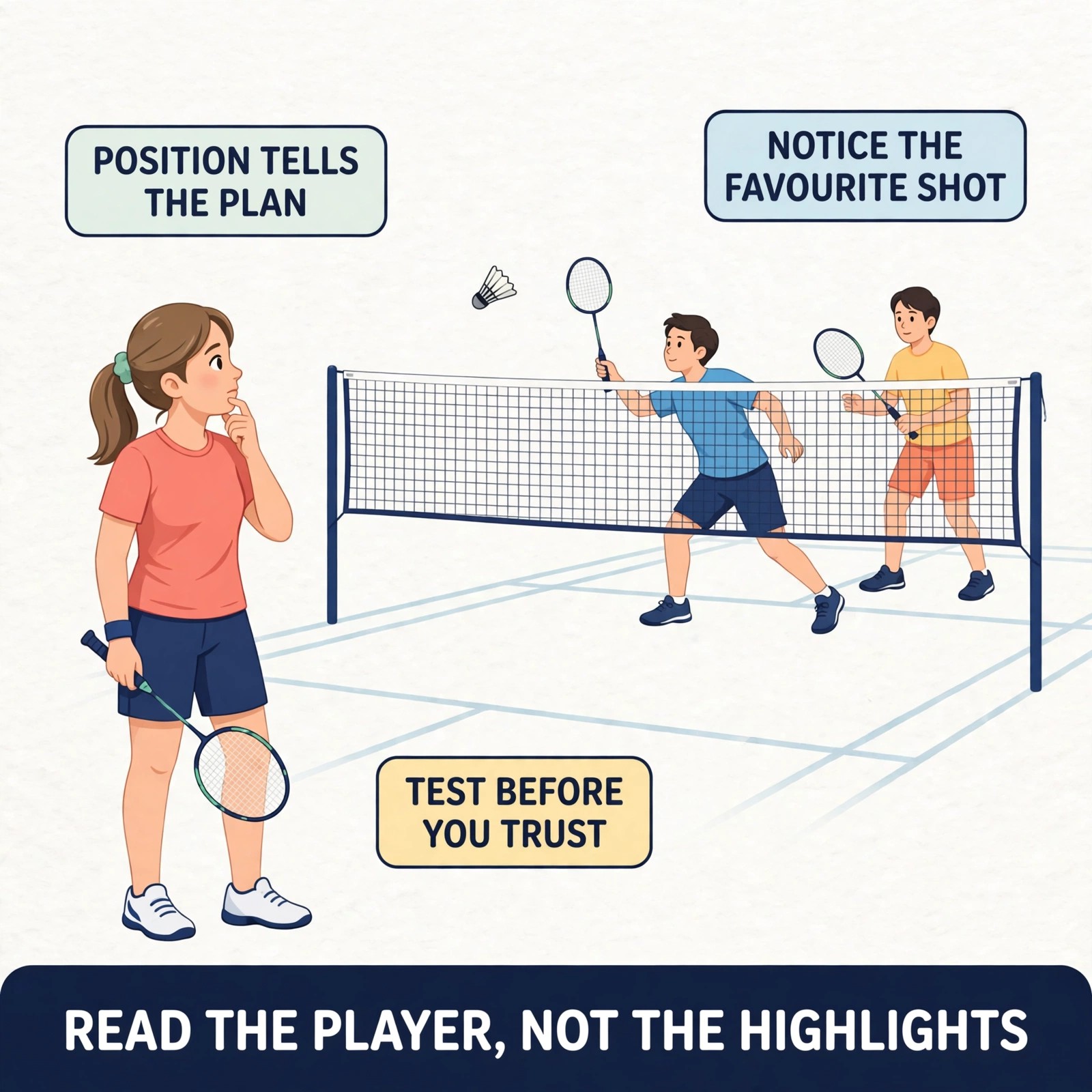
Reading starts before the shuttle moves. Where the opponent stands tells you what they are protecting and what they are offering. A player guarding the net is offering the deep corners. A player camped at the back is offering the front. Body shape speaks next: shoulders turned early suggest the straight shot, a late racket change hints at the cross. None of this is guessing. It is a short list of cues, learned by watching with a question in mind. In training we freeze rallies and ask one thing only: where was the space before the shot was played? Keep the list short enough to use at full speed: stance, position, one favourite shot, one weak corner. Four cues, honestly watched, beat forty noticed once and forgotten.
Opponents are creatures of habit, and habits are points waiting to be collected. Most players have a favourite escape when they are in trouble, a favourite kill when they are on top, and a side they trust less. Your job in the first game is to test, gently and cheaply: push the backhand corner and watch, drive at the body and watch, lift to the favourite smash and see what comes back. Testing is not wasting points. It is buying information at the lowest price of the match, before the rallies turn expensive in the third game.
Tactics also live in the score. The right shot at 5 all can be the wrong shot at 19 all, not because the geometry changed but because the pressure did. Tight scores reward your most reliable patterns and punish experiments. Big leads are where new ideas can be tried at fair prices. Players who ignore the score play every rally the same way and wonder why close matches slide away. In our scored drills the score is part of the exercise: start at 18 all, and let the players feel how their choices should change.
Tactics Check #3
Building Patterns: Three Shots With A Purpose
A pattern is a small sequence with a job: move the opponent one way, then use the space that opens. The classic shape is simple. Push them deep, draw the weak reply short, finish into the space they left. Patterns beat single brilliant shots because rallies are rarely won by one ball; they are won by the third ball, played into a court the first two balls emptied. Build two or three patterns around your strongest shots, not eight around shots you admire. A pattern you trust at 19 all is worth more than a library you only use when winning. Notice the order inside the shape: the moving shots come first and the attacking shot comes last, played into space the earlier shots created. Reversing that order is the most common tactical error we coach.
Build a pattern the way you would build a sentence: one clear idea, practised until it runs without thinking. Start from your best shot. If your clear is strong, your pattern might be clear deep, clear deep again, then the drop when they camp. Feed it in drills in the same order until the sequence feels boring, because boring in the drill means automatic in the match. Then practise the exit: what you do when the opponent reads it and counters early. A pattern without an exit is a trap you built for yourself.
The discipline of patterns is knowing when to repeat and when to stop. Repeat while it works, even if it feels predictable; opponents often need several rallies to solve a pattern, and some never do. Stop when the counters start arriving early and balanced, not after one lucky winner against it. Changing too early throws away a working plan out of boredom, and changing too late donates a run of points out of stubbornness. In reviews we count honestly: how many rallies did the pattern win before it broke, and what was the first sign?

Tactics Check #4
Changing The Plan Mid Match
Plans fail in every match. The skill is noticing quickly and calmly. The signs are practical: your favourite shot starts coming back with interest, you are moving more and winning less, rallies keep ending on the same error. Panic makes players change everything at once, which destroys the information about what was actually wrong. Sit with the discomfort for two or three rallies, name the one leak precisely, and only then edit. A plan that fails is not a disgrace. It is data, and the players who use it calmly usually win the second half of the match. This is also where partners earn their keep in doubles: one calm sentence from a player you trust can find the leak faster than your own frustrated search.
Between games you have a short break and a head full of noise. Spend it on one change. One change can be remembered under pressure, tested cleanly, and judged fairly over the next five rallies. Three changes cannot. Pick the edit with the best evidence: the corner that kept scoring against you, the pattern that kept breaking. Say it plainly, to yourself or your partner, then let it run. If the leak continues after the change has had a fair trial, edit again. Matches are long enough for two or three honest edits, and that is usually all a close match needs.
Late in games, tactics tighten. Your patterns should shrink toward the shots you trust most, and your risks should be chosen, not stumbled into. A cross court gamble at 19 all is fine if it is the plan; it is a leak if it is a hope. Defend the same way: give the opponent the hardest version of their favourite shot rather than a free look at it. Training this is simple and uncomfortable, which is why it works: scored games that start at tight scores, with the coach naming the situation out loud until the players start naming it themselves.

Tactics Check #5
Tactics Drills That Train Real Choices
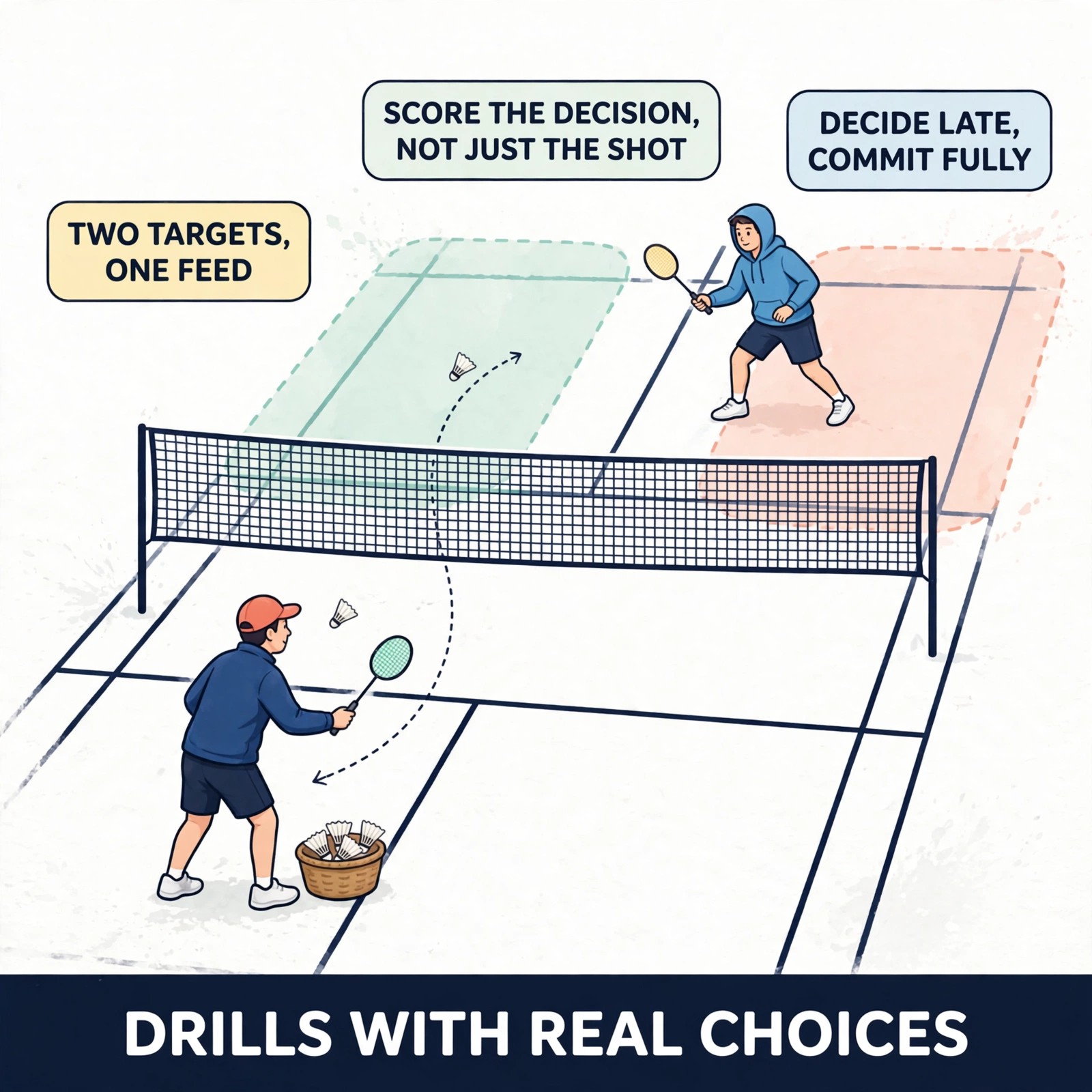
Tactics cannot be trained by drills with no decisions in them. If the feed always goes to the same corner, the player practises movement, not choice. Our tactics work therefore uses feeds with two or three honest options and asks the player to choose, late and fully. The coach scores the decision as well as the shot: a well chosen shot that clips the tape teaches more than a lucky winner from a bad choice. That scoring feels strange for a week, then players start thinking in rallies instead of in swings, and the change shows up in matches soon after. The scoreboard inside the drill matters as much as the feed. When decisions carry points, players start protecting their good choices and questioning their habits, which is the entire point.
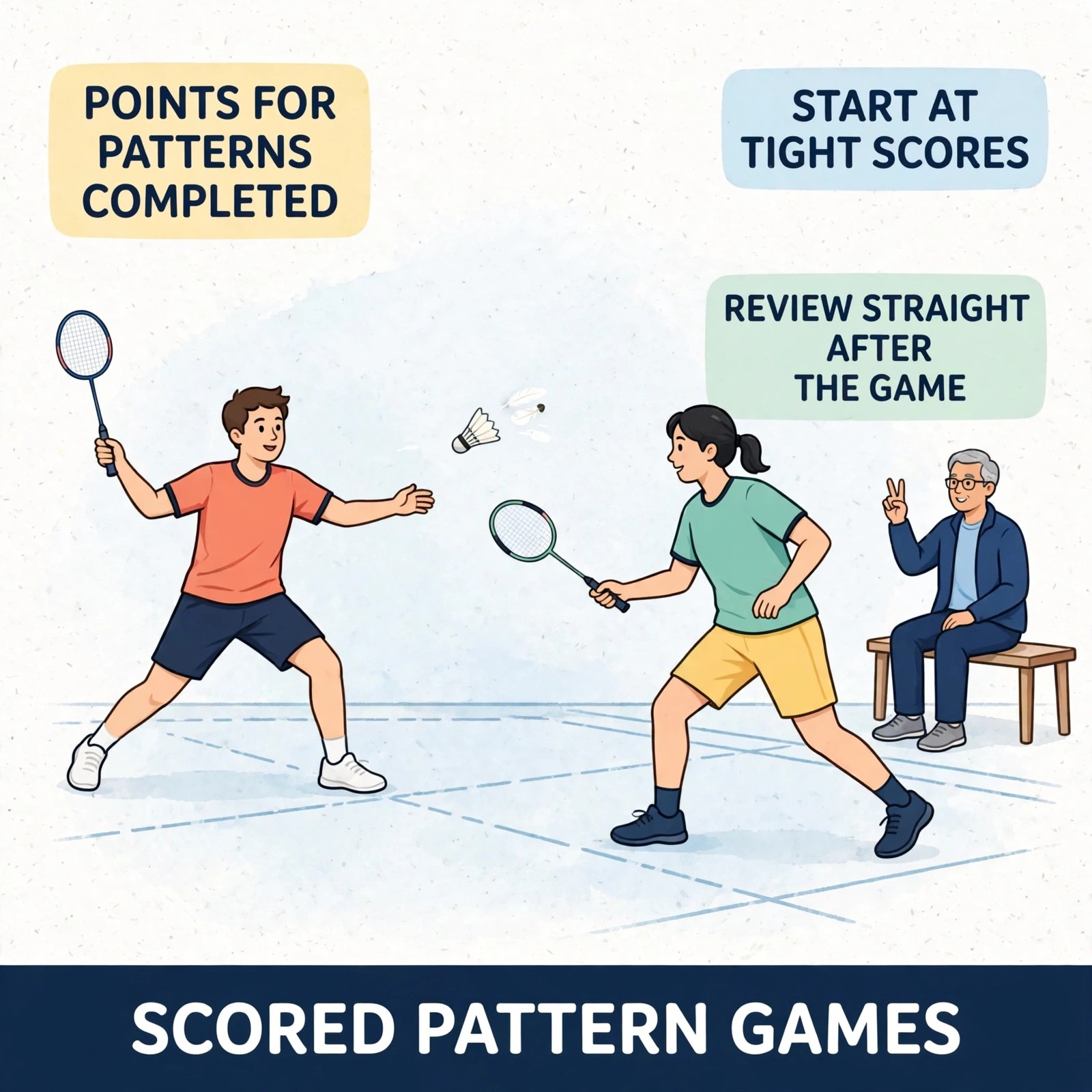
Scored pattern games bridge drills and matches. A player might score double for winning a rally with their practised pattern, or start every game at 18 all to rehearse tight score choices. Constraints teach faster than lectures: ban the favourite shot for one game and watch a second pattern get born out of necessity. Keep the games short, note which decisions kept appearing, and finish with the review while the rallies are still fresh in the legs and the memory. This is where tactics stop being theory for most players. The coach’s job in these games is mostly to guard the honesty: counting the pattern points fairly and refusing to let a lucky winner impersonate a good decision.
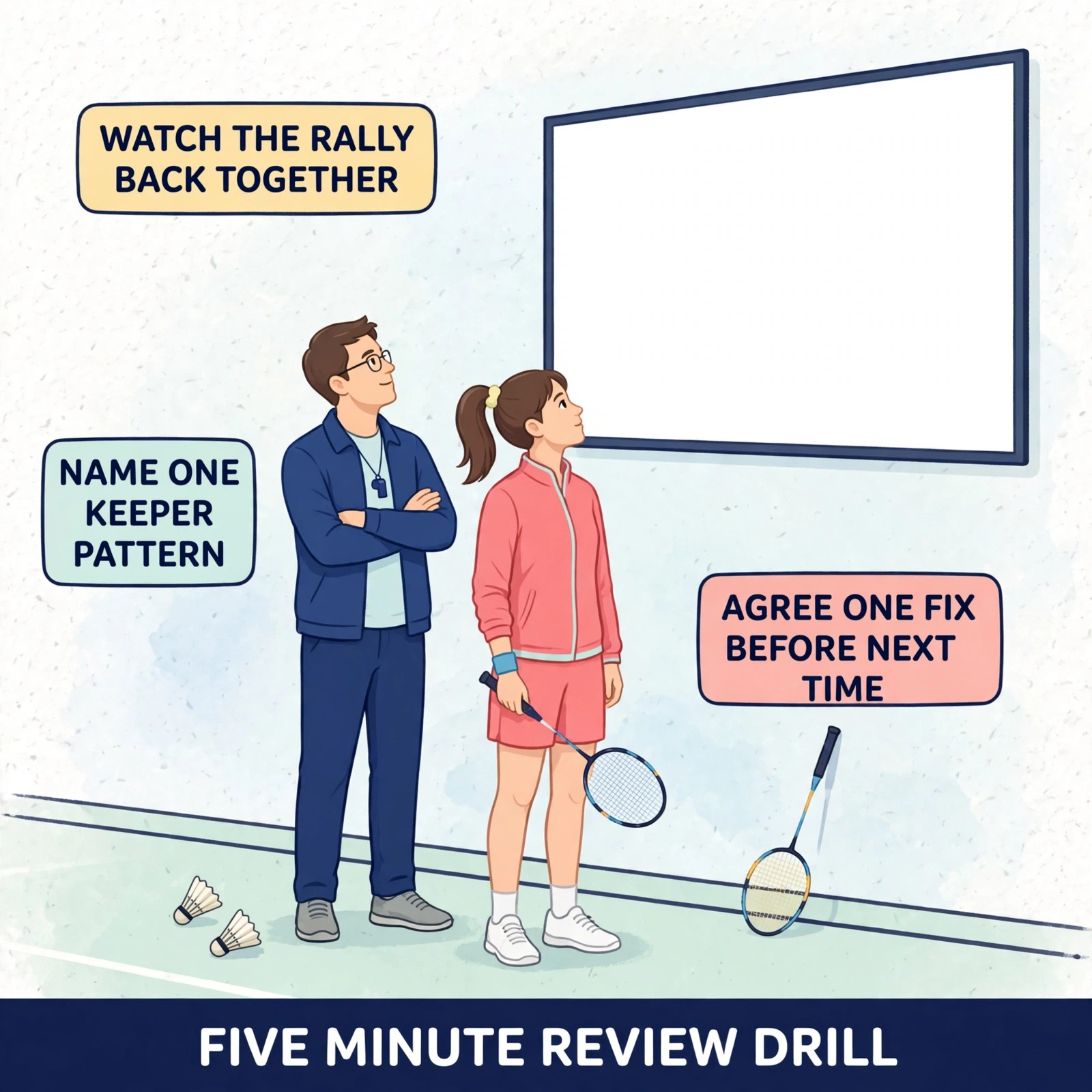
The five minute review is the smallest tactics habit with the biggest return. After a session or a match, answer three questions in writing: what worked, what leaked, and what is the one fix for next time. Keep the notes where you will actually see them, and bring them to the next session. Reviews turn scattered matches into a curriculum, because the same leaks stop surprising you. Over a month, the notes become a map of your own game: which patterns hold, which opponents trouble you, and which edits have already been tested.
Myth vs Reality
Myths About Match Tactics
Myth one: tactics mean trick shots. Deception has its place, but most rallies at every level below the very top are decided by plain shots chosen well: the clear that arrives when they lean forward, the drive at the body that rushed them all afternoon. A player who reaches for a trick shot every time a rally tightens is not being tactical. They are avoiding the simpler work of choosing the right ordinary shot, and opponents learn to wait for the trick within a game. Ordinary shots chosen well also age better. A trick shot that surprises one opponent this month is a scouting report for every opponent next month.
Myth two: copying a professional plan makes you play like one. Pro plans are built on pro shots: a smash that holds its speed from the back tramlines, a defence that never lifts short. Borrow the ideas, not the blueprint; a pattern must be rebuilt around the shots you actually own. Myth three sits beside it: that more shots automatically mean more tactics. A player with twelve shots and no plan loses to a player with five shots and a clear one, most weeks of the year.
The truth is that tactics are simple patterns, honestly reviewed. Read the space, attach a purpose to your shots, repeat what works, edit one thing when it breaks, and write it down after. None of that needs talent, and all of it responds to training, which is the encouraging part. The players who improve fastest are rarely the ones who learn the most shots. They are the ones whose choices get a little less random every month, until opponents start saying they are hard to play against, without quite knowing why.

Why Choose Us
Why Players Choose ST Badminton Academy
Players choose our tactics coaching because we train decisions, not just strokes. Feeding sessions carry real choices, scored games carry real pressure, and reviews are part of the session rather than homework nobody marks. Groups stay at no more than four students, so your patterns and your leaks get individual attention every week. Nothing is layered on top of your game. The patterns are built from the clear, drop, drive and smash you already trust on a good day.
We keep the tactical load honest and small. You will build two or three patterns around your strongest shots, learn the cues that tell you when to repeat and when to edit, and practise tight score situations before a tournament asks you about them. Progress is counted in decisions that improve, recorded in your review notes session by session.
And we teach the calm that tactics need. Changing a plan mid match is a skill of temperament as much as knowledge, so our drills include the uncomfortable moments: bad starts, favourite shots failing, tight scores. Players leave steadier, with a method for the next time a match turns, instead of only a memory of this one.
FAQs: Badminton Tactics And Training in Malaysia (KL)
These are the questions players ask us most about improving tactics through training. The thread through all of them is the same: tactics are choices, choices can be practised, and honest reviews make the practice stick. If your question is about a pattern that keeps failing in your own matches, bring a description of the rallies to a trial session and we will pull it apart together.
Can a beginner improve badminton tactics through training in Setapak or Gombak?
Yes. Tactics for a beginner means one simple pattern and the habit of watching where the space is, not a thick playbook. In our Setapak sessions we start with your most reliable shots, build one pattern around them, and test it in scored games. Groups stay at no more than four students, so your choices get reviewed individually.
What is the first tactical habit a new player should build in KL?
Learn to watch the opponent’s position before you watch the shuttle. Space appears a moment before the shot is played, and players who look for it start making better choices within weeks. Practise by freezing rallies in your head: where were they standing, where was the gap? That one habit feeds every pattern you build later.
Why does hitting every shot hard stop working at a serious level?
Because good opponents settle into the rhythm and start arriving early. Power without placement gives a prepared defender the same ball again and again, and each return comes back faster than the last attack. Tactics break the rhythm: change the height, the pace and the corner, and the same defender suddenly has decisions to make.
I play the same shots every rally and opponents read me. Should I add more shots or build better patterns first?
Build patterns first. More shots give you more options, but a pattern gives those options a job: move them, then use the space. Take your three most reliable shots, arrange them into one sequence, and drill it until it survives pressure. New shots can join later, one at a time, once the pattern has a place waiting for them.
How can I train tactics when I practise mostly on my own in between classes?
Use watching and shadow work. Call the shot you would play while watching rallies, before it lands, and note where you were wrong. Shadow your main pattern slowly, saying its purpose out loud. Keep a short review note after matches: what worked, what leaked, one fix. Bring the notes to class and we will train from them.
Do you coach tactics beside badminton training near Wangsa Maju?
Yes. Our academy is based in Setapak, a short drive from Wangsa Maju, and tactics are coached inside regular sessions there: choice feeding, scored pattern games and five minute reviews. Groups stay at no more than four students, so the coach sees your actual decisions and can rebuild your patterns around the shots you truly own.
Where does ST Badminton Academy teach badminton training in Malaysia?
We teach in Setapak, Kuala Lumpur, and students join us from across the Klang Valley. Tactics training sits inside normal sessions in groups of no more than four: your reading assessed against live opponents, patterns built around your strongest shots, and your progress measured by decisions that improve, recorded in your review notes.
How do I book a trial session to assess my match tactics?
Book a trial session with us in Setapak and bring your racket and an honest account of the rallies that trouble you. The coach will play and feed against you, watch your choices under scored pressure, and map your first pattern and your biggest leak before you leave, so the plan starts from evidence, not guesswork.
What makes Mr Eric Chuar a suitable coach for tactics in badminton?
Mr Eric Chuar coaches the academy sessions himself, with more than 15 years of coaching in Malaysia and Singapore. He teaches tactics the way this page describes: read the space, build simple patterns, edit one thing at a time, and review honestly. No copied pro blueprints, and no promises, just decisions that get less random every month.
Badminton Tactics Training in Action


We benchmark our tactics coaching against World Badminton (BWF) coaching standards and our own academy values: before any player trusts a training plan, they deserve honest checks. You can verify our coaches' credentials through the Badminton Association of Malaysia (BAM) coach education pathway.
One standard governs how we coach tactics: every claim has to survive contact with a rally. If a pattern only works in shadow drills, we say so. If a read was a guess, we name it a guess in the review. That honesty is what makes the system trustworthy when a match tightens. Our coaches model it in their own feedback, changing their minds when the evidence changes, and we expect players to hold us to it. Groups stay at no more than four students so every decision can be discussed while it still matters. Players can check the standard in their own notes: if a review says a pattern worked and the rallies say otherwise, the rallies win, every time.
| Factor | Players Who Hit And Hope | Players Who Play Patterns TACTICS |
|---|---|---|
| Frequency | 1 or 2 times a week. Mostly for fun and sweat. | A planned player tests the corners early, so the match plan is built on evidence, not guesses. |
| Drills Focus | Basic static feeding. Minimal footwork pressure. | Patterns repeat while they work, so pressure builds on the same weakness rally after rally. |
| Physical Conditioning | Rarely included. Just playing games on court. | Core, agility, and speed training included in every session to prevent injury and build stamina. |
| Tactical Awareness | "Just hit it over." No real game plan. | Video analysis, point construction, and learning to read the opponent's game. |
| Coach Ratio | Large groups (8-10 kids). Coach barely watches you. | Max 4 students. Mr Eric Chuar personally corrects every stroke and movement detail. |
| Goal Setting | Fun and exercise. | A failing plan gets one edit at a time, so the player always knows what changed and why. |
| Long Term Result | Good recreational player. | A planned player: reads early, patterns with purpose, edits calmly, reviews honestly. |
Badminton Training For Better Tactics in Kuala Lumpur
Better tactics do not start with a thicker playbook. They start with one pattern you trust, one honest review habit, and the discipline to edit one thing at a time. Book a trial session in Setapak, tell us about the rallies that keep getting away from you, and we will build your first pattern around the shots you already own, then test it together under scored pressure. Bring a notebook. The first page is where your first pattern will live, and it is usually shorter than players expect.


