10 Solo Badminton Training Drills You Can Do at Home
After this, continue the paragraph to understand that this article shares 10 practical solo badminton drills that players from Setapak, Wangsa Maju, Cheras, Kepong and Ampang can do at home with no court needed. Whether you are a beginner wanting to improve your footwork or a junior player looking to maintain fitness, these drills are designed for small spaces like apartments, car porches, or living rooms commonly found in Kuala Lumpur.

Preparation
Home Training Principles
Before you start these solo badminton drills, safety is the priority. In many Malaysian homes, especially apartments in Cheras, Setapak or Kepong, you must check your ceiling height. Ensure there are no low-hanging lights or ceiling fans that your racket could hit. Clear a small floor space of about 2×2 meters, remove fragile items, and ensure the floor is not slippery. Wearing non-slip indoor court shoes is highly recommended to protect your ankles, even if you are just in your living room.
You do not need a full court to improve. You only need a racket, a few shuttles, a wall (if available), and the discipline to focus. These sessions should be short but intense, lasting 20-40 minutes. Remember, solo training supports your regular court sessions it builds the muscle memory and fitness that helps you play better when you return to the court at ST Badminton Academy.

Drills 1-3
Shadow Footwork & Rhythm
1. Basic 6-Corner Shadow Footwork (Small Space)
Stand in the center (base). Move to the front-right corner with a lunge, return to base. Repeat for front-left, sides, and rear corners. In a small room in Wangsa Maju or Ampang, take smaller steps but focus on the correct leg push and balance. Do 3 sets of 20 movements.
2. Split Step Reaction Drill
Stand at your base. Perform a small “hop” (split step) and immediately push off to a random corner (imagined). Return to center and pause. This trains your explosive start, which is crucial for badminton.
3. Low Defensive Lunge
Practice taking a wide step to the side as if defending a smash. Keep your chest up and racket in front. Recover back to the center quickly. This strengthens your legs for defense.
Drills 4-6
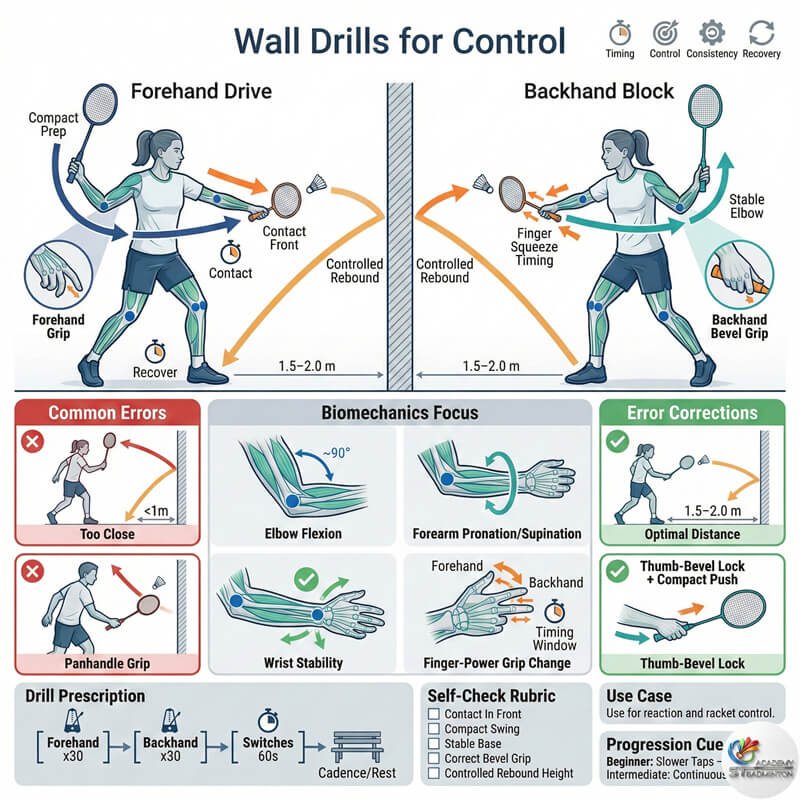
Wall Drills for Control
4. Forehand Wall Drive
Find a solid wall (outside your house or a smooth spot in the car park). Stand about 1.5 meters away. Hit the shuttle gently against the wall using only your wrist and forearm. Keep the rally going. This improves your grip strength and reaction time.
5. Backhand Wall Block/Drive
Switch to your backhand grip (thumb on the wide bevel). Repeat the wall drill using your backhand. Focus on short, sharp tapping motions. This is excellent for defense practice.
6. Finger Power Grip Changes
Without hitting a shuttle, hold your racket in front of you. Quickly switch between forehand and backhand grips using only your fingers (twisting the handle). Do this for 1 minute to loosen your fingers and improve racket control.

Drills 7-8
Serve & Swing Technique
7. Short Serve to Target
Place a box or cushion on a chair about 2 meters away. Practice your backhand low serve, trying to make the shuttle land gently on the target. This builds touch and consistency without needing a net.
8. Overhead Swing Mechanics (Watch Ceiling!)
If your ceiling is high enough (e.g., outside in the porch or a high-ceiling living room), practice your overhead swing without a shuttle. Focus on the rotation of your hips and shoulders, and the “swoosh” sound of the racket. If the ceiling is low, practice the motion on your knees to protect your racket and lights.

Drills 9-10
Fitness & Coordination
9. Skipping (Jump Rope)
Skipping is the best way to train the light, bouncy footwork needed for badminton. Do 3 sets of 1 minute. If you live in a condo in Setapak or Wangsa Maju, be mindful of neighbors downstairs use a yoga mat to dampen the noise or skip in the corridor.
10. Shuttle Drop Reaction
Throw a shuttle high up in the air. As it falls, do a quick footwork movement (e.g., split step) and catch it with your racket hand fully extended before it touches the ground. This trains hand-eye coordination and timing.

Environment Check
Space & Safety Management
Adapting drills for your specific home environment is crucial. If you live in a landed house in Kepong or Melati Utama, you might have a car porch which is perfect for wall drills and higher swings. However, if you are in a condo in Setapak or Cheras, you must modify your movements. Avoid full overhead smashes if the ceiling is low practice the footwork or defensive drives instead.
Respect your neighbors. Footwork drills can be noisy. Try to land softly on the balls of your feet (which is better technique anyway!) or use a yoga mat for stationary exercises. Controlled movement is safer and often builds better muscle control than wild jumping in a small space.

Routine Example
Building a Simple Home Session
You can combine these solo badminton drills into a quick effective workout. For example:
1. Warm-up: 5 mins of joint rotations and light skipping.
2. Footwork: 3 sets x 20 reps of 6-corner shadow movement.
3. Wall Work: 5 mins of continuous wall drives (forehand/backhand).
4. Skill: 5 mins of short serve practice to a cushion.
5. Cool-down: Light stretching.
Doing this 2-3 times a week keeps your body “badminton-ready.” Players from Setapak, Gombak and Petaling Jaya who do this regularly find their on-court movement much smoother when they come for their weekend coaching sessions. Consistency is key!
FAQs: Solo Badminton Training at Home
Common questions from players and parents in Kuala Lumpur about practising badminton alone without a court or partner.
Can I really improve with solo badminton training at home?
Yes, absolutely. While you cannot play a match alone, you can significantly improve your footwork speed, racket handling, and finger power. Many players in Setapak and Wangsa Maju use home drills to maintain fitness during busy weeks. Solo training builds the “engine” (legs and stamina) and “tools” (grip and swing), so when you return to the court, you are faster and more consistent.
What are the safest badminton drills for a small apartment in KL?
For small apartments in Cheras or Kepong, shadow footwork (without a racket if space is very tight) is the safest. Grip change drills and short serve practice onto a sofa or cushion are also excellent. Avoid full overhead swings if you have ceiling fans or low lights. Wall drills are great if you have a solid wall, but use a soft tap to keep noise down for neighbors.
How often should I do these badminton wall drills at home?
Consistency is better than intensity. Aim for 2 to 3 short sessions per week, lasting about 20-30 minutes each. This frequency helps keep your wrists strong and your reaction time sharp without causing burnout. It is perfect for students or working adults in Kuala Lumpur who may only be able to visit the court on weekends.
Can home training replace normal badminton classes?
No, solo home training cannot fully replace court training because you need a real shuttle flight and a partner to learn timing, tactics, and game pressure. However, it is an incredibly powerful support tool. Players who practice shadow footwork at home progress much faster during their actual lessons at ST Badminton Academy in Setapak because their movement is already automatic.
Do I need special equipment for solo badminton drills?
Not really. You just need your standard badminton racket, comfortable sportswear, and non-slip indoor shoes (crucial for safety). For wall drills, old shuttles are fine. Some players in KL use a heavier “training racket” for swing practice to build strength, but your normal racket is perfectly fine for all the drills listed here.
Can kids practice badminton alone at home?
Yes, and it is very beneficial. Simple drills like hitting a shuttle up in the air (keepy-uppy) or hitting against a wall help children develop hand-eye coordination. Parents in Setapak and Ampang should supervise to ensure the child has enough space and does not swing near furniture or other people. Short 15-minute sessions are great for juniors.
Is shadow footwork useful for beginners in badminton?
Shadow footwork is one of the most effective drills for beginners. It teaches you the correct steps to reach the shuttle without the distraction of actually hitting it. Practising the 6-corner movement at home helps your brain memorize the patterns, so you stop “thinking” about your feet and just move naturally during a game. It is a staple of training at our academy.
What if I don’t have a wall for badminton practice?
If you don’t have a suitable wall, focus on shadow swings and footwork. You can also do “self-feeding” drills where you hit the shuttle high up and catch it, or practice low serves into a bucket or onto a cushion. There are plenty of no-wall options to improve your control and fitness in a small space.
How do I stop making noise while training in a condo?
Condo living in KL requires being considerate. Use a yoga mat to dampen the sound of your landing during footwork drills. Focus on “soft landings” (landing on toes/balls of feet), which is actually better technique than stomping. For wall drills, if the wall is shared with a neighbor, avoid hitting it hard or practice at the void deck/car park instead.
Supporting Your Game with Home Training


Why Solo Badminton Training Works
Consistent solo practice at home, even in small spaces, builds the foundation for your game. It turns conscious movements into automatic habits. Here is why dedicating time to these 10 drills helps you succeed on the court.
| Training Aspect | Solo Home Training | Full Court Training (Academy) |
|---|---|---|
| Primary Focus | Technique isolation, footwork patterns, wall control, and basic fitness maintenance. | Tactical application, game rhythm, full court coverage, and opponent interaction. |
| Space Required | Small space (2x2m) in living room, car porch, or condo void deck in KL. | Full standard badminton court with net and proper flooring. |
| Equipment | Racket, shuttle, wall, non-slip shoes. | Racket, shuttles, net, partner/coach, specialized court mat. |
| Main Benefit | Convenience, repetition, muscle memory, and zero cost. Great for busy days. | Real game experience, feedback from coach, power hitting, and social play. |
| Limitation | Cannot practice smashes fully (ceiling height), no net play, no opponent. | Requires travel, court booking fees, and fixed schedule. |
| Ideal Frequency | 2-3 short sessions per week to maintain sharpness. | 1-2 long sessions per week for major improvement. |
| Best For | Fixing grip habits, speeding up footwork, and building finger power. | Learning match strategy, full swings, and competitive readiness. |
Combine Solo Drills with Professional Coaching in KL
While solo badminton drills at home are excellent for building footwork and control, nothing beats on-court training with a coach. At ST Badminton Academy Malaysia, we help players from Setapak, Wangsa Maju, Cheras, Kepong and Petaling Jaya take their home-practiced skills and apply them in real games. Contact us to learn how to balance your home training with our structured classes.