Chinese Men’s Singles Rising Star
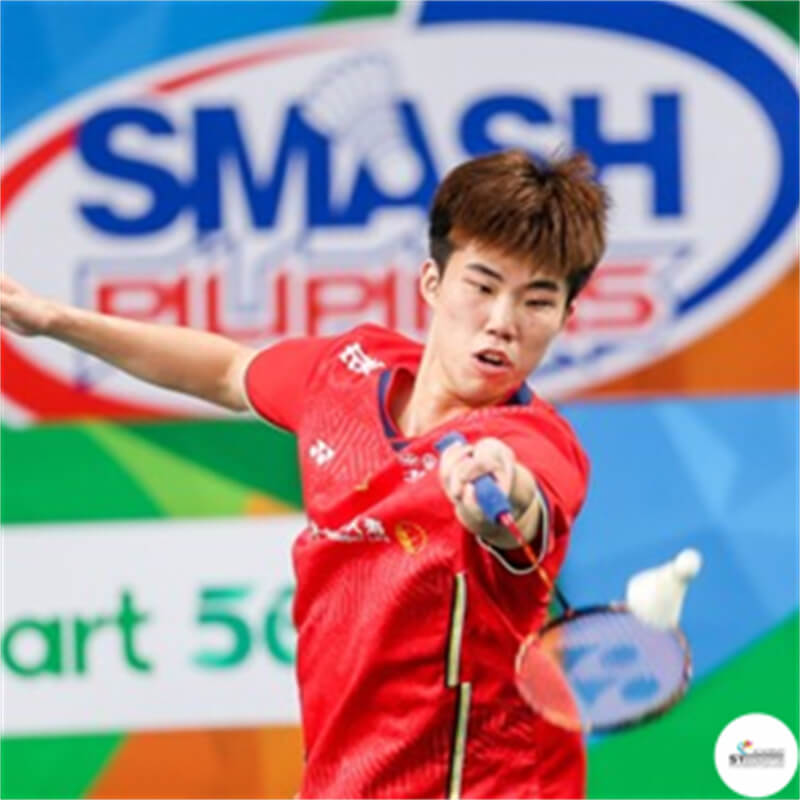
WENG Hong Yang (翁泓阳)

China
Player Event: Men’s singles
Date of Birth: 18 June 1999, Fuzhou, Fujian, China
Playing Style: Left-handed balanced attack and defence with calm mentality
Known For: China Open 2024 champion and Thomas Cup 2024 winner
Understanding WENG Hong Yang (Chinese Badminton Champion)
WENG Hong Yang represents China in men’s singles badminton and has emerged as one of the country’s most consistent rising stars in recent years. Born on 18 June 1999 in Fuzhou, Fujian province, he is a left-handed specialist who progressed through China’s sports school system starting at Fuzhou Sports School in 2006, moving to Fujian Sports School in 2009, joining the provincial team in 2011 and earning selection to the China national team in 2018. His impressive achievements include capturing BWF World Tour titles across all levels from Super 100 to Super 1000, with notable victories at the 2019 Lingshui China Masters, 2020 China National Championships, 2022 Korea Open Super 500, 2023 Australian Open and Denmark Open Super 750 titles, 2024 China Open Super 1000 championship in Changzhou ending a seven-year Chinese drought at that event, 2024 Thomas Cup team gold with China, and 2025 Swiss Open and China Masters victories. Standing approximately 1.82 meters tall, he is recognized for his calm on-court mentality, strong fundamental skills, and balanced attack-defence playing style that reflects traditional Fujian technical excellence. He reached a career-high BWF men’s singles world ranking of No.10 on 30 September 2025 and continues competing at the sport’s highest level, inspiring fans and young players throughout China, Malaysia, Singapore and across Asia.
Early Life in Fuzhou and Path Through China’s Sports System
WENG Hong Yang was born on 18 June 1999 in Fuzhou, the capital city of Fujian province in southeastern China. He entered Fuzhou Sports School in 2006 at age seven, beginning the structured training pathway that characterizes Chinese badminton development. Daily life in sports school focused intensely on building fundamental skills through repetitive footwork drills, multi-shuttle feeding routines and group training sessions emphasizing discipline and consistency. In 2009, he progressed to Fujian Sports School where training intensity increased further, and by 2011 he earned selection to the Fujian provincial team competing against other provinces in China’s domestic tournament system.
Sports School Foundation
The years spent in Fuzhou and Fujian sports schools built essential foundations for his later success. Chinese sports school training emphasizes clean technical execution, with coaches correcting small details in grip, swing path and footwork patterns until movements become automatic. Daily routines included multi-shuttle feeding drills to develop stroke consistency, shadow badminton for movement quality, and physical conditioning to build the stamina needed for long training sessions. This systematic approach helped him develop the strong basic skills and balanced style that would become his trademark at international level.
Provincial Team Competition
Joining the Fujian provincial team in 2011 exposed him to higher-level competition within China’s domestic system. Provincial teams compete in national tournaments including the National Games, National Championships and various ranking events that serve as talent identification platforms for the national team. Training with provincial teammates while competing against players from powerhouse provinces like Jiangsu, Guangdong and Zhejiang provided crucial match experience. The internal competition within China’s system is famously intense, with many talented players competing for limited national team spots.
National Team Selection
His consistent performances at provincial level earned him selection to the China national team in 2018, marking a major milestone in his development. Joining the national squad meant training alongside China’s best players at elite facilities and adjusting to even higher expectations. National team coaches expect not only technical excellence but also mental toughness, tactical understanding and ability to handle pressure representing China at major international events. This transition from provincial to national level represents one of the toughest steps in Chinese badminton, requiring players to prove themselves worthy of wearing the national jersey.
Career Milestone #1
First World Tour Title and National Championships
WENG Hong Yang achieved his first BWF World Tour victory at the 2019 Lingshui China Masters, a Super 100 event held in Hainan province. This maiden international title provided crucial confidence and confirmed his ability to perform under tournament pressure. While Super 100 events represent the entry level of the World Tour system, winning such titles is an important step for young Chinese players seeking to establish themselves on the international circuit and justify their national team selection.
In 2020, he captured an even more significant achievement by winning the China National Championships men’s singles title. The National Championships carry special importance within Chinese badminton as they bring together the country’s strongest players in direct competition for domestic supremacy. Given the depth of Chinese men’s singles talent, winning the national title represents a major accomplishment that demonstrates ability to handle pressure and defeat high-quality opponents.
The 2021 National Games of China brought another milestone when he helped Fujian men’s team win gold medal. Representing his home province at this prestigious multi-sport event carried particular significance, as provincial pride runs deep in Chinese sports culture. Contributing to Fujian’s team success while competing against rival provinces provided valuable experience performing under intense expectations with teammates depending on his results.
Career Milestone #2
2022 Korea Open and Asian Championships Breakthrough
The 2022 season marked WENG Hong Yang’s breakthrough into international prominence. At the Korea Open Super 500 in Seoul, he originally entered as a reserve but got promoted into the main draw when other players withdrew. Making the most of this opportunity, he defeated Heo Kwang-hee, Cheam June Wei, Ng Tze Yong and Victor Svendsen en route to the final. The championship match against Indonesia’s Jonatan Christie became one of his most memorable victories as he saved game points while trailing late in the second game before mounting a comeback to win the title in dramatic fashion.
Later in 2022, he earned bronze medal at the Badminton Asia Championships in Manila, Philippines. His run to the semi-finals included impressive victories over India’s Srikanth Kidambi and Indonesia’s Anthony Sinisuka Ginting, both established top-10 players. Although he lost the semi-final to Malaysia’s Lee Zii Jia, reaching the last four at a continental championship demonstrated his growing consistency against elite opponents. The Asian Championships bronze medal confirmed that his Korea Open victory was not a one-time result but rather evidence of genuine improvement to world-class level.
These 2022 achievements pushed him significantly up the world rankings and established his reputation as one of China’s most promising young men’s singles players capable of challenging the established Asian powers. His ability to perform well at Super 500 tournaments and continental championships showed he possessed not just the technical skills developed in China’s training system but also the mental toughness needed for success on the international stage.

Career Milestone #3
2023 Australian Open and Denmark Open Super 750 Titles
The 2023 season brought WENG Hong Yang’s most impressive World Tour results to that point in his career. At the Australian Open Super 500 in Sydney, he captured the men’s singles championship in a dramatic final against India’s H.S. Prannoy. The match saw him mount another characteristic comeback after falling behind, demonstrating the mental resilience that was becoming his trademark in crucial matches. The Australian Open title showed his ability to travel internationally and perform well in different playing conditions outside Asia.
Even more significantly, he won the Denmark Open Super 750 in Odense, one of Europe’s most prestigious badminton tournaments. The final against Malaysia’s Lee Zii Jia saw him deliver a dominant performance, controlling the match from start to finish. Super 750 events sit just below Super 1000 in the World Tour hierarchy, and winning in Denmark demonstrated his continued improvement and consistency at the sport’s highest levels. He also reached the Malaysia Masters Super 500 final later in 2023, narrowly missing another title but proving his ability to compete regularly in tournament final rounds.
These 2023 achievements pushed him firmly into the world’s top-15 men’s singles players and established him as a regular contender at major tournaments throughout Asia, Europe and beyond. His success at different tournament levels across multiple continents proved that he possessed the versatility and professionalism required to succeed on the global badminton circuit rather than only performing well at select events or home tournaments in China.

Career Milestone #4
China Open 2024 Super 1000 and Thomas Cup Glory
WENG Hong Yang achieved his biggest career breakthrough at the 2024 China Open Super 1000 in Changzhou, Jiangsu province. Competing in front of home fans at China’s premier domestic tournament, he navigated through a strong draw to reach the final where he defeated Japan’s Kodai Naraoka to claim the championship. This victory carried special significance as it ended a seven-year drought for Chinese men’s singles players at the China Open, with no Chinese man having won the title since Lin Dan’s last triumph. His Super 1000 breakthrough confirmed his status among the world’s elite men’s singles players.
The China Open victory was particularly meaningful given the pressure of performing for home crowds and the weight of Chinese badminton history. Super 1000 events represent the pinnacle of the BWF World Tour system alongside World Championships and Olympic Games, and winning at this level requires sustained excellence across an entire week against the world’s best players. His ability to handle this pressure while delivering his best badminton showed maturity and championship mentality.
Later in 2024, he contributed to China’s Thomas Cup triumph as part of the men’s singles line-up. The Thomas Cup represents the men’s team world championship and carries enormous prestige in Chinese badminton culture, where team events are highly valued. Playing for China at the Thomas Cup meant representing his country at badminton’s biggest team competition, contributing crucial points and experiencing the unique pressure of team events where individual performances directly impact collective success. The Thomas Cup gold medal added another dimension to his achievements beyond individual tournament victories.
Career Milestone #5
2025 Swiss Open and China Masters Victories
WENG Hong Yang continued his winning ways in 2025 by capturing the Swiss Open Super 300 men’s singles title in Basel, Switzerland. While Super 300 events rank below the higher-tier tournaments, winning in Europe demonstrated his ability to perform effectively during extended overseas travel and adjust to different playing conditions. The Swiss Open victory added another country and continent to his growing list of international successes, showing the consistency required to compete successfully on the global badminton calendar.
Later in 2025, he won the China Masters Super 750 men’s singles championship, triumphing in front of home fans in China. The China Masters represents one of China’s premier domestic badminton events alongside the China Open, and winning this title reinforced his status as one of the country’s top men’s singles players. Playing before passionate Chinese crowds adds extra pressure but also provides tremendous motivation and support, and his ability to deliver championship performances in these high-expectation environments showed mental strength.
With BWF World Tour titles now spanning Super 100, 300, 500, 750 and 1000 levels, he had achieved the rare distinction of winning at every tier of the World Tour system. This comprehensive record of success across tournament categories demonstrated consistency and versatility rather than only performing well at specific events. His career-high world ranking of No.10 achieved on 30 September 2025 reflected this sustained excellence, and he remained a fixture in the world’s top-15 men’s singles players heading into future seasons.

Playing Style
Left-Handed Balance, Tempo Control and Calm Mentality
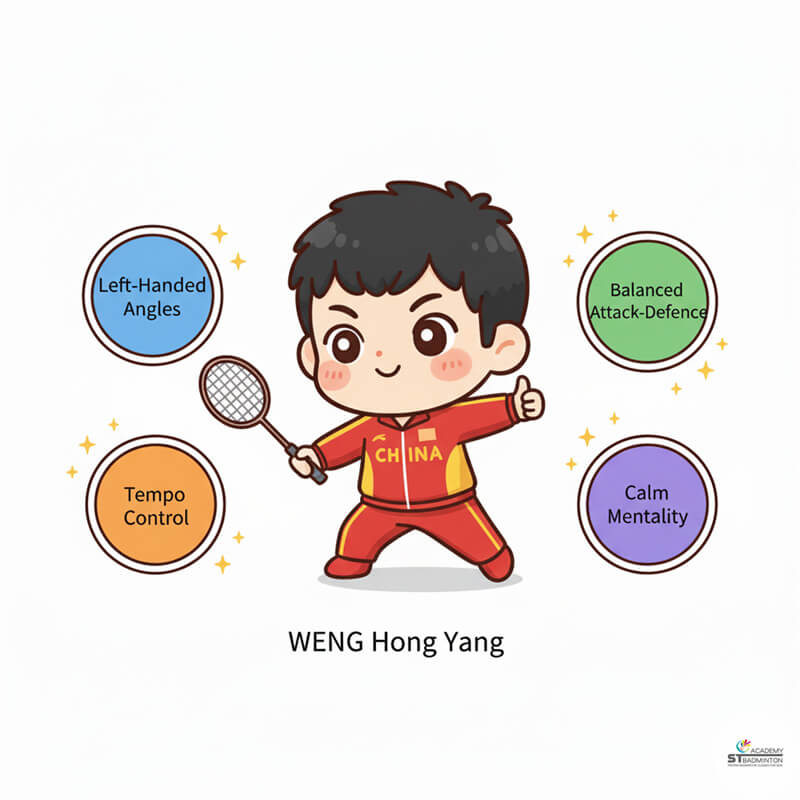
WENG Hong Yang’s playing style centers on his left-handed stroke production which creates unusual angles from the rear court that right-handed opponents find challenging to read and counter. His game reflects traditional Fujian badminton philosophy emphasizing fine technique and solid fundamental skills over pure power or aggressive risk-taking. Standing approximately 1.82 meters tall, he demonstrates balanced capabilities in both attack and defence rather than specializing exclusively in either area, making him difficult to predict and exploit tactically.
His calm on-court mentality represents one of his most distinctive characteristics. Students watching his matches should observe how he maintains composed body language even when trailing in score, refusing to show frustration or panic during difficult moments. He excels at changing rally tempo, mixing slow build-up sequences with sudden bursts of attacking pace to disrupt opponent rhythm. His use of clear, drop and half-smash patterns moves opponents around the court while he waits patiently for the right moment to deliver finishing shots rather than forcing attacks from defensive positions.
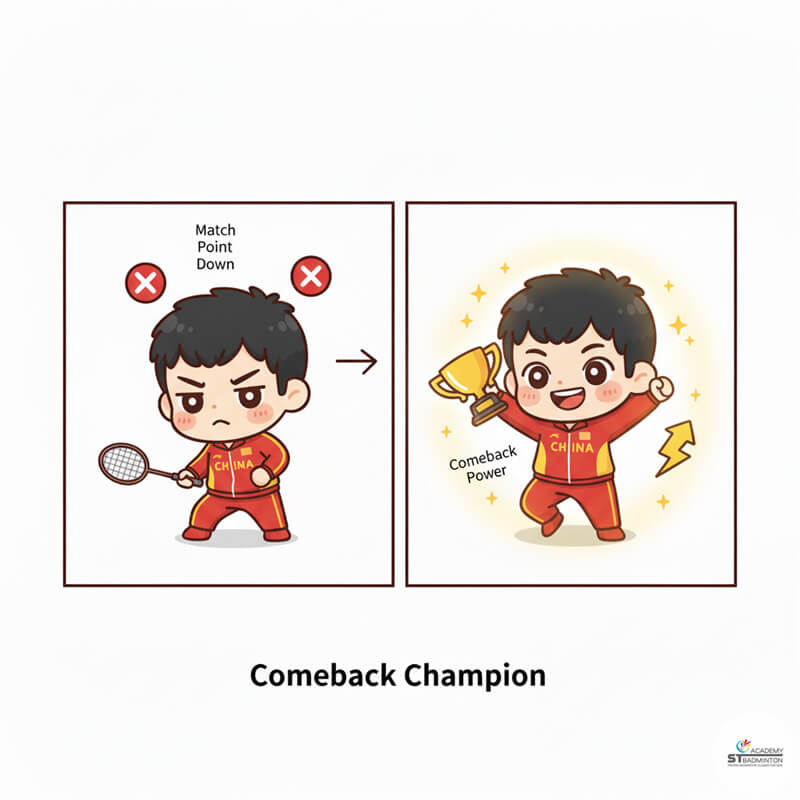
His ability to mount comebacks from behind in crucial matches demonstrates mental toughness developed through years of competitive experience within China’s demanding system. Young players can learn from how he constructs rallies point by point, using high clears to create time for recovery, mixing shot speeds to keep opponents guessing, and staying mentally present during deciding games. His style proves that success in modern men’s singles requires not only physical skills but also tactical intelligence and emotional control under championship pressure.
Training Mindset
Patient Development and Lessons for Young Players
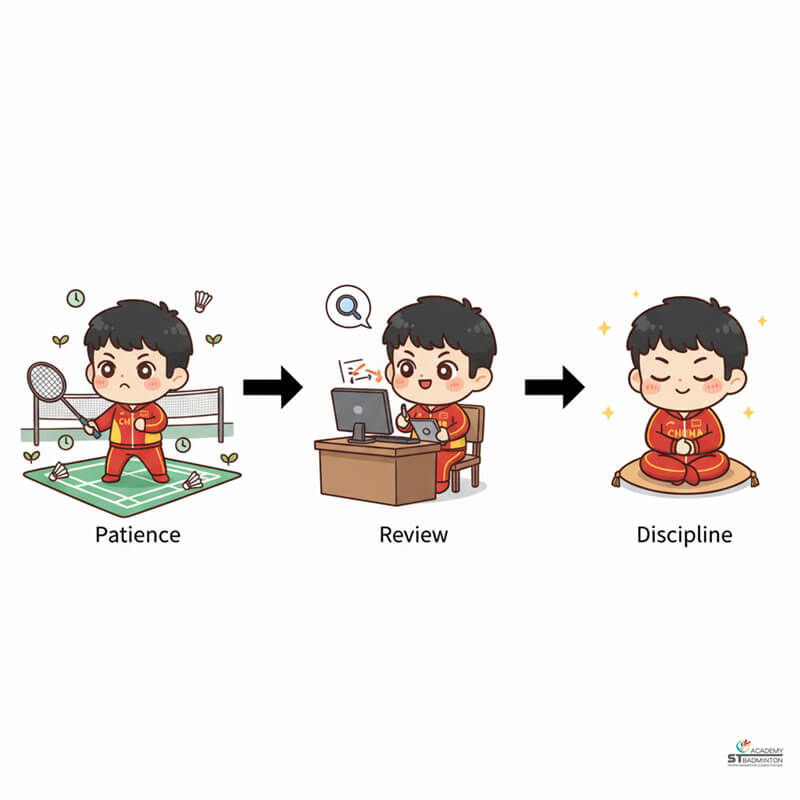
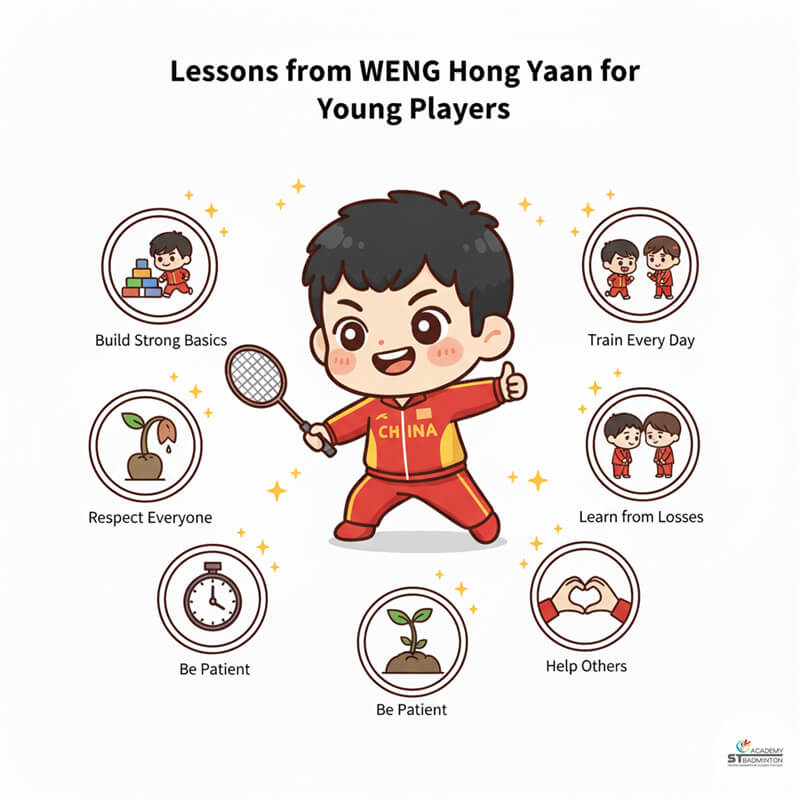
WENG Hong Yang’s career demonstrates the value of patient development through systematic training over many years. His progression from Fuzhou Sports School in 2006 through provincial team, national team selection in 2018, and finally Super 1000 championship in 2024 shows that building a world-class badminton career requires sustained dedication across more than a decade. During years when results were limited before his 2022 breakthrough, he continued working on small technical details and fundamental improvements rather than seeking shortcuts or becoming discouraged by setbacks.
His willingness to improve incrementally rather than expecting immediate transformation reflects mature understanding of athletic development. Young players can learn from his approach of focusing equally on attack and defence, ensuring that footwork quality and recovery steps receive as much attention as powerful smashes. His calm fighting spirit during comebacks shows mental toughness that can be developed through match experience and deliberate practice handling pressure situations during training.
For kids building foundations hoping to reach school teams or national-level trials, and for juniors and adults in Malaysia, Singapore and throughout Asia who want to learn from his balanced style, practical lessons include watching video replays to study how top players construct rallies point by point, training both attacking shots and defensive retrieval with equal emphasis, and developing composure during deciding games through competitive match practice. His journey proves that combining strong basic skills from Chinese sports school training with calm mentality and willingness to work patiently on continuous improvement can produce championship results at badminton’s highest level.

Learning Reference
ST Badminton Academy Connection
ST Badminton Academy has no official partnership or endorsement from WENG Hong Yang. He is not connected to our academy in any way. However, coaches at ST Badminton Academy in Kuala Lumpur simply hope their students treat his hard work, discipline and balanced playing style as a reference for understanding what serious badminton development requires.
Many of our students from Malaysia and visiting players from Singapore study his matches to observe his left-handed stroke angles, tempo control patterns, calm mentality during pressure situations and ability to mount comebacks when trailing in deciding games. His journey from Fuzhou Sports School at age seven through Fujian provincial team to China national team selection and eventually Super 1000 championship demonstrates how patient systematic training focusing on strong fundamentals produces sustained results over many years.
We encourage our students to learn from his balanced approach training both attack and defence equally, his composure during tight match situations, and his willingness to improve incrementally rather than seeking shortcuts. While he is not affiliated with our academy, his career provides useful inspiration for any young player who wants to build real badminton foundations through disciplined work, showing that combining technical excellence from structured training with calm fighting spirit enables success at championship level across multiple years.
FAQs: WENG Hong Yang China Badminton Player
Here are answers to common questions about WENG Hong Yang’s career, achievements and what young players can learn from his journey.
Who is WENG Hong Yang and which country does he represent in badminton?
WENG Hong Yang is a China professional badminton player competing in men’s singles. Born on 18 June 1999 in Fuzhou, Fujian province, he is a left-handed specialist who progressed through Chinese sports schools starting in 2006 before joining the national team in 2018. He represents China at the highest international level with achievements including Super 100 to Super 1000 titles, 2020 China National Championships, 2024 China Open Super 1000 and Thomas Cup team gold, plus career-high world ranking of No.10.
What are WENG Hong Yang’s biggest badminton achievements?
WENG Hong Yang’s major achievements include 2024 China Open Super 1000 men’s singles champion ending seven-year Chinese drought, 2023 Australian Open and Denmark Open Super 750 titles, 2022 Korea Open Super 500 champion with dramatic comeback final, 2022 Badminton Asia Championships bronze medal, 2020 China National Championships gold, 2024 Thomas Cup team champion with China, 2025 Swiss Open and China Masters victories, titles spanning Super 100 to Super 1000 levels, and world ranking peak at No.10.
What is WENG Hong Yang’s playing style in men’s singles?
WENG Hong Yang’s playing style centers on left-handed stroke production creating unusual angles, balanced attack-defence capabilities reflecting Fujian technical philosophy, and calm on-court mentality even when trailing. He demonstrates strong tempo control mixing slow rallies with sudden attacking bursts, uses clear-drop-half-smash patterns systematically, maintains composed body language during pressure situations, and excels at mounting comebacks through patient point-by-point construction rather than forcing risky attacks from defensive positions.
Why is WENG Hong Yang’s 2024 China Open victory so significant?
WENG Hong Yang’s 2024 China Open Super 1000 championship carries special significance because it ended a seven-year drought for Chinese men’s singles players at this prestigious home tournament, with no Chinese man winning since Lin Dan’s final title. Performing successfully in front of home fans at China’s premier domestic event while handling pressure of Chinese badminton history demonstrated championship mentality. Super 1000 represents the World Tour’s highest tier requiring sustained excellence across an entire week against elite competition.
How can my child learn from WENG Hong Yang’s development approach?
Young players can study WENG Hong Yang’s approach by watching how he balances attack and defence training equally and maintains calm composure during pressure situations mounting comebacks. His career shows importance of patient systematic development over many years focusing on strong fundamental skills, willingness to improve incrementally on technical details rather than seeking shortcuts. At ST Badminton Academy, coaches use his discipline, balanced style and calm fighting spirit as references to help students understand that championship careers require sustained dedication across more than a decade.
What was significant about WENG Hong Yang’s 2022 Korea Open victory?
WENG Hong Yang’s 2022 Korea Open Super 500 championship marked his international breakthrough. Originally promoted from reserve list into main draw, he defeated strong opponents including Ng Tze Yong before reaching the final against Jonatan Christie. The championship match showcased his mental toughness as he saved game points while trailing late in the second game before mounting dramatic comeback to win the title. This victory established his reputation for calm fighting spirit and ability to perform under pressure at international level.
How did WENG Hong Yang rise from Fuzhou sports school to world top-10?
WENG Hong Yang rose from starting at Fuzhou Sports School age seven in 2006 through Fujian Sports School and provincial team to China national team selection in 2018. He captured 2019 Lingshui China Masters Super 100, 2020 National Championships, 2022 Korea Open and Asian Championships bronze, 2023 Australian Open and Denmark Open Super 750 titles, 2024 China Open Super 1000 championship ending Chinese drought, Thomas Cup team gold, and 2025 Swiss Open and China Masters victories, reaching career-high No.10 ranking through patient systematic development emphasizing fundamental skills and balanced style.
What makes WENG Hong Yang’s left-handed style effective?
WENG Hong Yang’s left-handed style creates unusual angles from rear court that right-handed opponents find challenging to read and counter effectively. His left-side stroke production forces opponents to adjust their positioning and tactical patterns, disrupting their normal rhythm. Combined with his balanced attack-defence capabilities, calm tempo control and ability to change rally pace systematically, his left-handed angles provide tactical advantage throughout matches. Students studying his style learn how different-handed players create unique problems for orthodox opponents through angle generation and pattern variation.
Does ST Badminton Academy have any connection with WENG Hong Yang?
No, WENG Hong Yang is not a student, coach or ambassador of ST Badminton Academy. He represents China and trains within Chinese national team system. However, coaches at our academy in Kuala Lumpur use his hard work, discipline and balanced playing style as learning references for our students, showing them how his journey from Fuzhou sports school to Super 1000 champion demonstrates that patient systematic training focusing on strong fundamentals combined with calm mentality produces sustained championship results over many years of dedicated development.
WENG Hong Yang Career Highlights

Career Statistics and Rankings
WENG Hong Yang's professional career demonstrates impressive progression from Fuzhou Sports School starting 2006 through Chinese provincial and national team system to world top-10 ranking. His historic achievements include BWF World Tour titles spanning Super 100 to Super 1000 levels with 2024 China Open championship ending seven-year Chinese drought, 2023 Australian Open and Denmark Open Super 750 victories, 2022 Korea Open Super 500 and Asian Championships bronze, 2024 Thomas Cup team gold with China, 2025 Swiss Open and China Masters titles, showing remarkable consistency developed through patient systematic training emphasizing strong fundamental skills, balanced attack-defence capabilities and calm competitive mentality across multiple years.
| Development Area | Common Misconception | What WENG Hong Yang's Career Shows REALITY |
|---|---|---|
| Sports School Foundation | Elite players can skip systematic youth training and jump directly to professional competition with natural talent alone. | He progressed through Chinese sports school system from age seven at Fuzhou Sports School in 2006 through Fujian provincial team to national squad in 2018, demonstrating that building world-class foundations requires years of structured training emphasizing footwork quality, stroke consistency and disciplined group practice rather than shortcuts or accelerated pathways that skip fundamental development phases. |
| Patient Long-Term Development | Top players achieve breakthrough results immediately without enduring years of limited success while building skills. | His first international title came at 2019 Lingshui China Masters with major breakthrough not arriving until 2022 Korea Open when he was already 23 years old, proving that championship careers often require more than decade of patient training and competition before reaching elite level, with persistence through difficult early years being essential rather than expecting instant transformation or early stardom. |
| Left-Handed Advantage | Left-handed players automatically succeed without needing to develop complete skills due to their unusual angles alone. | His left-handed strokes create tactical advantages through unusual angles, but his success stems from balanced attack-defence capabilities, calm mentality and systematic rally construction rather than only angle generation. This shows that physical attributes like handedness provide opportunities but require combination with complete technical skills, tactical intelligence and mental strength to produce championship results consistently. |
| Balanced Style Development | Modern men's singles requires specializing exclusively in either aggressive attacking or defensive counter-punch styles. | His balanced Fujian-style approach training both attack and defence equally demonstrates that complete players who can adapt tactics based on match situations hold advantages over specialists. His ability to control rally tempo mixing slow build-up with sudden attacks, defending patiently before counter-attacking, proves versatility enables sustained success across different opponents and tournament conditions more effectively than one-dimensional approaches. |
| Mental Composure Under Pressure | Champions naturally possess calm mentality without needing to deliberately develop emotional control skills through experience. | His ability to mount comebacks after saving match points in crucial finals like 2022 Korea Open demonstrates mental toughness developed through years of competitive experience. His calm body language during deciding games and composed approach to pressure situations show that emotional control requires deliberate development through match practice, learning from difficult losses and systematic exposure to championship-level pressure rather than being innate unchangeable trait. |
| Internal Competition Benefits | Training within highly competitive national systems creates excessive pressure that hinders rather than helps player development. | His progression through China's intensely competitive provincial and national team structures built resilience, work ethic and ability to perform consistently under evaluation pressure. The demanding Chinese system where many talented players compete for limited opportunities forced him to continuously improve and maintain high standards, demonstrating that systematic competitive environments with clear selection criteria can produce championship mentality and sustained excellence when managed appropriately. |
| Breakthrough Timing Expectations | If players haven't achieved major results by early twenties, they lack potential to reach world-class level later in careers. | His first Super 500 title came at age 23 in 2022, Super 750 titles at 24 in 2023, and Super 1000 championship at 25 in 2024, proving that patient development can produce peak performance in mid-twenties when strong foundations combine with accumulated experience. This timeline shows that late bloomers who build systematically can achieve sustained excellence rather than burning out early after premature success built on insufficient foundations. |
Study WENG Hong Yang's Patient Training and Balanced Approach
This profile explains who WENG Hong Yang is, his major achievements, and what developing players can learn from his journey. ST Badminton Academy Malaysia encourages students to study how world-class athletes like him combine patient systematic training, strong fundamental skills and calm competitive mentality to reach elite level. While we are not connected to WENG Hong Yang, his career provides valuable lessons about importance of balanced attack-defence development, incremental improvement focus and long-term dedication for any young player serious about building real badminton foundations through disciplined work across many years.