The 70/30 Rule: Why You’re Losing Rallies (And How to Fix Your Footwork)
Stop blaming your shots. The reason you lose rallies is rarely your hand technique it is your feet. ST Badminton Academy introduces the “70/30 Rule”: match success is 70% footwork efficiency and only 30% stroke execution. Whether you play in Kepong, Setapak, or Wangsa Maju, this guide explains how to master the split-step, hit the shuttle early (in front), and recover faster to dominate the court.

1.1 The Reality Check
What is the 70/30 Rule in Badminton?
The “70/30 Rule” is a coaching framework we use to reset priorities. It states that 70% of a successful shot is determined by your movement and positioning before you hit, while only 30% comes from the actual racket skill.
If you arrive late, your body is off-balance, and your contact point is behind you. No amount of wrist technique can save that shot. However, if your footwork gets you behind the shuttle early, even a simple stroke can become a winning shot because you have options and control. You are losing rallies because you are training the 30% (hands) while ignoring the 70% (feet).

1.2 The Breakdown Chain
Why “Late Contact” Destroys Initiative
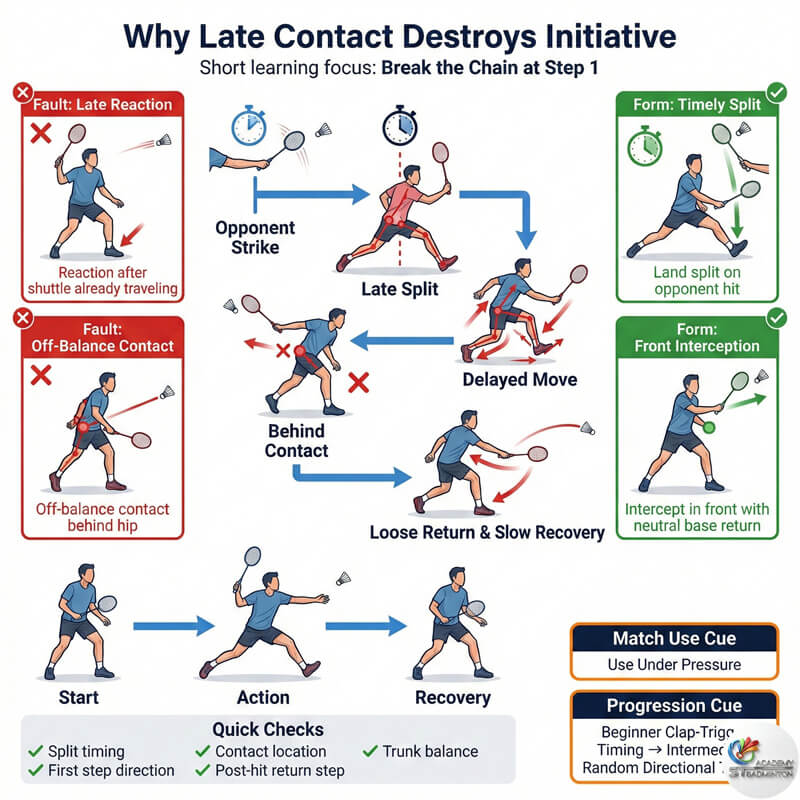
Losing a rally usually happens 3 shots before the final error. It starts with the “Late Contact Breakdown Chain”:
1. Late Split-Step: You react after the shuttle crosses the net.
2. Delayed Movement: You rush to the corner.
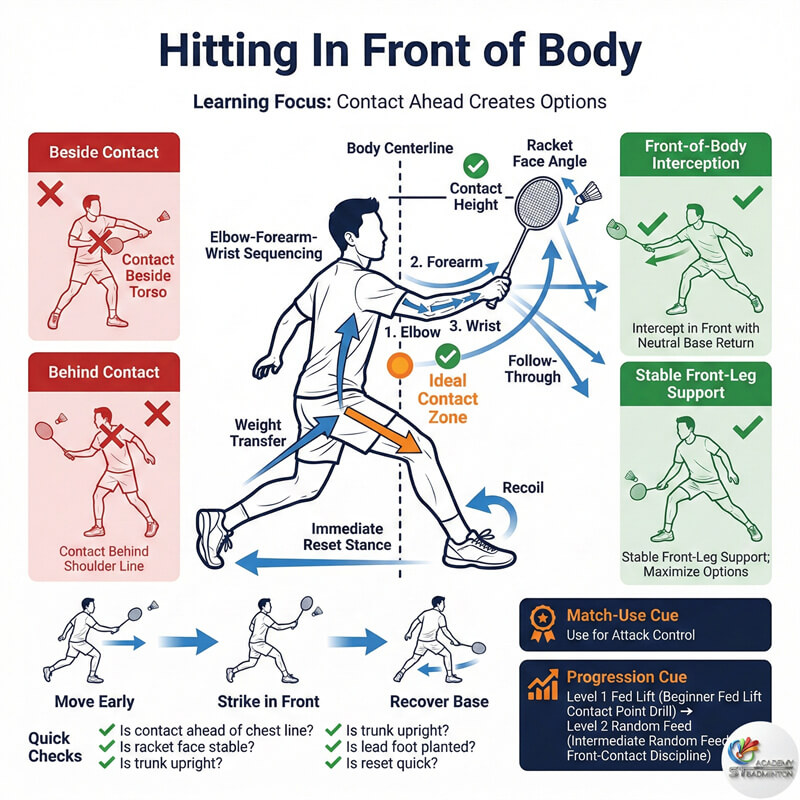
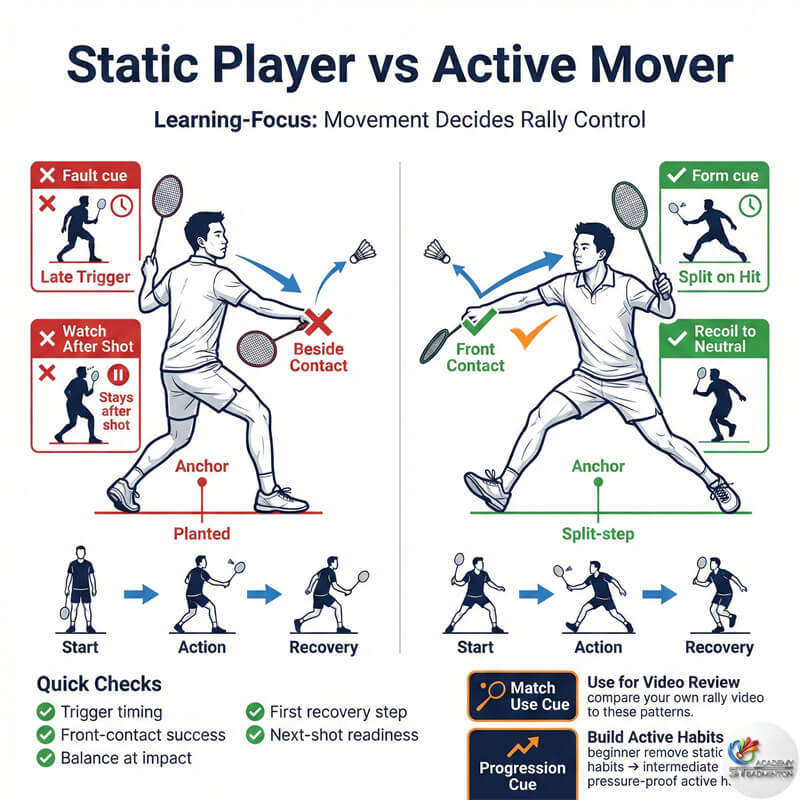
3. Late Contact: You hit the shuttle beside or behind your body instead of in front.
4. Weak Return: You are forced to lift or play a loose block.
5. Poor Recovery: Because you were off-balance, you are slow to return to base.
The result? You are under pressure for the next shot, and the rally is lost. To fix this, you must break the chain at step 1.
1.3 Mechanics
Mastering the Split-Step Timing
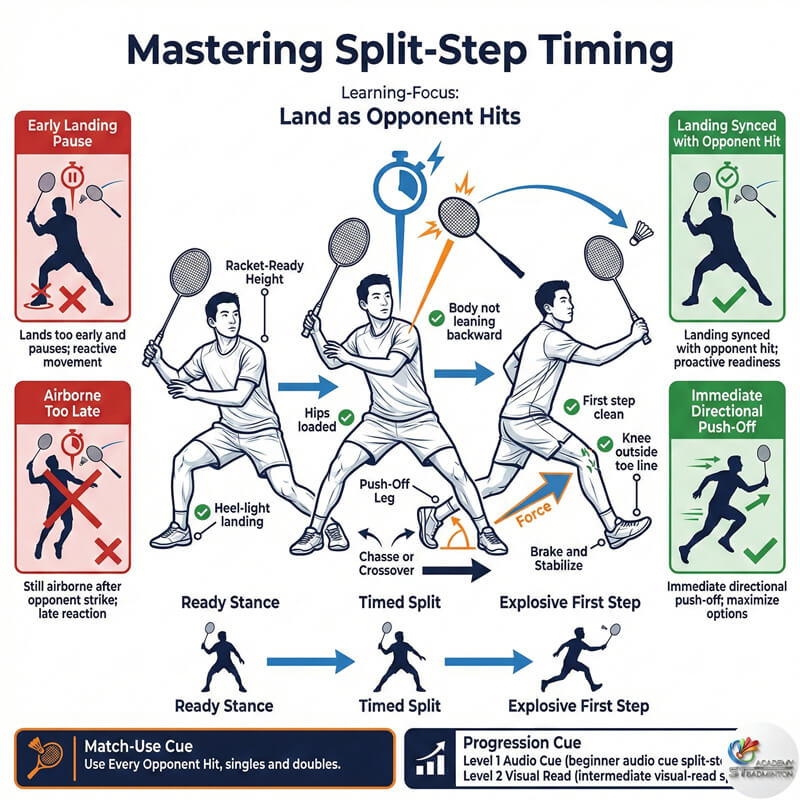
The “split-step” is the ignition key for your movement. It is not a jump; it is a widening of your stance to load your legs like springs.
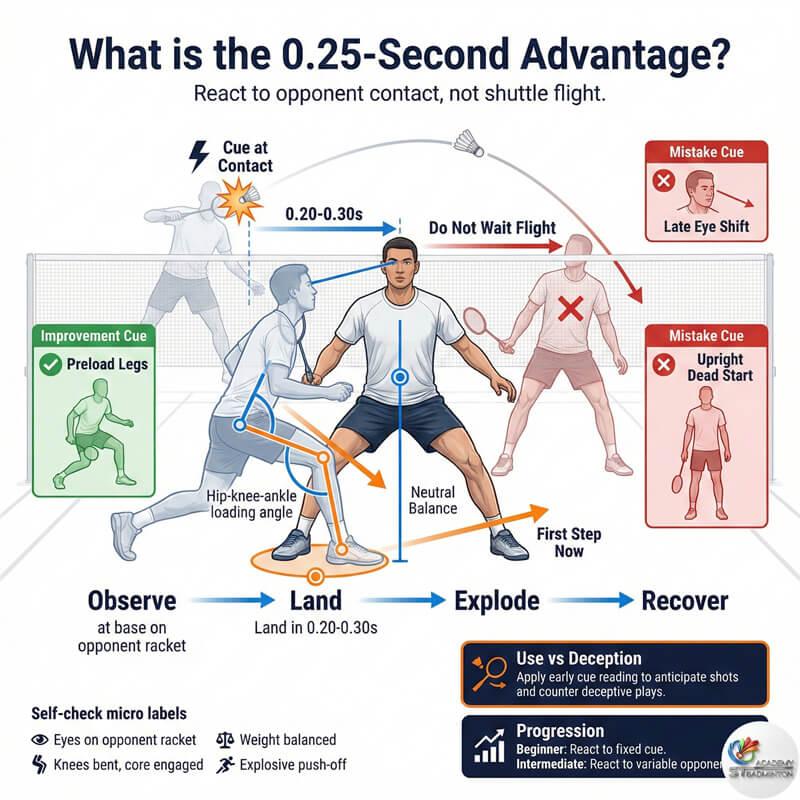
The Timing Rule: You must land your split-step exactly as your opponent hits the shuttle. Not before, not after.
• Too early: You land, stop, and lose the spring energy.
• Too late: You are still in the air when the shuttle is traveling.
When you time this correctly, your first step becomes explosive, allowing you to intercept the shuttle in front of your body. This preserves your attacking options and keeps you in control of the rally.
1.4 Recovery Habits
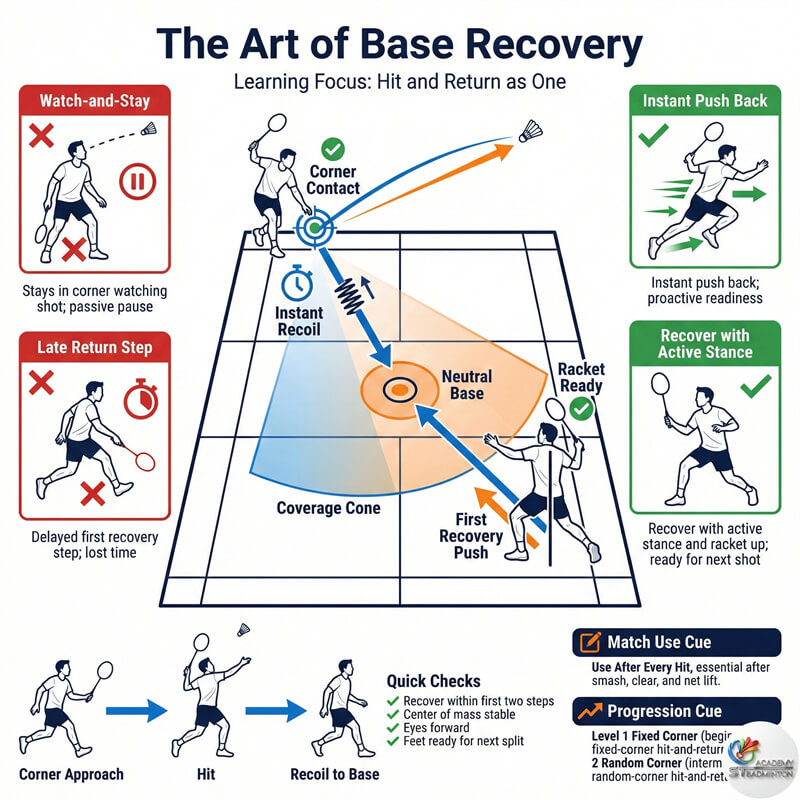
The Art of Base Recovery
Footwork isn’t just about going to the shuttle; it’s about coming back. A common mistake among intermediate players is “admiring the shot” staying in the corner to see if their smash worked. This leaves the rest of the court open.
Effective footwork requires Recoil. As soon as you hit, your legs must push you back toward the central base. You don’t need to return to the exact center dot every time, but you must move towards a neutral position that covers the most likely replies. In our Setapak training, we drill “Hit-and-Recover” as a single, continuous motion.
1.5 Drill Framework
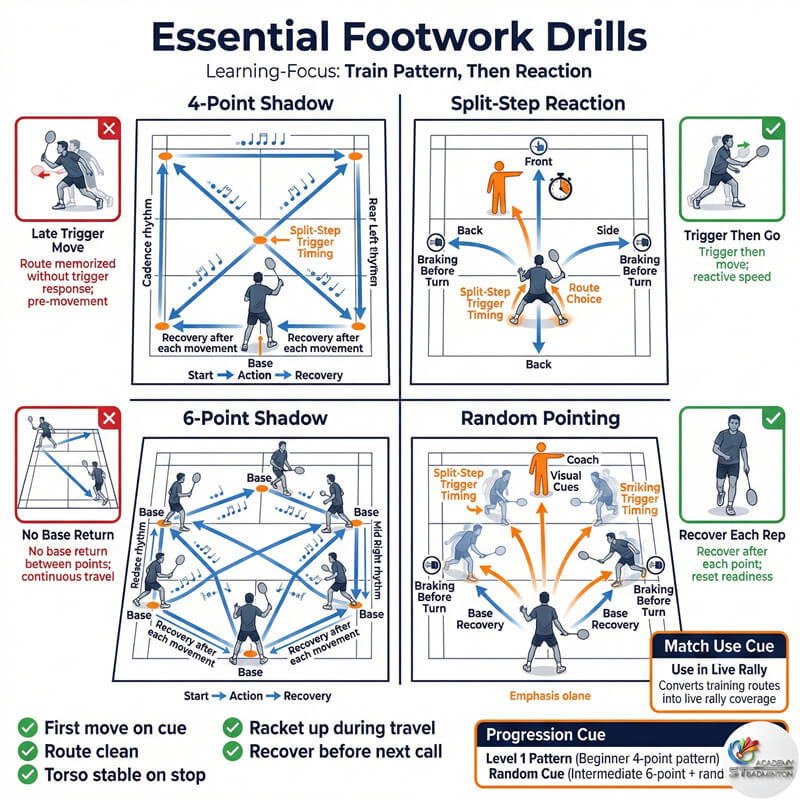
Essential Footwork Drills
To fix your footwork, you must train movement patterns until they become automatic. We use a progressive drill structure:
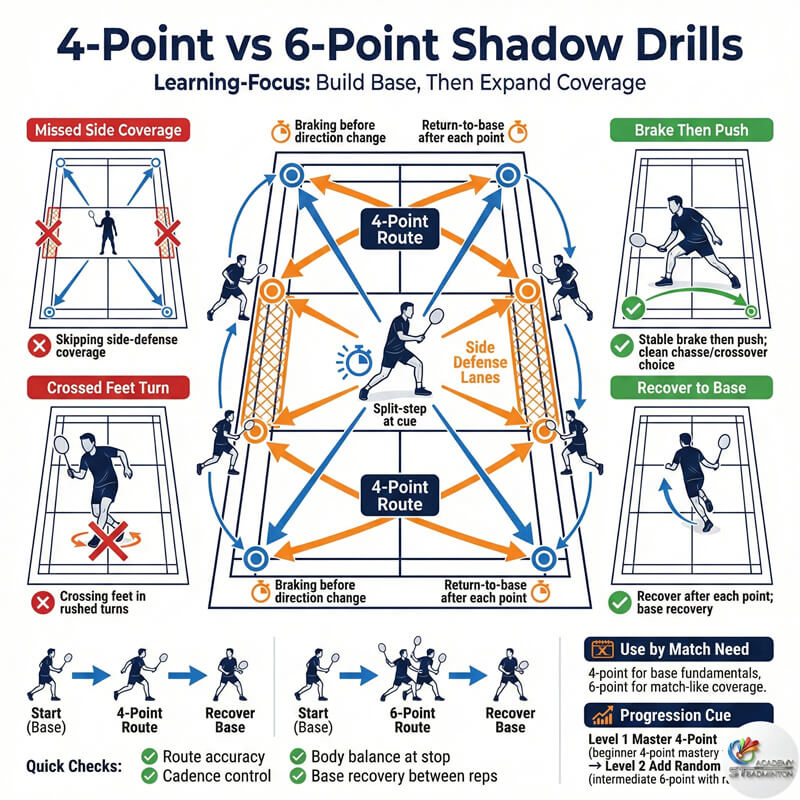
1. 4-Point Shadow: Move to the four corners (Front R/L, Back R/L) without a shuttle. Focus on clean Chassé steps and returning to center. (Duration: 1 min x 3 sets)
2. Split-Step Reaction: A partner claps their hands; you split-step instantly. This isolates the timing trigger.
3. 6-Point Shadow: Adds the mid-court defensive sides. Crucial for doubles players to train side-to-side defense.
4. Random Pointing: A partner points to a corner randomly. You must move there and recover. This trains reaction, not just memory.
1.6 Progress & Frequency
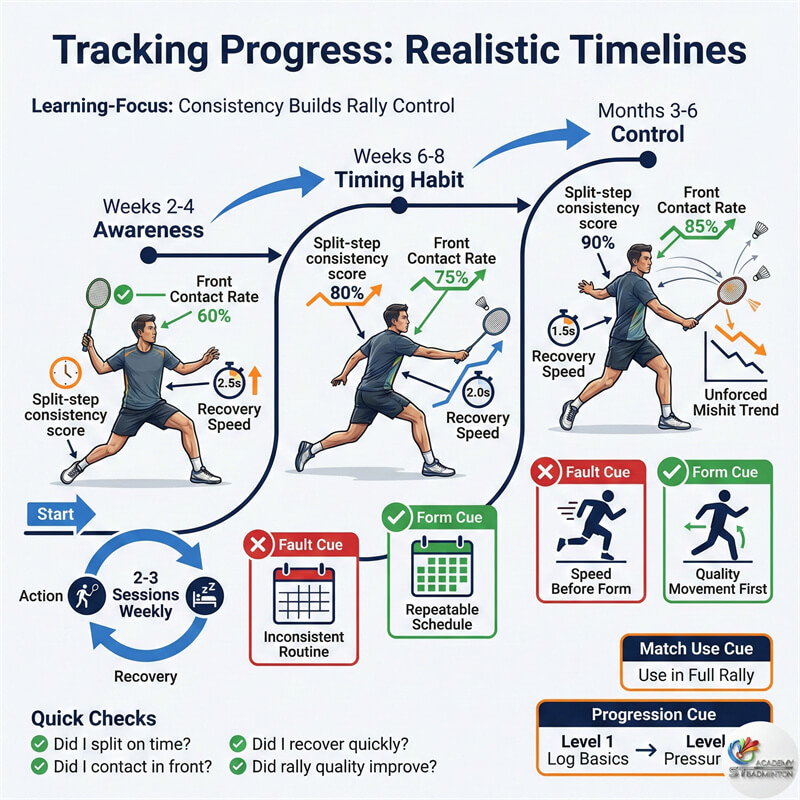
Tracking Progress: Realistic Timelines
Improving footwork takes physical conditioning and mental discipline. For students in our Kepong classes training 2x a week, here is a realistic timeline:
Weeks 2-4: Awareness improves. You start noticing when you are flat-footed and begin correcting your base position.
Weeks 6-8: Split-step becomes habitual. You are reaching the shuttle earlier, allowing for better quality clears and drops.
Months 3-6: Initiative control. You are no longer scrambling. You can maintain rally pace without panicking, and your unforced errors drop significantly.
1.7 The Coaching Philosophy
Professional Footwork Coaching in KL North
Our coaching philosophy at ST Badminton Academy prioritizes movement efficiency. We believe that if you can’t reach the shuttle, you can’t hit it. A dedicated coach in Kepong provides an accountable sports education program designed to instill footwork discipline and correct technical mechanics.
We continuously track progress by evaluating court coverage, split-step timing, and recovery speed. This focused observation ensures that foundational movement errors are addressed instantly before they become bad habits.
Common Questions About Badminton Footwork & Rally Control
Direct, practical answers to help you improve your court coverage and game consistency.
What is the 70/30 rule?
It’s a coaching concept stating that 70% of match performance comes from footwork and positioning, while only 30% comes from racket technique. Good feet enable good shots.
Why am I losing rallies despite good technique?
You are likely reaching the shuttle late (beside or behind you). This forces defensive lifts. Improved footwork allows you to contact the shuttle in front, giving you attacking options.
Is footwork more important than hand skill?
Yes, especially for beginners and intermediates. You cannot use advanced strokes if you aren’t in position. Footwork is the foundation that allows hand skill to shine.
What does “hitting in front” mean?
It means contacting the shuttle clearly ahead of your body line. This allows for steeper angles, more power, and easier cross-court shots, keeping you in control of the rally.
How to time the split-step?
You should initiate your split-step (hop) exactly at the moment your opponent strikes the shuttle. This pre-loads your legs to explode in the direction of the shot instantly.
4-point vs 6-point shadow drills?
Start with 4-point (corners) to master the basic chassé steps. Once stable, add 6-point (including mid-court sides) to train full-court coverage and defense.
How many sessions per week?
For noticeable footwork improvement, 2-3 sessions per week are recommended. One session maintains; two builds muscle memory and speed.
How long to see results?
With focused training, better movement awareness happens in 2-4 weeks. Rally consistency typically improves significantly within 2-3 months.
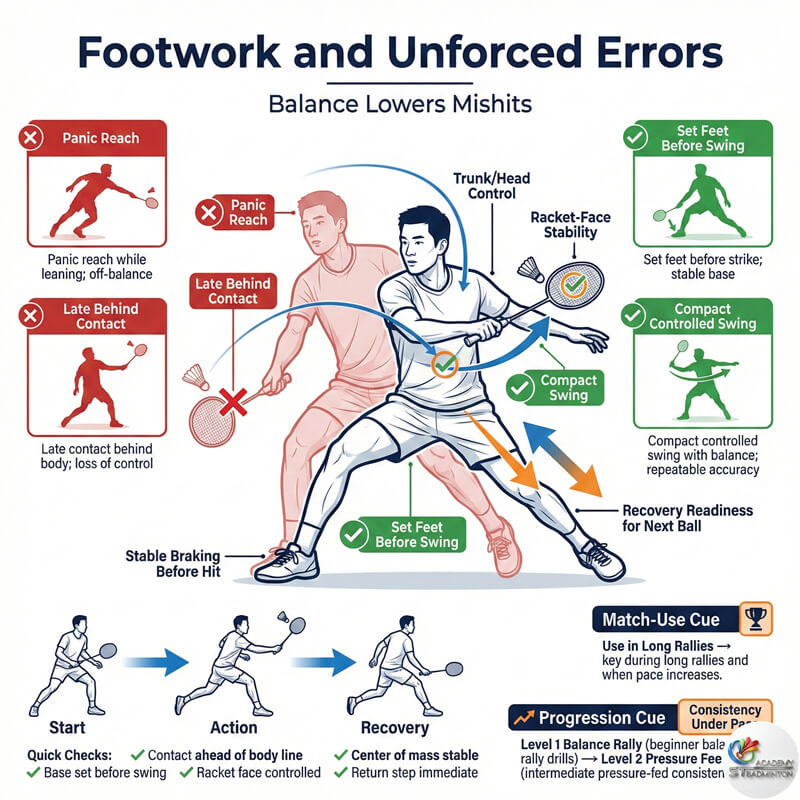
Does footwork reduce unforced errors?
Yes. Good footwork ensures you are balanced when hitting. Being balanced drastically reduces panic shots and mishits, lowering your error count.
Footwork Training Gallery
Footwork Facts
We base our coaching on the proven 70/30 principle used by elite coaches.
| Comparison | The Static Player (Late Contact) | The Active Mover (70/30 Pro) |
|---|---|---|
| Priority | Relies on hand speed to save the rally | Uses footwork to get in position first |
| Contact Point | Beside or behind the body (Defensive) | In front of the body (Attacking/Neutral) |
| Movement Trigger | Moves after seeing the shuttle flight | Split-steps when opponent hits the shuttle |
| Recovery | Stands and watches shot outcome | Immediately returns to base (Recoil) |
| Drill Focus | Random rallying without structure | Shadow footwork & timing drills |
Book a Footwork Session in Kepong
Ready to stop running late and start dominating rallies? ST Badminton Academy specializes in footwork correction and movement efficiency. We help you master the split-step and build match-winning habits. Contact us to schedule a session with Coach Eric.