Why Your Smash is Weak: The Truth About ‘Wrist Strength’ vs. Forearm Rotation
Stop doing wrist curls to fix your smash. ST Badminton Academy exposes the biggest myth in badminton: that power comes from snapping your wrist. Whether you train in Kepong, Setapak, or Wangsa Maju, this guide explains the real biomechanics of a powerful smash forearm pronation, correct grip timing, and the kinetic chain. Learn why “death gripping” your racket kills speed and how to unlock effortless power.

1.1 The Core Myth
It’s Not Wrist Strength, It’s Physics
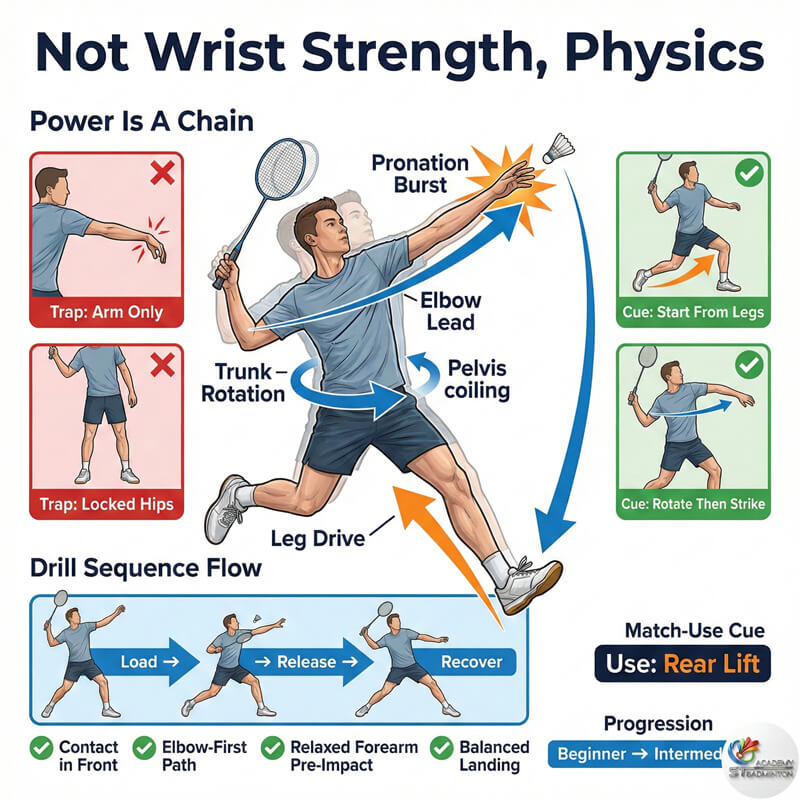
Many beginners believe they need a “stronger wrist” to smash harder. This is false. The wrist joint itself is small and cannot generate the explosive power needed for a smash. Power comes from the Kinetic Chain: energy starts from your legs, moves through trunk rotation, extends the elbow, and is released via forearm pronation (rotating the forearm inward, like turning a doorknob).
If you only “snap” your wrist (flexion), you limit your power ceiling and risk injury. Real power comes from the whip-like rotation of the forearm, where the wrist merely guides the angle.
1.2 The Grip Problem
The V-Grip vs. The “Death Grip”
The #1 reason for a weak smash is holding the racket too tight (Death Grip) or using a “Panhandle” grip (like holding a frying pan). A tight grip locks your forearm muscles, preventing the rotation needed for speed.
Correct Technique: Use the V-Grip (shake hands style). Your grip should be loose like holding a raw egg until the very last split-second before impact. This “loose-to-tight” transition is what creates the explosive snap at contact.

1.3 Biomechanics
The Kinetic Chain Sequence
Power is a wave, not a muscle contraction. The correct sequence for a smash is: 1) Legs push off -> 2) Hips/Trunk rotate -> 3) Chest opens -> 4) Elbow leads forward -> 5) Forearm rotates (Pronation) -> 6) Impact.
If you swing with your arm only, skipping the body rotation, you are using the smallest muscles to do the biggest job. This results in weak, flat smashes and shoulder pain. In our Setapak classes, we drill “elbow lead” to ensure the arm lag creates maximum whip.

1.4 Timing Secret
Squeeze at the Last Moment
Biomechanics studies show that maximum grip force should occur roughly a few hundredths of a second before impact. If you squeeze too early (during the backswing), you slow down your racket head speed. If you squeeze too late, the racket wobbles.
The feeling should be: Relaxed Arm -> Swing -> SQUEEZE -> Impact -> Relax. This rapid tightening stabilizes the racket face to transfer all energy into the shuttle. Practice “finger power” drills to separate arm movement from grip tightening.

1.5 Recovery Technique
Recoil Action for Speed
A powerful smash isn’t just about hitting hard; it’s about recovering fast. Beginners often swing through all the way to their shin, leaving them off-balance. Advanced players use “Recoil” a controlled braking mechanism immediately after impact.
Think of cracking a whip. The tip moves fastest when you pull the handle back. In badminton, this slight “pull back” or stop after impact does two things: it accelerates the racket head further and returns your racket to a ready position instantly for the next shot.

1.6 Training Drills
Step-by-Step Drills for Power
Fixing your smash requires rewriting muscle memory. Follow this progression:
1. Pronation Shadow: Stand still. Hold racket loose. Rotate forearm to snap racket face flat. No shoulder movement. Focus on “turning the doorknob.”
2. Stick Smash Feed: Coach feeds high. You use ONLY forearm rotation (no big swing) to hit steep shots. Focus on the crisp sound.
3. Timing Squeeze: Hit clears at 50% power, but focus 100% on squeezing the grip only at impact.
4. Full Smash Sequence: Integrate body rotation. Turn sideways -> Elbow up -> Pronate -> Recover.

1.7 Timeline
Realistic Progress Roadmap
Fixing a weak smash takes patience. Here is a realistic timeline for our students in KL:
Weeks 2-4: You stop “panning” the racket. Contact becomes cleaner (sweet spot), but power might not increase yet as you adjust to the V-Grip.
Weeks 4-8: Pronation becomes natural. You start hearing a sharper sound on impact. Mishits decrease.
Weeks 8-16: Power transfer improves significantly. You can now smash 5-10 times in a row without shoulder fatigue because you are using your body, not just your arm.
Smash Mechanics FAQ (Malaysia Edition)
Common questions from players struggling with power and technique.
Why is my smash weak even with strong wrists?
Because the wrist joint doesn’t generate power; it only directs it. Power comes from forearm rotation (pronation) and body weight transfer. Using only your wrist limits your swing speed.
Is forearm pronation essential?
Yes. Pronation allows the racket head to accelerate from zero to max speed in milliseconds. Without it, you are “pushing” the shuttle rather than “whipping” it.
What is the correct grip for smashes?
Use the V-Grip (Shakehand grip), slightly relaxed. This allows the racket handle to rotate in your palm during pronation. Avoid the Panhandle grip, which locks your wrist.
Does gripping tighter help?
No. Gripping tight too early slows down your muscles. You should hold the racket loosely during the swing and only squeeze tightly at the split-second of impact.
What is recoil action?
Recoil is the immediate relaxation and slight pullback of the racket after impact. It stabilizes the racket head and prepares you instantly for the next shot.
Can beginners learn this?
Yes. In fact, beginners should learn pronation early to avoid bad habits like “panhandling.” Start with simple stick smash drills to feel the rotation.
How many sessions to improve?
We recommend 2-3 focused technical sessions per week. Improvement usually becomes noticeable in 4-8 weeks as your muscle memory adapts to the new motion.
What kills smash power most?
Tension. If your shoulder or arm is stiff before you hit, you lose speed. Relax your body until the moment of impact.
Does racket weight matter?
Yes. A head-heavy racket can help with momentum, but technique matters more. A beginner with good technique and a light racket will smash harder than a pro racket user with bad form.
Smash Technique Gallery


Biomechanics Facts
We base our coaching on the proven laws of physics and body mechanics, not old-school myths.
| Comparison | The “Wrist Snap” Myth | The Pronation Truth |
|---|---|---|
| Power Source | Flexing the wrist (forward/backward) | Rotating the forearm (like a doorknob) |
| Grip State | Tight squeeze all the time (Death Grip) | Loose/Relaxed until 0.02s before impact |
| Movement | Arm-only swing | Kinetic Chain: Trunk -> Shoulder -> Forearm |
| Recovery | Full swing collapse to shin | Controlled Recoil (stopping the racket) |
| Result | Weak, flat smash; elbow pain | Steep angle, high speed, fast recovery |
Book a Smash Correction Session in Kepong
Ready to stop hitting flat, weak smashes? ST Badminton Academy specializes in correcting biomechanics. We help you unlearn the “death grip” and master the relaxed whip of forearm pronation. Contact us to schedule a session with Coach Eric and start hitting steeper, faster smashes.