How to Master Lee Zii Jia’s Backhand Smash: Step-by-Step Training Guide
Experience the explosive power of the backhand stick smash. ST Badminton Academy breaks down the exact mechanics used by top pros like Lee Zii Jia to generate surprise attacks from the rear court. Whether you train in Kepong, Setapak, or Wangsa Maju, this technical guide explains how to convert defensive clears into offensive winners using proper forearm rotation, recoil action, and precise grip timing preventing injury while maximizing shuttle speed.

1.1 The “Stick” Technique
What is the Lee Zii Jia Style Backhand Smash?
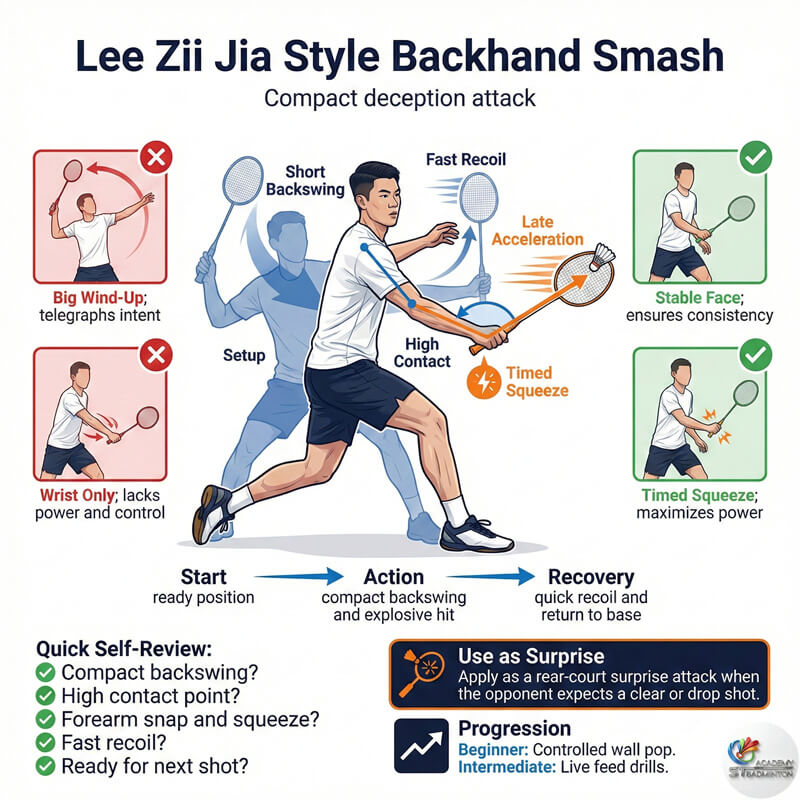
The Lee Zii Jia style backhand smash is technically defined as a “stick smash” rather than a full-arm swing. Unlike a standard clear where the follow-through is long and relaxed, this shot relies on a compact, explosive “snap” generated by rapid forearm rotation and an immediate recoil (stopping the racket).
The primary goal is surprise. By using a shorter backswing, you hide your intention until the last millisecond, catching opponents off-guard. For students training in our Kepong or Setapak centers, we emphasize that this is an advanced variation. It requires precise timing over raw muscle. The power comes from the “kinetic chain” transferring energy from the ground, through the torso, and releasing it via the forearm and fingers at the highest possible contact point.
Warning: Attempting this shot with a loose wrist or without proper pronation mechanics often leads to tennis elbow. Mastery requires disciplined step-by-step progression.
1.2 Biomechanics Focus
Power Source: Forearm Rotation vs Wrist
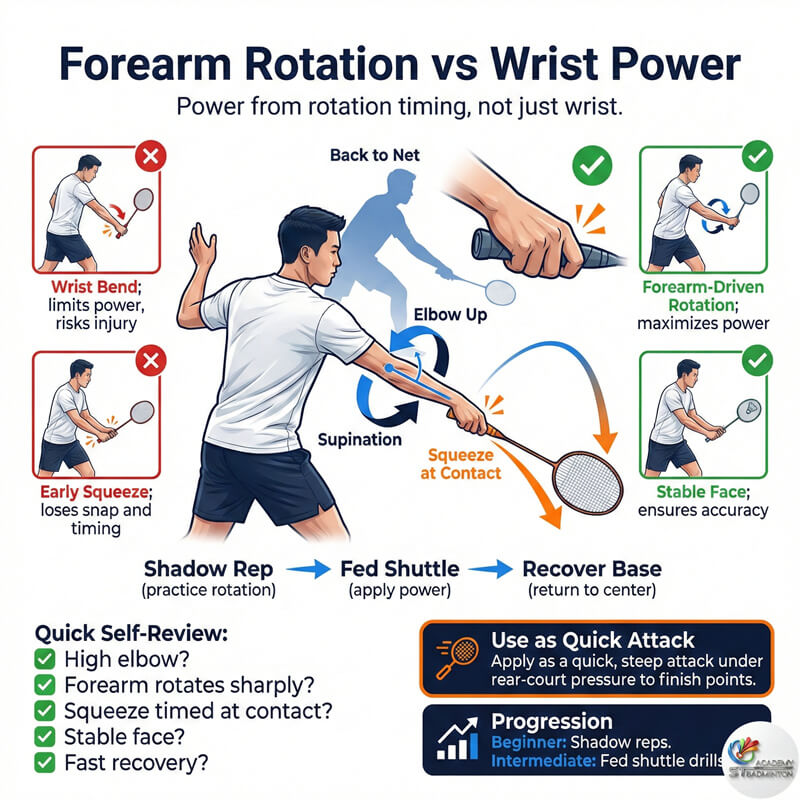
A common misconception is that the backhand smash is purely a “wrist flick.” In reality, the power comes from coordinated forearm rotation specifically rapid supination (turning the palm up/outward) as you prepare, followed by explosive pronation (turning palm down/inward) at contact. Relying solely on the wrist joint often causes injury and weak shots.
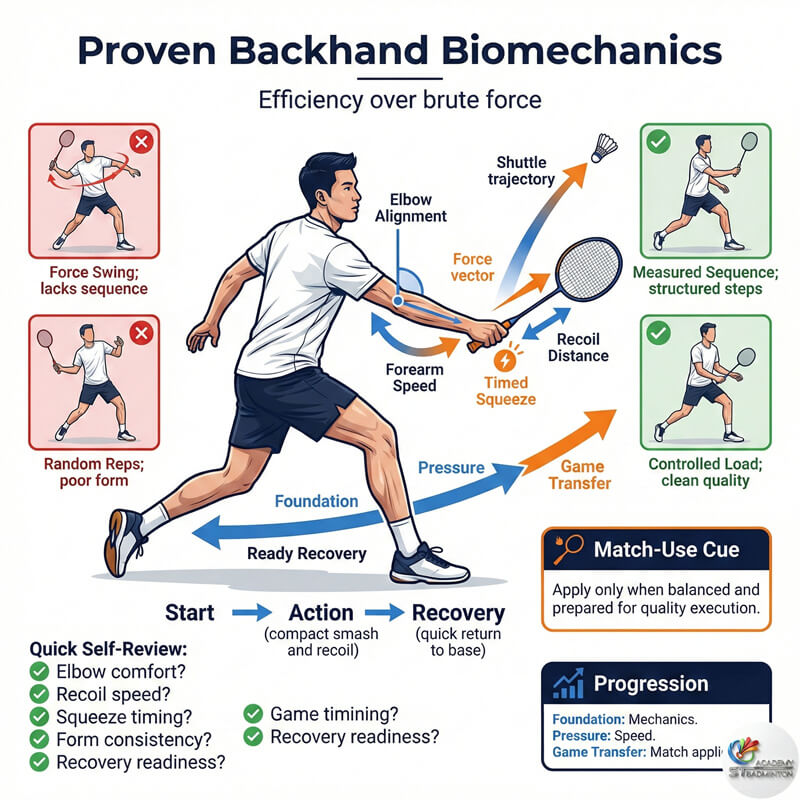
The sequence must be precise: Setup (back to net) → Elbow Lift (high alignment) → Forearm Rotation (generating torque) → Finger Power (squeezing grip at impact). This “unwinding” action allows the racket head to accelerate faster than a standard swing.
In our private coaching sessions near Kepong Baru and Gombak, we drill this specific kinetic chain. We teach students to keep the elbow “locked” momentarily at impact to transfer maximum energy into the shuttle, creating that signature “crack” sound associated with Lee Zii Jia’s winners.
1.3 The Recoil Factor
The Secret to Fast Recovery
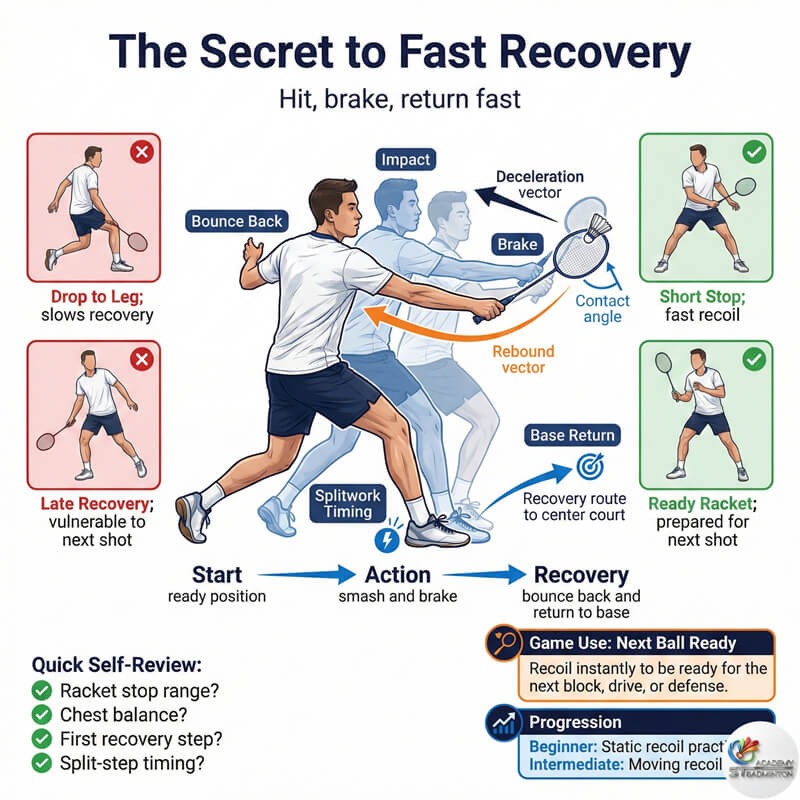
Why is Lee Zii Jia always ready for the next shot? The secret is “Recoil Action.” After the stick smash contact, the racket does not follow through all the way down to the legs (which is common in basic clears). Instead, the arm actively brakes and bounces back toward the body.
This controlled deceleration serves two purposes: it stabilizes the shuttle trajectory (preventing it from floating out) and immediately resets your racket for the next defensive block. In stick smash training, we drill this “hit-and-return” motion.
Drill Tip: When practicing at your local court in Setapak or Jinjang, visualize hitting a wall. Your racket should stop shortly after contact. This recoil momentum helps pull your body back to the center, allowing for a faster split-step recovery.
1.4 Drills Progression
Step-by-Step: From Shadow to Smash
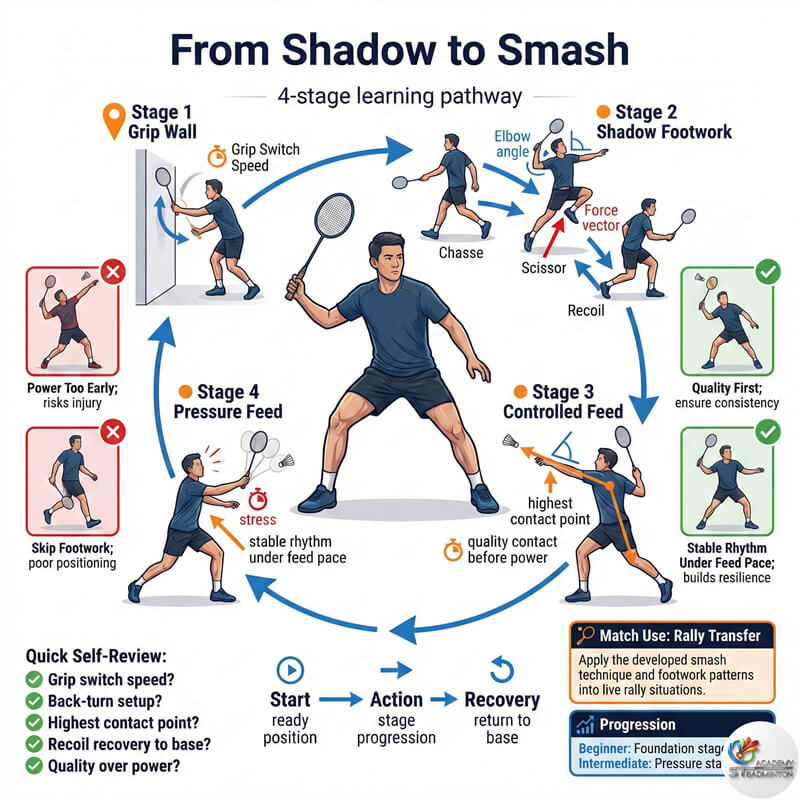
You cannot master the Lee Zii Jia backhand by just smashing hard in games. We use a 4-stage progression model:
Stage 1: Grip Wall Drill. Practice switching from forehand to thumb grip (or bevel grip) instantly. Hitting a shuttle against a wall repeatedly builds the forearm endurance needed for the “stick” action.
Stage 2: Rear Court Shadow. Focus on footwork rhythm: Chassé step → Scissor kick → Recoil. Ensure your back is fully turned to the net before the swing starts.
Stage 3: Controlled Feeding. A coach feeds high shuttles to your backhand corner. Your goal is not power, but hitting the shuttle at the highest point with a clean “pop” sound.
Stage 4: Pressure Feeding. We increase the pace, forcing you to use the stick smash mechanics while under movement stress. This bridges the gap between practice and real match scenarios.
1.5 Common Mistakes
Why Your Smash Lacks Power
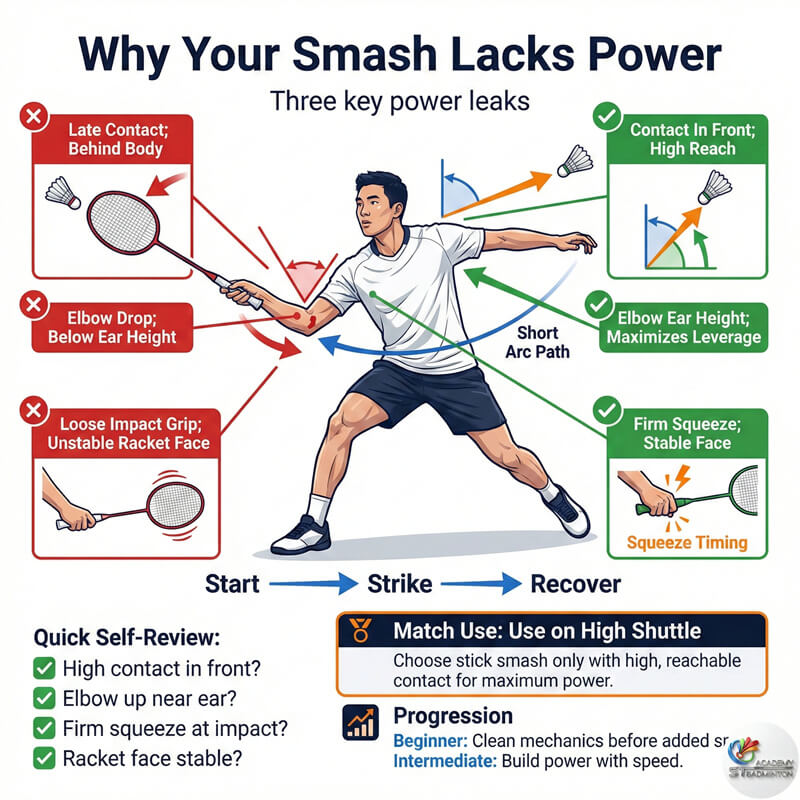
Mistake 1: Hitting Late (Behind the Body).
Power evaporates if you contact the shuttle behind your shoulder. You must contact it slightly *in front* or directly above your dominant shoulder.
Mistake 2: Dropping the Elbow.
Many players drop their elbow close to their ribs before swinging. The elbow must remain high at ear level to create the leverage needed for the stick smash snap.
Mistake 3: Loose Grip at Impact.
A loose grip is good for preparation, but if you don’t squeeze firmly exactly at the moment of impact, the racket face will wobble, resulting in a weak slice instead of a smash.
1.6 Realistic Timeline
How Long to Master It?
The backhand smash is one of the hardest shots in badminton. Be realistic with your progress:
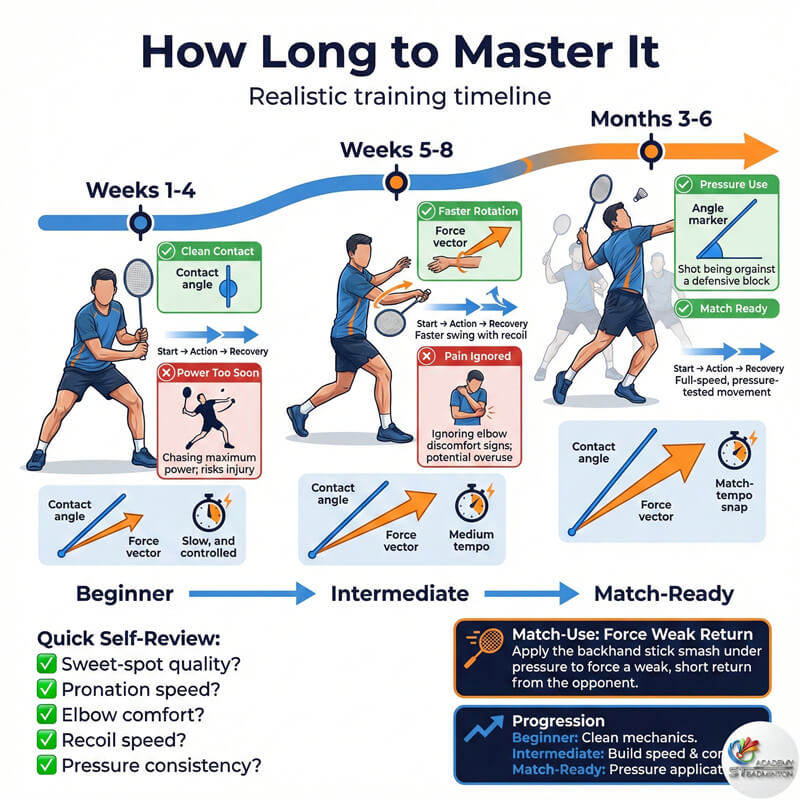
Weeks 1-4: Focus on cleaner contact (sweet spot) and correct grip transition. Do not expect huge power yet. Focus on not hurting your elbow.
Weeks 5-8: Speed of pronation increases. You should start hearing a louder “pop” on contact. The shuttle should reach the mid-court of the opponent consistently.
Months 3-6: Match application. You can now use the stick smash under pressure to force a weak return. True Lee Zii Jia level power requires years of conditioning, but a functional stick smash is achievable in this timeframe with weekly drills.
1.7 Safety Warning
Preventing Tennis Elbow
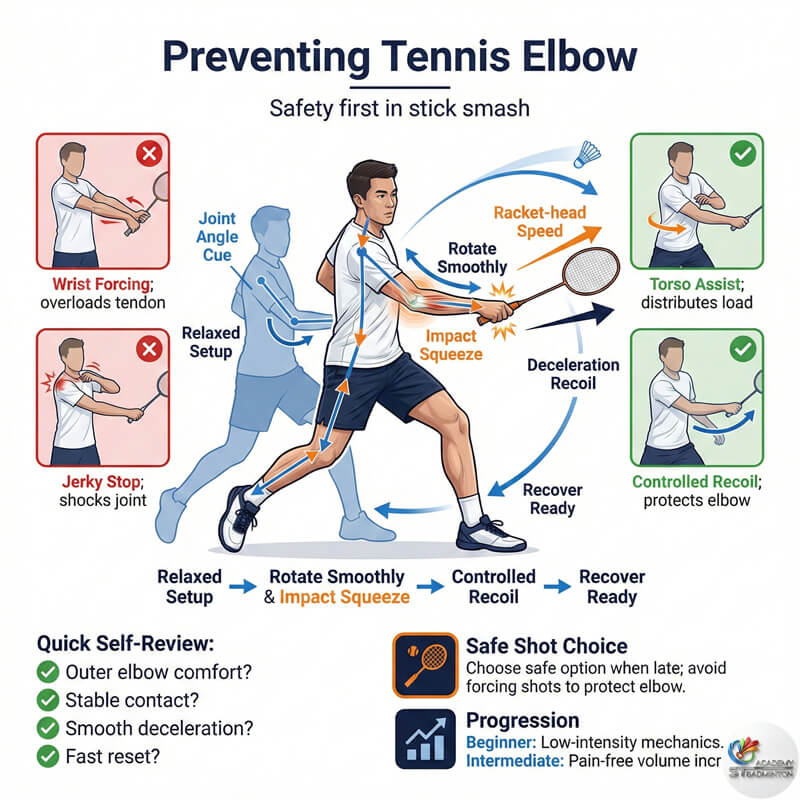
A poorly executed backhand smash is the #1 cause of tennis elbow (lateral epicondylitis) in recreational badminton players. This happens when players try to muscle the shot using only their wrist flexors without engaging the larger forearm muscles or torso rotation.
At ST Badminton Academy (serving Kepong, Setapak, and Gombak), we prioritize safety. We do not allow students to attempt full-power stick smashes until their grip mechanics are verified. We continuously monitor for “jerky” movements that stress the tendon.
If you feel pain on the outside of your elbow, stop immediately. It means you are forcing the power rather than letting the kinetic chain do the work. Proper technique feels smooth and effortless, not painful.
Backhand Smash Training FAQ
Common questions about learning the backhand stick smash and training requirements.
What is a stick smash?
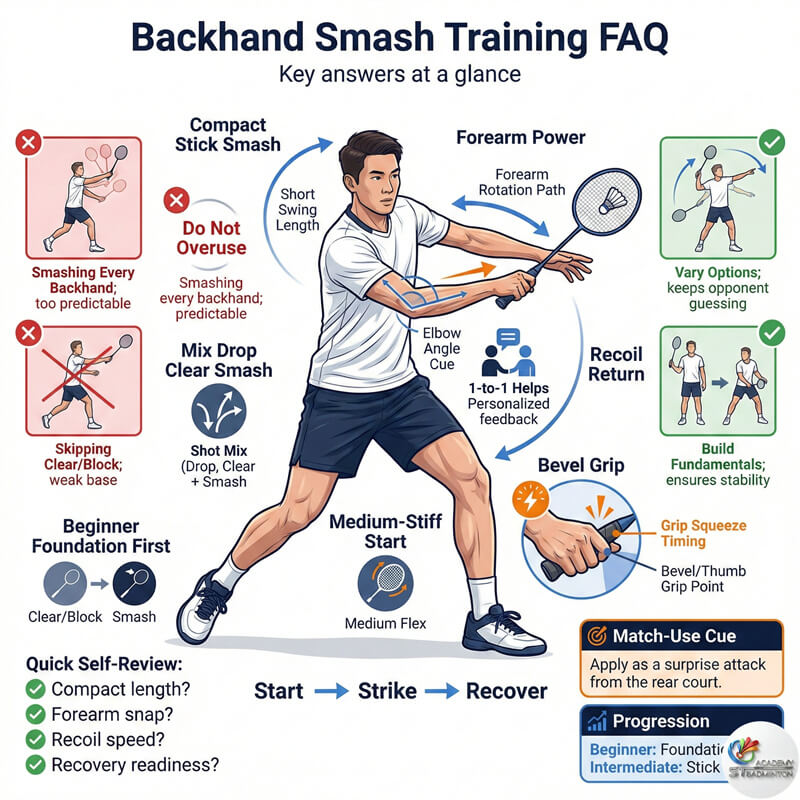
A stick smash is a steep, compact offensive shot that uses a short swing and forearm rotation rather than a full arm swing. It is designed for surprise and quick recovery, typical of Lee Zii Jia’s backhand style.
Is power just from the wrist?
No. Power comes from forearm supination (unwinding the arm) and timing the finger squeeze on the grip. Using only wrist flexion leads to weak shots and elbow injuries.
Can beginners learn this?
We recommend mastering the backhand clear and defensive blocks first. The stick smash is an intermediate-to-advanced skill. Beginners attempting it too early risk developing poor habits and tennis elbow.
How long to see results?
With dedicated weekly training, expect cleaner mechanics in 4-8 weeks. Match-ready power and consistency under pressure typically require 3-6 months of specific drilling.
What is recoil action?
Recoil is the immediate stopping or “bouncing back” of the racket head after impact. This action stabilizes the shuttle trajectory and ensures your racket returns to a ready position instantly for the next shot.
Which grip should I use?
For a backhand smash, we use a “Bevel Grip” or modified Thumb Grip, where the thumb is on the diagonal edge. A flat thumb grip often restricts the wrist and forearm snap needed for steep angles.
Should I smash every backhand?
No. The backhand smash is a surprise weapon. Overusing it makes you predictable. Combine it with backhand drops and clears to keep your opponent guessing.
Is 1-to-1 coaching necessary?
Because the mechanics (pronation timing, grip squeeze, recoil) are so precise, 1-to-1 coaching is the fastest way to learn. In groups, it’s hard to get the detailed micro-corrections needed to prevent bad habits.
Do I need a stiff racket?
A stiffer racket helps with accuracy and power transfer for stick smashes, but it requires better timing. We recommend starting with a medium-stiff racket until your forearm rotation speed improves.
Backhand Technique Gallery
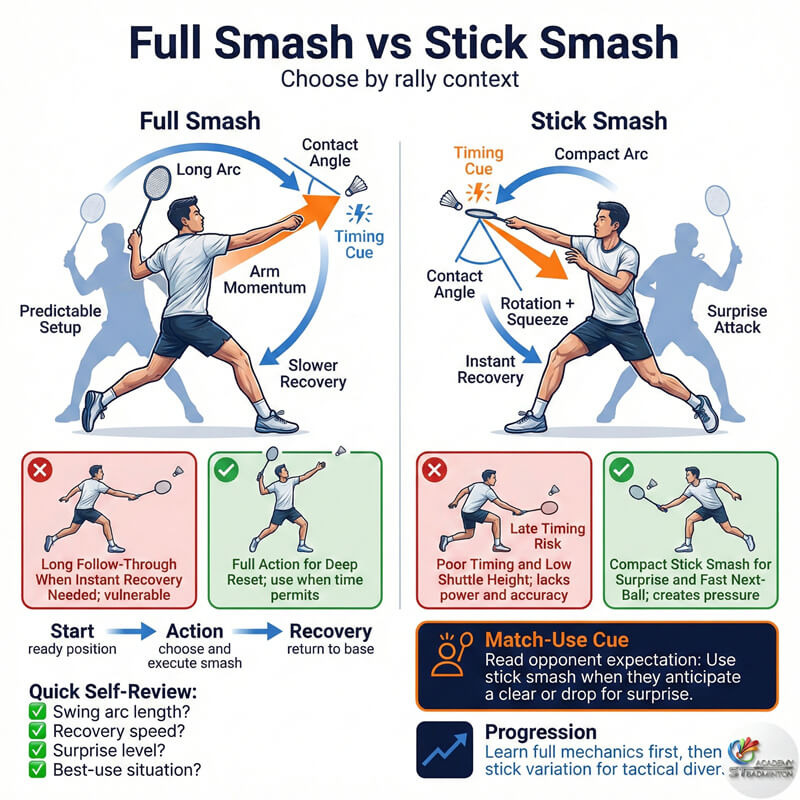
Proven Biomechanics
Our backhand smash syllabus is based on verified biomechanics used by professional players. We prioritize joint safety and efficiency over brute force.
| Comparison | Standard Full Backhand | Lee Zii Jia Style STICK SMASH |
|---|---|---|
| Swing Arc | Long follow-through to knee/ankle | Compact, stops abruptly (Recoil) |
| Power Source | Full body weight + Arm momentum | Forearm rotation speed + Grip squeeze |
| Recovery | Slow (due to momentum follow-through) | Instant (due to recoil braking) |
| Surprise Element | Low (Setup is obvious) | High (Short swing hides intent) |
| Difficulty | Moderate | Advanced (Requires precise timing) |
| Best Use | Clearing from deep court | Sharp angles and fast mid-court kills |
Master the Stick Smash in Kepong
Ready to upgrade your backhand? ST Badminton Academy offers specialized 1-to-1 coaching to teach the Lee Zii Jia stick smash mechanics safely. We serve students from Setapak, Wangsa Maju, and Gombak. Contact us to check availability for technical training slots.