What Are The Top Tips For Maintaining Focus During Badminton Training Drills? (Focus Guide)
Every coach has watched the same drill produce two completely different players. One player is inside every repetition: eyes up, feet ready, each shot played like it matters. The other is physically present and mentally somewhere else, hitting the shuttle while thinking about the last mistake, the next game, or the phone in the bag. The drill is identical. The value is not. Focus during drills is not a personality trait that some players are born with. It is a set of small, trainable habits: one cue at a time, eyes that live on the shuttle, short resets between repetitions, and distractions parked before the session starts. This guide goes through those habits in the order a drill actually runs.
Attention Check #1
One Cue Per Drill: Give Your Attention One Job
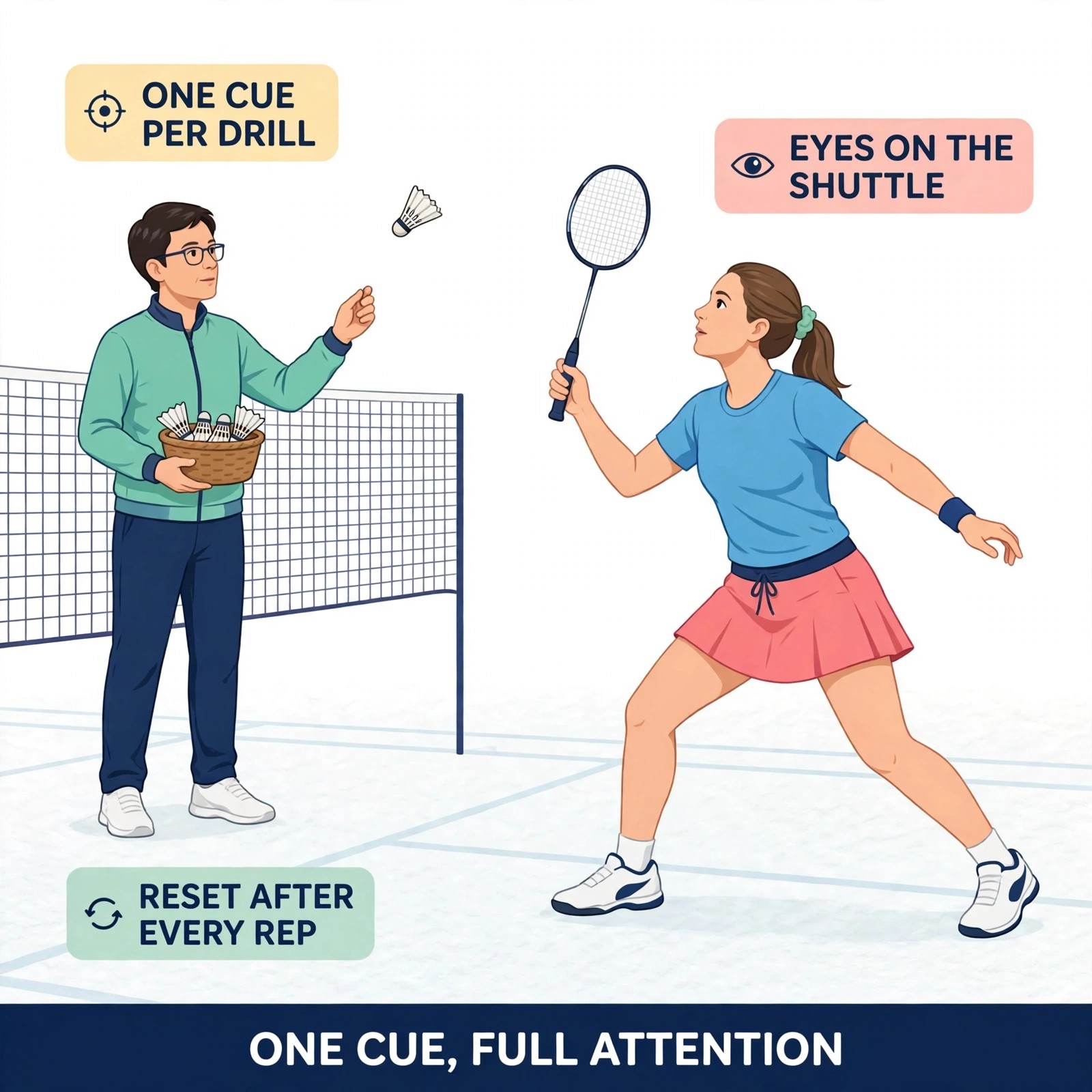
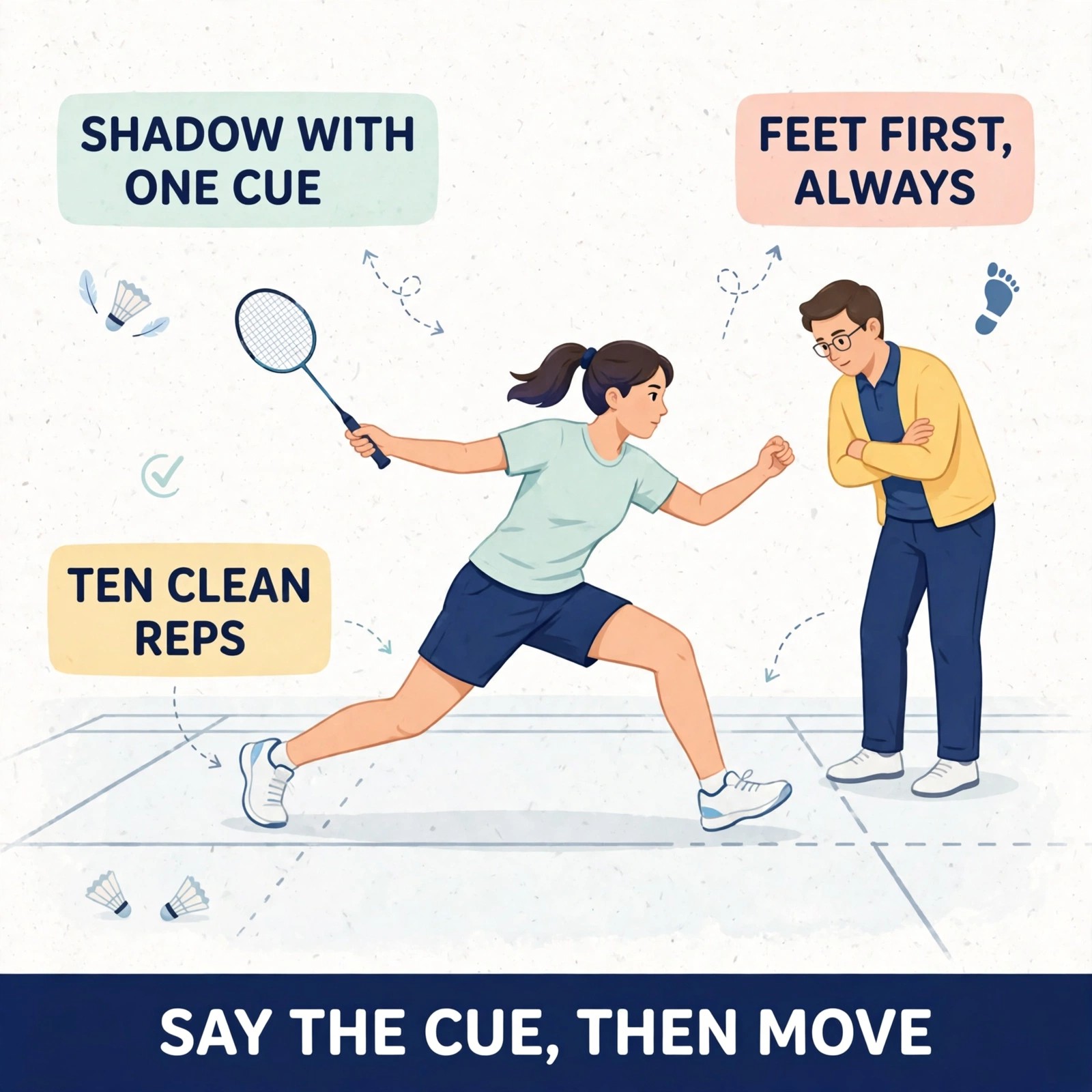
Attention works like a single spotlight. It can light up one thing properly, or it can flicker across five things and light none of them. That is why the first focus habit is one cue per drill. Before a block starts, choose a single job for your mind: watch the contact point, land softly from the lunge, recover to base after every shot. One cue, stated plainly, gives your attention something to hold during the repetitions where it would otherwise wander. When a coach gives you three corrections at once, ask which one matters first, or pick the one you heard clearest. Three cues at once usually means no cue at all by the third repetition.
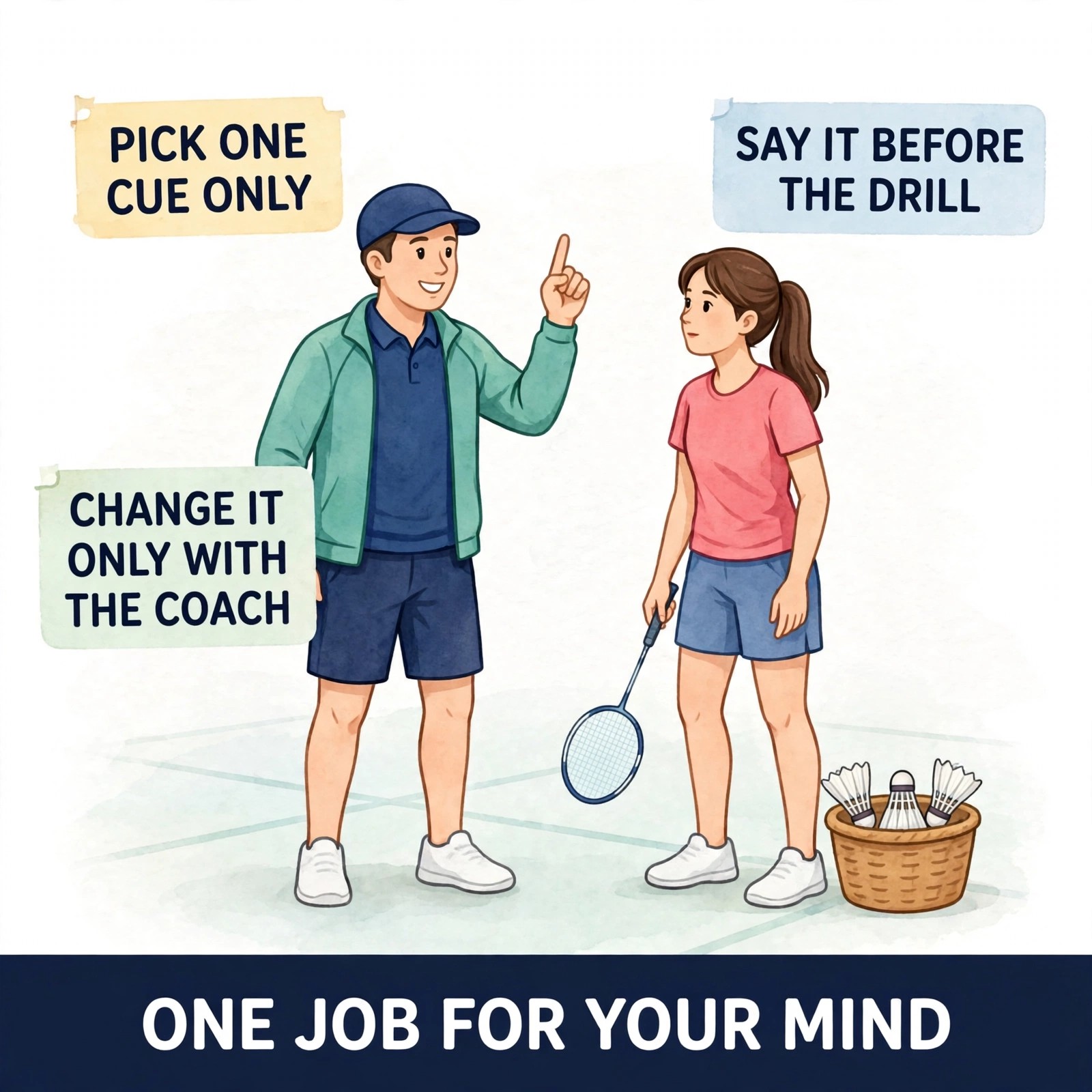
Using a cue well is a small routine of its own. Say the cue to yourself before the drill begins, in a few words you could repeat under your breath. Keep the same cue for the whole block, even when a repetition goes wrong, because changing cues mid block restarts the settling process every time. When the block ends, note honestly whether the cue held or slipped, and where. Then let the coach set the next cue, or choose the next one yourself if you train without one. Focus built this way is boring to describe and powerful to own: one job, held kindly, block after block, session after session.
Attention Check #2
Eyes on the Shuttle: Where Focus Actually Lives
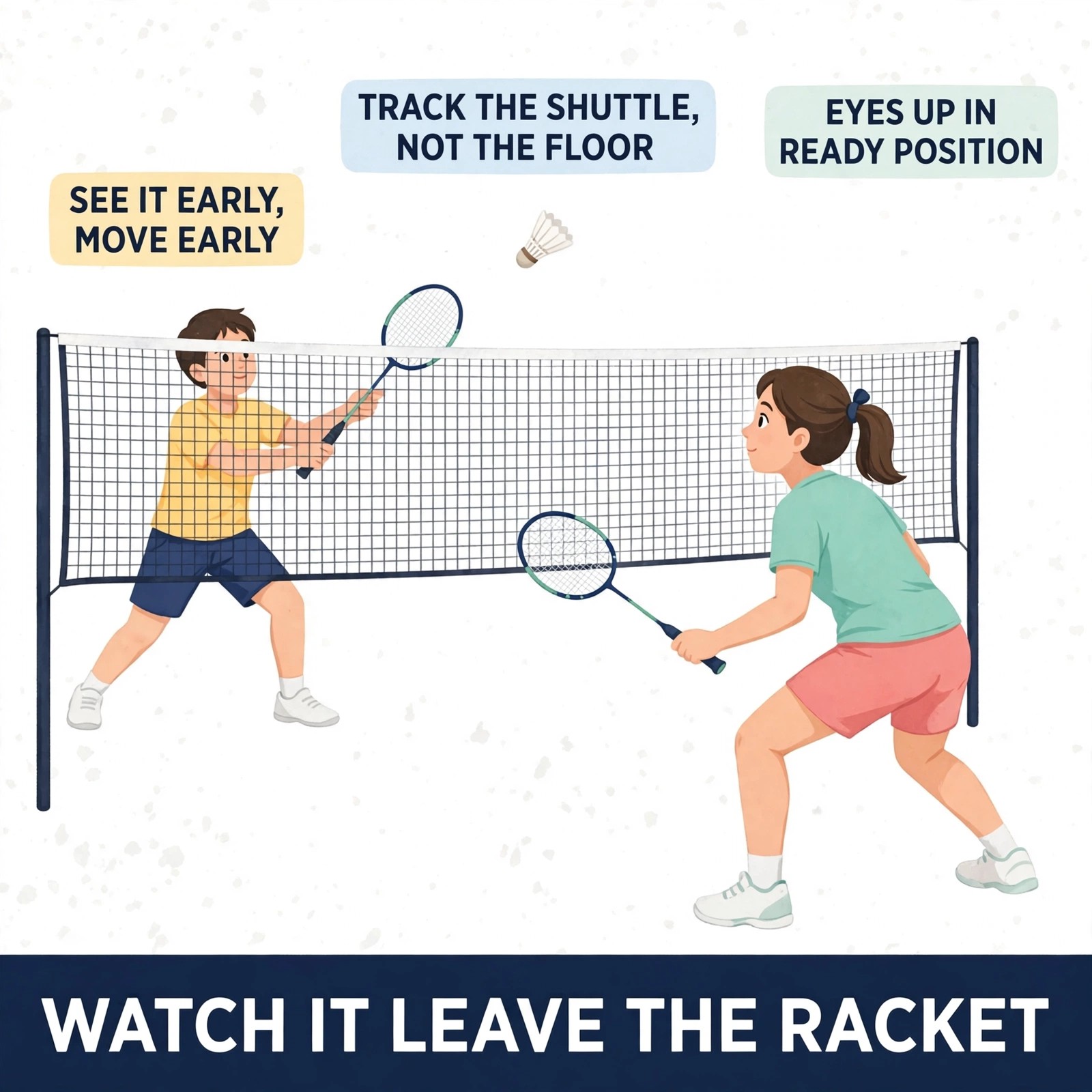
If one cue is where focus starts, the shuttle is where it lives. Badminton is too fast for thinking your way through a rally. The information your body needs arrives through your eyes, and it arrives early: the angle of the feeder’s racket, the first flight of the shuttle, the moment it starts to drop. Players who watch the shuttle from the second it leaves the racket move earlier and look calmer, because their feet got the news in time. Players who watch the floor, the net tape or their own shoes between shots are always reacting late, and late reactions feel like poor focus when they are really poor watching.
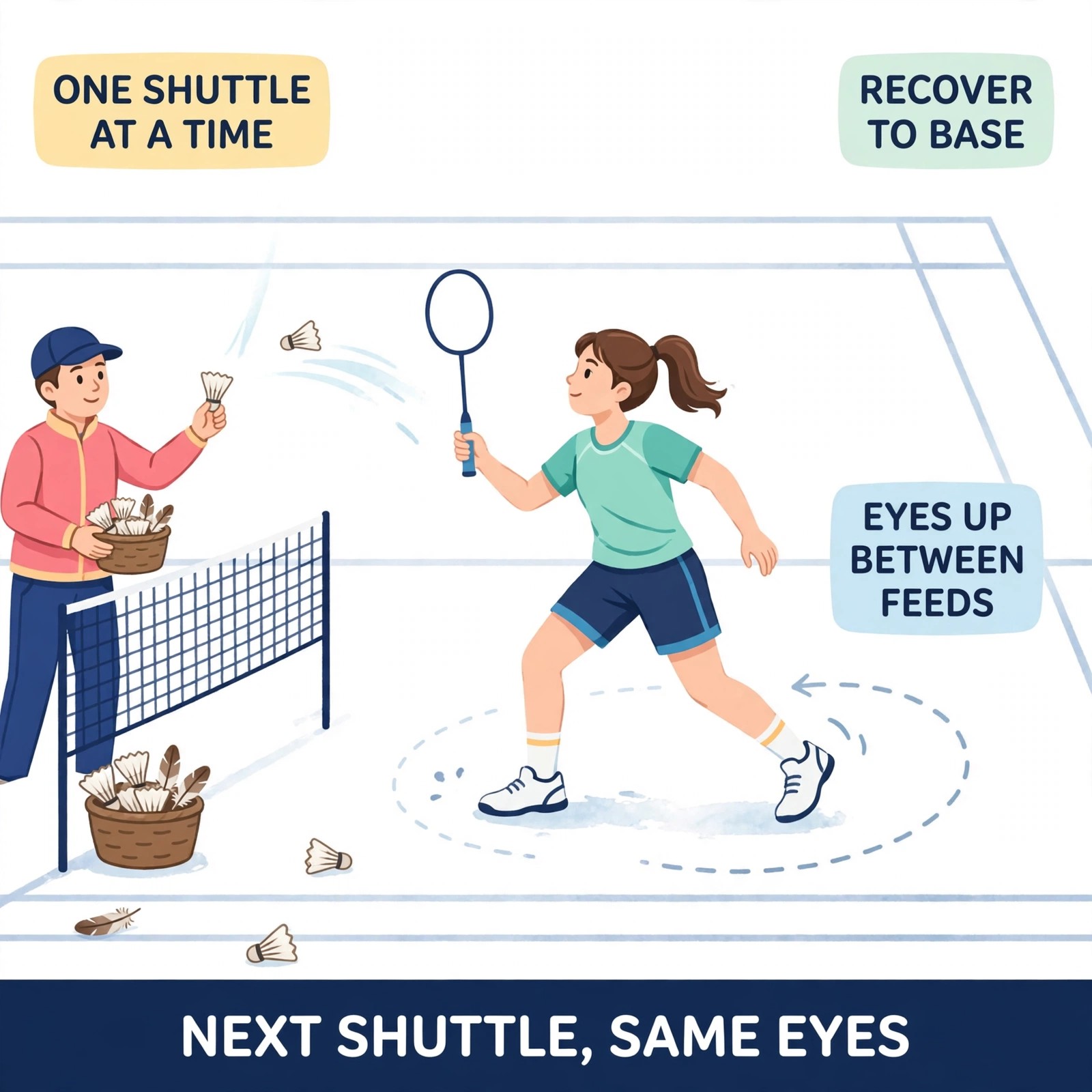
Good watching has a shape you can practise. In the ready position, your eyes are up and settled on the shuttle and the racket holding it, not scanning the hall. During a drill, track the shuttle all the way onto your strings, especially on net shots and drives where contact is quick. Between repetitions, lift your eyes back to the feeder instead of dropping them to your shoes while you walk back. It sounds simple, and it is, but simple is not the same as automatic. Most players need a few weeks of deliberate watching before it becomes the default, and that is fine. It is a skill, and skills take repetitions. A simple way to train it is to name the shuttle’s job silently as you watch: high and deep, flat and fast, soft at the net. Naming keeps the eyes honest, because you cannot name what you did not actually see. Within a few sessions, the naming fades and the watching stays, which is exactly how habits are supposed to form: effortful first, then quiet, then simply yours.
Watching also means watching the people, at the right moments. See the demonstration fully before you pick up your racket, because half watched demonstrations produce fully confused drills. Watch your partner’s repetitions when you are feeding, since their drill quality depends on your feeds landing where they should. And in doubles drills, watch your partner’s position between shots so the pair moves as one. None of this is staring. It is attention pointed at the things that decide the next shot, in the order they decide it. Train your eyes that way and your feet will usually follow.
Attention Check #3
Reset Between Reps: Seconds That Save the Next Ten
Between repetitions there is a small gap, a few seconds while the shuttle is picked up or the feeder reloads. Untrained attention treats that gap as a break from focus, and wanders: to the last error, to the score of the game after training, to what someone said at school. Trained attention treats the gap as a reset, a short routine that clears the last rep and loads the next one. A reset can be tiny: one slow breath out, a loose shake of the racket hand, eyes lifted to one steady spot, the cue repeated once in your head. Ten seconds of reset can save the next ten repetitions.
The reset matters most after a mistake. A missed shot wants to travel with you into the next repetition, where it tightens your grip, rushes your feet and produces a second mistake, which invites a third. Coaches call it a spiral, and every player knows the feeling. The reset is how you step out of it: breath, loose grip, eyes up, cue. The error becomes information instead of luggage. You can even give the error its one honest second: contact was late. Noted. Then reset and go. A drill is long enough to contain many fresh starts, if you let each repetition be one.
Resets are not only for drills. The same habit is what good match players do between points: they turn away, loosen the grip, breathe, and arrive at the next rally cleaned of the last one. Building the reset inside training drills is how it becomes available in matches, because match pressure does not create new habits, it reveals trained ones. So treat every gap in every drill as a rep of the reset itself. You will get hundreds of those reps in a month of training, far more than matches alone could ever give you, and focus that survives mistakes is the only kind worth having.

Attention Check #4
Park the Distractions: Phone Away, Chatter Later
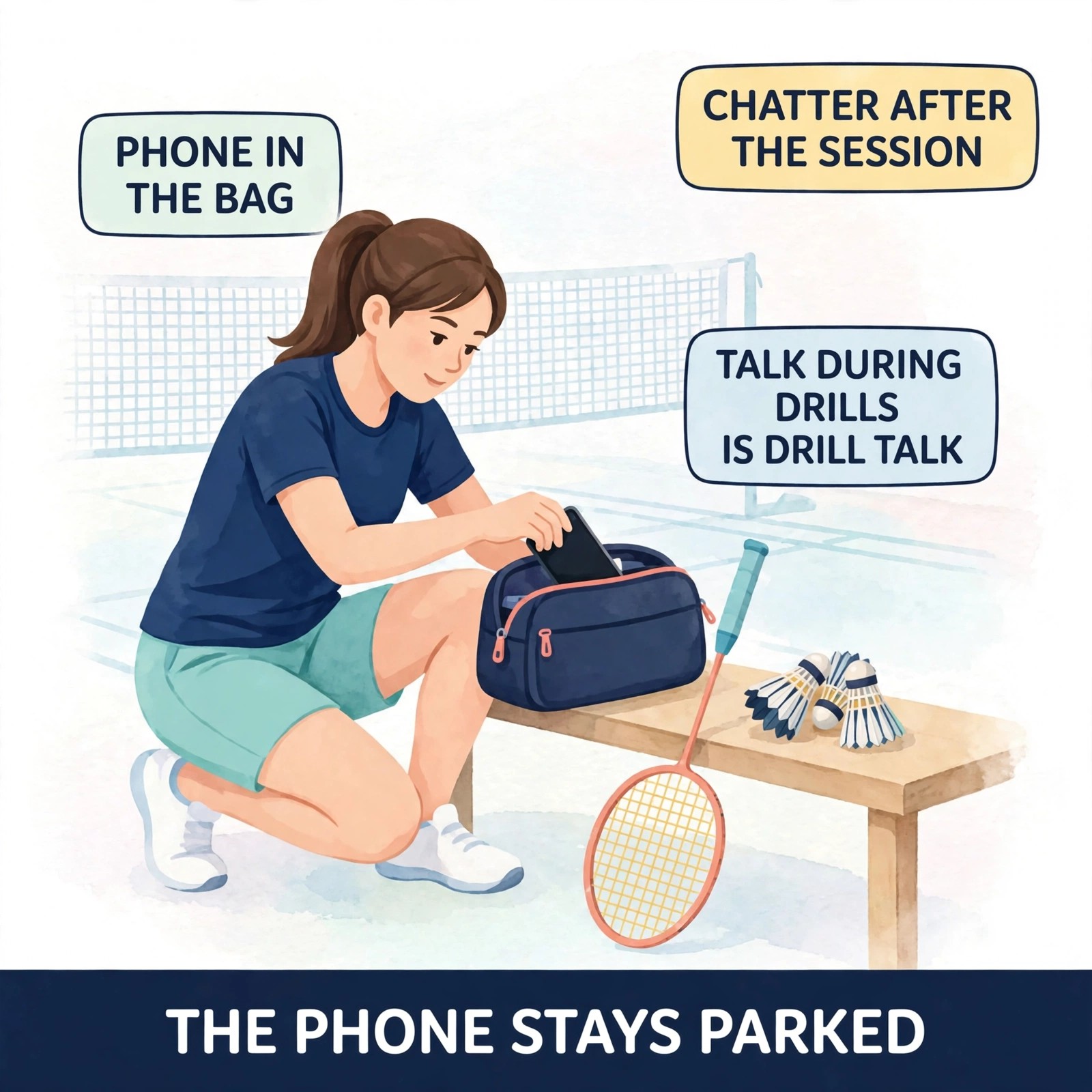
Some distractions can be parked before they cost you anything, and the phone is the first of them. A phone checked between drills is never a five second glance. It is a message that needs an answer, a feed that pulls, a small problem from outside the hall sitting in your head during the next block. Put the phone in your bag, zipped away, for the whole session. The messages will keep until training ends. What will not keep is the drill block, which happens once, at full quality, only for players who are actually inside it. Most players who try a phone free month tell us the sessions feel longer, in the good way.
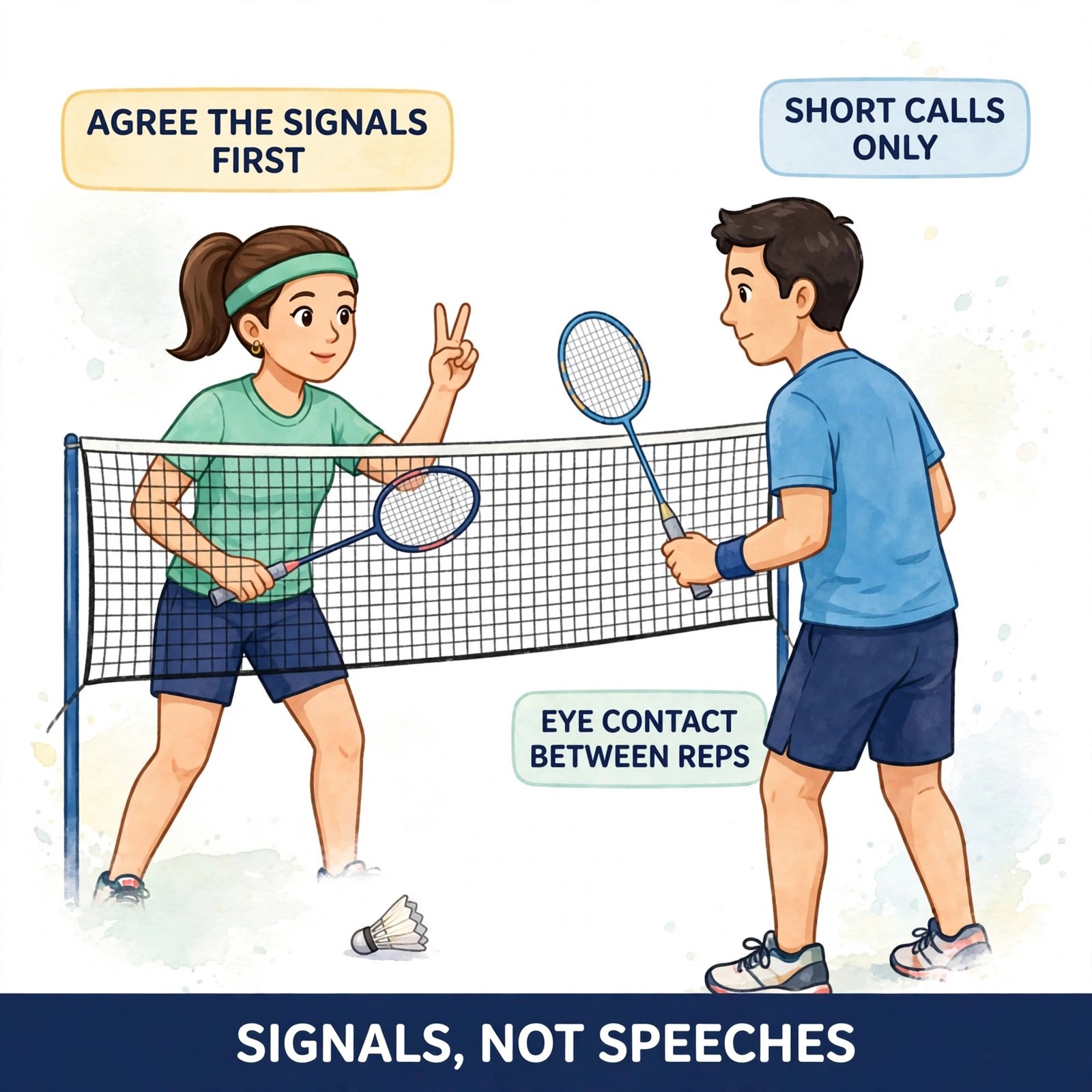
Sideline chatter is the second distraction, and it is a kinder one, because it comes from friends. The fix is not silence or seriousness. It is timing. During drill blocks, talk is drill talk: short calls, agreed signals, the count of clean repetitions. The stories, the jokes and the weekend plans get their time before the session, after it, and in the walk to get water if your hall allows that walk. Being the partner who keeps drill talk short is a gift to the pair, not a coldness. Your partner’s focus is partly in your hands, the same way yours is in theirs.
The third distraction is quieter: a tired mind. Late in a long session, or late in a hard week, attention thins no matter how good your habits are, because focus runs on the same energy as your legs. Water, a real break and honest pacing protect it, which is why our hardest, most technical drills sit early in the session while minds are fresh. If you notice your focus going late in sessions, say so. A coach can move the demanding blocks earlier or shorten them, but only if the drift is reported instead of hidden behind nodding. Honest players get better planned sessions. There is one more everyday thief worth naming: the conversation you carry into the hall. An argument at home, a worry from work, an exam next week: none of these can be deleted at the door, and pretending they do not exist rarely works. Give the worry its honest minute before the warm up, decide that it will wait at the bench until the session ends, and then give the first drill your whole attention as a deliberate act. Worries are patient. They will still be there afterwards, and you will meet them with a clearer head for having trained properly first.
Attention Check #5
Know Your Drift: Patterns, Partners and Honest Logs
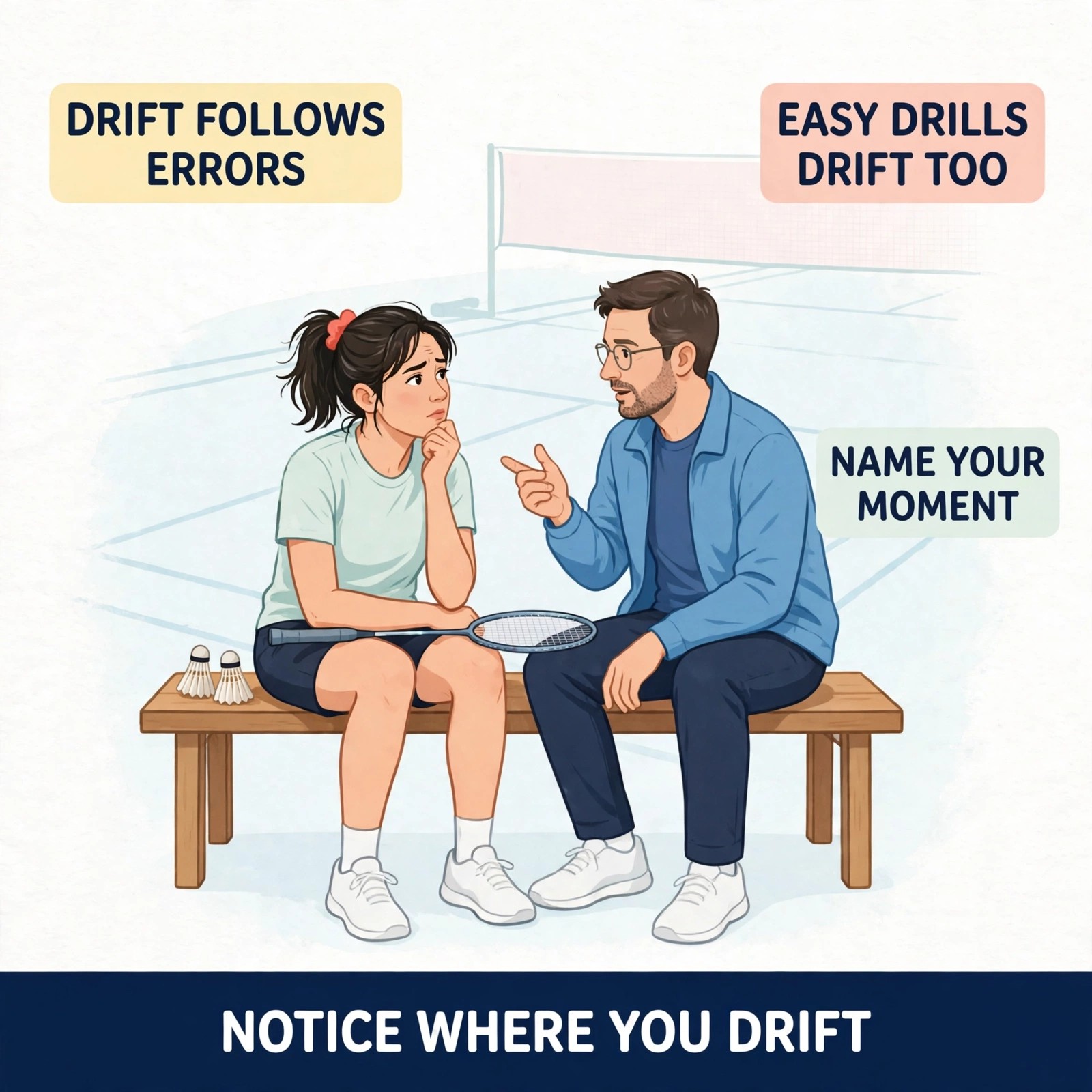
Every player drifts, but not at random. Drift has patterns, and yours are learnable. Some players drift after errors, replaying the miss. Some drift in easy drills, because the work feels too light to deserve attention. Some drift in queues and watching turns, arriving at their repetition already half asleep. Some drift when a stronger player is on the next court, comparing instead of training. Spend a month noticing which of these is yours, without judgement, the way you would notice a weak backhand clear. A pattern you can name is a pattern you can plan around.
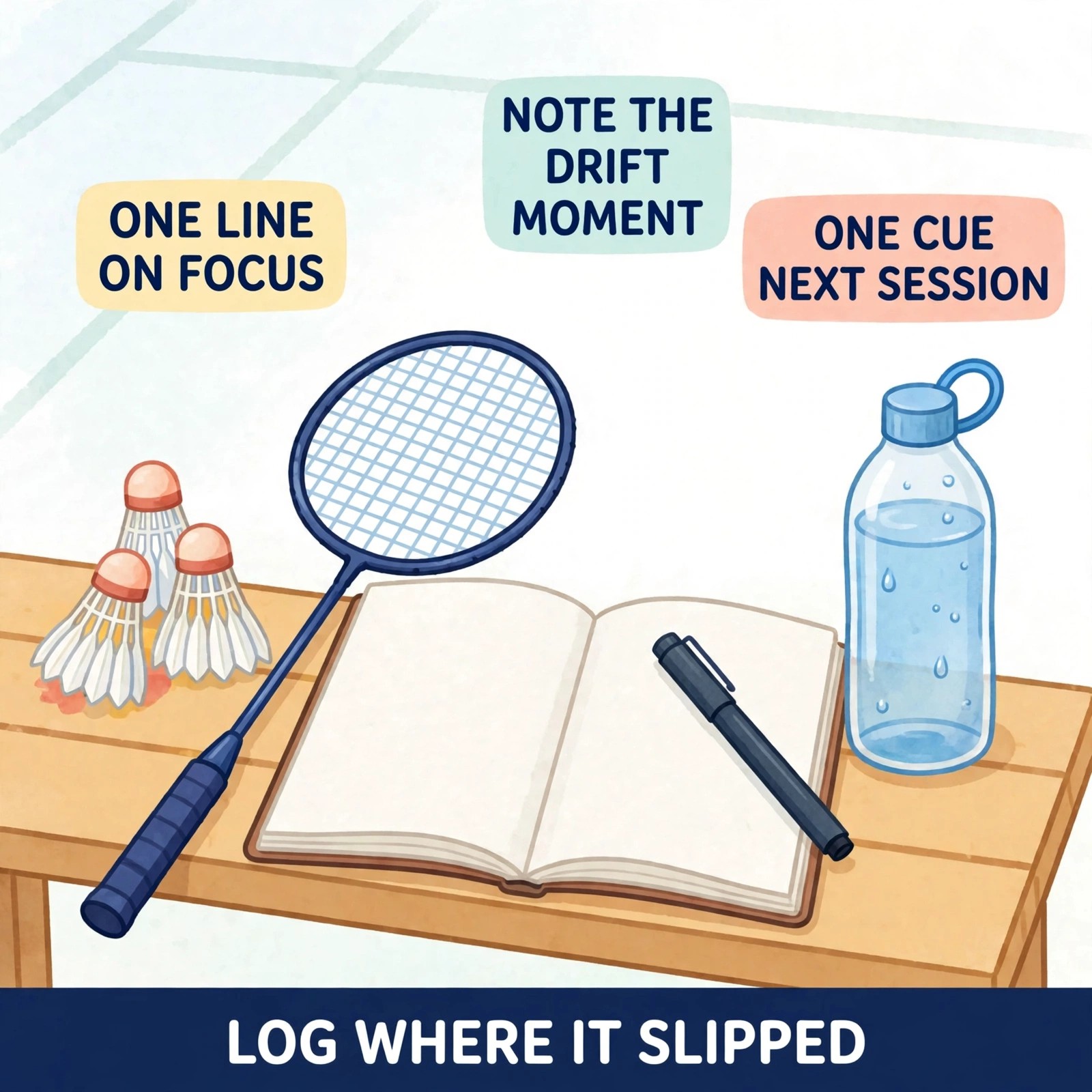
Partners and group size shape drift more than willpower does. In a big class with long queues, even keen players fade between turns, because attention cools while you wait. In a small group the repetitions come thick and fast, the coach sees your eyes drop the moment it happens, and a word at the right second brings you back. Choose training where the structure protects your focus, and be honest in your log about the sessions where it slipped: what the drill was, what hour it was, what happened just before. Three lines like that, over a month, show you your pattern in your own handwriting.
That is the honest summary of this whole guide: focus is a skill with repetitions, not a mood you wait for. It grows the way footwork grows, through small correct reps done often: one cue held, the shuttle watched, the reset used, the phone parked, the pattern noticed. It will still slip. It slips for professionals on television, in finals. The difference between a focused player and a drifting one is not that one never loses attention. It is how quickly attention comes back, and whether the player has a routine for bringing it back. Build the routine, and the comebacks get shorter every month.
Myth vs Reality
Myths About Focus and Drifting
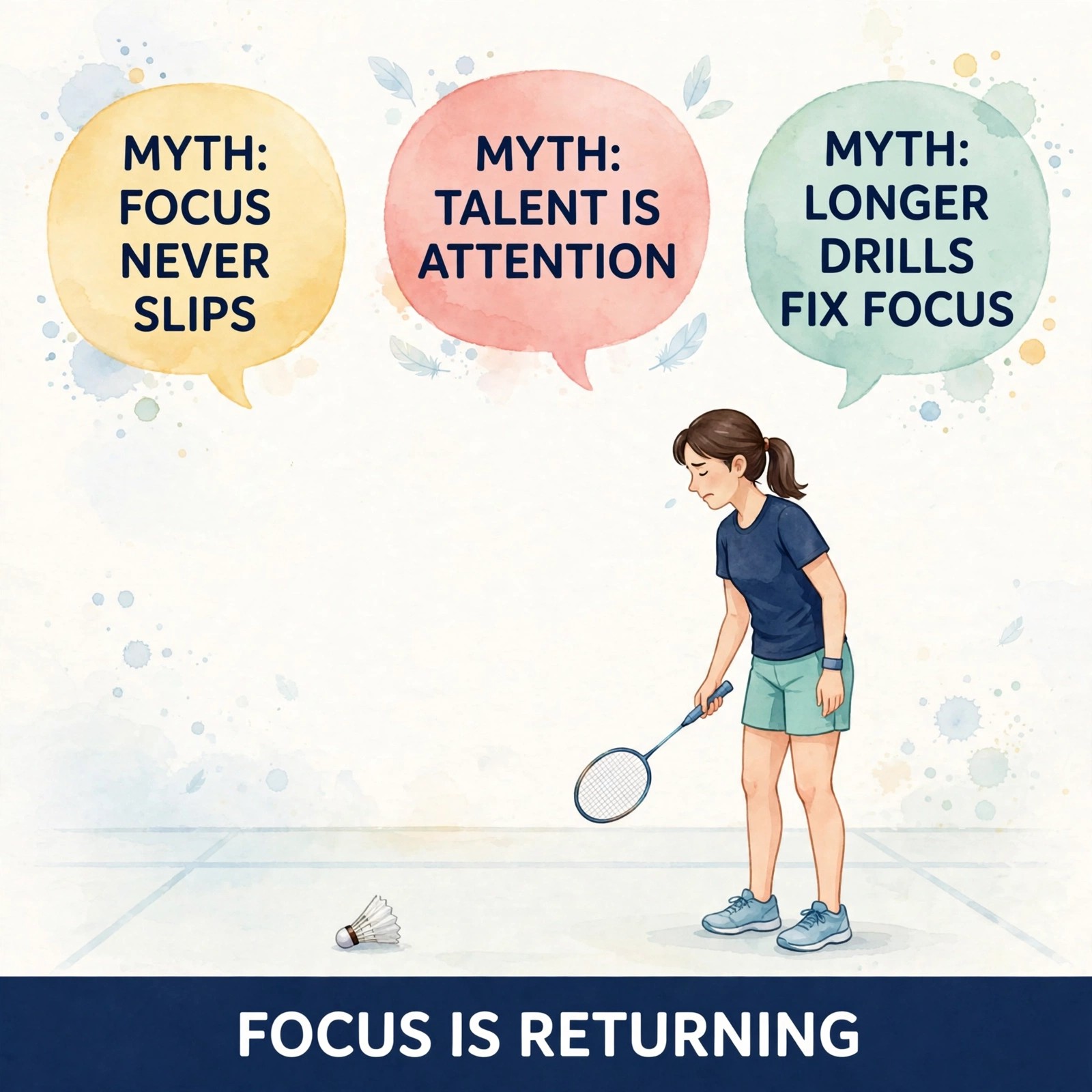
Focus advice collects myths because everyone has felt attention slip and everyone has a theory about it. Three myths do the most damage. The first says real focus never slips at all, so a wandering mind means you are doing it wrong. The second says attention is talent: some players are born focused and the rest are stuck. The third says longer drills automatically build focus, so the cure for drifting is simply more and longer repetitions of the same thing.
Each myth breaks on contact with a real training hall. Attention slips for every player alive, including champions, usually several times in a single session. What training changes is the return speed. Attention is also plainly trainable: players who practise one cue, watching and resetting improve at all three in measurable, visible ways within weeks. And long drills done while drifting do not build focus. They build drifting, practised perfectly, for longer. A short drill done with full attention teaches more focus than an hour of wandering through a long one.
The honest version is less dramatic and far more useful. Focus in drills is built from one cue at a time, eyes that live on the shuttle, a ten second reset between repetitions, distractions parked before the session, and patterns noticed without shame. None of it requires special talent, special equipment or a special brain. It requires a structure, a few honest habits and repetitions, which is exactly what training is for. Attention, treated this way, stops being the mysterious thing that decides your day and becomes one more part of your game that you can train.
Why Choose Us
Why Players Choose ST Badminton Academy
Focus is coached in our sessions, not just requested. Groups are capped at four students, which means repetitions come quickly, queues stay short, and your coach sees your attention the moment it slips, not ten minutes later. Corrections come one at a time, because we know three at once means none land. A player in our hall always knows the one thing they are working on in the current block, and if they do not, we have failed before they have. Small groups make that standard possible. Big classes make it a poster on a wall.
Our drills are built with the reset inside them. Feeds arrive at a pace that leaves room to breathe, loosen the grip and reload the cue, and players are taught the reset routine explicitly in their first weeks with us, the same way they are taught a split step. Phones stay in bags, as a normal house rule rather than a punishment, and drill talk stays short and kind. Feedback lands during the drill, while the repetition can still be re-run with the cue in place, because a correction you can try again in ten seconds is worth ten given at the end.
And we talk about drift honestly. Players tell us when their focus is going, after errors, in easy blocks, late in sessions, and the plan bends: themes move earlier, blocks shorten, a livelier drill goes in. We treat attention as part of technique, with patterns, causes and fixes, not as a character flaw to be scolded. Over a season, our players build resets and cue habits that travel with them into school exams, work presentations and tournament matches. Focus trained on a badminton court rarely stays only on the court.
FAQs: Maintaining Focus During Badminton Training Drills in Malaysia (KL)
These are the questions players ask us most about staying focused during drills. The short version is always the same: one cue per drill, eyes on the shuttle, a short reset after every repetition, the phone parked, and your drift patterns noticed kindly. The longer answers are below.
I am a beginner. How do I stay focused during drills in Setapak or Gombak?
Start with the habits in this guide: one cue per drill, eyes on the shuttle, a short reset after every repetition, and your phone in your bag. Beginners drift mostly because nobody has taught them where attention goes during a drill. In our groups of four, your coach sets your one cue and watches it with you.
How many cues should I hold in my head during a drill in KL?
One. Attention is a single spotlight, and a drill gives it one job at a time: the contact point, the landing, the recovery step. If your coach offers three corrections, ask which comes first, or take the one you heard clearest. A second cue joins only when the first has become habit.
My mind wanders after I make a mistake at club level?
Use the reset the moment the mistake lands: one slow breath out, loosen your grip, lift your eyes to one steady spot, and repeat your cue. The error gets one honest second of thought, then it is finished. Players who reset well make the same number of mistakes as everyone else. They just stop paying for each one five times.
Should my phone stay in my bag during training sessions in Kuala Lumpur?
Yes, zipped inside it for the whole session. A phone checked between drills is never a five second glance: it is a message thread sitting in your head during the next block. Messages keep until training ends. Drill blocks do not. Most players who park the phone find their sessions feel longer and richer within a week.
How do I reset between repetitions when the drill is moving fast?
Keep it tiny and repeat it every time: breath out slowly, shake the racket hand loose, eyes up to one spot, cue said once in your head. It takes seconds, fits inside the gap while the feeder reloads, and it gets faster with practice. Hundreds of drill gaps a month will train it better than any match can.
Do you coach focus and attention during training near Wangsa Maju?
Yes. Focus is coached in our Kuala Lumpur sessions like footwork: one cue per player per block, resets taught inside the drills, phones in bags as a house rule, and drill talk kept short. With no more than four students, the coach sees attention slip the moment it happens and brings it back with a word, kindly.
Where does ST Badminton Academy run badminton training in Malaysia?
The academy coaches in Kuala Lumpur, with our original base in Setapak and players joining from across the Klang Valley. Sessions run for kids, teens and adults in groups capped at four students, with focus coached inside the drills: one cue, watched shuttles, practised resets and honest talk about drift, from the first session onward.
Can I book a trial session in Kuala Lumpur and feel how focus is coached?
Yes. A trial shows you the full method: your coach sets one cue for the session, teaches you the reset between repetitions, and keeps the group at four so your attention is actually watched. Tell us when you book that focus is what you want to work on, and we will build the trial around it.
Is Mr Eric Chuar a suitable coach for players whose focus drifts badminton?
Mr Eric Chuar coaches the academy sessions himself and treats attention as technique: one correction at a time, resets practised like footwork, drift named kindly and planned around. With over 15 years of coaching in Kuala Lumpur, he measures focus coaching by one thing: how quickly a player’s attention comes back after it slips.
Badminton Drill Focus in Action
One Standard for Every Session and Every Player
One standard runs through this guide and through our coaching: honesty about attention. We will never promise you instant concentration or a mind that never wanders, and we will never call a drifting player lazy. What we promise is structure that trains focus the way it trains footwork: one cue at a time, watched shuttles, practised resets and small groups where your attention is actually seen. Focus is a skill. In our hall, it gets coached like one.
| Factor | Wandering Drills | Focused Drills ATTENTION |
|---|---|---|
| Frequency | 1 or 2 times a week. Mostly for fun and sweat. | One cue per drill gives attention a single job, so repetitions are played with intent instead of drift. |
| Drills Focus | Basic static feeding. Minimal footwork pressure. | Eyes stay on the shuttle and resets clear every mistake, so errors teach instead of travelling into the next rep. |
| Physical Conditioning | Rarely included. Just playing games on court. | Core, agility, and speed training included in every session to prevent injury and build stamina. |
| Tactical Awareness | "Just hit it over." No real game plan. | Video analysis, point construction, and learning to read the opponent's game. |
| Coach Ratio | Large groups (8-10 kids). Coach barely watches you. | Max 4 students. Mr Eric Chuar personally corrects every stroke and movement detail. |
| Goal Setting | Fun and exercise. | Phones stay parked and drill talk stays short, so the block belongs to badminton from first feed to last. |
| Long Term Result | Good recreational player. | A focused player: attention that slips and returns quickly, with every drill visibly building something. |
Badminton Drill Focus in Kuala Lumpur
Start with your very next drill block: pick one cue, say it before the first repetition, and reset with one slow breath after every rep, good or bad. Then book a trial session with us and feel what a small group does to your focus when the repetitions come fast and the coach sees every one. Bring your honest drift pattern, and we will plan around it together.




