
 All languages
 Chinese (Simplified)
 Chinese (Traditional)
 English
 Indonesian
 Japanese
 Korean
 Malay
 Thai
 Vietnamese


What Are The Top Strategies For Overcoming Slumps In Badminton Training? (Slump Guide)
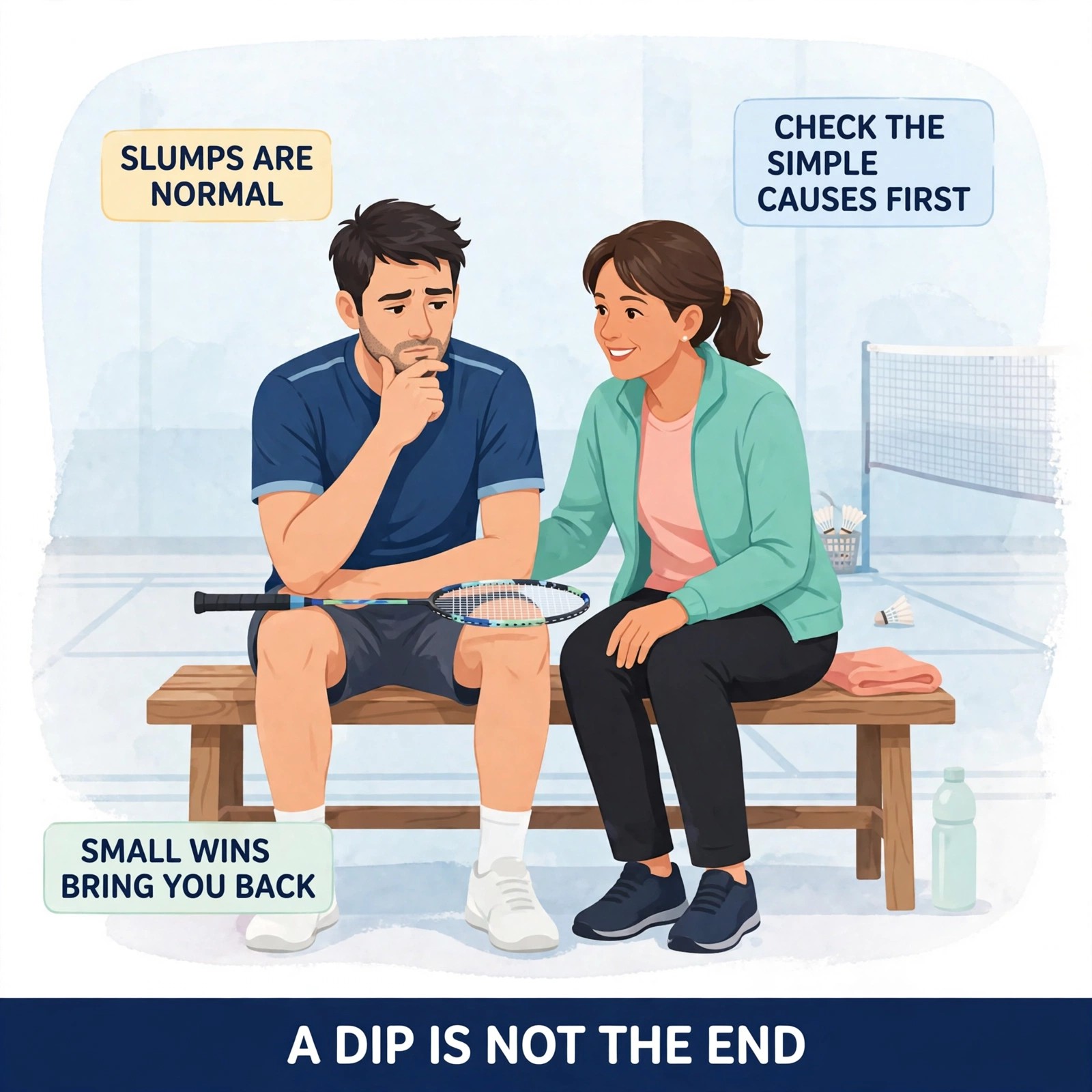
A slump feels different from slow progress. Last month your clears reached the back line without thinking. This week they land mid court, your net shots bounce high, and shots you own feel like strangers. Nothing is injured. Nothing dramatic happened. The game has simply gone flat, quickly, and it is frightening precisely because it feels like losing something you had. Take the first honest fact: slumps are a normal part of a training life. Every player at every level meets them. A slump is usually a training problem with training causes, and it responds to a calm order of work: check the simple causes, shrink the game back to basics, rebuild proof with small wins, and talk to your coach early. This guide walks that order step by step.
Slump Check #1
Check The Simple Causes First: Body, Habits And Kit
Start any slump investigation with the body, because tired legs lie about skill. A week of poor sleep, heavy work or school demands, a run of late nights or a small illness passing through will flatten your game before it flattens anything else, and the shots that go first are the ones needing the most legs and timing. Before you rebuild a single technique, ask the plain questions. Have I slept properly this week? Have I trained hard many days in a row without an easy one? Am I fuelling and drinking like a person in training, or like a person who forgot? Rest two nights properly, take one easy day, and test the game again. A surprising share of slumps are just tiredness wearing a disguise, and they leave the way they came.
Next, check the habits and the kit, because small breakages hide well. A rushed warm up for a few sessions in a row can quietly move your contact point and your first steps, and suddenly every shot is being played slightly late. Worn strings, a grip gone smooth, or shoes that have lost their bite all tax timing in ways players blame on their hands. And look for the one broken habit: a grip that has drifted, a ready position that has crept too high, a backswing that has grown. Slumps often have a single small mechanical cause that a coach can spot in ten minutes. Check sleep, warm up, strings, grip, shoes and your basic shapes before you conclude anything about your talent or your future in the sport.

Slump Check #2
Shrink The Game: Back To Basics You Own
Once the simple causes are checked, shrink the game. A slump is not the week to chase new tricks or hero shots. Go back to the shots you own most deeply: high clears with clean shape, simple drops, honest net play, serves you could hit in your sleep. Play them at an easier speed than you know you can, with slow feeds and full attention on shape: grip right, contact in front, recovery step honest. This feels like going backwards and it is the opposite. Basics are the floor of your game. Rebuilding the floor, rep by clean rep, is what brings the ceiling back. Most slumps end not with a breakthrough session but with the quiet return of shots that feel like yours again.
Slowing down is the active ingredient. In a slump, the body is usually rushing to compensate: swings get bigger, feet get hurried, and decisions arrive a fraction late and a fraction forced. Deliberately easy feeds break that loop. Feed at a pace where you can be perfect, then stay there longer than pride wants. Count clean repetitions instead of total ones, and stop a drill while the shape is still good rather than grinding into the errors you are trying to leave behind. There is no shame in an easy week of basics inside a hard season. Coaches prescribe it for professionals. The only players who refuse it are the ones whose slumps last longest.
In matches during a slump, shrink your ambitions the same way. Choose the safe shot one rally longer than feels natural. Build points with length and patience instead of reaching for winners from bad positions. A slump game plan is simple: fewer unforced errors, more rallies ended by the opponent’s mistakes, and no experiments. This protects two things at once. It protects results, because basic badminton played cleanly still wins plenty of points at club and school level. And it protects confidence, because every rally where your simple game holds is fresh evidence that the player you were last month is still in there. Hero shots can wait for the week your basics feel boring again. Boring basics are the sound of a slump ending.

Slump Check #3
Small Wins: Rebuild Proof One Drill At A Time
With the game shrunk, rebuild proof through small wins. Set targets so modest they feel almost silly: ten clean clears in a row from a steady feed, a whole game of serves landing in, one drill finished with the new shape intact on every rep. Hit the target, and write it down. Confidence is not a mood you wait for. It is a record you build, and in a slump the record has to be built from small, undeniable entries. Each small win is a fact your brain cannot argue with at midnight. Stack enough of them across two or three weeks and the feeling starts following the facts, which is the natural order of things, however much we wish it ran the other way.
End sessions on a clean one. Shape the last drill of the day so it finishes with a success: an easier feed, a familiar shot, a short set you complete properly. The final minutes of a session colour the whole memory of it, and players carry that colour into the next session’s warm up. Coaches use this deliberately during slumps. It is not trickery; it is honest session design, the same reason good teachers end a hard lesson by returning to something the class can do. Leave the hall with a clean rep in your pocket. Over a fortnight of small wins and clean endings, most players feel the ground come back under their game, one session at a time.
Keep the slump log separate and simple. Note what you checked: sleep, warm up, strings, the habit your coach fixed. Note the small wins as they land. Note which basics feel solid again and which still wobble. This short record does two jobs. First, it stops the slump feeling endless, because the page shows movement even when the mood denies it. Second, it becomes your personal manual for the next slump, which will come, because they come for everyone. Players who have climbed out once with a written map climb out faster the second time. What felt like a mysterious collapse becomes a known road with known steps, and known roads are far less frightening.

Slump Check #4
Talk To Your Coach Early: Slumps Are Team Work
Do not carry a slump alone. Tell your coach early, plainly, while it is still small: my clears have gone, my timing feels off, I am not enjoying this. Coaches have watched hundreds of slumps. What feels to you like a unique personal failure looks to them like a familiar pattern with familiar causes, and a fresh pair of trained eyes will often spot the drifted grip or the rushed first step in one session. Hiding a slump, by contrast, feeds it. You start avoiding the shots that are failing, practising around the problem, and the hole quietly widens. In badminton, as in most things, the dip you share early is the dip that ends early.
Expect the plan to bend when you speak up. A good coach answers a slump by adjusting the work: more basics, easier feeds, a game plan trimmed to the shots you trust, and sometimes a lighter week if tiredness is written all over the evidence. This is not the plan failing. This is the plan doing its job, because a training plan is a living thing that responds to the player in front of it. Your part is honesty: report sleep, soreness and mood as plainly as you report scores. Coaches can only steer by the instruments they can see, and in a slump, the player is the most important instrument of all.
Partners and friends matter too. Train beside people who treat a slump as weather, not as identity. The partner who feeds you steady shuttles without commentary, the friend who still picks you for the friendly game, the group that laughs with you when a sitter goes into the net: these people are part of the way back. Keep some fun in the week on purpose. One relaxed game where the score does not matter reminds your body that badminton is a game you chose, and joy is a genuine training resource, not a distraction from one. Slumps grow in heavy, lonely weeks. They shrink in weeks that contain work, honesty and at least a little laughter.

Slump Check #5
When A Slump Is More: Lasting Lows Deserve Support
Once in a while, a slump is not just a slump, and honesty requires saying so. If the flat feeling lasts for weeks rather than days, if sleep stays poor and mood stays low far beyond the court, if training and everything else has felt grey for a long stretch, treat that as more than a badminton problem. Talking to a doctor or a counsellor is a sensible, ordinary step, the same way seeing a physiotherapist is for a knee that will not settle. There is no toughness points for silence, in sport or anywhere else. Getting proper support early is what people who take their health seriously do, and it protects the player and the person at the same time.
A real break is also a legitimate answer. Some slumps are the body’s final memo in a long negotiation: too many hard months, too little rest, too much pressure carried too quietly. A planned pause of a week or two, with a return date set and easy movement kept in the days, can restore what pushing through could not. A break is not quitting. Quitting has no return date. If you take a pause, take it cleanly: no guilty secret sessions, no testing yourself daily. Rest, live the other parts of your life, and come back on the date you chose. Many players return from a clean break playing freer than they have in months.
Zoom out for the last word. A slump is a dip, and dips end. Your skills have not been deleted; they are sitting under tiredness, a broken habit or a noisy few weeks, waiting for calm work to uncover them. Check the simple causes first. Shrink the game to basics you own. Stack small wins and write them down. Tell your coach early and let the plan bend. Take lasting low mood seriously and get support if it stays. Run that order and most slumps close the way they opened, only quieter: one session where the clears start landing again, and you realise the player you thought you had lost was only ever resting underneath.

Myth vs Reality
Myths About Slumps in Training
Slump talk collects myths like every other corner of training. The first says a slump means you have lost it, that the skill is gone for good. The second says the answer is always to train harder, more hours, more intensity, until it breaks. The third says never tell anyone, because naming a slump makes it real and weakness spreads. All three are heard in halls every week. All three make slumps longer than they need to be.
Watch what each myth does. The lost it myth turns a bad fortnight into an identity crisis, and players start making career decisions at the lowest point of a mood graph. The train harder myth pours tired volume onto a problem that is usually tiredness or one small broken habit, so the hole deepens and the small strain arrives right on schedule. The silence myth cuts the player off from the two fastest cures: a coach’s fresh eyes and a group’s easy company. Myths survive because each holds one grain of truth: slumps feel permanent, effort does matter, and privacy is a real comfort. The damage is in turning feelings into instructions.
The honest position is calmer. Skills built over months do not evaporate in a fortnight; they get buried under fixable things. Effort helps when it is aimed at the actual cause, in the right dose, which is why checking comes before pushing. And telling your coach is not weakness; it is the standard move of every serious player who wants the dip to end quickly. A slump is weather in a training life, not climate. Treat it with a calm order of work, a written log and honest conversation, and it passes the way weather does: certainly, and sooner than it threatens to.

Why Choose Us
Why Players Choose ST Badminton Academy
At ST Badminton Academy, slumps are spotted early because groups are capped at four students. A coach who sees your whole game every week notices the drifted grip, the late first step or the vanished net shot before it becomes a month of misery, and names it kindly in the session where it appears. The plan then bends on the spot: basics restored, feeds eased, targets shrunk to small wins the player can bank. Players are often surprised how undramatic the fix is. Most slumps are small problems with good timing. They only grow large when nobody with trained eyes is watching closely enough to catch them small.
Our coaches also protect the person inside the player. Sessions in a slump keep their fun deliberately: a game the player enjoys, success designed into the end of the session, and no public scoreboard of anyone’s bad week. When the evidence points past badminton, to exhaustion or a mood that has stayed low for weeks, our coaches say so honestly and encourage proper support, the way they would send a knee to a physiotherapist. Coaching that only watches shots is half a job. In groups of four, there is time to watch the player properly, and slumps are where that watching pays for itself.
That standard runs across our Kuala Lumpur sessions for kids, teens and adults. Young players learn that a dip is normal and fixable, which protects their love of the game for years. Adult players returning after long breaks, who meet their first slump like a verdict on their comeback, get the calm order instead: check, shrink, stack small wins, talk early. Bring your current slump to your first session, however it looks. We will check the simple causes with you, starting with the ones coaches find most often, and build the small wins back one at a time.
FAQs: Overcoming Slumps In Badminton Training in Malaysia (KL)
Slump questions are usually asked with some urgency, because a dip feels like an emergency from inside it. Here are the answers we give in the hall.
Why has my badminton game suddenly gone flat if I train in Setapak or Gombak?
Start with tiredness, because flat games are usually a tired body before they are a broken technique. A week of poor sleep, heavy work or school demands, or hard sessions stacked without an easy day will flatten your shots before anything else changes. Rest two nights properly, take one easy day, then test the game again before rebuilding technique.
What should I check first when a slump starts in KL?
Work through the simple list in order. Sleep and recent training load first. Then your warm up routine, which may have shrunk. Then your kit: worn strings, a smooth grip, shoes losing their bite. Then one basic shape, like a drifted grip or a ready position crept too high. Most slumps have one small cause on that list.
Should I train harder to break a slump at club level?
Usually no. More volume poured onto tiredness or one small broken habit deepens the hole and invites a strain. The better answer is to shrink the game: back to basics you own, slower feeds, clean shape, small targets you can hit today. Harder training has its place once the simple causes are fixed and your shots feel like yours again.
When is a slump more than a badminton problem?
When the flat feeling lasts for weeks rather than days, and sleep and mood stay low well beyond the court, with everything feeling grey. That deserves proper support: talk to a doctor or a counsellor, the same ordinary step as seeing a physiotherapist for a knee. Tell your coach too. There is no toughness points for silence.
Should I tell my coach that I am in a slump?
Yes, early, while the dip is still small. Coaches have watched hundreds of them and often spot the drifted grip or rushed first step in one session. Hiding a slump makes players practise around failing shots, and the hole widens. A shared dip gets a bent plan, easier feeds and smaller targets. In our hall, that is a normal conversation.
Do you help players out of slumps during training near Wangsa Maju?
Yes, early, because groups are capped at four students. Your coach sees your whole game, so a drifted grip, a late first step or a vanished net shot gets named in the session it appears, then answered with basics, easier feeds and bankable small wins. Most slumps are small problems caught late. Small groups are how we catch them small.
Where does ST Badminton Academy run badminton training in Malaysia?
The academy coaches in Kuala Lumpur, with our base in Setapak, players joining from across the Klang Valley. Sessions run for kids, teens and adults in groups of four. Slump care is part of coaching here: simple causes checked first, basics restored without drama, small wins designed into sessions, and honest support encouraged when a dip is more than badminton.
Can I book a trial session in Kuala Lumpur and get my slump checked?
Yes. A trial includes a slump check: your coach works through the simple causes with you, sleep, load, warm up, strings, grip and basic shapes, then resets one or two basics and sets the first small targets you can bank this week. You will leave knowing what most likely caused the dip and the order we would fix it in.
Is Mr Eric Chuar a suitable coach for players stuck in a slump in badminton?
Mr Eric Chuar coaches the sessions himself and answers slumps with a calm order: check simple causes, shrink the game to basics, stack small wins, and never pour blind volume onto a dip. With over 15 years of coaching in Kuala Lumpur, he has talked hundreds through flat patches, and he measures success by how quickly the dip closes.
Badminton Slump Recovery in Action


One Standard for Every Session and Every Player
Our slump standard is one honest rule for every player: check the simple causes first, shrink the game to basics, rebuild proof with small wins, and tell the coach early. No player hides a dip in our hall, no dip is answered with blind extra volume, and a flat stretch that outlasts training causes gets pointed toward proper support without embarrassment. A beginner and a state level junior are held to the same standard at different depths: calm order, honest evidence, kind coaching. That is how dips stay short and players stay in the game.
| Factor | Panic Changes | Calm Order SLUMP |
|---|---|---|
| Frequency | 1 or 2 times a week. Mostly for fun and sweat. | Simple causes are checked first: sleep, load, warm up, strings and one basic shape, before any technique is rebuilt. |
| Drills Focus | Basic static feeding. Minimal footwork pressure. | The game shrinks back to basics at an easier speed, so clean shots return and confidence is rebuilt from facts. |
| Physical Conditioning | Rarely included. Just playing games on court. | Core, agility, and speed training included in every session to prevent injury and build stamina. |
| Tactical Awareness | "Just hit it over." No real game plan. | Video analysis, point construction, and learning to read the opponent's game. |
| Coach Ratio | Large groups (8-10 kids). Coach barely watches you. | Max 4 students. Mr Eric Chuar personally corrects every stroke and movement detail. |
| Goal Setting | Fun and exercise. | Small wins are stacked and written down, and the coach hears about the dip early enough to bend the plan. |
| Long Term Result | Good recreational player. | A recovering player: basics boring again, proof in the log, and a dip that closed in weeks instead of months. |
Badminton Slump Recovery in Kuala Lumpur
Bring your slump exactly as it is, flat shots and all, and let us check it together. In a group of no more than four, your coach will look for the simple causes first, reset your basics, and set the first small targets you can bank this week. Book a trial session in Kuala Lumpur and start the way back now, while the dip is still small enough to fix in a handful of honest sessions.


