What Are The Top Strategies For Doubles Play In Badminton Training? (Doubles Guide)
Two good singles players can make a poor doubles pair, and two ordinary players who understand each other can beat them. That is the first thing to accept about doubles: it is not singles with company. The court is shared, the shuttle is shared, and most rallies are won or lost by the pair’s shape before anyone hits a winning shot. A pair in the right shape makes the next shot easy. A pair in the wrong shape manufactures emergencies all match. This page works through the strategies that hold a pair together: the two shapes, the rotation between them, the middle ball, short calls, and the serve that starts it all. None of these strategies needs a gifted partner or a new racket. They need agreement and rehearsal, which any pair at any level can manage. By the end of this page you should know exactly what to agree with your partner before your next match, and what to drill when you train together.

Pair Check #1
Two Shapes Every Pair Needs: Front And Back, Side By Side
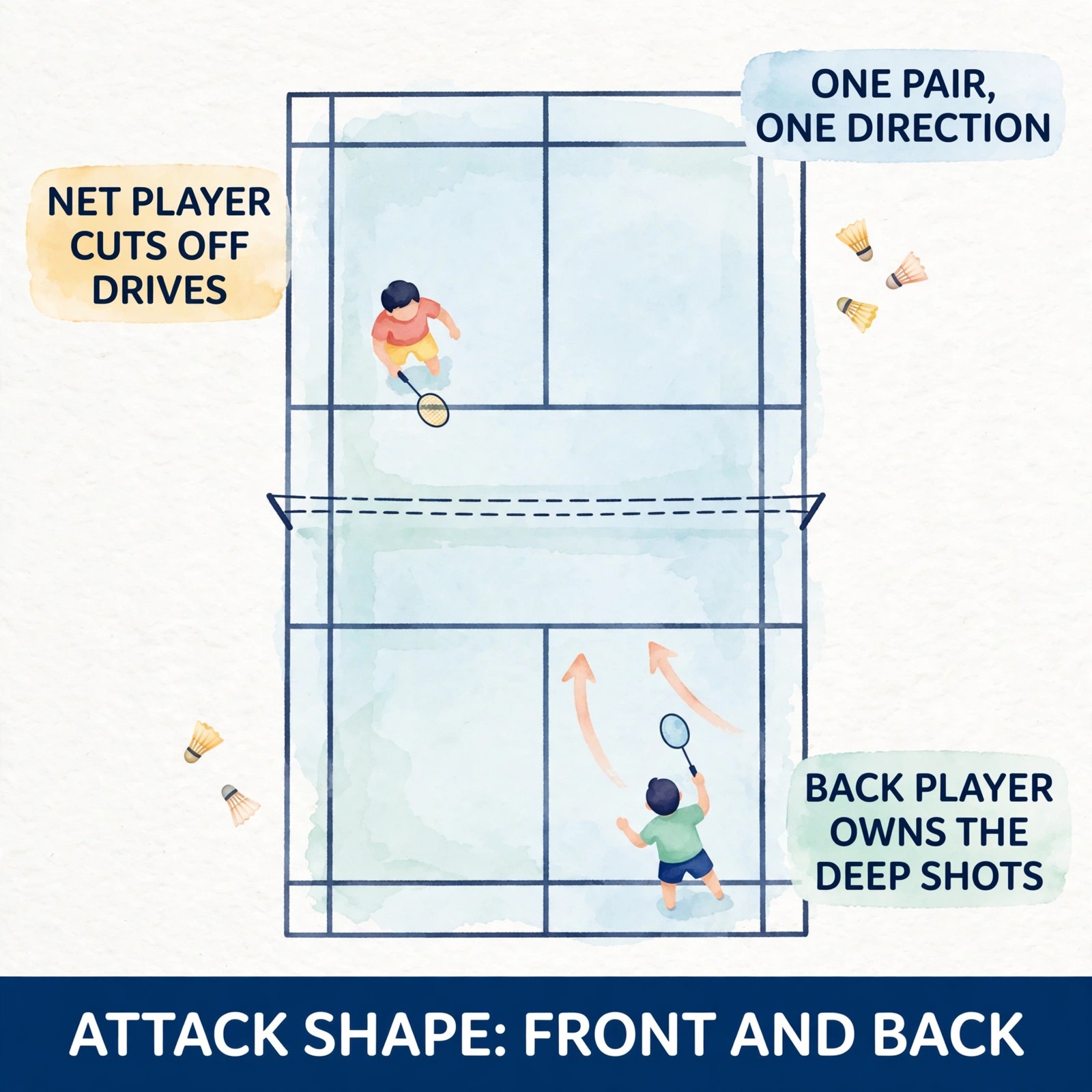
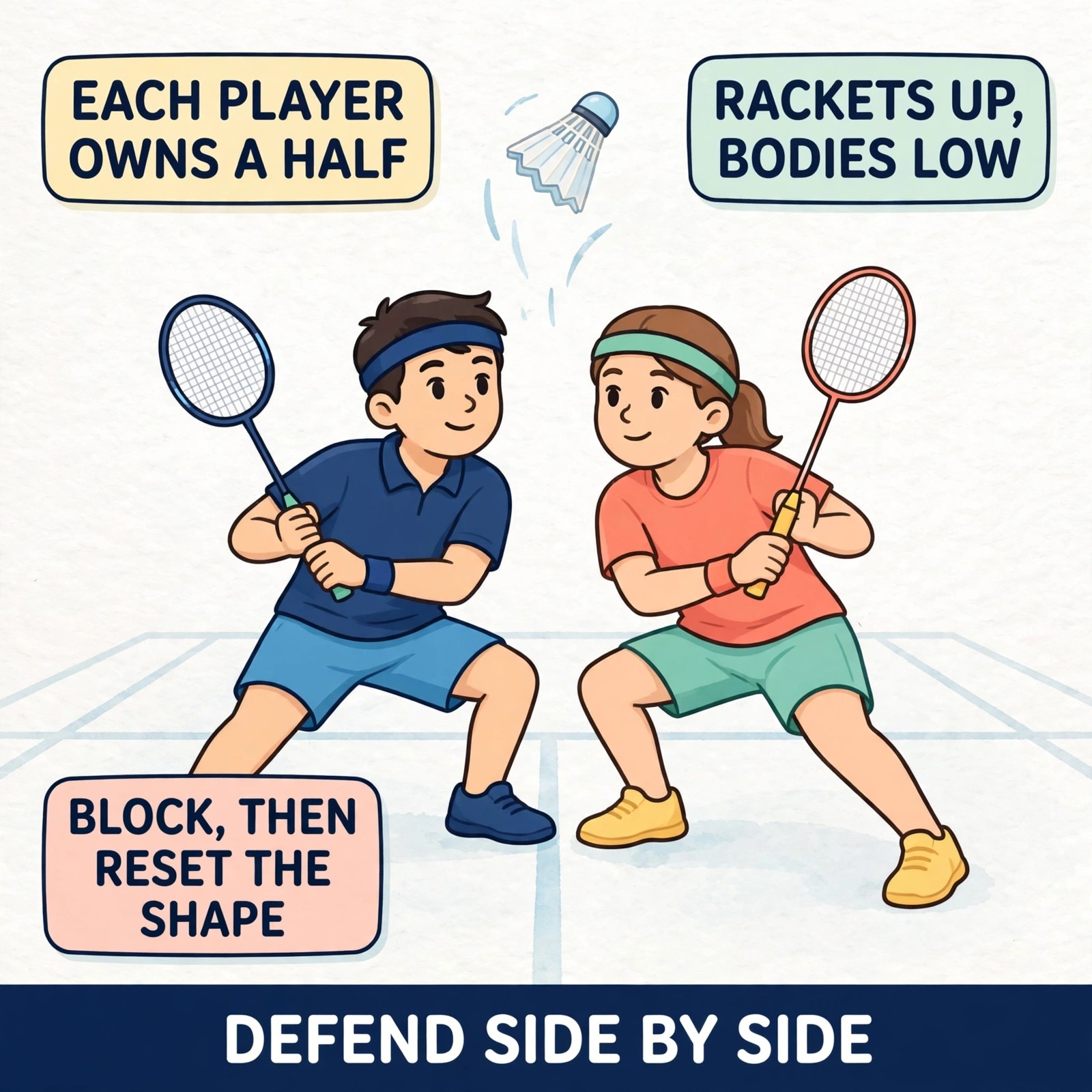
Every doubles rally lives in one of two shapes. When your pair is attacking, you stand front and back: one player at the net, racket up, cutting off drives and finishing loose returns, and one player behind, owning the deep shots and hitting down. When your pair is defending, you stand side by side, each player covering a half of the court, rackets up in front, bodies low, ready to block and counter. There is no third shape, and there is no standing still between them. Almost every doubles error in club badminton is a shape error first and a shot error second.
The attacking shape only works because the two jobs are different. The net player is not waiting for a turn; she is hunting. Her court is the front third, her racket stays above net height, and her job is to end rallies early and force lifts. The back player is not a spare defender; he owns everything deep, moves his opponents with smashes and drops, and creates the loose replies his partner finishes. The moment both players drift to the same job, one covering the net and one admiring it, the pair leaks. Know your job in the shape, do that job, and trust your partner to do hers. Notice what happens to the court when both jobs are done: the opponents run out of safe shots. Their clears get smashed, their drives get cut off, their net shots get met early. Attacking shape is not about one big shot. It is about a court with no comfortable answers in it, built by two players doing two different jobs at the same time.
Pair Check #2
Rotation: How A Pair Swaps Shapes Without A Gap
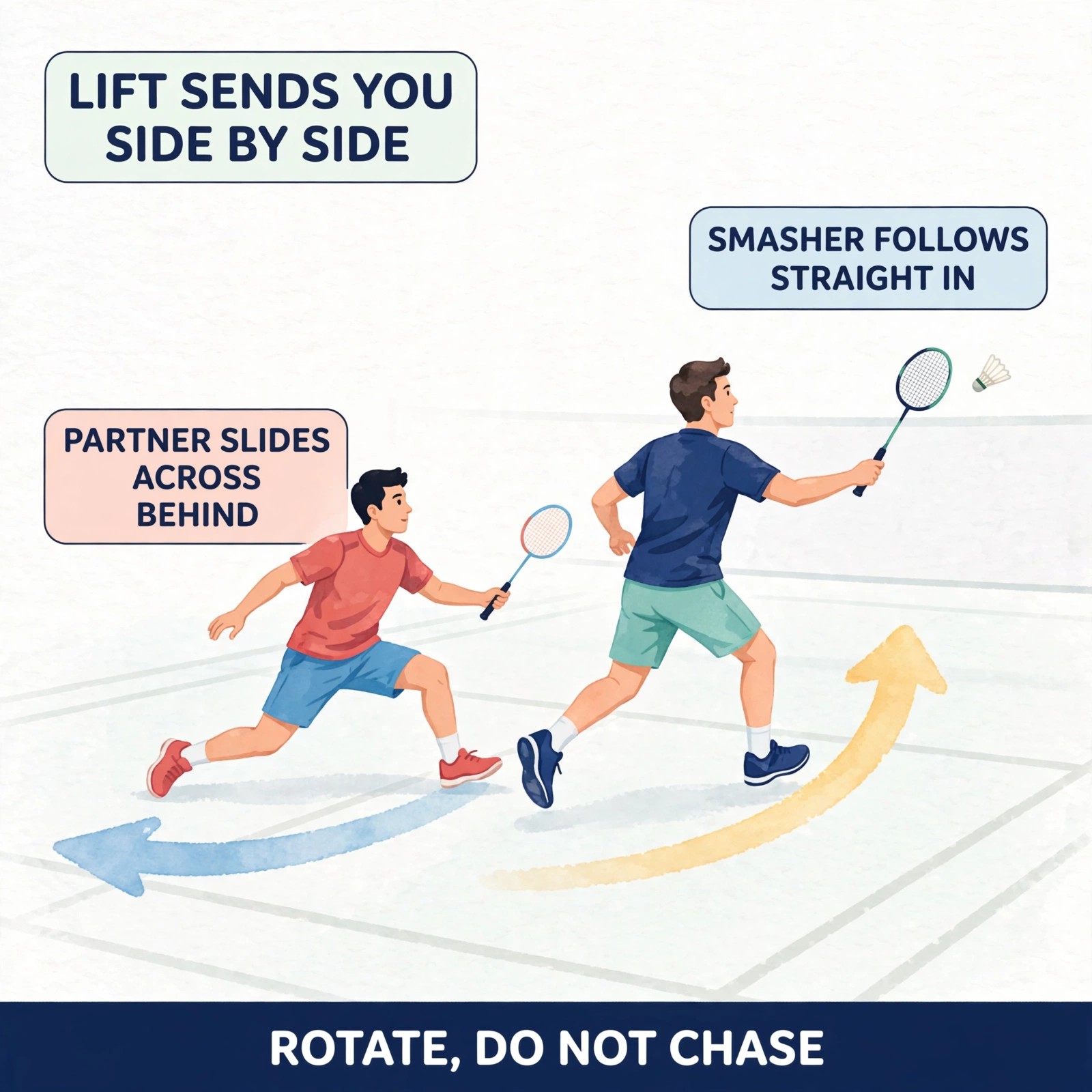
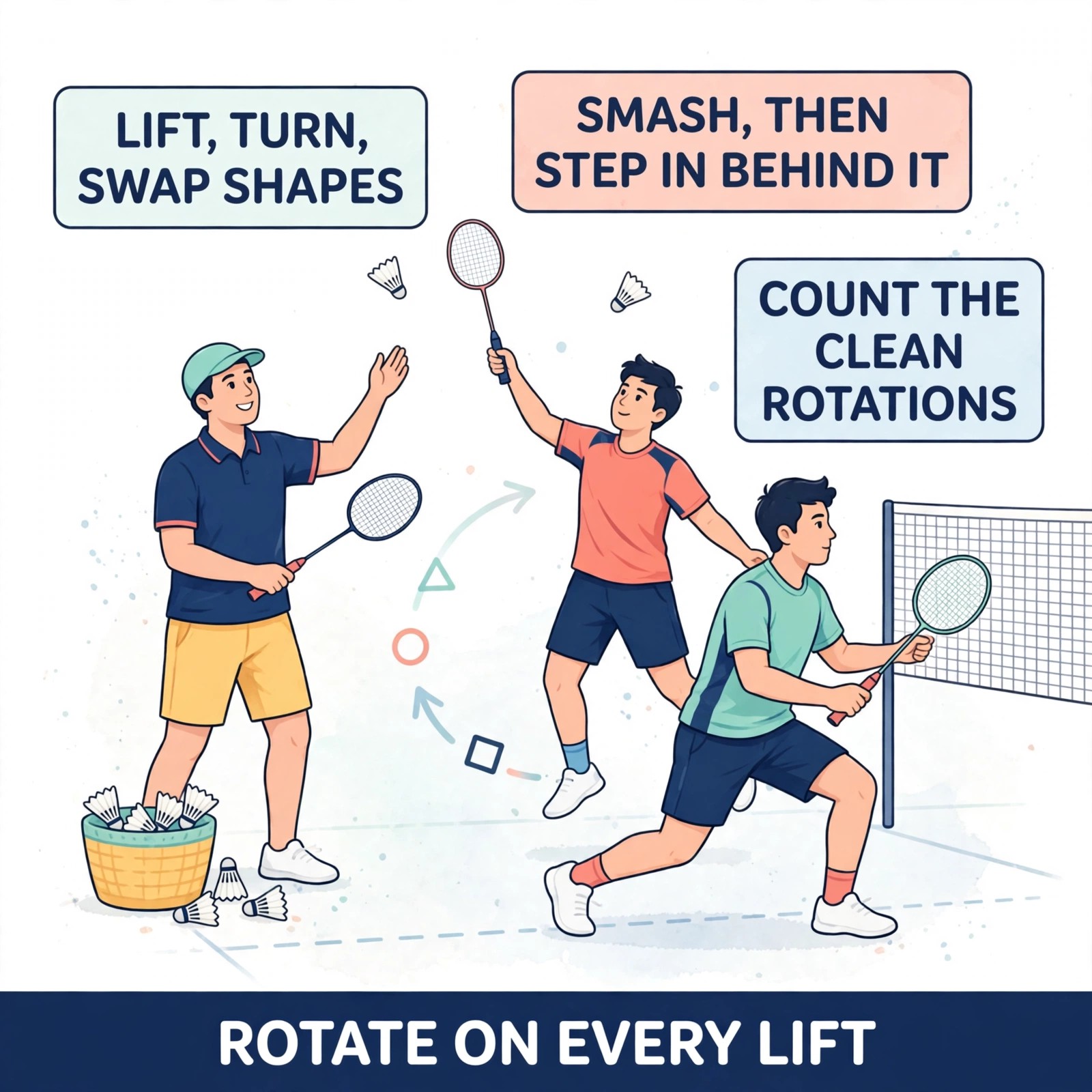
Rotation is how a pair swaps shapes without opening a hole. The rally decides the rotation: when your opponents lift, your pair turns attacking; when your pair is forced to lift, you turn defensive. The movements themselves are small. After a smash, the smasher follows straight in toward the net while the partner slides across and back to cover the rear court. After a lift, the lifter steps back into their defensive half while the partner settles into theirs. Rotations fail when a player chases the shuttle instead of the shape, sprinting after a shot that was never theirs and leaving a corner empty behind them.
Train rotation as a habit, not an idea. In training, run the simple rule out loud until it goes quiet: lift means side by side, smash means follow in, drive means hold and cover. Pairs that rotate well look calm on film, because their movement is small and early. Pairs that rotate badly look busy, because every rotation starts late and becomes a sprint. The difference is rarely fitness. It is whether the pair agreed the rules before the match, and rehearsed them until the feet knew them without the head getting involved. Start slower than match speed when you drill it. Walk the rotation first, then feed it gently, then at rally pace, and only then inside games. A rotation learned slowly survives tired legs and tight scores. A rotation explained once in a team talk usually dissolves the first time a rally runs long, which is exactly when the pair needs it most.
One honest warning about the middle of the rotation: the moment of change is where confusion lives. A shuttle played between two rotating players is the most donated point in club doubles. The cure is the call, covered later on this page, and a standing agreement about the middle ball. Rotation and the middle rule are really one strategy wearing two coats, and pairs should train them together: a lift, a rotation, a middle ball, a call, until the whole sequence runs like one movement.
Pair Check #3
The Middle Ball: Agree The Owner Before The Match
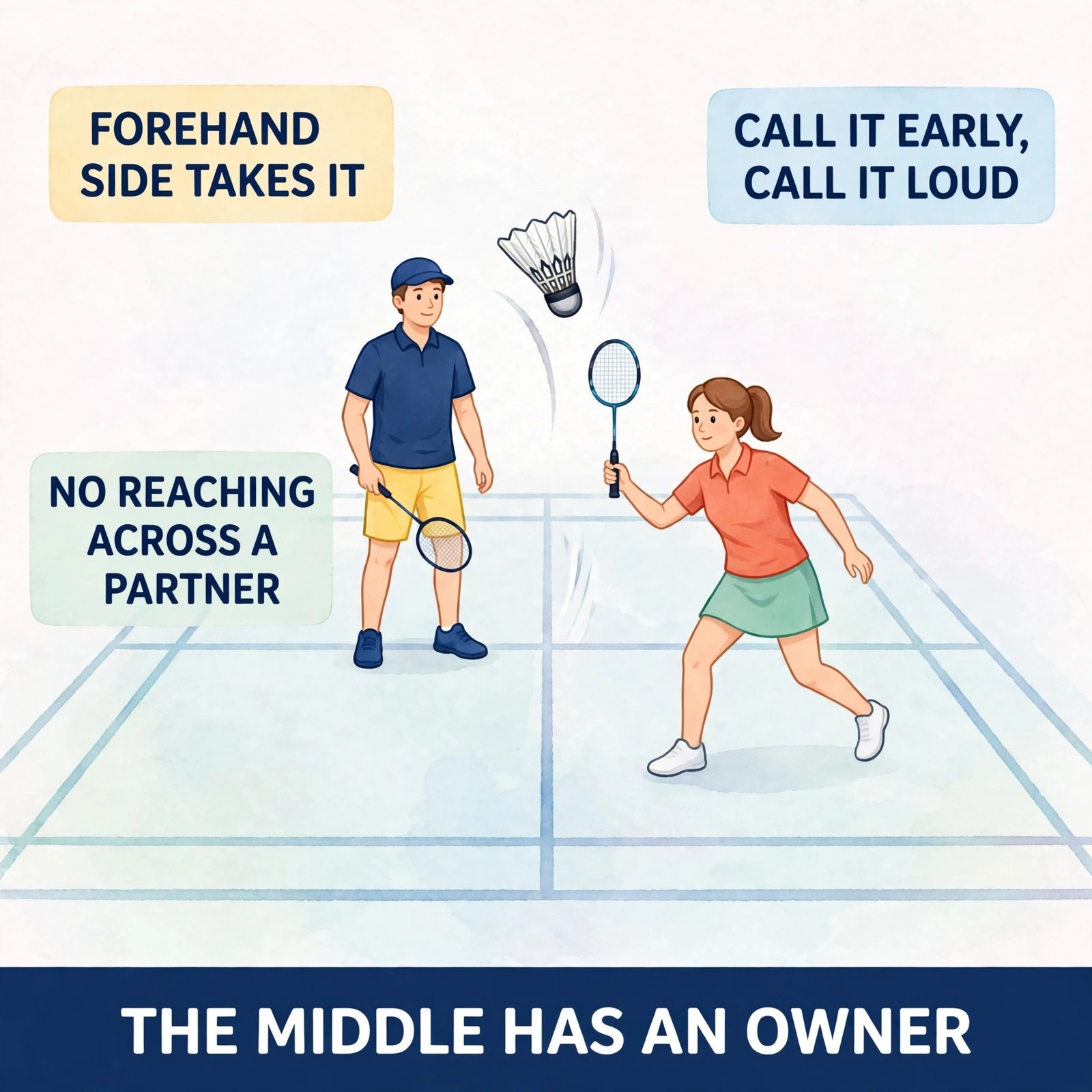
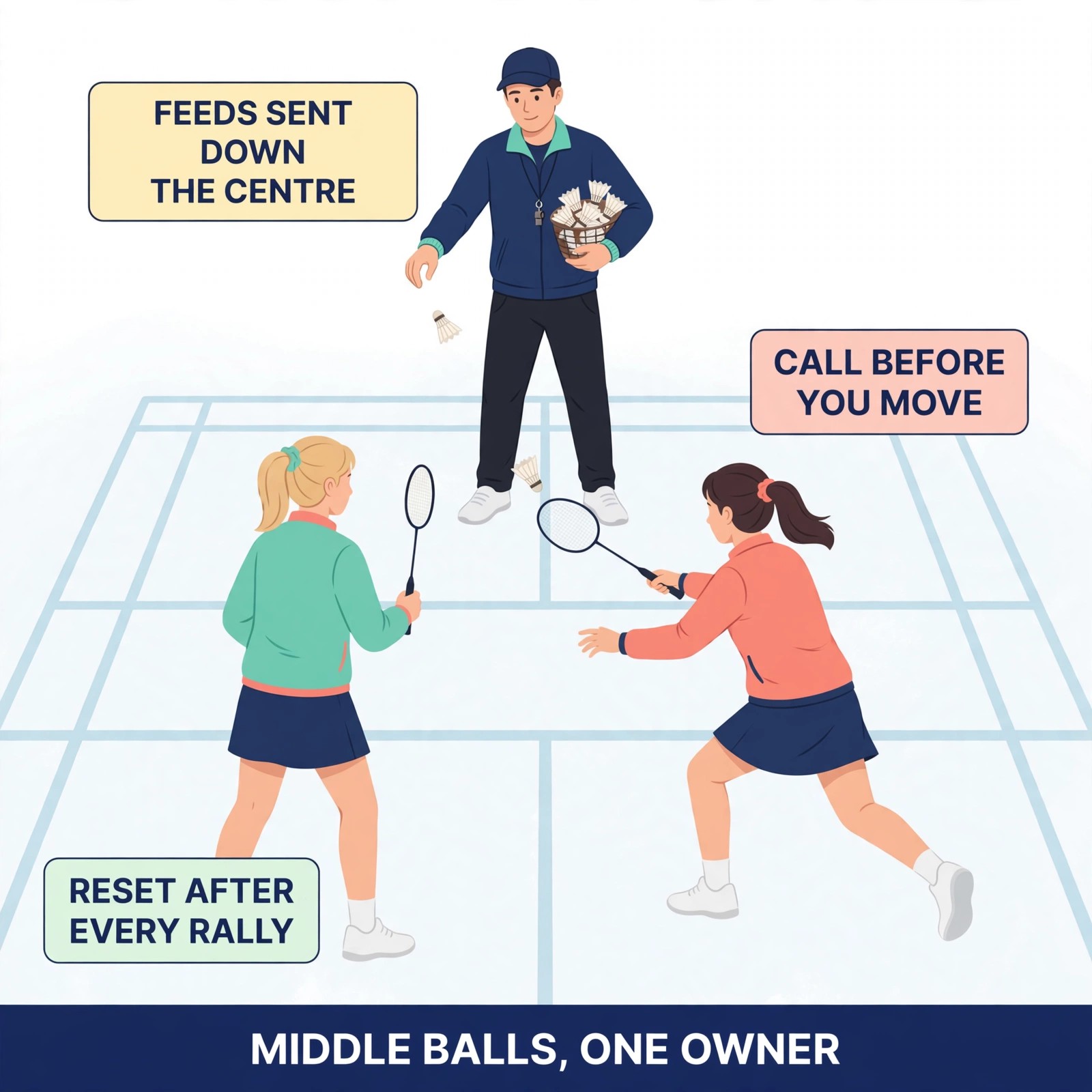
The middle ball is where partnerships go to be tested. A shuttle down the centre channel belongs to somebody, and if the pair has not agreed who, it belongs to nobody: both rackets hesitate, or both swing. The common club rule is simple. The player on the forehand side takes the middle, because the forehand plays the centre channel strongly. Some pairs reverse it for backhand reasons or because one player is clearly quicker; the rule matters less than the agreement. Agree it, say it before the match, and then honour it at full speed, especially tired, especially at the end of a long game.
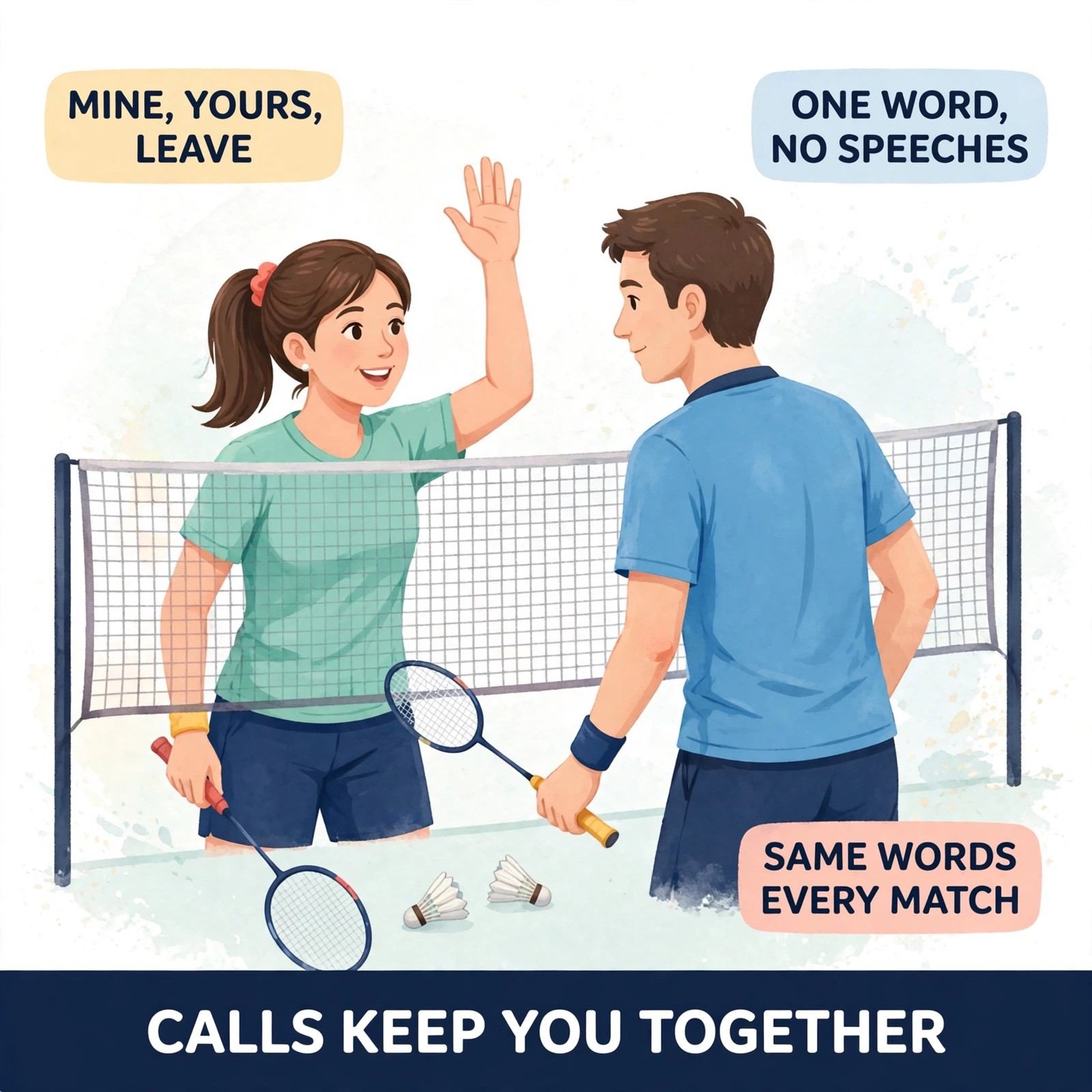
Calling is the second half of the middle rule. The owner calls early and loud: one word, mine, before the shuttle arrives, not during the swing. A call made early lets the partner relax and cover the rest of the court. No call at all should mean the standing rule applies, so silence is also information. What a pair cannot survive is the late, doubtful call, the half word that stops one player and does not start the other. In training, drill the centre channel on purpose: feeds down the middle, one owner, one call, reset, repeat, until the channel stops being an argument. Expect the agreement to feel unfair for a week if it hands your partner balls you used to enjoy taking. That feeling is the sound of the system working. Borderline shuttles stop belonging to the quicker racket and start belonging to the plan, and rallies get longer because fewer of them end in a tangle at the centre of the court.
Reaching across a partner is the middle ball’s cousin. When a shuttle is clearly in your partner’s half and clearly hers by the agreement, your racket stays home, even when you are sure you could reach it. The spectacular rescue looks brave and teaches your partner to hesitate, because she can no longer trust that her court is hers. Pairs get better when each player’s territory is predictable. Take your shuttles fully, leave hers completely, and let the odd borderline ball be settled by the call rather than by whichever racket is longer or louder.
Pair Check #4
Short Calls: One Word That Moves Two Players
Doubles communication is mostly short. The working vocabulary of a good pair fits on one hand: mine, yours, leave, out, and a name or a word for the shape change when a pair wants one. Short calls work because a rally gives nobody time for sentences. A call is a movement instruction, delivered early enough to act on. Pairs should agree their words in training and then use exactly those words in matches, because a new word invented mid match is a half second of translation nobody has.
Talk between rallies matters as much as calls during them, and it should stay just as short. One piece of information, said plainly: they are lifting everything to your backhand, or the front player is standing too far from the net. Then the next serve. Long conferences between points usually carry frustration rather than information, and frustration is catching. The pair that talks best is not the pair that talks most. It is the pair whose few words are always about the next rally, never about the last one’s blame. Keep the same tone you would want aimed at you at 19 all. Partners play the next rally with the last sentence still in their ears, so make the sentence useful: short, factual, and pointed at the game rather than at each other. Pairs who protect each other’s confidence between points spend their attention on opponents, where it belongs.
Partners should also agree what silence and body language mean. A partner who goes quiet after errors may be concentrating, or may be sinking, and the pair does better when that is known in advance rather than guessed at 18 all. Agree a small reset habit for the bad patches too: a tap of rackets between points, a breath, the next serve taken slowly. None of this is decoration. Doubles is two nervous systems trying to act as one, and the pairs that plan their communication simply have fewer arguments with themselves during matches.
Pair Check #5
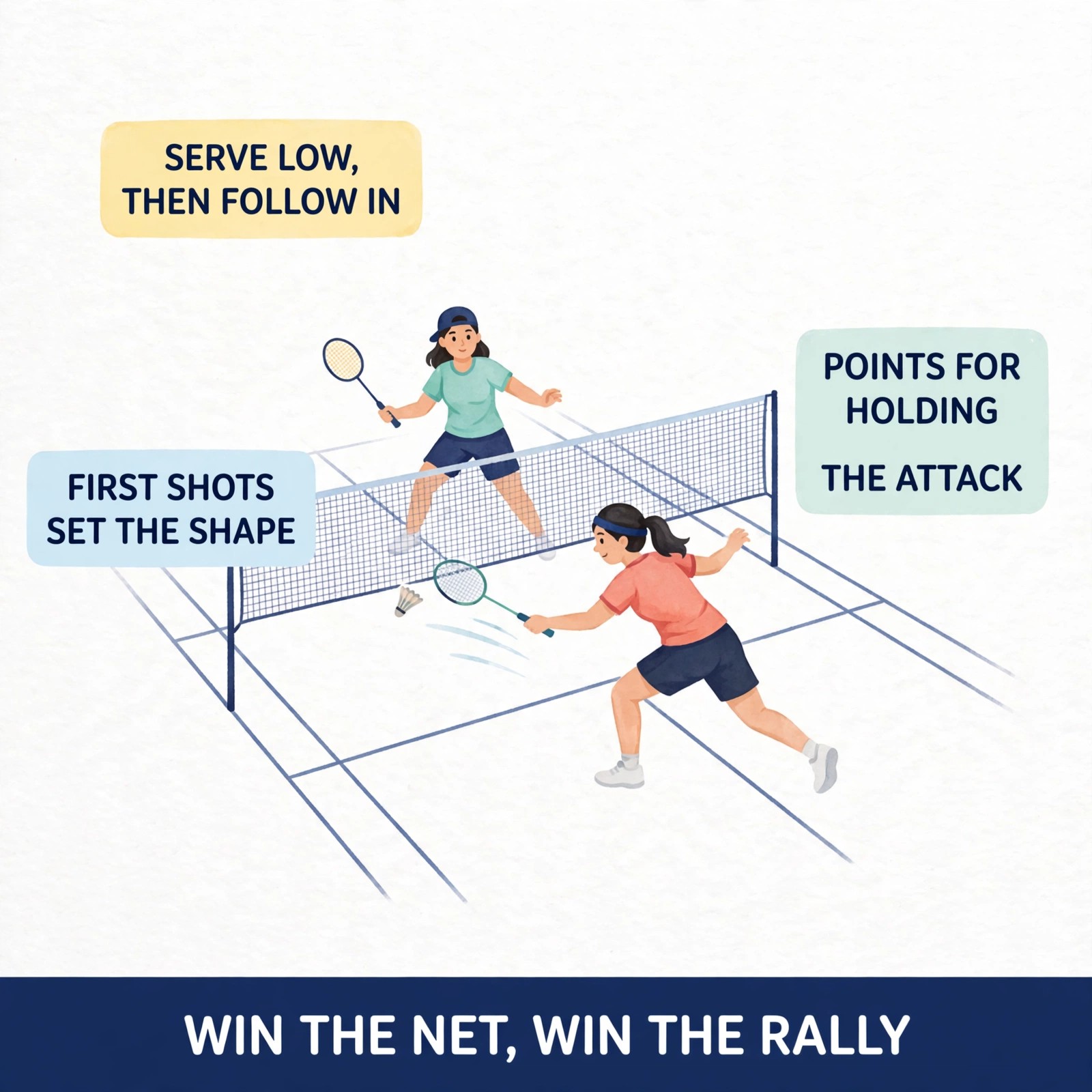
The Serve And The First Three Shots Set The Shape
Under rally scoring, every serve can win a point, and the doubles serve has its own discipline. It must travel upward from below 1.15 metres and land inside the short, wide service box, which makes it a precision shot, not a warm up. The serving pair’s first job is a low serve that gives nothing away, because the receiver’s partner is hunting at the net and a loose serve is finished before the rally starts. Serve mostly to the front corners of the box, vary the target enough to stay unreadable, and treat the flick serve as a surprise with a cost, not a habit.
The first three shots of the rally decide which pair gets the attacking shape, so train them as a unit. Serve, return of serve, third shot: the receiver attacks the serve, the server’s partner protects the net, and the pair that wins that small fight usually owns the rally’s shape from there. In training, play games that start points at the third shot, or award double points for rallies won after a good low serve. Pairs often practise long rallies and almost never practise their beginnings, then wonder why every match starts at a disadvantage the rest of the rally must repay. Returners should practise with the same seriousness: a low, tight return that attacks the serve, or a push that turns the serving pair around. The receiver who treats the return as a real shot, rehearsed rather than improvised, hands their partner an attacking shape within two shots. Matches between even pairs are often decided in these small beginnings long before anyone notices a rally worth remembering.
Putting it together, a good pair training session looks ordinary from outside and is specific from inside. Rotation patterns with a feeder. Centre channel feeds for the middle rule. Serve and third shot games. Shape discipline inside every conditioned game. Then open games where the coach counts shape errors, not just winners. Doubles rewards the pair that has decided the most things in advance: shapes, rotations, the middle, the words, the serve plan. Decide them in training, rehearse them until they are boring, and matches become the place where two players simply do what they agreed.
Myth vs Reality
Myths About Doubles Pair Play
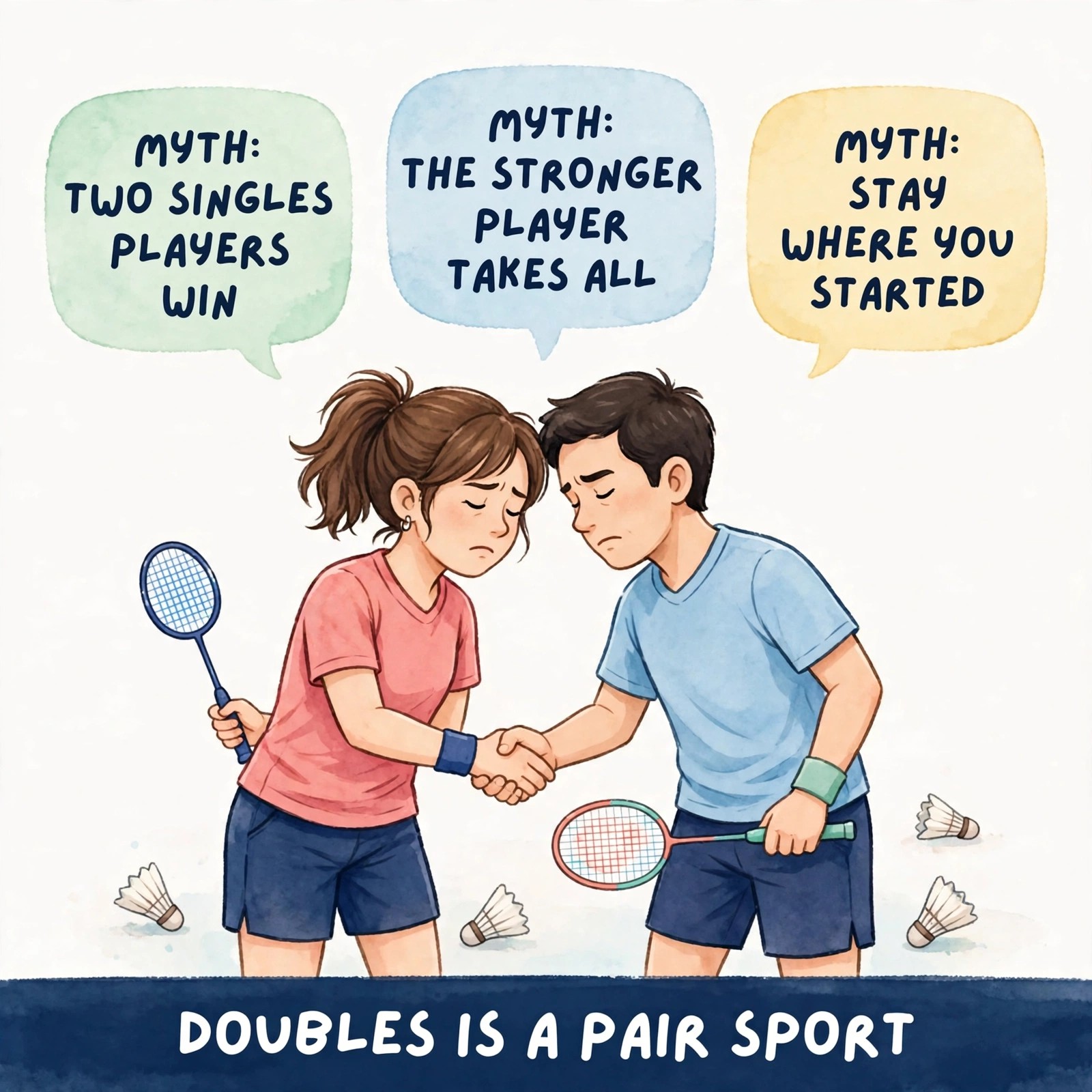
Doubles talk collects myths like every corner of the sport. The first says two strong singles players automatically make a strong pair. The second says the stronger player should take as much of the court as possible. The third says partners should stay where they started, one at the front and one at the back, for the whole match.
Watch what each myth does on court. The two singles players chase the same shuttles, leave the same corners, and play a rally as two private matches sharing a scoreboard. The stronger player who takes everything creates a partner who stops moving, then gets blamed for standing still. The fixed positions pair defends smashes with one player standing at the net, watching, while the back player covers a whole court alone. Every one of these myths survives because it contains a grain of comfort: it asks nobody to learn the pair game itself.
The honest position is plain. Doubles is a separate skill built on a small number of agreements, rehearsed until they hold under pressure. Singles skill helps, the stronger player matters, and everyone has favourite zones. But the pair’s shape, rotation, middle rule and calls are the game within the game, and pairs that train them beat pairs that merely own bigger shots. If your doubles results have stalled, do not start by upgrading a shot. Start by auditing the agreements.
Why Choose Us
Why Players Choose ST Badminton Academy
At ST Badminton Academy, doubles is coached as pair craft, not as two singles lessons side by side. Groups are capped at four students, which suits doubles teaching well: the coach can work with whole pairs, watch the rotation as it happens, and correct the shape at the moment it breaks. Partners learn the two shapes, the rotation rules and the middle agreement as one system, with the same short calls used by every pair in the session.
Pair habits are coached like skills. Feeds down the centre channel. Serve and third shot games. Rotation counted out loud before it is trusted silently. Feedback is aimed at the pair’s system, one correction at a time: whose ball that was, which shape the rally needed, where the rotation started late. Players also learn to be good partners in the room: honest calls, no blame between points, and a reset habit for the bad patches that every pair meets.
That standard runs across our Kuala Lumpur sessions for kids, teens and adults. Junior pairs learn the shapes early, before habits harden into two solo games. Adult pairs, many playing social doubles around work, get the agreements that make club nights better: a middle rule, a rotation, words that work at full speed. Bring your regular partner, or come and be paired, and feel how much calmer a rally becomes when both players know where the other one is going.
FAQs: Doubles Play and Pair Training in Malaysia (KL)
Doubles questions are usually pair questions: whose ball, which shape, what to say. Here are the answers we give on court.
How can I improve my doubles play if I live in Setapak or Gombak?
Start with the pair agreements, because they travel to any hall: the two shapes, the rotation and the middle rule. Then find a regular partner and train those agreements weekly, in drills first and games after. At our sessions the coach works with whole pairs, so your rotation and calls are corrected as a team, not separately.
What should a doubles pair agree before their first match in KL?
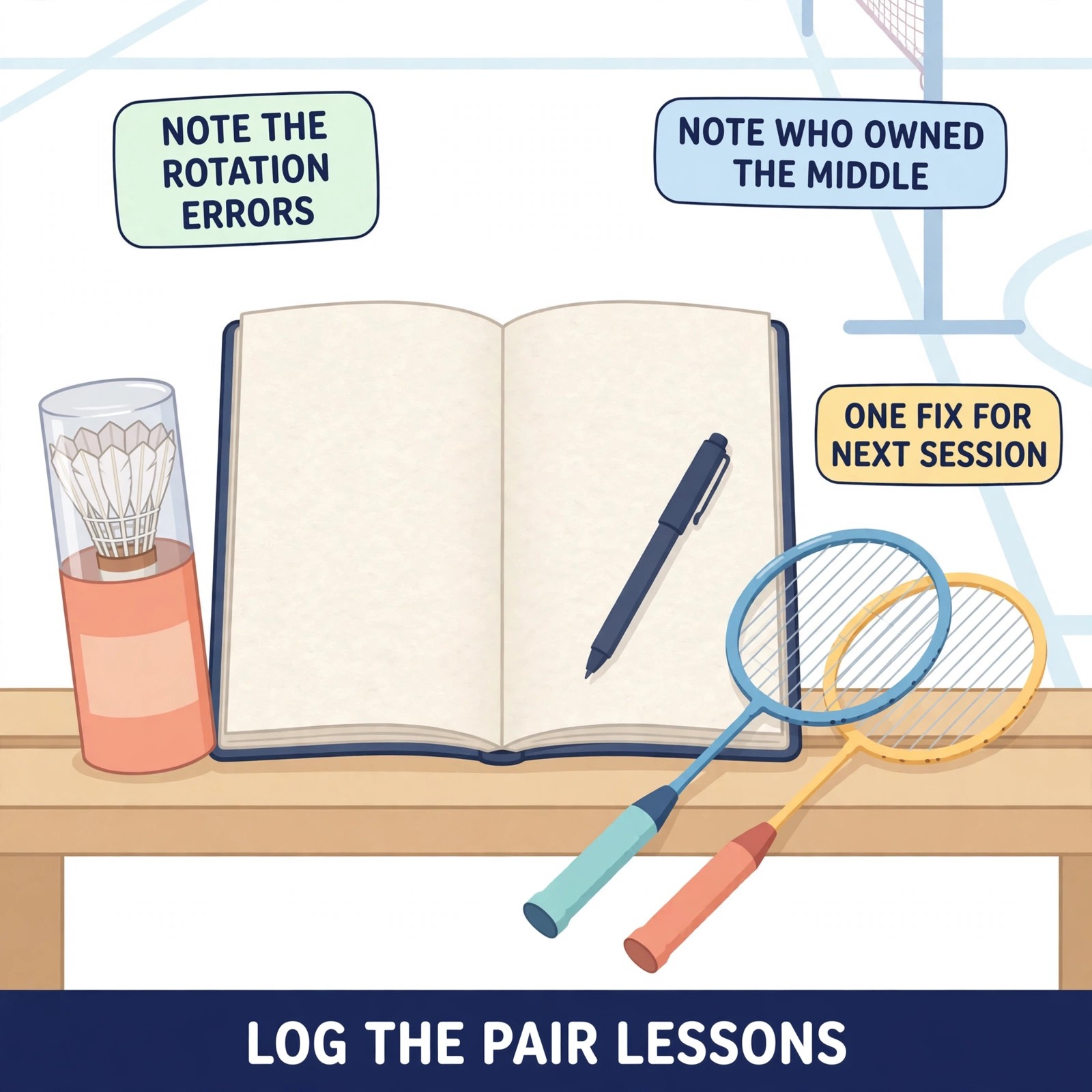
Four things, in this order: who takes the middle ball, what your calls are, how you rotate after a lift and a smash, and where the serve goes on the first points. Write them down, warm up with them, and review them between games. Pairs who agree these four rarely argue about a rally afterwards.
How often should a doubles pair train together to reach a steady level?
Twice a week together is a strong rhythm for most pairs: one session for drills, rotation patterns and the middle rule, one for games where the agreements get tested. One session a week still builds a pair, only slower. What matters most is that both players attend the same sessions, so the agreements stay shared.
My partner and I keep colliding in the middle. Whose fault is it when we both go for the same shuttle?
Usually neither player’s: it is a missing agreement. Set the standing rule that the forehand side takes the centre channel, practise it with feeds down the middle, and add one early call: mine. Collisions nearly always stop within a few sessions once the rule exists, because both players finally know what the other one will do.
Should the stronger player take more of the court in doubles, or hold their own zone?
No, and it usually backfires. When one player takes everything, the other stops moving, the covered court actually shrinks, and opponents aim at the passenger the pair has created. Agree territories by the shape instead: front or back when attacking, a half each when defending. Strong players help most by holding their job and feeding their partner confidence.
Do you coach doubles pairs near Wangsa Maju?
Yes. Our Kuala Lumpur sessions welcome established pairs and players who arrive without one. Because groups are capped at four students, a pair trains as a unit: shapes, rotation, the middle rule and serve plans, with the coach watching both players at once. Bring your partner along if you can; the agreements are learned twice as fast together.
Does your academy coach doubles for adult social players in Malaysia?
Yes, and adult social players are some of our favourite doubles students, because the pair agreements transform club nights quickly. Sessions run for adults in Kuala Lumpur in groups of no more than four, mixing pair drills with conditioned games. You will work on shapes, rotation, calls and serve plans at a pace that suits working players.
Can I book a trial session in Kuala Lumpur and bring my doubles partner?
Yes, and bringing your partner is the best way to use a trial. Train together in a group of no more than four, and the coach will watch your pair’s shapes, rotation and middle ball, then set your first agreements before you leave. Come as you are; the session is a working training hour, not a test.
What makes Mr Eric Chuar a suitable coach for doubles badminton?
Mr Eric Chuar coaches the academy sessions himself, with over 15 years of coaching in Kuala Lumpur. For doubles he teaches the pair as one unit: shapes, rotation, the middle rule and short calls, correcting both players in the rally where the shape broke. His pairs learn agreements they keep using at their own clubs long after the session ends.
Doubles Pair Training in Action
One Standard for Every Session and Every Player
Our doubles standard for every pair is plain: two shapes known by both players, a rotation rehearsed until it is quiet, the middle ball owned by an agreement and a call, and talk that stays short and kind between points. A new pair in their first month and partners of five years train under the same standard, because doubles is not two players sharing a court. It is one plan carried by two people.
| Factor | Two Singles Players | A Real Pair PAIR |
|---|---|---|
| Frequency | 1 or 2 times a week. Mostly for fun and sweat. | The pair holds two shapes: front and back to attack, side by side to defend, and swaps between them without a gap. |
| Drills Focus | Basic static feeding. Minimal footwork pressure. | Rotation is rehearsed, the middle ball has an owner, and one early call settles every borderline shuttle. |
| Physical Conditioning | Rarely included. Just playing games on court. | Core, agility, and speed training included in every session to prevent injury and build stamina. |
| Tactical Awareness | "Just hit it over." No real game plan. | Video analysis, point construction, and learning to read the opponent's game. |
| Coach Ratio | Large groups (8-10 kids). Coach barely watches you. | Max 4 students. Mr Eric Chuar personally corrects every stroke and movement detail. |
| Goal Setting | Fun and exercise. | The serve is low and planned, and the first three shots are fought for as one unit. |
| Long Term Result | Good recreational player. | A pair playing one plan: fewer collisions, calmer rallies, and late points that look like the early ones. |
Doubles Badminton Training in Kuala Lumpur
Come and build a pair properly. Book a trial session in Kuala Lumpur, train in a group of no more than four, and learn the shapes, rotation and middle rule with a partner beside you. Bring your regular partner if you have one; come alone if you do not, and we will pair you. You will leave with your first agreements set and a calmer game to take back to your club nights.






