Badminton And Speed: Exercises For Improving Quickness And Reaction Time (Speed Guide)
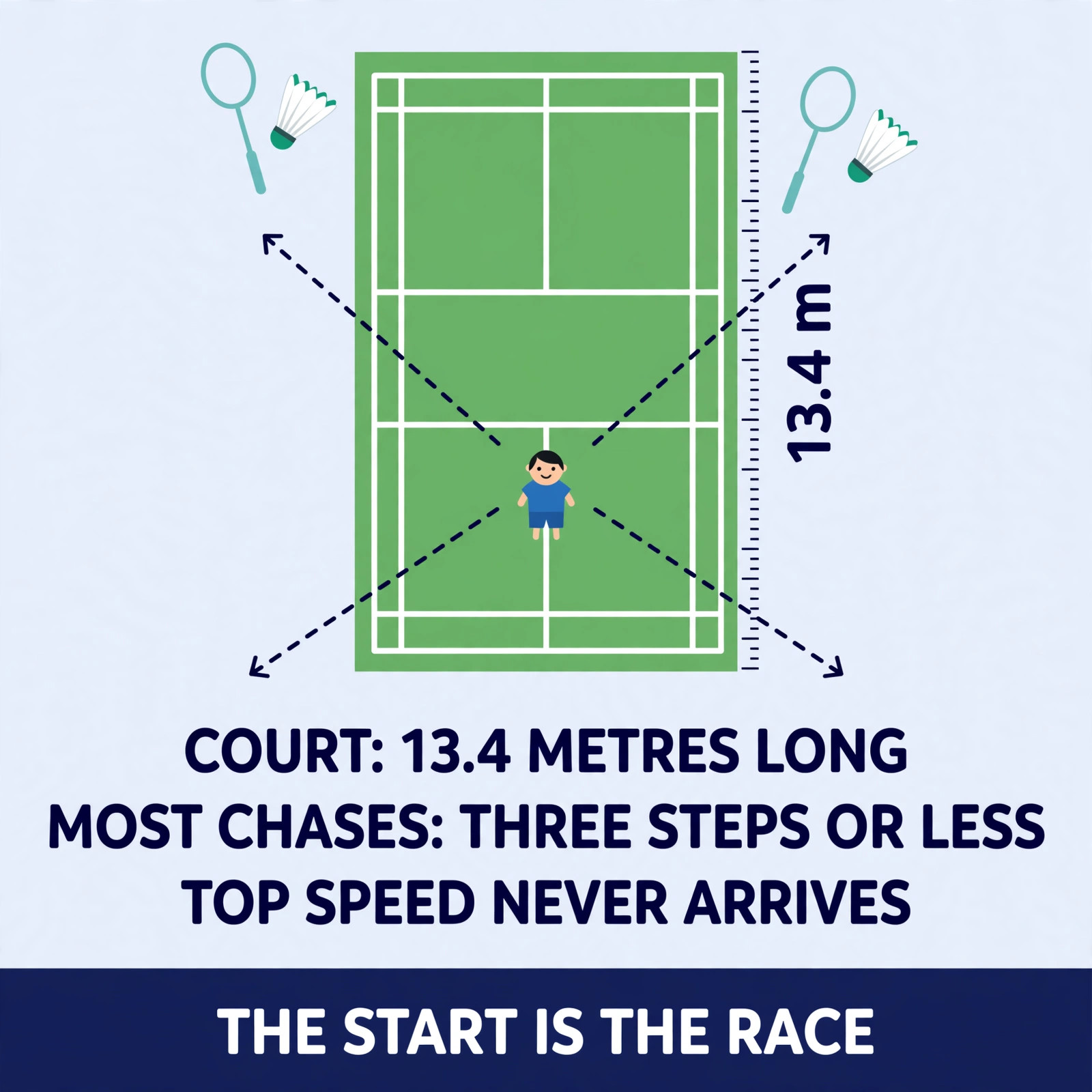
Watch two club players chase the same drop shot and the difference is rarely leg power. One player is moving before the shuttle crosses the net, the other starts after it lands in his half. Court speed in badminton is mostly start speed: how early you begin, and how good your first three steps are. The court is only 13.4 metres long, so nobody reaches top speed on it. This page covers the parts that actually make a player quicker on court: the split step start, short bursts between the lines, the rest that makes speed work real, light feet drills, and where speed work sits in a training week.
Speed Check #1
Speed Starts With the Split Step and the First Step
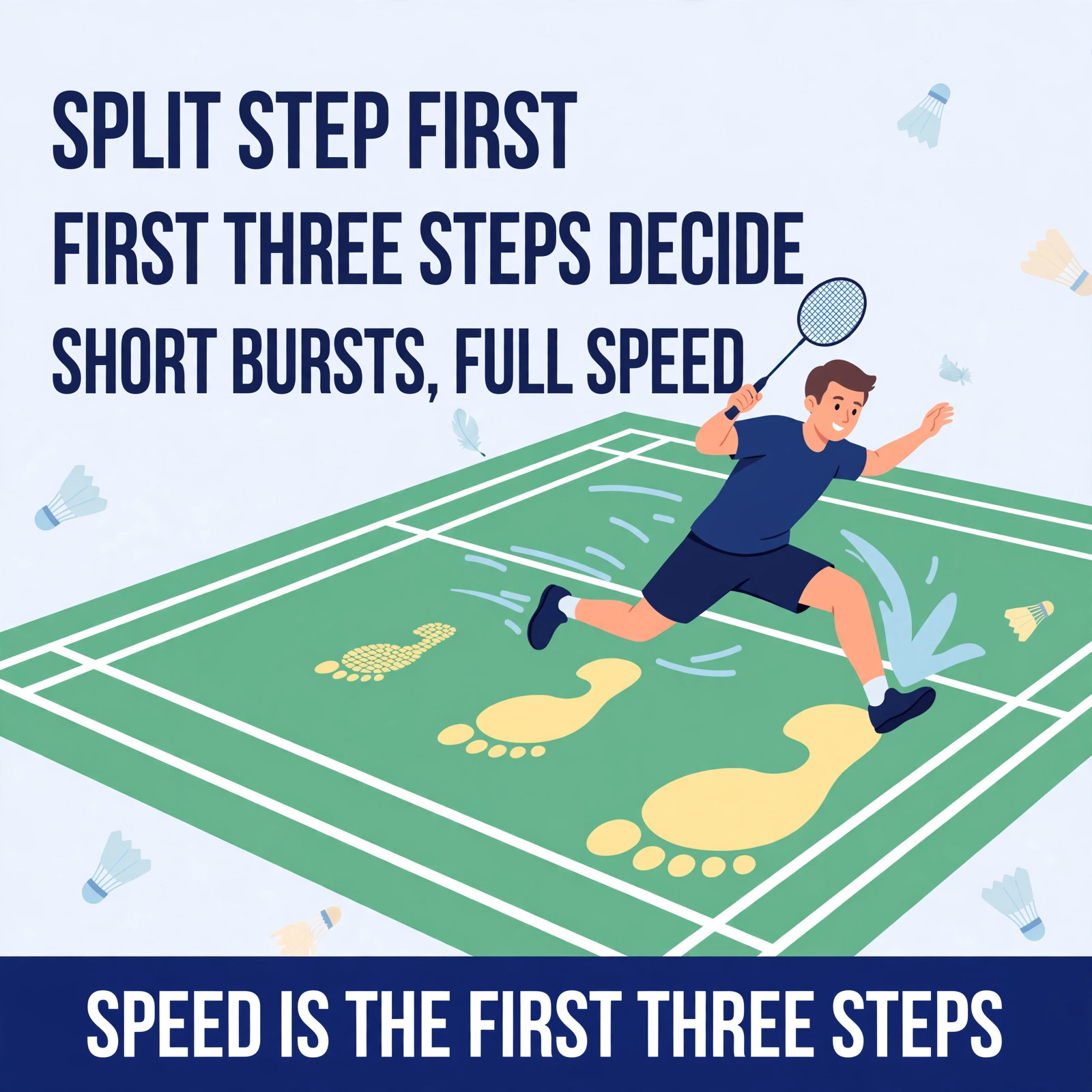
From base position, the front corners of the court are about three steps away and the back corners are a turn and a few more. That means most chases in a rally are decided inside the first three steps. If the first step goes the wrong way, or starts late, or begins with a step backwards to gather balance, the remaining steps cannot rescue the shot. You end up lunging at full stretch, playing whatever you can reach instead of the shot you wanted. Good players are not fast everywhere. They are fast in the first moment, and that moment is trainable.
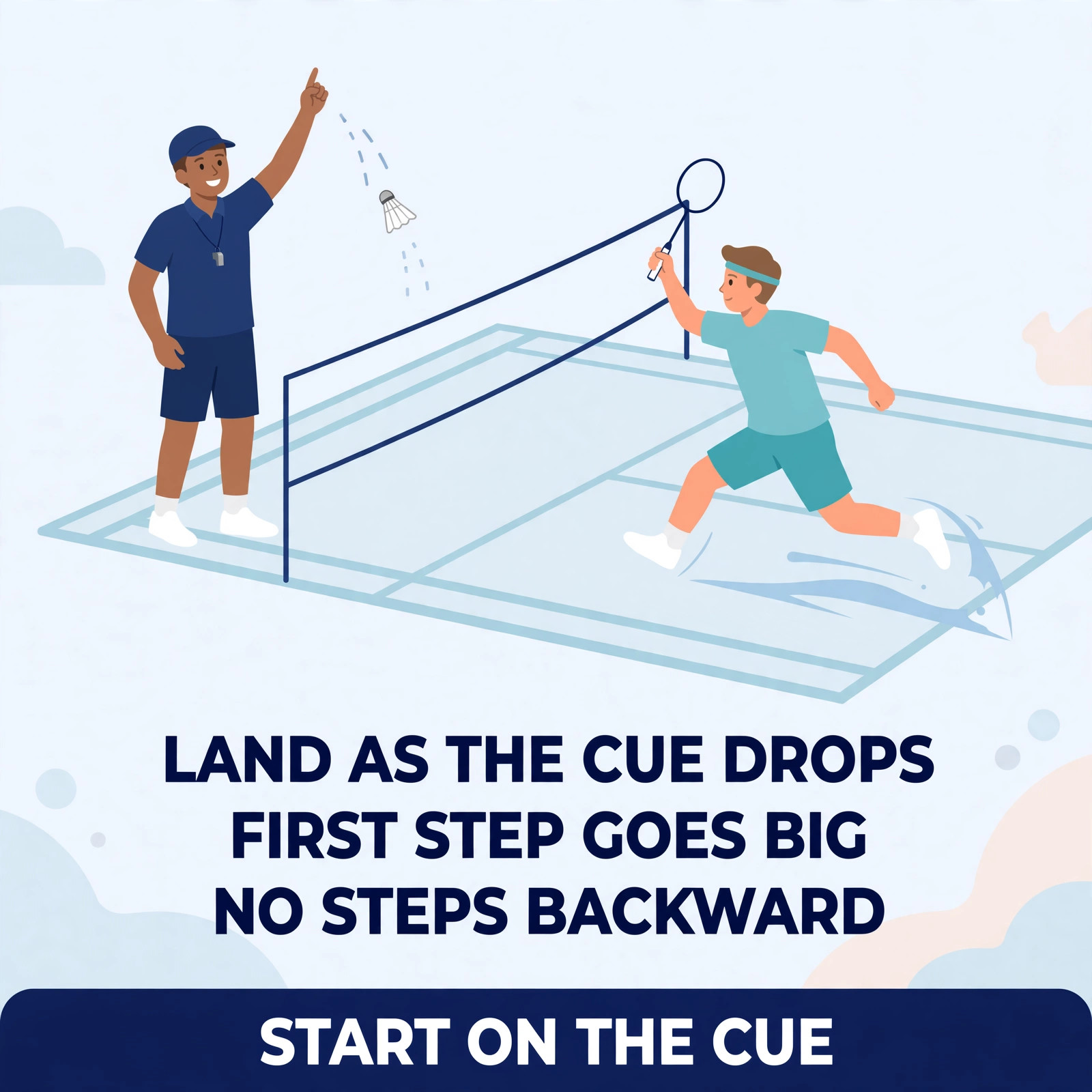
The start begins with the split step: a small, light landing on both feet just as your opponent strikes the shuttle. It loads your legs like springs at the exact moment the direction becomes clear, so your first step pushes off instead of starting from standing. The first step should be big and aimed, not a shuffle. The second and third steps are quicker and lower, and then the recovery steps bring you back toward base. Speed on court is a chain of these pieces. Break the first link and the whole chain drags, however strong your legs are.
Speed Check #2
Short Bursts Between the Lines
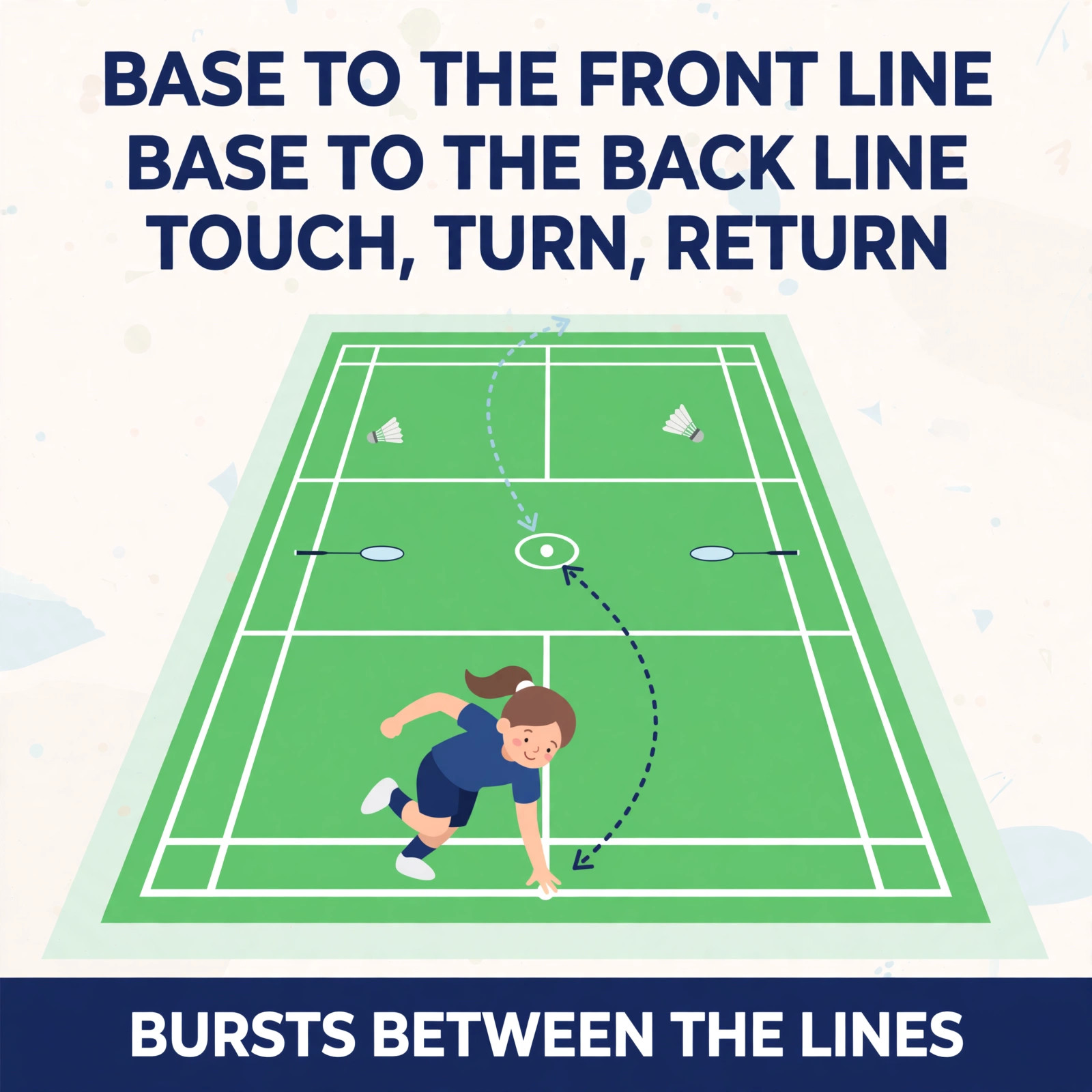
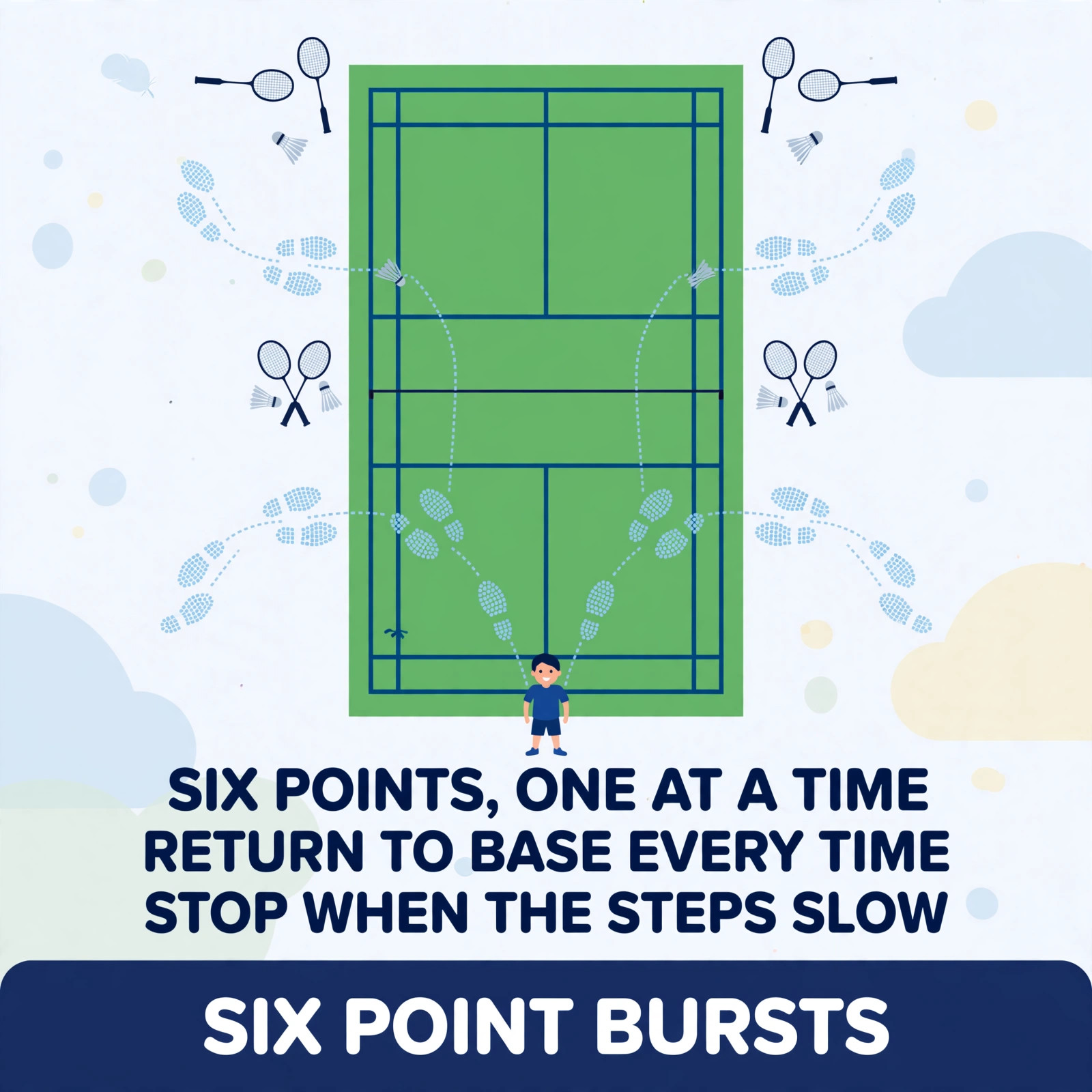
The core speed drill on a badminton court is a short burst between the lines. Start at base, burst to the front service line, touch it low, and push back to base. Then burst to the back boundary line and return. Then work the six points of the court one at a time: both front corners, both sides, both back corners. The distances are short because the court is short. Every burst lasts a few seconds at full effort, and every burst ends back at base, because that is how rallies actually work.
Run the bursts one direction at a time while you are learning them. Walk back slowly between reps and let your breathing settle. Quality is the whole point: a burst where your steps slow down, your feet slap the floor or your posture stands up tall is no longer speed work, it is just tired running. Stop a set while the steps are still fast and clean. Three to five good bursts teach your legs more than fifteen fading ones, and they leave you able to do the next set properly.
Once the patterns are clean, add uncertainty. A partner points to a corner, or drops a shuttle as the start signal, and you burst on the signal rather than on your own count. This is where reaction joins speed: the shuttle does not wait for you to feel ready in a rally, so the drill should not either. Keep the feeds honest, one signal at a time, with a real rest after each burst. Reaction work done in a rush turns into guessing, and guessing is just another way of starting in the wrong direction.
Speed Check #3
Full Recovery Is What Makes It Speed Work
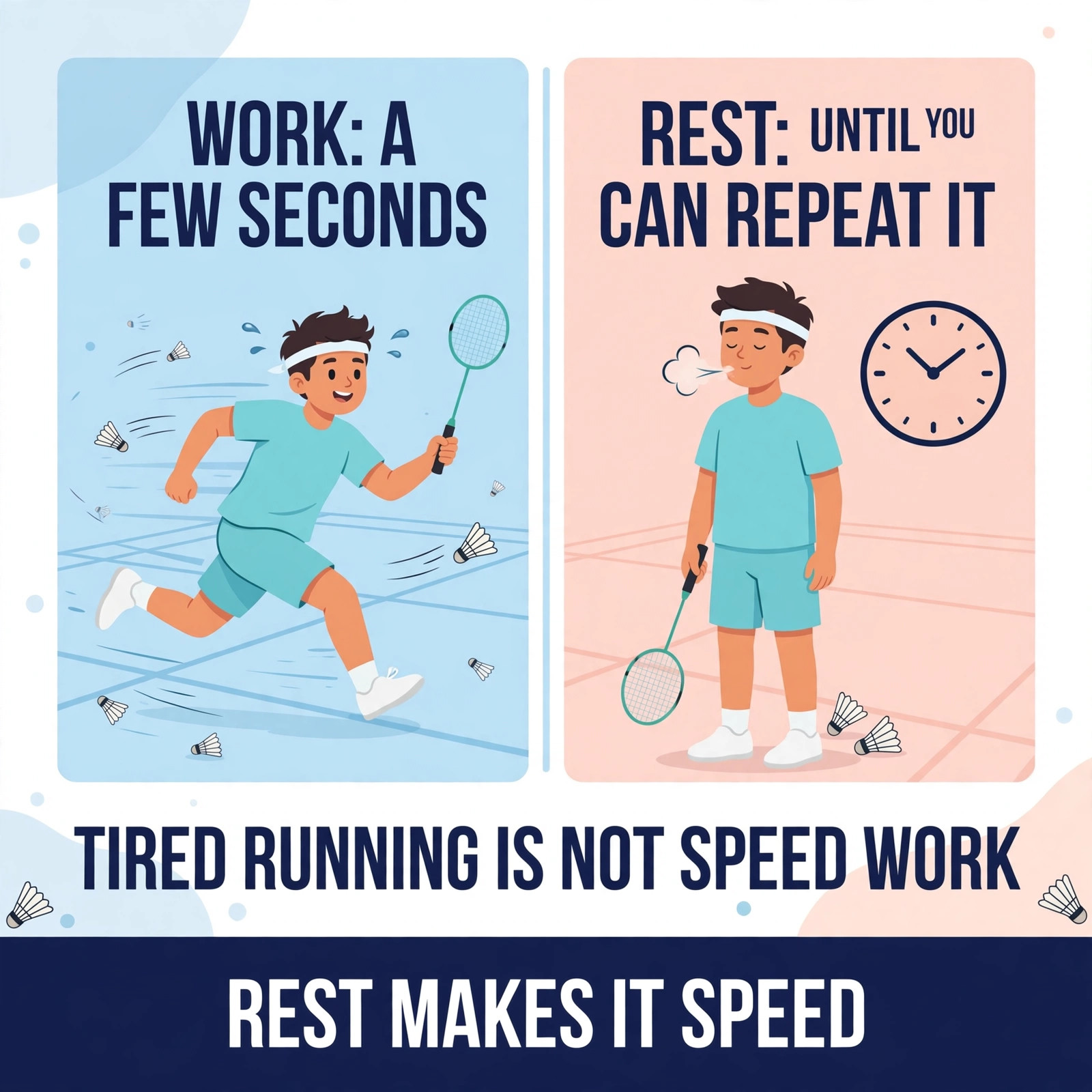
Rest is what separates speed work from conditioning. A burst of a few seconds uses your fastest energy system, and that system needs time to refill before it can fire at full power again. If you start the next burst half recovered, your steps are slower, and you are practising slower steps very thoroughly. The simple rule: rest until you believe you can repeat the same time. For most short court bursts that means a rest many times longer than the burst itself, walking and breathing, not standing with hands on knees.
A typical speed block is short. After a full warm up, ten to fifteen minutes of bursts, hops and starts, with generous rests, is plenty for most club players. The total distance covered is small, and that is correct: you are training the quality of the first steps, not mileage. If you want a fitness session, do one later, separately, and call it what it is. Mixing the two in the same block usually gives you neither: steps too slow to be speed, rests too long to be fitness.
Learn to read the signs that your rest is too short. Your burst times drift upward. Your landings get loud. Your first step shrinks and your chest rises instead of staying low and loaded. These are not character flaws, they are information: the fast system is empty. Lengthen the rest, or end the block and bank the good work you have done. The players who get faster across a season are the ones who protect the quality of every rep, session after session, instead of proving toughness once and training slowly for a month.
Speed Check #4
Light Feet and Spring: Skipping, Hops and Ladder Work
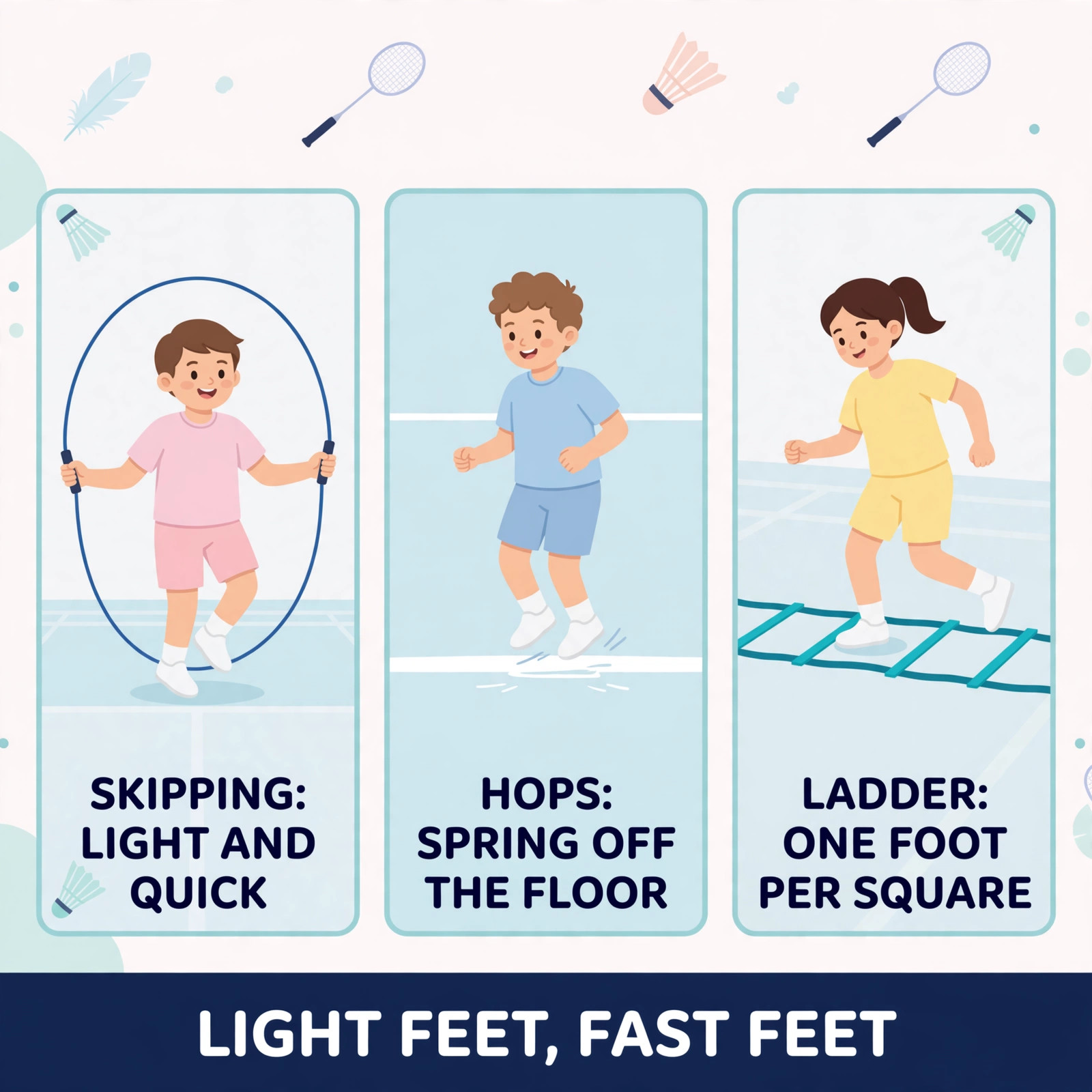
Skipping belongs in speed training because it teaches quick, light contact with the floor. A player who skips quietly, landing on the front of the foot and leaving the ground quickly, is rehearsing exactly the contact a fast first step needs. Keep sets short and bouncy rather than long and grinding. Two feet, then one foot, then travelling forward along the court lines. The rope is a teacher here: it punishes heavy, flat landings instantly, and rewards rhythm, which is why coaches keep using it long after players think they have outgrown it.
Hops and small jumps build the spring in the step. Start with low two foot hops over a court line, forward and sideways, landing soft and quiet. Add single leg hops only when the landings stay controlled, a few contacts at a time. The goal is a quick rebound off the floor, not height records: the floor should feel like it pushes you back up. Keep the volume low and the landings tidy, and stop the moment the landings turn heavy, because tired hopping teaches exactly the slow, flat contact you are trying to remove.
Ladder drills polish the patterns your feet use between the big steps: in and out steps, sideways shuffles, quick turns. Run one foot in each square with your eyes up, not staring at your feet, and learn the pattern slowly before you chase speed through it. The ladder is support work, not the main course. It cannot replace bursts on a real court, because the court asks for big first steps, not just busy feet. Use it to tidy your coordination, then take those tidy feet back to base and test them on the six points.
Speed Check #5
How Speed Work Fits the Training Week
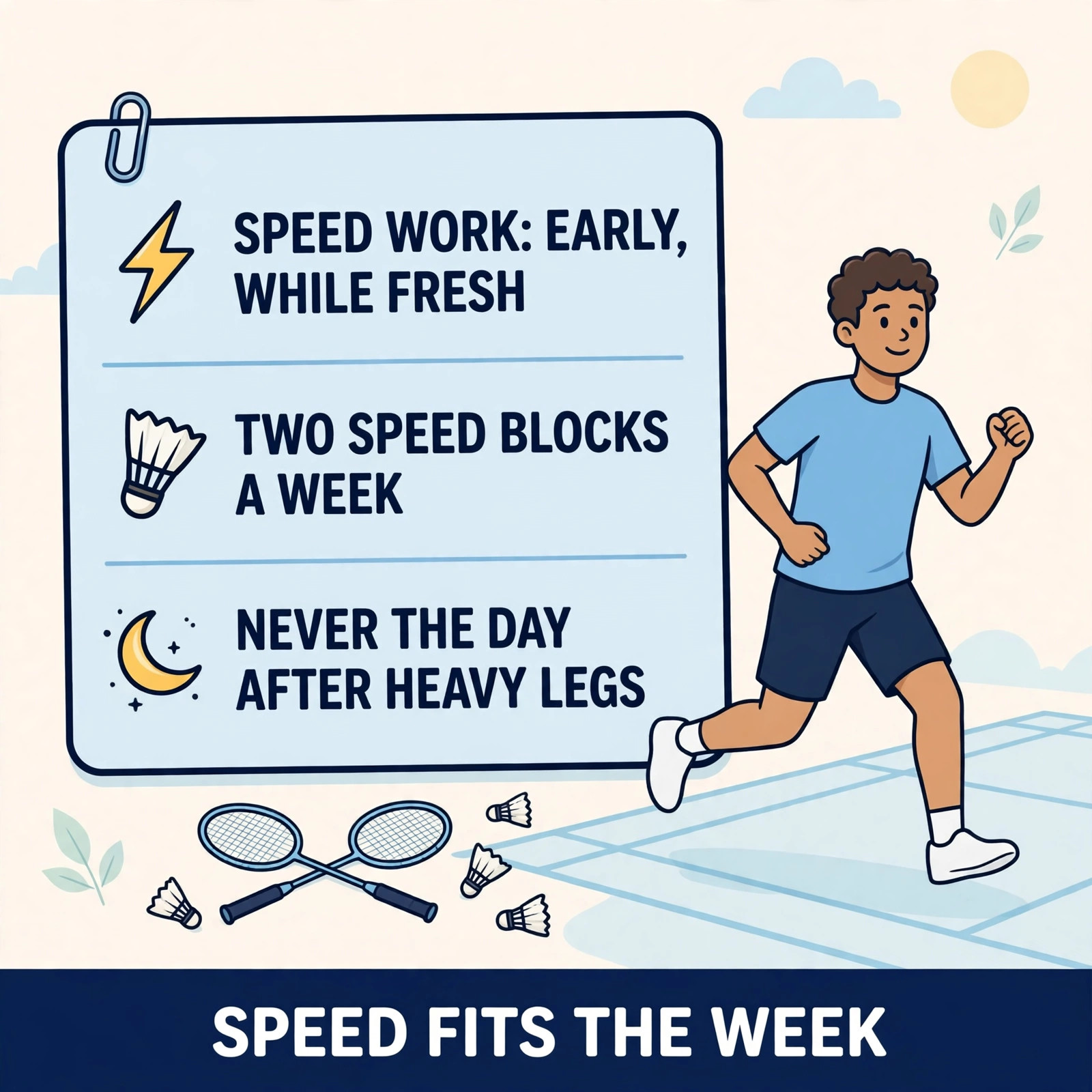
Speed work belongs early in a training session, straight after the warm up, while your legs and mind are fresh. Everything about a first step gets worse under fatigue: the split lands late, the push weakens, the steps shorten. A player who does speed drills after two hours of rally play is practising tired movement and calling it speed. Put the fast work first, then let technique, rallies and fitness fill the rest of the session. That order alone makes many players quicker within weeks, with no extra drills at all.
Two speed blocks a week is a good rhythm for most players. Speed adapts to short, sharp, regular practice, and it fades fast when every session is run on tired legs. Between the blocks, your normal court training still uses the starts you are building, so the work carries over. If you play matches at the weekend, place the sharper block early in the week and let the second one be lighter, so you arrive at the match with your legs feeling springy rather than drained.
Plan speed and heavy leg work as one budget. A hard squat session and a speed block on back to back days is a reliable way to train slowly twice. Put at least a day between your heaviest leg training and your fastest court work, and treat sore legs as a reason to move the speed block, not to push through it. Coaches look at the whole week, not single sessions: court days, speed days, strength days and rest days each protect the others when they are spaced with a little common sense.
Myth vs Reality
Myths About Court Speed
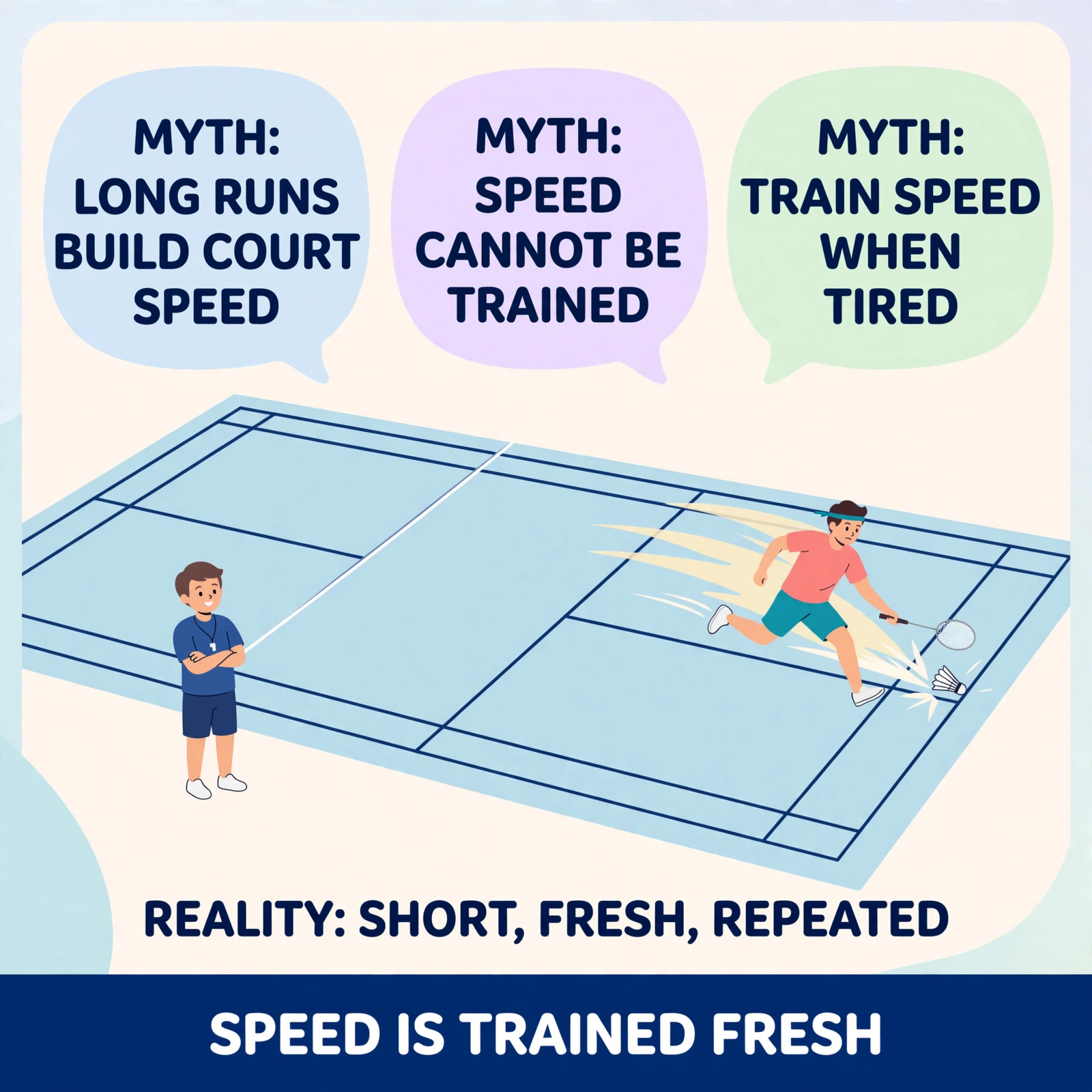
Myth one: long runs build court speed. Distance running builds endurance, which badminton also needs, but it never once asks for a three step burst, a split step or a sudden stop. Speed is a different quality with different training. Players who only run long often arrive fit and still late, because their legs know how to keep going, not how to start. Train the start on court, and let your endurance work support the third game in its own place.
Myth two: speed is something you are born with. Some players do start quicker, but the biggest gaps at club level are not talent gaps. They are wasted steps: a step backwards before the step forward, a split step that lands after the shuttle is hit, feet that cross when they should push. Remove the waste and most players gain more time than any gift of birth gave the player across the net. Starting on time is a skill, and skills can be coached.
Myth three: speed should be trained when you are tired, because matches are tiring. Matches do test speed under fatigue, but you cannot build a fast movement by practising it slowly. Tired practice writes slow steps into your habits. The honest order is to build the speed fresh, when every rep is your best, and then let match play test it. Players who reverse the order end up very good at moving slowly for a long time, which is not the quality that wins rallies.
Why Choose Us
Why Players Choose ST Badminton Academy
At ST Badminton Academy, speed is coached inside regular small group sessions of no more than four students. That number matters for this topic: a coach can watch the split step and first step of every player in the group on every rep, and correct the timing in the same session it slips. In a big class, a player can start late ten thousand times and never be told. Here, your starts are seen, timed and fixed while they are still easy to fix.
Coach Eric Chuar has spent more than 15 years coaching players in Singapore and Malaysia, and his speed teaching treats the first steps as part of the footwork system, not as a fitness extra. Players are timed over the same burst courses across the weeks, so quicker starts show up as numbers, not impressions. Starts, bursts and recovery steps are drilled in the same sessions as strokes, because in a rally they are the same event.
The academy is based in Setapak, Kuala Lumpur. If you keep arriving a fraction late to shots you feel you should reach, a trial session is the quickest test: bring your normal game, we will time your bursts to the corners, and show you the first fix, which is usually the split step or the first step. No hype and no promises of overnight pace, just honest timing and coached starts.
FAQs: Badminton Speed and Quickness in Malaysia (KL)
Players and parents ask the same fair questions before adding speed work to training. Here are straight answers, with no hype and no promises we cannot keep.
Where can I train badminton speed and quickness if I live in Setapak or Gombak?
With us, in Setapak. ST Badminton Academy is based in Setapak, Kuala Lumpur, and players travel in from Gombak, Wangsa Maju and nearby areas. Speed is coached inside regular small group sessions, not as a separate class, so your starts and bursts are watched by a coach alongside your strokes and footwork.
What matters most for badminton court speed in KL?
The split step and the direction of your first step. Raw leg speed matters less at club level than starting on time and stepping the right way. Most players gain more from fixing their split timing and removing a wasted backward step than from any amount of extra running or gym work.
How often should I train court speed to reach a steady level?
Two short speed blocks a week suits most players. Each block is brief, around ten to fifteen minutes of bursts with full recovery, placed early in a session while you are fresh. Speed responds to regular sharp practice, and it stalls when every attempt is made on tired legs.
Can I train court speed at home with no court or partner?
Partly, yes. Skipping, small hops, ladder patterns and split step timing can all be practised in a small clear space, and they support your court speed well. What home practice cannot give you is a full court to burst across or a coach timing your starts, so treat it as support work beside coached sessions.
Should speed drills come early in a session or at the end?
Early, straight after the warm up, while your legs and mind are fresh. Speed drilled at the end of a hard session is just tired running, because your split lands late and your steps shorten. Plan the session so the fast work comes first and the slower work fills the time after it.
Do you offer speed and quickness coaching near Wangsa Maju?
Yes. Our base is in Setapak, a short drive from Wangsa Maju, and speed work runs inside our regular small group sessions rather than as a separate course. With no more than four students in a group, a coach watches your split step and first steps closely and can time your bursts on every visit.
Is speed training suitable for young kids in Malaysia?
Yes, and young players usually enjoy it, because the work is short races, hops and quick games rather than long runs. Loads stay light, bursts stay short, and everything is built on the split step and tidy landings. Small groups matter here, so a coach can watch young feet closely.
Where does ST Badminton Academy coach badminton speed?
At our home base in Setapak, Kuala Lumpur. Speed coaching runs inside regular small group training with no more than four students per group, so starts and bursts are timed and corrected on the spot. Players come in from Gombak, Wangsa Maju and across the Klang Valley, and trial sessions can be arranged.
What does a coach watch first when a player plays badminton?
Your split step timing, before anything else. A coach watches whether you land as your opponent strikes, then which way your first step goes and whether you recover to base. Those three checks explain most lateness on court, and all three can be improved quickly once they are seen clearly.
Badminton Speed Training in Action


One Standard for Every Player and Every Session
Speed is tested with a stopwatch, not opinions. A player at this academy repeats the same burst courses every few weeks: base to the front line and back, and the six point course, always with full recovery. The standard is simple: the times come down, the landings stay quiet, and the backward step disappears. Results are written down, so a quicker start is something you can point to, not just feel.
| Factor | Long Runs | Court Speed Training SPEED |
|---|---|---|
| Frequency | 1 or 2 times a week. Mostly for fun and sweat. | Two short speed blocks a week, done fresh at the start of sessions. |
| Drills Focus | Basic static feeding. Minimal footwork pressure. | Split steps, first steps and short bursts between the lines of the court. |
| Physical Conditioning | Rarely included. Just playing games on court. | Core, agility, and speed training included in every session to prevent injury and build stamina. |
| Tactical Awareness | "Just hit it over." No real game plan. | Video analysis, point construction, and learning to read the opponent's game. |
| Coach Ratio | Large groups (8-10 kids). Coach barely watches you. | Max 4 students. Mr Eric Chuar personally corrects every stroke and movement detail. |
| Goal Setting | Fun and exercise. | Speed measured with timed bursts and full recovery between reps. |
| Long Term Result | Good recreational player. | A player who reaches the shuttle early instead of lunging late. |
Badminton Speed Coaching in Kuala Lumpur
This page covered what court speed really is: a split step that lands on time, big first steps, short bursts between the lines, full recovery between reps, and speed work placed fresh in the week. ST Badminton Academy coaches it in small groups of no more than four students in Setapak, Kuala Lumpur. If you play in Wangsa Maju, Gombak or nearby and keep arriving a step late, contact us today and book a trial session.






