The Best Badminton Warm-Up Exercises For Preventing Injuries (Warm-Up Guide)
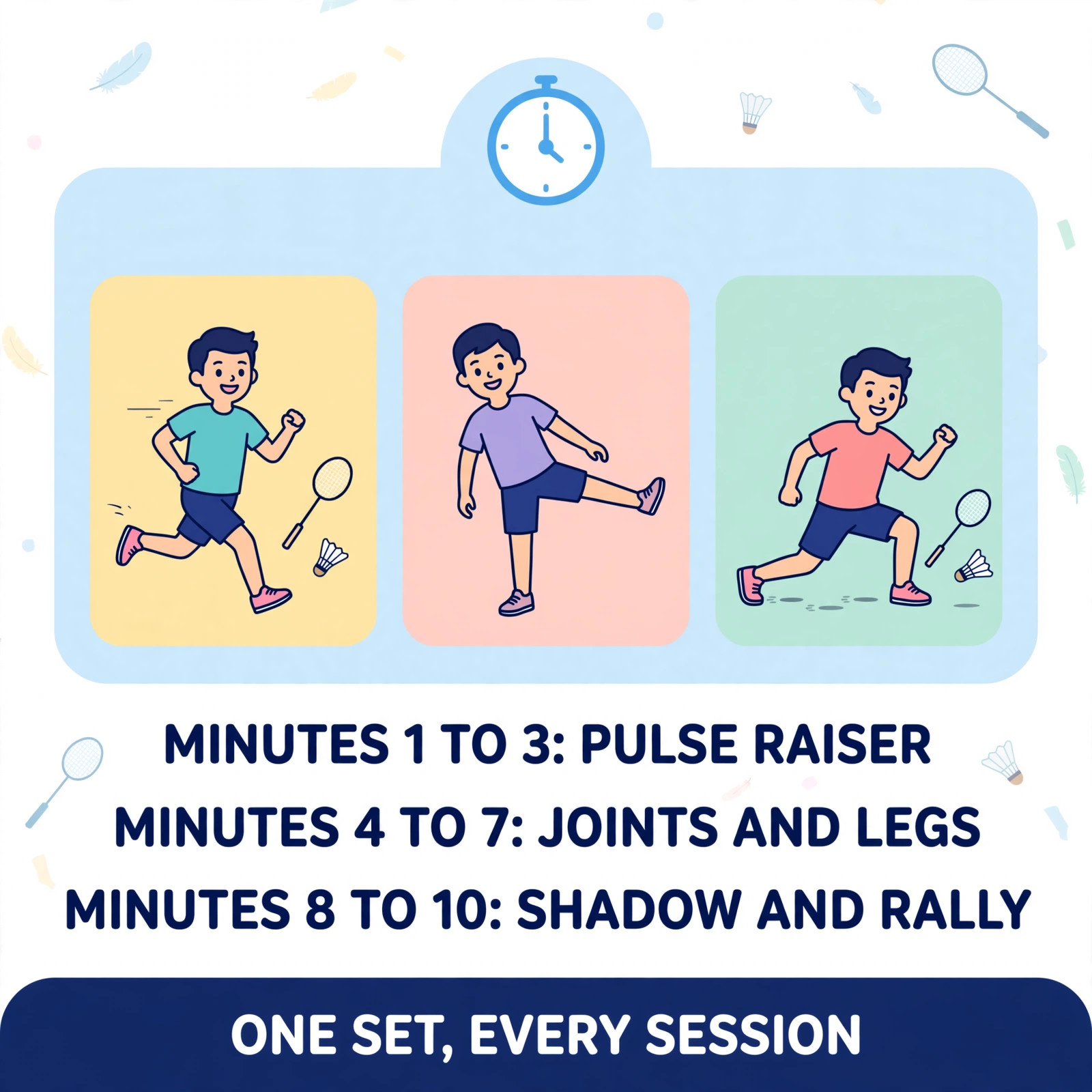
Every badminton injury story seems to start the same way: a cold player, a quick lunge, and a pull or a twist that ruins the next few weeks. A warm-up cannot make any player injury proof, and this guide will not pretend otherwise. What a proper warm-up does is lower the risk, prepare the joints and muscles for the lunges and jumps the game demands, and make the first rallies feel smooth instead of stiff. The set in this guide is the one we run at ST Badminton Academy in Kuala Lumpur before classes: a pulse raiser, arm circles and shoulder moves, leg swings and lunges, shadow footwork, and gentle rallies to finish, in that order, in about ten minutes. The order matters as much as the exercises. Easy movement first wakes the body up gently, moving joints come next, then the badminton patterns themselves, and only then real hitting. Each stage prepares the next. Players who keep the same order every session stop deciding what to do when they arrive at the hall, and the warm-up actually happens, even on rushed evenings. Coaches care about that reliability more than any single exercise. A plain set done every time beats a fancy set done once a month, and the set below is deliberately plain, so any junior can learn it, lead it, and use it before school games long after they leave our classes. For players who like it, a minute or two of gentle foam rolling on a tight calf before the set can ease a stiff spot, though rolling never replaces moving: it prepares one spot, while the set warms the whole body.

Warm-Up Check #1
Start Moving: The Pulse Raiser Comes First
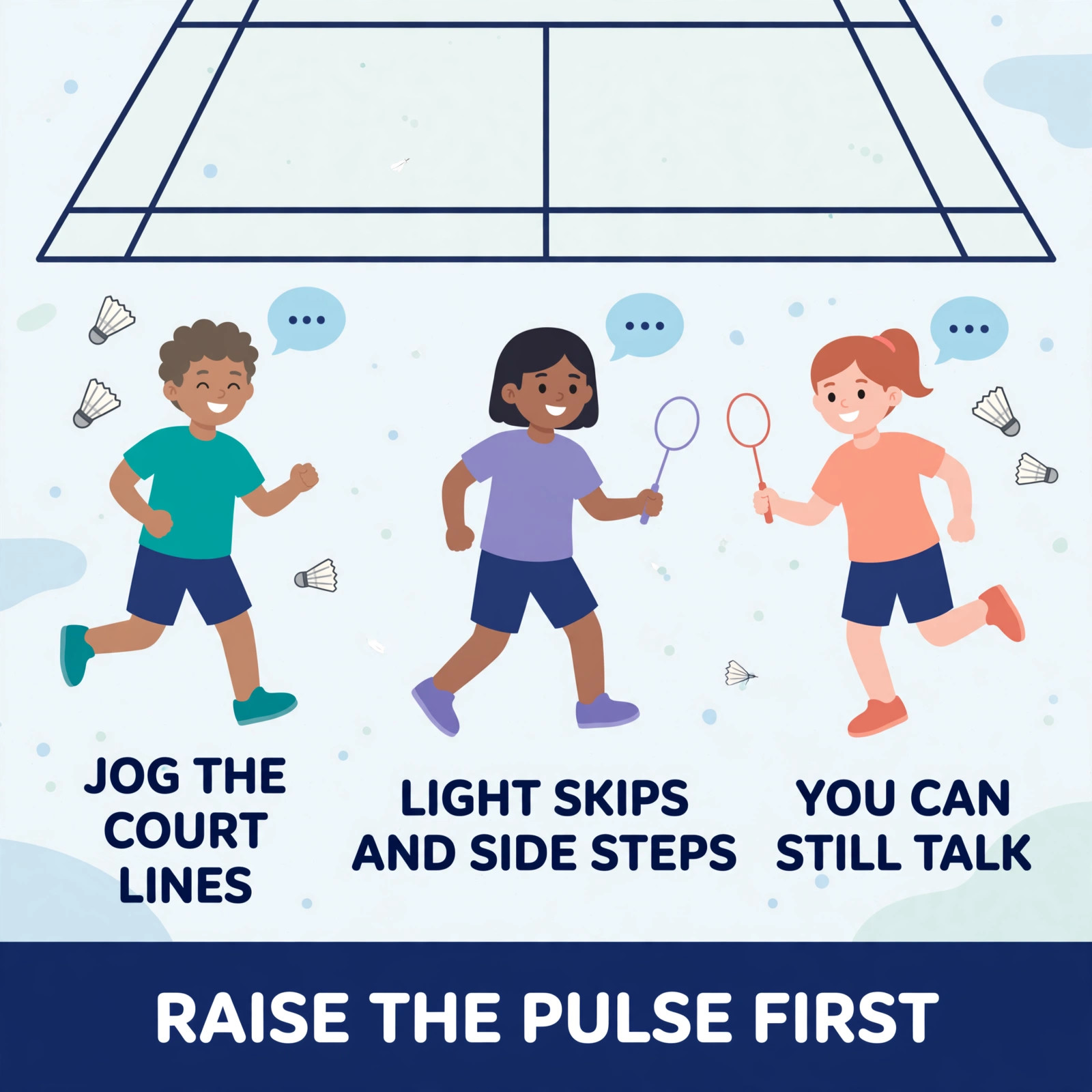
The pulse raiser opens the set, and it is exactly what the name says: move easily until your pulse is up. Jog slowly around the court lines, add light side steps along the back boundary, then a few gentle skips. Two to three minutes is enough for most players. The talk test keeps it honest: you should be breathing faster than resting, but still able to hold a conversation. If you cannot talk, you are working too hard for a warm-up; if you can sing, you are not moving yet. Start slower than feels necessary. The first minute should feel almost too easy, because the body is being invited, not ambushed.
Why does this gentle start matter so much? Cold muscles are stiff muscles, and stiff muscles and cold joints handle sudden lunges badly. Easy movement raises the body’s temperature, sends more blood to the legs and shoulders, and lets the joints begin to move through their range without load. Think of it as the difference between bending a warm candle and a cold one. The pulse raiser also wakes up balance and attention: by the end of it, players are watching the lines, judging space, and thinking like badminton players instead of people who just arrived from school, work, or a car. The game starts in the head during these minutes too.
Warm-Up Check #2
Arms and Shoulders: Circles, Rolls and Swings
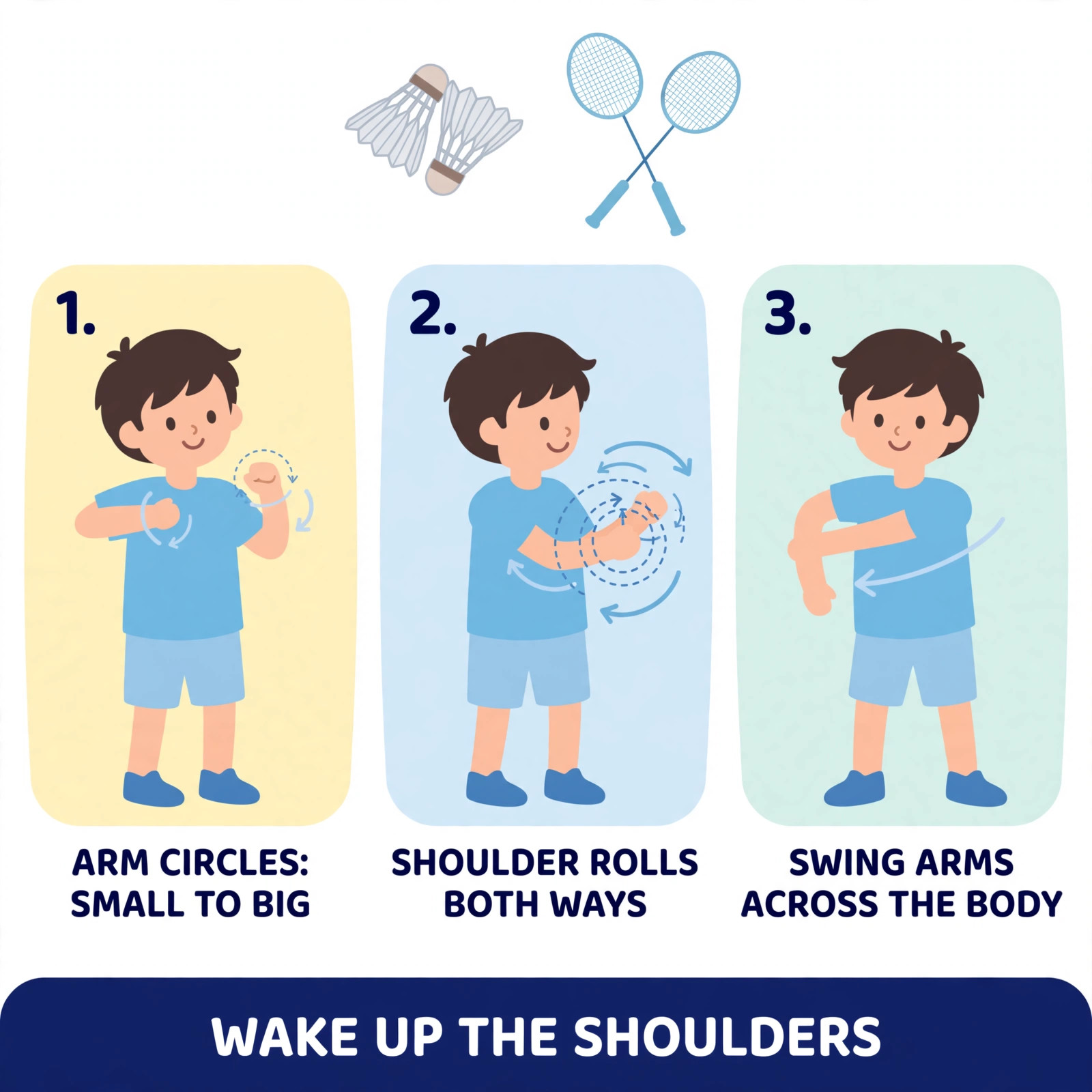
With the pulse up, the set moves to the arms and shoulders, because badminton asks the shoulder to work overhead in every rally. Start with arm circles, small ones first, then growing bigger, in both directions. Add shoulder rolls, forward and back, slow and round. The shoulder joint is the most mobile joint most players own, and it appreciates being taken through its full circle before it is asked to smash. Keep the movements smooth and pain free. A warm-up that pinches or hurts is giving information, and the answer is to ease the range down, not to push through and hope.
Follow the circles with cross body arm swings, hugging the arms across the chest and opening them wide, and with gentle overhead reaches as if plucking shuttles from a high shelf. Finish the arm block with wrist circles and a few easy fist squeezes, because the forearm and grip warm up too, and a cold grip is a clumsy grip. Two honest notes belong here. First, all of this is movement, not holding: the arm keeps travelling, and no position is held for a long stretch. Second, the shoulder block takes about two minutes. Skipping it because the arms feel fine standing still is a mistake players only understand after their first stiff smash of the day.
The shoulder deserves this attention because badminton is an overhead sport. Clears, drops, and smashes all swing the arm through the same high arc, hundreds of times in a hard session. A shoulder that has circled, rolled, and swung gently for two minutes meets the first full clear with the joint awake and the muscles around it sharing the work. A cold shoulder lets the biggest muscles grab the job alone, and that is when the front of the shoulder starts to grumble. Two minutes of circles is cheap insurance for the joint you will use most.
Warm-Up Check #3
Legs in Motion: Swings, Lunges and Heel Flicks
Legs come next, and they also work in motion. Leg swings lead the block: hold a net post or a wall, and swing one leg gently front to back, then side to side, growing the swing a little as the hip loosens. The hip does the steering in badminton footwork, and swings wake it up through the exact ranges the lunges will use. Keep the standing leg soft at the knee and the body tall. A swing that throws the whole body around is too big; control the leg, do not launch it. Ten to fifteen easy swings each way, each leg, is a solid guide for most players.
Walking lunges follow, across the width of the court, staying tall through the body with the front knee tracking over the toes. Lunges in the warm-up are about pattern and warmth, not strength: step, lower gently, rise, and walk on. Add light heel flicks and easy knee lifts on the way back, the classic footballer’s jog movements, kept small and springy. Together these moves rehearse the bend and push of badminton legs without any shuttle pressure. A player who has lunged gently ten times in the warm-up owns a first match lunge that feels like the eleventh, not like a surprise.
The ankles get their own minute, because on a hard court the ankle is the brake and the spring of every movement. Calf raises, slow up and slow down, warm the back of the lower leg. Ankle rocks and gentle circles take the joint through its range. Players who roll ankles know this minute well, and it is the one they should never rush. The set keeps ankle work inside the leg block rather than as a separate stage, so it never gets skipped when time is short. Warm ankles land softer, push off cleaner, and forgive the small missteps that cold ankles punish.

Warm-Up Check #4
Shadow Footwork: Practise the Pattern Before Play
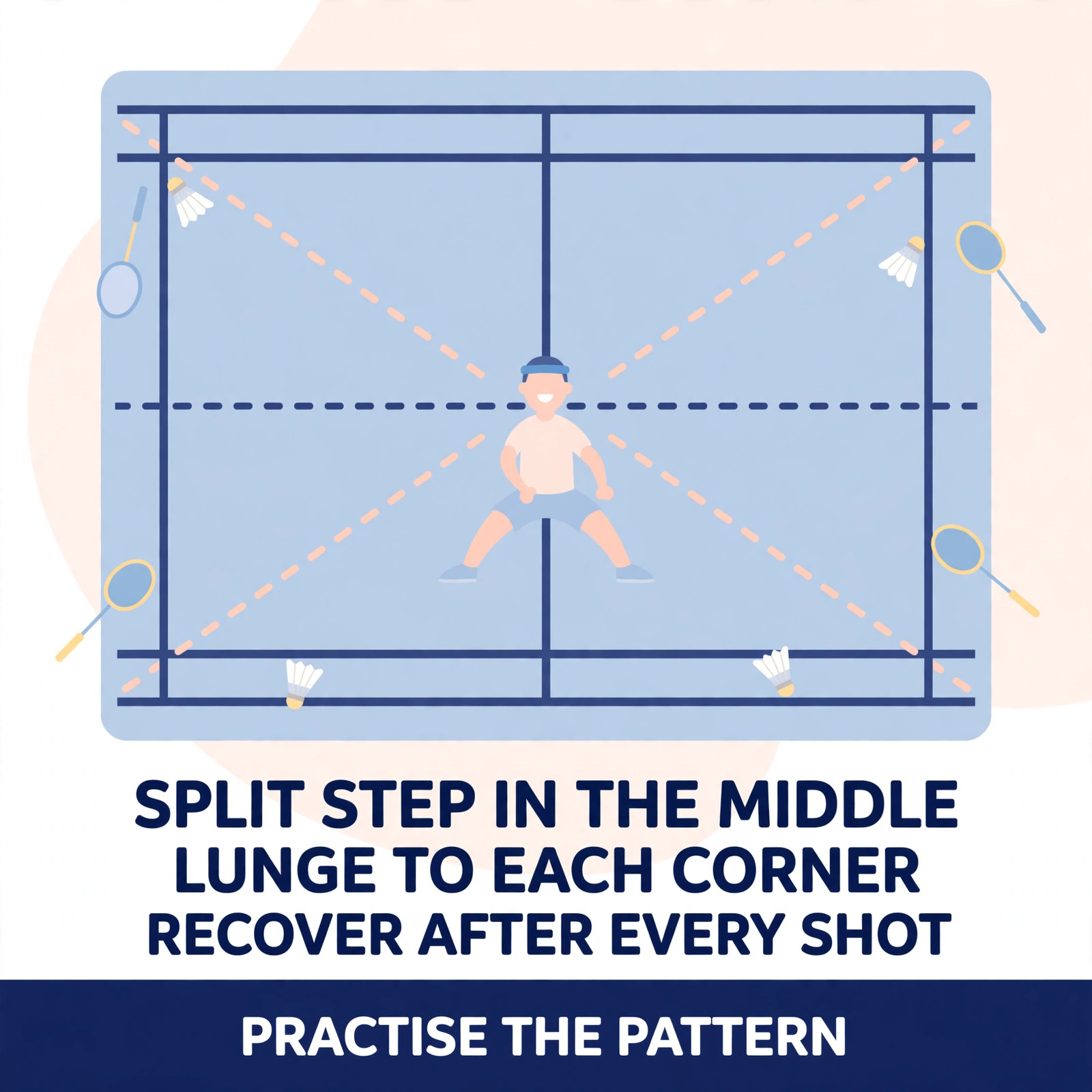
Stage four is shadow footwork, the most badminton specific part of the set. Without a shuttle, players split step in the middle of the court, then move to the corners: lunge to the front corners, push to the sides, recover behind to the back corners, always returning through the middle. The speed is half pace at first, building to something like three quarter pace by the last round. This is the stage that connects the warm body to the actual game, because the feet rehearse the map of the court before a single rally asks them to use it at full speed.
Add the racket for the second half of the shadow work: shadow swings at the net, gentle overhead shadows to the back, always with the same rule, smooth before fast. Balance touches belong here too: a few seconds standing on one leg in the ready position, or lunging and holding the landing for a breath before recovering. Balance work inside the shadow stage asks the ankles, knees, and hips to steady the body in exactly the positions the game will demand. Players wobble in the warm-up so they do not wobble in the match.
Build the shadow speed in layers. The first round to each corner is a walk through: check the split step, the lunge shape, and the recovery step back to the middle. The second round moves at easy rally pace. Only the last round, if the set has gone well, touches three quarter pace, and it stops there. Shadow work is rehearsal, not a fitness test. A player who finishes the shadow stage panting has spent energy the match was saving, while a player who finishes it tidy and warm owns feet that already know where they are going.
Warm-Up Check #5
Finish With Rallies: Gentle Hits and Small Jumps
The set finishes with gentle rallies, because nothing warms a badminton player like badminton. Start cooperative: clears to the back, drops to the net, drives at half pace, feeding each other rather than finishing each other. Five or six minutes of this brings the whole system to match temperature, eyes tracking the shuttle, feet moving in rhythm, timing settling in. The jump from shadow work to real shuttles should feel small, and it does when the rallies begin kindly. Save the winning shots for the game; the warm-up rally is two players building one rhythm together.
Only at the very end, for players who are ready, come a few small jumps: little hops in place, a few soft jump landings, landed quietly with bent knees and the whole foot settling. Three to six gentle jumps are seasoning, not a workout. Landing softly is the skill; height is not. Any player with sore knees skips the jumps without discussion and spends the minute on extra shadow steps instead. The set is a ladder with the hardest rung last and smallest, which is exactly where hard things belong in a warm-up.
The finish is a check, not a collapse: breathing up but settling, body warm, mind on the game. Take water, pick up the racket, and walk on ready. The whole set has taken about ten minutes, and not one minute of it was wasted, because every stage had a job and the jobs were done in order. Players who finish a warm-up feeling tired have warmed up wrong; the set should spend a little energy to save a lot of trouble. Feeling ready, slightly warm, and keen to start is the sign the set was done right.

Myth vs Reality
Myths About Badminton Warm-Ups
Myth one: stretch cold, hold it long, and you are warmed up. Long static holds on cold muscles do not raise the pulse, do not warm the joints in motion, and can leave the muscles feeling sleepy for the first rallies. The moving stages of this set do the warming. Static stretching has a real place in badminton, after play, when the muscles are warm and the body is settling down. Players who swap the order, moving work before the game and holding work after it, get the best of both instead of the worst of each.
Myth two: young players do not need to warm up. Growing bodies are changing bodies: bones grow faster than muscles adapt, coordination shifts during growth spurts, and yesterday’s easy lunge lands differently this month. Juniors also copy what they see, and a junior who skips warm-ups at twelve becomes the adult who skips them at thirty, with ankles that forgive far less. The habit argument is the strongest one: warm-ups are a routine a player will need for life, and childhood is when routines are cheapest to build.
Myth three: a harder warm-up is a better warm-up. A warm-up that leaves a player breathless and heavy legged has stolen from the match it was meant to serve. Players sometimes copy the intense routines of professionals without the years of conditioning underneath them, and arrive at the first rally already tired. The set in this guide is deliberately modest: it raises temperature, rehearses patterns, and stops. If a coach wants conditioning, it belongs in training, at the right time, in the right dose, not disguised as preparation for a game about to start.

Why Choose Us
Why Players Choose ST Badminton Academy
Every class at ST Badminton Academy starts with this set, led by the coach, in the same order. That consistency is the point. With a maximum of four students per group, the coach watches every lunge and landing while the set runs, correcting a knee that caves in or a landing that lands stiff, in the minutes when correction is easiest and safest. Juniors do not just repeat the set; they learn why each stage exists, so the routine becomes theirs, not the coach’s property. Within a month, most students can lead the set themselves.
The academy teaches the set as a life skill for school and social badminton. Our juniors play for school teams, in halls we never visit, in games we never see. A player who owns a ten minute routine carries their preparation with them: before a school match, a social night, or a family game at a rented court. Parents tell us this is one of the most useful things their children take from class, because it protects the player in exactly the settings where no coach is standing by to insist on it.
Warm-up habits also shape how the academy handles caution. Coaches teach players to speak up about pain during the set, to ease off a move that pinches, and to tell the coach about any injury before training starts. A warm-up is a daily body check disguised as a routine: the player who notices a stiff ankle in minute three has learned something valuable before the fast work begins. We would rather adjust a session around an honest report than lose a player for three weeks to a brave silence.
FAQs: Badminton Warm-Up Exercises and Staying Safe in Malaysia (KL)
Here are the questions parents and players ask us most about badminton warm-up exercises, the order of the set, and how the routine is coached in our classes in Kuala Lumpur and Setapak.
Where can juniors learn a proper warm-up routine in Setapak or Gombak?
Juniors learn the routine inside our classes at our Setapak base in Kuala Lumpur, where coaches lead the same set at the start of every session. Within weeks, students run it themselves, and they take it with them to school games and social sessions, where no coach is present to lead it.
What is the right order of warm-up exercises before a game in KL?
The order never changes: pulse raiser first, then arm and shoulder movement, then leg swings and lunges, then shadow footwork, and gentle rallies to finish, with small jumps only at the very end for players who are ready. Each stage prepares the next, which is why the order is part of the teaching.
How long should a warm-up last if a player is at social level?
About ten minutes is enough for social play: long enough to raise the pulse, move the joints, and rehearse the footwork, short enough that nobody arrives at the first rally tired. Before a hard match or on a cold morning, players can stretch the set to fifteen minutes by adding shadow rounds.
Should players do static stretches before a match or after?
Moving stretches come before play, inside the set: swings, circles, and lunges that keep travelling. Long static holds belong after play, when muscles are warm and holding a stretch is comfortable and useful. Warming up cold with long holds leaves muscles sleepy, so the academy always teaches the order as move first, hold later.
What warm-up moves should young players never skip?
The pulse raiser, the leg swings, and the shadow footwork. The pulse raiser wakes the whole body, the leg swings free the hips that badminton footwork depends on, and shadow footwork connects the warm body to the court’s map. Those three stages protect the player most, and they take under six minutes together.
Do you run guided warm-ups before classes near Wangsa Maju?
Yes. Every academy class opens with the coach led set, including sessions serving the Wangsa Maju and Setapak area. Coaches demonstrate, count, and correct as the set runs, and older juniors take turns leading it, because the fastest way to learn a routine is to be trusted with leading it.
Does your academy teach warm-up habits to every class in Malaysia?
Yes, the set is a standing part of every class the academy runs, for beginners and advanced groups alike. Only the dose changes: stronger groups add shadow rounds and speed, beginners keep everything gentler. The order, the stages, and the honest purpose stay identical for every student who trains with us.
Where does ST Badminton Academy coach warm-up routines for juniors?
Warm-up coaching happens at our Setapak base in Kuala Lumpur, at the start of every junior session, indoors on the same courts where the training follows. Visiting players joining a class learn the set by doing it beside regular students, who are usually proud to show a newcomer the order.
What makes Mr Eric Chuar a good coach for safe, steady warm-up badminton?
Mr Eric Chuar has coached for over 15 years and treats the warm-up as coaching time, not waiting time. He watches landings, corrects knee positions, and keeps the tempo gentle first, because he has seen too many avoidable strains start with a cold lunge. His standard is simple: nobody trains cold, ever.
Badminton Warm-Up Exercises in Action


One Standard for Every Player and Every Session
The academy's standard is that no session starts cold, for any student, at any level. The set runs in full, in order, every time, led by the coach or by a trusted senior student under the coach's eye. Players who arrive late join the set at the stage it has reached and finish it before touching a shuttle. Standards like this sound strict until the first season passes without a warm-up strain; then they just sound like coaching.
| Factor | Cold Start | Warmed Up WARM-UP |
|---|---|---|
| Frequency | 1 or 2 times a week. Mostly for fun and sweat. | Pulse raised step by step, so the first rally already feels smooth. |
| Drills Focus | Basic static feeding. Minimal footwork pressure. | Joints moved through their range before any hard lunges or jumps. |
| Physical Conditioning | Rarely included. Just playing games on court. | Core, agility, and speed training included in every session to prevent injury and build stamina. |
| Tactical Awareness | "Just hit it over." No real game plan. | Video analysis, point construction, and learning to read the opponent's game. |
| Coach Ratio | Large groups (8-10 kids). Coach barely watches you. | Max 4 students. Mr Eric Chuar personally corrects every stroke and movement detail. |
| Goal Setting | Fun and exercise. | Shadow footwork rehearsed, so the feet know the pattern from point one. |
| Long Term Result | Good recreational player. | A player who starts steady and lowers the risk of a silly early strain. |
Badminton Coaching With Proper Warm-Ups in Kuala Lumpur
Ten minutes, the same order, every session: that is the whole secret of this set, and it is not really a secret at all. Learn the stages, keep them gentle first and badminton shaped by the end, and your first rallies will feel like continuations instead of cold starts. If your child trains with us at ST Badminton Academy in Setapak, Kuala Lumpur, they will learn this routine by heart, and they will own it for every game they ever play. Book a trial class, come a few minutes early, and join the warm-up. It is where every good session here begins.






