How To Play Badminton Like A Pro: Secrets From The World’s Best Players (Pro Habits Guide)
Every badminton player has asked the question: what do the professionals know that I do not? The honest answer is less exciting and more useful than the rumours. There are no secret shots. Nobody at the top is hiding a grip, a string trick or a training method that changes everything. What top players have is habits: structured weeks, honest review, footwork drilled daily, recovery treated as part of training, and the discipline to repeat ordinary work for years. This guide goes through those habits one by one, in general terms any club player can copy at their own scale, because that is the real road toward playing like a pro.

Pro Check #1
No Secret Shortcuts: What Pro Habits Really Are
Start by retiring the word secret. When players watch the professional game, they see the finished product: the speed, the disguise, the impossible retrieves. They assume something hidden powers it. Watch instead what the top of the game is openly known for. Training is planned in blocks with clear themes. Matches are recorded and reviewed. Footwork is drilled even by players whose movement already looks perfect. Sleep, food and rest days are managed like part of the job, because they are part of the job. None of this is hidden. It is simply done with a consistency that most club players, juggling work and life, find hard to copy. The gap is not knowledge. The gap is repetition.
That gap is good news, because repetition is available to everyone. You cannot copy a professional training load, and this guide will not pretend otherwise: full time players train with a support team around them, and copying their hours on a working week is a fast road to exhaustion. What you can copy is the shape of their habits, scaled to your life. A written plan, even for two sessions a week. A short review after matches, even on a phone recording. Ten minutes of shadow footwork before you play. Regular sleep on training days. Small versions of pro habits, done every week, will move your game further than any secret ever promised.

Pro Check #2
Train With a Plan: Structured Weeks, Honest Targets
Top players train from a plan, not from a mood. A week has themes: footwork and speed on one day, shot quality on another, match play on another, with the hard days and easy days placed on purpose. Each session has a target that can be counted, like blocks that land in, or corners reached cleanly, so progress is measured rather than felt. Club players can build the same structure at a smaller size. Before the week starts, write down what each session is for. One theme per session is enough. When the session ends, note honestly whether the target was met. That small loop, plan, do, note, is the engine behind professional improvement.
A plan also protects you from the two common club mistakes. The first is training only what you enjoy, which for most players means smashing and playing games, while footwork and defence wait forever. The second is training everything at once, so nothing gets enough reps to change. A planned week spreads the work across the whole game and gives weak areas their turn, in writing, where they cannot be quietly skipped. Over a month, the difference is visible. The unplanned player has played a lot of badminton. The planned player has improved at specific things, and can name them.
Honest targets matter as much as the plan itself. A target like play better is not a target; it cannot be checked. A target like eight out of ten blocks landing over the net and in court can be checked in one feeding drill. Top players are known for living by numbers of this simple kind, not because numbers are magic, but because honesty is. When a target is missed, the plan adjusts. When it is met, the target grows slightly. Your version can live in a notebook or a phone note. What matters is that it exists before the session, not as a story invented after it.

Pro Check #3
Watch and Learn: Video Review and Match Study
Professionals study the game on screens, and this habit is the easiest one to copy exactly. Film your own matches, even from a phone propped at the back of the court, and watch them within a day or two while the feelings are fresh. You will see a different player than the one you remember being: the base position that drifted, the backhand corner that leaked, the attacks launched from impossible positions. Pick one fix only. A review that ends with ten corrections ends with none. Write the fix down, build the next sessions around it, and film again to test whether it held.
Watching the professional game itself is also training, if you watch it the right way. Do not watch the shuttle, and do not watch only the winners. Watch one player feet for a whole rally: where their base sits, how early they move, how they recover after a smash. Watch where points are built, two shots before the winner lands. Then watch your own recording again and compare the shapes, kindly and honestly. The point is not to imitate a specific player style. It is to train your eyes to see badminton as patterns rather than as highlights, because players who see patterns start to play them.
Review has a partner habit: writing. Top players and their coaches keep notes because memory edits matches in your favour. A few lines after each match, what worked, what leaked, one fix, will tell you the truth over a season. Your notes will start to repeat themselves, and that repetition is the most valuable coaching information you own: it is your real weakness list, measured rather than guessed. When the same fix appears for the fourth week, it stops being a note and becomes the plan. This is how professionals choose what to train. Not by fashion, and not by feelings. By evidence.

Pro Check #4
Footwork First: The Pro Habit Nobody Films
If one habit separates the top of the game from everyone else, it is this: footwork is trained on its own, daily, even by players famous for their shots. Movement is the base every shot stands on. A perfect smash technique is worth little from a late, unbalanced arrival, and an ordinary shot played early and balanced troubles everyone. Professional training is full of shadow footwork: the six corners, the recovery to base, the split step, repeated slowly and then at speed, without a shuttle, so the feet can be the whole lesson. Cameras rarely film these sessions, which is why club players underrate them. They are, quietly, the main event.
Copy the habit at your scale. Ten minutes of shadow footwork before playing will change more matches than ten extra minutes of hitting. Move slowly enough that every corner ends in a correct shape: the lunge controlled, the landing quiet, the recovery complete. Speed comes later and only as far as the shapes survive it. Grooved patterns are what professional speed actually is: not faster legs, but fewer wasted movements, each one rehearsed until it costs no thought. When your feet stop needing your attention, your eyes and your racket are free to win the rally.
Footwork first also changes how you judge your own game. Many players blame their shots for points their feet lost. The clear that hit the net was a late arrival. The smash that flew out was struck falling backwards. Review your recordings with this lens and the fix list changes: fewer shot corrections, more movement corrections. That is how professionals and their coaches talk about matches, and it is a more hopeful conversation, because movement habits respond quickly to honest drilling. Shots take years to rebuild. Base positions, split steps and recoveries can look different within a month of planned work.

Pro Check #5
Recover Like a Pro: Sleep, Food and Easy Days
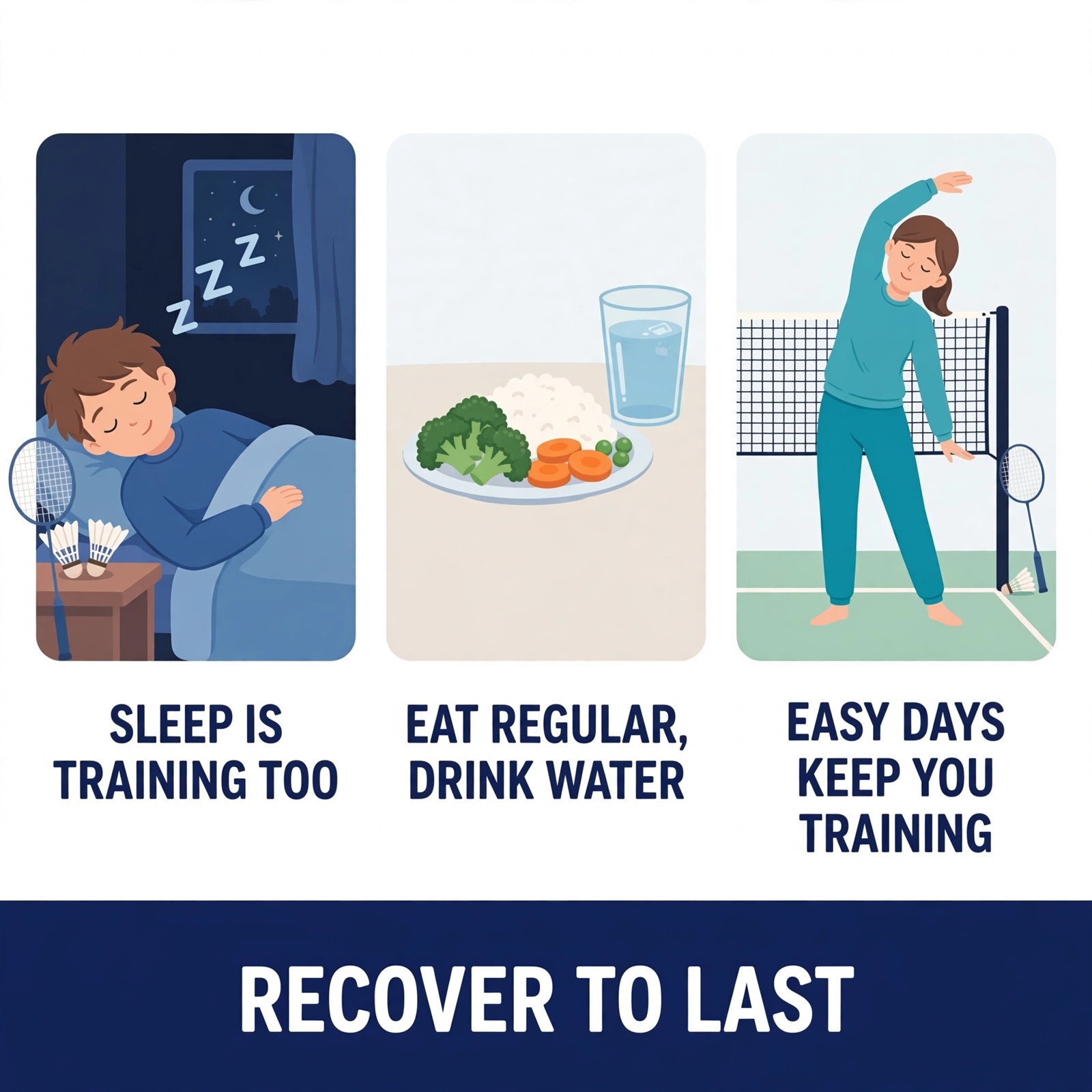
The last habit is the one club players skip entirely: recovery is training too. Top players are known for treating sleep as part of the programme, eating regular meals, drinking water through the day and taking planned easy days where the body rebuilds. Hard training tells the body what to improve; rest is when the improvement actually happens. A player who trains hard and sleeps badly is keeping only half of each session. You do not need a support team to copy this. Regular sleep on training days, a proper meal afterwards, water instead of guesswork, and one genuinely easy day a week will carry most of the benefit.
Warm ups and cool downs belong to the same habit. Professionals do not wander onto court and start smashing; they arrive early, move through a routine, and build the session up. Afterward they cool down and note how the body feels. Keep your version simple and repeatable: a few minutes of easy movement and shadow swings before you play, gentle stretching after, and a line in your log about anything that felt off. Pain that keeps returning is information, not weakness, and it deserves a proper check rather than another week of pushing through. Looking after the body is not the soft part of training. It is what allows the hard part to continue.
Recovery is also where honesty about scale matters most. A club player with a job, a family and two sessions a week cannot recover like a full time athlete, and should not train like one either. Build your week so the hard days are followed by easy ones, and let your log tell you when the load is too much: heavy legs that never lift, sleep that gets worse, the same small ache returning. Adjust the plan before the body forces the adjustment. Professionals stay at the top for years largely because they manage this well. Longevity is a habit too, and it starts with respecting your own limits.
Myth vs Reality
Myths About Playing Like a Pro
The first myth says professionals have secret techniques that coaches hide from club players. It survives because it is comforting: if a secret exists, your current level is not your fault. The truth is plainer. Professional technique is the same technique taught in academies everywhere, grooved by years of counted reps and honest correction. The grips, the footwork patterns, the shot shapes, all of it is public. What is rare is not the information. It is the years of structured repetition behind it. That is available to you starting this week, at your scale, with no one permission needed.
The second myth says professionals train all day, every day, so more hours is always the answer. Hours matter, but the top of the game is built on planned intensity, not endless volume: hard sessions are hard, easy days are genuinely easy, and rest is scheduled rather than collapsed into. Club players who copy only the hours, adding session after session without a plan or recovery, mostly collect tiredness and small injuries. Copy the structure instead. Two planned sessions with themes, targets and notes will out improve five evenings of random games, and you will still be healthy enough to enjoy the sixth.
The third myth says professional gear is the difference: special rackets, magic strings, equipment club players cannot buy. The rackets top players use are sold in ordinary shops, in the same weight classes anyone can choose, commonly the 3U and 4U ranges, set up to personal liking. String tension is a preference, not a spell. Even the shuttlecocks are a known story: top level competition uses feather shuttles, while nylon suits training because it lasts. Gear should fit you and be in good condition. Beyond that, the difference between you and a professional is measured in habits, not in equipment.

Why Choose Us
Why Players Choose ST Badminton Academy
At ST Badminton Academy, we coach the habits in this guide openly, because they are the whole method. Sessions run from written plans with one theme at a time. Players keep simple logs. Matches and rallies are reviewed with the coach, and fixes are chosen one at a time and tested in the following weeks. There is no secret curriculum behind this, and we will happily explain any part of it. Players improve here the way players improve everywhere honest: by planned work, counted reps and feedback they can act on.
The structure suits club players with real lives. Groups stay small, with a maximum of 4 students, so your plan and your habits are watched personally rather than guessed at. A session might pair footwork drilling with a review of last week filmed rally, connecting the plan to your actual game. Targets are set in numbers you can check, and the log you keep becomes the evidence of your progress. Over a season, that evidence is encouraging: fixes that held, patterns that stopped leaking, matches that started ending differently. It is the professional method, scaled to fit around a job and a family.
Honesty matters in this kind of coaching. We will tell you when a weakness is a footwork habit rather than a shot problem, when your week needs more rest rather than more sessions, and when a fix will take months rather than weeks. We will not sell you secrets, because there are none to sell, and we will not promise professional results on a club schedule. What we can promise is the professional approach: a plan, honest targets, review and patience. Players who stay with that approach find their game changing in the way that lasts, quietly and for good.
FAQs: Pro Badminton Habits, Training and Match Play in Malaysia (KL)
Below are the questions players ask us most about training with professional habits at ST Badminton Academy. If your question is not here, bring it to a trial session and we will answer it on court, where the answers are easiest to show.
Can a club player really train with pro habits in Setapak or Gombak?
Yes, because the habits scale. You cannot copy a professional training load, but you can copy the shape: a short written plan, one theme per session, a target you can count, a few lines of notes afterwards, and regular sleep on training days. Two planned sessions a week built this way will improve a club player steadily.
What is the first pro habit a club player should copy in KL?
Copy the plan. Before your next session, write down its theme in one line and one target you can count, like blocks landing in or corners reached cleanly. After the session, note honestly whether the target was met. That tiny loop is the habit underneath all the others. Most players feel the difference within a month of keeping it.
Do pros use special rackets that club players cannot buy at club level?
No. The rackets used at the top of the game are the same models sold in ordinary badminton shops, in the usual weight classes such as 3U at 85 to 89 grams and 4U at 80 to 84 grams. Players choose a setup that suits them: sound strings, sensible tension, a fresh grip. There is no professional only equipment shelf.
I train hard but my matches do not improve. Should I train more or review my games?
Review your games. Hard training without review repeats the same leaks at a higher speed. Film a match, even on a phone, and watch where points actually went: usually two or three patterns do most of the damage. Pick one and let your next training block target it. One honest review a week turns effort into direction.
How can a busy club player copy pro habits in training?
Build the habits into the week you already have. Two sessions with a written theme and a counted target, ten minutes of shadow footwork before you play, one short match review, and regular sleep on training days: that is the professional pattern at club scale. The mistake is waiting for a month off to start. Start with your current schedule.
Do you coach pro level training habits near Wangsa Maju?
Yes. Coaching built on professional habits runs on court at our Setapak base and nearby areas, including Wangsa Maju. Sessions follow written plans with themes and counted targets, in small groups of a maximum of 4 students, with review of your own rallies where filming is possible. Tell us your level and weekly schedule when you book.
Where does ST Badminton Academy teach badminton in Malaysia?
Our base is in Setapak, Kuala Lumpur, and players join us from across the city and from Singapore. Coaching here is built on the habits this guide describes: planned sessions, honest targets, match review and recovery taken seriously. The method does not change with level, only the load does. A trial session will show you the plan and feedback style.
How do I book a trial session to work on my training habits?
Send us a message on WhatsApp or through the website and tell us your level. We will suggest a session time and explain what to bring: court shoes, sports clothes and a water bottle. In the trial we run a planned mini session, set one counted target with you, and show you how we review progress. No pressure afterwards.
What makes Mr Eric Chuar a suitable coach for building pro habits in badminton?
Mr Eric Chuar coaches from a plan, with honest targets and no talk of secrets. He watches your rallies, names the pattern costing you points, and builds the next sessions around fixing it, one fix at a time. With more than 15 years of coaching behind him, he helps club players train in the professional way: structured, reviewed and patient.
Pro Standard Badminton Training in Action



One Standard for Every Session and Every Player
Every session at ST Badminton Academy follows the same coaching standards. Sessions run from a written plan with one theme and a counted target. Groups stay small, with a maximum of 4 students, so habits and technique are watched closely. Matches and rallies are reviewed honestly, fixes are chosen one at a time, and progress is tracked in the player log rather than in promises. These standards hold for every player, from a beginner building a first plan to an advanced player preparing for competition.
| Factor | Chasing Secrets | Building Habits HABITS |
|---|---|---|
| Frequency | 1 or 2 times a week. Mostly for fun and sweat. | Training runs from a written plan: one theme per session and a target that can be counted. |
| Drills Focus | Basic static feeding. Minimal footwork pressure. | Matches are filmed and reviewed, and only one fix is chosen at a time. |
| Physical Conditioning | Rarely included. Just playing games on court. | Core, agility, and speed training included in every session to prevent injury and build stamina. |
| Tactical Awareness | "Just hit it over." No real game plan. | Video analysis, point construction, and learning to read the opponent's game. |
| Coach Ratio | Large groups (8-10 kids). Coach barely watches you. | Max 4 students. Mr Eric Chuar personally corrects every stroke and movement detail. |
| Goal Setting | Fun and exercise. | Footwork is drilled daily and recovery is treated as part of training, not a break from it. |
| Long Term Result | Good recreational player. | A player with pro habits: planned weeks, honest logs and ordinary work done every single week. |
Pro Habits Badminton Coaching in Kuala Lumpur
You already know more of the professional game than you think. Come to ST Badminton Academy in Kuala Lumpur and train with the habits that actually power it: a plan, counted targets, honest review and proper recovery. Book a trial session, bring your court shoes, and we will show you how your current week could look when it is run like a professional one, at your scale.






