How To Play Badminton Singles: Tips And Strategies For Success (Singles Guide)
Singles is the purest test in badminton. One player, one long narrow court, nobody to cover your mistakes and nobody to blame for them. It rewards fitness, yes, but it rewards thinking more: the players who win singles at club level are rarely the ones with the biggest smash. They are the ones who hold the middle, build rallies patiently, attack only when the attack is earned, defend without panic and manage their energy across a whole match. This guide walks through a complete singles game in that order, from your base position to the last rally, with the habits that hold it together.

Singles Check #1
Base Position: Own the Middle of the Court
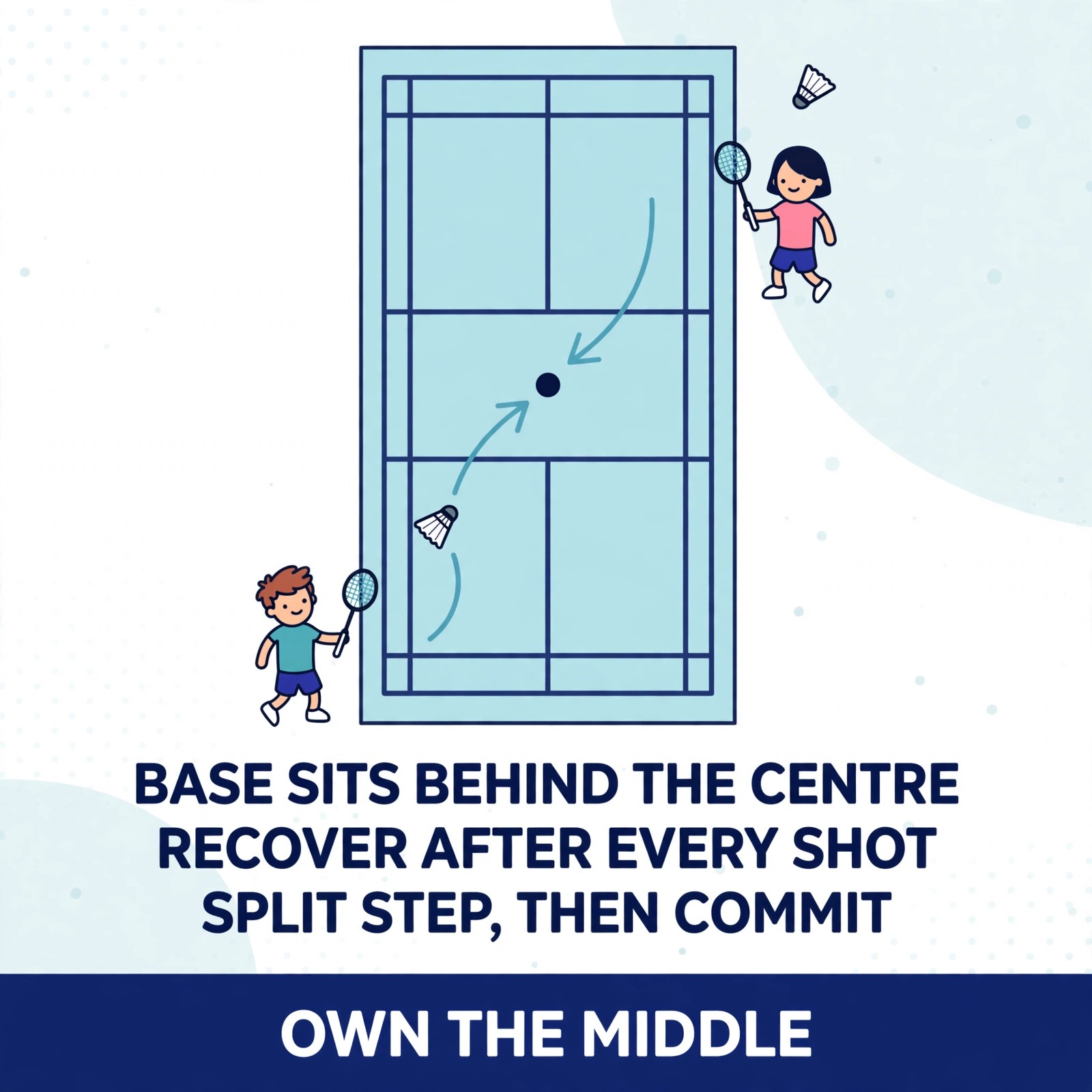
Singles is played on a court 13.4 metres long and 5.18 metres wide, narrower than doubles but just as long, and your base position sits a step behind the centre of it. That step matters. From there, the back corners are the longest trip, so your home stands slightly closer to the shots that come quickly: net shots and drives. Stand low, weight forward, racket up, and treat base as a place you pass through constantly rather than a spot you camp on. After every shot, your first job is to recover toward base. Your second job is to watch. Everything in singles flows from that loop: hit, recover, watch, move.
The split step times the loop. As your opponent strikes the shuttle, land from a small hop and push toward the shot. Players who skip the recovery give away the match in slow motion: each shot starts a little further from base, each arrival a little later, until a corner sits empty. Readiness also means reading. From base, watch the opponent whole body, not just the racket: their position tells you which corners they can reach, and their habits tell you which ones they like. A player who always cross courts under pressure has told you where to lean. Singles rewards the player who collects these small tells and spends them late in the match, when legs are tired and patterns repeat.
Singles Check #2
Build the Rally: Move Them Before You Attack
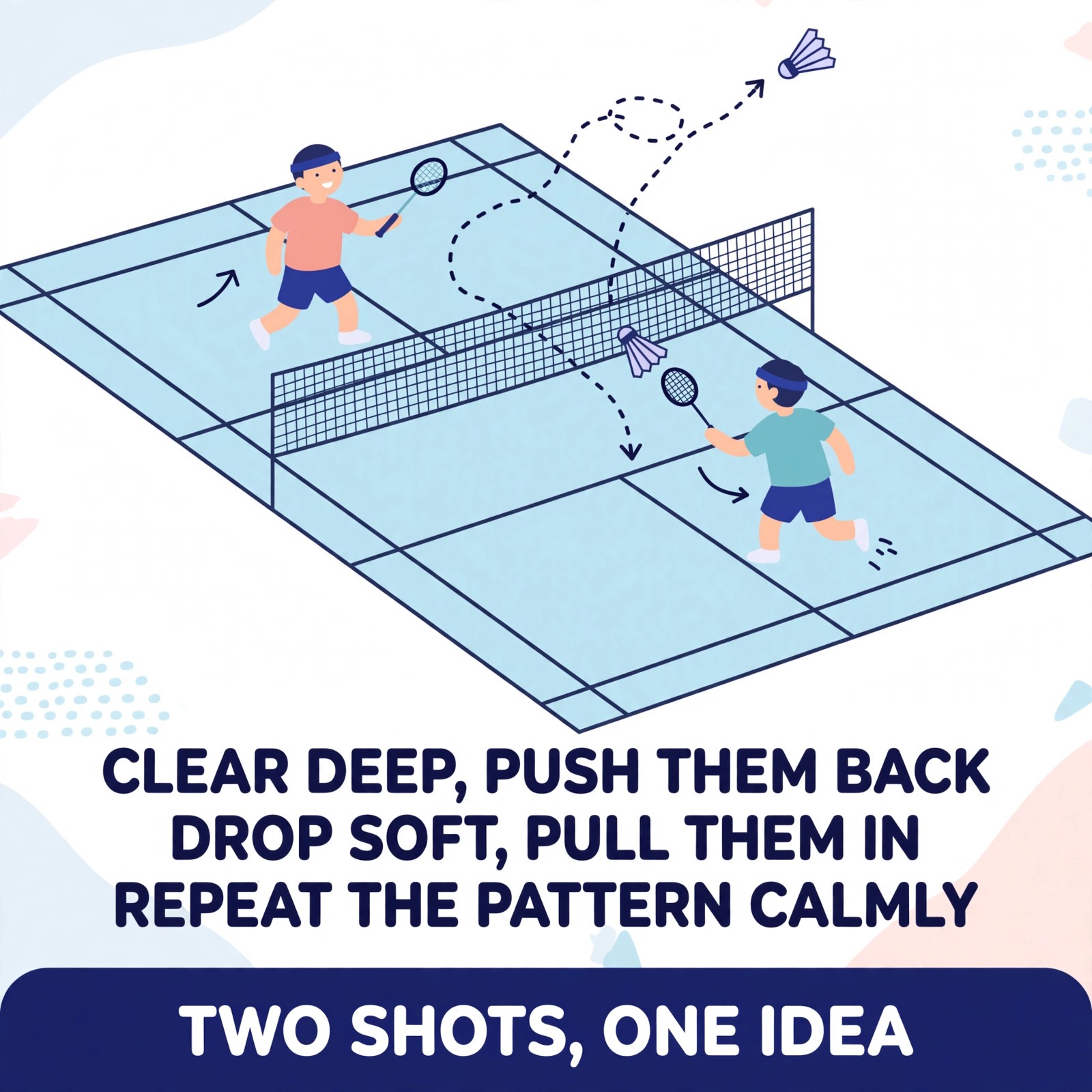
A singles rally is built, not blasted. Your default tools are length and patience: clears that land deep near the back line and drops that pull your opponent to the front corners, played in patterns that move them the longest distances. Front to back stretches the legs more than side to side, so make them travel the full length of the court. Every shot you play should ask a question. A deep clear asks: can you still reach the back? A soft drop asks: can you still get forward? Keep asking calm questions until one answer comes back weak: a short lift, a late arrival, a shot played falling backwards. That weak reply is the rally you have been building.
Shot selection inside the rally follows one honest rule: the quality of your shot is decided by your position when you play it. Balanced and early, you can attack. Stretched and late, your job is to buy time with height and depth, not to attempt a winner from the floor. Lifts played under pressure should be high and deep, giving you seconds to recover. Net shots played under pressure should be simple and safe. Players lose singles by trying to win every rally twice: once with a brave shot from a bad position, and again in their head afterwards. Play the shot your position has earned, and the rally stays yours to build.
Patterns help the building stay calm. A simple one: clear to the backhand corner, drop to the forehand front, then clear again behind them as they rush forward. Another: keep everything straight until they lean, then change direction once. You do not need twenty patterns. Two or three grooved patterns, played with discipline, will carry most club matches, because discipline is rarer than variety at club level. When a pattern works, repeat it until the opponent solves it. When they solve it, change one thing, not everything. Singles is a long conversation, and the patient speaker usually gets the last word.

Singles Check #3
Attack the Corners: Finishing With a Plan
Attack in singles is a reward you collect, not a mood you play in. The moment to attack arrives when your building has done its work: the opponent is late, off balance, or has lifted short. Now the corners pay. Smash wide to the side they are leaving, or straight at the body when they are retreating and cannot set their feet. Attack the space their recovery cannot reach, which is usually the corner furthest from where their weight is travelling. A smash played at the right moment needs less power than players think, because a late opponent makes an ordinary smash look fast.
The follow up is half the attack. After a smash, move forward: a weak block is coming, and the net is where you finish. Many club players smash, admire, and watch the block drop in front of an empty front court. Commit your feet with your shot. If the smash is defended deep instead, your forward move still leaves you balanced to turn and recover. Attacking also has a cost you must respect: every full power smash spends energy and position. Spend both when the rally has been built to pay you back. Attacking a neutral rally from a neutral position is not bravery; it is donation.
Choosing not to attack is a skill too. Against a strong defender, your smashes may come back all day, and the winning move is to keep building until their defence cracks under movement rather than power. Against a tiring opponent, longer rallies are the attack. Read what the match is telling you. The scoreboard helps: if your attacks keep failing, the plan changes; if the opponent fades late in games, the long rally becomes your sharpest weapon. Strategies for success in singles are mostly this: honest reading, patient building, and the discipline to attack the moment rather than the idea.

Singles Check #4
Defend the Smash: Stay Calm, Stay Low
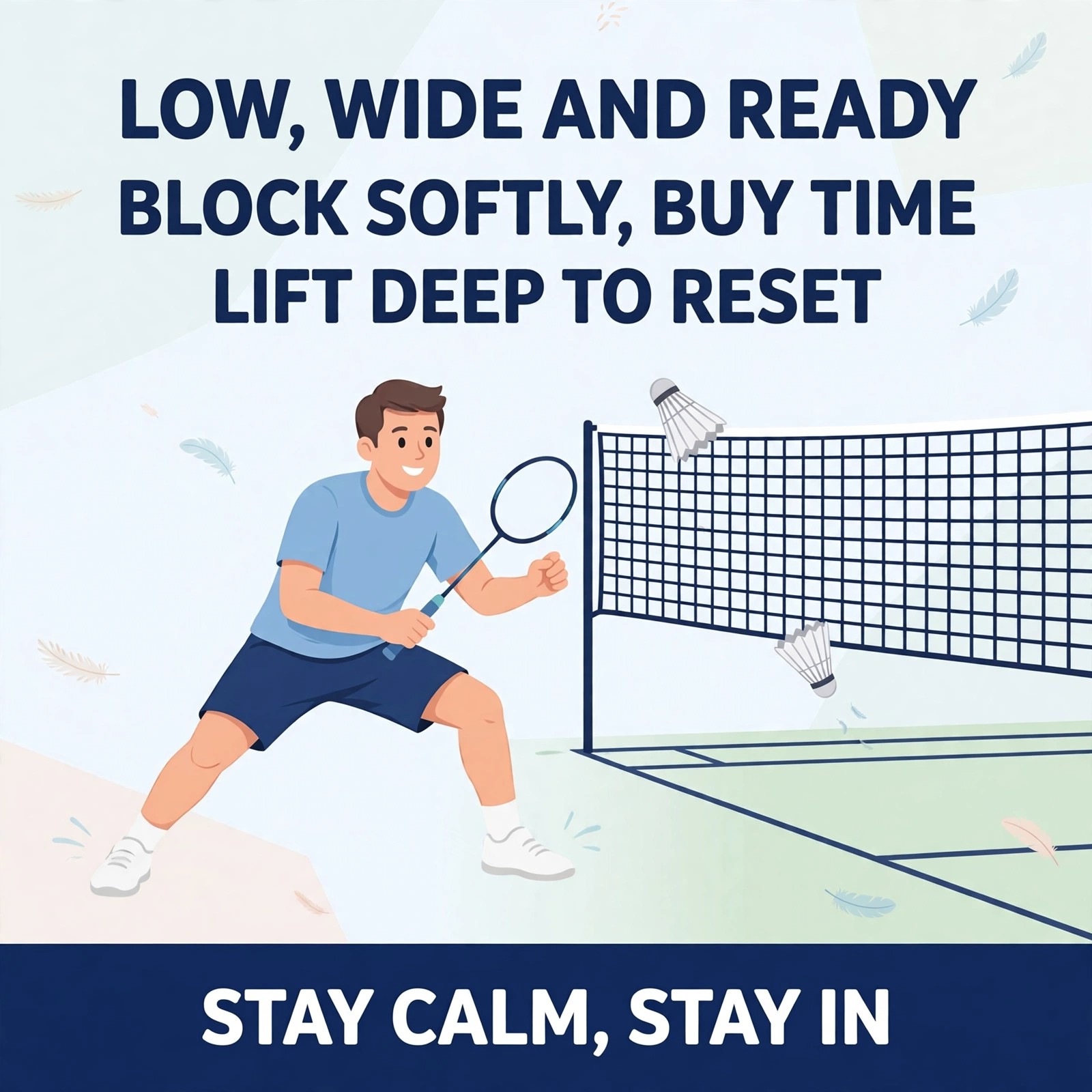
Sooner or later the smash comes at you, and singles defence decides whether you survive it. Take a low, wide stance with your racket up in front of your body and your weight forward. Against a steep smash, block softly and let the shuttle die just over the net: your opponent, recovering from their own jump, must now sprint the full length of the court. Against a flatter smash, drive it back cross court or lift it deep. The worst defensive habit is backing away and swinging big; it turns a playable smash into an emergency. Defence is not passive. A good block is an attacking shot played quietly.
Position makes defence possible. If you are caught a step too deep, every smash lands in front of your racket. If you are too close to the net, the clear beats you instead. Defend from your base, slightly forward of your attacking position, and trust the stance. Keep the swing small: the smash provides the pace, your racket is a wall with angles, not a second hammer. Between smashes, recover one step and breathe. Defenders lose when they defend one smash brilliantly and the next one badly because the recovery never happened. Survive the shot, then rebuild your base, then the rally is a rally again.
There is a mental side to defence that matters just as much. Being smashed at feels like losing, and players rush to escape the feeling with a wild counter attack. Resist it. A rally where you defend three smashes and win the point teaches your opponent that smashing at you is expensive, and they will think twice for the rest of the match. Calm defence is a message: your best shot is not enough. Send that message a few times and the attacks slow down, the lifts get safer, and the match tilts toward the patient player. Defence, played well, is how singles players take control without touching the attack.
Singles Check #5
Pace the Match: Energy, Routines and Honest Plans
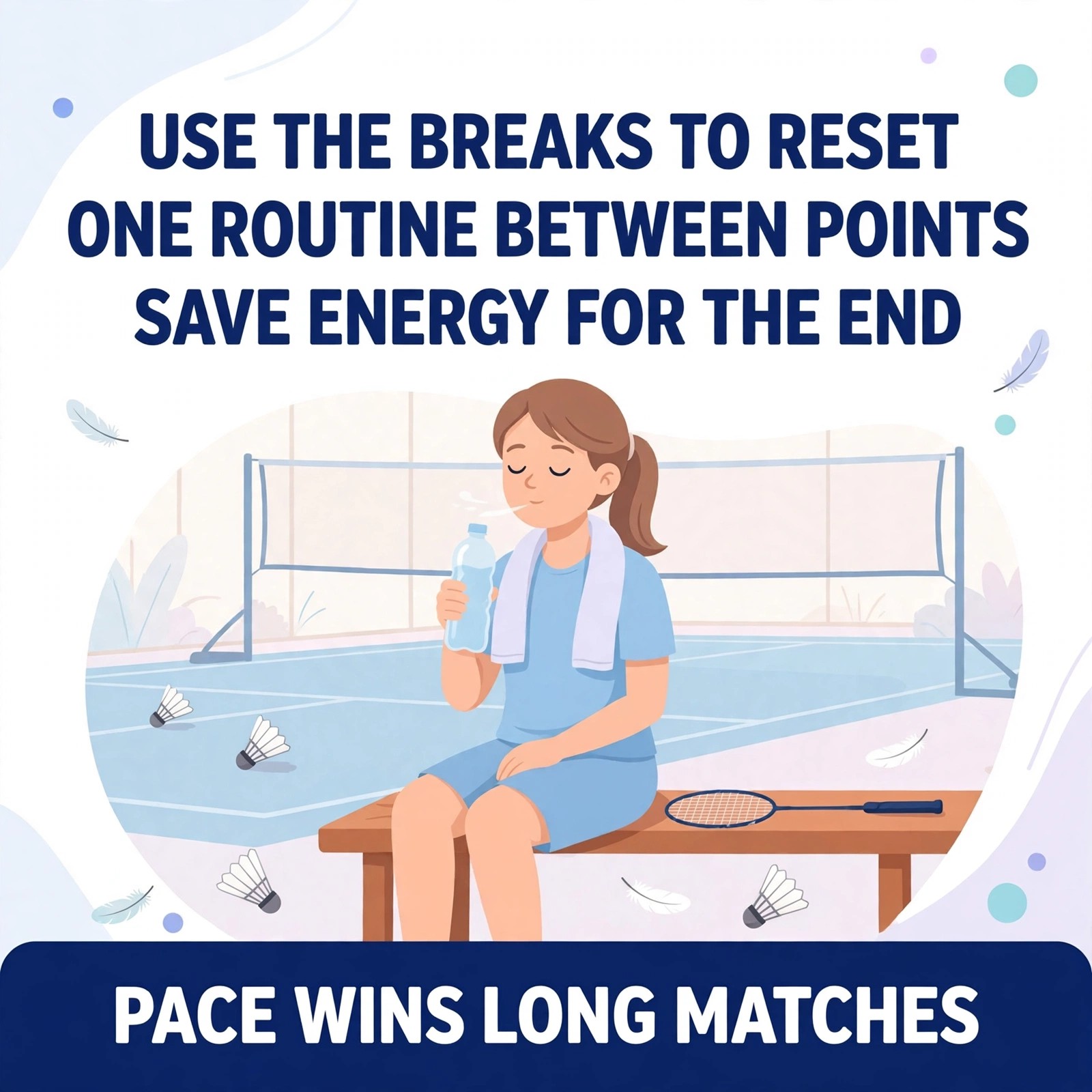
Singles matches are long, and the player who manages energy usually owns the ending. Matches run to 21 points per game, best of three games, with a short interval when the leading score reaches 11. Use every break the rules give you: the interval, the moments between games, the towel breaks. Between points, build a small routine: turn away, breathe out slowly, decide the next serve or return, then step in. The routine is not superstition. It is pacing. It stops one bad point from hurrying the next three, and it gives your legs small rests that add up across a match.
Pacing also means choosing your battles inside the match. Not every rally deserves full speed. When you are far ahead, keep the rallies honest but simple. When the score is tight late in a game, that is when your best patterns and full commitment come out. Fitness supports all of this, and it is built the boring way: footwork drills, rally based conditioning and enough rest between hard days. Be honest about your current fitness and plan around it. A plan that respects your legs will still be working in the third game. A plan that ignores them stops working in the second.
Momentum swings are normal in singles, and how you answer them decides matches. When points run against you, slow everything down: take your full time between points, play your safest pattern, and win one simple rally before you chase anything clever. When points run for you, keep doing exactly what is working and resist the urge to finish in style. The scoreboard never asks how a point looked. Write your game plan down before tournaments if it helps: two patterns, one defensive rule, one reminder for hard moments. A plan on paper is easier to trust than a plan invented at 19 all.
Myth vs Reality
Myths About Singles Success
The first myth says singles is only about fitness. Fitness matters, and nobody wins long matches on empty legs, but club singles is full of fit players who lose to calmer ones. They run to the wrong places, attack from the wrong positions and spend their energy in the first game. Fitness decides whether you can still play your game in the third game. Thinking decides whether your game was worth playing. Train your legs, absolutely, and train your patience with the same seriousness, because the two together are what singles success is actually made of.
The second myth says more smashes mean more wins. The smash is the most expensive shot in singles: it costs energy, it costs position, and when it is defended it often costs the point. Players who smash at every lift teach their opponents to wait for it, and a waited for smash is just a fast clear. Watch how rarely strong singles players smash compared with how often they threaten to. The threat moves the opponent; the smash, saved for the earned moment, finishes. Power is a savings account. Singles rewards the player who spends it last.
The third myth says you should copy professional singles exactly. Professional players move at speeds built over years of full time training, and their tactics assume that movement. Copying their shot choices without their legs leads to positions you cannot recover from. Copy their habits instead: the patience, the recovery after every shot, the routines between points, the honest review after matches. Those scale to any level. Your version of singles will be slower than theirs and that is fine. A calm club game built on base, building and timing will beat a frantic copy of the professional game almost every time.

Why Choose Us
Why Players Choose ST Badminton Academy
At ST Badminton Academy, singles is coached as a thinking game with a physical base. Players learn the geometry first: where base sits, why the corners pay, when a rally is ready to attack. Then the patterns are grooved in drills until they can be played under pressure without a committee meeting in your head. Coaches watch your matches and your rallies with you, pointing at the moment a point was really decided, which is usually two shots before the winner. That kind of review changes how players see the game, and singles is a game you win largely by seeing it clearly.
Sessions mix tactical explanation with counted practice. A building drill might ask for ten rallies where the attack is only allowed after four shots, teaching patience by rule. Defence feeds test your block under real smash pressure, with the count kept on blocks that land in. Groups stay small, with a maximum of 4 students, so your patterns and habits are seen and corrected personally. Singles can feel lonely on court, but learning it does not have to be. Training partners in the group push your rallies while the coach shapes the thinking behind them.
Honesty matters in singles coaching. We will tell you when you attacked too early, when your base crept too deep, and when a third game faded because the first game was spent too fast. We will not promise that tactics turn anyone into a champion in a month, and we will not sell you a secret system. Singles improves the way rallies are built: patiently, piece by piece, with feedback you can act on. Players who stay with that process find their results change, not because they found a trick, but because they stopped giving points away.
FAQs: Badminton Singles, Tactics and Match Play in Malaysia (KL)
Below are the questions players ask us most about playing badminton singles at ST Badminton Academy. If your question is not here, bring it to a trial session and we will answer it on court, where the answers are easiest to show.
Can a beginner learn to play singles well in Setapak or Gombak?
Yes. Singles looks advanced because one player covers the court, but its habits are simple: hold a base position, recover after every shot, build rallies with length and defend calmly. Beginners learn these at a pace their legs can handle. You do not need a smash to play singles well. You need patience and a base you return to.
What is the first singles habit a new player should build in KL?
Build the recovery habit. After every shot, return toward your base position a step behind the centre, low and ready, before anything else. Most beginner singles problems are recovery problems: the shots are fine, but played from wherever the last one ended. Add the split step next, timed as your opponent hits. With those two habits, the whole court shrinks.
How wide is a singles court compared with doubles at club level?
The singles court is 5.18 metres wide, while the doubles court is 6.1 metres wide. Both are 13.4 metres long. Singles uses the narrow side lines but the full length, including the back area beyond the doubles service line. That corridor shape is why singles rewards length: moving an opponent front to back covers more ground than side to side.
I keep getting beaten by the same cross court shot. Should I stand wider or read it earlier?
Read it earlier. Standing wider to guard one shot opens the other corners, and a thinking opponent will play where you are not. Hold your base and study the habit: most players cross court from the same position, with the same preparation, under the same pressure. Lean a half step only after the pattern repeats. Test it in feeding drills.
How can I practise singles footwork alone without a partner in training?
Yes. Shadow footwork is the main solo tool: move through the singles patterns, front corners, sides and back corners, recovering to base after each one, slowly first and then at rally pace. Wall rallies build touch and quick hands. Self feeding clears and drops teaches length and control. Keep solo sessions short and technical rather than long and tired.
Do you coach badminton singles near Wangsa Maju?
Yes. Singles coaching runs on court at our Setapak base and nearby areas, including Wangsa Maju. Sessions cover base position, rally building, attacking choices, smash defence and match pacing, with rallies reviewed shot by shot. Groups stay small, with a maximum of 4 students, so your patterns get seen and corrected. Tell us your level when you book.
Where does ST Badminton Academy teach singles in Malaysia?
Our base is in Setapak, Kuala Lumpur, and players join us from across the city and from Singapore. Singles coaching is part of our regular programme for juniors and adults, from first base position lessons to match play against stronger training partners. Every session follows the same standards: small groups, checked reps and honest tactical feedback on your rallies.
How do I book a trial session to test my singles game?
Send us a message on WhatsApp or through the website and tell us your level. We will suggest a session time and explain what to bring: court shoes, sports clothes and a water bottle. In the trial we will rally, watch your base position, building shots and defence, then tell you what we saw. No pressure to sign up afterwards.
What makes Mr Eric Chuar a suitable coach for singles tactics and badminton?
Mr Eric Chuar coaches singles the way it should be coached: patiently, with the whole rally in view. He reads where points are decided, usually in the building shots before the winner, and teaches players to see the same thing. His feedback is plain: which corner, which moment, which habit. More than 15 years of coaching sits behind that eye.
Badminton Singles Training in Action



One Standard for Every Session and Every Player
Every singles session at ST Badminton Academy follows the same coaching standards. Tactics are taught before they are tested at speed, and drills carry a clear rule or count so progress can be seen. Groups stay small, with a maximum of 4 students, so rallies and habits are watched closely. Feedback is honest and specific, and match reviews point at the real moment each point turned. These standards hold for every player, from a beginner learning where base sits to an advanced player preparing for tournament singles.
| Factor | Smash Everything | Build and Finish SINGLES |
|---|---|---|
| Frequency | 1 or 2 times a week. Mostly for fun and sweat. | Rallies are built with length first: deep clears and soft drops that move the opponent. |
| Drills Focus | Basic static feeding. Minimal footwork pressure. | The attack comes only when the rally has earned it: a late, off balance opponent. |
| Physical Conditioning | Rarely included. Just playing games on court. | Core, agility, and speed training included in every session to prevent injury and build stamina. |
| Tactical Awareness | "Just hit it over." No real game plan. | Video analysis, point construction, and learning to read the opponent's game. |
| Coach Ratio | Large groups (8-10 kids). Coach barely watches you. | Max 4 students. Mr Eric Chuar personally corrects every stroke and movement detail. |
| Goal Setting | Fun and exercise. | Defence is calm and low, blocking softly to make the attacker sprint the full court. |
| Long Term Result | Good recreational player. | A thinking singles player: patient building, honest pacing and attacks that arrive on time. |
Badminton Singles Coaching in Kuala Lumpur
Singles is waiting to reward your patience. Come to ST Badminton Academy in Kuala Lumpur and learn to hold the middle, build rallies that earn their endings, and defend like the point is never over. Book a trial session, bring your court shoes, and we will show you exactly where your singles game stands and how far calm thinking can take it.






