The Dos And Don’ts Of Badminton Etiquette: Rules For Good Sportsmanship (Etiquette Guide)
Badminton runs on trust. In most games there is no umpire watching every line, no camera to check a close shuttle, and no referee to settle an argument. The game only works because the players police themselves, call honestly, and treat each other well. That is why etiquette is not decoration on top of the sport. It is part of the sport, as real as a grip or a footwork pattern. This guide sets out the dos and don’ts we teach at ST Badminton Academy, in pairs, so a young player can remember them easily: what to do, and what to leave out. The pairs cover the five places where manners are tested most. Line calls, where honesty matters. The net, where hands and rackets must stay fair. Noise, delays and phones, where patience matters. The minutes before and after a game, where greetings and handshakes set the tone. And the sidelines, where partners, coaches and waiting players all share the same hall. None of this needs a rulebook the size of a phone book. It needs habits, practised in class until they happen without thinking. A player with good habits gets invited back to social games, gets trusted with close calls in school matches, and enjoys the sport more, because games stay friendly even when they are close. Coaches notice these players too. Skill can be taught in drills. Character shows in the small moments: the honest call at 19 all, the calm reaction to a mistake, the handshake after a loss. Read the pairs below with that in mind.

Etiquette Check #1
Line Calls: Call What You See, and Give the Benefit of the Doubt
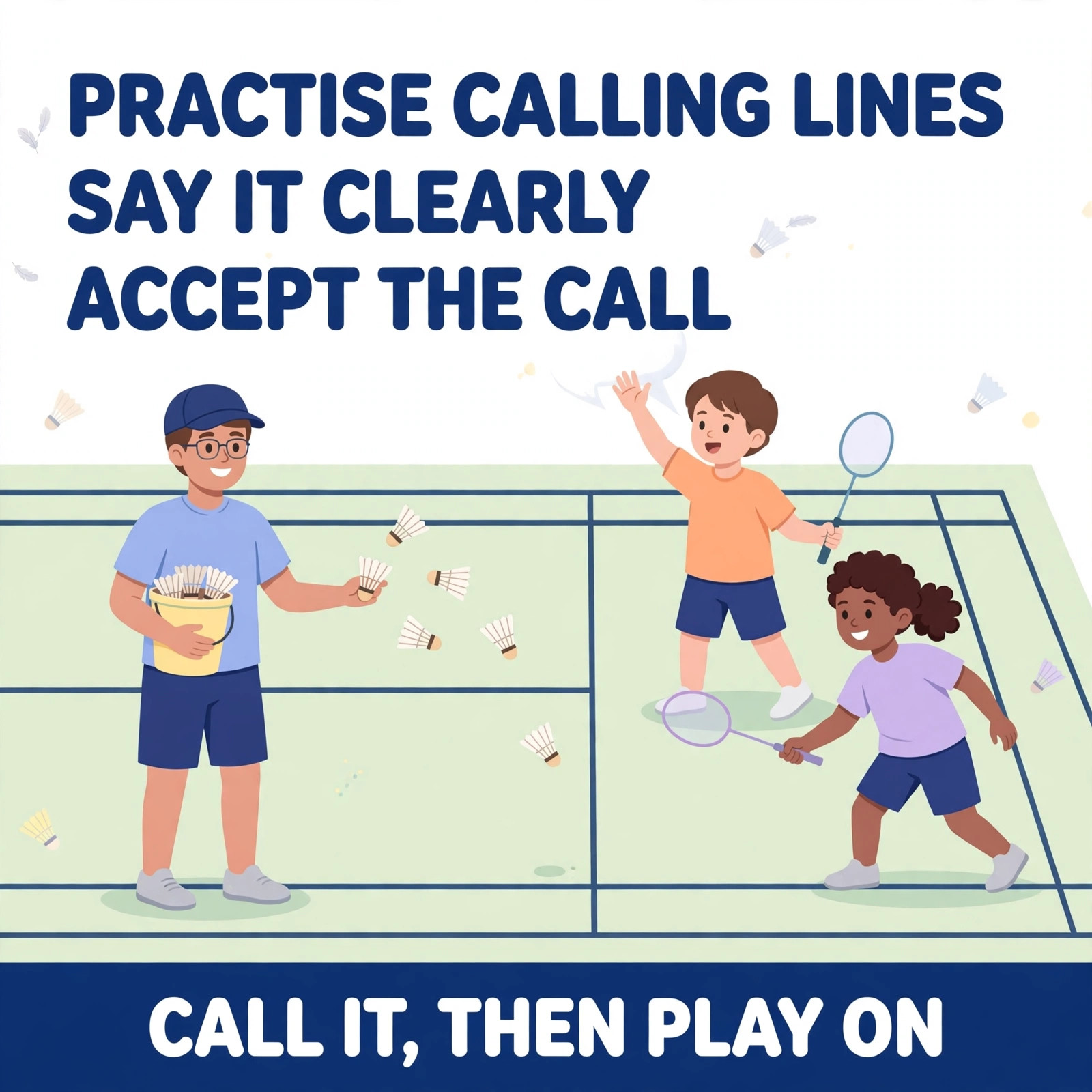
Start with the line call, because it is where etiquette is tested hardest. In club and school games, players call the shuttles on their own side of the court. The rule of manners is simple: call what you honestly saw, and call it clearly so your opponent hears you. If the shuttle lands on the line, it is in. If you are standing close and you saw it out, say out at once, with a clear hand signal. Do not wait to see whether the point suits you. Do not look at your partner or the sideline for help with a call that is yours to make. The moment a player starts calling shuttles the way they wish they had landed, the whole game becomes an argument waiting to happen.
The close call deserves its own habit. Sometimes a shuttle lands fast, near the line, and you truly are not sure. Honest players give the benefit of the doubt to the opponent: if you cannot say it was out, treat it as in, or offer to replay the point in a friendly game. That one habit saves more friendships than any other in this guide. If the two sides still disagree in a social game, replaying the point costs nothing and keeps the evening pleasant. In an umpired match the job changes hands: the umpire and line judges decide, and the player’s job is to accept the decision and play the next point. Arguing has never once moved a line judge’s chair.

Etiquette Check #2
At the Net: Hands, Rackets and the Shuttle Crossing
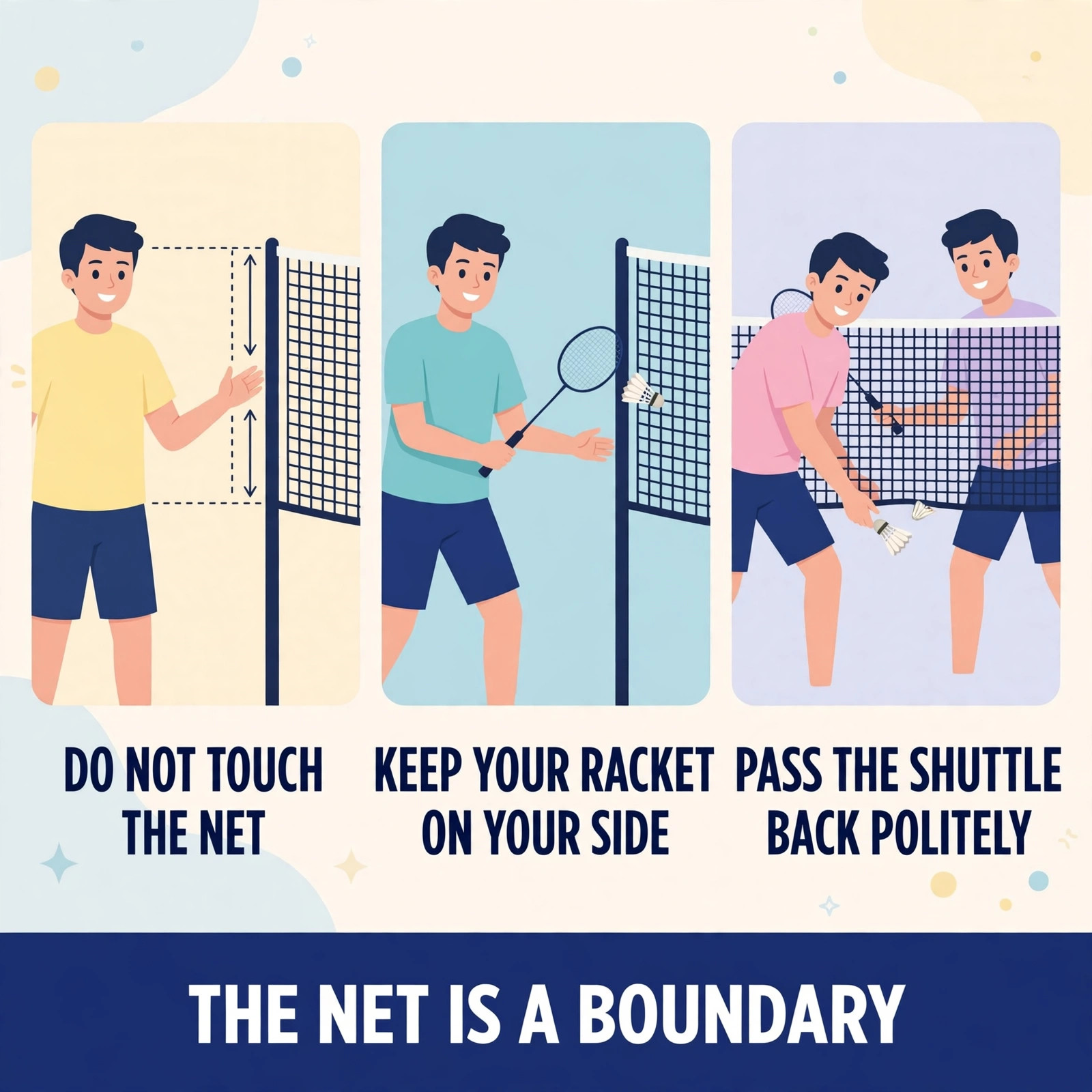
The net is a boundary, and treating it as one is the second pair of habits. Do not touch the net with your body or your racket while the shuttle is in play. A shirt brushing the net, a racket tip tapping the tape during a rally, a hand steadying itself on the post: all of these are faults in a match, and poor manners in any game. Keep a small space between you and the net even when you are rushing in for a net shot. If you do touch it, own up at once in games without an umpire. Owning up quickly, with a simple sorry and the point given away, earns more respect than any winning shot played afterwards.
Your racket has its own net rules. You may follow through over the net after hitting the shuttle on your side, because the swing has to finish somewhere. What you may not do is reach over the net to hit a shuttle that is still on the other side, or wave your racket in front of an opponent who is about to play a shot. Blocking, waving and shouting near the net are distractions, and distraction is a form of gamesmanship this guide asks players to leave out. The same goes for the shuttle itself between rallies. Pass it gently to your opponent, under the net or around the post, never thrown hard across the floor, and if the feathers are damaged, show your opponent and agree on a new shuttle together.
The net area is also where tempers show first, so keep it clean in every sense. Do not celebrate a point in your opponent’s face across the tape, do not stare an opponent down after a net kill, and do not fish for a reaction when a lucky net cord wins you a point. A raised hand and a quiet sorry is the accepted apology for a lucky cord, and players who offer it are remembered kindly. If your shuttle rolls under the net after a point, collect it at a natural pause rather than reaching under the net and dragging it back during the next rally.
Etiquette Check #3
Noise, Delays and Phones: Keep the Hall Calm
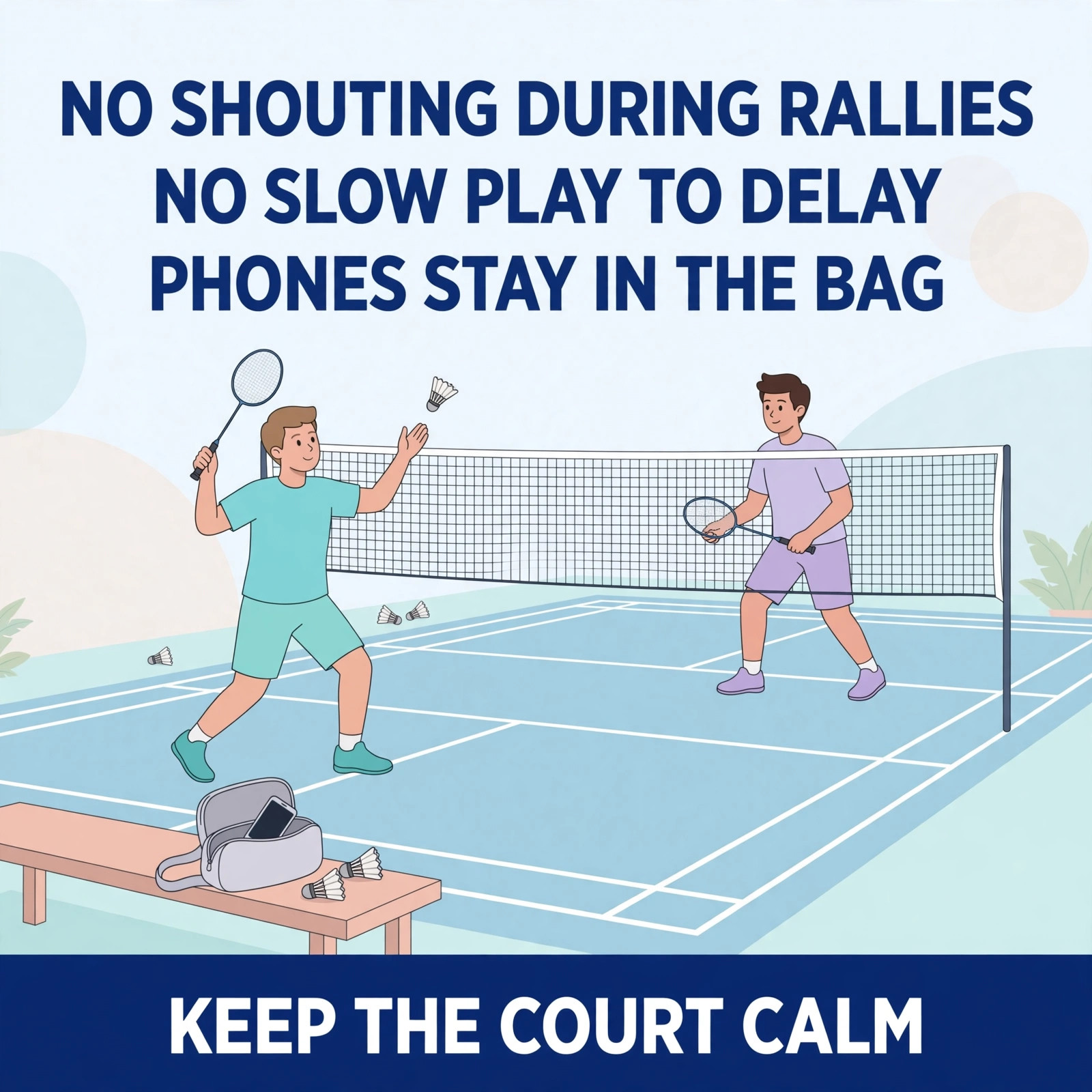
Noise is the third test. Badminton halls echo, and a shout carries across three courts. During a rally, the only voices should be partners calling mine or yours in doubles. Shouting as your opponent is about to smash, cheering a mistake loudly, or coaching from the sideline in the middle of a point all spoil the game for players on your court and the courts beside you. Cheering is welcome between points, in short bursts, for good play from either side. Applause for a great rally, whoever won it, is one of the nicest sounds in a hall, and it costs nothing.
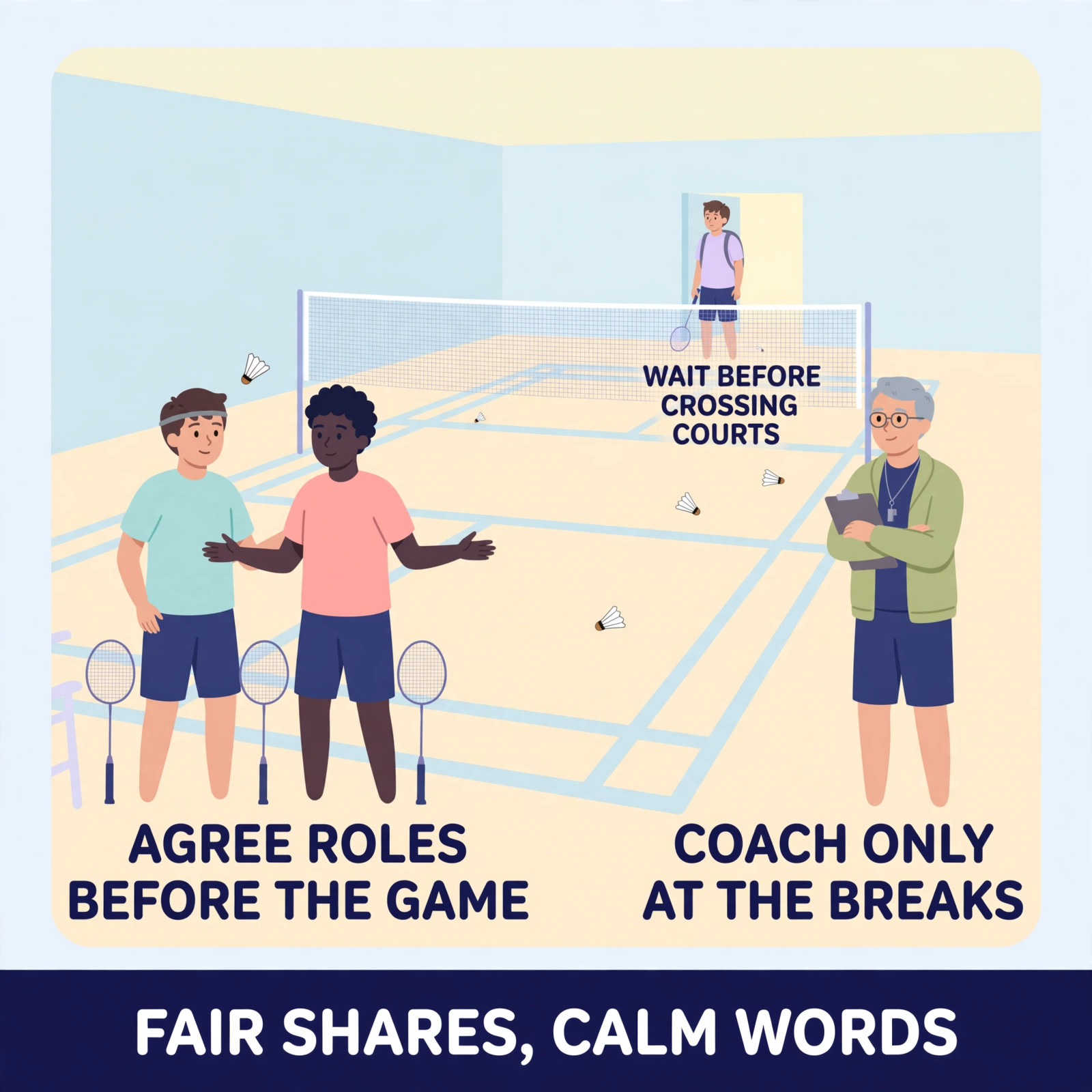
Delays and phones sit in the same family. Be ready when it is your turn to serve or receive; a match is not the place for long walks, repeated shoe tying, or slow trips to the towel after every rally. Towel breaks and drinks belong at the interval, when the leading score reaches 11, and between games. Phones should be silent and inside the bag, not on the bench where a ringtone can break a rally on the next court. Filming a game is fine only when the hall allows it and the people in the frame are happy with it. And when you need to cross the hall, wait behind the court until the rally ends. Walking behind a court mid rally is both rude and a quick way to collect a stray shuttle.
Respect also runs sideways, to the courts beside yours. When your shuttle lands on a neighbouring court, wait for their rally to end before stepping in to fetch it, and say thanks when they pass it back. When their shuttle lands on your court, return it promptly and gently at the next pause. Keep your bags, bottles, and spare rackets behind your own court, out of the walkways and out of the landing space of the players beside you. A hall where everyone minds the courts around them runs smoothly; a hall where everyone minds only themselves does not.
Etiquette Check #4
Before and After: Greet Well and Shake Hands
The minutes around a game shape how it feels. Do arrive on time, greet your opponent by name if you know it, and wish them good luck before the first serve. In social games a short introduction is enough: your name, a smile, and a friendly first rally. It sounds small, but players who greet each other play fairer games afterwards, because it is harder to argue with someone you have just wished well. If you are new to a group, say so. Experienced players almost always soften the game for a newcomer who is honest about being new, and they remember the courtesy.
The knock up before the game has manners of its own. A warm up rally is shared work, not a first chance to win. Hit clears to the back so your opponent can move, drop a few to the net so they can warm up their net play, and keep the shuttle reachable. Blasting smashes at a cold opponent, or aiming every shot at the corners so they cannot return it, wastes both players’ warm up. Keep it short and even, a couple of minutes, and if one side needs a few extra clears to settle, give them without a sigh. Both of you start the game warmer and friendlier.
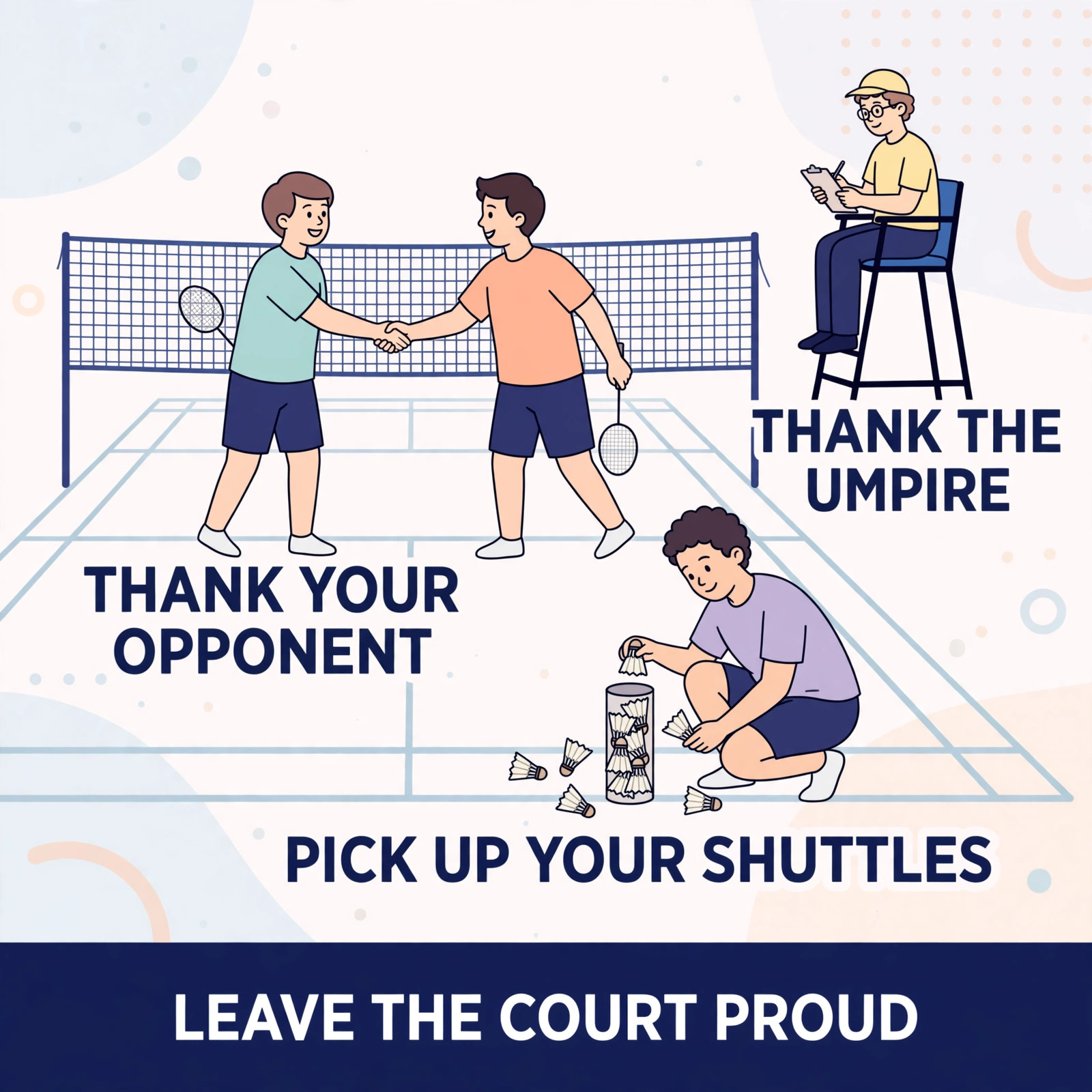
After the last point, the routine is fixed and short: go to the net, shake hands, and thank your opponent and your partner. Do it the same way after a loss as after a win. A player who is warm in victory and cold in defeat is remembered for the second one. Thank the umpire if there is one. Then leave the court tidy, taking your shuttles, tape and water bottle with you, so the next pair walks onto a clean court. If a call went against you and still stings, the handshake is not the place to reopen it. Smile, thank, and let it go; there is always another game.

Etiquette Check #5
Partners and Sidelines: Fair Shares, Calm Words
Doubles adds a partner to the manners list. Before the game, agree the simple things: who takes the middle shuttles, who serves first, and how you will call mine and yours. Agreeing for ten seconds at the start saves the small collisions and glares that spoil doubles. During the game, a mistake by your partner is met with encouragement, never blame. No head shaking, no loud corrections, no turning your back. Partners play worse after public blame and better after a calm word and a tap of rackets. The pair that looks after each other between rallies is very hard to beat when the score gets close.
Coaching has its moments, and they are not every moment. In a match, a coach speaks at the interval and between games. That is the rule, and keeping to it is part of respecting the other side, who are playing without advice between rallies too. In training the manners run the other way: listen when the coach is talking, ask questions at the right breaks, and do not talk over a demonstration your classmates are trying to watch. From the sideline of a friendly game, keep advice short and welcome, or keep it to yourself. Unasked coaching during someone else’s game is rarely received as kindly as it is meant.
Courts are shared, so the last pair of habits is about taking turns. In open sessions, follow the hall’s system: winners stay on for an agreed number of games in some halls, rotation boards in others, and in every hall the same rule of fairness: do not dodge strong opponents, do not camp on a court while others wait, and invite waiting players into the rotation. If you see a shy newcomer standing with a racket and no game, offering them a place in your four is the single most welcoming act in badminton. Every regular player in every hall was once that newcomer.
Myth vs Reality
Myths About Badminton Etiquette
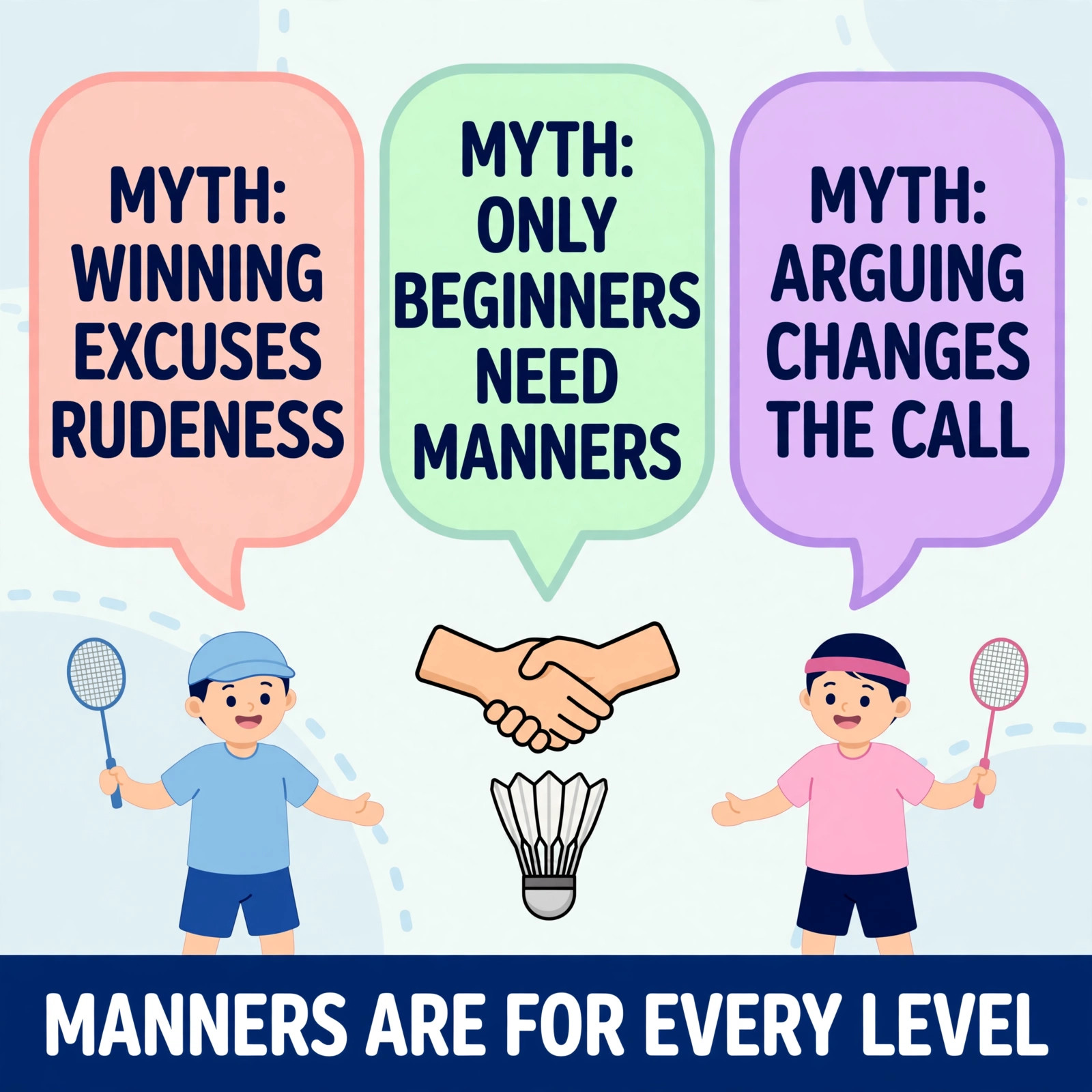
Myth one: winning excuses rudeness. It does not. The results sheet forgets most matches within a season, but players remember exactly who argued every call, who gloated over mistakes, and who could not lose with grace. A strong player with poor manners finds fewer invitations, fewer partners, and colder receptions at new halls. The win lasts an evening. The reputation follows the player from hall to hall, and it is built entirely out of the small moments in this guide.
Myth two: manners are for beginners, and serious players are above them. The opposite is true. The higher the level, the more the small habits matter, because the games are closer, the calls are tighter, and the same opponents appear again and again across a season. Top players shake hands, thank umpires, and accept close calls with a nod, on camera, at 20 all. Coaches selecting juniors for squads watch for exactly this. A talented junior who argues and sulks is a risk no selector wants to carry into a team event.
Myth three: arguing can change a call. In club games there is nobody to persuade; the call belongs to the player on that side, and arguing only hardens it. In umpired games the umpire’s decision stands, and arguing costs focus, sometimes a warning, and always the next two or three points while the mind is still on the last one. The players who handle bad calls best share one habit: they treat the call as weather, note it, and play the next rally. That habit is trainable, and we train it like a shot.
Why Choose Us
Why Players Choose ST Badminton Academy
At ST Badminton Academy, etiquette is taught the same way as technique: named, shown, and practised. Coaches explain the do and do not pairs in plain words, juniors practise them in class games, and small groups, with a maximum of four students per coach, mean the habits are actually seen and corrected. A coach watching four players notices who calls honestly, who encourages a partner, and who needs a quiet word about a slammed racket. In a crowd of twenty, those moments pass unseen. Manners grow where somebody is paying attention.
The academy also models the behaviour from the front. Coaches greet every student, thank players at the end of sessions, and call lines honestly in demonstration games, even when the honest call loses them the point in front of the class. That example matters more than any poster on the wall. Parents tell us they value this side of the training as highly as the footwork: their children learn to win without arrogance, lose without excuses, and treat opponents, partners and officials with steady respect.
Finally, etiquette is part of how the academy prepares players for school teams and tournaments. Selection is not only about strokes. Teachers and selectors pick players they can trust in a team shirt, players who will represent the school well in a hall full of strangers. Our juniors are taught the umpire’s world too: how to ask a question politely, how to accept a decision, and how to thank officials. A player who behaves well under pressure is a player coaches are happy to send anywhere.
FAQs: Badminton Etiquette and Good Sportsmanship in Malaysia (KL)
Here are the questions parents and players ask us most about badminton etiquette, the dos and don’ts of good sportsmanship, and how manners are taught in our classes in Kuala Lumpur and Setapak.
How does your academy teach juniors good court manners in Setapak or Gombak?
Coaches teach manners inside the training itself, not in a lecture. A drilling pair learns to feed kindly, a class game includes honest line calls and a handshake at the end, and coaches praise good behaviour out loud when they see it. Habits praised in public grow fast, especially with juniors.
What is the polite way to handle a close line call in KL?
A close call is handled the same way at every level of friendly play: call what you honestly saw, say it clearly, and if you are genuinely unsure, give the point to your opponent or replay the rally. Never argue. Games stay friendly when players would rather lose one point than lose the room.
How early should a junior learn court manners if they play at social level?
From the very first session. A beginner’s first habits are greetings, passing the shuttle politely, and calling shots honestly on their own side. These are taught alongside the first grip and the first footwork steps, so good manners and good technique grow together from the start.
Should a player ever argue with an umpire during a junior match?
No. A player may ask the umpire a polite question at a break, through the proper channel, and must accept the answer. Arguing changes nothing, costs concentration, and can draw a warning. We teach players to note the decision, breathe, and put everything into the next rally instead.
What should players say to each other before and after games?
Before the game: good luck, and have a good game. After the game: well played, and thank you. Naming one shot you genuinely admired costs nothing and is remembered for weeks. The handshake at the net ties it together, win or lose, in exactly the same tone.
Do you teach badminton manners and sportsmanship near Wangsa Maju?
Yes. Manners are part of every class at the academy, including sessions in the Wangsa Maju and Setapak area. Students are reminded about honest calls, quiet sidelines, and handshakes as part of normal coaching, and coaches correct poor behaviour the same way they correct a wrong grip.
Does your academy remind players about phones and noise in Malaysia?
Yes, with simple standing reminders. Phones stay silent and inside bags during sessions, voices stay down while rallies are live on any court, and students wait before walking behind a court in use. Players pick the habits up quickly because everyone around them follows the same rules.
Where does ST Badminton Academy teach etiquette as part of coaching?
Etiquette is taught inside regular coaching at our Setapak base in Kuala Lumpur. It is not a separate course: it is woven into warm ups, class games, and match play practice, so students learn the manners of the sport at the same time as the shots of the sport.
What makes Mr Eric Chuar a good coach for teaching fair, honest badminton?
Mr Eric Chuar has coached for over 15 years and treats behaviour as part of the game, not an extra. He calls lines honestly in front of his own students, thanks players after every session, and corrects poor manners calmly and early. Players copy what their coach does every week.
Badminton Etiquette and Good Manners in Action

One Standard for Every Player and Every Session
The academy's standard is simple to state and checked in every session: greet, call honestly, encourage your partner, respect the officials, and shake hands at the end. Coaches hold players to that standard the same way they hold them to a ready position. Nobody at the academy is too senior, too strong, or too young for the manners of the game, and the standard does not bend for a close score or a big match.
| Factor | Poor Manners | Good Manners ETIQUETTE |
|---|---|---|
| Frequency | 1 or 2 times a week. Mostly for fun and sweat. | Calls every close shuttle honestly and accepts the call without a debate. |
| Drills Focus | Basic static feeding. Minimal footwork pressure. | Greets opponents, thanks partners and shakes hands at the net after every game. |
| Physical Conditioning | Rarely included. Just playing games on court. | Core, agility, and speed training included in every session to prevent injury and build stamina. |
| Tactical Awareness | "Just hit it over." No real game plan. | Video analysis, point construction, and learning to read the opponent's game. |
| Coach Ratio | Large groups (8-10 kids). Coach barely watches you. | Max 4 students. Mr Eric Chuar personally corrects every stroke and movement detail. |
| Goal Setting | Fun and exercise. | Keeps noise down, waits for the breaks to talk, and keeps the phone in the bag. |
| Long Term Result | Good recreational player. | A player others ask to play with again, win or lose. |
Badminton Coaching With Good Manners in Kuala Lumpur
Good sportsmanship is a skill, and like every skill in this guide it grows with practice. Start with one pair of habits this week: honest line calls, perhaps, or the greeting and handshake done properly every game. Add the others one by one, and within a season the manners will run themselves. If you would like your child to learn badminton in a place where fair play is coached as seriously as footwork, come and join a class at ST Badminton Academy in Setapak, Kuala Lumpur. Book a trial, bring a racket, and we will show you how a well mannered game is also a stronger game.






