The Evolution Of Badminton Gear: From Wooden Rackets To High-Tech Equipment (Gear Guide)
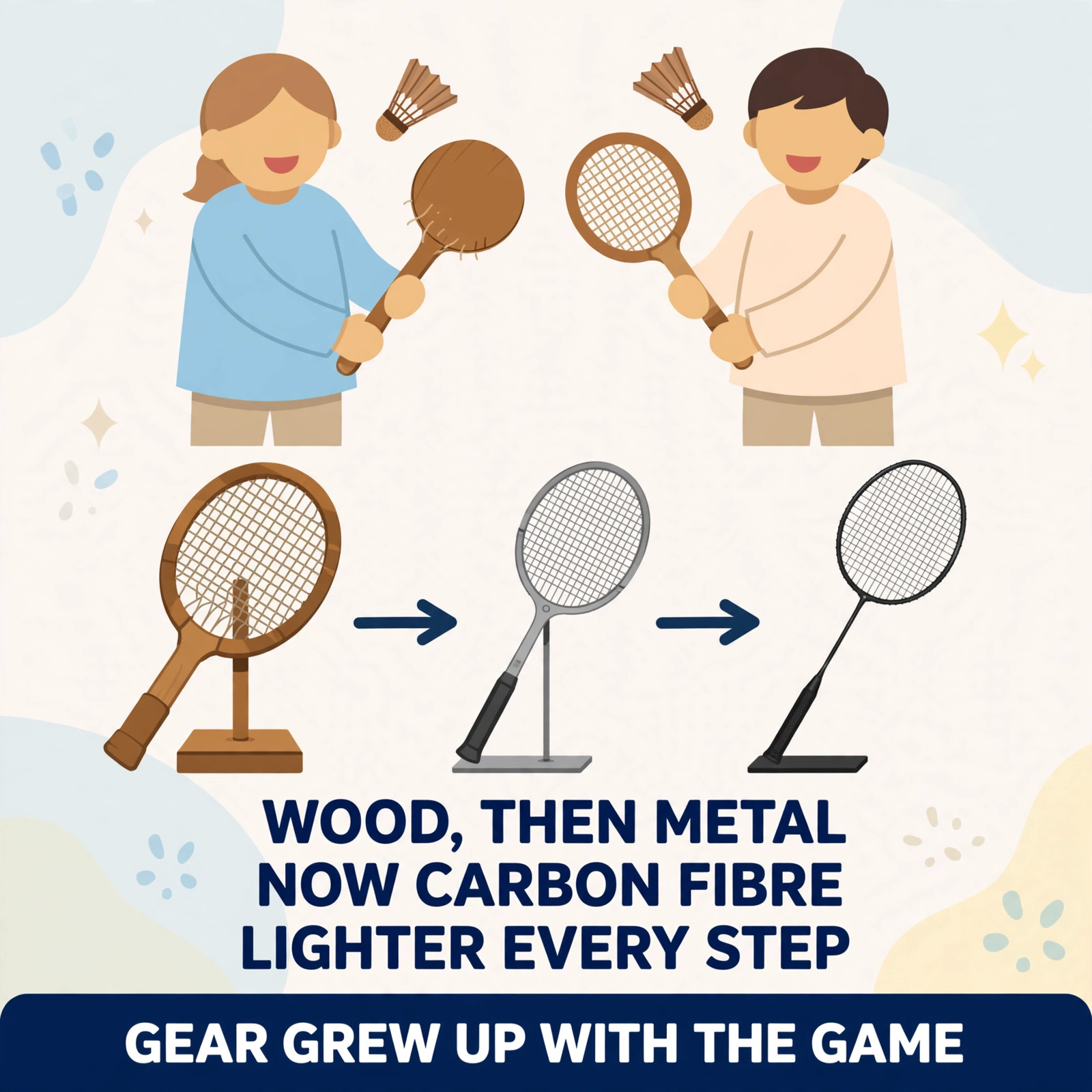
Pick up a badminton racket from a hundred years ago and a modern one side by side, and you are holding the whole story of the sport. The old racket is wood, heavy in the hand, strung with gut, and it lived in a wooden press to stop it warping. The new one is carbon fibre, weighs less than a small apple, and comes in weight classes printed on the shaft. Between those two objects sits every material the game has tried: wood, steel, aluminium, carbon. This guide walks through them in order, and through the strings, shuttles, shoes and grips that changed alongside. Gear history is not trivia for a learner’s family; it is buying guidance in disguise. When you understand why rackets got lighter, why gut strings disappeared, and why feather shuttles refused to leave, the wall of choices in a sports shop stops being noise. You can see which changes were real progress and which are just this season’s colours. That is how we teach gear at our academy: the story first, then the shopping, so families spend on fit and feel rather than on labels. A note on honesty before we start. This guide talks about materials in general terms, the way coaches do: wood gave way to steel, steel to aluminium, aluminium to carbon fibre. It does not retell any brand’s history, it invents no launch dates, and it quotes no prices, because gear prices move and brand stories belong to the brands. The numbers it does use are the stable ones printed on rackets today: the weight classes and shuttle speed grades any player can check in a shop.
Gear Check #1
Wooden Frames, Gut Strings and the Racket Press
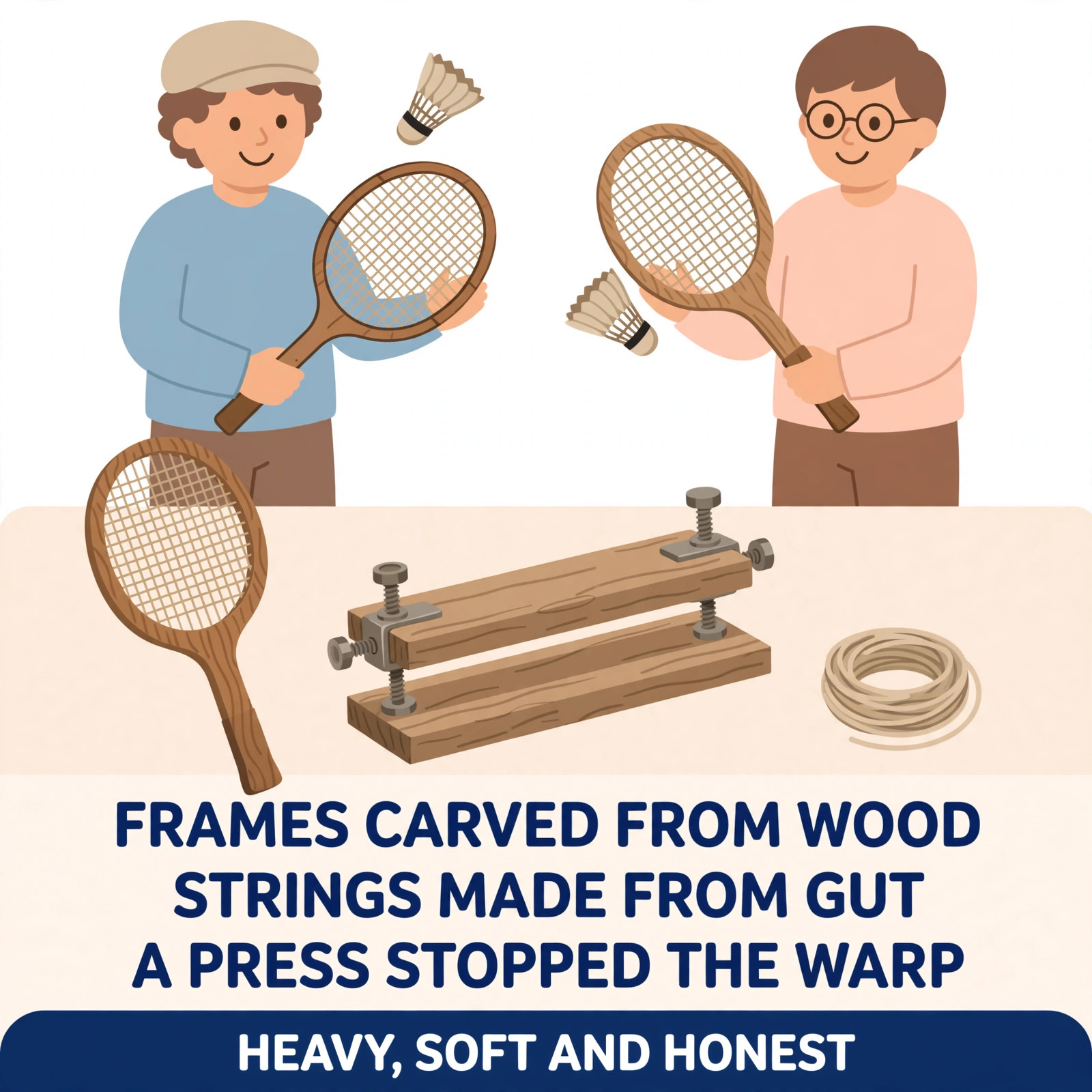
The first real badminton rackets were carved and laminated from wood, with a solid wooden shaft flowing into an oval wooden head. They were handsome objects and honest tools, but they were heavy by modern standards, and the weight lived in the head, so every swing asked more of the wrist and shoulder than a shot needed. Wood also moved with the weather. A frame left in a damp hall or a hot car boot could twist slowly out of shape, and a warped racket pulls every shot toward the bend.
The strings of the wooden era were natural gut, made from animal intestine, dried and twisted into cord. Fresh gut played beautifully, with a soft, lively feel that old players still describe with real affection. But gut drank moisture from the air, slackened in humid halls, and could snap without warning. A serious player travelled with spare rackets the way a guitarist travels with spare strings, because the material simply could not be trusted to last a hard month of play. The third member of the wooden kit was the press: two flat boards joined by screw clamps, which clamped around the racket head whenever the racket was not in use. The press held the frame flat and fought the warp that wood and gut tension wanted to cause. If you find an old racket in a relative’s storeroom, there is a fair chance it is still sitting in its press, a small wooden sandwich that tells you how much care the old gear demanded just to stay straight.
Gear Check #2
Steel, Then Aluminium: The Metal Years
Metal entered the game through the shaft first. A steel shaft could be made thinner and straighter than a wooden one, it did not warp, and it gave the swing a firmer, more predictable feel. For a while the typical racket was a hybrid: a wooden head joined to a steel shaft by a separate T shaped piece, the T joint, sitting where the shaft meets the throat of the head. That joint is such a marker of the era that older players still use it to date a racket at a glance.
Aluminium heads followed, and the frame became metal all through. Aluminium is lighter than the woods it replaced, so rackets shed weight and gained consistency: two rackets of the same model finally felt like the same racket, which wood could never promise. Frames also grew stiffer, which better players liked, because a stiffer frame returns more of the swing’s energy to the shuttle instead of soaking it up in flex. The metal years did not make the wooden game unrecognisable; they made it repeatable.
What metal could not do was go much lighter without going fragile, and the shafts of the era still flexed and twisted more than strong players wanted. The materials race had a ceiling, and everyone in the sport could feel it. The next material would not be an improvement on metal so much as a different idea altogether: build the whole frame, head, T joint and shaft, from one engineered material that is light precisely because it is strong. That idea was carbon fibre, and it ended the metal years.

Gear Check #3
Carbon Fibre: Light, Stiff and Everywhere
Carbon fibre, often called graphite on racket shafts, is a composite: fibres of carbon set in a resin, layered and baked into shape. Because the fibres carry the strength, a carbon frame can be both much lighter and much stiffer than a metal one, and the maker can tune where the frame flexes by changing the layers. Modern rackets are built in one piece, with the T joint formed inside the frame rather than added on, which removed the weak point the metal era had to engineer around.
The results are printed on every modern shaft as weight classes: 3U rackets weigh 85 to 89 grams, 4U rackets 80 to 84 grams, and 5U rackets 75 to 79 grams, before grip and strings. Around those classes sit the other choices a player feels: balance, head heavy rackets carrying weight toward the head for power, head light ones toward the handle for speed, and shaft stiffness, stiff for players with fast, strong swings and more flexible for players still building technique. None of this vocabulary existed in the wooden era; all of it is the carbon era’s gift to buyers who know how to read it.
Lighter is not automatically better, and this is where we slow parents down in the shop. A very light, stiff, head heavy racket in a young player’s hand can strain a growing wrist and wreck timing, because the player cannot yet swing it the way it was designed to be swung. The carbon era’s real progress is not lightness itself; it is choice. The same shop wall now holds a racket for a strong adult smasher and a gentle, flexible one for a ten year old beginner, and both are carbon.

Gear Check #4
Strings and Shuttles: What Changed and What Stayed
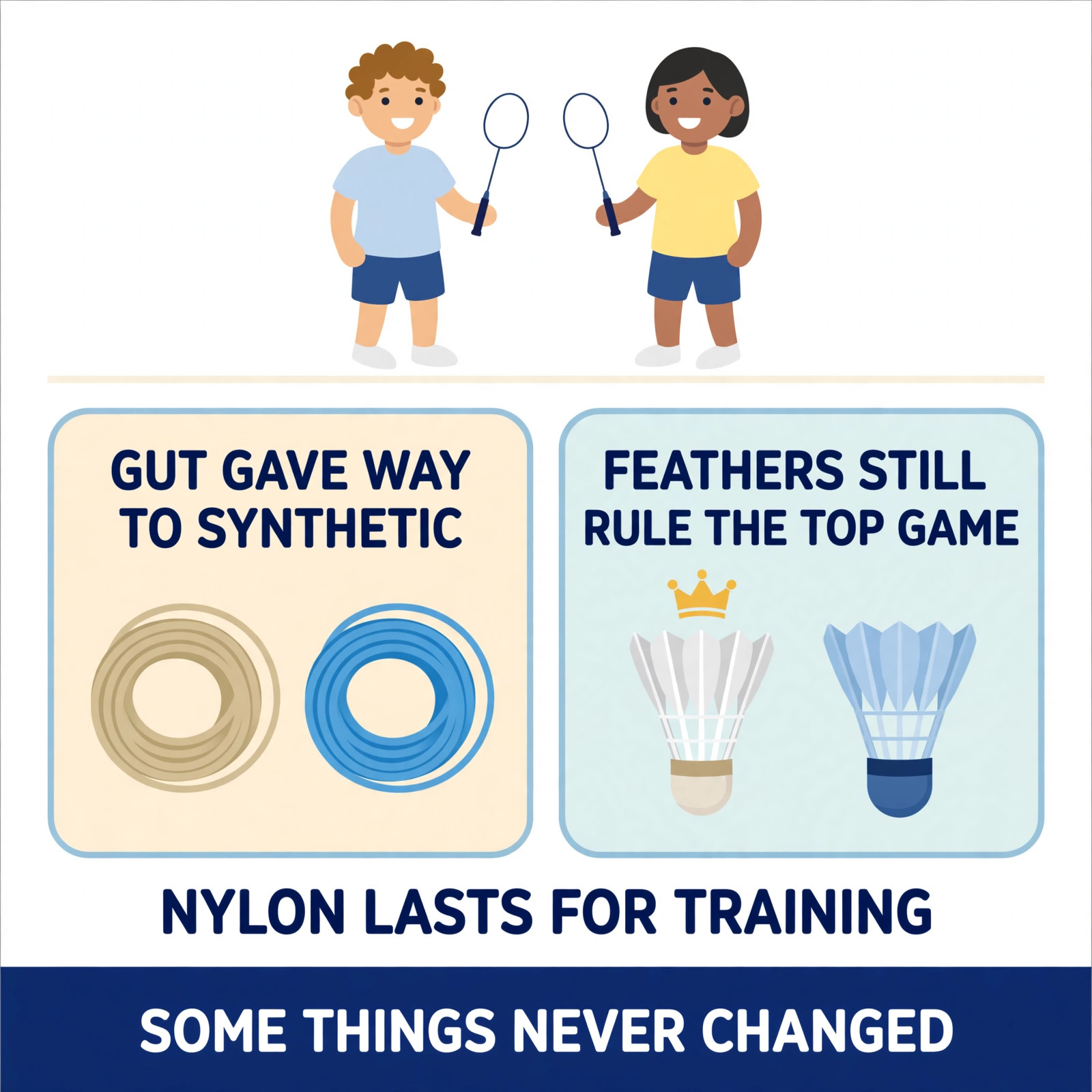
Strings changed sides completely. Natural gut all but disappeared from badminton, replaced by synthetic strings built from fine nylon based filaments wound and coated in a factory. Synthetic strings last far longer than gut, shrug off humidity, and come in a menu of thicknesses: thinner strings feel livelier and are kinder to touch players, thicker ones survive more smashes and suit hard hitters and beginners. A modern string bed is also a choice a player can change in an afternoon, which makes it the cheapest real upgrade in the whole kit bag.
Shuttles, meanwhile, refused to change where it matters most. The feather shuttle, sixteen goose feathers set into a cork base covered with thin leather, is still the shuttle of top level badminton, because nothing synthetic flies quite like it: the feathers brake and steady the shuttle in a way that gives badminton its unique flight, fast off the racket and dropping steeply at the net. Shuttles come in speed grades, marked 75 to 78, slower to faster, chosen so the shuttle suits the hall’s temperature and conditions. Even the grading is a small piece of the game’s practical history.
Nylon shuttles took the other half of the world. A one piece nylon skirt on a cork or synthetic base cannot match feather flight exactly, but it survives practice by the bucket where feathers would shred, which is why training halls, schools and academies, ours included, feed juniors with nylon for most drills and keep feathers for matches and match practice. The split is not old versus new or cheap versus proper. It is two materials each doing the job they are honestly best at, which is the gear story of the whole sport in miniature.
Gear Check #5
Shoes, Grips and Bags Followed the Rackets
Shoes tell the same story as rackets, a step behind. Early players played in ordinary canvas shoes or whatever sports shoes they owned, on whatever floor the hall had. As courts standardised indoors, the badminton shoe became its own thing: a low court shoe with a gum rubber sole, the pale, sticky rubber that grips wooden and synthetic indoor floors without marking them, a flatter profile for lunging and side steps, and support built sideways rather than for straight line running. A running shoe on a badminton court is now the one gear mistake coaches correct on sight.
Grips and bags followed the same path from plain to purposeful. Wooden handles were wrapped in leather; today most players use synthetic grips they replace in minutes, thin ones for feel, cushioned or towel grips for players whose hands sweat in Malaysian halls, sized so the fingers close around the handle with a small gap to spare. Kit bags grew compartments for rackets, shoes, shuttles and wet clothes as the amount of gear a regular player carries grew. None of these items makes a headline, but each one is the same pattern: a real problem in play, answered by a material.
Standing back, the pattern of the whole story is that gear changed when the game asked it to, and stayed when the old answer was still the best one. Frames changed three times because weight was a real problem. Strings changed because gut could not survive the modern game. Feathers stayed because flight could not be improved on. Shoes and grips changed quietly because feet and hands asked them to. A family that shops with that pattern in mind buys well: change what the game has genuinely improved, and respect what it kept.

Myth vs Reality
Myths About Badminton Gear
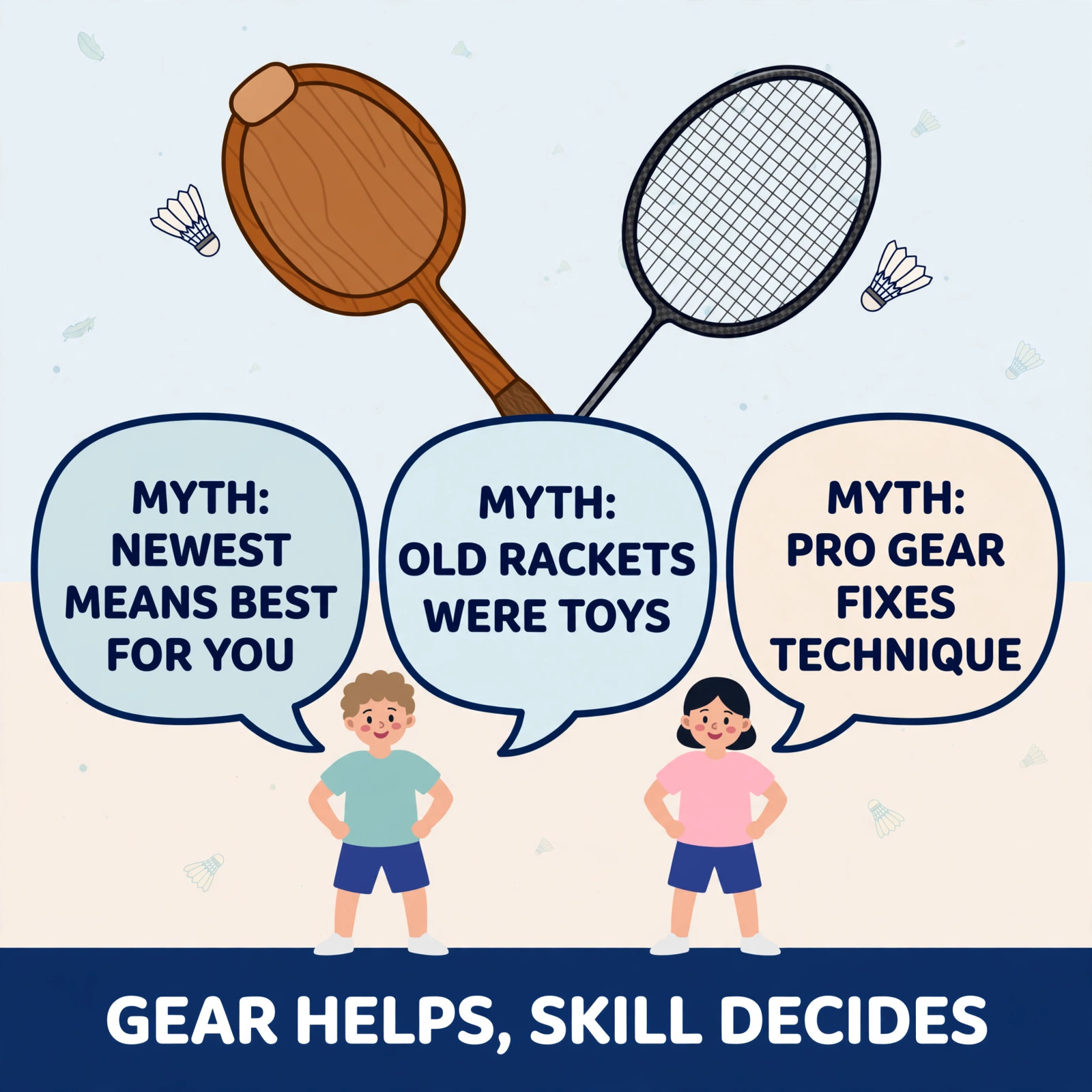
Myth one: the newest racket is the best racket for your child. It is not. The best racket is the one whose weight class, balance and shaft stiffness match the player’s size, strength and stage. A flagship racket built for an adult professional can be the worst choice on the wall for a junior, whatever its year of release. Gear makers improve their ranges over time, but fit beats newness every single time we test the two against each other in a hall.
Myth two: the old wooden rackets were toys, and old players played a soft game. The wooden era’s best players would trouble most club players today, with heavier rackets, unreliable strings and shoes that offered little help. Their touch and fitness were built under harder conditions than ours. Gear progress is real, and this guide celebrates it, but it raised the floor of the game far more than the ceiling. Skill was always the ceiling, in every era.
The reality is that gear helps and skill decides, in the wooden era and the carbon one alike. What changed across a century is how much the equipment asks of the player: less weight to swing, strings that last, shoes that grip, and choices fine enough to fit a beginner and a champion from the same shop wall. What did not change is the order of things. Technique first, gear fitted to it second. That order is exactly how we coach, and this guide ends where our lessons begin.
Why Choose Us
Why Players Choose ST Badminton Academy
At ST Badminton Academy, gear guidance is part of coaching, in groups of no more than four students per coach. That size lets a coach watch what the gear is doing to the player: the wrist bending under a too heavy racket, the timing lost to a dead string bed, the slide of a running shoe in a lunge. We would rather correct a grip size in week one than rebuild a swing in month six, because so many technique faults are really equipment faults wearing a disguise.
Our advice to families follows the history in this guide. Start a beginner on a modest, flexible racket in a sensible weight class, with a grip that fits the hand, proper court shoes, and nylon shuttles for practice. Upgrade one piece at a time as skill grows and the player can feel what changed. Keep feathers for matches. Replace grips and strings before replacing rackets. None of this needs a big budget; it needs order, and order is free.
We never sell gear, and we have no shop wall to clear, so the advice carries no second agenda. If a child’s current racket is sound, we say so, whatever its age or brand. If the shoes are the problem, we say that instead, and parents save the racket money entirely. Honest gear guidance is part of what families are paying a coach for, and the history of the equipment makes the reasoning easy to show rather than just state.
FAQs: Badminton Rackets and Gear Old and New in Malaysia (KL)
These are the questions families ask us most about badminton gear, old and new. The short answer running through all of them: frames moved from wood to metal to carbon, strings went synthetic, feathers stayed on top, and the right choice for any player is the gear that fits their hand, feet and stage.
Can my child start classes with a basic starter racket in Setapak or Gombak?
Yes. A modest starter racket with a flexible shaft and a grip that fits your child’s hand is the right first tool, and it is what most of our beginners in Setapak and Gombak use. Coaches check the fit in the first session. Expensive rackets can wait until technique is steady enough to feel the difference they make.
Does a modern carbon racket really help a young player in KL?
It helps in a specific way: a lighter carbon racket is easier to swing for hours of practice, and its consistent frame rewards good technique. It does not supply the technique itself. A junior with sound coaching on a modest racket will outplay a junior with a flagship racket and no coaching, in Kuala Lumpur as anywhere else.
How do I pick a racket weight for a junior at any level?
Read the class on the shaft first: 3U is 85 to 89 grams, 4U is 80 to 84, and 5U is 75 to 79. Most juniors start in the lighter classes with a flexible shaft, then move as strength and technique grow. The real test is in the hand: shadow swings should feel quick, controlled and pain free.
Is a lighter racket always better for a junior player who is still growing?
Not always. A racket that is too light can feel twitchy and offers little help clearing to the back, while one that is too heavy strains the wrist. The right weight is the one the junior can swing fast, with control, for a full session. That is why we test rackets in the hand before any money is spent.
How do I know when a racket string has gone dead and needs changing?
Three signs: the string bed sounds dull instead of crisp, clears that used to reach the back start falling short, and the strings move and need straightening after every rally. Any one of them means the bed has gone dead. A restring costs little and makes an old racket feel new again, so check the strings before blaming the frame.
Do your coaches help families choose gear near Wangsa Maju?
Yes. Coaches at our Setapak base, a short drive from Wangsa Maju, check rackets, grips and shoes as part of normal sessions, and we will tell you plainly if a child’s current gear is fine as it is. We sell nothing, so the advice is only about fit: the racket, the grip size and the shoes on the feet.
Are feather shuttles still used at top tournaments held in Malaysia?
Yes. Feather shuttles remain the shuttle of top level badminton everywhere, Malaysia included, because their flight has never been matched by a synthetic. Tournaments at the highest level are played with feather shuttles in graded speeds. Nylon shuttles do the heavy work in training halls, where durability matters more than perfect flight.
Where does ST Badminton Academy coach badminton in Setapak?
Our home base is Setapak in Kuala Lumpur, and that is where the full programme runs, gear checks included. Players join us from Wangsa Maju, Gombak and across the city. Tell us your area when you book a trial and we will confirm the session times that suit your child, at whatever level they are starting from.
What basic gear does a beginner truly need to start badminton?
Very little: a racket that fits the hand in weight and grip, court shoes with gum rubber soles, comfortable sports clothes and a water bottle. Shuttles are provided in our sessions. Everything else, from feather shuttles to a second racket, can wait until your child is playing regularly and knows what they actually need.
Badminton Gear Guidance and Classes in Action


One Standard for Every Player and Every Session
One standard runs through our gear guidance: fit before fashion, and honesty before sales. At ST Badminton Academy we check every new player's racket weight class, balance, grip size and shoes against the player's body and stage, and we say plainly when the gear they already own is good enough. The history in this guide is the reason: a century of progress means the right gear exists at every budget, and a coach's job is to point at the right piece, not the newest one.
| Factor | Wooden Gear | Modern Gear GEAR |
|---|---|---|
| Frequency | 1 or 2 times a week. Mostly for fun and sweat. | Carbon frames in clear weight classes, matched to the player holding them. |
| Drills Focus | Basic static feeding. Minimal footwork pressure. | Synthetic strings that last, with gauges and tensions a player can choose. |
| Physical Conditioning | Rarely included. Just playing games on court. | Core, agility, and speed training included in every session to prevent injury and build stamina. |
| Tactical Awareness | "Just hit it over." No real game plan. | Video analysis, point construction, and learning to read the opponent's game. |
| Coach Ratio | Large groups (8-10 kids). Coach barely watches you. | Max 4 students. Mr Eric Chuar personally corrects every stroke and movement detail. |
| Goal Setting | Fun and exercise. | Feather shuttles at the top level and tough nylon shuttles for training halls. |
| Long Term Result | Good recreational player. | A player whose gear fits the hand, the feet and the stage of learning. |
Badminton Coaching and Gear Guidance in Kuala Lumpur
This guide walked your family through a century of equipment: wooden frames and gut, steel and aluminium, carbon fibre in printed weight classes, synthetic strings, feathers that never left, and shoes and grips that quietly became proper tools. The next step is not a shopping trip; it is a fitting. Bring your child's current racket to a trial session with us in Setapak, Kuala Lumpur, and we will check it against their hand and their game, free of any sales talk. Good gear, honestly chosen, is a fine place to start.






