The History And Evolution Of Badminton: From Battledore To Shuttlecock (History Guide)
Every smash your child learns in a hall in Setapak started as a gentle game in gardens and drawing rooms. Badminton was not born on a marked court with a rulebook. It grew, step by step, from a simple keep-it-up pastime played with wooden paddles, through army stations in India, into an English country house that gave it a name, and finally into the fastest racket sport on the planet. This guide walks through that story in four stops, using only the milestones historians agree on, so young players know where their game came from. Knowing the story does a quiet job for a learner. A child who understands that the net, the lines and the scoring were all added for a reason reads the modern game differently. The serve is low because the rules grew that way. The shuttle is feathered because it has been feathered for well over a century. History turns a list of rules into a story with causes, and stories are what young players remember when a coach explains why we do things this way. We will keep the facts honest. Some parts of the early story are well documented, like the written rules of the 1870s and the world body formed in 1934. Other parts, like exactly who first strung a net across a lawn in India, were never recorded cleanly, and this guide will say so where that is the case. No invented kings, no made up inventors, no attendance figures. Just the four stops: battledore, Poona, Badminton House, and the road to the Olympic Games.
History Check #1
Battledore: The Keep-It-Up Game With No Net
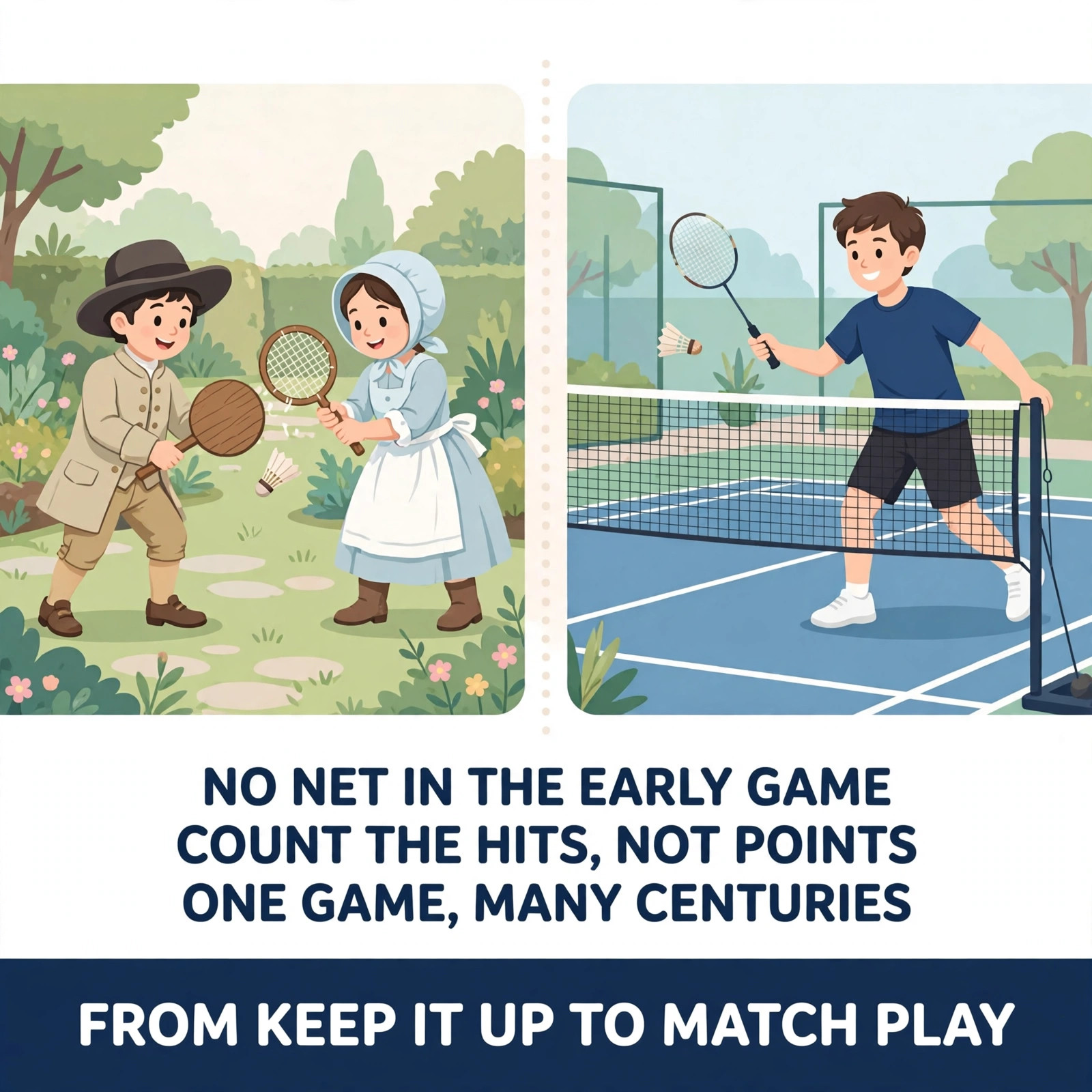
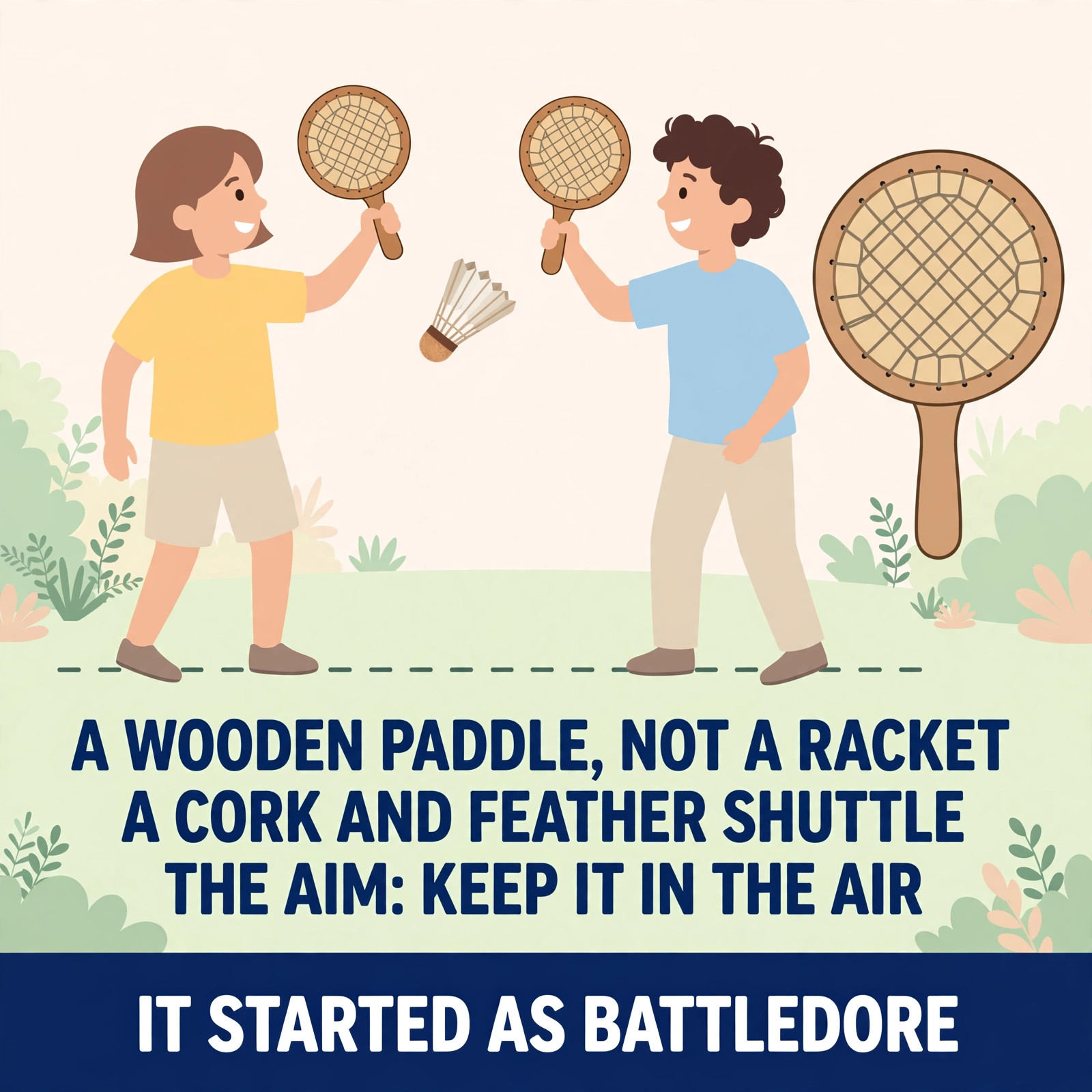
Before there was badminton, there was battledore and shuttlecock. Two players stood facing each other, each holding a wooden paddle called a battledore, and they hit a feathered cork back and forth between them. There was no net, no court and no score. The only aim was to keep the shuttle in the air for as many hits as possible, and players counted the rally, not points against each other. It was a game of cooperation, closer to juggling with a partner than to the contest we play today.
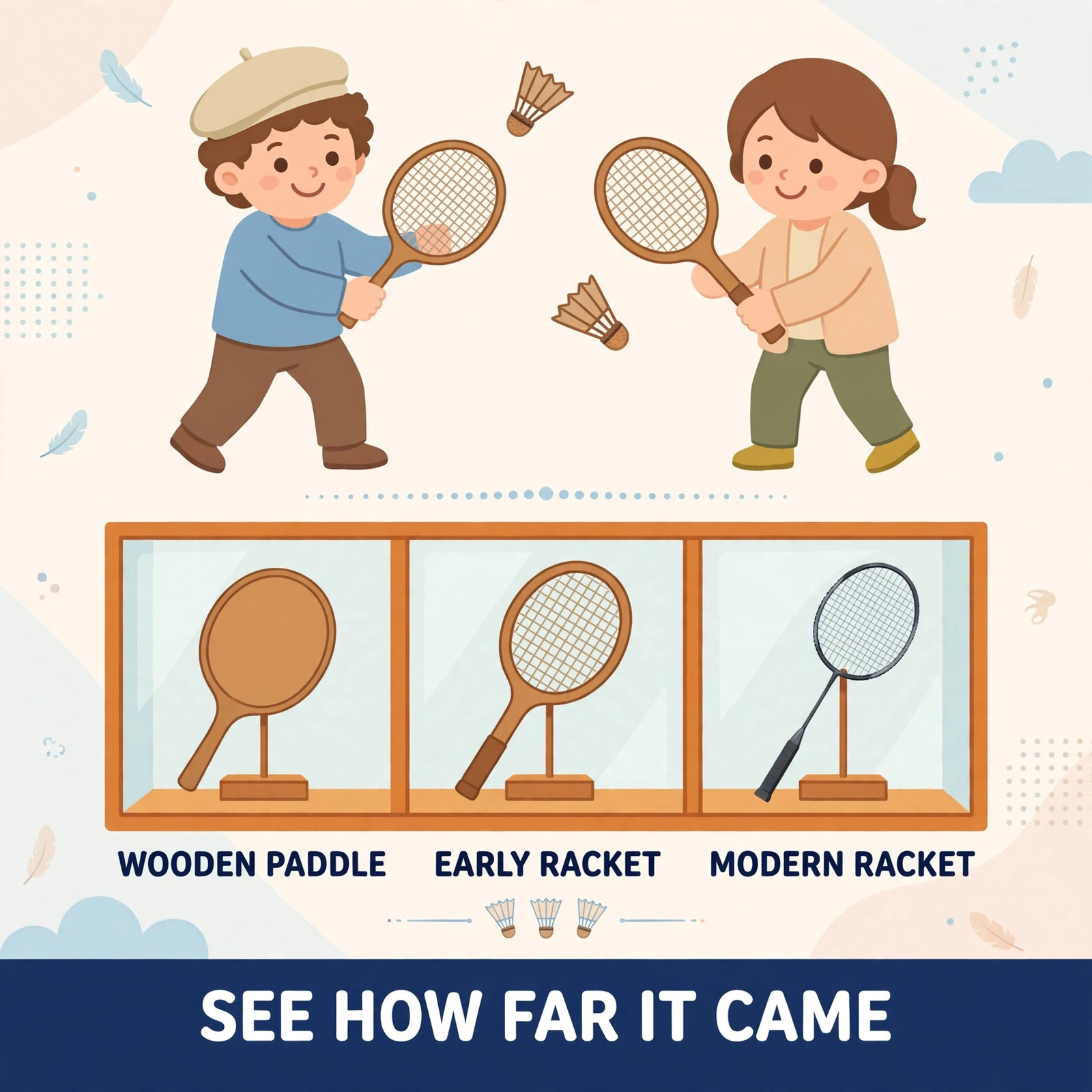
Games like this were played for centuries in different forms across Europe and Asia, which is why no honest history can point to a single inventor. What changed the pastime into a sport was competition: a net to hit over, lines to hit inside, and a way to win. Until those arrived, battledore stayed what it had always been, a pleasant test of touch and patience. You can still feel that origin in modern training, because the first thing we teach a beginner is exactly what battledore players practised: keep the shuttle up, rally after rally. The paddles tell the story too. A battledore was a solid round wooden paddle, light and simple, made for gentle tapping rather than power. The shuttle was a small piece of cork with feathers stuck into it, much like the feather shuttles used at the top level today. When you hold a modern carbon racket next to a picture of a battledore, the tools look worlds apart, but the object flying between the players has barely changed at all.
History Check #2
Poona in India: Where the Net Came In
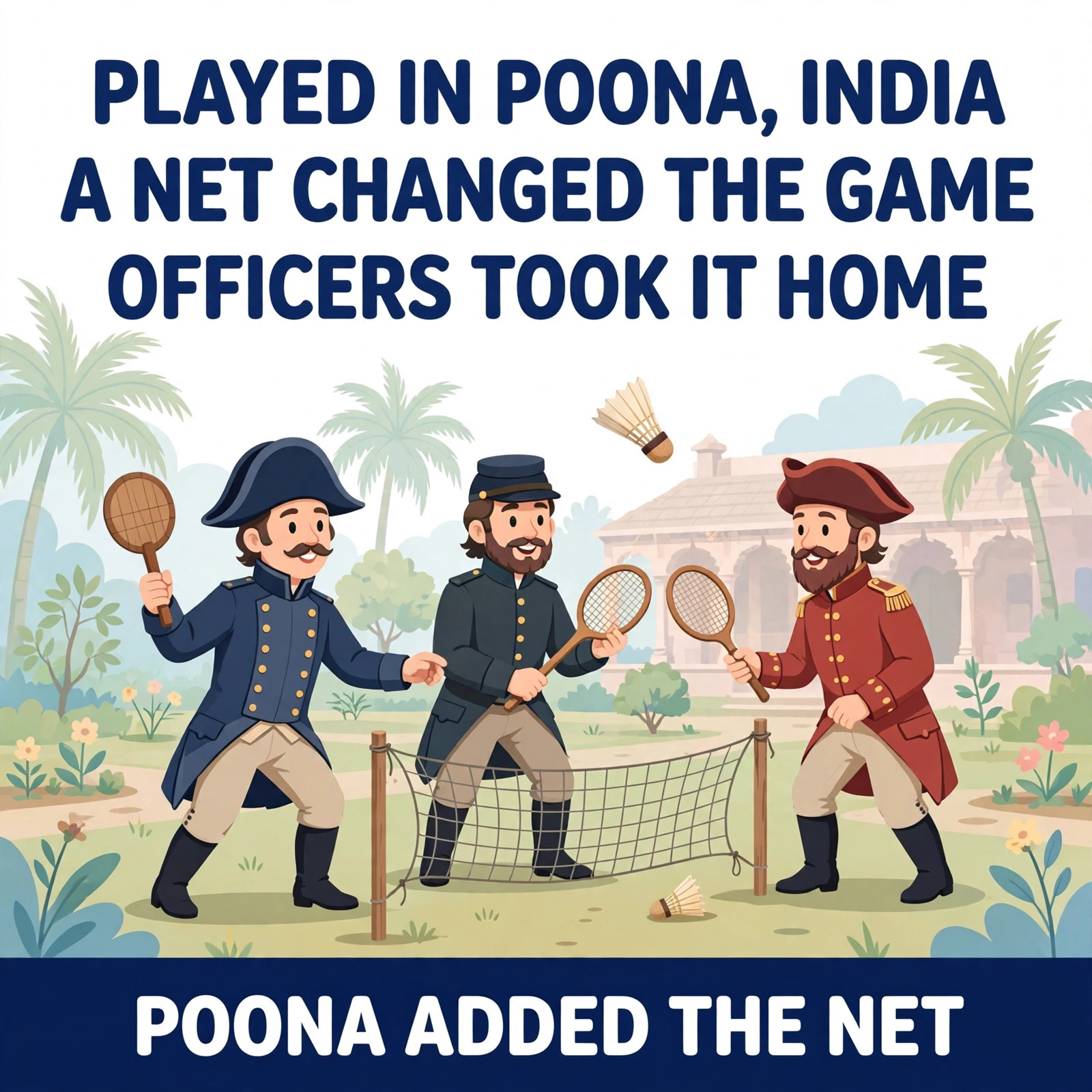
The next stop is India. In the 1800s, British army officers stationed in the town of Poona, now called Pune, played a version of the game with one big addition: a net strung across the middle. The net changed everything. With something to clear and a far side to aim at, the keep-it-up pastime became a contest of placement. You could now win a rally by making the shuttle land where your opponent was not. Players called this version Poona, after the town where they played it.
Officers posted home to England took the game with them in the 1870s, and it landed in a country ready for it. Lawn games were fashionable, country houses had the space, and a game that needed only a net, light rackets and a shuttle could be set up on any lawn or in any large hall. Poona was played at parties and garrisons first, a novelty guests could join without training. But it spread because the rallies were genuinely good: fast, skilful and fun to watch even for people who had never held a racket.
It is worth pausing on what the net really did, because coaches still teach its lesson. Without a net, the best shot is the safest shot, high and down the middle, and nothing forces a mistake. With a net, height becomes a decision: too low and you hit the tape, too high and you feed a smash. The tape, the lines and the low serve all grew from that one change in India. The modern game, with its net kills and tumbling spins, is Poona’s idea carried as far as it can go.
History Check #3
Badminton House Gives the Game Its Name
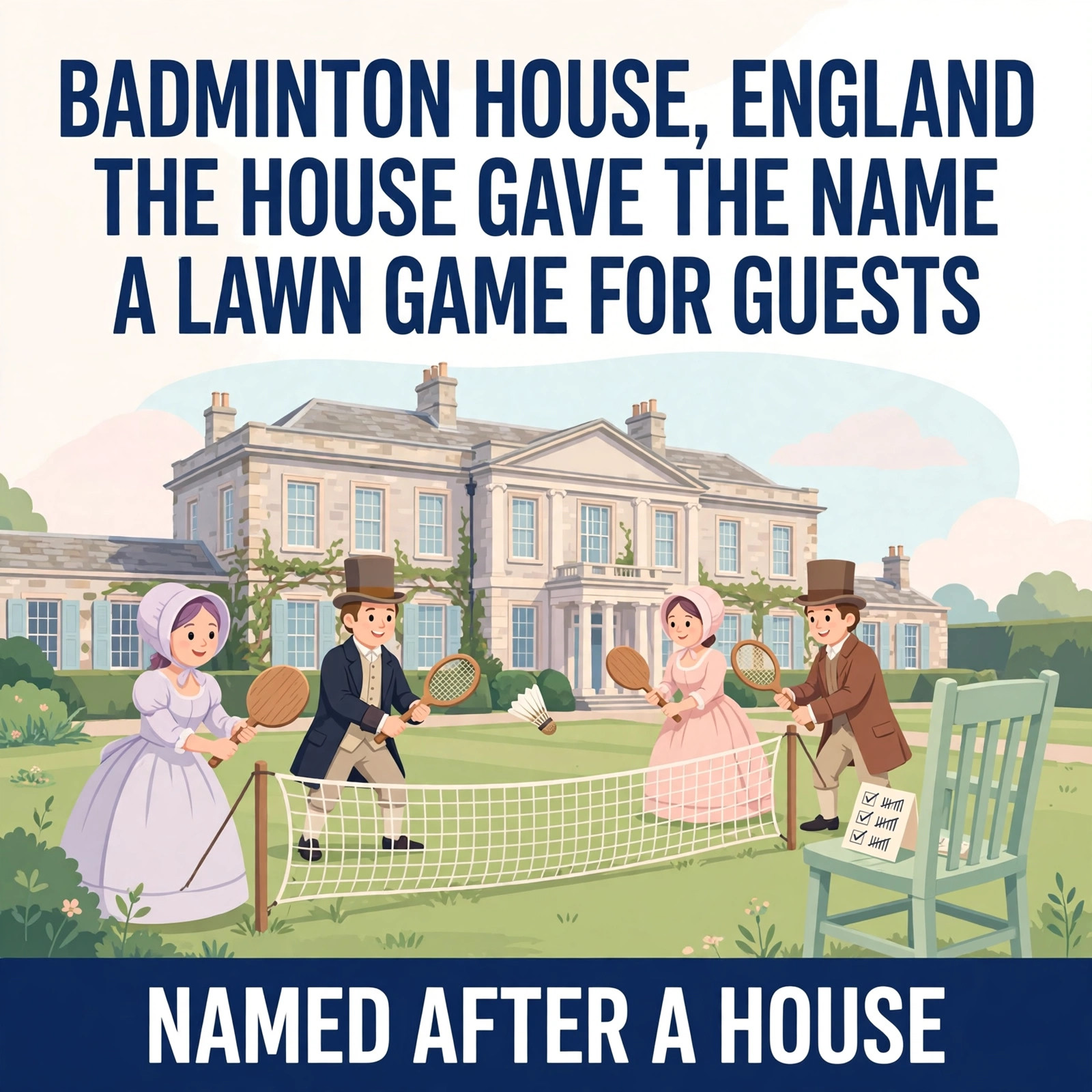
In 1873 the game was played at Badminton House in Gloucestershire, the country home of the Duke of Beaufort, and guests who learned it there carried the house’s name away with the game. Within a few years, people stopped calling it Poona and started calling it badminton. Why this house and not another is partly luck: the game was demonstrated and enjoyed there at the moment it was spreading through English society, and a memorable name from a famous house travelled faster than the name of a distant garrison town.
A name sounds like a small thing, but it mattered. Poona described a place most English players would never see. Badminton sounded like a sport a club could organise, with members, matches and a fixture list. The game now had an identity separate from the army game it grew out of, and identities are what clubs, leagues and championships are built around. When your child says the word badminton today, she is using the name of a house in Gloucestershire without knowing it.
The same years fixed the game’s shape. Players in England played on an hourglass shaped court at first, narrow at the net and wide at the back, a leftover from the rooms the game was played in. The court soon settled into the rectangle we know. Rackets became strung wooden frames rather than solid paddles, because a string bed hit the shuttle cleaner and further. Each change answered a practical problem, which is a pattern you will see again and again in this story.
History Check #4
First Written Rules, Clubs and One Rulebook
A game played in many towns needs shared rules, or every match becomes an argument. In the 1870s, players in India wrote down rules for Poona, covering the court, the scoring and how the serve worked. Back in England, clubs formed through the 1870s and 1880s, each playing a little differently, until the need for one rulebook became obvious. In 1893 the Badminton Association was founded in England and published the standard rules the clubs could all follow. The modern game descends from that rulebook.
Written rules did three things at once. They let strangers play a fair match without negotiating first. They let competitions happen, because everyone was finally playing the same game. And they let coaching exist as a real craft: once the rules are fixed, technique can be taught against a stable target. That is the world our academy still works in. The laws have been revised many times since 1893, scoring included, but the principle set in that decade has never changed: write it down, share it, play the same game everywhere.
Rules also explain some features that puzzled you if you only know the modern sport. The old scoring, where only the server could win a point, came straight from those first rulebooks and lasted more than a century before rally scoring replaced it in 2006. The low serve, the lines, the let when a shuttle touches the tape and drops over: each is a written answer to an argument somebody had in a hall long ago. A player who knows this stops seeing rules as traps and starts seeing them as the game’s memory.

History Check #5
A World Body and the Road to the Olympic Games
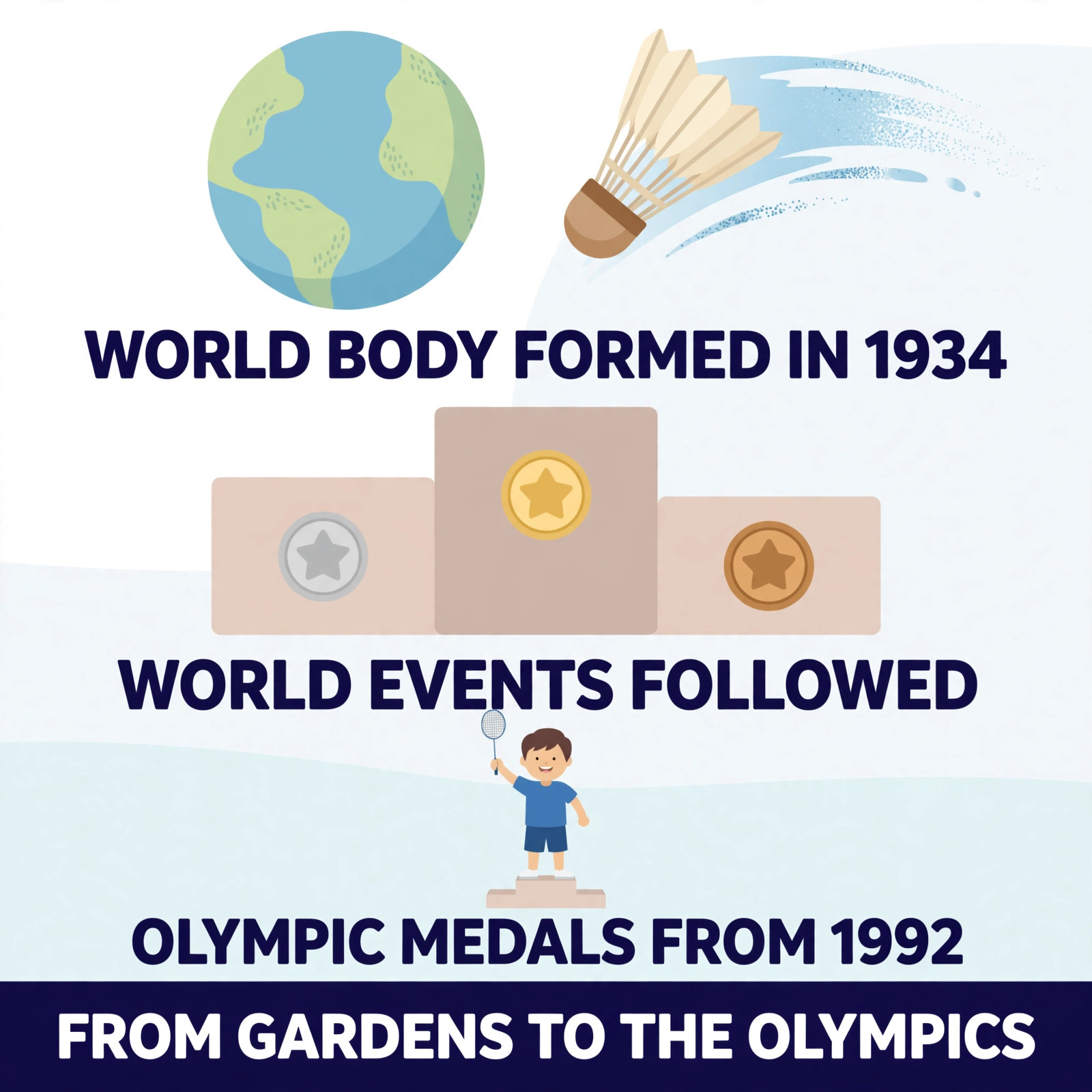
By the early 1900s the game had spread across the British world and beyond, and national bodies were running their own championships. What the sport lacked was one world authority to set the laws for everyone. That arrived in 1934, when the International Badminton Federation was founded by nine member nations, including England, Canada, Denmark and France. That federation, known today as the Badminton World Federation, still runs the world game: the laws, the world championships, the world tour and the rankings your child may one day dream about.
World championships followed as the century went on, and the sport kept pushing for the biggest stage of all. Badminton appeared at the Olympic Games as a demonstration sport in 1972 and as an exhibition in 1988, a long audition in front of the Olympic movement. In 1992, at the Barcelona Games, badminton became a full medal sport, with singles and doubles medals decided in front of a worldwide audience. For a game that began with two paddles and a feathered cork on a lawn, it was a remarkable finishing point for the story, and a starting point for the modern era.
The Olympic chapter matters for Malaysian and Singaporean families in particular, because this region helped write it. Malaysia and Indonesia became giants of the sport through the middle of the last century, and badminton remains one of the few sports where a Malaysian school player grows up watching home heroes at the very top of the world game. When we tell juniors the road from Poona to the Olympics, we are also telling them their own sporting inheritance, and that gives the history a local heartbeat.
Myth vs Reality
Myths About Badminton History
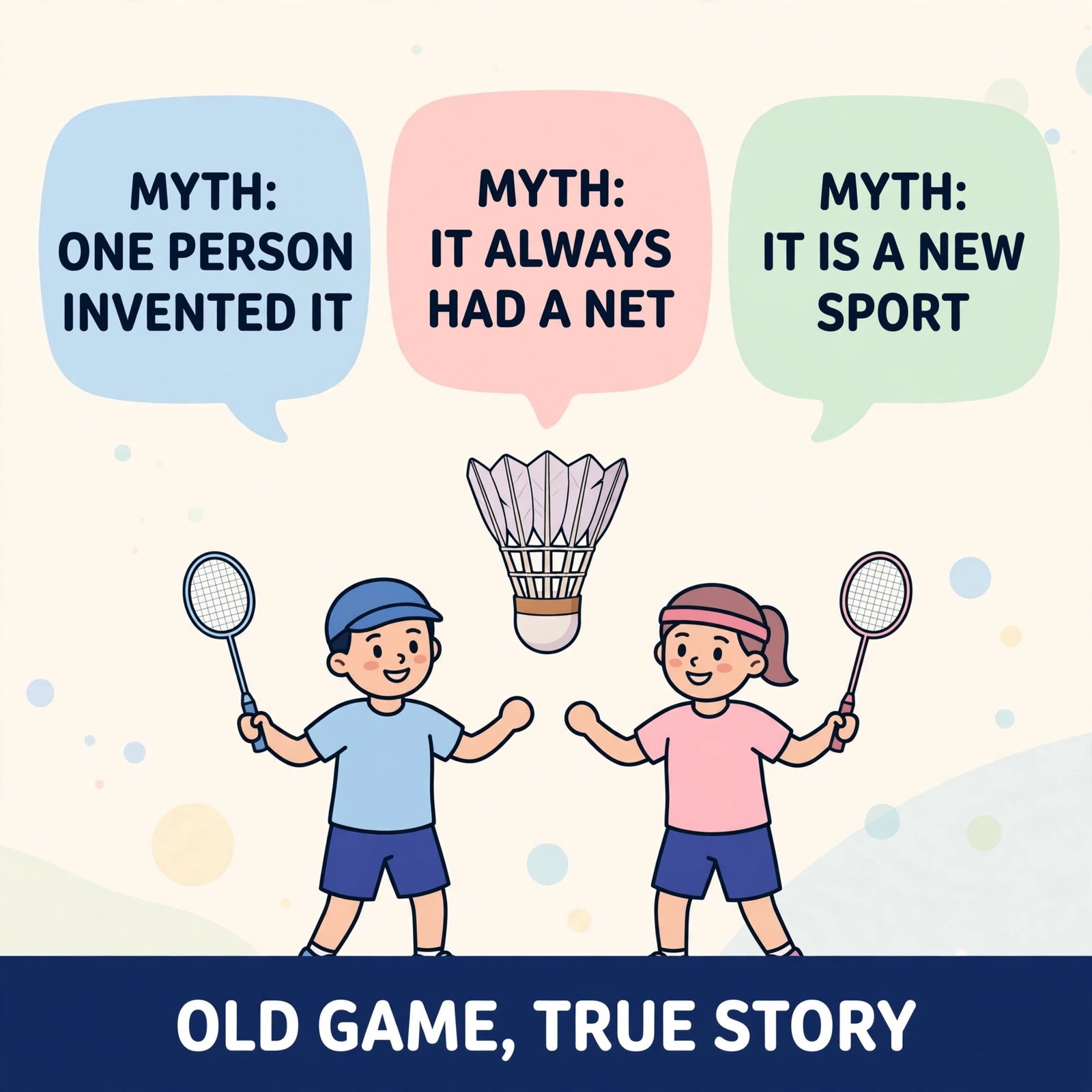
Myth one: badminton was invented in a single afternoon at Badminton House. It was not. The house gave the game its name, not its birth. By 1873 the game already had decades of play behind it in India and centuries of battledore behind that. Invention stories with one hero and one day are tidier than the truth, but the truth, a game shaped slowly by officers, guests and clubs, is the better story and the one worth teaching.
Myth two: badminton began as a soft garden game and only became athletic recently. Garden game it was, but soft it never stayed for long. Photographs and reports from the early club era show players in long rallies, diving around marked courts, in a game already recognisable as ours. What changed across the years was the equipment, the training and the scoring, not the basic demand: move fast, hit precisely, and think one shot ahead of your opponent.
The honest summary is this. Battledore gave the game its shuttle and its touch. Poona gave it the net and the contest. Badminton House gave it the name. The rule writers and the 1893 association gave it a shared shape, and the 1934 world body and the 1992 Olympics gave it the world stage. Every layer is still visible in the game your child plays each week, which is why the history is not decoration. It is an explanation of the sport itself.
Why Choose Us
Why Players Choose ST Badminton Academy
At ST Badminton Academy, we teach the story of the game inside normal training, in groups of no more than four students per coach. Small groups mean the coach has time for the story as well as the strokes: why the net is the height it is, why the serve stays low, why the shuttle is still feathered. Juniors who hear these threads during warm ups and water breaks absorb the game’s culture while they learn its skills, without a classroom in sight.
We find the history does practical work. A beginner who knows the net came from Poona understands net play as the heart of the game, not an extra. A young player who knows the rules were written to make matches fair argues less with line calls and umpires. A junior who knows Malaysia’s place in the sport’s story trains with a sense of belonging to something bigger than one hall in Setapak. None of this replaces footwork and grips, but it gives those drills a meaning that keeps children coming back.
Parents ask whether history lessons eat into playing time. They do not. The story is told in the pauses the session already has: while shuttles are gathered, while the coach sets the next drill, across a two minute breather. Two or three sentences at a time, across a term, add up to the full four stops of this guide. The playing time stays playing time. The difference is that our players leave knowing what game they are actually playing, and where it came from.
FAQs: Badminton History and How the Game Began in Malaysia (KL)
These are the questions families ask us most about the history of badminton. The short version running through all of them: the game grew slowly from battledore and Poona, took its name from Badminton House, gained written rules in the 1870s, a world body in 1934 and Olympic medals in 1992.
Where can juniors learn the story of the game alongside training in Setapak or Gombak?
Yes, in the natural pauses of training rather than as a separate class. Coaches at our Setapak base share the four stops of the game’s story across a term: battledore, Poona, Badminton House and the Olympics. Small groups keep it conversational, and players can ask questions as the story connects to the drill they are practising.
Does knowing where badminton came from help a young player in KL?
It gives the rules and techniques a reason. A child who knows the net arrived in Poona treats net play as the heart of the game, and a child who knows Malaysia’s place in the sport’s story feels part of something bigger. That sense of belonging keeps many young players training longer and listening better.
Is the history of the game taught to beginners at every level?
Yes. Beginners hear the story in the same simple form as everyone else, one stop at a time, linked to what they are learning that week. The history needs no playing skill at all, and we find new players often enjoy it first, because it gives them the map of the sport before the techniques fill it in.
Was badminton invented at Badminton House, or did it grow from older games?
No single moment counts as the invention. Badminton House gave the game its name in 1873, but the game itself grew out of the net game played in Poona and, behind that, centuries of battledore and shuttlecock. The honest answer is that badminton was not invented; it developed, and the name is simply where the development became visible.
Which badminton history dates are solid, and which are still argued about by historians?
The milestones in this guide are the solid ones: written rules in the 1870s, the Badminton Association in 1893, the world body in 1934 and Olympic medals in 1992. The softer parts are the very early details in India, where records are thin and retellings differ. Good teaching names the difference, and so does this guide.
Do your coaches share the game’s story in classes near Wangsa Maju?
Yes. Our base is in Setapak, a short drive from Wangsa Maju, and the game’s story is woven into normal sessions there. Coaches link each history stop to the skills being taught that week, so players hear about Poona while they learn net play and about Badminton House while they learn the rules of the modern court.
Has badminton been loved for a long time in Malaysia?
It has, and deeply. Malaysia became one of the sport’s great nations in the last century, and badminton is one of the very few world sports where Malaysian heroes have stood at the very top for generations. Our juniors grow up inside that tradition, and the academy’s job is to pass both the skills and the story on.
Where does ST Badminton Academy coach badminton in Setapak?
Our home base is Setapak in Kuala Lumpur, and that is where the full programme runs, story included. Players join us from Wangsa Maju, Gombak and across the city. Tell us your area when you book a trial and we will confirm the session times that suit your child, at whatever level they are starting from.
What makes Mr Eric Chuar a good coach for teaching the story behind badminton?
Mr Eric Chuar has coached in Singapore and Malaysia for over fifteen years, and he treats the game’s story as part of the craft, not a decoration. In his small groups he links each milestone to the technique on court that day, keeps the facts honest where records are thin, and answers juniors’ questions straight.
Badminton History and Coaching in Action



One Standard for Every Player and Every Session
One standard runs through how we teach this history: only the milestones we can stand behind get taught as fact. Dates like 1873, 1893, 1934 and 1992 are solid, and we use them. The hazier parts of the early story are taught as what they are, the best account we have, not as certainty. At ST Badminton Academy that honesty is deliberate, because a coach who is straight about the past earns the trust to be believed about technique, effort and what a young player can achieve.
| Factor | The Garden Game | The Modern Sport HISTORY |
|---|---|---|
| Frequency | 1 or 2 times a week. Mostly for fun and sweat. | Written rules and one rulebook, so clubs in different towns play the same game. |
| Drills Focus | Basic static feeding. Minimal footwork pressure. | A world body, world championships and Olympic medals on the line. |
| Physical Conditioning | Rarely included. Just playing games on court. | Core, agility, and speed training included in every session to prevent injury and build stamina. |
| Tactical Awareness | "Just hit it over." No real game plan. | Video analysis, point construction, and learning to read the opponent's game. |
| Coach Ratio | Large groups (8-10 kids). Coach barely watches you. | Max 4 students. Mr Eric Chuar personally corrects every stroke and movement detail. |
| Goal Setting | Fun and exercise. | Coached footwork, grips and tactics taught step by step from the first lesson. |
| Long Term Result | Good recreational player. | A player who knows the game has a story, and plays like it matters. |
Badminton Coaching With the Full Story in Kuala Lumpur
This guide gave you the four stops: battledore's keep-it-up game, Poona's net, the name from Badminton House, written rules and a world body, and Olympic medals from 1992. The next time you watch your child play, you will see every stop still alive in the modern game. If you would like your child to learn the skills with the story woven through them, come and try a session with us in Setapak, Kuala Lumpur. The game has a past worth knowing, and a future your child can be part of.






