10 Tips For Improving Your Badminton Footwork (Footwork Guide)
When I started playing badminton, my feet felt like they were dancing on hot coals: busy, loud and always a half step behind. Coaches told me I was quick, yet rallies kept slipping away at the last stretch. What changed everything was not speed. It was a short list of footwork habits, learned one at a time, until my feet looked calm and, honestly, a bit graceful. These are the ten tips that did it, the same ones we now coach at ST Badminton Academy, in an order that lets each tip support the next.

Footwork Check #1
Tips 1 and 2: Start From a Stance That Can Move
Tip 1: build your stance before anything else. Stand with your feet shoulder width apart, one foot very slightly in front of the other, knees soft and your weight resting toward the front of your feet. From here you can push in any direction without a preparatory shuffle or a tell tale rock backward. Most players stand either too narrow, which tips them sideways, or too wide, which glues them to the floor. Shoulder width is the honest middle: stable, but ready to spring.
Tip 2: stay low, and keep your head and shoulders upright while you do it. Bending from the waist feels low but throws your weight forward and tires your back; sinking through the knees keeps your centre of gravity down and your eyes level. Watch the shuttle with a still head and your balance improves before your feet do anything clever. Good posture also looks confident, and confidence is not cosmetic here: players who look balanced commit to their first step earlier.

Footwork Check #2
Tips 3 and 4: Shuffle Small, Jump Softly
Tip 3: shuffle in small, quick steps. The shuffling drill is the simplest in this guide: move sideways across the court in short steps, staying low, head up, arms relaxed for balance. Small steps keep your feet under your body, which means you can stop, turn or lunge at any moment. Big steps feel faster and are not: each one commits you, and a committed player cannot change direction when the shuttle goes the other way. Keep the steps small enough that a coach could shout stop and you could freeze instantly.
Tip 4: jump softly, and land on both feet. Jumping drills, hopping from spot to spot or over low markers, build the spring your split step and your smash recovery need. The rule is the landing: both feet down together, knees bent, sound turned down. A quiet landing means your legs absorbed the force; a loud one means your joints did. Vary the intensity, some rounds light and bouncy, some rounds higher, but never trade a soft landing for a bigger jump. Spring that you cannot control is just noise.
Put tips 3 and 4 together inside your warm up and they stop being drills and start being habits. Shuffle the width of the court, hop and stick at each line, shuffle back. Two or three easy rounds wake up the ankles and remind the body what tidy movement feels like before rallies start. Players often skip this because it looks basic. Then their first game is spent finding their feet, which is the same job done badly, under pressure, at the worst possible time.

Footwork Check #3
Tips 5 and 6: Move Sideways and Pivot Without Falling
Tip 5: when you move laterally, keep your weight centred. Sideways movement falls apart when players lean toward the target: the lean feels like effort but it removes the option to come back. Move with quick, small steps, your trunk upright and your weight balanced between both feet, so a sideways move can become a lunge, a stop or a return trip without a reset. Test yourself against the net: if you can freeze mid shuffle without tipping, your weight is where it belongs.
Tip 6: pivot with your feet close together. Pivoting turns you to face a new direction on the spot, and it works best as a small, tidy motion. The habits from our coaching checklist: keep your feet close together as you turn, take small quick steps rather than one big swing, land each step flat and balanced, and picture your path before you move. A pivot done this way takes a fraction of a second and leaves you facing the next shot already set, instead of untangling your legs.
Practise pivots in both directions, not just toward your racket side. Rallies do not respect your preferences, and a player who can only turn one way has a map the opponent can read. Singles players use pivots constantly around the base; doubles players use them in the flat exchanges at the front and mid court. Ten slow, perfect pivots each way inside a warm up will teach your feet more than a hundred rushed ones at the end of training.

Footwork Check #4
Tips 7 and 8: Split Step Timing and First Step Direction
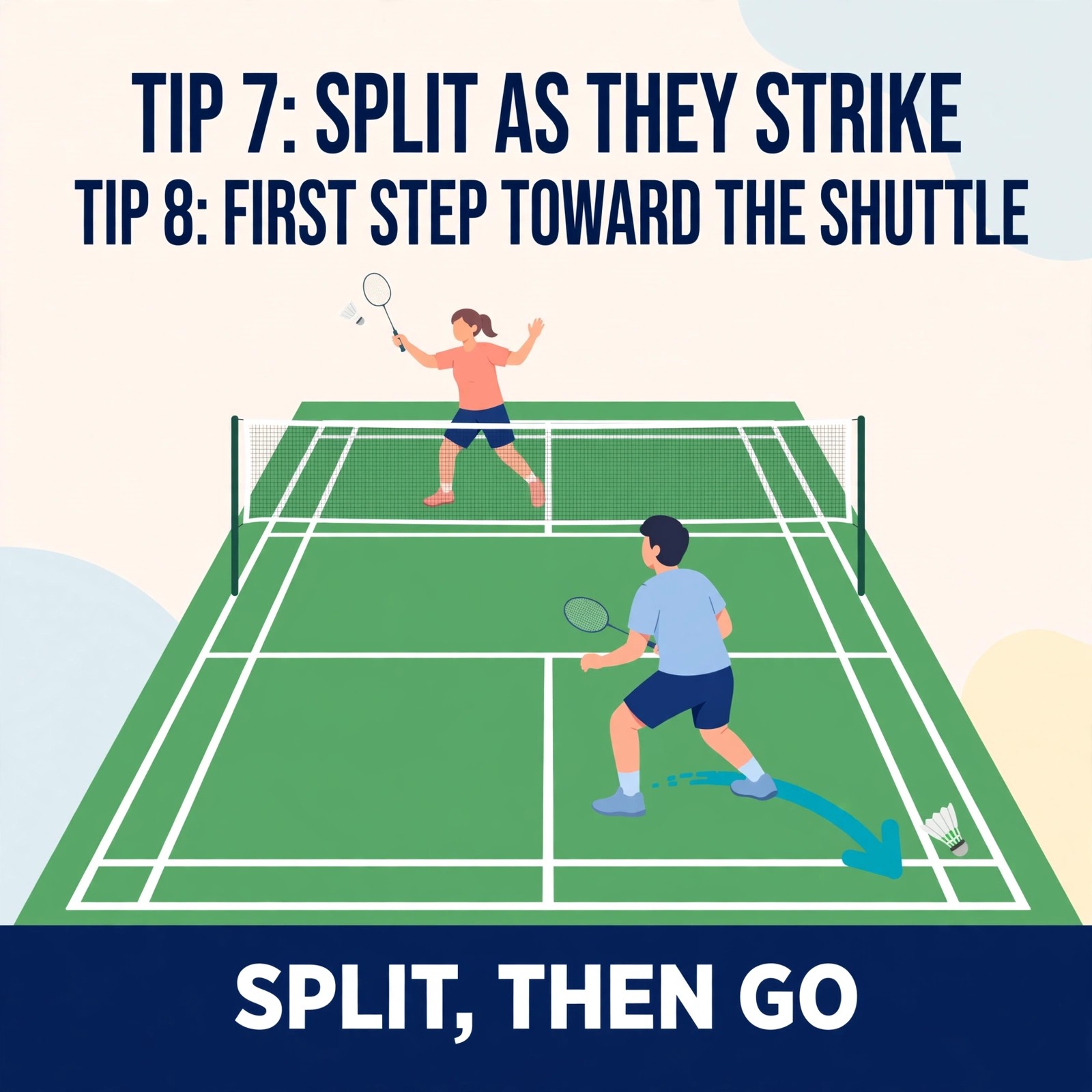
Tip 7: master the split step. Forget the garbled versions: a split step is a small, light landing on both feet at the same time, made just as your opponent strikes the shuttle. You are not switching legs or dancing; you are loading both legs like springs at the exact moment the direction is revealed. Land too early and the spring is spent. Land too late and you are airborne while the shuttle travels. Timed right, your first step fires the instant the shot is known.
Tip 8: make the first step go toward the shuttle. After the split, the first step is a push, not a reach: drive from both feet and step in the shuttle’s direction with purpose, letting the bigger steps come after. Players lose time by reaching with the racket and letting the feet follow apologetically. Reverse it. Feet first, racket already up, body travelling behind the step. A decisive first step also buys you the recovery: momentum that starts clean is far easier to reverse than a lunge born from a lean.
The split step becomes a habit through short, daily touches rather than one big weekly session. Do a few minutes of split and first step practice before you play and again at the end, when you are tired and the timing wants to drift. End of session reps matter most, because that is the state your third game will be played in. Keep them honest: split on a real or imagined strike, never on your own count, or you are training to move on a signal matches never give.
Footwork Check #5
Tips 9 and 10: Practise With Intent and Wear the Right Shoes
Tip 9: practise each drill with intent, for ten to fifteen minutes at a time. Footwork improves when two things get your full attention: the intensity of the drill and the precise placement of your feet. Short, focused blocks beat one long, vague session, because your concentration and your landing quality fade together. Choose one tip per session as the theme, run the drills at an intensity that keeps the tip possible, and stop while the movement is still tidy. Tidy reps are the deposit; sloppy reps are the withdrawal.
Tip 10: wear the right shoes. Badminton footwork asks a lot of footwear: quick sideways steps, sudden stops, lunges that load the front foot hard. Look for court shoes with real grip so the sideways steps bite instead of slide, a light build so your feet stay quick late in games, cushioning that softens repeated landings, and proper support around the ankle and midfoot. Running shoes are built to go straight; their tall, soft soles are exactly what a pivot does not need.
Underneath all ten tips sits one skill: coordination. Footwork is your hands, eyes and feet agreeing quickly, and that agreement is trainable at any level. Regular, varied practice ties the tips together until the right pattern fires without a committee meeting in your head. Give it weeks, not days. The players who look graceful on court are not thinking about their feet during rallies; they did their thinking in practice, one tip at a time, until the feet could be trusted alone.

Myth vs Reality
Myths About Quick Feet
Myth one: good footwork is natural talent. The introduction to this page is the counterexample: feet that danced on hot coals became calm feet through ten practised habits. Some players pick patterns up faster than others, but nobody is born knowing a split step. What looks like talent from the stands is usually a player who was taught the patterns early and has been quietly repeating them ever since. That route is open to you too, starting with tip 1.
Myth two: bigger strides cover the court faster. A stride is a commitment: while it is unfolding, you cannot change direction. Small steps keep your feet under your body and your options open, which is why trained players look busy yet unhurried. The lunge is the one big step in badminton footwork, and it comes last in a chain of small ones, at the moment the shuttle’s destination is certain. Stride early and you are fast in exactly one direction, the wrong one half the time.
Myth three: reading the tips is enough. You now know all ten, and your footwork has not improved by one step. Tips only work when they are practised inside real movement: drills first, then rallies, then matches. Take one tip per week, give it ten focused minutes in your sessions, and test it in games. Ten weeks from now the list will not be something you remember. It will be something your feet do while you think about the score.

Why Choose Us
Why Players Choose ST Badminton Academy
At ST Badminton Academy, these ten tips are a checklist our coaches actually coach from. Groups are kept to a maximum of four students, which matters for footwork: a coach can watch your split step land, check your pivot, and correct a landing in the same set it happens. In bigger classes those details pass unseen for months and harden into habits. Here, each tip is introduced, watched and retested, so progress is visible to the player, not just promised.
Coach Eric Chuar has spent more than 15 years coaching players in Singapore and Malaysia, and his footwork teaching is deliberately unglamorous: stance first, split step timed to a real swing, small steps before big ones. Players are filmed occasionally so they can watch their own feet, which ends most arguments about what their feet are doing. The ten tips on this page are the same list his students work through, in the same order, for the same reason: it works.
The academy is based in Setapak, Kuala Lumpur. If your feet feel busy but your rallies feel late, book a trial session and let a coach watch your footwork as it really is. You will leave knowing which of the ten tips matters most for you right now, and how to practise it. No hype and no instant fixes: just small steps, coached closely, in a group of four or fewer.
FAQs: Badminton Footwork Tips in Malaysia (KL)
Players and parents ask the same fair questions before working through a list of footwork tips. Here are straight answers, with no hype and no promises we cannot keep.
Where can I get my footwork coached if I live in Setapak or Gombak?
With us, in Setapak. ST Badminton Academy is based in Setapak, Kuala Lumpur, and players travel in from Gombak, Wangsa Maju and nearby areas. Footwork is coached inside our regular small group sessions, so your stance, split step and pivots get watched and corrected by a coach rather than left to improve by accident.
What is the best way to practise footwork in KL?
Short, focused and inside real rallies. Work one tip at a time for ten to fifteen minutes, then test it in games the same session. At our Kuala Lumpur base we coach footwork inside small group training rather than as a separate class, because tips that never meet a rally rarely survive one. Bring court shoes; we bring the checklist.
How long should I spend on each drill to reach a solid level?
Ten to fifteen focused minutes per drill is a sensible block for most players. Footwork quality fades as concentration fades, and the two usually go together. Work one tip per session, inside drills and then rallies, and add time only while landings stay quiet and steps stay small. Consistency across weeks matters far more than one heroic long session.
What is the most important skill behind good footwork and balance?
Coordination. Good footwork is your eyes, hands and feet agreeing quickly: the eyes read the shot, the feet arrive in balance, the racket is already up. That agreement is trainable, which is why drills pair movement with a shuttle or a signal as early as possible. Balance is part of it, but balance without timing is just standing still gracefully.
How should I move my feet when I move forward in a rally?
Split first, then let the feet follow the shuttle: a small push step, a chasse or running steps through the middle, and a lunge as the last, biggest step. Arrive with the racket up and your weight behind the shot, then recover with the same pattern in reverse. One giant stride forward is the common mistake.
Do you offer footwork coaching near Wangsa Maju?
Yes. Our base is in Setapak, a short drive from Wangsa Maju, and footwork coaching runs inside our regular small group sessions. With no more than four students in a group, your split step, stance and pivots are watched on every set. That close correction is the difference between reading ten tips and actually owning them.
What shoes should I wear for footwork training in Malaysia?
Proper badminton court shoes: strong grip for sideways steps, a light build, cushioning for repeated landings and support around the ankle. Our halls here are hard and the weather keeps feet warm and quick to tire, so fit matters too. Avoid running shoes for footwork work; their tall, soft soles are built to go straight and can roll during pivots.
Where does ST Badminton Academy hold its footwork training?
At our home base in Setapak, Kuala Lumpur, inside regular small group training sessions. Footwork is not a separate class here; it is woven into warm ups, drills and rallies, with a coach watching the details. Players come in from Gombak, Wangsa Maju and across the Klang Valley, and trial sessions can be arranged through the academy.
What makes the split step the most coached move in badminton?
Because it decides everything after it. A split step landed on time loads both legs at the exact moment the shuttle’s direction is revealed, so the first step fires fast and in balance. Landed early or late, the same player looks slow all rally. It is a move with a shadow, which is why coaches return to it every session.
Badminton Footwork Training in Action


One Standard for Every Player and Every Session
Footwork is tested at this academy the way it is coached: one tip at a time. A new player shows us their stance, a split step against a real swing, and a shadow run to four corners, so the first fix is the right fix. The standard after that is simple: small steps before big ones, quiet landings before higher jumps, and every pattern finished with a recovery. Progress is checked against the same ten tips, so a player always knows which tip they have earned and which comes next.
| Factor | Guessing Footwork | The Ten Tip System FOOTWORK |
|---|---|---|
| Frequency | 1 or 2 times a week. Mostly for fun and sweat. | Short footwork practice most weeks, always with a tip in mind. |
| Drills Focus | Basic static feeding. Minimal footwork pressure. | Stance, split step, small steps and soft landings as named habits. |
| Physical Conditioning | Rarely included. Just playing games on court. | Core, agility, and speed training included in every session to prevent injury and build stamina. |
| Tactical Awareness | "Just hit it over." No real game plan. | Video analysis, point construction, and learning to read the opponent's game. |
| Coach Ratio | Large groups (8-10 kids). Coach barely watches you. | Max 4 students. Mr Eric Chuar personally corrects every stroke and movement detail. |
| Goal Setting | Fun and exercise. | Feet that arrive early and balanced at every corner. |
| Long Term Result | Good recreational player. | A player whose feet are never the reason a shot fails. |
Badminton Footwork Training in Kuala Lumpur
Reading ten tips takes five minutes. Owning them takes a few weeks of honest practice, and a coach watching your feet speeds that up a lot. Book a trial session at our Setapak base, bring your current footwork exactly as it is, and leave knowing which tip to work on first and how to practise it. Groups stay at four students or fewer, and the first step, in every sense, is yours to take.






