Badminton And Agility: Exercises For Improving Footwork And Movement (Movement Guide)
Agility in badminton is often mistaken for plain speed. Watch the best movers and you will see something quieter: they change direction without wobbling, arrive balanced, and play the shot from a stable base. That is agility: the ability to change direction quickly while keeping balance, coordination and control. This guide covers the exercises that build it: the lateral shuffle, forward and backward hops, single leg balance work, cone drills and ladder patterns. Each one teaches a named movement pattern, because movement you can name is movement you can practise, correct and trust in a rally.

Movement Check #1
Agility Is Movement With Control
A badminton rally is a chain of direction changes. Forward to the net, back to the rear court, sideways to the tramlines, sometimes all three inside a single exchange. Raw straight line speed helps with almost none of it. What helps is the ability to stop, turn and go again without your body tipping past your feet. Every stumble costs a half step, and half steps are where rallies are lost at club and school level alike.
The encouraging part is that movement quality is coachable. Players talk about natural movers, but most tidy movers were taught patterns: how to shuffle without crossing the feet, how to hop and land quietly, how to balance on one leg with the racket up. Once the patterns are named and practised slowly, speed can be added safely. This page takes the patterns one at a time, in the order we teach them, with the details that make each one work.

Movement Check #2
The Lateral Shuffle: Sideways Movement Done Right
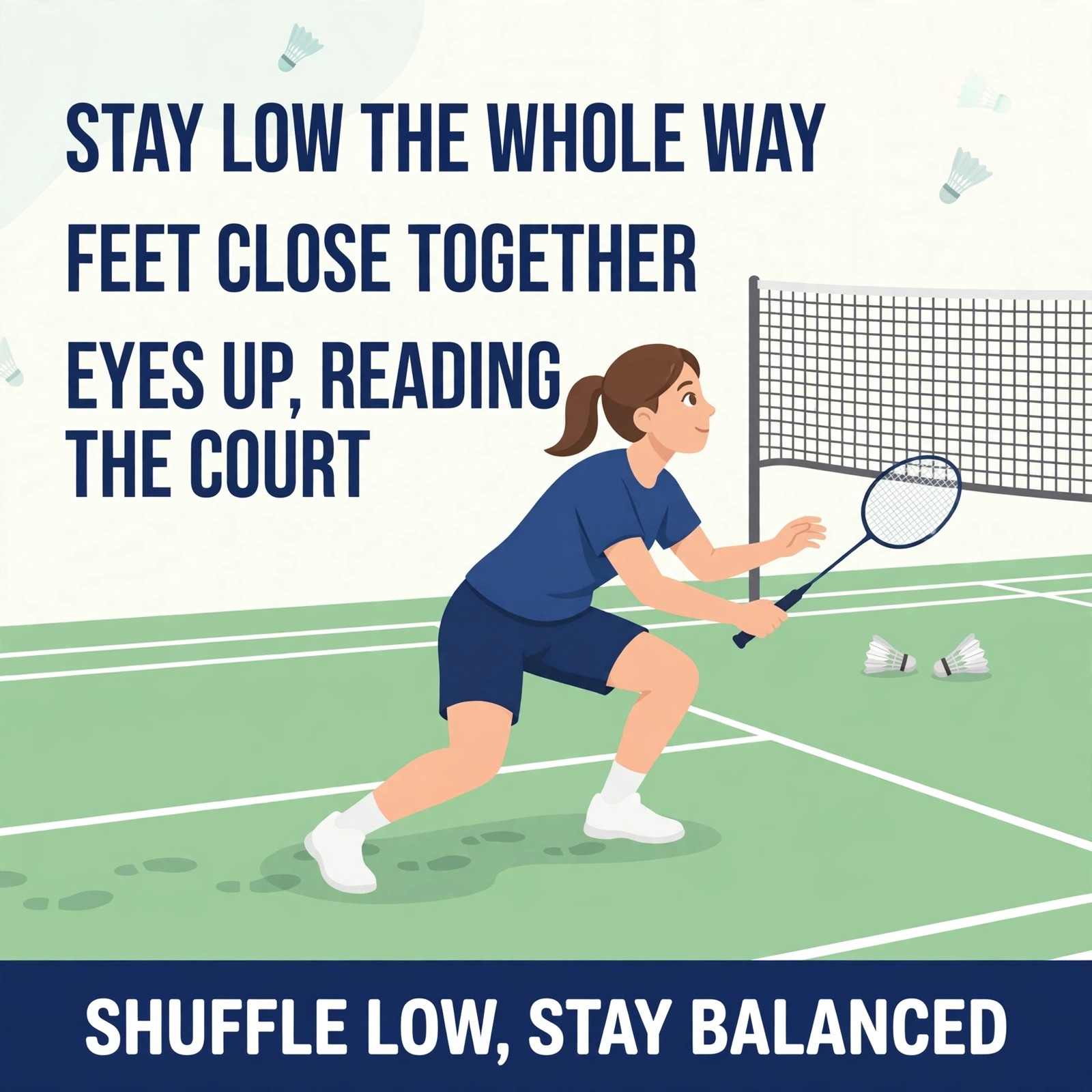
The lateral shuffle is the sideways engine of badminton footwork. Start in a low ready stance, feet apart, knees bent. Step sideways with the lead foot, bring the trailing foot close without letting the feet touch, and repeat across the court. Your heels stay light, your hips stay level, and your racket stays up in front. Done well, the shuffle feels like gliding: no bouncing, no crossing, no upright jogging. It carries you to wide shots and brings you back to base under control.
Four coaching points make the shuffle work. First, look where you are going next: eyes on the play, not on your shoes. Second, stay low from the first step to the last; rising up mid shuffle is where balance leaks. Third, keep the steps quick but never rushed: control first, speed second. Fourth, vary the pattern once the basics are clean: add a crossover step for longer distances and zigzag changes of direction to test the brakes as well as the engine.
Practised this way, the shuffle strengthens far more than the legs. Ankles, knees, hips and the whole core learn to work as one unit, and your confidence in wide positions grows with them. That confidence matters: players who trust their sideways movement commit to it earlier, and earlier commitment is what turns a desperate stretch into a balanced shot. If your wide forehand defence feels like falling, the shuffle is usually the first pattern to rebuild.
Movement Check #3
Hops Forward and Backward Build the Base
Forward hops build the base underneath everything. Stand with feet together, knees soft, and hop forward a short distance, landing on both feet with bent knees and a quiet sound. The aim at the start is not distance: it is a landing you could freeze and hold. Small hops, tidy landings, then a little more distance as control allows. This forward spring is the same force that drives your first step to the net, so the landing quality here shows up in every lunge later.
Backward hops are the awkward cousin, and that is why they matter. Moving backward in badminton is where balance gets tested: rear court shots, recovering from deep lunges, resetting after a smash defence. Hop backward in small steps, staying low, landing on both feet and checking that you could stop dead at any point. Start smaller than you think you need. Backward movement done in a rush teaches leaning and stumbling; done small and low, it teaches control you can trust at full stretch.
As the basics settle, hops can progress. Experienced players add plyometric variations: slightly bigger bounds, quicker ground contacts, changes of direction between hops. The rule never changes though: the landing decides the level. If landings get loud, knees dive inward or the trunk tips forward, the drill is too big for today, whatever the plan says. Quiet, balanced landings repeated often build the ankles and calves that every movement pattern on this page depends on.

Movement Check #4
Balance and Cone Drills Tie Movement Together
Single leg balance is where movement becomes honest. Stand on one leg, opposite knee bent up, racket held in front as if waiting at base. Hold, breathe, and feel the small corrections your ankle and hip make to keep you still. That micro control is exactly what a lunge landing needs at the end of a long rally. Progress slowly: longer holds, a gentle racket reach forward, a partner’s soft toss to catch. Wobbling is not failure here; wobbling is the training happening.
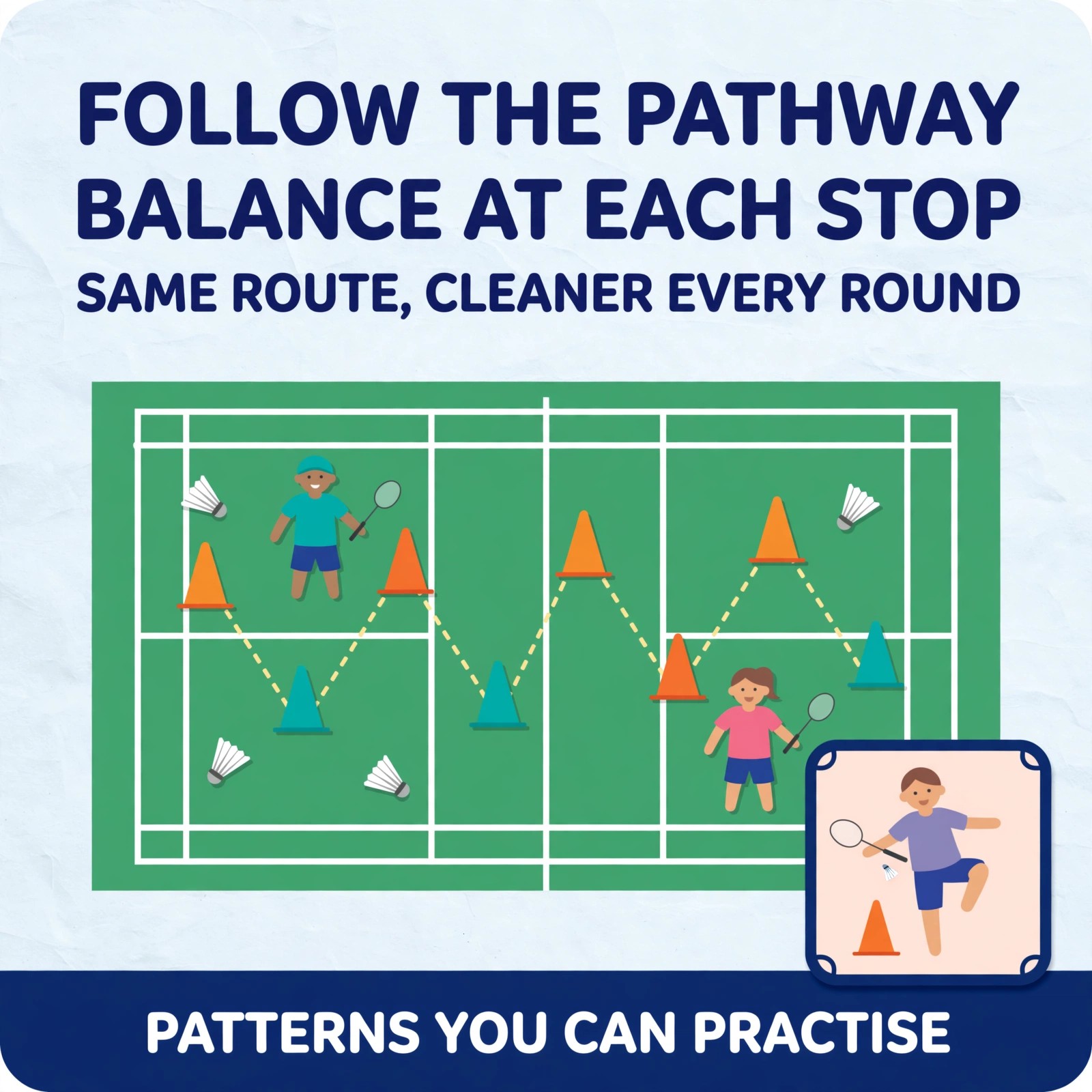
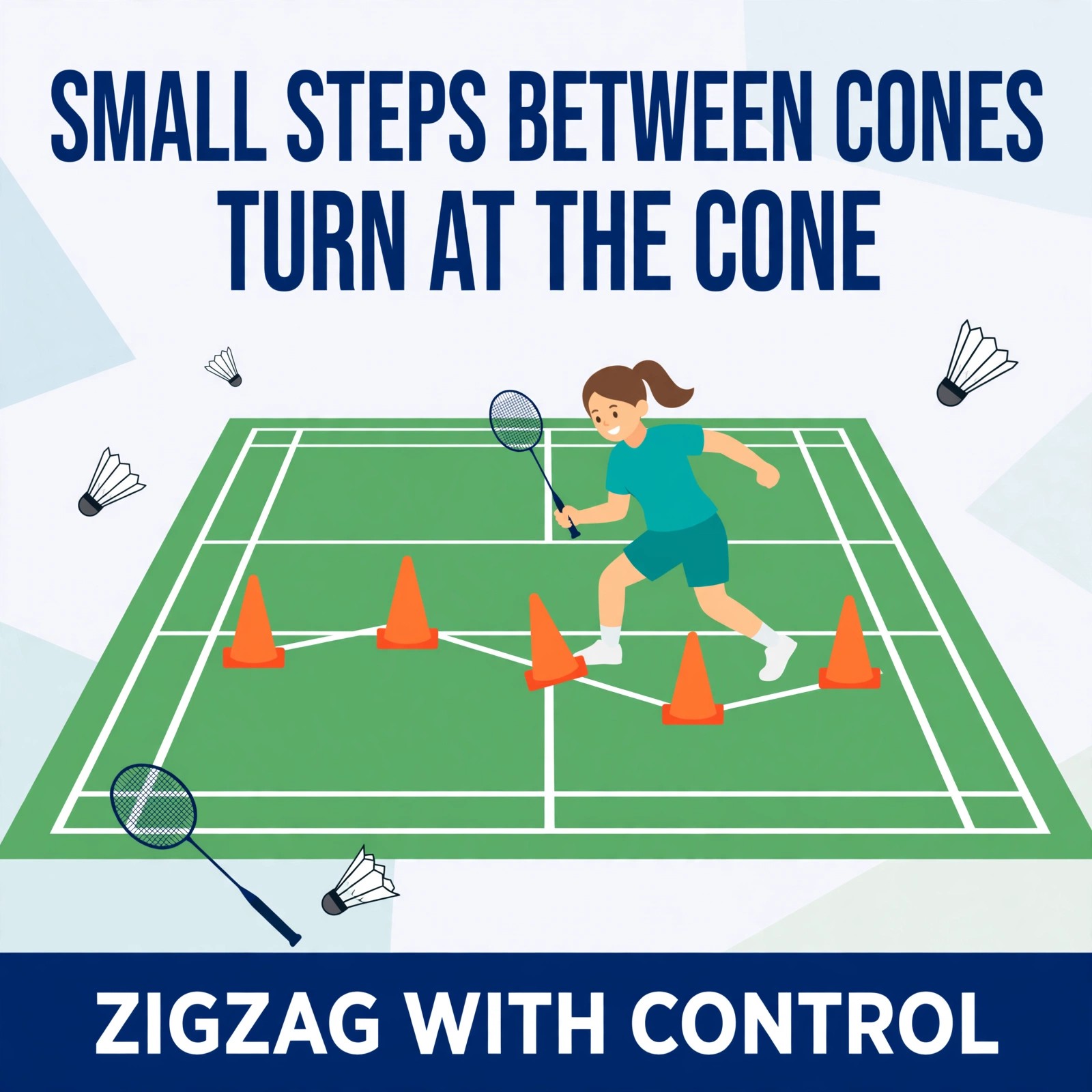
Cone drills give movement a map. Set cones in a zigzag or a box and move between them with named patterns: shuffle out, crossover back, hop and stick at each stop. The cones turn vague effort into visible pathways, so both player and coach can see where a step went wrong. Start with the route walked, then jogged, then at rally speed. Same route, cleaner every round: that simple loop is how patterns become habits your feet remember under pressure.
The kit list for all of this is short. A handful of cones or flat markers, an agility ladder if you have one, and a skipping rope for warm ups: that covers nearly every exercise in this guide. The ladder teaches quick, neat feet inside fixed rungs; the rope wakes up the ankles and calves before hops. None of it is expensive, and none of it is the point. The point is the pattern your body learns while using it.
Movement Check #5
How Movement Work Fits the Week
Two or three movement sessions a week is the dose that works for most players, based on how the body adapts: enough to build the patterns, spaced out enough to recover. Daily maximum effort hopping is not better; it is just tired practice, and tired practice teaches tired movement. Place movement work on days when you can give it attention, either inside court sessions as a focused block or as a short separate session with a proper warm up.
A good movement session has a simple shape. Warm up until the ankles are awake. Practise one or two patterns slowly until they are tidy. Speed them up in short bursts with full rests. Finish with a game like element, a cone race or a shadow rally, so the patterns are used rather than just performed. When form breaks down for two rounds in a row, that pattern is done for the day: bank the good reps and move on.
A word on care. Agility work loads ankles, knees and calves, so build up gradually, listen to your body and keep the total volume moderate while you adapt. Sharp pain is a stop signal, not a challenge. For food, general guidance is enough for most players: eat balanced, nutrient rich meals and stay hydrated around training; anyone wanting a personal nutrition plan should speak to a qualified specialist rather than copying generic advice from the internet. Movement improves fastest in a body that is fuelled and rested.

Myth vs Reality
Myths About Movement Training
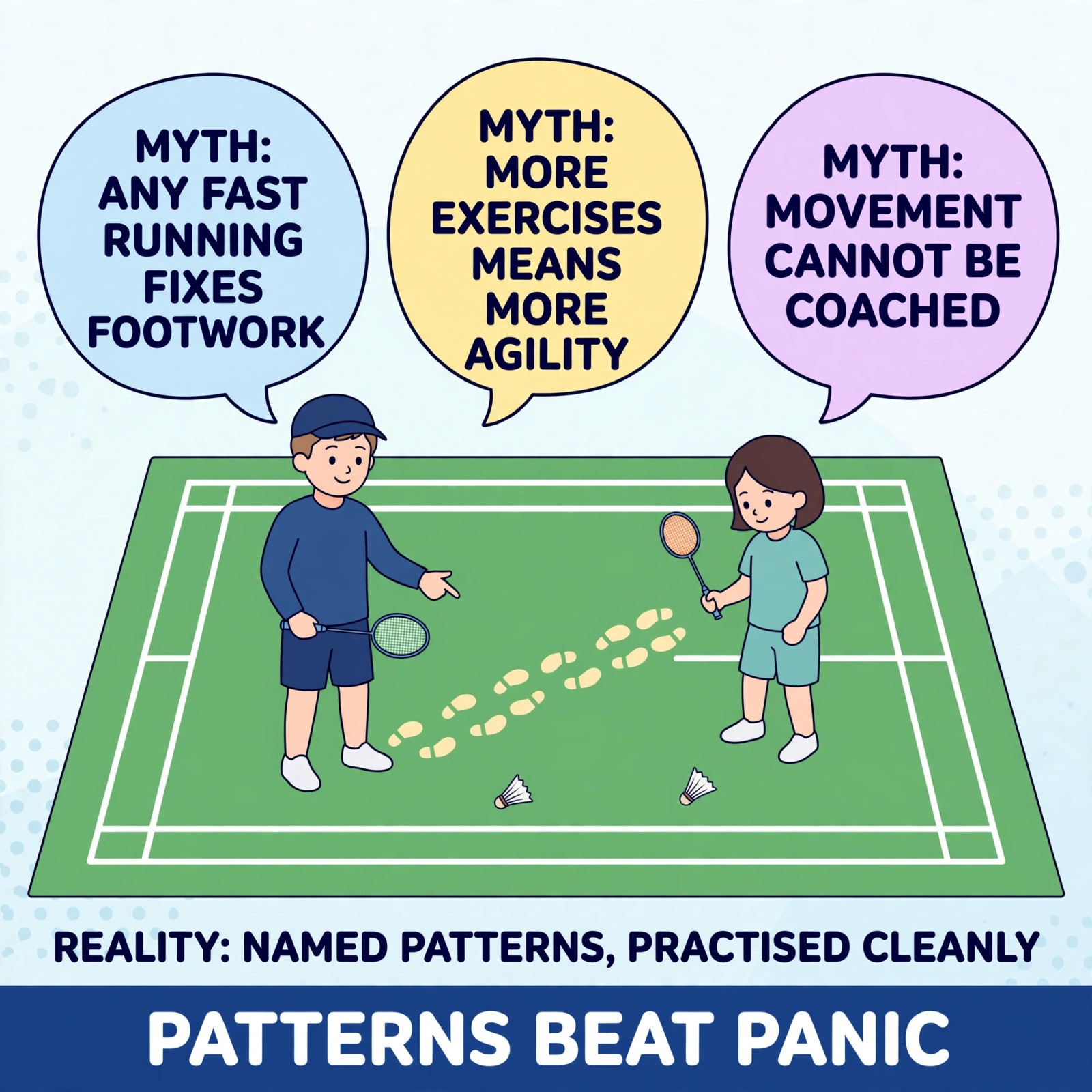
Myth one: agility only matters for badminton and other racket sports. Direction change with balance and control is a general athletic quality: footballers, basketball players and martial artists all train versions of it. But the patterns are sport specific. A badminton player needs the shuffle, the lunge recovery and the backward reset far more than generic sprint drills. Train the general quality through the movements your sport actually asks for, and the transfer takes care of itself.
Myth two: faster is always better. A shuffle done at full speed with a bouncing trunk and crossing feet is not agility training; it is rehearsing a fall. Movement patterns are learned at the speed where they stay clean, then stretched gradually. Players are often surprised that slowing a drill down for two weeks makes them faster in matches a month later. Speed is the last ingredient added to a pattern, never the first, and coaches who rush it spend the season fixing it.
Myth three: you need a gym full of equipment. Almost every exercise on this page needs cones, floor space and your own body weight. A ladder and a rope are nice extras, not requirements. Players sometimes use equipment shopping as a delay tactic: new gear feels like progress while the patterns stay unpractised. Ten tidy minutes with four cones will do more for your movement than a boot full of untouched kit. Start with what you have, today.
Why Choose Us
Why Players Choose ST Badminton Academy
At ST Badminton Academy, movement patterns are coached in groups of no more than four students. That size matters for this work: a shuffle is a chain of small details, and a coach can only fix the detail they can see. With four players, every set gets watched, the knee that dives inward gets spotted, and the pattern gets corrected before it hardens into a habit. Movement homework is then simple: the same named patterns, practised the same way.
Coach Eric Chuar has coached in Singapore and Malaysia for more than 15 years, and his movement teaching follows a plain rule: name the pattern, teach it slowly, then earn the speed. Players learn the shuffle, the hops, the balance work and the cone routes as a set vocabulary, so a correction in a match is one word long. That shared language is why small details, a level hip here, a quieter landing there, actually stick between sessions.
The academy is based in Setapak, Kuala Lumpur. If your footwork feels like running rather than moving, a trial session is the easiest way to see the difference: we will watch your shuffle, test your balance and show you the first pattern to rebuild. No promises of instant speed, just tidy patterns taught in the right order, in a group small enough for the coach to see your feet on every single rep.
FAQs: Badminton Agility and Movement Training in Malaysia (KL)
Players and parents ask the same fair questions before adding movement work to a badminton week. Here are straight answers, with no hype and no promises we cannot keep.
Where can I learn proper footwork movement if I live in Setapak or Gombak?
With us, in Setapak. ST Badminton Academy is based in Setapak, Kuala Lumpur, and players come in from Gombak, Wangsa Maju and nearby areas for small group coaching. Movement patterns are taught inside normal sessions, so your shuffle, hops and balance work are corrected by a coach from day one rather than left to videos and guesswork.
What does good movement look like in badminton training in KL?
It looks quiet. A good mover arrives at the shuttle balanced, plays the shot without leaning, and recovers to base in one smooth chain. In our Kuala Lumpur sessions we coach it as named patterns: shuffle, crossover, lunge, hop and stick. When those patterns stay tidy at rally speed, that is good movement, whatever the stopwatch says.
How often should I train movement to hold a high rally level?
Two or three times a week works for most players, in focused blocks of twenty to thirty minutes. Patterns need recovery between sessions to settle, so daily maximum effort is not better. Inside a session, quality decides the dose: when landings get loud or the shuffle gets sloppy twice in a row, that pattern is finished for the day.
Can I practise movement patterns at home with cones or markers?
Yes. Four cones, flat markers or even shoes can set a zigzag or a box in a porch, corridor or garden. Walk the route first, then jog it, then move at rally speed, balancing at each stop. Keep hops small on hard floors and skip any drill that needs space you do not have. It keeps patterns warm between sessions.
Which movement pattern matters most in a match?
The recovery. Getting to the shuttle matters, but matches are lost on the way back: the step that returns you to base balanced and ready. That is why our patterns always finish with a recovery to base, never at the shot. Practise the whole chain, out, play, recover, and the famous patterns like the shuffle start to look after themselves.
Do you coach footwork and movement near Wangsa Maju?
Yes. Our base is in Setapak, a short drive from Wangsa Maju, and footwork and movement coaching is part of our regular small group training. With four students or fewer in a group, a coach can watch your shuffle and your landings on every set and correct the small details that videos and big classes usually miss.
Do movement drills help in other sports beyond badminton in Malaysia?
They help, because direction change with balance and control is a general sporting quality. Players here in Malaysia use the same shuffle, hops and balance work for school football, basketball and martial arts fitness. The patterns still matter most inside badminton, where the lunge and the recovery are specific, but the body control you build carries across sports.
Where does ST Badminton Academy teach movement and footwork training?
At our home base in Setapak, Kuala Lumpur. Movement and footwork coaching runs inside our regular small group sessions, with no more than four students per group, so patterns are watched and corrected closely. Players travel in from Gombak, Wangsa Maju and across the Klang Valley, and trial sessions can be arranged through the academy.
What should I watch when my movement feels slow in badminton?
Start with three checks. Are you rising up tall mid movement? Are your landings loud? Are you recovering to base, or admiring the shot? Most slow looking movement is one of those three, not a lack of fitness. Film one rally on your phone and watch your feet only: the honest answer is usually there, and it is usually fixable.
Badminton Movement Training in Action


One Standard for Every Player and Every Session
Movement is tested at this academy before it is trained. A new player shuffles the width of the court, holds a one leg balance and hops and sticks a landing, so the starting point is honest. The standard after that is simple: patterns stay tidy before they get faster, landings stay quiet before hops get bigger, and every pattern finishes with a recovery. Retests are written down, so progress is something a player can point to, not just feel.
| Factor | Random Running | Patterned Movement Training MOVEMENT |
|---|---|---|
| Frequency | 1 or 2 times a week. Mostly for fun and sweat. | Two or three movement blocks a week, always with clean form. |
| Drills Focus | Basic static feeding. Minimal footwork pressure. | Chasse, cross steps, lunges and shuffles learned as named patterns. |
| Physical Conditioning | Rarely included. Just playing games on court. | Core, agility, and speed training included in every session to prevent injury and build stamina. |
| Tactical Awareness | "Just hit it over." No real game plan. | Video analysis, point construction, and learning to read the opponent's game. |
| Coach Ratio | Large groups (8-10 kids). Coach barely watches you. | Max 4 students. Mr Eric Chuar personally corrects every stroke and movement detail. |
| Goal Setting | Fun and exercise. | Movement that stays balanced at match speed. |
| Long Term Result | Good recreational player. | A player who glides between shots and arrives set. |
Badminton Movement Training in Kuala Lumpur
If your footwork feels like running, chasing the shuttle rather than moving to it, a trial session is the fastest way to feel the difference. Come to our Setapak base, show us your shuffle and your lunge as they are today, and leave with the first pattern to rebuild and a simple way to practise it. Groups stay at four students or fewer, and the coaching is patient, specific and honest about the order things improve.






