How To Develop A Winning Badminton Strategy: Analysis And Planning (Analysis Guide)
Coaches have a saying worth stealing: the match you played is not the match you remember. Memory keeps the lucky winners and the silly errors, and quietly deletes the forty ordinary rallies that actually decided things. Match analysis is how you get the real story: watch the footage, count what repeats, write it down, and turn two or three honest notes into your next plan. This guide covers the homework side of strategy: what to count first, how to study an opponent, how to study yourself, and how notes become a plan you can use.
Review Check #1
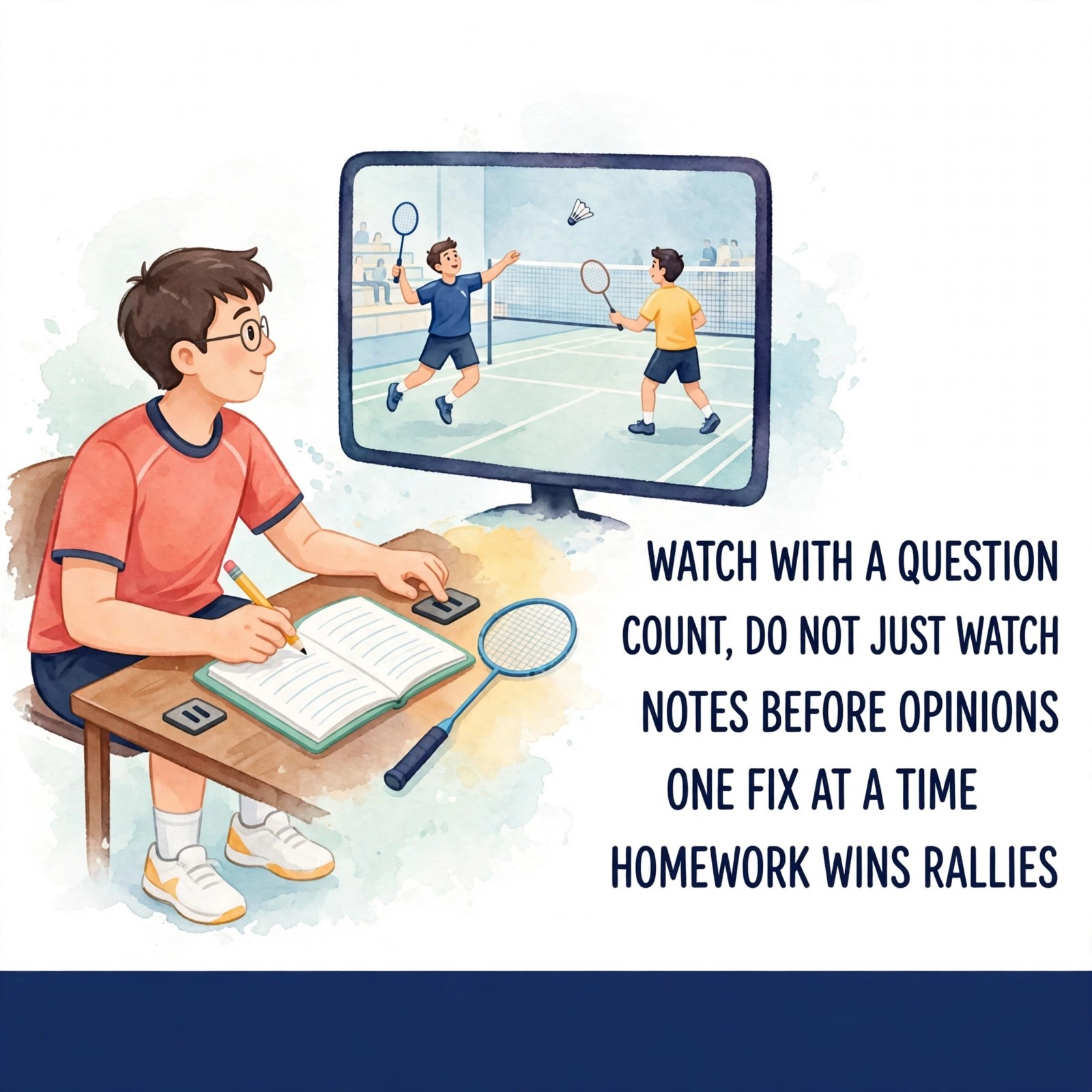
Watch With a Notebook: What to Count First
You cannot analyse everything, so count the few things that decide club matches. Start with where your errors land: net, wide or long, and in which corner the rally broke down. Add how each rally ended, your winner, your error, their winner or their error. Ten rallies of counting will already show a shape that a whole evening of remembering never would.
Keep the counting dead simple. A tally mark needs a second, a paragraph needs a minute you do not have between rallies. Mark first, think later: the thinking happens after the match, with the page in front of you. Players who try to write essays courtside stop counting by game two, and the story of the match slips away again.

Review Check #2
Study the Opponent: Habits Caught on Film
Studying an opponent on film is about habits, and habits love to hide behind one good or bad day. Watch how they serve under pressure, which corner they avoid, and what they do with the same shot three times in a row. A player who always clears cross court from the forehand corner has told you where your next shot should wait.
Look for what they do when they are late. Every player has a rescue shot: the panic lift, the hopeful cross court net, the drive hit straight at the body. Rescue shots are gold for planning, because a plan that makes an opponent late is a plan that keeps feeding you their weakest reply. Note the rescue shot and what forced it.
One match of film is a clue, not a verdict. Habits repeat across matches; a single brilliant day does not. If you can, glance at two matches before trusting a pattern, and check whether the habit survived a strong opponent as well as a weak one. Honest analysis is patient: it would rather be right than fast.

Review Check #3
Study Yourself: Your Patterns on Screen
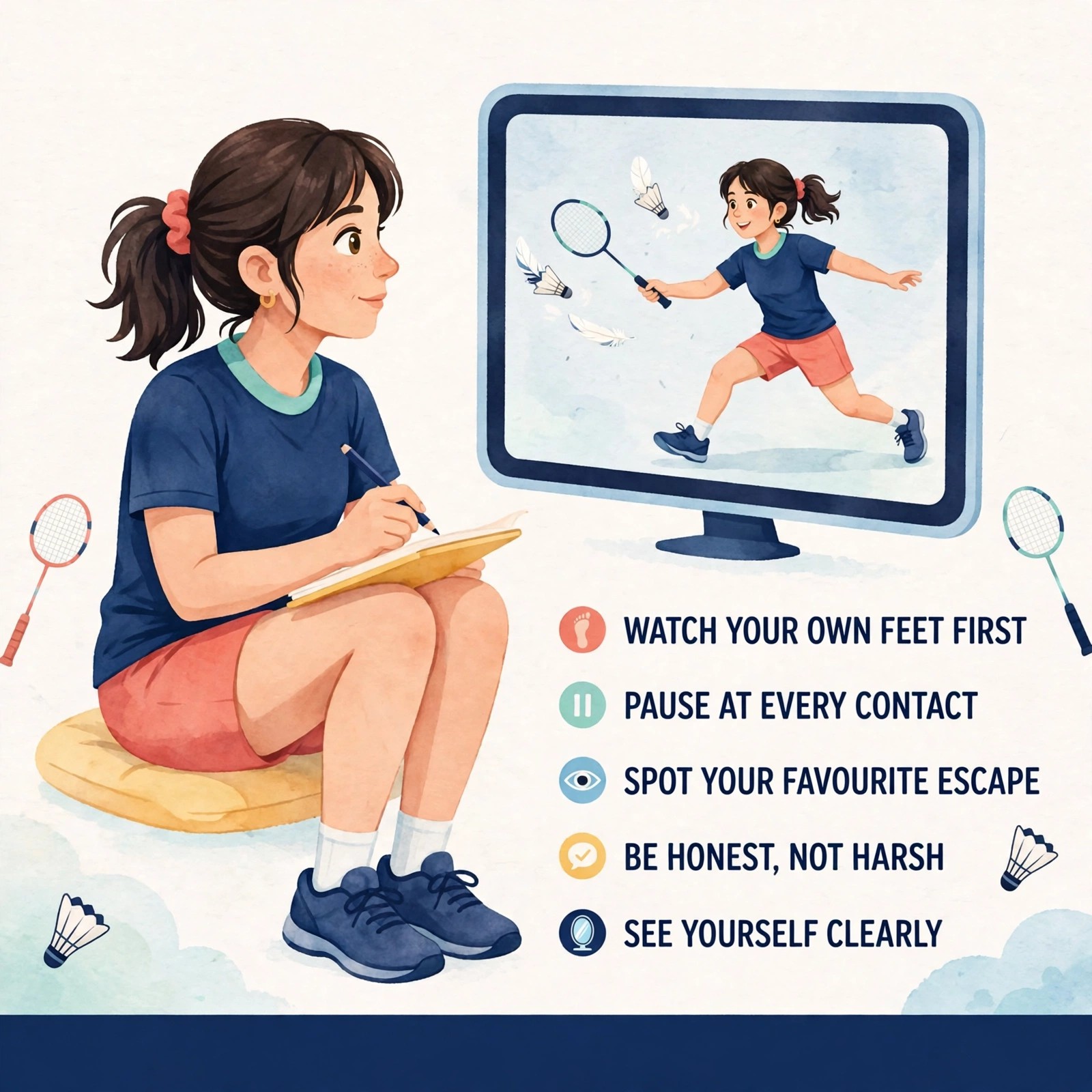
Your own footage is the harder watch, and the more valuable one. You will see the thing your memory swore never happened: the step you skip, the corner you leave open, the shot you choose every time you are tired. Count your unforced errors by type for one match. Most club players find one error doing half the damage, and that error is the first thing to coach.
Watch your position, not just your shots. Freeze the rally at random moments and ask where you are standing and where the shuttle is going. Players are often beaten by geometry before the shot is even hit: standing too deep, watching from the wrong side, recovering toward the middle when the rally still lives at the net.
Be kind to the player on the screen; it is you, and shame is a terrible coach. Note what repeated, not what felt worst. One pattern, written plainly, is a training task. Ten complaints are just a bad mood with a notebook. Analysis should hand you the next practice session on a plate, not a list of reasons to feel slow.
Review Check #4
From Notes to a Plan: Two or Three Points Only
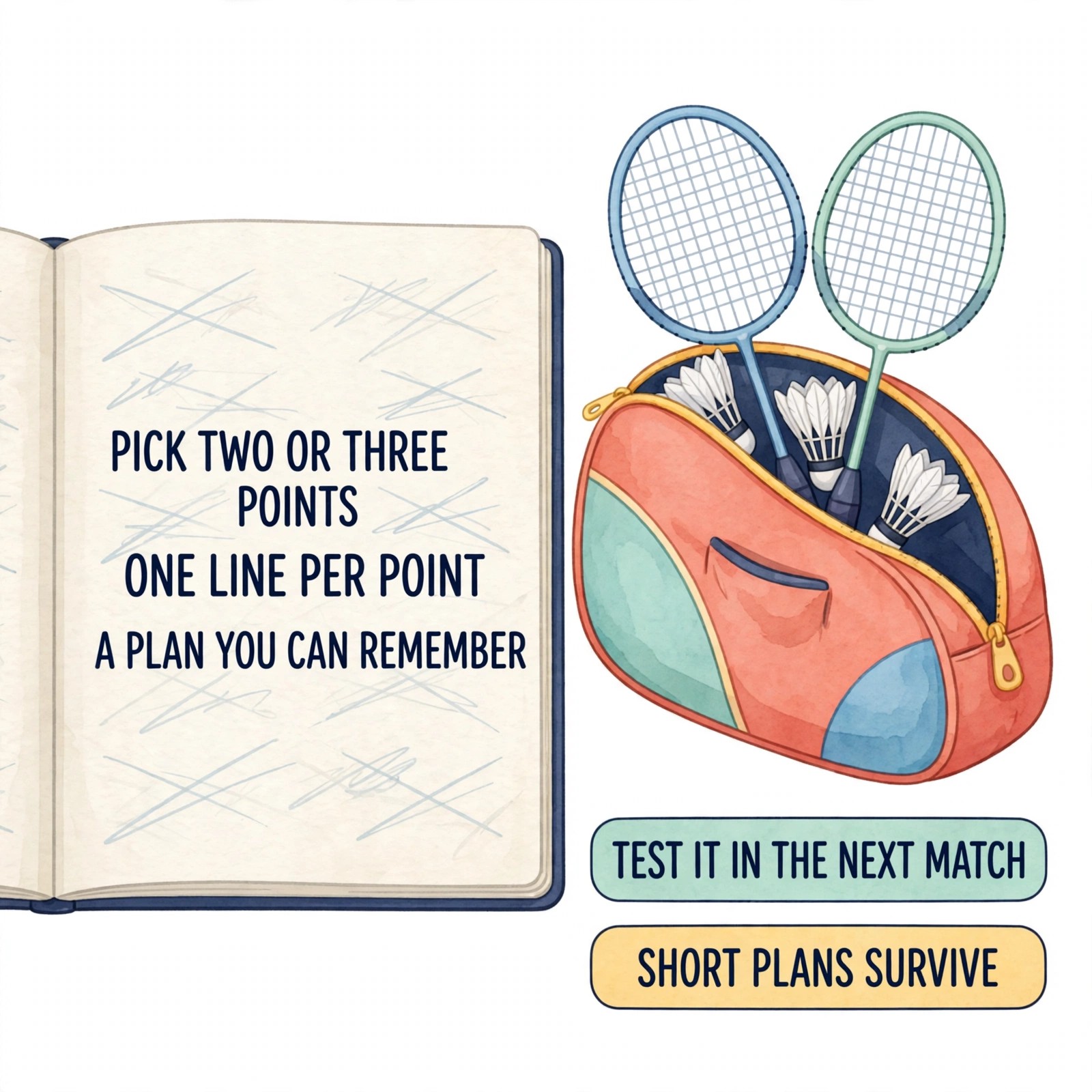
Notes become useful only when they shrink. After reviewing, choose two or three points, no more: one pattern of theirs to attack, one pattern of yours to protect, and one set play to open with. Write them as short instructions you could say out loud at the change of ends. If a note cannot be read in five seconds, it is not ready.
Turn each point into a test as well. A plan that says attack the backhand is unfinished; a plan that says test the backhand corner in the first five rallies, then decide, is a working tool. Tests keep you honest mid match, because the plan includes its own checking, instead of asking you to believe it for an hour.
Keep the old notes. A log of two or three points per match becomes, over a season, a map of your game: which patterns keep returning, which opponents trouble you, and which fixes actually held. That log is also the best thing you can hand a coach. It turns one trial session into a conversation about your real game, not your best guess at it.
Review Check #5
Review After the Match: Close the Loop
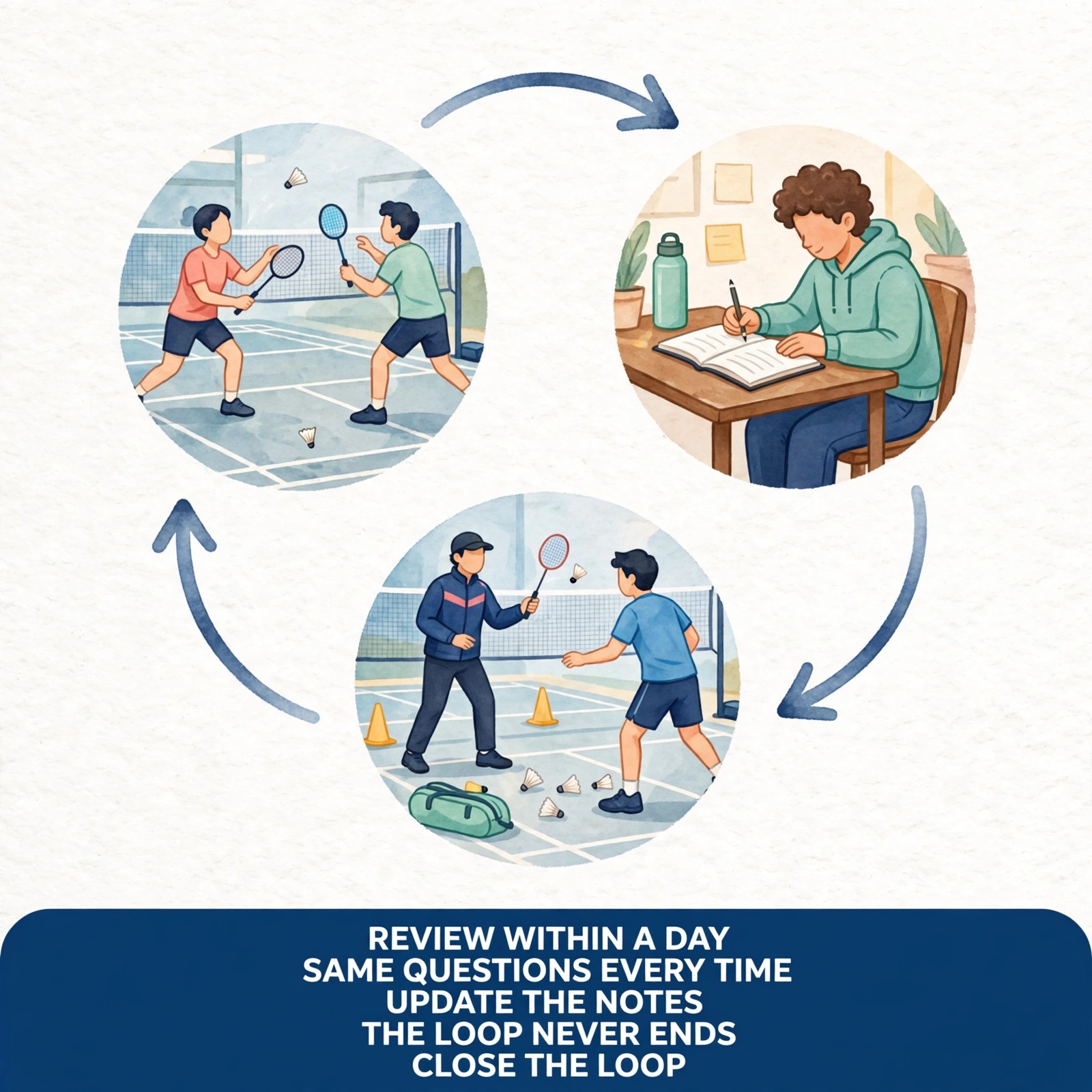
Analysis is a loop, not an event. You play, you count, you note, you plan, and then the next match tests the plan and starts the loop again. Each round makes the notes sharper and the plans shorter. Players who run this loop for a few months stop fearing new opponents, because they own a method, not a collection of tips.
Close the loop after every match, even a friendly one. Five minutes with the notebook while the rallies are fresh beats an hour next week when they have faded. Write what the plan predicted, what actually happened, and the one adjustment you would make. That last line is the seed of the next plan, planted before you forget it.
Share the loop where you can. A friend counting for you, a coach reviewing two rallies, a doubles partner comparing notes at the change of ends: analysis gets stronger with a second pair of eyes. Just keep the counts honest. The notebook that flatters you is worse than no notebook at all, because it teaches a plan built on fiction.
Myth vs Reality
Myths About Badminton Match Analysis
Myth: you must study hours of film to analyse a match. Reality: one honest set of counts from ten rallies tells you more than an evening of casual watching. Analysis is counting what repeats, and repeats show up fast. Start small, stay regular, and let the log grow by minutes, not marathons.
Myth: match analysis is only for professionals with coaches and cameras. Reality: a phone on a tripod and a friend with a pencil give a club player everything needed. The tools were never the barrier. The habit is: five minutes of notes after the match, every match, win or lose.
Myth: notes win matches by themselves. Reality: notes only point. Feet, shots and nerve still have to do the work on court, which is why every note must shrink into a plan small enough to carry into a rally. Analysis that never reaches your feet is just trivia about yourself.

Why Choose Us
Why Players Choose ST Badminton Academy
We do not just feed shuttles; we build players. ST Badminton Academy Malaysia is different because our head coach, Mr Eric Chuar, has over 15 years of coaching experience in Singapore and Malaysia, and he corrects technique personally in small groups. Bring your notes or a clip, and the session starts from your real patterns, not from a generic drill sheet.
Our small group policy, with a maximum of 4 students, leaves room for review inside training: two rallies watched together, one pattern named, one drill built to fix it. In a crowded class there is no time to look at your game this closely. In a group of four, your footage and your notebook become coaching tools.
We focus on long term player development. Analysis is a habit that keeps improving a player long after any single technique is learned, because it turns every match into feedback. Players who review honestly keep finding the next thing to fix, and that steady loop is what long term development actually looks like week after week.
FAQs: Badminton Strategy Analysis and Planning in Malaysia (KL)
Here are answers to common questions from players in Kuala Lumpur about badminton match analysis, studying opponents and turning notes into plans, and how review coaching at ST Badminton Academy works.
Can a club player do useful match analysis in Setapak or Gombak?
Yes, with a phone, a notebook and ten honest rallies. Count where your errors land and how rallies end, note one habit of the opponent, and write two or three points before the next match. That simple loop, repeated weekly, is real analysis at any level.
What should I write down first when analysing a match in KL?
Write the counts first: where your errors went, how rallies ended, and any shot of theirs that kept working. Memory will try to write the story for you, and it always edits out the boring rallies that decided the match. Counts first, opinions second, plan third.
How many rallies should I count before trusting a pattern at club level?
Count ten rallies to see a shape, and check the pattern across a second match before building a whole plan on it. One failure is an accident; the same breakdown three times is a pattern worth attacking. Keep the tallies simple so the counting habit survives busy weeks.
I record my matches but never watch them. Where should I even start?
Start with one game, not the whole match. Count only your errors by type for those rallies, write the one pattern that repeats, and stop. Fifteen honest minutes with one game beats a guilty backlog of ten unwatched matches. The habit grows when the first step stays small.
How can a friend help me analyse while I play during training?
Ask them to tally one thing only: where your errors land, or how each rally ends. One job keeps the counting reliable. Between games, glance at the page together and pick the one pattern to test next. A counting friend is the cheapest analysis team in badminton.
Do you offer match analysis coaching near Wangsa Maju?
Yes. ST Badminton Academy is based in Setapak, a short drive from Wangsa Maju, Melati Utama and Danau Kota. Review work is coached in small groups of no more than four students, so your clips, counts and plans can be looked at properly with the coach during training.
Where does ST Badminton Academy review match footage in Malaysia?
We coach in Setapak, Kuala Lumpur, where match review is part of how players develop: counting patterns, studying footage and turning notes into short plans. Players from Gombak, Sentul, Ampang and nearby areas train with us weekly and bring their match notes into sessions.
How do I book a trial session to review my match before training?
Message us on WhatsApp and tell us match review is the project. Bring a clip or your last notes if you have them. We will place you in a small group session where the coach watches two of your rallies with you and builds the next drill from what repeats.
What makes Mr Eric Chuar a suitable coach for match analysis in badminton?
Mr Eric Chuar has coached in Singapore and Malaysia for over 15 years and reads matches the way analysis should be done: counts before opinions, patterns before plans. In a small group he can review your footage with you and turn one honest pattern into the next training task.
Badminton Analysis Training in Action


One Standard for Every Session and Every Player
Match analysis coaching at ST Badminton Academy KL follows one standard: honest counts, short plans and a review after every match. With a maximum of 4 students per group, your footage is actually watched and your patterns named, so the homework side of your game gets coached, not guessed.
| Factor | Watch and Forget | Count and Note REVIEW |
|---|---|---|
| Frequency | 1 or 2 times a week. Mostly for fun and sweat. | Errors and rally endings are tallied first, because memory quietly edits out the rallies that decided the match. |
| Drills Focus | Basic static feeding. Minimal footwork pressure. | Opponent habits and rescue shots are noted from film, then checked across a second match before being trusted. |
| Physical Conditioning | Rarely included. Just playing games on court. | Core, agility, and speed training included in every session to prevent injury and build stamina. |
| Tactical Awareness | "Just hit it over." No real game plan. | Video analysis, point construction, and learning to read the opponent's game. |
| Coach Ratio | Large groups (8-10 kids). Coach barely watches you. | Max 4 students. Mr Eric Chuar personally corrects every stroke and movement detail. |
| Goal Setting | Fun and exercise. | The notes shrink to two or three points, written as tests the next match can actually check. |
| Long Term Result | Good recreational player. | A player who reviews honestly: every match becomes feedback, and every plan gets shorter and sharper. |
Badminton Match Analysis Coaching in Kuala Lumpur
This guide gives you the full loop: count what repeats, study their habits and your own, shrink the notes into two or three points, and close the loop after every match. If you want that homework coached properly, ST Badminton Academy in Setapak reviews matches in small groups every week. Message us to book a trial session.






