How To Develop A Winning Badminton Strategy: Tactics And Game Plans (Game Plan Guide)
Every player has walked off court thinking the same thing: I was fitter than them, my shots were fine, so why did I lose? Most club matches are lost by the plan, not by the shots. A badminton game plan is simply choosing, before and during the match, where your rallies should go and why. This guide builds one in the order that works: know your own strengths first, read the opponent, write a short plan, groove set plays, then learn to adjust it without throwing it away.
Plan Check #1
Know Your Own Game First: Strengths You Can Trust
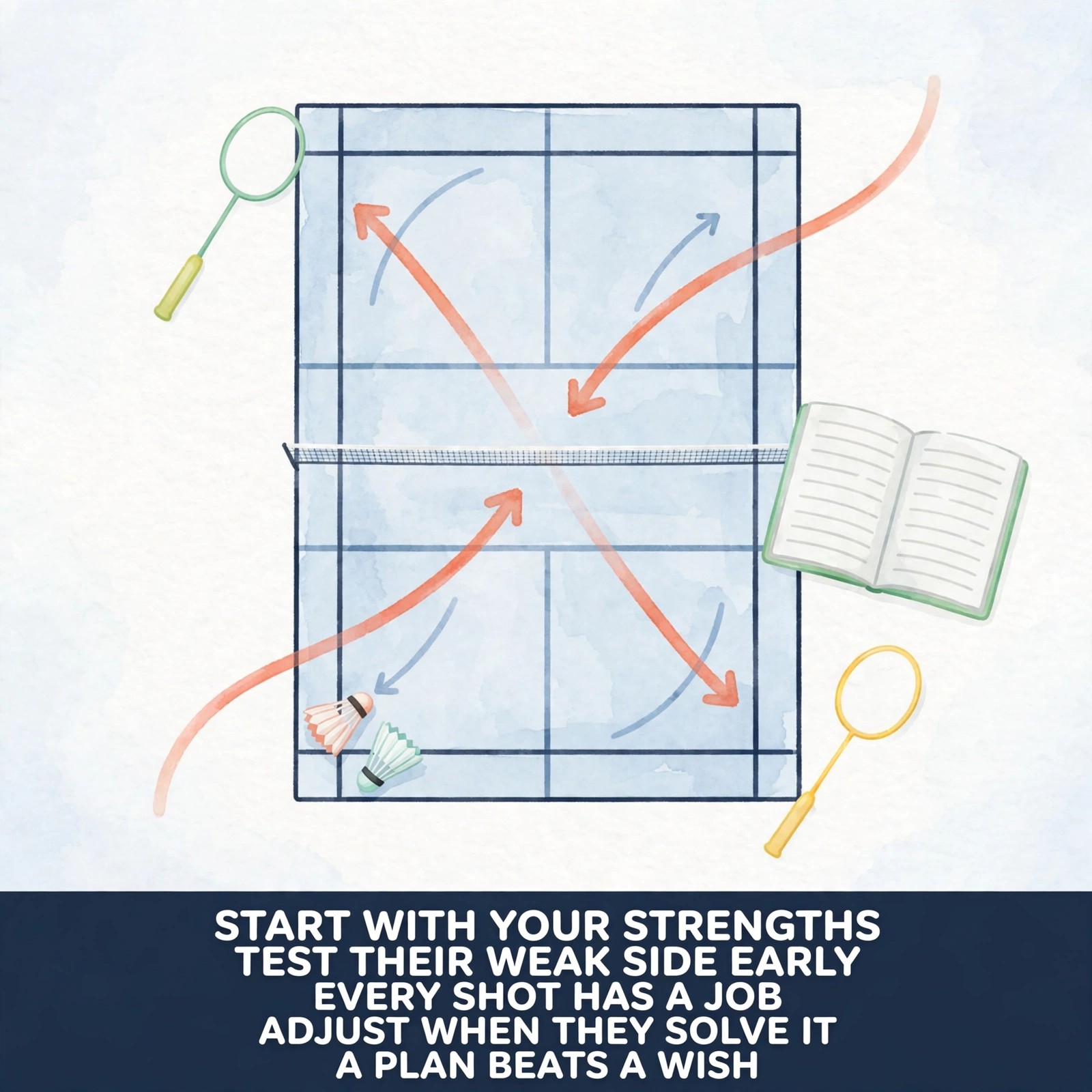
A plan built on shots you only hit in practice will collapse by the third rally. Start with the shots you trust under pressure: the lift that always reaches the back line, the net shot that stays tight, the drive that wins the middle. Write down two or three genuine strengths. Those are the shots your plan is allowed to lean on when the score gets tight.
Be honest about the rest of your game too. If your backhand clear lands short, the plan should not pretend otherwise; it should include how you will protect that corner, with earlier movement and safer choices, until training fixes it. Strengths first is not false confidence. It is knowing exactly which parts of your game can hold weight, and building the plan on those parts only.

Plan Check #2
Read the Opponent: Weaknesses Worth Testing
Opponents tell you their weaknesses in the first few rallies, if you test calmly instead of guessing. Try the backhand corner early. Vary the pace and watch which side breaks down first. Note how they handle the flick serve, body shots and flat drives. A weakness is only worth building a plan on when you have seen it fail more than once.
Watch the habits, not just the misses. Many club players step the same way every time, reach instead of moving, or rush the net after any short shot. Each habit is an opening: a player who rushes the net can be flicked, a player who reaches can be moved one step further, and a lazy recovery can be punished by playing behind them.
Keep the test small and quick. Two or three rallies per idea is enough to learn plenty, and the scoreboard barely notices. What you must not do is announce your test. Hit your normal shots in your normal rhythm while the tests hide inside them, so the opponent never realises they are being measured. Plans built on real evidence beat plans built on hope.

Plan Check #3
Build the Plan: Give Every Shot a Job
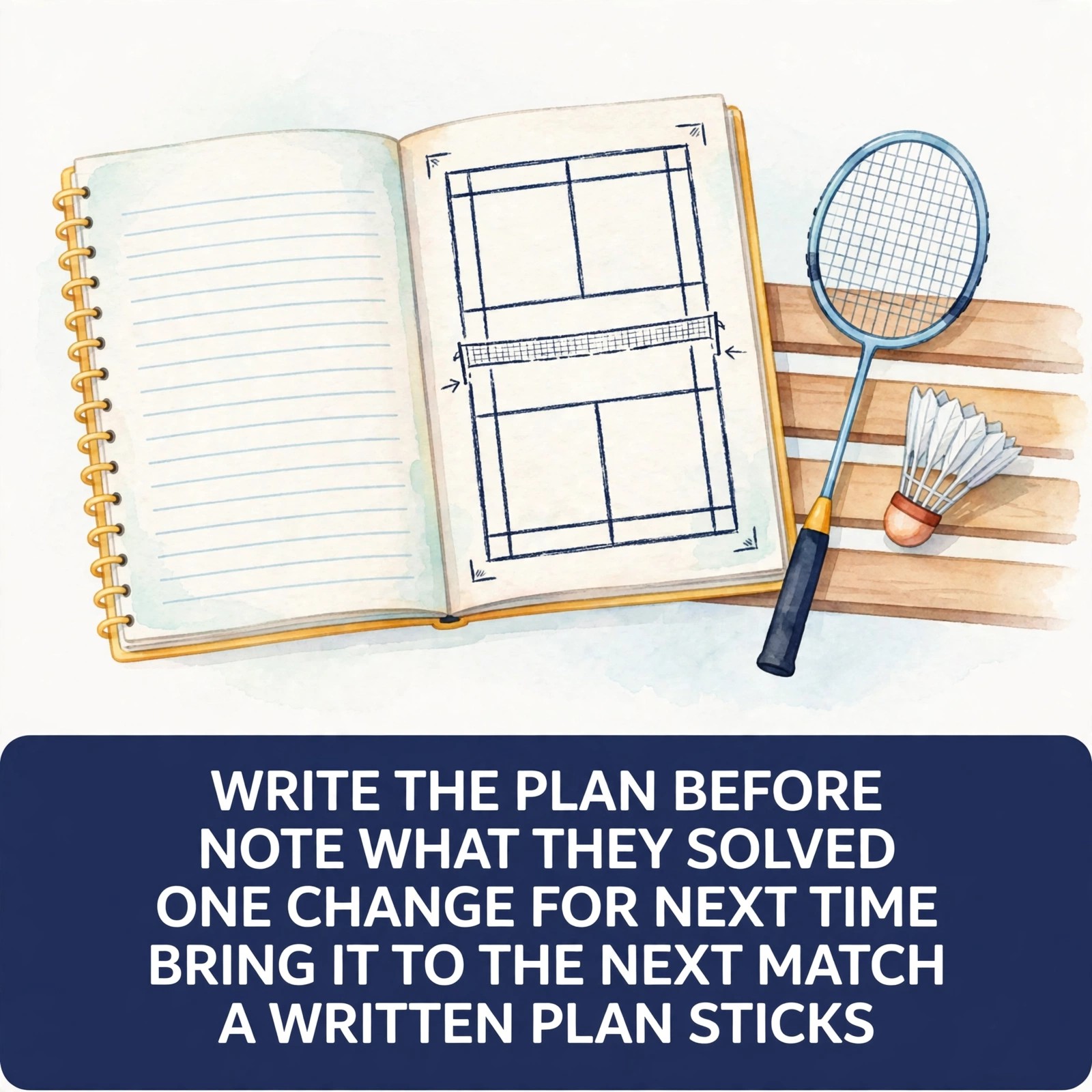
Now turn the evidence into a plan short enough to remember at 19 all. One strength to build around, one target to test, one set play to open rallies with, and one thing you will stop doing. That is the whole document. A plan with nine parts is not a plan; it is homework you will forget by the second game.
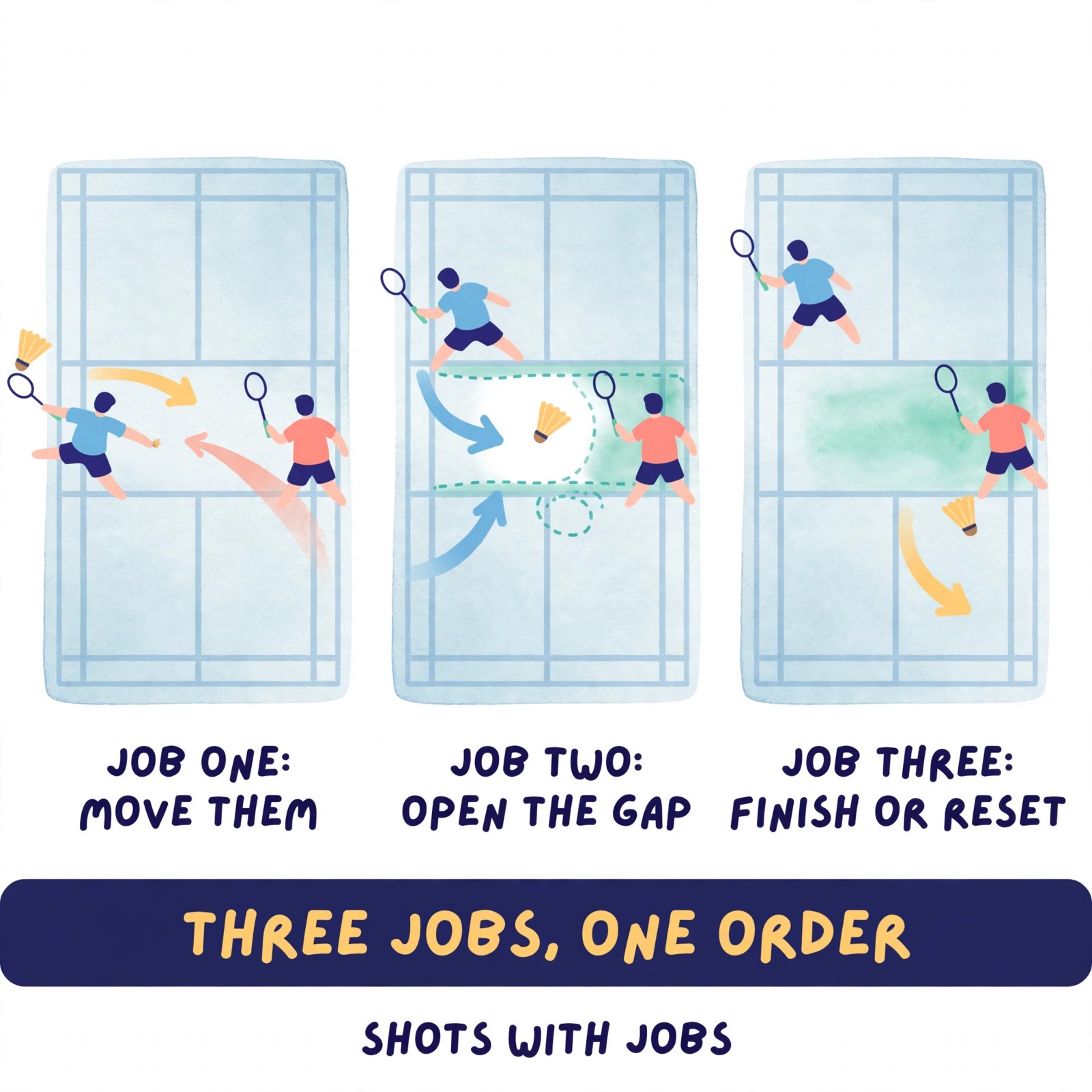
Give every shot a job while the plan is live. A lift is not just a lift: it is buying time, pushing the opponent to the corner you are targeting, or setting up the reply you want. When shots have jobs, rallies stop feeling random. You start seeing the rally you are building, and mistakes become information instead of noise and frustration.
Decide your scoring zones as well. Every player has parts of a match where they drift: after losing three points in a row, or right after a long rally. Plan for those moments in advance. Slow down, return to the set play, and play two safe rallies to steady the ship. A plan that includes your bad patches is a plan that survives them.
Plan Check #4
Set Plays: Serve, Return and the Third Shot
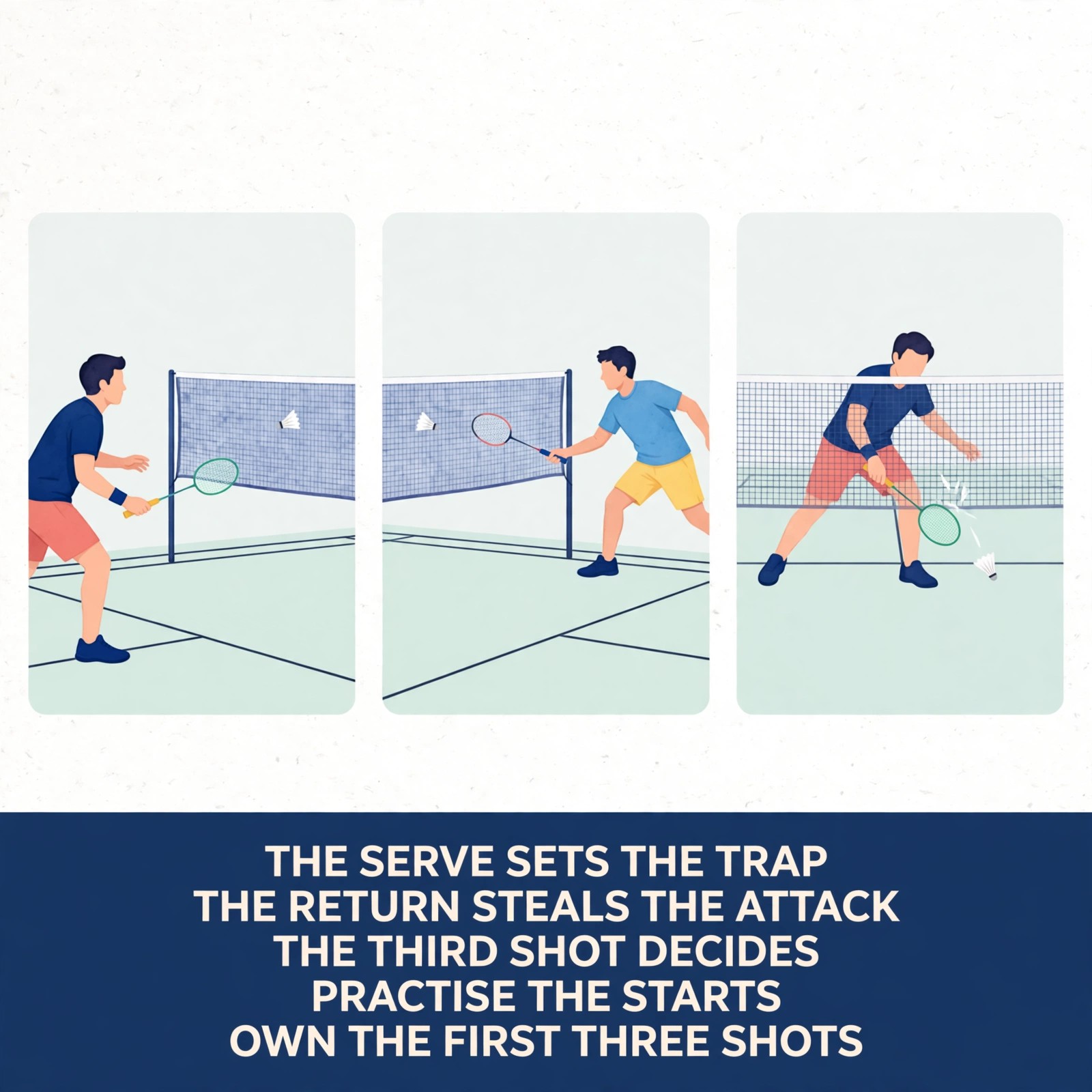
The first three shots of a rally are the most planned shots in badminton. Know your serve targets for this opponent, know what return you want to invite, and know what your third shot is hunting. In doubles especially, the pair that owns the first three shots usually owns the rally, because the attack starts before the defence settles.
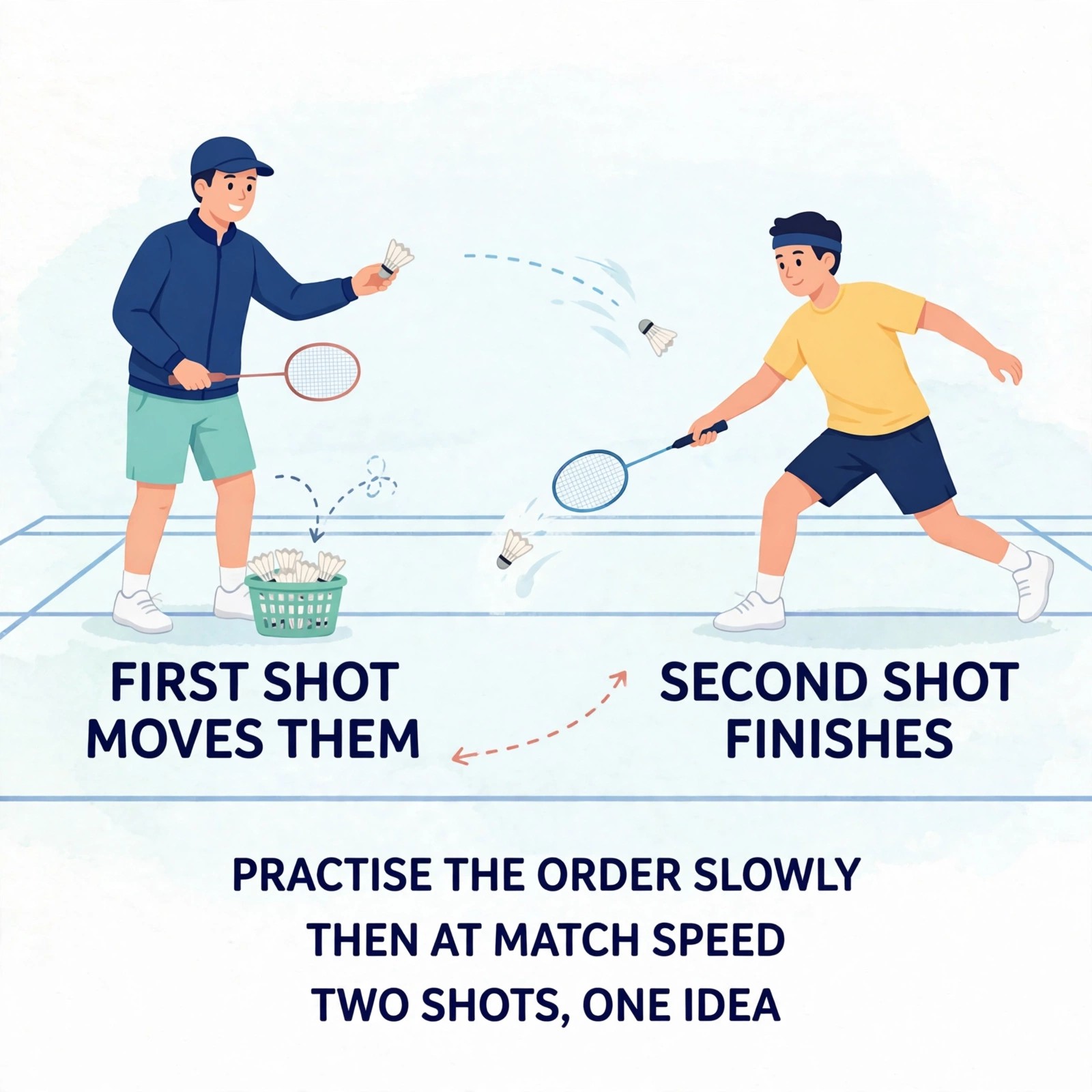
Build two or three set plays, not ten. A low serve to the target, a flat return pushed wide, then a ready third shot at the space left behind. Or a flick serve against a rusher, a step in, and the first smash at the body. Each set play should start from your strengths, and each one needs a simple variation so it cannot be read and parked.
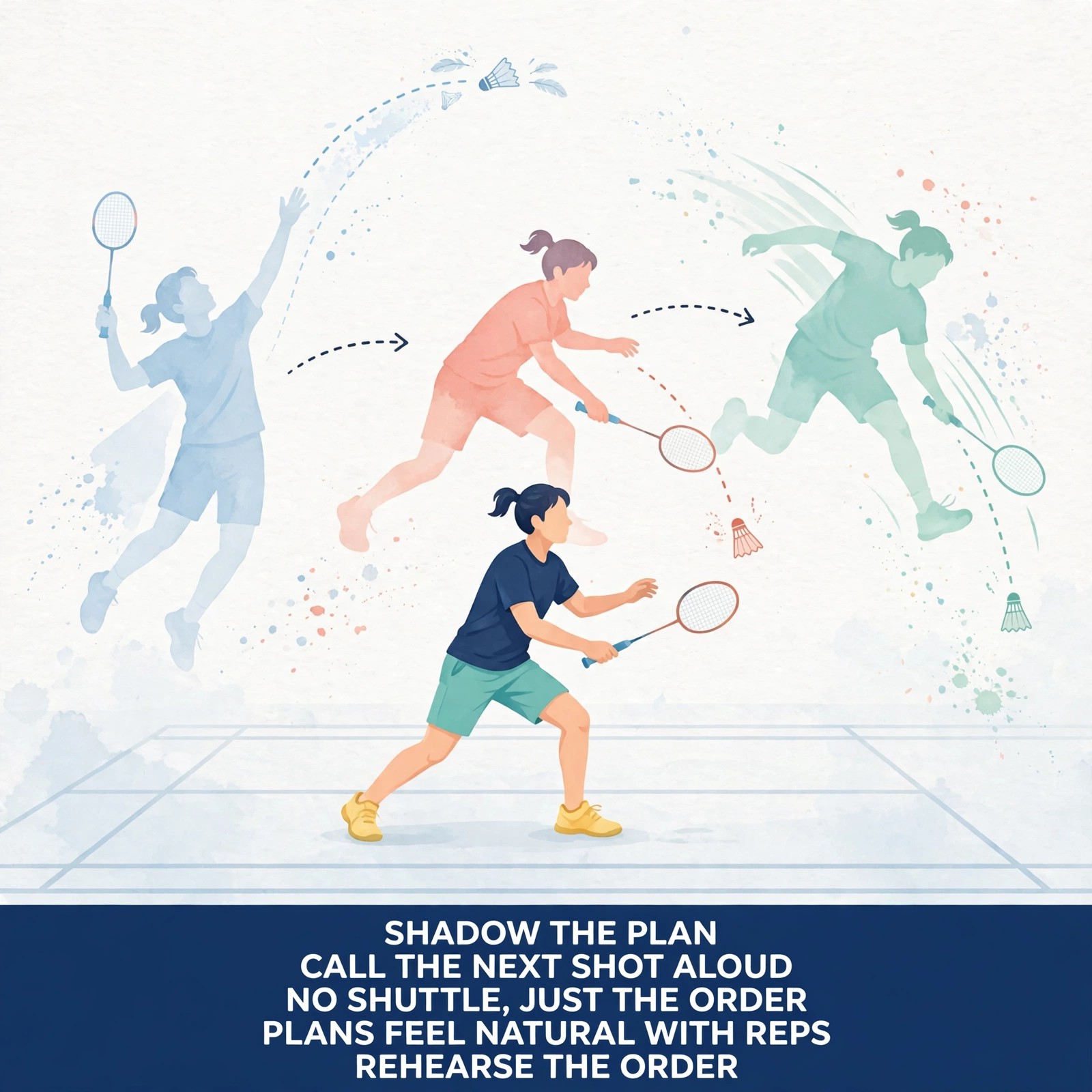
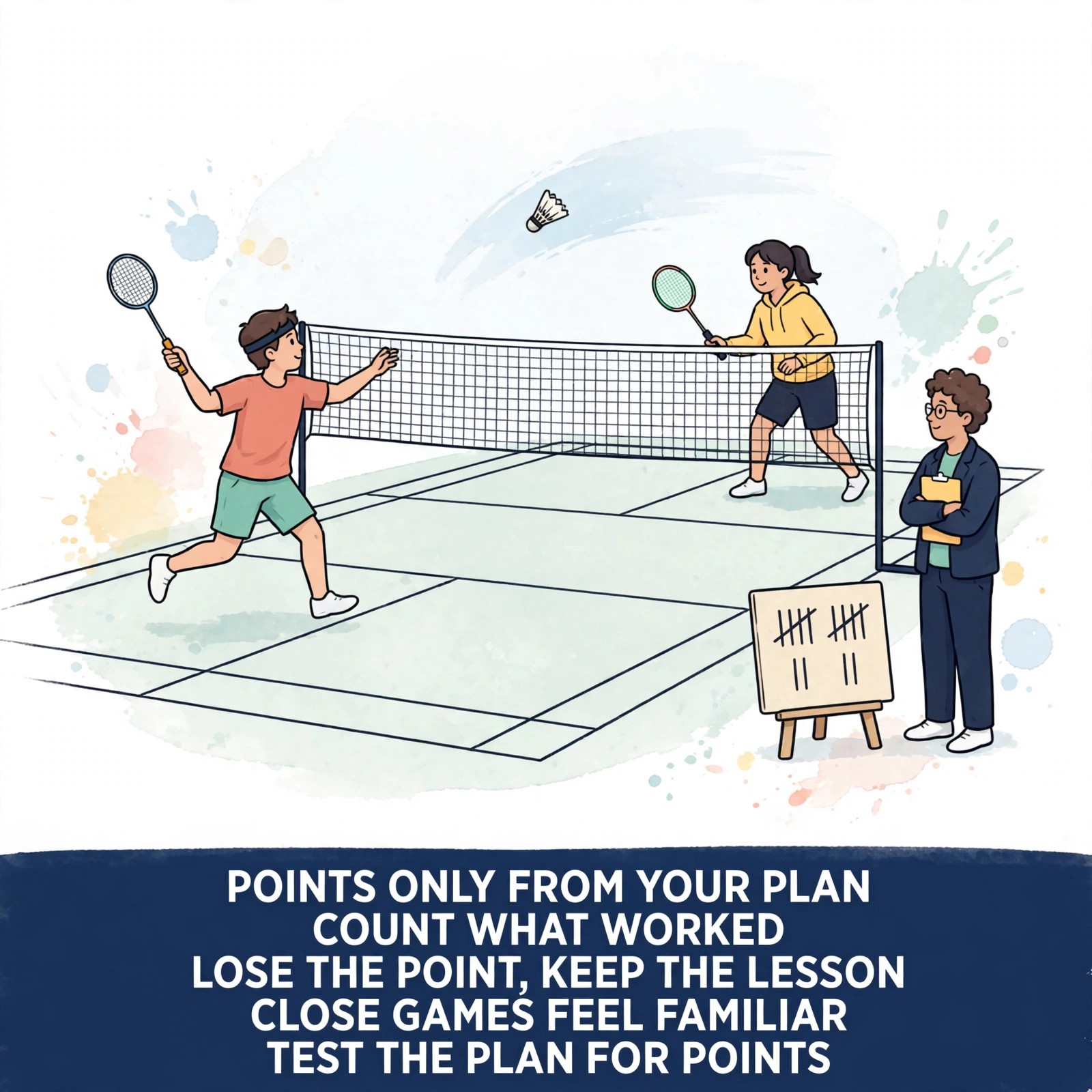
Groove set plays in practice until they feel boring. Feed them, shadow them, then run them in conditioned games where points only count if the rally started with the set play. A set play that only exists on paper will vanish under pressure. One you have hit five hundred times walks onto court with you and stays calm when you cannot.
Plan Check #5
Adjust Mid Match: When the Plan Meets Reality
No plan survives the whole match unchanged, and that is fine. The opponent adjusts, conditions shift, and your favourite shot may stop landing. The skill is adjusting the plan, not abandoning it. Make one change at a time: a new target, a different serve mix, a slower tempo. Then give the change three or four rallies to prove itself before judging it.
Score pressure lies to you. At 15 to 18 down, the voice in your head says the plan has failed, when usually only one part has. Go back to the evidence: is the target still weak, is your set play still working, are the errors yours or theirs? Change what is actually broken and hold what is still paying you points.
Use the breaks well. The interval and the change of ends are your planning office: breathe, check the score pattern, pick your one adjustment, and walk back on with it clear. Players who drift between games come back with hope. Players who plan come back with a job to do. Hope is not a tactic, but a checked plan is.

Myth vs Reality
Myths About Badminton Game Plans
Myth: a game plan guarantees wins if you follow it. Reality: no plan can promise a result. Opponents adjust, shuttles drift and luck plays its part. What a plan does is raise the quality of your decisions across thirty or forty rallies, and better decisions win more of the close ones.
Myth: planning is only for advanced players. Reality: a short plan helps beginners most, because their rallies are the most random. One target and one set play give a developing player something clear to do on court, instead of chasing the shuttle and hoping the rally works out by itself.
Myth: you need one perfect plan for every opponent. Reality: you need a small toolbox and the calm to use it. Your strengths stay the same; only the target changes. Players who rebuild their whole game for every opponent end up playing nobody game at all.

Why Choose Us
Why Players Choose ST Badminton Academy
We do not just feed shuttles; we build players. ST Badminton Academy Malaysia is different because our head coach, Mr Eric Chuar, has over 15 years of coaching experience in Singapore and Malaysia, and he corrects technique personally in small groups. Tactics stick when a coach watches your actual rallies and asks what the shot was for, not just how it looked.
Our small group policy, with a maximum of 4 students, gives room for real tactical work: set plays fed and tested, conditioned games with a plan to hold, and honest reviews after points. In a big class, rallies blur together. In a group of four, your patterns are visible, and visible patterns can be fixed.
We focus on long term player development. A player who plans is building a skill that keeps paying for years: reading opponents, choosing shots with a reason, and staying calm when a match turns. Technique wins shots, but thinking wins matches, and thinking can be coached, practised and improved like any footwork pattern.
FAQs: Badminton Strategy, Tactics and Game Plans in Malaysia (KL)
Here are answers to common questions from players in Kuala Lumpur about building badminton game plans, tactics and set plays, and how strategy coaching at ST Badminton Academy works.
Can a club player really use a game plan in Setapak or Gombak?
Yes, and club players gain the most, because their matches swing on decisions more than on brilliant shots. Start with one strength, one target and one set play. Keep it short enough to remember at 19 all, test the target early, and adjust one thing at a time when the match changes.
What should a badminton game plan include first in KL?
Start with your own strengths, because the plan has to stand on shots you trust under pressure. Then add one opponent weakness you have actually tested, one set play for the first three shots, and one habit you will stop. Four lines is a full plan for most club matches.
How long should I test a weakness before deciding it is real at club level?
Test it in two or three rallies spread across the first game, hidden inside your normal shots. If the same shot breaks down twice under honest pressure, count it as real and build on it. If it fails once on a lucky swing, keep testing before you commit the whole plan to it.
My game plan falls apart when I go behind. Should I change it or hold my nerve?
Hold your nerve and change one thing, not everything. Going behind makes the whole plan feel broken when usually only one part is. Check whether your target is still weak and your set play still works, adjust the part that is failing, and give it three or four rallies to settle.
How can I practise set plays with a partner during training?
Run set plays in pairs: one player serves or feeds the opening, the other plays the return and the third shot to the called target. Then play conditioned games where points only count when the rally starts with the set play. Finish by reviewing which plays survived real pressure.
Do you coach match tactics near Wangsa Maju?
Yes. ST Badminton Academy is based in Setapak, a short drive from Wangsa Maju, Melati Utama and Danau Kota. Strategy work is coached in small groups of no more than four students, with set plays, conditioned games and plan reviews led personally by the coach in each session.
Where does ST Badminton Academy coach game planning in Malaysia?
We coach in Setapak, Kuala Lumpur, where match tactics are part of regular training: reading opponents, building set plays and reviewing plans after games. Players from Gombak, Sentul, Ampang and nearby areas train with us weekly, learning to win rallies with decisions as well as shots.
How do I book a trial session to test my game plan before training?
Message us on WhatsApp and tell us match tactics are the project. We will place you in a small group session where you can test a simple game plan in conditioned games, with the coach reviewing your choices after the points. One session is enough to leave with a plan format that works.
What makes Mr Eric Chuar a suitable coach for strategy coaching in badminton?
Mr Eric Chuar has coached in Singapore and Malaysia for over 15 years and teaches tactics from real rallies, not whiteboard theory. In small groups he can watch your set plays, question your shot choices kindly but honestly, and help you build a plan your own game can actually carry.
Badminton Strategy Training in Action
One Standard for Every Session and Every Player
Strategy coaching at ST Badminton Academy KL follows one standard: plans built on your real strengths, targets tested honestly, and changes made one at a time. With a maximum of 4 students per group, your rallies are seen and reviewed, so tactics are learned in play, not just talked about.
| Factor | Hit and Hope | Plan the Points PLAN |
|---|---|---|
| Frequency | 1 or 2 times a week. Mostly for fun and sweat. | The plan starts from real strengths: the two or three shots that hold up under score pressure. |
| Drills Focus | Basic static feeding. Minimal footwork pressure. | One opponent weakness is tested early and honestly, hidden inside normal shots and normal rhythm. |
| Physical Conditioning | Rarely included. Just playing games on court. | Core, agility, and speed training included in every session to prevent injury and build stamina. |
| Tactical Awareness | "Just hit it over." No real game plan. | Video analysis, point construction, and learning to read the opponent's game. |
| Coach Ratio | Large groups (8-10 kids). Coach barely watches you. | Max 4 students. Mr Eric Chuar personally corrects every stroke and movement detail. |
| Goal Setting | Fun and exercise. | Set plays own the first three shots: serve, return and the third shot each have a job. |
| Long Term Result | Good recreational player. | A player with a working plan: rallies have reasons, errors give information, and tight games stay calm. |
Badminton Strategy Coaching in Kuala Lumpur
This guide gives you the full route: build on strengths you trust, test the opponent early, write a four line plan, groove two or three set plays, and adjust one thing at a time when a match turns. If you want that thinking coached into your game, ST Badminton Academy in Setapak works on tactics in small groups every week. Message us to book a trial session.






