Badminton And Nutrition: Eating Right For Peak Performance (Everyday Eating Guide)
Match day gets the attention, but match day runs on ordinary days. A player who skips breakfast, lives on snacks and remembers water only at the hall arrives at training already behind, whatever the match day plan says. The good news is that eating right for badminton is not a strict diet and it is not imported. It is regular meals, balanced plates built from local food, snacks chosen on purpose and a bottle that travels with you. This guide covers those everyday habits for players in Malaysia and Singapore, the way we teach them at ST Badminton Academy in Setapak, Kuala Lumpur.

Plate Check #1
Why Everyday Eating Decides Your Badminton
Start with the pattern, because energy across a day is a pattern, not a single superfood. Players who eat breakfast, lunch and dinner at roughly regular times feel it in evening training: the warm up feels normal, the drills hold their quality, the last game is still a game. Players who graze on whatever appears, or go six hours on an empty stomach, ride a roller coaster of full and flat. No single meal rescues that pattern. Three ordinary meals, eaten on time, beat one heroic meal eaten late.
Most players do not need less food; many need more, more regularly. This is often true for juniors who are still growing while training several times a week: growing and training both draw from the same plate. The everyday aim is enough food, enough variety and enough sleep around it. If training feels heavy every single day, look at the boring basics first: Was there breakfast? Was lunch real? Did water happen before the hall? Coaches ask these questions before they ask anything clever, because the answers explain most flat sessions.

Plate Check #2
Building a Balanced Plate, Malaysian Style
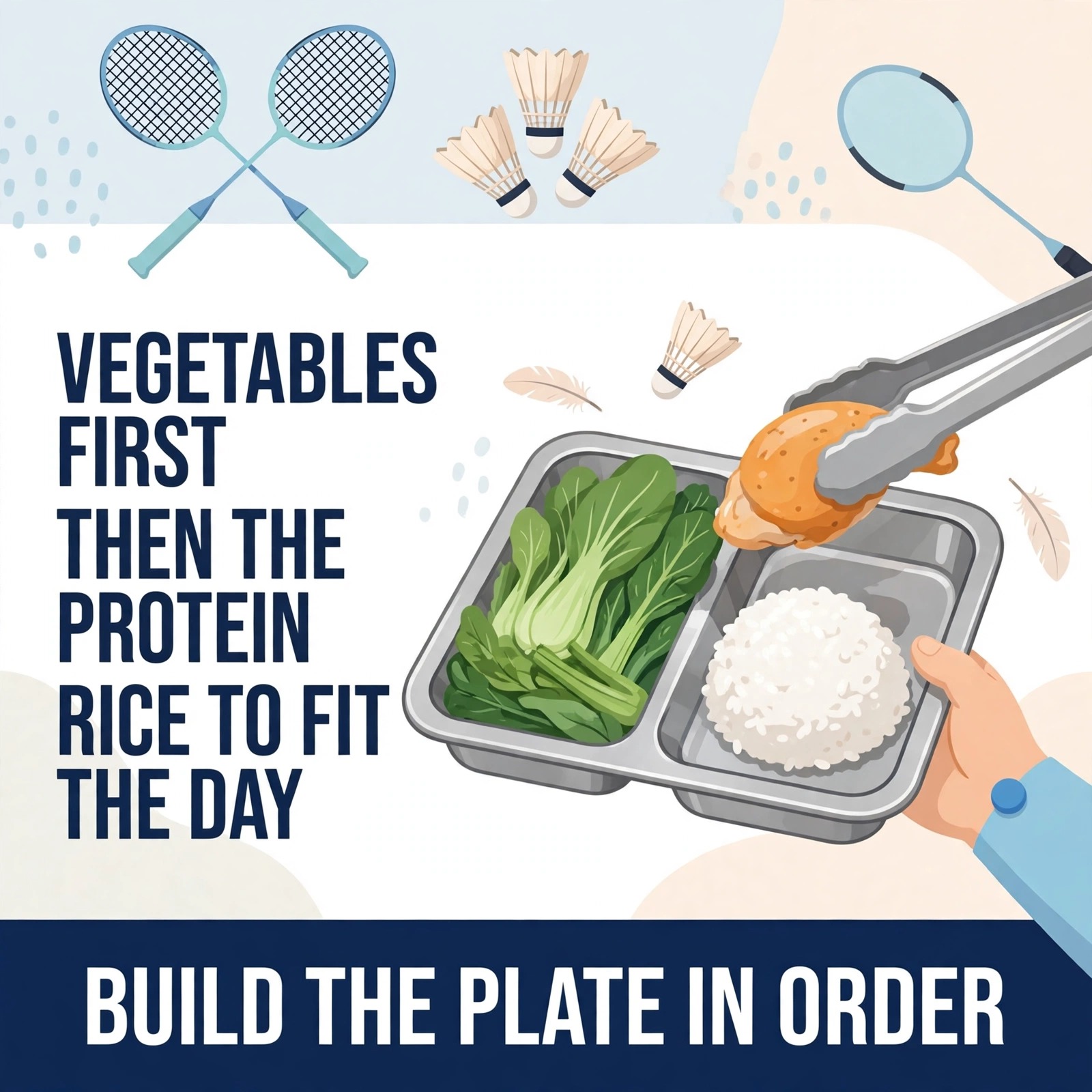
The balanced plate can be said in one breath: about half the plate vegetables and fruit, about a quarter rice or other staples, and about a quarter protein foods such as chicken, fish, eggs, tofu, tempeh or dhal. That is not a foreign formula. It is what a good economy rice tray already looks like when you choose it that way, and what a home dinner looks like when the vegetables are not an afterthought. Players do not need a new cuisine. They need the plate they already eat, arranged with a little intent.
Protein deserves a line of its own because players tend to save it all for after training. Spread it across the day instead: eggs, milk, yogurt or peanut butter at breakfast; chicken, fish or tofu at lunch; whatever the family eats at dinner. The body repairs and builds all day, not only in the hour after a session. Fats belong on the plate too: fish, eggs, nuts and cooking oils all carry jobs food needs done. The everyday question is balance, not banishment. Deep fried food at every meal crowds out everything else; deep fried food now and then is just lunch.
Colour is the easiest quality check ever invented. Different coloured vegetables and fruits across the week cover more ground than the same single vegetable every day, and fruit makes a better default sweet snack than biscuits: bananas, papaya, oranges and apples travel well and need no preparation. Where swaps are painless, take them: brown rice at home if the family likes it, wholemeal bread for the training bag, water instead of a sweet drink at one meal a day. Small swaps kept for months change more than strict weeks that collapse.

Plate Check #3
Hawker Centre Choices That Work for Players
Most players in Malaysia and Singapore eat out often, so the guide has to survive the hawker centre. It does. Chicken rice with extra vegetables works; economy rice built as two vegetables and one protein works better than most cafe salads; noodle soups, thosai, idli and fish soup all have their place. At the mamak, a nasi kandar plate is fine when the gravies are a flavouring rather than a flood. Two habits help everywhere: ask for less oil or less sugar where that is easy, the famous kopi kurang manis included, and look at the tray before you sit down. Half vegetables is visible at a glance.
The habits around hawker food matter as much as the choices. A heavy, oily meal in the last hour before training sits badly on court, so time the big meal earlier and let a banana, a bun or a boiled egg bridge the gap. Keep a snack in the training bag for afterwards, because the trip home past every food stall in the neighbourhood is a poor place to make decisions while hungry. Drinks follow the same pattern: water as the default, sweet drinks as an occasional treat rather than the fluid the whole day runs on.
Drinks are the other half of hawker eating. The default order that helps players most is the unglamorous one: plain water, Chinese tea without sugar, or barley water. Teh and kopi are part of life here; ordering them kurang manis keeps the pleasure and loses much of the sugar. Fresh coconut water after a hot session is a local gift. What deserves a firm limit is the pattern of a sweet drink at every meal plus another one at training: that is a lot of the day’s energy arriving with nothing else attached.

Plate Check #4
Drinking Enough: Water as a Daily Habit
Water is a daily habit before it is a match day topic. In our heat, a player who waits for strong thirst all day starts training already behind, and no bottle at the hall fully catches that up. The workable system is embarrassingly simple: a bottle you own, filled in the morning, carried to school or work, refilled when empty, and finished by the end of the day. Drink at meals, drink between them, and let pale urine be the rough sign that the habit is working.
Evening sessions expose a dry day quickly: heavy legs in the warm up, a headache arriving with the drills, cramps in long rallies. Many of those evenings trace back to a day of almost no water rather than to any fitness problem, though no drink fixes everything. Sweet drinks do not build the habit, and energy drinks have no place in a school bag. Water first, every day, is the whole rule. Players who keep it for a month usually stop needing to be reminded, because feeling normal at training is its own reward.
Make the habit easy to succeed at. A bottle around a litre suits most school and work bags; smaller bottles get forgotten because they are always empty, and enormous ones get left at home. Know your refill points: the school water cooler, the office pantry, the hall tap you trust. Some players keep a second bottle in the training bag so the day bottle can stay in the school bag. If plain water bores you, a slice of lemon or a few mint leaves changes it without turning it into a sweet drink. Systems beat intentions, here as everywhere.
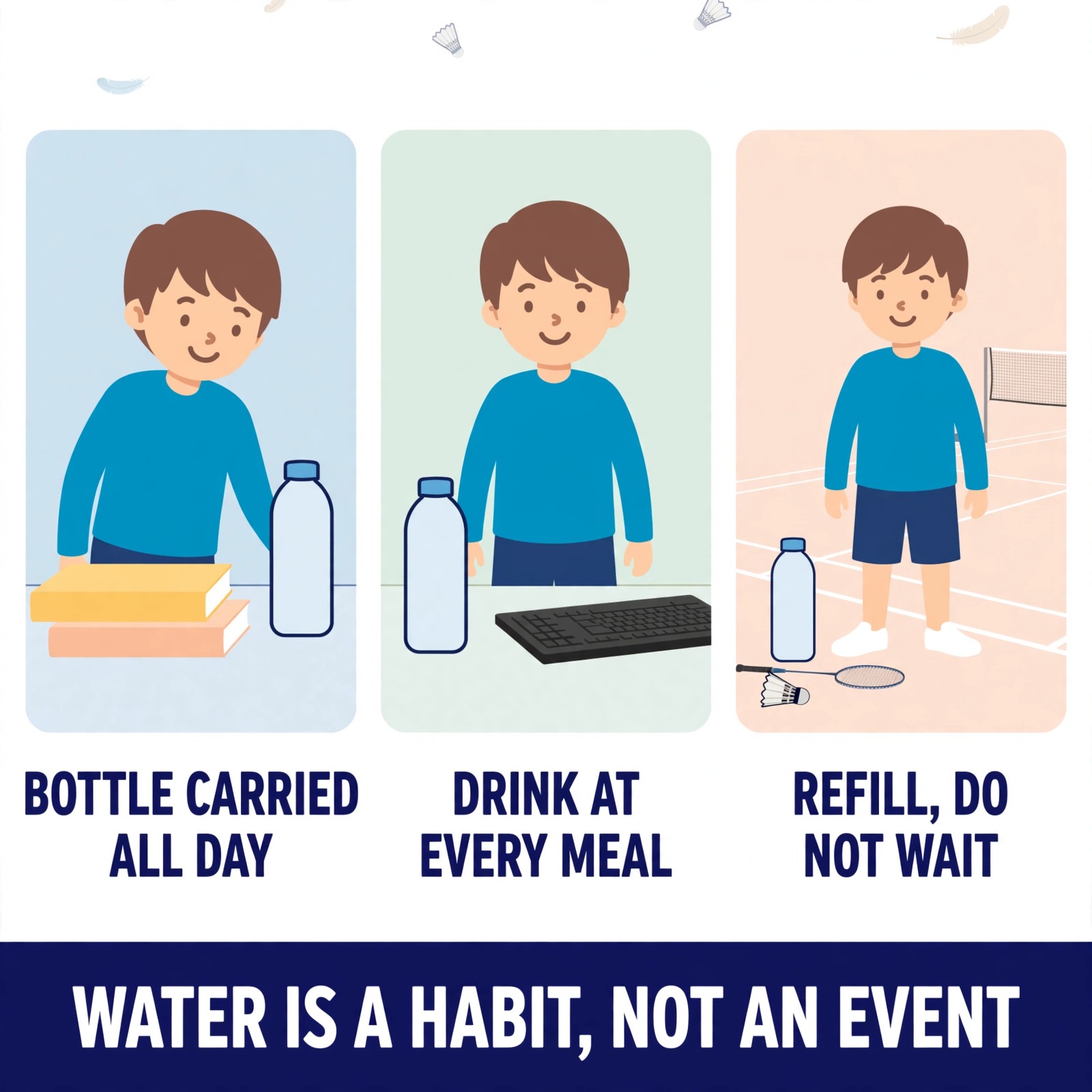
Plate Check #5
How Good Eating Fits a Training Week
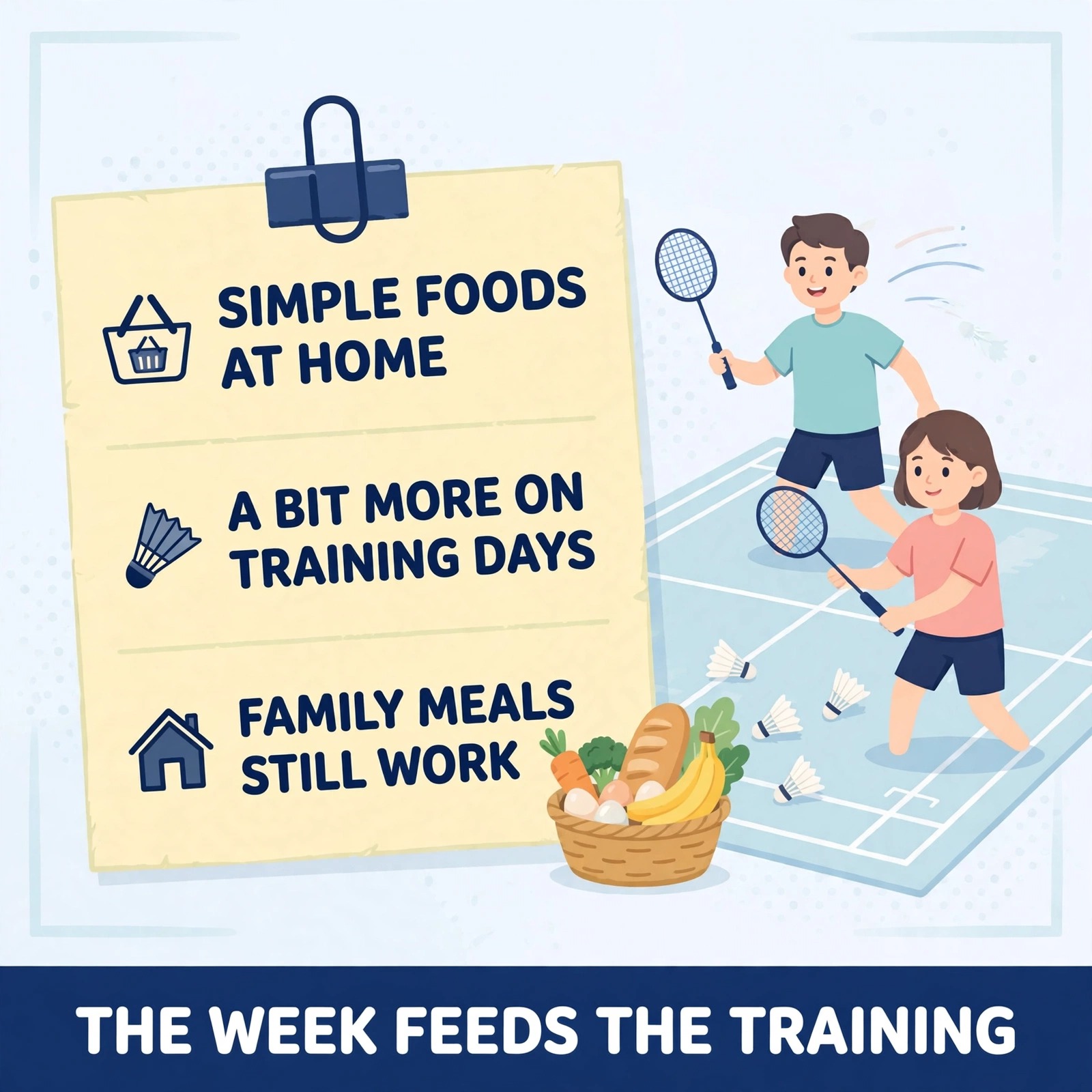
A training week has a rhythm and eating can follow it. A little simple preparation makes good choices the easy choices: eggs, fruit, bread, rice and frozen vegetables in the house; a snack permanently living in the training bag; leftovers from dinner becoming tomorrow’s lunch. On heavy training days, eat a bit more around the session, a snack before and a proper meal after. On rest days, eat normally and let the body get on with repairs. Nothing in this paragraph requires a spreadsheet. It requires a stocked shelf and a bag that is packed before the rush.
Family meals deserve a defence, because players sometimes imagine they need a separate athlete menu cooked apart from everyone else. They do not. The family dinner plus small adjustments covers almost every player: an extra serving of vegetables, a second helping of rice on a heavy training day, an egg added at breakfast. Eating together is also how habits survive; a special menu lasts a week, while the family table lasts for years. Parents of juniors can relax: feed the family well and the player is fed.
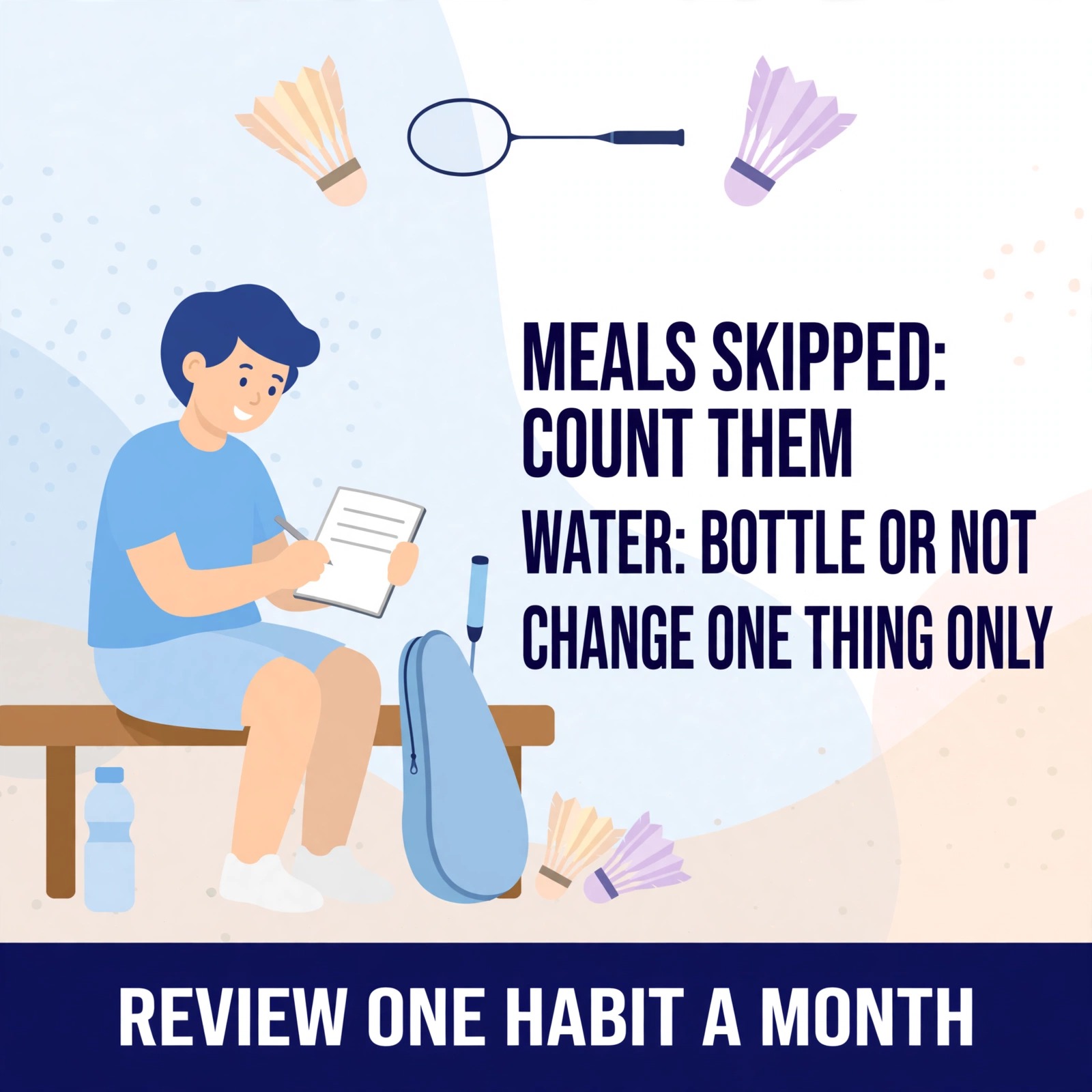
Review the pattern monthly, the same way you would review anything you train. Three questions are enough. How many meals were skipped this week? Did the water bottle travel every day? What lived in the training bag? Adjust one answer at a time and give it a month. Players often cannot feel their own pattern because they live inside it; a coach watching energy rise and fall across sessions usually can. Bring the answers to training and the adjustment is usually small, local and easy to keep.
Myth vs Reality
Myths About Eating for Badminton
Myth one: badminton players should cut rice and carbohydrates to stay light. Badminton runs on carbohydrate energy: the rallies, the jumps and the third game are all paid for by it. Rice is a perfectly good base for a player’s plate, and generations of strong players here have eaten it three times a day. What deserves attention is what sits with the rice and whether the total day balances. Cutting the fuel and then wondering why training feels heavy is a confusion, not a diet.
Myth two: eating right means expensive imported superfoods, protein powders and supplement stacks. Look at what actually covers a player’s needs: eggs, ikan kembung, tofu, tempeh, dhal, bananas, papaya, leafy greens, rice. The local market sells all of it, cheaply, every day of the week. Supplements cannot replace meals, and money is almost always better spent on coaching, court shoes and shuttles. If a product promises to do the job of breakfast, it is selling you the one thing breakfast already does.
The honest summary is that eating right for badminton is mostly unglamorous: regular meals, a plate arranged half, quarter, quarter, protein spread across the day, fruit and vegetables in real amounts, snacks packed on purpose, and water carried like equipment. None of it needs a strict diet, a imported shopping list or a miserable week. It needs small habits kept across a season, which is exactly how badminton itself improves. Players feel the difference first in ordinary evening training, long before any tournament.

Why Choose Us
Why Players Choose ST Badminton Academy
At ST Badminton Academy, everyday eating is coached as part of training habits, inside our small group sessions of four students or fewer. Coaches hear the real answers when they ask juniors what breakfast was, and the plate guide is explained in the same plain words used on this page, to players and parents together. Nobody is put on a strict diet. The work is a stocked bag, a carried bottle and meals that happen on time, checked the same way footwork is checked: kindly, and every week.
Head coach Eric Chuar leads the programme, with over 15 years of coaching experience across Singapore and Malaysia. Eric’s rule is that players should eat like players on ordinary days, not only on match days. He is realistic about hawker food because he eats it too; his advice is about choosing within the food culture players actually live in, not pretending they will cook steamed chicken alone at home. Fifteen years of evening sessions have taught him which flats are food, which are water, and which are sleep.
You will find us in Setapak, Kuala Lumpur, easy to reach from Wangsa Maju, Melati Utama, Danau Kota and Gombak. If your evening training keeps feeling heavier than it should, your junior trains hard but eats like a bird, or every day runs on snacks and sweet drinks, come and try a session with us. We will look at the ordinary week first, because that is where a player’s energy is actually built.
FAQs: Badminton Everyday Nutrition in Malaysia (KL)
Everyday eating raises practical questions about plates, rice, hawker food and snacks. Here are the answers we give most often.
Where can I learn everyday eating for badminton if I live in Setapak or Gombak?
With us, in Setapak. ST Badminton Academy is based in Setapak, Kuala Lumpur, and players travel in from Gombak, Wangsa Maju, Melati Utama and Danau Kota. Everyday eating habits are coached inside our regular small group sessions: the balanced plate in plain words, snacks for the training bag, and the water habit, explained to players and parents together.
What does a balanced plate look like for a badminton player in KL?
Picture the plate in parts: about half vegetables and fruit, about a quarter rice or other staples, and about a quarter protein foods like chicken, fish, eggs, tofu or dhal. An economy rice tray chosen that way is a balanced plate, and so is a home dinner with generous vegetables. No special shopping is required; arrangement is the skill.
How often should I eat across the day to keep energy at a steady level?
Three regular meals suit most players, with a snack fitted around training: something small before an evening session if lunch was early, and a proper meal after. Long gaps are the pattern to avoid, because energy and mood dip together. Exact clock times matter less than regularity; eat by routine, not by emergency.
Is rice really okay for badminton players, or should I cut it out?
Yes, rice is fine. Badminton is paid for in carbohydrate energy, and rice is the staple that provides it for most players here. The plate around it does the balancing: vegetables in real amounts, a protein food at every meal, and portions that grow a little on heavy training days. Players who cut rice cut their training quality with it.
What are good snacks between school, work and training?
Choose snacks that carry something: a banana, a boiled egg, a handful of nuts, a yogurt, a cheese or peanut butter sandwich, a plain bun. The winning move is packing them the night before, so the snack is in the bag between school or work and the hall, instead of whatever the nearest stall is selling to a hungry player.
Do you teach everyday nutrition habits to players near Wangsa Maju?
Yes. Our base is in Setapak, a short drive from Wangsa Maju, and everyday nutrition habits are part of our regular small group coaching rather than a separate course. We keep the advice local and practical: hawker choices, family meals and training bag snacks that a player in this neighbourhood can actually keep.
Does your academy help players plan meals around training in Malaysia?
Yes, in plain and practical form. We help players fit meals around school, work and session times: what a training day plate looks like, what to eat in the gap before an evening session, and what to keep in the bag for afterwards. The plan is built from foods the player already eats, adjusted rather than replaced.
Where does ST Badminton Academy coach badminton in Setapak?
At our home base in Setapak, Kuala Lumpur. Everyday habits, including eating and drinking, are coached inside regular badminton training with no more than four students in a group. Players come in from Wangsa Maju, Gombak and across the Klang Valley, and trial sessions can be arranged through the academy.
What makes Mr Eric Chuar a suitable coach for player nutrition habits in badminton?
Eric teaches eating the way he coaches footwork: plainly, locally and with an eye on what a player will actually keep doing. He works with the foods players already eat, at home, at school and at the hawker centre, and adjusts portions, timing and snacks rather than handing out strict diets. Fifteen years of evening sessions sit behind that judgement.
Badminton Everyday Nutrition in Action


One Standard for Every Player and Every Session
Hold your everyday eating to five standards. Meals happen at regular times, not by emergency. The plate runs half, quarter, quarter, at home and at the stall. Protein appears at every meal, not only after training. A snack lives in the training bag, packed the night before. And the water bottle travels every day. Review those five monthly and adjust one at a time. Steady plates build steady players.
| Factor | Random Eating | A Planned Player Plate PLATE |
|---|---|---|
| Frequency | 1 or 2 times a week. Mostly for fun and sweat. | Meals planned around training days, with rice, protein and vegetables at most sittings. |
| Drills Focus | Basic static feeding. Minimal footwork pressure. | Snacks chosen on purpose: fruit, eggs, yogurt and nuts instead of only fried items. |
| Physical Conditioning | Rarely included. Just playing games on court. | Core, agility, and speed training included in every session to prevent injury and build stamina. |
| Tactical Awareness | "Just hit it over." No real game plan. | Video analysis, point construction, and learning to read the opponent's game. |
| Coach Ratio | Large groups (8-10 kids). Coach barely watches you. | Max 4 students. Mr Eric Chuar personally corrects every stroke and movement detail. |
| Goal Setting | Fun and exercise. | Water carried all day in your own bottle, not just remembered at the hall. |
| Long Term Result | Good recreational player. | A player whose energy stays steady from the first drill to the last rally. |
Badminton Nutrition Coaching in Kuala Lumpur
Eating right is not a diet week; it is the ordinary background of a training life: regular meals, balanced local plates, planned snacks and water that travels. Build those habits and match day has something to run on. If you would like the habits coached alongside your badminton, train with us in Setapak. Bring your racket, your bottle and your questions. We will start with what breakfast looked like today.






