Badminton And Massage Therapy: Techniques For Muscle Recovery And Pain Relief (Recovery Guide)
Every badminton player knows the morning after a hard session: stiff calves, tight shoulders, a back that complains when you bend for your shoes. It is natural to look for something that fixes it fast, and massage is usually the first idea. This guide gives massage its proper place. It can help ease tight, sore muscles and help you relax, and for many players it is a pleasant part of a recovery routine. It is not a cure, it does not fix injuries, and it never replaces sleep, food and sensible training loads. Read on for what massage can and cannot do, the techniques you will meet, when to book, and the warning signs that mean you should see a doctor or physiotherapist instead. At ST Badminton Academy in Setapak, Kuala Lumpur, this is the honest version we teach our players.

Recovery Check #1
What Massage Can and Cannot Do
Massage is hands on work on the muscles and soft tissues: pressing, gliding and kneading with the hands, sometimes with oil, usually on a table. Players book it for a simple reason. After hard training, muscles feel tight and sore, and a good session can help them feel looser and more comfortable. Many players also find they relax properly during a session and sleep well that night. Those are real benefits, and they are enough. Massage earns its place in a recovery week by helping sore muscles feel easier and by giving a busy player one quiet hour that is only about looking after the body.
Now the limits, stated plainly. Massage does not cure injuries, repair torn tissue or fix pain that comes from a joint, a tendon or a trapped nerve. It does not make you injury proof, and it cannot cancel out a training load that is too heavy. If a page or a practitioner promises that massage will heal an injury, melt away all soreness or keep you safe from future problems, that is marketing, not medicine. Treat massage as support: it helps muscles feel better while the real recovery work, rest, sleep, food and graded training, does the heavy lifting underneath.

Recovery Check #2
The Techniques You Will Meet in a Session
Most sessions start with long gliding strokes along the muscle, often called effleurage in the textbooks. The strokes follow the length of the muscle, warm the area and let the therapist feel where the tight spots sit. Kneading comes next: the hands lift, squeeze and roll the muscle slowly, a bit like working dough. For badminton players the usual targets are the calves, the front and back of the thighs, the shoulders and the back, the muscles that lunges, jumps and overhead shots load the hardest.
Deeper work uses slower, firmer pressure on smaller areas, sometimes with the thumbs, knuckles or an elbow, and sometimes holding one tender spot while you breathe out. This is the part players describe as good pain: strong, but bearable, and it eases when the therapist backs off. The line is simple. Pressure should never make you clench your fists, hold your breath or count the seconds. If it does, it is too much for that day, whatever you booked. Firm is a choice, painful is a warning.
A session goes better when you talk. At the start, say which muscles feel tight, mention any knocks or sore spots, and say clearly if you have a match coming up. During the session, use a simple scale from one to ten and ask for less pressure the moment you pass seven. A good therapist expects this feedback and adjusts without taking offence. If you feel sharp pain, numbness or pins and needles at any point, say so at once and that work stops. Your body, your call, every single time.

Recovery Check #3
Timing: When to Book Around Training
Timing decides whether massage helps or gets in the way. Deep work in the day or two before an important match is a poor plan for most players: muscles can feel heavy, loose or slightly sore afterwards, and match day is the wrong day to discover that. A light, short session close to a match, aimed at easing general tightness, suits some players well, but only if you have tried it before an ordinary training day first. Nothing new before a big match: that rule covers food, shoes and massage alike.
The best slots are the quiet corners of the week. The evening after a hard training session works well for many players, when the work is done and an easy day follows. A rest day is even better, because the body gets the session and the recovery in one package. If you play in a weekend tournament, save any deeper work for after the last match, not between rounds. Between matches, your tools are food, water, shade, a gentle walk and maybe a light stretch, all things you control yourself.
How often is often enough? For most social and club players, a session every two to four weeks is plenty, matched to how hard the training block feels. In a heavy month you might go a little more often; in a light month, not at all. Daily massage is neither needed nor sensible for healthy players, and a therapist who insists you must come several times a week to stay safe is selling, not treating. Let your legs vote: if warm ups feel easier and soreness settles faster, the rhythm is right.

Recovery Check #4
Warning Signs: When Massage Is Not the Answer
Some problems are not massage problems. Book a doctor or a physiotherapist instead if you notice any of these: sharp or shooting pain, pain in a joint rather than the muscle belly, swelling, bruising that appears after a knock or a fall, numbness or pins and needles, a muscle that suddenly feels weak, or pain after a clear incident like a twist, a pop or a tear feeling. These signs can point to injury, and injury needs assessment first. Massage can come later, once a professional has told you it is safe.
Pain that stays beyond a few days, keeps returning in the same spot, or slowly gets worse across the weeks also deserves a proper check. It is easy to keep booking massage for a problem that massage cannot solve, and months can pass that way. A physiotherapist can test the area, explain what is going on and give you exercises that load the tissue in the right way. That is treatment. Massage sits beside treatment as comfort and support, and honest practitioners will tell you the same.
Even in a normal session, keep your guard up. A fresh injury, less than a couple of days old, should not get deep pressure; the area is still settling and strong work can make it angrier. Bruised skin, rashes and open cuts are no go areas too. Feeling a bit tender the day after deep work is common and usually settles within a day or two, but pain that is worse than the soreness you arrived with is feedback to share before any next session. Choose clean, professional premises and a therapist who asks about your health before starting.

Recovery Check #5
How Massage Fits a Recovery Week
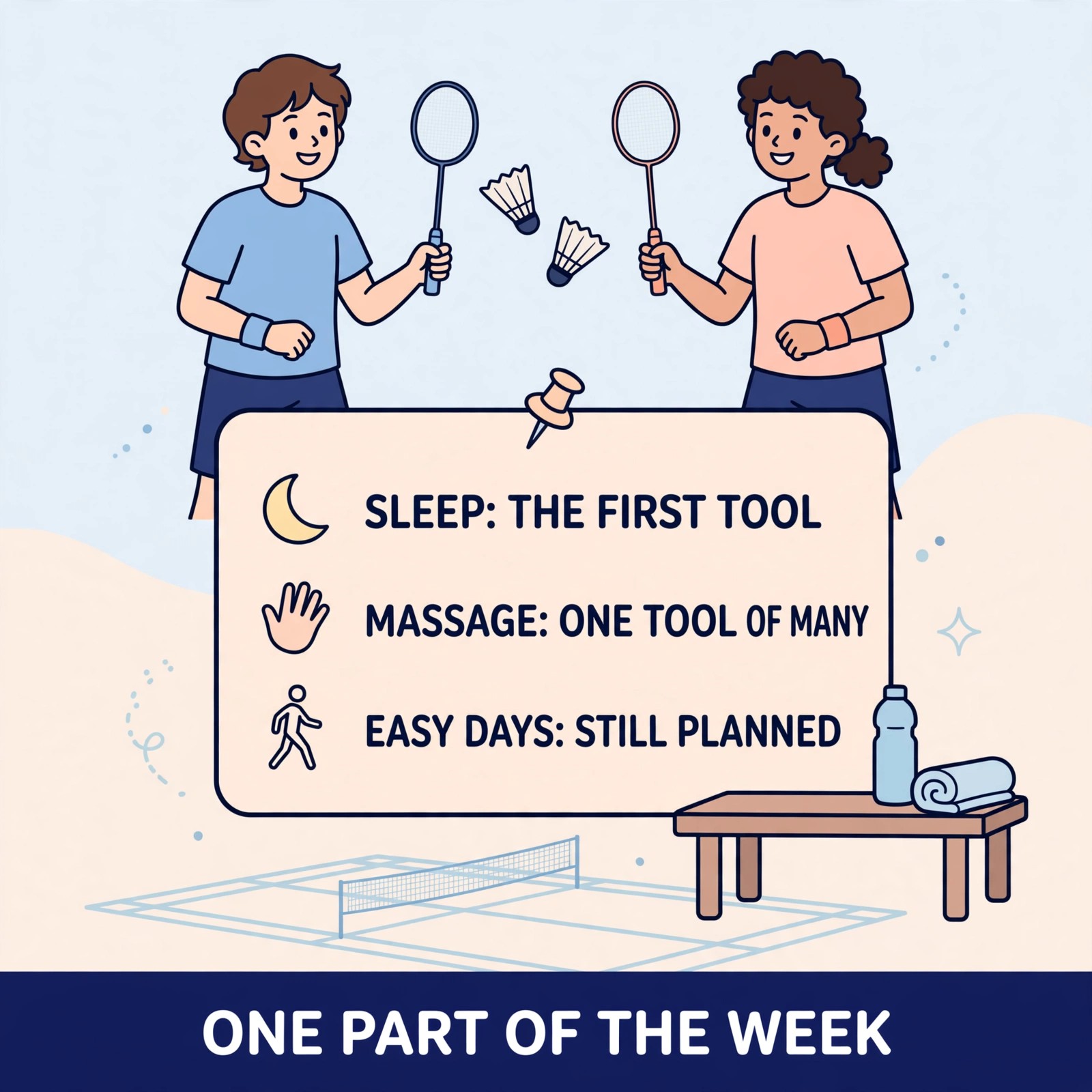
Look at a full recovery week and massage is one line in it, not the headline. Sleep comes first: most of the repair your body does happens overnight, and players who sleep badly feel it in their legs before they feel it anywhere else. Food and water come next, ordinary meals eaten steadily, not skipped and then replaced with a huge one. Easy movement belongs in the week too: a walk, a gentle cycle, light mobility work on the days between hard sessions. Massage then adds its part on top of a base that already works.
Gentle stretching and sensible training loads complete the picture. A few calm minutes of stretching after sessions keeps the main badminton muscles moving through their full range, and it costs nothing. Loads matter most of all: sore muscles that never get a lighter day are telling you the plan, not the massage table, needs adjusting. When we coach at ST Badminton Academy, we would rather fix the week than sell you a remedy for it. Get the base right and massage becomes what it should be: a pleasant extra that helps you feel ready, not a rescue you depend on.
You can judge all of this yourself with two simple checks. First, the warm up test: across a month of planned recovery, do your legs feel ready sooner in the warm up than they used to? Second, the stairs test: does the morning after training feel easier on the stairs than it did last month? Write the answers in a notebook once a week. If both answers improve, your recovery plan, massage included, is doing its job. If nothing changes, change the plan, starting with sleep and load, before you change the therapist.
Myth vs Reality
Myths About Massage for Players
Myth one: deeper is always better. It is not. Muscles are not clay, and forcing them harder does not fix them faster. Very deep pressure can leave you bruised and sorer than you arrived, and the players who improve are usually the ones whose sessions stay strong but comfortable. The best pressure is the most you can relax into, not the most you can survive.
Myth two: massage fixes injuries and removes all soreness. Massage can help sore muscles feel easier, but it does not repair torn fibres, settle an angry joint or cure pain that comes back every week. Some soreness after a hard block of training is normal and fades with rest. A guide or therapist who promises to remove it all, forever, is promising something no hands can deliver.
The reality is quieter and more useful. Massage is skilled, pleasant support for muscles that work hard. It helps many players feel looser, calmer and readier, especially when it sits inside a week that already has sleep, food, easy days and honest training loads. Book it for those reasons, with those expectations, and it will rarely disappoint you. Expect miracles and it will, every time.

Why Choose Us
Why Players Choose ST Badminton Academy
Recovery is part of training at ST Badminton Academy, not an afterthought. Our groups stay small, with a maximum of four students per group, so the coach sees how every player is moving, not just how they are hitting. When a player arrives stiff and tired for the third session in a row, that is coaching information, and we adjust the session instead of pushing through and hoping.
We also teach the honest version of every recovery tool. Players learn what stretching, sleep, food and massage can each do, and where each one stops. That matters for juniors especially: a young player who understands that rest is part of getting better will still be playing, and improving, years from now. No shortcuts are sold here, and no miracle is promised. Just structured sessions, clear feedback and steady progress.
Our base is Setapak in Kuala Lumpur, and our players come from across the city, including Wangsa Maju and Gombak. Sessions run for kids, teens and adults, from first timers holding a racket to league players sharpening their game. Whichever level you are at, the standard is the same: train hard on the hard days, recover properly on the easy ones, and ask questions whenever something hurts or feels wrong.
FAQs: Badminton Massage and Recovery in Malaysia (KL)
These are the questions players and parents ask us most about massage and recovery. The short version runs through all of them: massage is useful support, it is not treatment, and pain that behaves like an injury deserves a professional check first. For anything about your own body that worries you, ask a doctor or physiotherapist. They are the right people for diagnosis.
Where can I get honest advice on massage and recovery for badminton if I live in Setapak or Gombak?
You can start right here at ST Badminton Academy in Setapak, where recovery advice is part of normal coaching and costs you nothing extra. We will tell you honestly when massage is a good idea, when rest alone is enough, and when a physiotherapist should look at the problem instead. Players from Gombak train with us as well.
How does massage fit into a badminton training week in KL?
Think of massage as one line in the week, booked on a rest day or after a hard session, never as the plan itself. Sleep, food, water and easy days do most recovery work. In Kuala Lumpur the heat adds sweat losses, so fluids matter even more here. Massage then tops the week up.
How often should I book a massage if I play at a social level?
For most social players, once every two to four weeks is plenty, and some months you may not need one at all. Book when tightness keeps returning after normal rest, not by a fixed rule. If a therapist says you must come several times a week to stay healthy, treat that as a sales line.
Can I get a massage on the same day as a match, or is the day before better?
The day before is safer than the same day, and light pressure is safer than deep work. A deep session can leave muscles heavy or tender for a day, which is a bad surprise on match day. If you have never had a massage before a match, test the timing before an ordinary training session first.
How do I know if the pressure is too deep, and when should I speak up?
Use a simple scale from one to ten. Good pressure sits around five to seven: strong, but you can breathe and relax into it. Speak up the moment you are clenching, holding your breath or feeling sharp pain. A good therapist will ease off at once and will not be offended. It is your body and your call.
Do you teach recovery habits to badminton players near Wangsa Maju?
Yes. Recovery habits are taught inside normal sessions at our Setapak base, a short drive from Wangsa Maju. Players learn how to plan hard and easy days, stretch properly, sleep and eat like athletes, and use massage sensibly. Parents of juniors get the same plain advice, so the habits continue at home between sessions.
Does your academy help young players look after sore muscles in Malaysia?
Yes, and we keep it simple and safe for young players. Juniors learn warm ups, gentle stretching, rest days and why sleep matters more than any treatment. We do not send kids for deep massage. If a young player has pain that lasts, we tell parents to see a doctor or physiotherapist for a proper check.
Where does ST Badminton Academy coach badminton in Setapak?
We coach at our base in Setapak, Kuala Lumpur, with small groups of no more than four students so every player gets seen and corrected. Sessions run for children, teenagers and adults, across the week. Setapak is easy to reach from Wangsa Maju, Gombak and the city centre, and trial sessions can be arranged through our WhatsApp line.
What makes Mr Eric Chuar a suitable coach for recovery planning in badminton?
Mr Eric Chuar has coached badminton in Malaysia for more than fifteen years and plans training loads the way he plans technique: carefully, and player by player. He teaches recovery as part of the sport, gives honest limits for every tool, and refers players to medical professionals when a problem is beyond coaching. That honesty is the point.
Badminton Massage and Recovery in Action



One Standard for Every Player and Every Session
Our standard for recovery advice is the same as our standard for technique: say what a tool does, say what it does not do, and never dress up a guess as a fact. Players at this academy get plans they can check against their own bodies, week by week. If something we teach stops working for you, we change the plan, not the story.
| Factor | Random Rest | A Planned Recovery Week RECOVERY |
|---|---|---|
| Frequency | 1 or 2 times a week. Mostly for fun and sweat. | Hard days and easy days planned together, so the body knows when to rebuild. |
| Drills Focus | Basic static feeding. Minimal footwork pressure. | Sleep, gentle movement and stretching treated as training, not leftovers. |
| Physical Conditioning | Rarely included. Just playing games on court. | Core, agility, and speed training included in every session to prevent injury and build stamina. |
| Tactical Awareness | "Just hit it over." No real game plan. | Video analysis, point construction, and learning to read the opponent's game. |
| Coach Ratio | Large groups (8-10 kids). Coach barely watches you. | Max 4 students. Mr Eric Chuar personally corrects every stroke and movement detail. |
| Goal Setting | Fun and exercise. | Massage booked on rest days, with honest pressure and honest expectations. |
| Long Term Result | Good recreational player. | A player who arrives at the next session fresh instead of carrying last week along. |
Badminton Recovery Coaching in Kuala Lumpur
Sore muscles are part of a sport worth playing, and looking after them is a skill you can learn like any other. Start with sleep, food and sensible loads, add massage where it helps, and get proper checks for anything that behaves like an injury. Come and train with us in Setapak, and we will build your recovery habits along with your game, one honest session at a time.






