Badminton And Flexibility: Stretching And Mobility Exercises (Flexibility Guide)
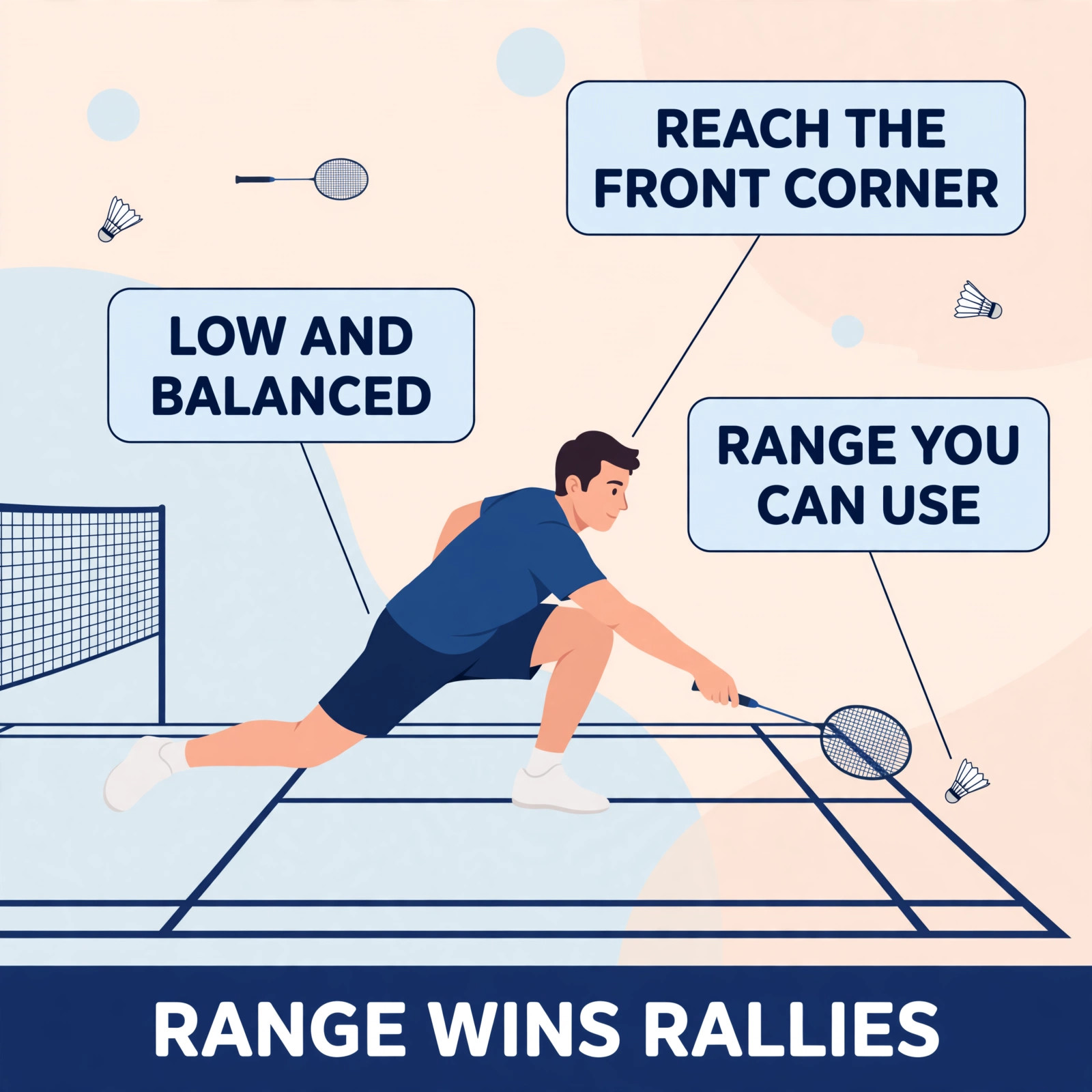
Watch a good player reach a shot at the front corner and you are watching flexibility at work. The lunge is deep, the back stays tall, the racket arm reaches long, and the recovery step is already happening. None of that is strength alone. It is range: ankles that bend, hips that open, a spine that turns, shoulders that reach overhead without complaint. Badminton asks for more range than most sports, in more directions, at speed. This guide covers flexibility and mobility the way we teach them at ST Badminton Academy in Setapak, Kuala Lumpur: what to move, what to hold, when to do each, and how range turns into shots.
Flexibility Check #1
Why Badminton Needs Real Range
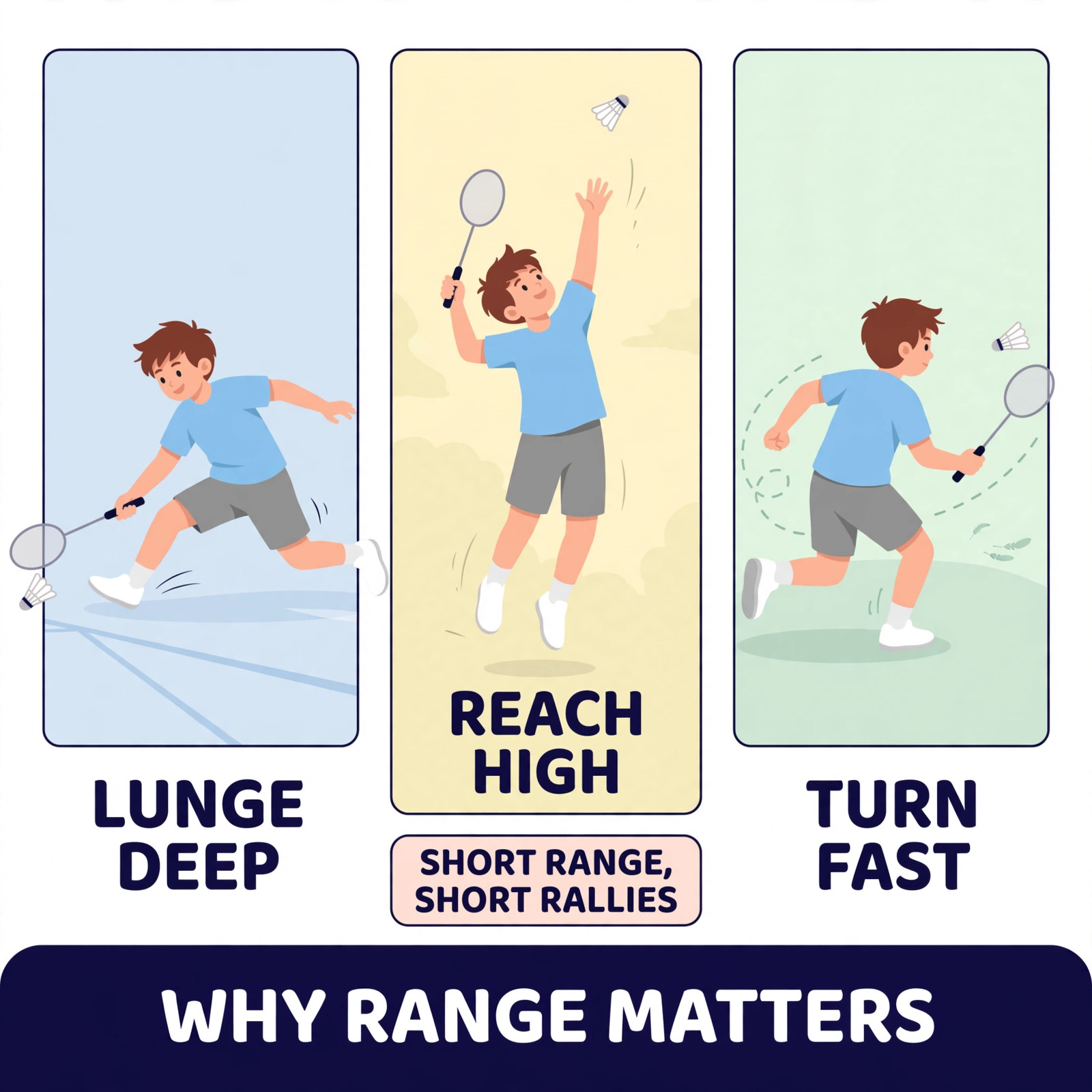
Start with the front court. A proper lunge needs the front ankle to bend deeply, the hip of the trailing leg to open, and the trunk to stay upright while the racket reaches far in front of the body. Lose any one of those and the shot changes: the lunge gets shallow, the net shot sits up, or the player falls into the corner and recovers late. Range at the front is not decoration. It is the difference between playing the shuttle and chasing it, and between a tight spinning net shot and a hopeful lift.
The rear court asks for a different range. Clears and smashes need the shoulder to reach high and rotate freely, the chest to open, and the spine to turn as the body rotates into the shot. Players with stiff shoulders muscle their overheads with the arm alone, and the arm pays for it before long. Add the side to side game, where hips and ankles decide how low and how wide you can defend, and the picture is complete: badminton flexibility is a full body map, and every corner of the court reads one part of it.
Flexibility Check #2
Warm Up Moving, Stretch After
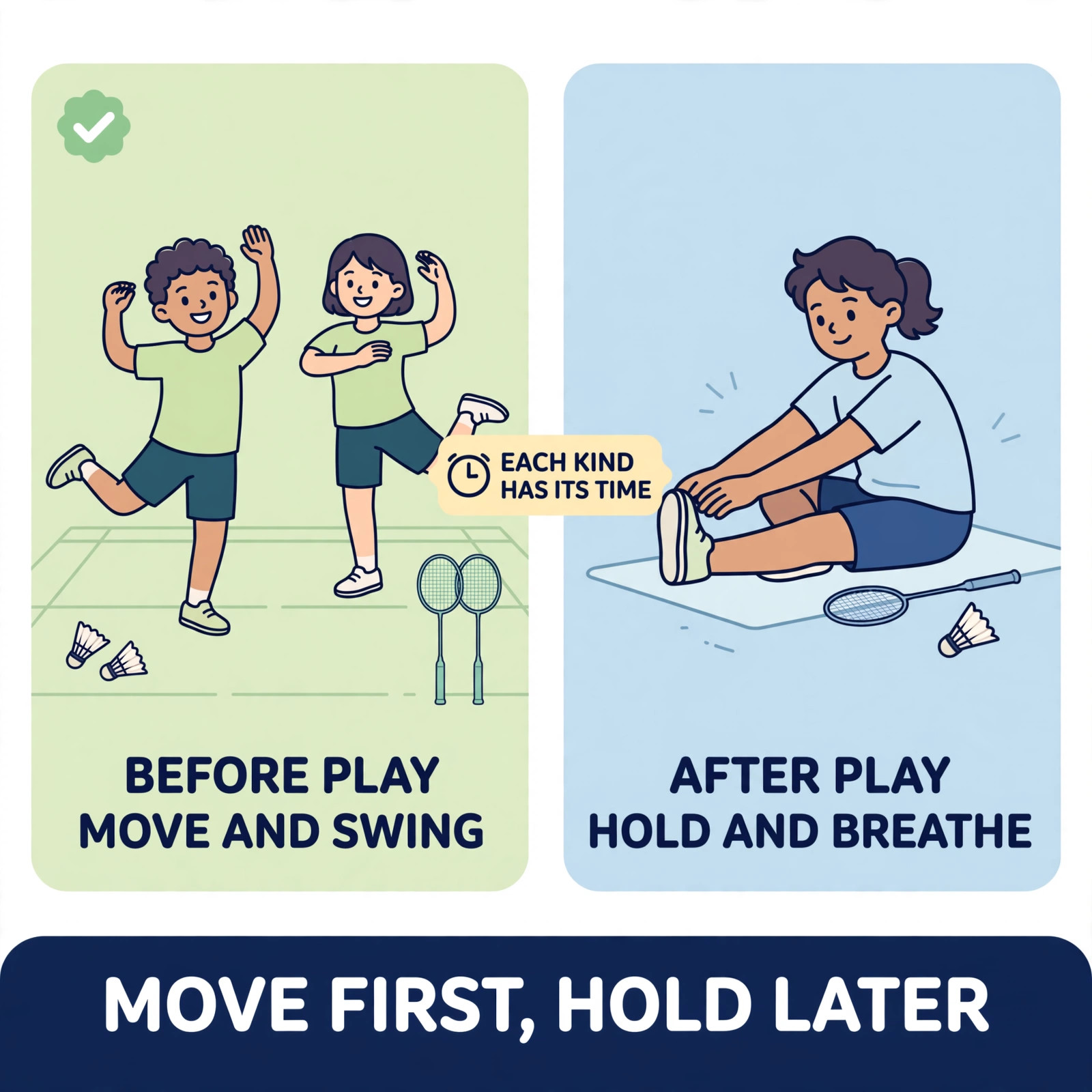
Order matters more than effort. Before play, muscles are cold and the body is sleepy; long, still stretches at that moment can temporarily blunt the power you are about to ask for, and they do nothing to prepare you for speed. So the warm-up is dynamic: movements that swing, rotate and reach through a growing range while the temperature rises. Leg swings, arm circles, walking lunges, shadow footwork. Ten minutes of moving well tells the body what is coming far better than ten minutes of sitting in a stretch.
After play, the job changes. The muscles are warm, the session is done, and now the long, quiet holds earn their place. Static stretching after training, held gently for twenty to thirty seconds per position, is where range is slowly built and kept. This is also the moment the body is most willing to accept it. Players who stretch only before training have the habit exactly backwards: they hold when the body wants motion, and skip the holds when the body would actually use them. Swap the order and the same ten minutes buys far more.
Between those two sits mobility work, which players often confuse with stretching. Stretching lengthens a muscle. Mobility trains a joint to move through its range with control: ankle rocks, hip circles, thoracic rotations, shoulder circles done slowly and owned at every angle. Badminton needs both, because a joint that can be pushed into a position is not the same as a joint that can play from that position. Mobility is the bridge between loose and useful, and it belongs in warm-ups and on rest days, in small daily doses.
Flexibility Check #3
The Joints That Decide Your Range
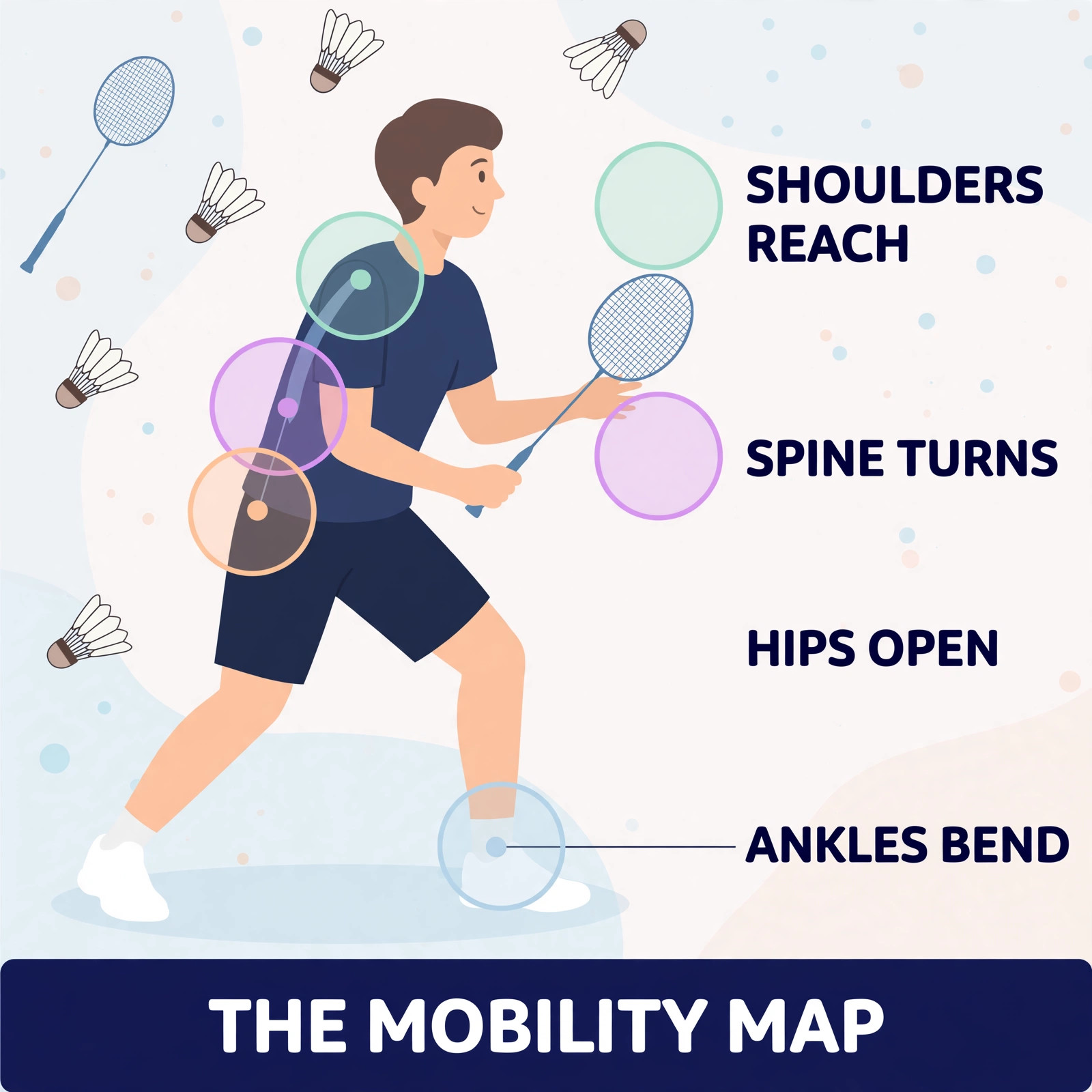
Ankles first, because everything stands on them. A deep lunge and a low defensive crouch both need the ankle to bend so the knee can travel forward over the toes. Stiff ankles push the work upward: the knee takes angles it dislikes, or the heel lifts and the lunge loses its base. Simple tests tell the truth: can you keep your heel down in a deep crouch? Ankle rocks against a wall, a few slow ones daily, are the quiet fix we give most often.
Hips decide the shape of your game. Open hips let the trailing leg extend in the lunge, let you sit low in defence without rounding your back, and let you turn to the rear corners without twisting the knee. Desk days shorten the hip flexors, and shortened hip flexors are the most common range problem we see in adult players. The spine and shoulders finish the map: a spine that rotates feeds the overhead shots, and shoulders that reach and rotate freely keep clears long and smashes honest. Four areas, checked honestly, cover nearly every range problem on a badminton court.
A word on honesty about range: bodies differ. Some players are naturally loose, others are built tighter, and both can play excellent badminton. The goal is not the range of a gymnast. The goal is the range your shots need, plus a small margin, owned with control. Chasing extreme positions you will never use on court wastes the minutes that the useful positions needed. Test the four areas, find your stiffest link, and spend your flexibility minutes there. Range work aimed at your actual limits improves your game; range work copied from someone else mostly improves your patience.
Flexibility Check #4
The Stretches Badminton Actually Needs
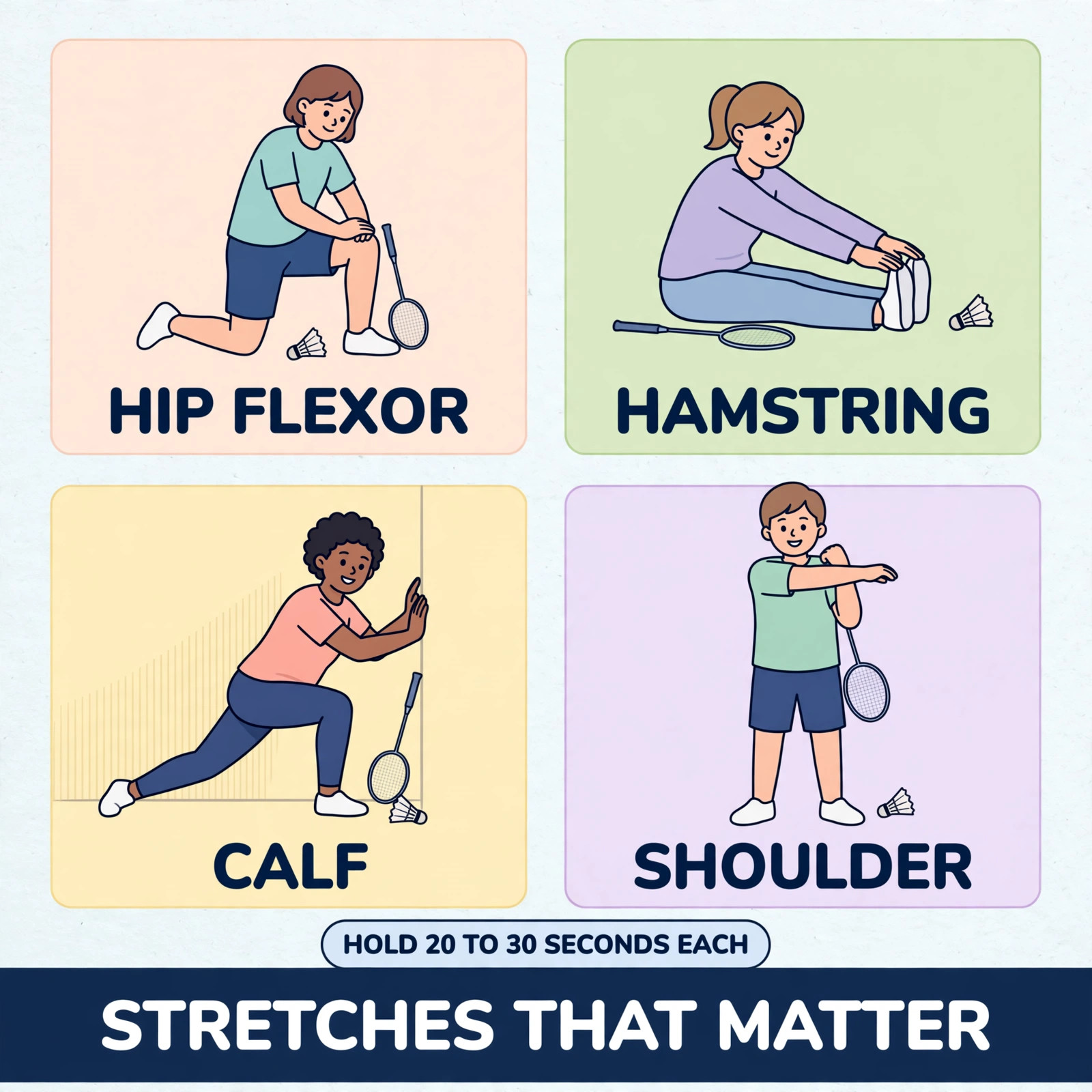
The kneeling hip flexor stretch is the highest value stretch in badminton. Kneel on one knee, tuck the pelvis slightly, and lean forward gently until the front of the hip and thigh stretch. Twenty to thirty seconds, both sides, after every session. The standing quad stretch and the seated hamstring stretch cover the front and back of the thigh that lunging loads. For calves, lean into a wall with the back heel pressed down, in both straight knee and bent knee versions, because the calf works in both shapes during a rally.
The shoulder series is simple and non negotiable for players who hit overheads. Pull one arm gently across the chest for the back of the shoulder. Use a towel or the racket behind the back to open the chest and the front of the shoulder. Circle the arms slowly through the biggest comfortable range, both directions. The forearm and wrist, which handle every grip change and net shot, get a gentle stretch too: palm up, fingers drawn back softly. Shoulders and forearms are small muscles with a huge workload; two minutes of care is a fair trade.
Technique for stretching is mostly restraint. Take the position to the first clear feeling of stretch, not to pain. Hold still, breathe out slowly, and let the range grow by millimetres over weeks, not by force today. Never bounce in a held stretch, and never let a partner push you deeper. Cold muscles get gentle treatment: if you stretch away from training, warm up with a few minutes of easy movement first. Flexibility is built the way rallies are won: patiently, repeatedly, and well within control.
The Routine
Making Flexibility a Weekly Habit
Range without strength is a loan you repay in injuries. A joint that travels far needs muscles that can control the whole range: slow the movement down, hold the end positions, and own the way back. This is why our flexibility work always arrives with its partner: core holds like the plank for the trunk that lunges lean on, slow controlled lunges and single leg balance for the legs, and light band work for the small shoulder muscles that keep the joint centred while it reaches. Supple and strong is the target. Either one alone is half a player.
The core deserves its own paragraph because players misread it. A strong trunk is what lets the hips and shoulders do their flexible work without the lower back stealing the movement. When the trunk is lazy, the back bends where the hips should open, and stretches feel like back strain instead of hip freedom. Planks, side planks and dead bug patterns, done slowly a few times a week, protect every stretch in this guide. Strength is not the opposite of flexibility. It is the frame the flexibility hangs on.
Put together, a badminton flexibility week is simple. Dynamic movement before every session. Ten minutes of held stretches after it. A few minutes of mobility on rest days, aimed at your stiffest link. Strength through the range twice a week. None of it is heroic, and all of it compounds. Players usually feel the first change not in a stretch but in a rally: a lunge that arrives balanced, a clear that leaves without effort, a third game where the corners still feel close. That is range paying rent.

Myth vs Reality
Myths About Badminton Stretching
Myth: “Long static holds before a match prepare the body.” Reality: long holds on cold muscles can temporarily blunt power and do not prepare speed at all. Warm up by moving through growing ranges. Save the holds for afterwards, when they build range instead of borrowing it.
Myth: “Flexibility is for juniors; adults are just stiff.” Reality: adult range responds to regular gentle work at any age, and adult players often need it more, because desks shorten what training lengthens. Myth: “Stretching prevents injuries, full stop.” Reality: sensible flexibility work can lower risk as part of a bigger picture of load, strength and rest. It is a contributor, not a guarantee.
Myth: “Push through pain; pain means it is working.” Reality: pain in a stretch is a stop signal, especially sharp pain or pain inside a joint. Range grows from weeks of tolerable holds, not from one brave session. Myth: “Flexible players do not need strength work.” Reality: range you cannot control is range you cannot use at speed.

Why Choose Us
Flexibility Coaching for Badminton Players
At ST Badminton Academy KL, flexibility and mobility are coached inside small group classes capped at max 4 students. Warm-ups and cool-downs are not filler at the edges of our sessions; they are taught, watched and corrected like any shot. In a group of four, the coach sees whose hips are limiting the lunge and whose shoulders are limiting the clear, and sets the range work to match.
Mr Eric Chuar has over 15 years of coaching experience in Singapore and Malaysia. His flexibility rule is plain: move first, hold later, and never force. He reads the range of a player the way he reads a rally, looking for the stiffest link in the chain, and he builds the routine around that link rather than around a poster of stretches.
Our academy is based in Setapak, Kuala Lumpur, convenient for players from Wangsa Maju, Melati Utama, Danau Kota and Gombak. If corners feel further away than they used to, or your overhead shots cost more every month, bring the problem to a session. We will test your four areas honestly and build the routine your game actually needs.
FAQs: Flexibility and Stretching in Malaysia (KL)
These are the questions players ask us most about flexibility and stretching in Malaysia. If your question is not here, message us, tell us which corner or shot feels restricted, and we will give you a straight answer about where to start.
How can I improve my badminton flexibility if I live in Setapak or Gombak?
Start with the hip flexors. Sitting all day shortens the front of the hip; badminton then asks that same hip to open fully in every lunge. The kneeling hip flexor stretch after sessions, plus dynamic leg swings before them, is the pair we prescribe most. In our Setapak classes we check your four areas and set your order.
What matters most in badminton flexibility and mobility in KL?
The order, and your stiffest link. Dynamic movement before play, held stretches after, and mobility minutes aimed at the joint that limits you: ankles, hips, spine or shoulders. Most players do not need more stretching. They need the right stretching, in the right order, at the tightest link in their own chain.
How many minutes a week should I stretch to reach a good level?
Ten minutes after every session covers it for most players: hip flexors, quads, hamstrings, calves and shoulders, twenty to thirty seconds each. Add a few mobility minutes on rest days aimed at your stiffest area. In our classes the cool-down is coached, so the ten minutes are spent on the stretches your game actually needs.
I sit all day at a desk and my hips feel locked. Where do I start?
Desk hips respond well to consistency: leg swings and walking lunges in every warm-up, the kneeling hip flexor stretch after every session, and standing up to move through the day when you can. Most players feel the lunge open up inside a few weeks. Bring your stiffest link to a session and we will build the order with you.
Which stretches should I do right after a match?
The cool-down set: kneeling hip flexor, standing quad, seated hamstring, calf against the wall, and the shoulder across the chest, twenty to thirty seconds each, breathing out slowly. Ten quiet minutes. In matches, that set is the difference between arriving tomorrow loose or arriving tomorrow already behind.
Do you coach flexibility and mobility work in classes near Wangsa Maju?
Yes. Flexibility and mobility work is built into regular group classes at our Setapak base, a short trip from Wangsa Maju. Warm-ups, cool-downs and range work are coached in small groups of max 4 students, matched to the corners and shots each player is chasing.
Can the academy help our players prepare for a school competition in Malaysia?
Yes. We prepare the range, warm-up and cool-down routines of players for the events they enter, and we are honest about timelines: range grows over weeks, so start early. Our players rehearse the full routine in training, in small groups, so event day uses a routine the body already knows well.
Where is ST Badminton Academy KL located for flexibility training?
We are based in Setapak, Kuala Lumpur, close to Wangsa Maju, Melati Utama, Danau Kota and Gombak. Sessions run in small groups of max 4 students. Message us for the current class schedule and we will place you in a group at your level.
What does Mr Eric Chuar teach about mobility in badminton?
Fifteen years of coaching in Singapore and Malaysia, with a simple order of work: dynamic first, held stretches after, strength through the range always. Eric finds the stiffest link in the chain of a player, hips, ankles, spine or shoulders, and builds the routine around it inside small groups.
Badminton Flexibility Training in Action


What It Takes to Move Freely
A player meets our flexibility standard when five habits hold: the warm-up is dynamic and never skipped, held stretches happen after sessions for ten quiet minutes, the four areas, ankles, hips, spine and shoulders, are checked honestly, pain in a stretch is treated as a stop signal, and strength work keeps the new range controlled. When those five hold, range becomes a weapon.
| Factor | Stiff and Hoping | Moves With Range RANGE |
|---|---|---|
| Frequency | 1 or 2 times a week. Mostly for fun and sweat. | Before play, the warm-up is dynamic: leg swings, arm circles and shadow footwork that grow in range. |
| Drills Focus | Basic static feeding. Minimal footwork pressure. | After play, ten quiet minutes of held stretches cover hips, hamstrings, calves and shoulders. |
| Physical Conditioning | Rarely included. Just playing games on court. | Core, agility, and speed training included in every session to prevent injury and build stamina. |
| Tactical Awareness | "Just hit it over." No real game plan. | Video analysis, point construction, and learning to read the opponent's game. |
| Coach Ratio | Large groups (8-10 kids). Coach barely watches you. | Max 4 students. Mr Eric Chuar personally corrects every stroke and movement detail. |
| Goal Setting | Fun and exercise. | Mobility work targets the ankles, hips, spine and shoulders that badminton actually loads. |
| Long Term Result | Good recreational player. | A player who reaches the front corner low and balanced, and still turns fast in the third game. |
Flexibility and Mobility Training in Kuala Lumpur
This page covered badminton flexibility from the map outward: the range the front and rear courts demand, the order that makes stretching work, dynamic before and static after, the four mobility areas, the stretches that matter most, and the strength that makes range usable at speed. Bring your stiffest corner to a session in Setapak and let us build your routine.






