Badminton And Endurance Training: Drills For Building Stamina And Conditioning (Endurance Guide)
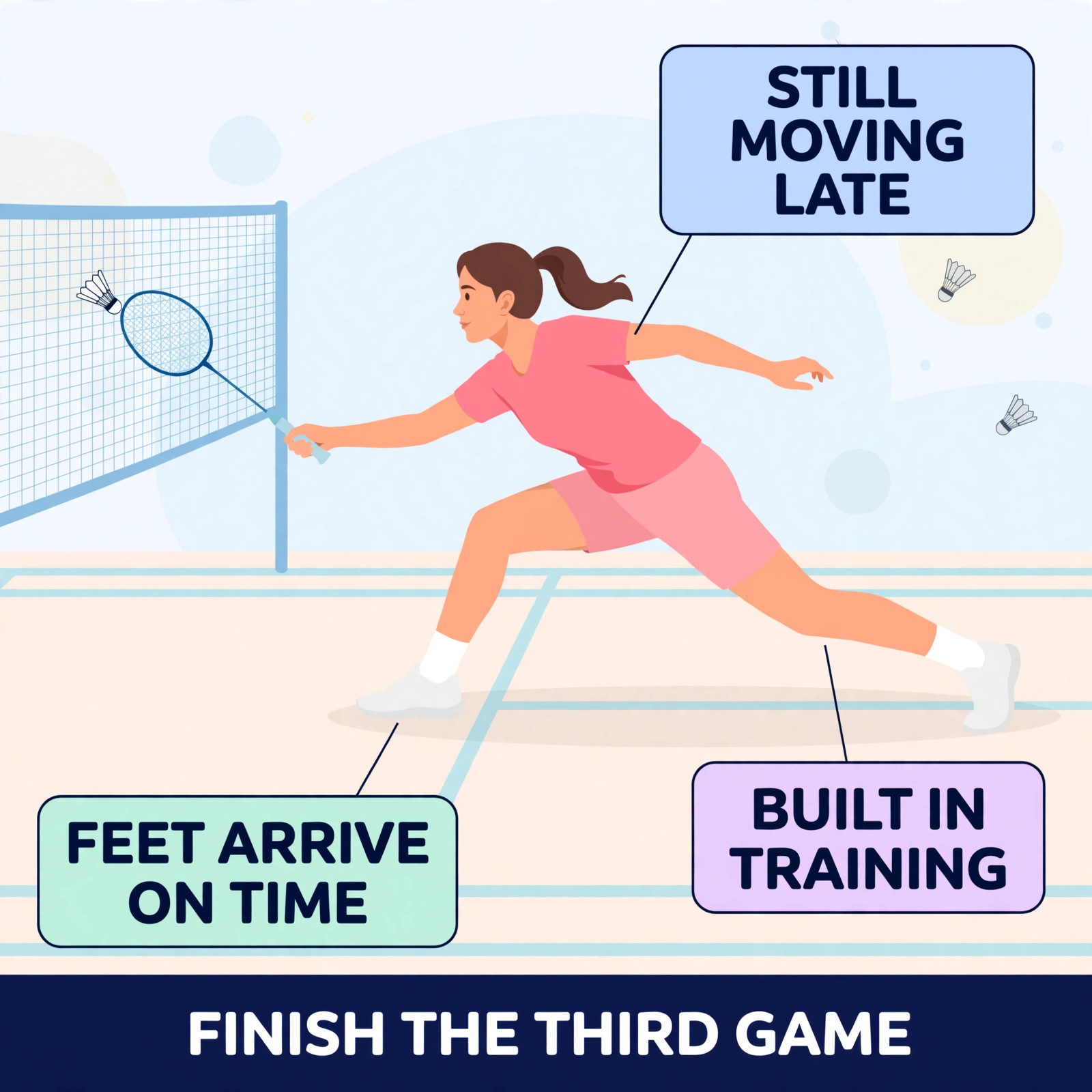
Every badminton player knows the third game problem. The first game was sharp: feet early, clears long, smashes timed. Then the rallies lengthen, the legs slow by half a step, clears start falling short, and shots you own become shots you apologise for. That fade is not a character flaw. It is an energy problem, and energy can be trained. Endurance in badminton is not road running fitness; it is the ability to repeat short, violent efforts, recover in seconds, and do it again for an hour. This guide covers endurance training the way we build it at ST Badminton Academy in Setapak, Kuala Lumpur: intervals on court, feeding drills, conditioning off court, and the recovery that makes it stick.
Endurance Check #1
Why Good Players Fade in Game Three
Understand what a rally actually costs. A single rally is a series of bursts: a split second of stillness, then an explosion to a corner, a shot, and a recovery sprint to base, repeated ten, twenty, thirty times. Between rallies you get seconds, not minutes. Badminton endurance is therefore repeatability: how many of those bursts you can produce before the quality drops. The heart and lungs supply the recovery between bursts; the legs supply the bursts themselves. Train only one side of that pair and the third game will expose the other.
This is why general fitness alone disappoints players. A comfortable five kilometre run builds a base, and bases matter, but it never asks your legs to lunge at full stretch, brake, and reverse in half a second. Players who only run arrive at matches fit in the wrong shape: steady when badminton is spiky. The good news is that the most effective endurance training for badminton looks like badminton: footwork patterns, feeding drills and rally games on a court, with rest arranged on purpose. Your conditioning should rehearse the exact problem it is solving.

Endurance Check #2
Why Fitness Alone Is Not Enough
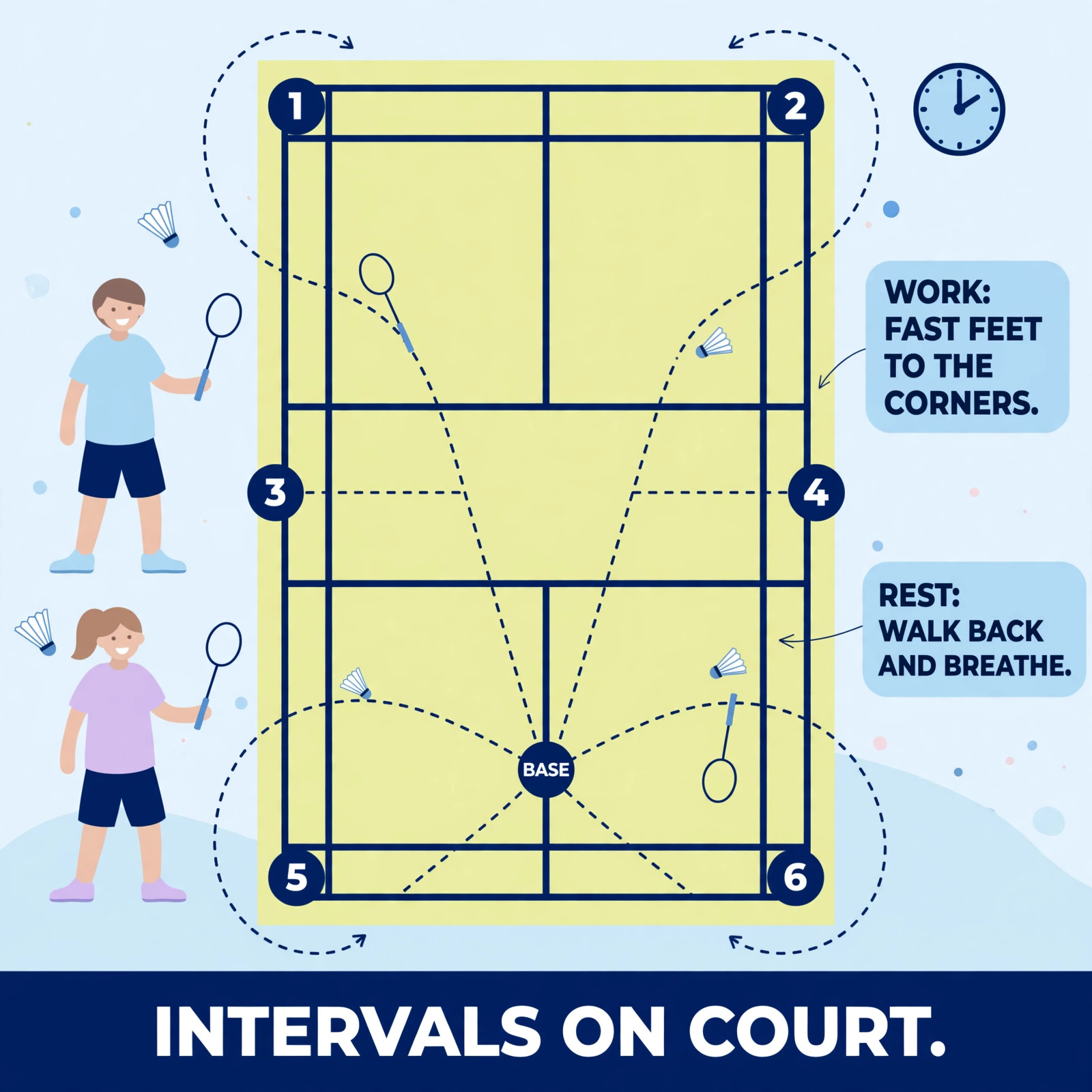
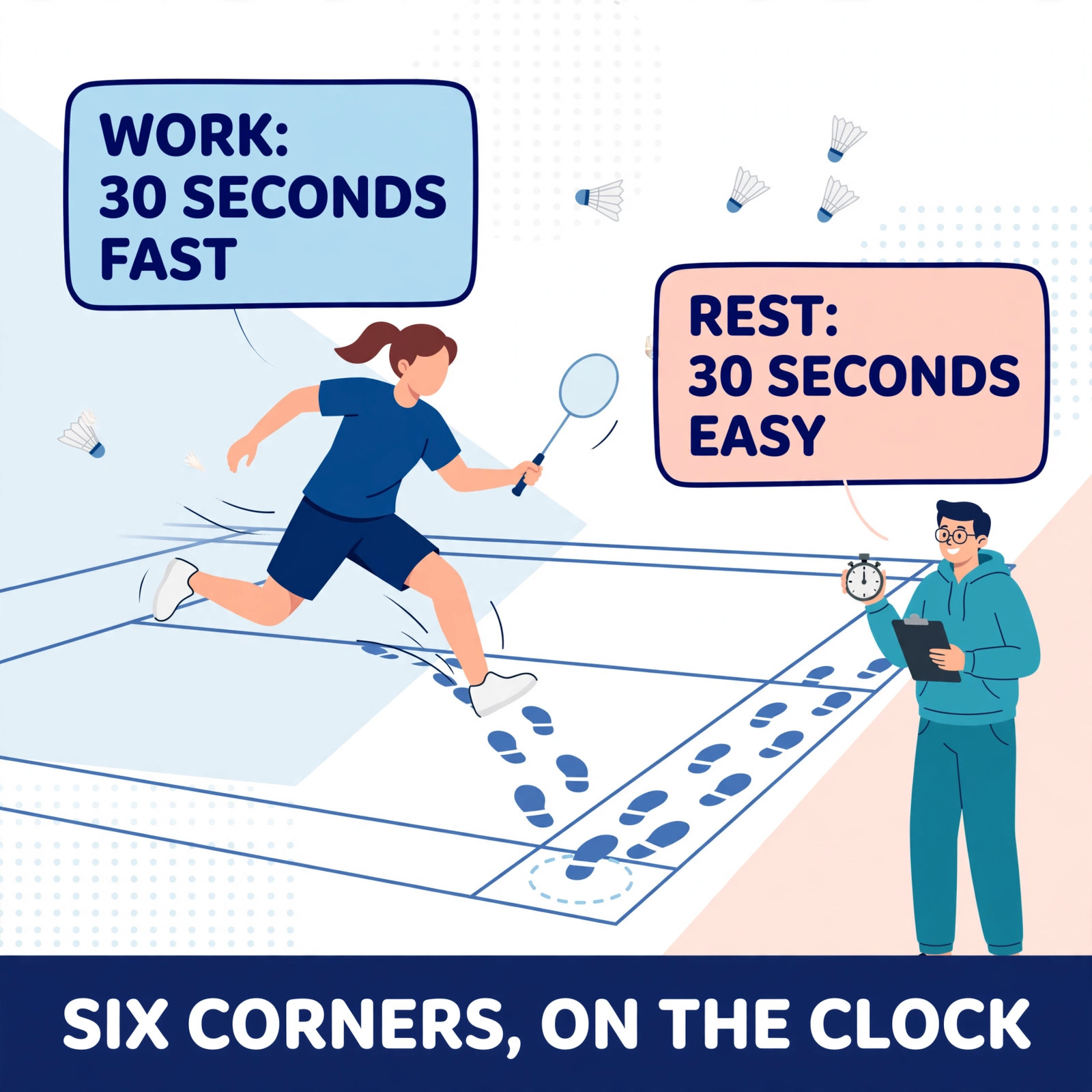
Intervals are the engine of the plan: short efforts at high quality, separated by rest that is planned, not collapsed into. On court, the classic form is six corner footwork: move fast and correctly to the corners in sequence or at random, then rest while a partner works or while you walk back and breathe. Thirty seconds of sharp work with thirty seconds of rest is an honest starting dose for many players. The rule that protects quality: the last repetition should look like the first. When form breaks, the set is over, however tough you feel.
Rest inside interval training is a tool, not a failure. Short rests keep the efforts fast and the technique clean while the heart works hard across the whole session. Longer rests suit fewer, harder efforts. What does not work is the grey middle: grinding at three quarter speed with no plan, too slow to build speed, too tired to build skill. Players often feel that suffering equals progress. In interval work, structure equals progress, and the stopwatch, not your suffering, is the measure.
Build intervals gradually. Add a set before you add speed, and add speed before you shorten the rest. One change at a time, over weeks. A player who doubles the work in a heroic week usually spends the next week ill, sore or injured, and the plan dies. The players who finish the third game strongly in six months are the ones whose training logs look boring: small steps, repeated, with easy days respected. Endurance is an accumulation sport. Respect the arithmetic.
Endurance Check #3
Intervals on Court: Work, Rest, Repeat
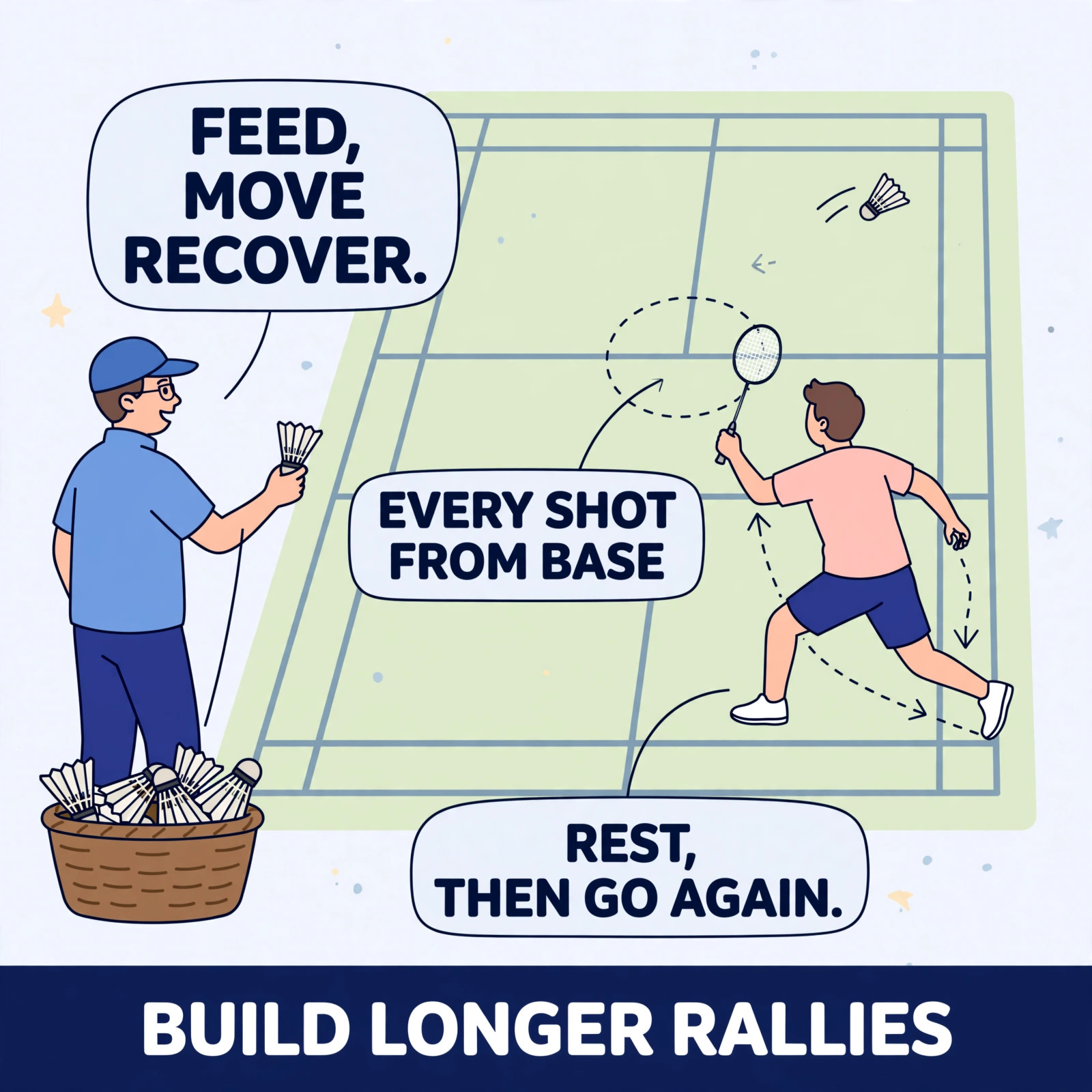
Multi-shuttle feeding is where endurance meets technique. A coach or partner feeds shuttles one after another from a basket, and the player moves, plays, and recovers to base between every shot. The feeder controls the dose: the corners chosen, the pace, the length of the sequence. Ten shuttles to mixed corners is a technique drill. Twenty, with the pace held, becomes endurance with a racket in your hand, and the faults that appear late in the sequence are exactly the faults that appear late in your matches. That honesty is why we use it so much.
Rally length games train the other half: endurance with decisions. A conditioned game where points only count after a rally passes twelve shots teaches patience and shot selection under fatigue, the exact skills that evaporate in the third game. Two players cooperating to extend rallies, counting shots instead of winners, build a different kind of toughness from competitive games: the ability to stay organised while tired. Mix both kinds: feeding for controlled load, games for honest pressure. Endurance that has never been tested by a score is a rumour.
Breathing runs underneath all of it. Under pressure, players hold their breath or snatch at air, and tension spreads from the lungs to the shoulders to the racket hand. The fix is rhythm, trained on easy days until it survives hard ones: breathe out on the effort, let the in breath happen in the recovery steps, and use the seconds between rallies to slow the breathing down deliberately. You cannot think your way to calm at 19 all in the third game. You can only fall back on a rhythm you have rehearsed a thousand times.
Endurance Check #4
Conditioning Off Court: Core, Legs and Jumps
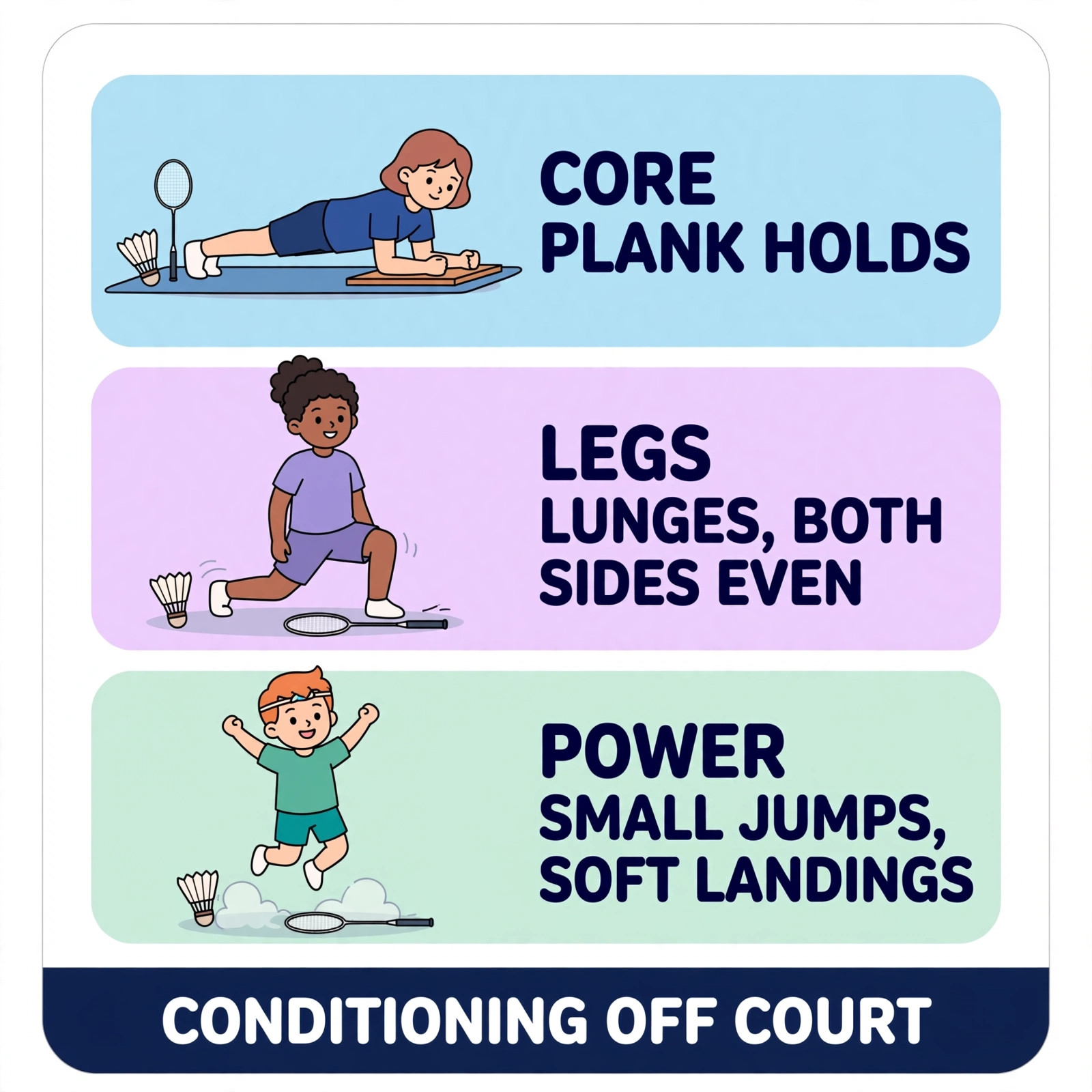
Off the court, the core is the first conditioning target, because a tired trunk leaks energy everywhere. Planks and side planks, dead bugs and carries: unglamorous work that keeps your posture tall in the last rally, so the lungs have room and the legs have a stable platform. Crunches alone are a poor trade for a badminton player. Train the trunk to resist movement and transfer force, not just to fold. Ten focused minutes, a few times a week, pays for itself in every long match.
Legs come next, and lunges are the honest exercise: they load the same muscles, in the same shape, as the shot they support. Work both sides evenly, because badminton will not. Calf raises and controlled single leg balance protect the push-off and the landing. Jumping work has a place too, small doses of hops and bounds for leg power, but it is the spice, not the meal: knees and calves pay for every jump, so plyometrics are dosed carefully, on fresh legs, with soft landings, and never as a punishment at the end of a session.
Keep off court conditioning in its place: it supports the court work, it does not replace it. Two short conditioning blocks a week alongside normal training is a strong dose for most club players. More is not better if it steals the freshness your skill sessions need. The test of a conditioning plan is simple: is your badminton getting better, or are you just getting tired in more places? A good plan makes the third game feel shorter. A bad plan makes the whole week feel longer.
The Plan
Recovery and Fuel: Where Stamina Is Built
Now the part players skip: endurance is built between sessions as much as inside them. Sleep is when the repair actually happens, and a player who trains hard on five hours of sleep is borrowing fitness at a terrible rate. Water before, during and after sessions keeps the machine running in Malaysian halls, where sweat leaves faster than thirst reports it. Food is the fuel line: enough carbohydrates to refill what rallies burn, protein to rebuild what training breaks. None of this is glamorous. All of it is load bearing.
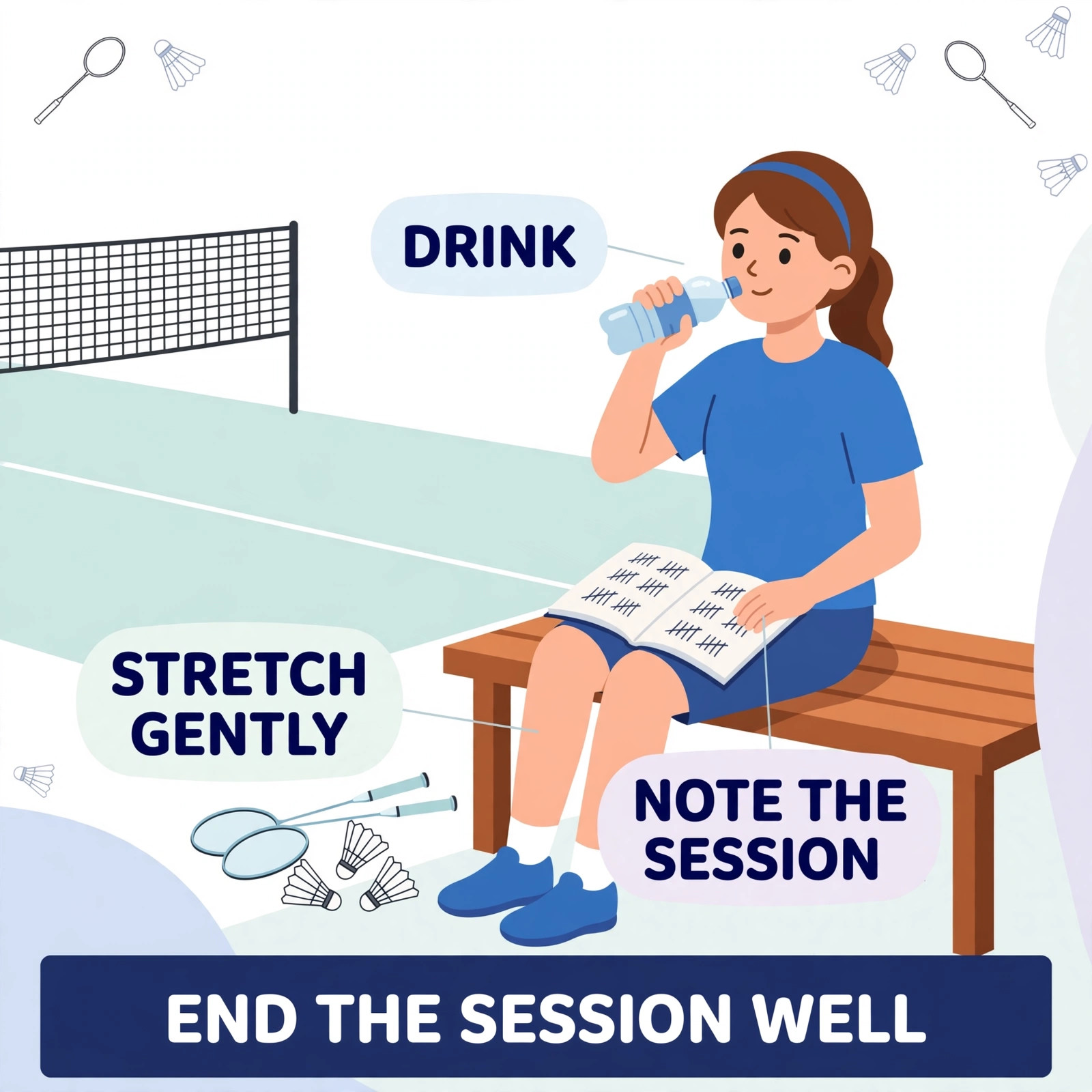
Easy days are the other half of the design. Hard training provides the signal; rest provides the adaptation. A week of seven hard days produces a tired player, not an enduring one. Alternate: hard days for intervals and feeding, easy days for technique, mobility and light games. This is also where recovery habits from our other guides belong: gentle stretching, rolling if it helps you, and honest reporting of tiredness to your coach. The plan only works if the athlete tells the truth about the battery.
Finally, measure something. Endurance you cannot see is endurance you will abandon. Count the shots in your longest training rally each week. Note the footwork set where your form survived to the end, or did not. Film the last game of a practice match once a month and watch your feet honestly. Small numbers, written down, turn a vague wish to be fitter into a visible climb. Players protect what they can see improving. Give your endurance a scoreboard and it will survive the weeks when motivation does not.

Myth vs Reality
Myths About Endurance Training
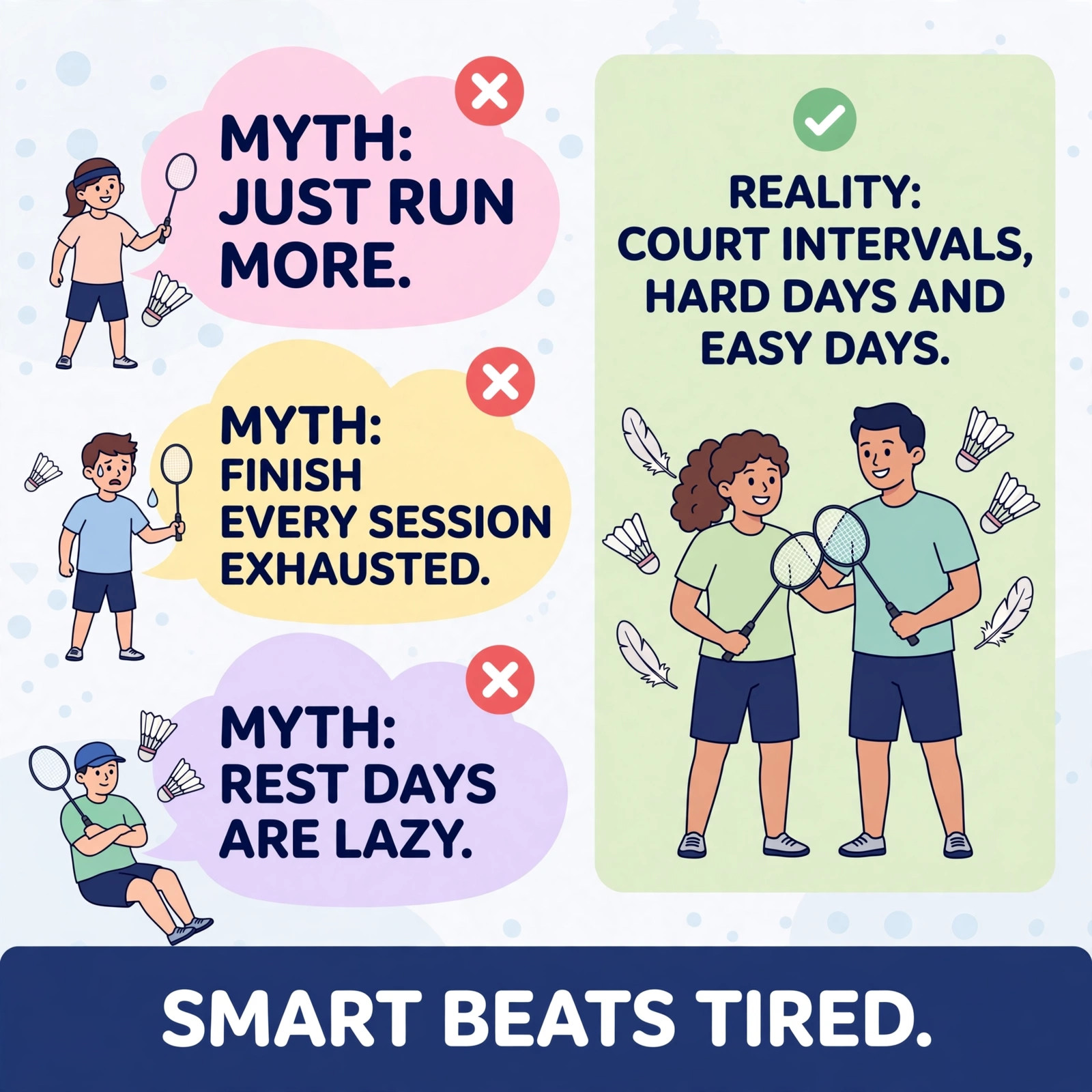
Myth: “Just run more and your badminton endurance will come.” Reality: running builds a base, but badminton endurance is repeated bursts with lunges, brakes and turns. Court intervals and feeding drills train the exact pattern. Run if you enjoy it, by all means, but do not expect it to rehearse your third game.
Myth: “A good session ends with total exhaustion.” Reality: sessions that bury you daily bury your technique and your week with them. The best endurance work is structured: hard efforts, planned rest, form intact. Myth: “Rest days are for the uncommitted.” Reality: adaptation happens during recovery. Easy days are where the fitness from hard days is actually banked.
Myth: “Endurance is only heart and lungs.” Reality: tired legs change your shots before your breathing does: late lunges, short clears, rushed smashes. Endurance is legs, trunk, breathing and patience together. Myth: “Young players just have more stamina naturally.” Reality: young players recover faster, but repeatability under pressure is trained at every age.
Why Choose Us
Endurance Coaching for Badminton Players
At ST Badminton Academy KL, endurance is built inside small group classes capped at max 4 students. Small groups let the coach dose the work properly: footwork intervals timed to the player, feeding sequences matched to their level, and rally games that stretch rally length without breaking form. Nobody hides at the back of a four player session, and nobody is asked for a dose their body is not ready for.
Mr Eric Chuar has over 15 years of coaching experience in Singapore and Malaysia. His endurance rule is plain: quality first, then quantity, then both. He watches the last repetition of a set as closely as the first, stops sets when form breaks, and plans hard and easy days like parts of one design. Fitness, in his sessions, is something a player builds, not something a coach inflicts.
Our academy is based in Setapak, Kuala Lumpur, convenient for players from Wangsa Maju, Melati Utama, Danau Kota and Gombak. If your third games keep slipping away, bring that pattern to a session. We will test where the fade starts, legs, lungs or patience, and build the block that fixes your version of it.
FAQs: Badminton Endurance in Malaysia (KL)
These are the questions players ask us most about endurance training in Malaysia. If your question is not here, message us, tell us where your matches usually fade, and we will give you a straight answer about where your block should start.
How can I build badminton endurance if I live in Setapak or Gombak?
Start with the pattern, not more playing time: two or three endurance blocks a week, intervals and feeding, with easy days between. In our Setapak classes we test where your fade starts, legs, lungs or patience, and set the dose to your level inside small groups of max 4 students.
What matters most in badminton endurance training in KL?
Repeatability. Badminton endurance is not one long effort; it is thirty short ones with seconds to recover. Intervals, feeding and rally games train exactly that, and structure matters more than suffering. In our training the last repetition must look like the first, or the set ends there.
How many endurance sessions a week should I plan to reach a good level?
For most club players, two or three focused endurance blocks a week inside or alongside normal training is a strong dose: intervals, feeding and rally games, with easy days between. Quality matters more than the count. In our classes the dose is set per player and built up in small steps over the term.
I run twice a week but still fade in matches. What am I missing?
The pattern. Running builds a steady base, but badminton asks for bursts: lunge, brake, turn, recover, again and again. Your engine is fit for the wrong shape of effort. Add court intervals and feeding drills that rehearse repeated efforts, and keep the running if you enjoy it. In our sessions we build exactly that bridge.
What breathing habits help a player last through long rallies?
Breathe out on the effort: the lunge, the hit, the push back. Let the in breath come in the recovery steps, and use the pause between rallies to slow everything down. We rehearse breathing inside footwork drills on easy days, so the rhythm is still there when the third game gets loud.
Do you coach endurance training in classes near Wangsa Maju?
Yes. Endurance training runs inside regular group classes at our Setapak base, a short trip from Wangsa Maju. Intervals, feeding and rally games are coached in small groups of max 4 students, with the dose matched to each player and built up gradually.
Can the academy help me prepare for long matches and competitions in Malaysia?
Yes, with the honest version: we build the repeatability those long matches demand, footwork intervals, feeding sequences and rally length games, in small groups where your dose is watched. Selection itself sits with schools and organisers, but players from our groups arrive at long matches with legs that last.
Where is ST Badminton Academy KL located for endurance training?
We are based in Setapak, Kuala Lumpur, close to Wangsa Maju, Melati Utama, Danau Kota and Gombak. Sessions run in small groups of max 4 students. Message us for the current class schedule and we will place you in a group at your level.
What does Mr Eric Chuar teach about conditioning in badminton?
Fifteen years of coaching in Singapore and Malaysia, and a conditioning philosophy of small causes first: quality before quantity, form before fatigue, hard days and easy days in one design. Eric doses endurance work per player inside small groups, so the third game becomes a place you have trained for.
Badminton Endurance Training in Action


What It Takes to Last the Whole Match
A player meets our endurance standard when five habits hold: interval sets finish with the form they started with, feeding sequences are recovered from properly, breathing stays rhythmic under pressure, hard and easy days are both respected, and sleep, water and food are treated as part of training. When those five hold, the third game stops being a threat.
| Factor | Just Plays More | Trains the Engine STAMINA |
|---|---|---|
| Frequency | 1 or 2 times a week. Mostly for fun and sweat. | Training includes court intervals: short fast footwork efforts to the corners, with planned rest between them. |
| Drills Focus | Basic static feeding. Minimal footwork pressure. | Multi-shuttle feeding and long rally games stretch the rally length the player can handle. |
| Physical Conditioning | Rarely included. Just playing games on court. | Core, agility, and speed training included in every session to prevent injury and build stamina. |
| Tactical Awareness | "Just hit it over." No real game plan. | Video analysis, point construction, and learning to read the opponent's game. |
| Coach Ratio | Large groups (8-10 kids). Coach barely watches you. | Max 4 students. Mr Eric Chuar personally corrects every stroke and movement detail. |
| Goal Setting | Fun and exercise. | Hard days and easy days alternate, with sleep, water and food treated as part of the plan. |
| Long Term Result | Good recreational player. | A player whose feet still arrive on time in the third game, not only the first. |
Endurance and Conditioning Training in Kuala Lumpur
This page covered badminton endurance from the rally outward: why matches fade late, intervals on court with planned rest, multi-shuttle feeding and rally length games, conditioning for the trunk and legs off court, and the recovery that turns work into fitness: sleep, water, food and easy days. Bring your third game problem to a session in Setapak and let us build your engine properly.






