Badminton And Circuit Training: Workouts For Building Endurance And Strength (Circuit Guide)
Some training methods feel like they were designed for badminton, and circuit training is one of them. A rally is not one long effort. It is a chain of short, sharp efforts with brief pauses between them, repeated for as long as the match lasts. A circuit copies that shape exactly: a series of exercise stations, each worked hard for a short burst, with planned rest as you move to the next. This guide explains how to build badminton circuits that develop endurance and strength together, and how we use them at ST Badminton Academy in Setapak, Kuala Lumpur.
Circuit Check #1
Why Stations Build Match Fitness
Badminton fitness has a specific shape, and it is not the shape of a long slow jog. Rallies last seconds, not minutes: a burst of lunges, jumps and direction changes, then a short walk back to serve. Your heart rate climbs, dips, and climbs again for an hour or more. Training that copies only the steady part, like distance running, prepares you for a sport badminton is not. Training that copies the stop and start pattern prepares the exact energy system the game uses, which is why circuits feel hard in a familiar way from the very first round.
There is a second reason stations work so well: variety with a purpose. One circuit can ask your legs to lunge, your trunk to brace, your arms to push and your feet to skip, all inside fifteen minutes. That spread matters because badminton never lets one muscle group rest while the player does. It also keeps training interesting, and interesting training gets repeated. The players who improve are rarely the ones with the most exotic programme. They are the ones who show up for a sensible one, week after week, and circuits are built to be returned to.

Circuit Check #2
Stations That Mirror the Rally
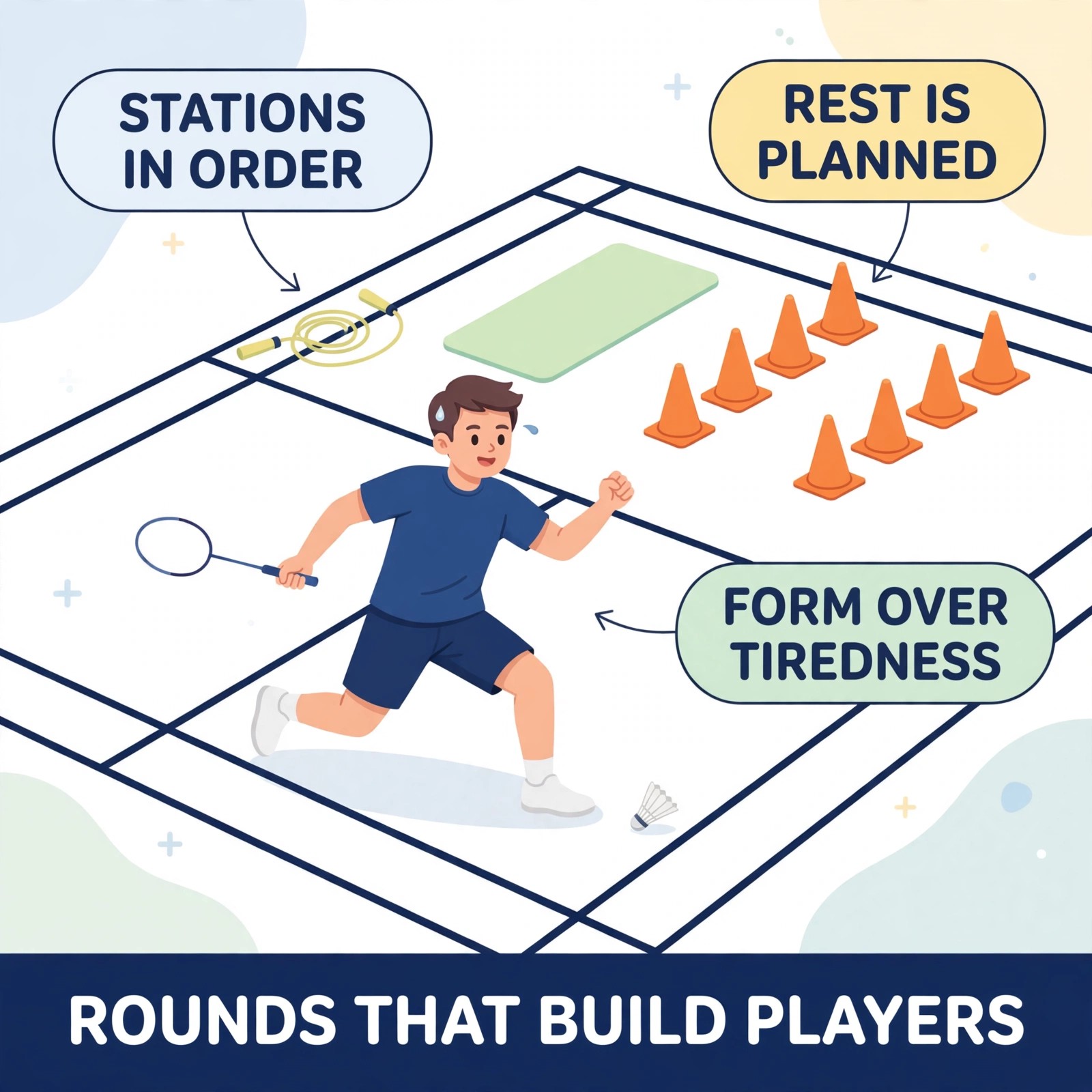
Build your circuit the way a rally is built: feet, legs, trunk, arms, feet again. Station one is shadow footwork, moving to the six corners with a split step on every return, because the feet lead everything in this sport. Station two is lunges, forward and lateral, training the exact shapes you land in at the net and in defence. Station three is a plank or mountain climbers for the trunk. Station four is push ups for the pushing muscles. Station five is skipping, light and fast, to finish with quick feet and an honest heart rate.
The order is not decoration. Putting a leg station right after shadow footwork would bury your footwork quality under tired legs, so the circuit alternates: a lower body effort, then a trunk or upper body effort, then back down again. Each station stays short enough that the last rep still looks like the first. If your lunges have collapsed into wobbles by rep six, the station is too long or the movement too hard for today. Shorten, simplify, and keep the shapes clean. A circuit is a rehearsal for match movement, not a punishment for existing.
Equipment stays humble on purpose. Cones or water bottles mark corners, a mat serves the floor stations, a skipping rope costs almost nothing, and your own bodyweight provides the resistance for most stations. A racket joins the footwork station so your upper body learns the circuit in playing posture, racket up, ready position honest. If you train with a partner, one works while the other rests and counts, which builds the rest discipline into the session and gives every station a second pair of eyes on form.

Circuit Check #3
Work and Rest: The Circuit Clock
The clock is the coach of a good circuit. A simple, proven shape for badminton players is forty seconds of work and twenty seconds to move and breathe, repeated for three or four rounds of the full circuit. Forty seconds is long enough to feel like a hard rally block and short enough to protect form. Twenty seconds is enough to walk to the next station, shake out your legs and decide to go again properly. When the clock runs the rest, nobody steals extra recovery and nobody skips it either. Both matter.
Scale the circuit to the player, not to pride. Beginners start with thirty seconds of work, longer rests, and two rounds. Stronger players extend the work, shorten the rest, or add a round, changing one dial at a time so the body can tell you what the change did. The signal to stop a station is never the bell. It is form: the moment lunges wobble, backs sag or feet get loud and heavy, the set is done, even mid interval. Stopping on form is not quitting. It is the skill that keeps circuit training useful instead of reckless.
Between rounds, take a fuller rest, one to two minutes of walking and water, and use it. Your heart rate should fall enough that round two starts as a training round, not a survival round. Coaches watch this closely: if a player cannot speak a short sentence at the start of round two, the circuit was set too hard for today, and the honest fix is more rest or fewer stations next time, not more suffering. Circuits build endurance by repeating quality efforts. The quality is the point; the tiredness is just the receipt.

Circuit Check #4
A Circuit You Can Run Anywhere
You do not need a gym membership to run a proper circuit. A living room with a mat, a chair for support, a skipping rope and enough floor to lunge in two directions covers the full station list. Clear the space properly first: move the coffee table, check the floor is not slippery, and put water within reach. Court shoes still matter indoors, because lateral lunges on socks are how ankles get hurt at home. The same stations, the same clock, the same rules about form apply; only the address changes.
Solo training works fine. The clock replaces the partner, and a phone timer with clear beeps keeps you honest about work and rest. If you train with family or a friend, work in pairs with one resting and counting, which most players find easier to sustain. Parents often ask whether circuits suit younger players; the movements scale down happily, shorter stations, longer rests, more game like stations, as long as the focus stays on clean shapes rather than exhaustion. Fun and form first, fatigue a distant third.
Warm up before the circuit and finish it properly. Three minutes of easy movement, leg swings, arm circles, gentle shadow footwork, raises your temperature and rehearses the shapes you are about to load. After the last round, walk until your breathing settles, then stretch the calves, quads, hips and shoulders while you are warm. Food and drink need no special rules for most players: a normal balanced meal pattern, water through the day, and something light before training if you are hungry. Ordinary habits, done consistently, support this training well.

The Circuit
A Circuit Week That Fits Training
A good circuit lives inside a badminton week, not on top of it. Court training comes first in priority, because circuits exist to serve your game. Two or three circuit sessions a week suit most players: one can sit after a lighter court session, the others on days between court training. Keep at least one full rest day, and never stack a hard circuit the day before an important match. The week should feel rhythmical: play, support, rest, repeat. If every day feels like a battle, the plan is wrong, however impressive it looks on paper.
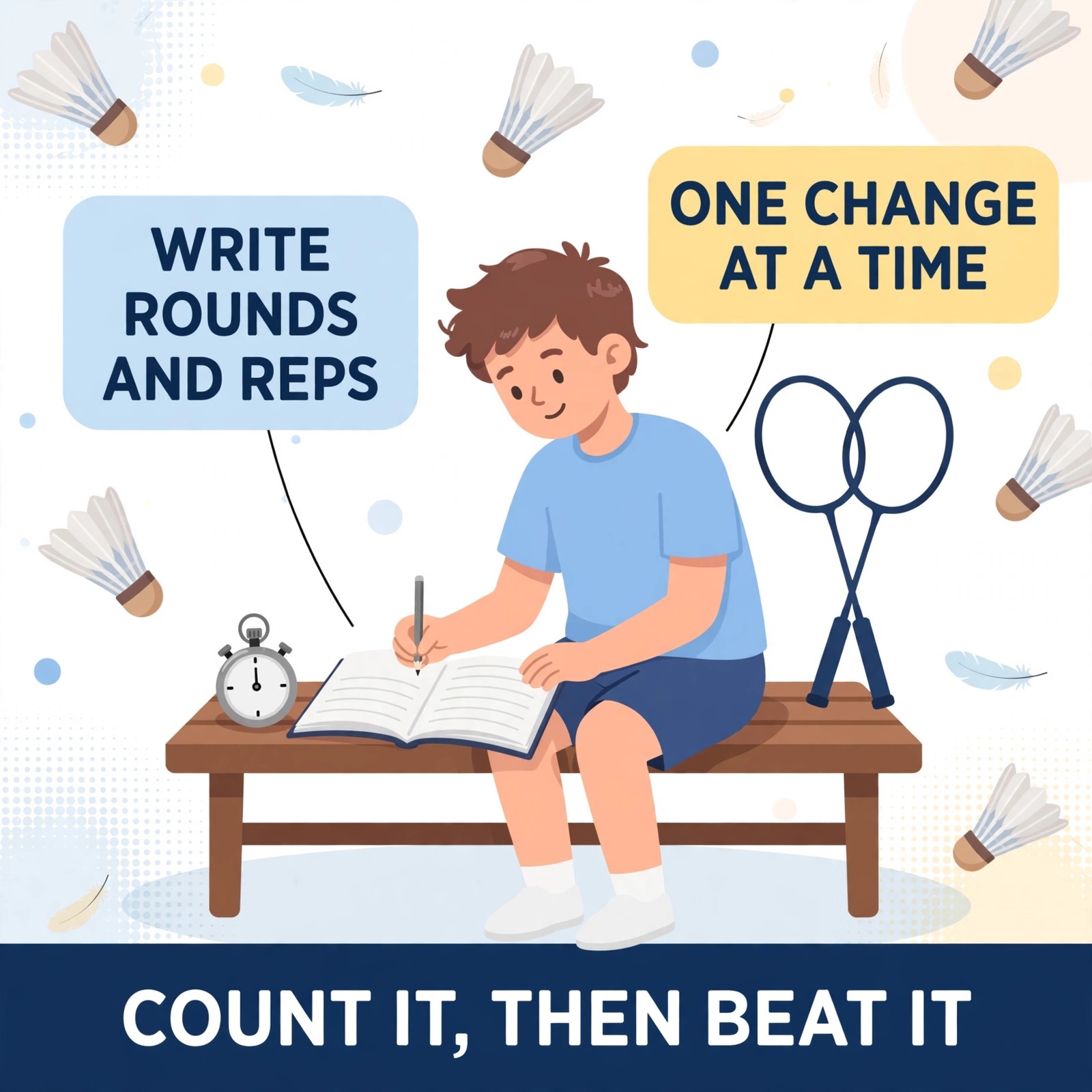
Progression is planned, not improvised. Change one thing at a time: add a round, extend the work interval by five seconds, swap in a harder station, or trim the rest slightly. Then give the change two weeks before judging it. Your notebook is the judge: rounds completed, reps per station, and a one line note on how the final round felt. When the last round of a circuit feels like the first did a month ago, fitness has genuinely moved, and that quiet evidence is worth more than any single heroic session.
Recovery is the other half of the programme, and it is trained as deliberately as the work. Sleep, regular meals and easy days let the body turn hard sessions into fitness. Watch for the warning signs of doing too much: heavy legs that never freshen, footwork that gets louder instead of lighter, a resting grumpiness about training you normally enjoy. The fix is rarely complicated: an extra rest day, a lighter week, then back to the plan. Endurance is built by players who can repeat hard work, and only recovered players can repeat anything.

Myth vs Reality
Myths About Circuit Training
Myth one: a circuit only works if there is no rest at all. The myth survives because collapse looks like effort. In truth, rest is what makes the next station worth doing; without it, every station after the first is practised in a sloppy, exhausted shape. Planned rest is not softness. It is the structure that keeps quality high enough to transfer to the court. Myth two: circuits are mainly about burning calories. The calorie question misses the point of the method entirely, which is practising badminton shaped efforts under control, again and again.
Myth three: if you are not wrecked at the end, it did not work. Exhaustion is a side effect, not a target. A well set circuit ends with you tired but tidy: breathing hard, shapes intact, able to describe the session. If you finish on the floor, the dial was set to pride, not progress. Myth four: circuits can replace court training. They cannot, and at our academy they never try to. Fitness supports skill. The shuttle still has to be hit, the corners still have to be covered in real rallies, and no station teaches that.
The honest version is less dramatic and more useful. Circuits are a tool for building the engine and the strength your badminton needs, in the stop and start pattern your matches actually use. They ask little: a mat, a rope, a clock and thirty honest minutes. They return a lot: rallies you can repeat, legs that arrive on time, and a third game that feels like your game still. Used beside court training, with rest planned and progress written down, they are among the best value work a badminton player can do.

Why Choose Us
Circuit Coaching for Badminton Players
At ST Badminton Academy, circuits are part of the training week for players who need a bigger engine, built around the stations in this guide and adjusted to the player in front of us. Groups stay at four students or fewer, so station form gets coached, not guessed, and the clock is set for the group we have rather than a poster on a wall. The aim is never the hardest session in Kuala Lumpur. It is the session that makes Saturday’s match feel easier than last month’s did.
Head coach Eric Chuar leads the programme, bringing over 15 years of coaching experience across Singapore and Malaysia. Eric sets circuits the way he sets footwork drills: by watching how a player moves when tired. He will lengthen a rest, swap a station or stop a set the moment shapes go, because he is coaching the player, not the stopwatch. His circuits have a reputation among our students: hard enough to respect, sensible enough to finish, and always explained, so players know exactly what each station is for.
You will find us in Setapak, Kuala Lumpur, within easy reach of Wangsa Maju, Melati Utama, Danau Kota and Gombak. Our circuit work happens in the same hall as our court training, before or after sessions, so players need one trip and one plan. If your legs fade in third games, or your training feels stuck at one gear, come and try a coached circuit with us. The first step is a conversation about your game and your week, and we will build the rounds from there.
FAQs: Circuit Training in Malaysia (KL)
Circuits raise good questions, especially from players new to structured fitness work. Here are the ones we answer most often.
How can I start circuit training for badminton if I live in Setapak or Gombak?
Start small: five stations, thirty seconds each, two rounds, twice a week. Shadow footwork, lunges, plank, push ups and skipping cover everything a beginner circuit needs, and all of it fits in a living room. At ST Badminton Academy in Setapak we coach the same starter circuit inside regular sessions, so local players learn the form with a coach watching.
What matters most in a badminton circuit workout in KL?
Three things matter most. First, station order: alternate legs, trunk and arms so no single muscle group is buried early. Second, the clock: work and rest set before you start, and honoured when you are tired. Third, form: the set ends when shapes go, not when the timer says so. Get those three right and the fitness follows.
How many circuit sessions a week should I plan alongside court level?
Two or three sessions a week is the range that works for most players, each lasting twenty to thirty minutes with rests. Space them out: never on back to back days while the habit builds, and never the day before an important match. Court training keeps priority in the week. Circuits are the support act, not the main event.
I feel wrecked after every circuit. What am I missing?
Almost always, rest. Either the breaks between stations are too short, the work intervals too long, or the circuit sits too close to hard court days. Fix it in this order: longer rest, shorter work, one round less. You should finish tired but tidy, breathing hard with your shapes intact. If you finish on the floor, the plan is wrong.
What equipment do I need to run a circuit at home?
Very little. A mat for the floor stations, a skipping rope, cones or water bottles to mark your corners, court shoes, and a phone timer. Your bodyweight covers the resistance for lunges, planks, push ups and mountain climbers. A racket joins the shadow footwork station so you hold a playing posture. Everything fits in one sports bag.
Do you run circuit training in classes near Wangsa Maju?
Yes. Circuits run inside our regular training at ST Badminton Academy in Setapak, usually as a coached block before or after court work. Groups stay at four students or fewer, so every station gets watched and every clock gets set for the players actually in front of the coach. Wangsa Maju is a short trip away.
Can the academy help me build endurance for long matches in Malaysia?
Yes. Long matches are lost in the legs before they are lost in the scoreline, and circuits target exactly that: repeated efforts with short rests, round after round. We set the stations and clock for your level and progress one dial at a time. Most players notice it first in their second match of a tournament day.
Where is ST Badminton Academy KL located for circuit training?
We are in Setapak, Kuala Lumpur, easy to reach from Wangsa Maju, Melati Utama, Danau Kota and Gombak. Circuit blocks run in the same hall as our court sessions, so there is no second venue and no second trip. Most players come after school or work. Message us before your first visit and we will confirm the session time.
What does Mr Eric Chuar teach about circuit training in badminton?
Eric teaches that the clock is a coaching tool, not a punishment. Work and rest are set before the session, stations fit the player, and any set ends the moment form goes, whatever the timer says. His rule is order: legs, trunk, arms, feet, so the circuit rehearses the way a rally loads the body. Players leave tired and tidy.
Circuit Training in Action


What It Takes to Own the Last Round
Hold your circuits to five standards. The clock is set before the session and honoured during it. Stations alternate around the body, never burying one part early. Every set ends on form, not on the bell. Every round is written down. And every week keeps its rest day sacred. These standards sound ordinary because they are. Ordinary standards kept for a season will out train any spectacular programme kept for a fortnight, and your third game legs will be the proof.
| Factor | Just Goes Hard | Trains the Circuit CIRCUIT |
|---|---|---|
| Frequency | 1 or 2 times a week. Mostly for fun and sweat. | Stations are planned in order: legs, trunk, upper body and feet, with rest set before you start. |
| Drills Focus | Basic static feeding. Minimal footwork pressure. | Work intervals match rally lengths, so the effort feels like the game it serves. |
| Physical Conditioning | Rarely included. Just playing games on court. | Core, agility, and speed training included in every session to prevent injury and build stamina. |
| Tactical Awareness | "Just hit it over." No real game plan. | Video analysis, point construction, and learning to read the opponent's game. |
| Coach Ratio | Large groups (8-10 kids). Coach barely watches you. | Max 4 students. Mr Eric Chuar personally corrects every stroke and movement detail. |
| Goal Setting | Fun and exercise. | Progress is written down: rounds, reps and how the last round felt. |
| Long Term Result | Good recreational player. | A player who finishes the final round with the same form as the first. |
Circuit Training in Kuala Lumpur
A circuit is a rally with the shuttle taken out: short efforts, short rests, repeated with intent. Build yours from badminton stations, run it by a clock you respect, progress it one dial at a time, and write it down. Do that beside your court training for a season and long matches stop feeling long. If you would rather have the rounds coached than guessed, join us in Setapak. We will set your stations, watch your form, and build the engine your game has been waiting for.






