The Best Badminton Socks For Comfort And Cushioning (Sock Guide)
Socks are the smallest item in the kit bag and the one players think about least, right up to the game where a blister ends their evening. A badminton sock has real work to do: cushion the heel and forefoot through hundreds of lunges and landings, hold the foot steady inside the shoe, move sweat away from the skin, and protect the spots where friction bites. This guide covers those jobs in plain order: what the sock must do, where cushioning actually counts, which materials work in Malaysian halls, how the fit should feel, and how to wash, rotate and replace pairs. There are no brand names and no prices here, only checks any player can run with their own feet.
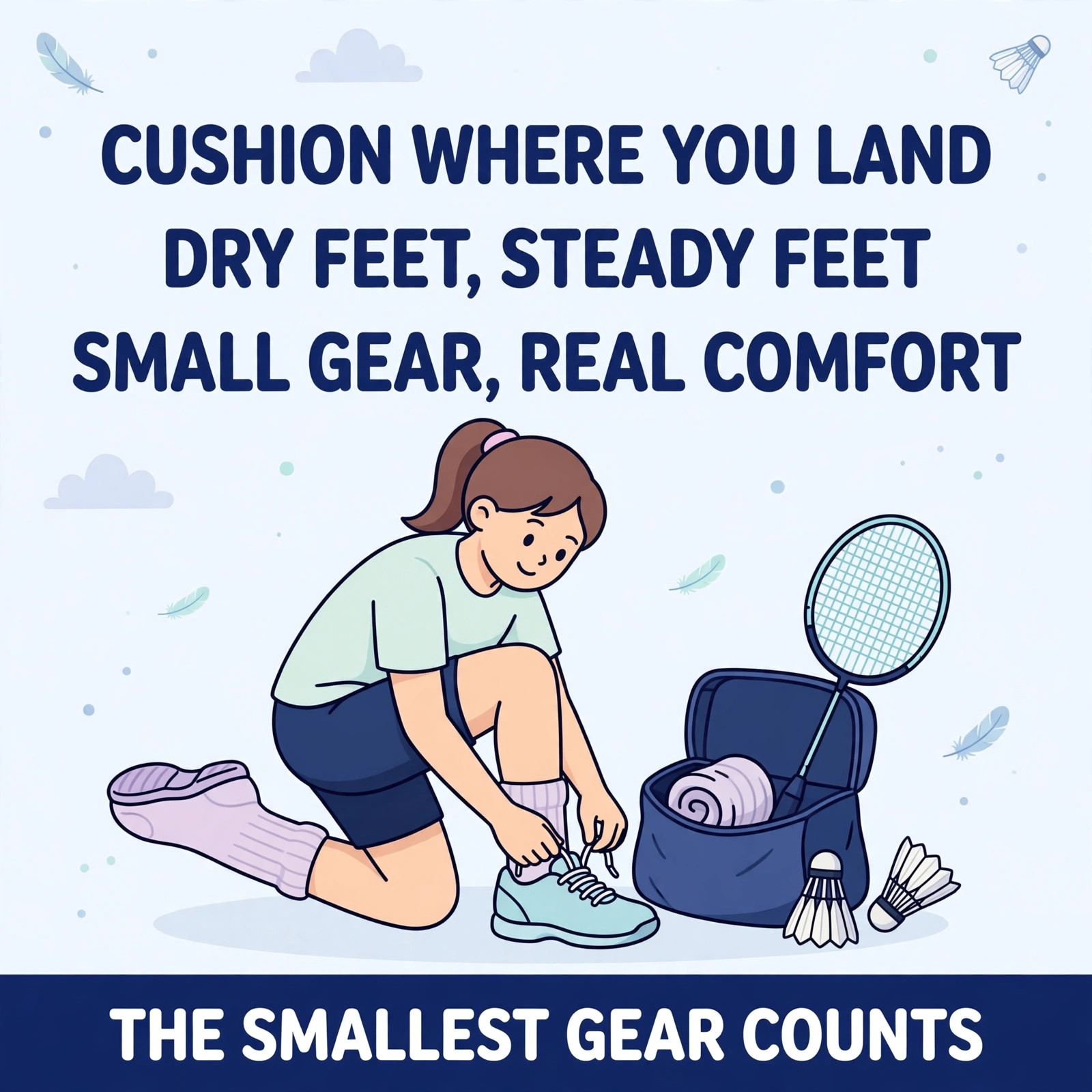
Sock Check #1
What a Badminton Sock Must Do: Cushion, Grip, Breathe
A good court sock does three jobs at once. It cushions, spreading the load of landings so the heel and the ball of the foot do not take every impact raw. It grips, holding the foot and the shoe together so the foot does not slide and rub with every change of direction. And it manages moisture, pulling sweat off the skin so feet stay drier, cooler and less likely to blister. A sock that does only one of the three is a partial sock, and badminton will find the gap by the second game.
Think about what badminton asks of feet. A single session holds hundreds of lunges, jumps, landings and sudden stops, most of them loaded on one leg at full stretch. The sock is the only layer between that work and your skin. Thin fashion socks and school socks were never built for it: they slide, they soak, and they wear through at the heel in weeks. A proper sports sock is not a luxury item. It is the cheapest piece of protective equipment in the bag, and the one replaced most often for good reason.
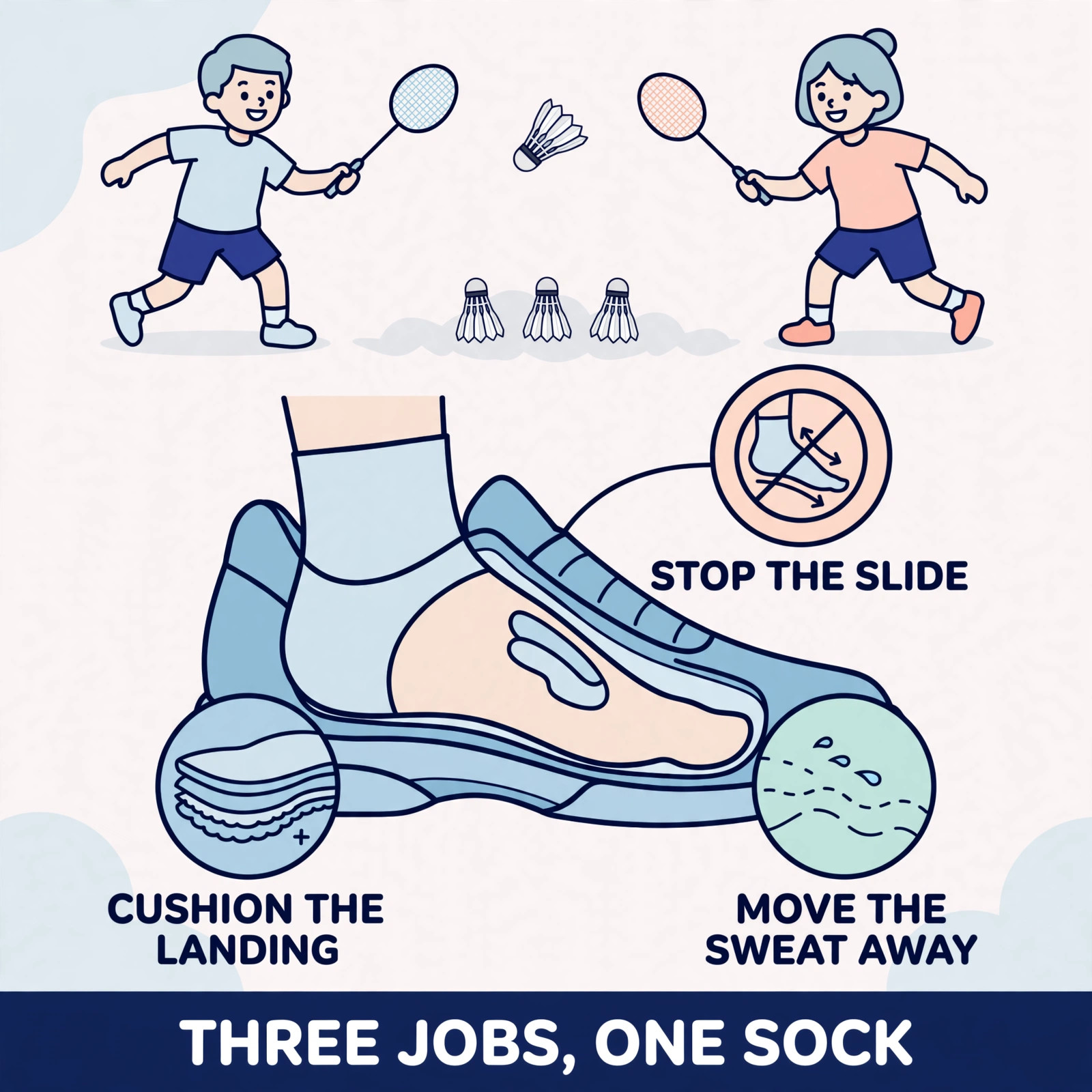
Sock Check #2
Cushioning Where It Counts: Heel, Toes and Forefoot
Cushioning earns its place where the load lands. The heel strikes first in a deep lunge and takes the shock of jump landings. The forefoot, the padded area behind the toes, drives every push off and absorbs the landing of the split step. The toes themselves jam into the front of the shoe on sudden stops, which is why a little padding and a smooth finish at the toe box save toenails over a season. When you turn a sock inside out, these are the zones to feel for: thicker, looped padding exactly there, not spread evenly everywhere.
More padding is not automatically better. A very thick sock changes how the shoe fits: the foot sits higher, the heel can lift, and the whole foot may swim in space the shoe designer never planned. That swimming is friction, and friction is blisters. The sweet spot is targeted cushioning inside a sock that still fits snugly, so the padding compresses where load lands and the rest of the sock behaves like a second skin. If your shoes were fitted with thin socks, try any thicker pair in the shoes before a match, not during one.
Read the inside of the sock, not the packet. Terry loops, the little towel like loops on the inner face, are what cushion; a sock that is smooth inside and out is mostly decoration. Padding should feel springy when you pinch it, not flat and papery. Seams matter as well: a bulky ridge across the toes will announce itself by the third game. None of this needs expertise to check. Pinch, stretch, rub a seam with a thumb, and compare two pairs side by side. Your hands will rank them honestly in a minute.

Sock Check #3
Materials: Why Cotton Goes Soggy
Cotton is the material most players start with, and its weakness is simple: cotton absorbs sweat and holds it. A cotton sock in a long session becomes a warm, heavy, soggy layer that stays wet against the skin. Wet skin softens, soft skin rubs, and rubbing is how blisters are made. Cotton socks also lose their shape as they soak, sliding down and bunching under the arch. For a short, casual knockabout they are harmless. For training and matches in a Malaysian hall, they are the wrong tool worn by habit.
Modern sports socks are built mostly from synthetic fibres such as polyester and nylon, precisely because those fibres move moisture instead of storing it. Sweat is wicked along the fibre to the outside of the sock, where air can dry it. A little elastane woven through gives the sock its stay put stretch. Some socks add mesh panels over the top of the foot, where heat escapes fastest. The result is a sock that still feels dry in the third game, which is exactly when a cotton sock has given up.
Heat is the local test. In Kuala Lumpur halls, feet sweat more and dry slower than any temperate climate guide assumes. Quick drying matters more than warmth, and thin mesh zones matter more than thick padding everywhere. Players in double sessions, training then playing socially, should plan a fresh pair for the second session; no fibre wins against four soaked hours. Treat material choice as climate choice: breathable, quick to dry, and shaped to hold the foot, and your socks will serve you in every hall in the country.

Sock Check #4
Fit: Snug Arch, No Slip, No Bunching
Fit starts with the heel. A well made sock has a shaped heel pocket, and that pocket should sit exactly on your heel, not drift under it. The arch band, the tighter woven strip around the middle, should feel snug and supportive without leaving deep marks. Toes need a smooth, closed finish with room to spread a little. Size by shoe size, and if you sit between sizes, choose the fit that keeps the heel pocket honest, because a wandering heel pocket is where bunching begins.
The enemy inside the shoe is sliding. Every slide is a rub, and rubs add up over hundreds of lunges into hot spots, then blisters. A sock that stays put protects better than a thicker sock that travels. Length is a matter of taste with one practical note: a crew length covers the ankle bone and the Achilles area, which some players like for deep lunges when the shoe collar presses; an ankle length runs cooler. Either can work. What cannot work is a sock you keep hauling up between rallies.
Blisters deserve one honest paragraph. They come from friction plus moisture plus time, and socks reduce two of the three, which is why good socks cut blister trouble sharply without promising to end it. Keep toenails trimmed, because long nails bruise against the shoe front in sudden stops and no sock can fix that. A black toenail usually blames shoe size, not socks. And answer hot spots early: the warm, tender patch you feel in game one is a blister introducing itself. Stop, dry the foot, change the sock, and the evening is saved.
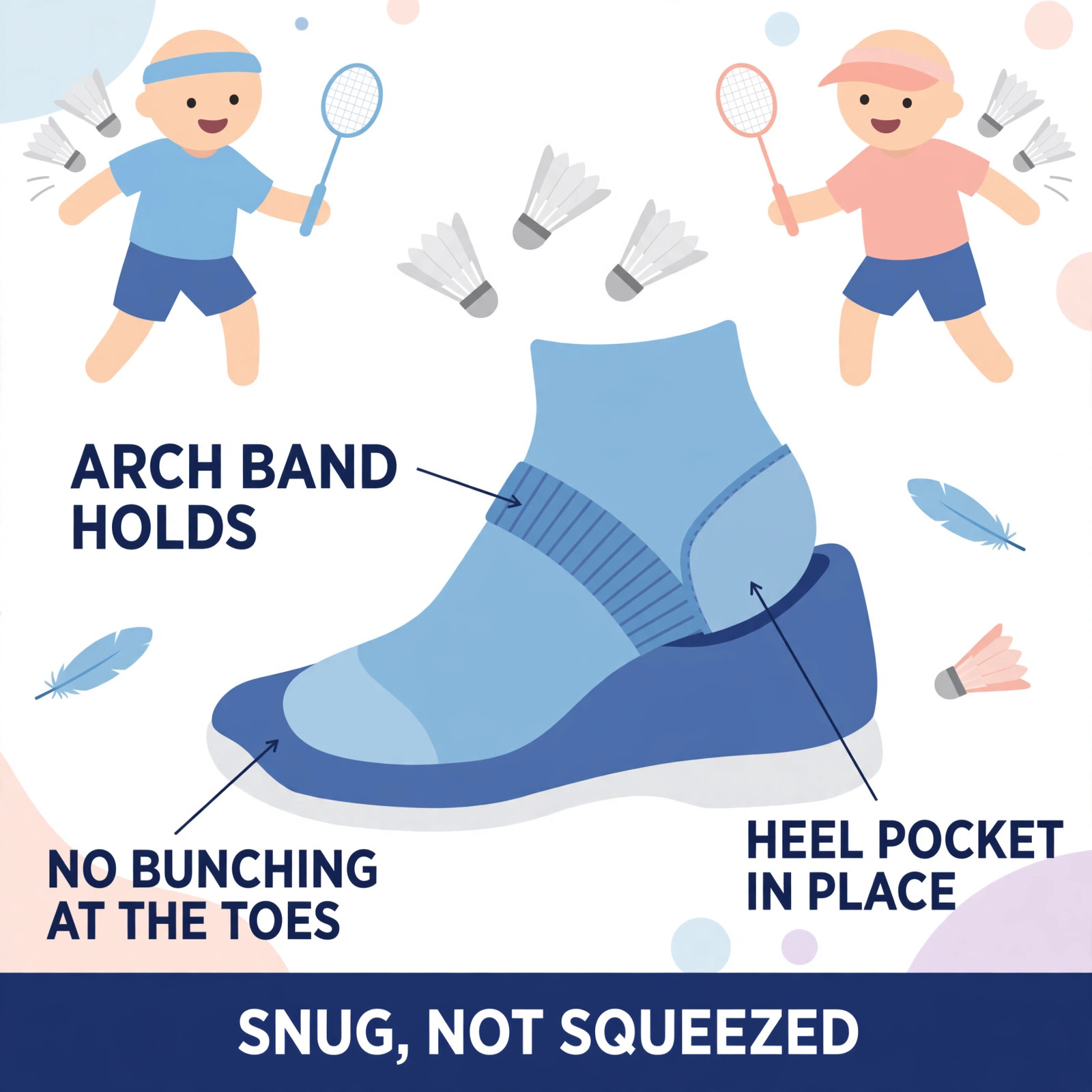
Sock Check #5
Care: Washing, Rotation and Replacing
Washing is simple and not optional. Sweat, skin and hall dust left in a sock stiffen the fibres and kill the cushion that justified buying it. Wash pairs after sweaty sessions, inside out so the terry loops get clean, with ordinary detergent. Skip strong heat when drying; tumble dryers and radiators age elastic faster than play does. In our weather, air drying in moving air works well and takes little time. A sock washed little and often keeps its spring; a sock washed rarely keeps its smell instead.
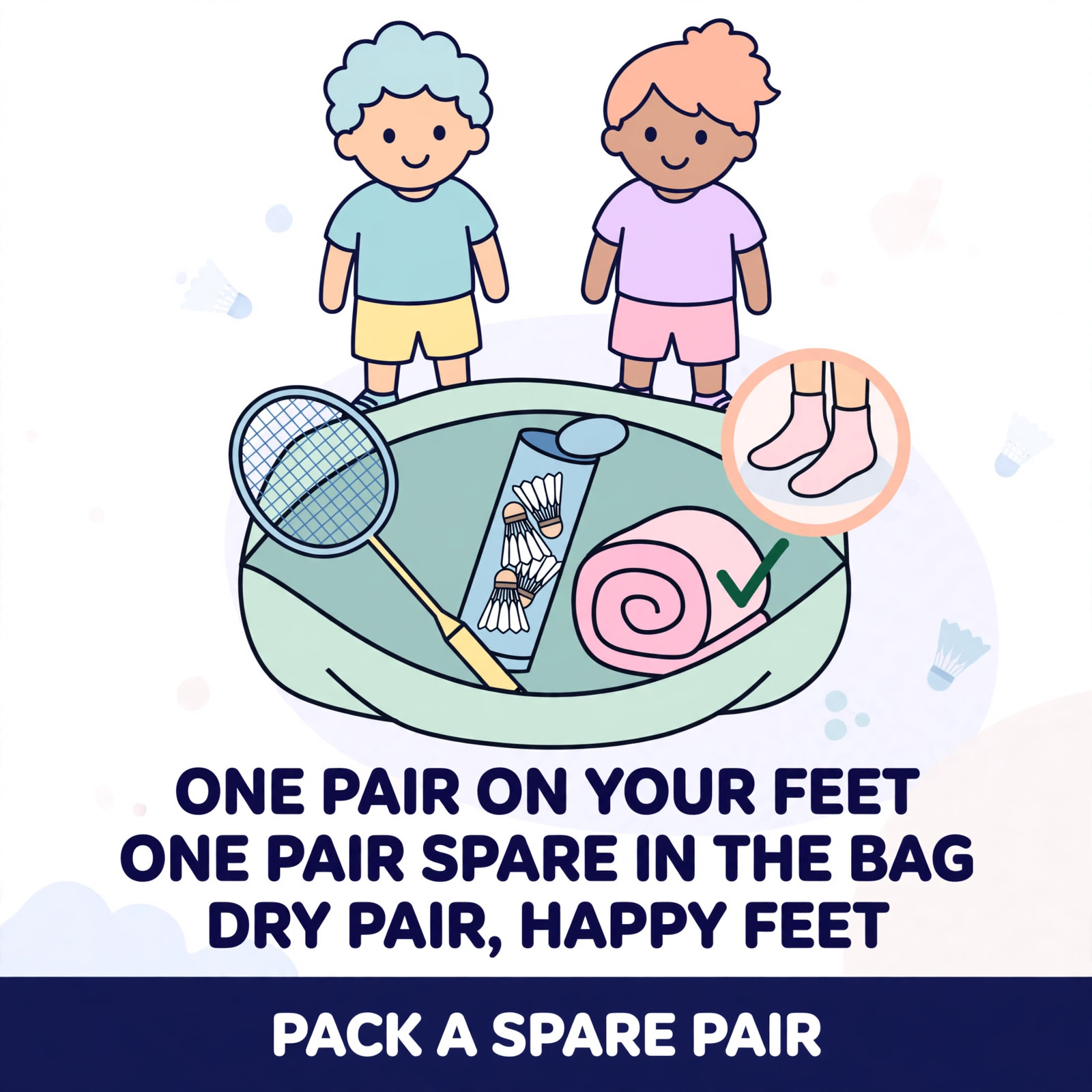
Rotation is the system that makes socks last and feet stay happy. Own at least as many good pairs as sessions in your week, plus one spare that lives in the kit bag. The spare earns its place constantly: a soaked pair changed at the break, a forgotten pair at home, a friend in need. Rotating also lets each pair dry fully and rest its elastic between outings. Store pairs dry and loose, not balled tight inside shoes, and let the shoes air too; the whole foot corner of the bag works as one system.
Replace socks by signs, not by season. A pair is finished when the heel or toe padding has gone thin and flat, when the elastic no longer holds the sock up through a session, when the fabric shines smooth where loops used to be, or when holes start at the heel or big toe. For a player training several times a week, good pairs give months of service before those signs gather. Socks are consumables, like grips: budget for their replacement calmly and your feet will never be the reason a session ends early.

Myth vs Reality
Myths About Badminton Socks
Myth one: the thickest sock is the most comfortable. Thick padding in the wrong places changes the shoe fit, lets the foot swim, and can make blisters more likely, not less. Comfort comes from targeted cushioning in a sock that fits snugly and stays put. Players who chase thickness usually end up loosening their laces to fit the sock, which undoes the shoe’s support. Judge a sock inside your own court shoes, moving, not by squeezing it in the shop.
Myth two: wearing two pairs of socks stops blisters. Two pairs can bunch against each other, trap heat, and thicken the foot until the shoe fit is wrong, and each layer can still rub. One well fitted pair with the right material does the job better. The exception thinking proves the rule: if two pairs seem to help, the real problem is usually shoe fit or a sliding single pair, and fixing that problem fixes the feet for good.
Myth three: cotton is natural, so it must be best for skin. Natural is not the same as suitable. Cotton’s talent is absorbing water, which is why towels are made of it, and why a cotton sock stays wet against your skin for hours. Synthetic sports fibres were invented for exactly this job: move moisture, dry fast, hold shape. Your skin does not care what a fibre is called. It cares whether it stays dry and unrubbed, and on court that means synthetics win.

Why Choose Us
Why Players Choose ST Badminton Academy
Feet come up in our classes more than parents expect, and coaches at ST Badminton Academy watch for the signs: a junior limping by the third game, a player hauling a sock up every rally, tape appearing on heels week after week. With a maximum of four students per group, these details get seen and named early. Most foot trouble in class traces back to simple causes: cotton socks, worn out pairs, or shoes a size off. The fix is usually cheap, quick and permanent once someone points at the real cause.
The academy does not sell socks, and that is deliberate. A coach with nothing to sell can tell a junior the sentence they most need: your socks are fine, spend nothing; or, these have gone thin at the heel, replace them before the tournament. Parents hear the same plain approach about pairs and rotation. Advice that sometimes says do not buy is the only advice worth trusting when it says buy, and small gear like socks is where that trust is built, one honest answer at a time.
Foot care is player education we want juniors to carry for life. A young player who packs a spare pair, airs shoes after sessions, and can say why cotton fails on court has learned to manage the base that all footwork stands on. That habit protects training time for decades, across every shoe and sock the shops invent next. At the academy, a two minute sock answer is never wasted time; it is injury prevention taught at the level a nine year old can use tonight.
FAQs: Badminton Socks, Comfort and Blisters in Malaysia (KL)
Here are the questions players and parents ask us most about badminton socks, cushioning, blisters, and how our coaches advise on foot gear in Kuala Lumpur and Setapak.
What socks should a junior wear for classes in Setapak or Gombak?
A cushioned sports sock in a synthetic blend, sized to the shoe, with padding at the heel and forefoot and a snug arch. Cotton school socks soak and slide, so save them for school. One good pair for class and a spare in the bag cover most junior weeks without fuss.
How thick should badminton socks be for training in KL?
Thick at the heel and forefoot, close fitting everywhere else. Total thickness is the wrong measure; a very thick sock can spoil the shoe fit and let the foot swim. Turn the sock inside out and feel for springy terry loops where the load lands. That is the thickness that counts.
How many pairs of socks does a player need if they train at a steady level?
As a working minimum, one pair per weekly session plus a spare for the bag: three sessions a week points to four pairs. Rotation lets every pair dry fully, keeps elastic alive longer, and means a soaked or forgotten pair never cancels a session or starts a blister.
Can cushioned socks stop blisters completely, or only help reduce them?
No pair of socks can promise zero blisters, because blisters also grow from shoe fit and long, wet sessions. Good socks cut the risk a lot by reducing sliding and keeping skin drier. Add trimmed nails, an early answer to hot spots, and a spare pair, and blisters become rare.
What should I check before buying socks for classes?
Check the inside first: springy padding at heel and forefoot, a smooth toe finish, a snug arch band and a heel pocket that matches your heel. Then check the material label for a synthetic blend, and finally try the pair inside your court shoes with a few lunges before committing.
Do your coaches check shoes and socks for students near Wangsa Maju?
Yes, when the gear is on the feet in front of them. Sliding socks, thin heels and soaked cotton all show themselves during footwork drills. Coaches near Wangsa Maju and Setapak give the same checks as this guide and will say plainly when socks are fine, worn out, or simply the wrong material.
Does your academy sell socks or just advise players in Malaysia?
We advise; we do not sell socks. Coaches explain what a sock must do and how to check fit and padding, then families buy wherever suits them, or decide the current pairs are fine. The academy earns its living from coaching, which keeps its gear advice free of sales pressure.
How long does a good pair of badminton socks last with regular training?
Looked after, good sports socks give months of regular training. Wash them gently, air dry them, and rotate pairs so elastic rests. Thin padding at the heel, a sock that will not stay up, or shiny worn patches are the honest end signals, usually after a season of steady use.
What makes Mr Eric Chuar a good coach for honest gear advice for badminton?
Mr Eric Chuar has coached for over 15 years and answers small gear questions with the same honesty as big technique ones. He starts with what the item truly does, names the checks anyone can run, and refuses to dress ordinary socks up as performance magic. Players trust advice that stays straight about small things.
Badminton Socks and Foot Comfort in Action
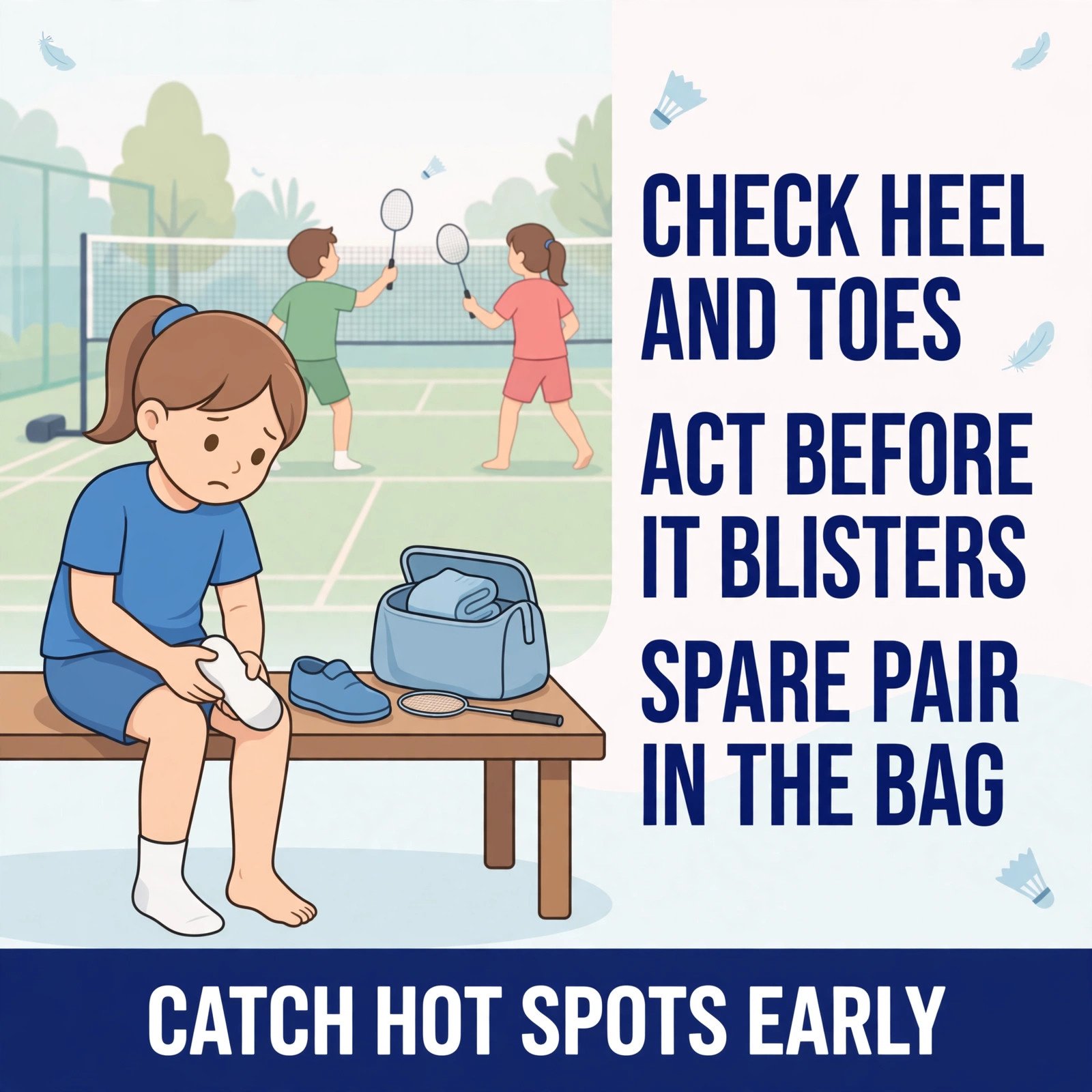


One Standard for Every Player and Every Session
The academy's standard for sock advice matches its coaching standard: say what the item does, say what it does not do, and let the player decide with clear checks. Nobody at ST Badminton Academy will tell a junior that a special sock will transform their footwork. We will tell them how to choose a pair that cushions, grips and dries, and how to care for it well.
| Factor | Chosen by Habit | Chosen by Checks SOCK |
|---|---|---|
| Frequency | 1 or 2 times a week. Mostly for fun and sweat. | A sock picked by its three jobs: cushion, grip and moisture control. |
| Drills Focus | Basic static feeding. Minimal footwork pressure. | Padding felt on the inside, springy at the heel and forefoot. |
| Physical Conditioning | Rarely included. Just playing games on court. | Core, agility, and speed training included in every session to prevent injury and build stamina. |
| Tactical Awareness | "Just hit it over." No real game plan. | Video analysis, point construction, and learning to read the opponent's game. |
| Coach Ratio | Large groups (8-10 kids). Coach barely watches you. | Max 4 students. Mr Eric Chuar personally corrects every stroke and movement detail. |
| Goal Setting | Fun and exercise. | Pairs washed, aired and rotated so feet start every session dry. |
| Long Term Result | Good recreational player. | A player who finishes three games with quiet, comfortable feet. |
Badminton Coaching and Honest Gear Advice in Kuala Lumpur
Comfortable feet are quiet feet, and quiet feet move well for three games. Choose socks by their three jobs, cushion, grip and dryness, fit them snugly, wash and rotate them, and replace them when the padding gives up. If your child trains with us at ST Badminton Academy in Setapak, Kuala Lumpur, ask any coach to look at the socks and shoes together. We will give you the straight answer, even when the straight answer is that the current pair is fine.






