How To Master Badminton Footwork: Agility And Movement Techniques (Footwork Guide)
Ask strong players what separates them and most will not name a shot. They will name their feet. Footwork is the system that carries you to every shuttle early enough to choose your shot, and it is the first thing that deserts players when they tire late in matches. This guide treats footwork as one system rather than a bag of tricks: six movement patterns around a single base, a start and a landing for every pattern, a recovery that counts as half the work, and shadow routines that groove the whole system until your feet stop needing instructions from your head.
Footwork Check #1
One System: Six Ways to Move on a Badminton Court
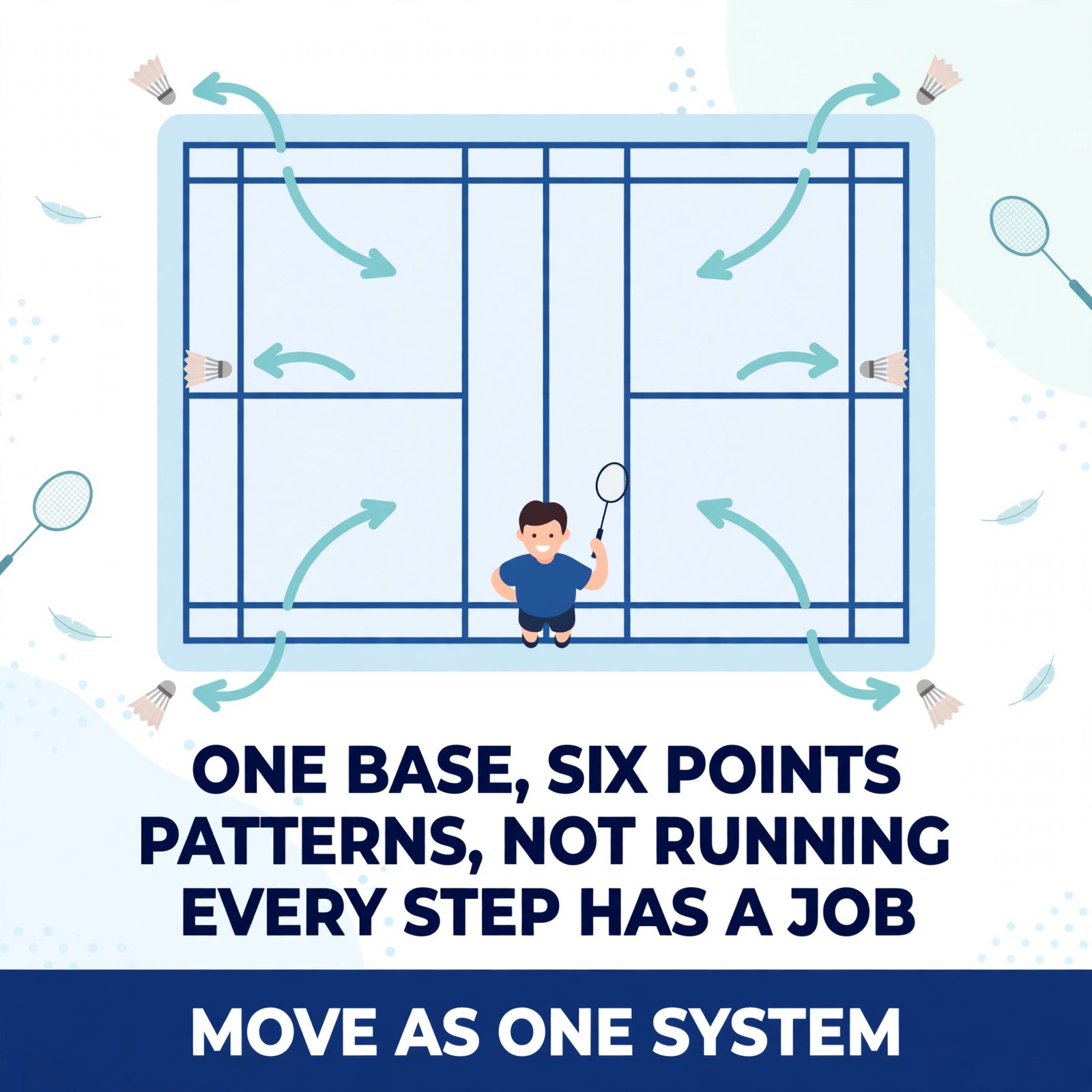
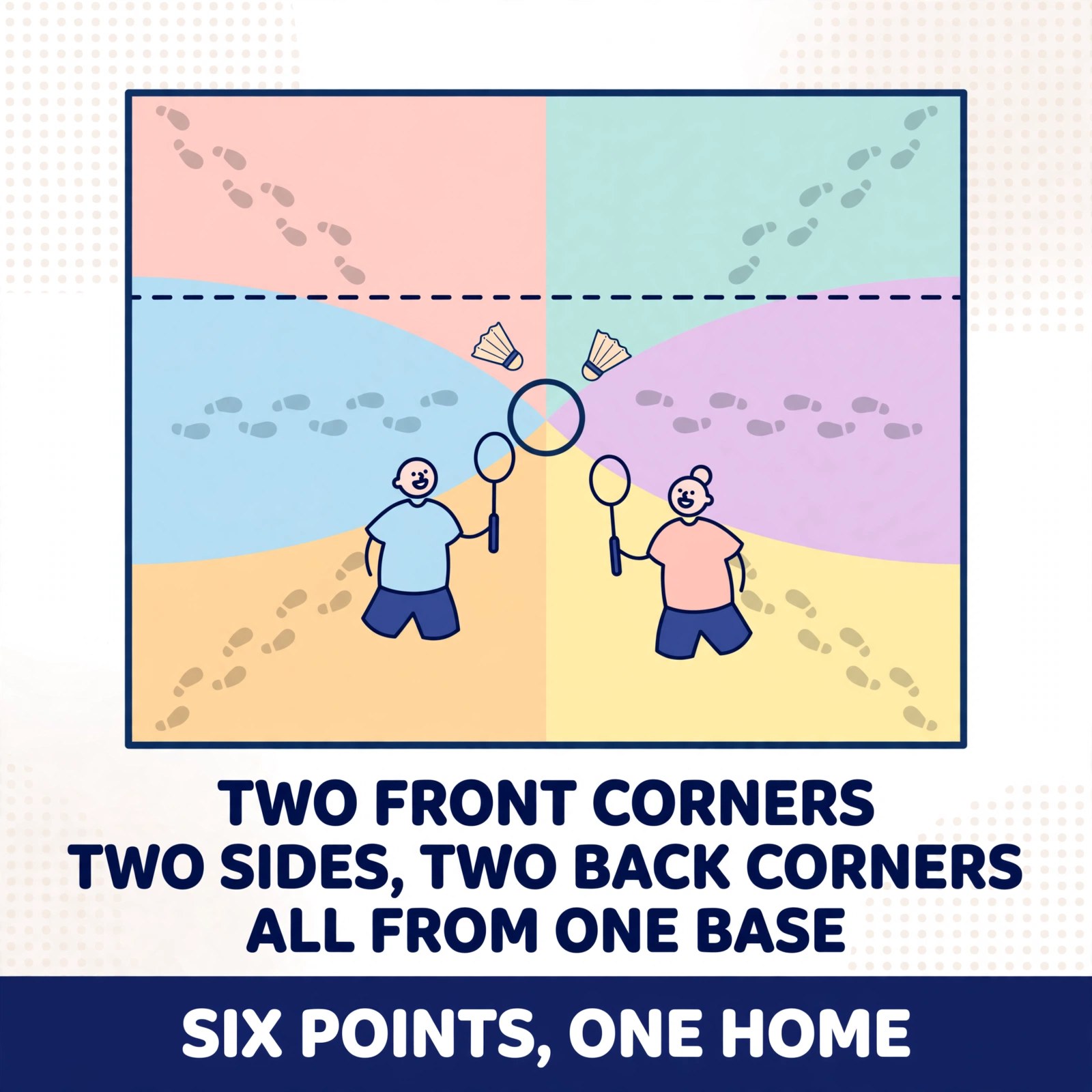
Every shot you play starts and ends at the same home: a base position a step behind the centre of your court, feet apart, knees bent, racket up in front. From that home, the court divides into six points you must be able to reach: the two front corners at the net, the two sides at mid court, and the two back corners behind you. Six points, six patterns. Each pattern is a small sentence of steps built from the same grammar: a split step to start, steps out to travel, a lunge or a turn to finish, then the recovery home.
Learning the system as six patterns changes how you practise. Instead of running wherever the shuttle goes and hoping fitness covers the gaps, you match the shuttle to a pattern you already own. Front forehand corner: one pattern. Deep backhand corner: another, with its own steps and its own way home. Patterns can be counted, frozen and corrected in a way that scrambling never can. That is why players with a system look calm at speeds that exhaust fitter opponents in the same rally. They are not moving more than everyone else. They are moving in sentences instead of syllables.
Footwork Check #2
Start and Stop: The Split Step and the Landing
Every pattern starts with the split step, the small hop that lands as your opponent strikes the shuttle. Land with both feet together, knees bending to load the legs, weight forward on the front of the feet, and the hop becomes a spring pointed at wherever the shuttle goes. Timing is the whole skill: land too early and the load is spent before you know the direction; land too late and you are still in the air while the shuttle travels. The split step is not a jump for height. It is a question you ask your legs just before you need their answer.
The landing at the far end of the pattern matters just as much. Lunges land heel first, the foot rolling flat and the knee in line with the toes, so the same leg can push you home afterwards. Overhead shots land through the scissor kick, one leg swinging back as the other comes down, turning your body toward the court while you are still in the air. A good landing is quiet and organised: feet under the hips, chest up, eyes already hunting the reply. A bad landing spends the next two steps on rescue work instead of badminton.
Start and stop are where patterns break down in matches. Players rush the start when they guess, leaving before the shuttle is struck and arriving nowhere useful at all. They neglect the stop when they lunge so far that the shot becomes a fall they must catch. The honest tests are simple to run. Can you freeze at the end of your lunge, racket steady, for a full second? Can you land from a jump and step forward at once, with no stumble step in between? If not, the pattern is not yours yet at that speed, whatever your drill results suggest.

Footwork Check #3
The Way Back: Recovery Is Half the Pattern
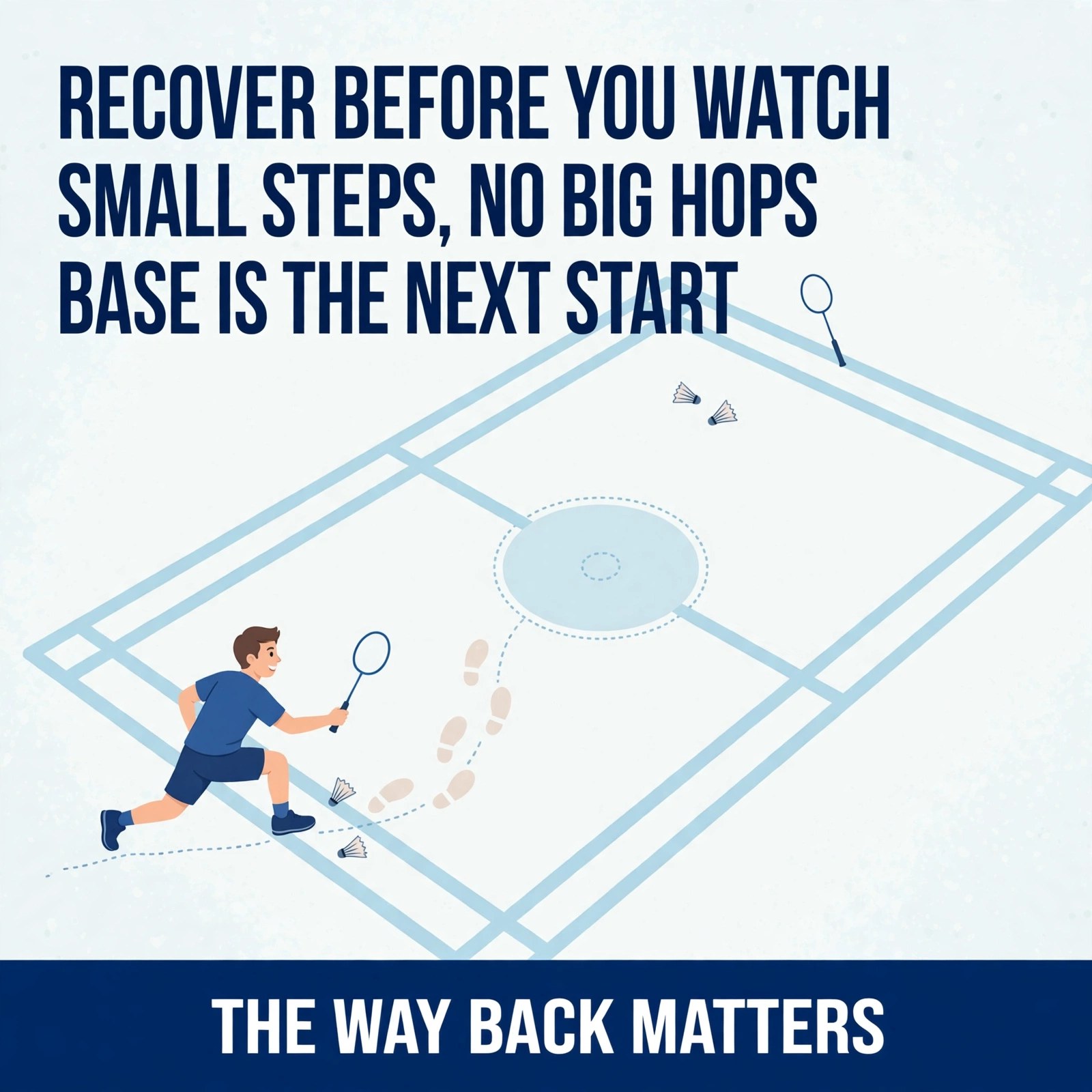
Coaches say the recovery is half the pattern, and it is the half most players skip. After the shot, your job is not finished; it has barely turned around. Push back from the lunge through the heel, take small quick steps home, and arrive at base early enough to split step for the next shuttle. The rally does not pause while you admire your shot. Every second spent out of position is borrowed from the next exchange, and the interest on that loan is charged in late arrivals, stretched replies and easy winners played past you.
Recovery has a rhythm you can hear when it is working. Push, step, step, arrive, split. When the rhythm holds, your breathing settles into it and long rallies feel organised even at full pace. When it breaks, you hear the scramble instead: big hops, crossed feet, heels striking the floor hard. Train the way back as a skill in itself. In shadow practice, count a rep as finished only when you are home and split stepping, not when you touched the corner. Corners are easy to visit for a moment. Home is where rallies are actually played from.
There is an economy to good recovery. Small steps cost less than big ones, arriving early costs less than arriving late, and a body that stays low spends nothing on standing up and crouching down again between shots. This is why system players look fresh in third games against opponents who ran just as far in the first two. They spent their energy on shuttles; the others spent theirs on travel. Footwork mastery is mostly this: the same distance covered at a lower price, rally after rally, until late in matches your feet are still arriving on time.
Footwork Check #4
Rhythm and Reach: Lunges, Chasses and Scissor Kicks
Three tools do most of the travelling inside the patterns. The lunge covers the final reach to the front and the sides: a long last step, heel first, knee tracking over the toes, free arm reaching back for balance. The chasse is the quick shuffle for mid distance work, feet moving together without crossing, body staying sideways and low. The scissor kick serves the back corners, turning you in the air so your landing already faces the court and the way home. Each tool owns a distance; mastery is choosing the right one without stopping to think.
Choosing wrong is expensive. Lunging from too far away dumps your weight past your front foot and strands you at the net while the rally goes elsewhere. Chassing all the way to a deep corner wastes the steps a scissor kick would have saved. Running backwards, the habit every coach works to remove, is slowest of all and takes your eyes off the shuttle at the worst moment. Patterns exist to make these choices automatic. When the shuttle leaves your opponent’s racket, the corner names the pattern, the pattern names the tool, and your feet move while others are still deciding.
Rhythm ties the tools together. Badminton movement is not a series of separate sprints; it is a beat that speeds up and slows down with the rally: split, travel, strike, recover, split. Players with rhythm look unhurried even in fast exchanges because their beat never breaks underneath them. Players without it look rushed in slow rallies because every movement starts late and ends in a small stumble. Build rhythm the way musicians build it: slowly, with counted repetitions, until the beat holds at speeds your conscious mind could never conduct step by step.

Footwork Check #5
Shadow Routines: Grooving the System Without a Shuttle
Shadow footwork is where the system gets installed. No shuttle, no partner, just you, the six points and one standard: every rep starts with a split step, finishes in a balanced freeze, and comes home before the next one begins. Shadow work feels easy to skip because nothing is being hit, yet it is the only practice where movement gets your full, undivided attention. Ten honest minutes of shadow tells your feet more than an hour of games where your mind was busy with winning points and watching scores.
Structure shadow work like a musician’s scales. Begin with one pattern at a time at walking pace, freezing at each corner to check your shape: heel down, knee in line, chest up, racket sitting where the shot would need it. Add patterns into pairs, then into random orders called out by a training partner standing at the side. Speed comes last and only in small steps. The rule is strict: the moment your shape breaks, the pace was too much, and the correct response is to slow down, not to push through sloppiness and groove that instead.
Make shadow work a habit small enough to keep. A short set before training begins, a few patterns while the court is being swept, a home routine in a hallway with the furniture pushed back for ten minutes. Little and often installs systems; rare and heroic sessions mostly install soreness. Keep a simple log of which corner still arrives late in matches. That corner becomes next week’s theme, and themes chosen by evidence are how a system keeps growing after the basics are learned. Your feet are being programmed either way; shadow work is how you choose the programme.

Myth vs Reality
Myths About Badminton Footwork
The first myth says footwork is just speed, that the fastest runner on the court has the best feet. Speed without patterns is only a quicker way to arrive unbalanced. Watch a strong player and a fast sprinter play the same rally: the sprinter reaches the shuttle and falls through the shot, while the player arrives, stops, hits and is home again before the reply comes. Footwork is the art of arriving organised. Raw speed is one ingredient in that art, and it is not the first one a good coach reaches for.
The second myth says more running is the answer: longer runs, more court sprints, heavier legs in training. Fitness supports footwork, but it cannot replace it. A fit player with no patterns still starts late, travels the long way round and recovers to the wrong place; they simply manage it for longer before tiring. Patterns first, then fitness to power them. The order matters because grooving steps into tired legs teaches the tired version of the steps. Fresh feet learn the pattern properly. Fit feet then make it last all match.
The third myth credits talent: some players are simply born movers. Born movers exist, but what looks like a gift is usually a system installed young and repeated thousands of times until it looks natural. Every element of that system, the split, the lunge, the chasse, the scissor kick and the recovery, can be named, shown and practised by any player willing to work slowly. Talent may set the speed of learning. It does not change the syllabus. The syllabus is the same six points, and it is open to everyone who shows up.

Why Choose Us
Why Players Choose ST Badminton Academy
At ST Badminton Academy, footwork is coached as the system it is. Players learn the six patterns one at a time, with the split step, the travel, the finish and the recovery checked as separate parts before they are joined into a whole. Coaches freeze players at corners and ask the honest questions: where is your weight, where is your racket, can you move again from here without a stumble? A pattern that cannot survive a freeze does not get speed added to it. That patience is why our players’ movement still holds together in the third game.
Sessions mix shadow work, feeding and conditioned games in that order. Shadow installs the shape, multi shuttle feeding loads it with real arrivals and departures, and games test whether the pattern survives an opponent who is actively trying to break it. Groups stay small, with a maximum of 4 students, so your feet are watched on every circuit, not sampled now and then. Progress is counted in clean reps and in corners that stop arriving late, and it is reviewed openly with you at the end of each block.
Honesty matters in footwork coaching. We will tell you when a corner is still late, when your recovery is a hop instead of steps, and when your speed has outrun your shape. What we will not promise is lightning feet inside a month. Systems are installed over months of short, correct practice, and they keep improving for as long as you keep playing. The reward for that patience is large: shots you used to watch land become shots you reach, and rallies you used to survive become rallies you run.
FAQs: Badminton Footwork, Agility and Movement in Malaysia (KL)
Below are the questions players ask us most about footwork and movement at ST Badminton Academy. If your question is not here, bring it to a trial session and we will watch your feet on court, where movement is easier to judge than to describe.
Can a beginner master basic footwork patterns in Setapak or Gombak?
Yes, if master means learning the system in the right order. Beginners start with the base position, the split step and one front corner pattern, all at walking pace with freezes. Each new pattern is added only when the last one holds its shape. Slow, correct and patient beats fast and tangled at every level.
What is the first footwork pattern to learn in KL?
The base and the split step come before any corner. From a low base behind the centre, practise landing the split step as a partner strikes a shuttle, then pushing one step in the direction shown. Once the start is automatic, the front forehand corner is usually the first full pattern players groove.
How many movement patterns does the footwork system use at club level?
Six. The system reaches six points from one base: two front corners, two sides and two back corners. Each point has its own pattern of steps out, a finish and a recovery home. Six sounds like a lot, but the patterns share the same start and the same way back, so they learn like one family.
I am quick in drills but slow in matches. Should I train speed or patterns first?
Patterns first, then speed. Matches expose patterns that drills forgive, because the starts are random and the pressure is real. Groove each pattern slowly in shadow work until the shape survives freezes, then load it with feeding, then test it in conditioned games. Speed added to a broken pattern just breaks it faster.
How can I practise footwork alone at home without a court in training?
Yes. Shadow footwork needs a few square metres, not a court. Move to imaginary corners slowly, freeze, check your shape and come home. Add the lunge and the scissor kick shape once the base patterns hold. Keep sets short and stop while your shape is clean; tired, sloppy reps teach the wrong programme.
Do you coach footwork and movement near Wangsa Maju?
Yes. Footwork coaching runs on court at our Setapak base and in nearby Wangsa Maju. Sessions install the six patterns in order, with freezes and counted clean reps before any speed is added. Groups stay small, with a maximum of 4 students, so your feet are watched and corrected on every circuit.
Where does ST Badminton Academy teach footwork in Malaysia?
Our base is in Setapak, Kuala Lumpur, and players join us from across the city and from Singapore. Footwork is built into all our coaching for juniors and adults, from a first split step to full six point circuits under feeding. Bring your current movement and we will show you honestly where it leaks time.
How do I book a trial session to check my footwork?
Send us a message on WhatsApp or through the website and tell us your level. We will suggest a session time and explain what to bring: court shoes, sports clothes and a water bottle. In the trial we will watch your six patterns, freeze you at the corners and tell you honestly what we saw.
What makes Mr Eric Chuar a suitable coach for footwork and movement badminton?
Mr Eric Chuar coaches feet before shots. He checks your split step timing, your landings and your way home, and corrects the pattern that is costing you time before touching your strokes. With more than 15 years of coaching, he knows movement is the base every shot stands on, so he builds it first.
Badminton Footwork Training in Action


One Standard for Every Session and Every Player
Every footwork session at ST Badminton Academy follows the same standards. Patterns are installed slowly and frozen at the corners before any speed is added. Reps are counted by clean shape, not by exhaustion. Groups stay small, with a maximum of 4 students, so movement faults are seen and corrected in the session where they happen. Progress is reviewed against your corners and your recovery home, and speed is earned, never assumed. These standards hold for every player, from a first split step to advanced circuits under match pressure.
| Factor | Running Around | One Footwork System FOOTWORK |
|---|---|---|
| Frequency | 1 or 2 times a week. Mostly for fun and sweat. | Every corner has a pattern: split step to start, steps out, a finish, then the way home. |
| Drills Focus | Basic static feeding. Minimal footwork pressure. | Movement begins at base and returns to base, so the next shot is already being prepared. |
| Physical Conditioning | Rarely included. Just playing games on court. | Core, agility, and speed training included in every session to prevent injury and build stamina. |
| Tactical Awareness | "Just hit it over." No real game plan. | Video analysis, point construction, and learning to read the opponent's game. |
| Coach Ratio | Large groups (8-10 kids). Coach barely watches you. | Max 4 students. Mr Eric Chuar personally corrects every stroke and movement detail. |
| Goal Setting | Fun and exercise. | Patterns are grooved slowly in shadow work, with freezes, before any speed is added. |
| Long Term Result | Good recreational player. | A system mover: calm feet, early arrivals and energy still left in the third game. |
Badminton Footwork Coaching in Kuala Lumpur
Your shots are only as good as your arrival. Come to ST Badminton Academy in Kuala Lumpur and install the system: six patterns, one base, and a way home you can trust. Book a trial session, bring your court shoes, and we will show you exactly where your feet stand and what they can become.






