Find The Best Local Badminton Clubs In Your Area (Club Guide)
Most badminton in Kuala Lumpur is played in clubs: weekly court bookings, a regular group, and games that run whether you show up or not. A good club is the cheapest way to play more badminton, and the fastest way to find regular opponents at your level. A poor fit, though, wastes months: courts at the wrong level, games that never include newcomers, or a group where your shuttles pay for everyone else’s night.
This guide explains how to find the best local badminton clubs in your area in KL: what kind of club to look for, where to find them, what to check on a trial visit, and how to become the kind of member every club is glad to have.
Club Check #1
Club, Social Group or Academy?
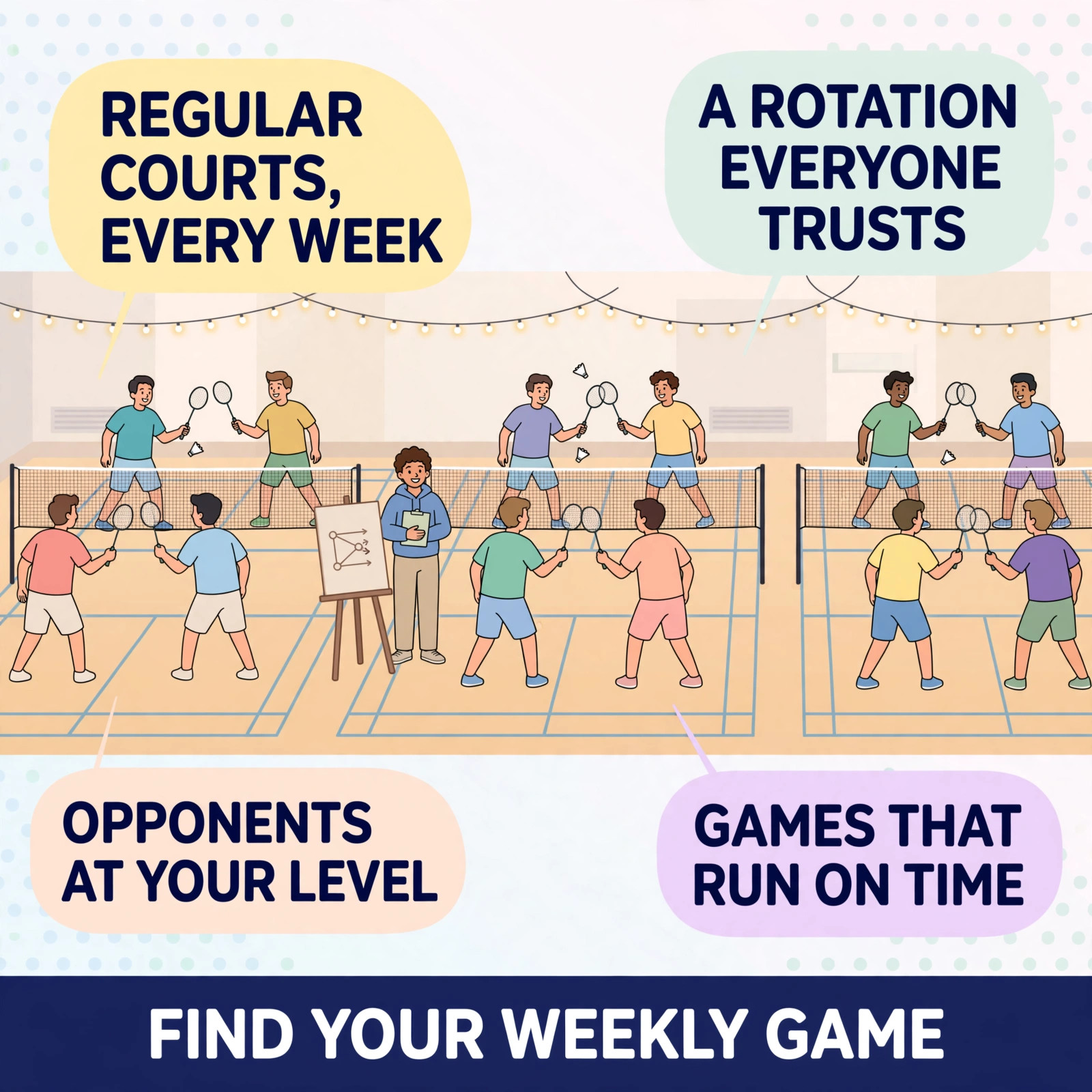
Not every weekly game is the same thing. A club is an organised group: it holds regular court bookings, keeps a list of members, usually runs a rotation so everyone plays, and often has someone in charge of shuttlecocks, fees and standards. That structure is what makes a club better than hoping a friend books a court. When you join a club, you are buying ready-made badminton, every week, at a set time.
A casual social group is looser: friends who book when they feel like it, no fixed rotation, standards set by whoever turns up. Social groups are friendly and cheap, and they suit players who only want games. The third option is not a club at all: coached training at an academy, where the point is learning rather than playing. Many KL players hold two memberships of the mind: a club for games, and coaching for improvement. Knowing which one you are looking for saves a lot of wrong trial visits.

Club Check #2
Where Good Clubs Hide
Start where badminton players already are. Ask players at your current hall, your stringer, and coaches you know which clubs run near you and what level they play at. Local knowledge is gold here, because clubs rarely advertise: a strong club with a waiting list has no reason to post anywhere. One honest sentence from a player who has been (“great rotation, but the games run late and strong”) tells you more than any listing.
Then search online the way players actually organise: community groups, club pages and hall noticeboards. Look for three signs of a living club: recent posts, a named organiser you can message, and a regular day and time that repeats. Message the organiser before visiting: say your level honestly, ask how the rotation works, what the guest fee is, and whether the level suits a player like you. Good organisers answer clearly, because they are protecting their group’s balance too.
Shortlist two or three clubs, then visit each once as a guest. One visit is enough to feel the level, the courts and the welcome. Do not sign up for the first club that says yes: the right club should survive comparison. Keep the search local. A club ten minutes from home that you attend every week beats a famous club across the city that you visit twice and quietly stop driving to.

Club Check #3
The Trial Visit: Courts, Rotation, People
Judge the courts first. Proper badminton courts have mats or a wooden floor with grip, lines you can read, and nets set at 1.55 metres at the posts and 1.524 metres in the centre. Lighting matters more than most players realise: you should be able to follow a clear against the ceiling without losing it in glare. Ask how many courts the club holds and for how long; a club with two courts and thirty players spends your night sitting.
Judge the rotation next. A fair club has a visible system: names on a board, pegs, or a simple order the organiser runs, so guests and quieter members get games too. Watch who plays with whom. If the strongest four monopolise a court all night while newcomers wait, that is the club’s real culture, whatever the organiser promised. Courts are usually shared with feather or nylon shuttlecocks provided by the club; check whether the shuttle quality matches the level of games, because worn shuttles ruin good rallies.
Judge the people last, and judge them seriously. You are choosing the room you will spend two evenings a month, or a week, inside. Are new players greeted? Do stronger players mix down a level sometimes, the way good clubs ask them to? Is the level honest: close games for most of the hall, not one superstar collecting scalps? The best local club for you is the one whose standard stretches you slightly: you lose more than you win at first, but every game teaches you something.

Club Check #4
Games or Coaching?
Here is the honest difference. Club nights give you games: real rallies, real opponents, and the match instincts that only playing builds. What club nights rarely give you is correction. Nobody stops your rally to fix your grip, and the same leak can survive a year of club games, because opponents exploit it and teammates are too polite to rebuild it. Players hit a ceiling at clubs for exactly this reason: plenty of games, no teaching.
Coaching gives you the mirror image: technique fixed properly, footwork rebuilt, drills that target your leak, but fewer real opponents. The strongest setup for most improving players is both: a club night for games and an academy session for fixes, each feeding the other. Your coach spots the leak on Tuesday; your club games on Thursday test whether it is fixed under pressure. If you must choose one, choose by your problem: stuck technique needs coaching; sharp technique with poor match sense needs games.
At ST Badminton Academy KL, our classes are capped at max 4 students per group precisely because correction needs small numbers. Club players join us to fix one thing at a time: the backhand corner that club opponents keep finding, the serve that gets rushed, the doubles rotation that breaks down. Bring your club problem to training, fix it in drills, then take it back to your club night and enjoy the difference your opponents notice before you do.

The Good Member
Costs, Value and Being Welcome Back
Ask about costs in general terms, and ask before you commit. Clubs usually split the world three ways: court fees divided among players, a shuttle contribution per session or per shuttle used, and sometimes a small membership fee that covers bookings and kit. Guest visits normally cost a little more than member rates. The numbers differ from club to club and hall to hall, so anyone quoting you an exact figure for clubs in general is guessing. What you can judge is fairness: are costs shared openly, and does the organiser account for them without being asked twice?
Value is easier to judge than price. A slightly dearer club with three courts, a fair rotation and good shuttles gives you more badminton per evening than a cheap club where you play two games and sit for two hours. Count your games on the trial visit. Four or five proper games in a session is a good night. One or two is a social evening with rackets, which is fine if that is what you wanted, and a poor buy if you came to improve.
Last, be the member clubs keep. Arrive on time, pay your share without chasing, rotate off when the system says so, and bring the right spirit: compete hard inside the rally, be gracious outside it. Offer to play with the new guest once a night; every strong club runs on members who do this. Players who are easy to organise get invited everywhere, including the stronger sessions that never advertise. In KL’s badminton world, your reputation travels faster than your smash.

Myth vs Reality
Myths About Local Clubs
Myth: “The best club is the one with the strongest players.” Reality: the best club is the one slightly above your level, where games are close and you play all night. Joining a hall of players far stronger than you usually means watching them play: strong groups protect their games, and a guest who cannot hold a rally sits out the rotation.
Myth: “Club games alone will keep improving your badminton.” Reality: games build match instincts, but they rarely fix technique. The same grip or footwork leak can survive years of club nights untouched. Myth: “You must commit for a year before trying.” Reality: nearly every club welcomes guest visits first. One honest trial night tells you the level, the courts and the culture better than any description.
Myth: “Clubs and coaching are rivals, so you must pick one.” Reality: they do different jobs. Clubs give you opponents and matches; coaching gives you correction and drills. Most improving players in KL use both, and each makes the other more valuable: coaching fixes the leak, club games prove the fix under pressure.

Why Choose Us
From Club Nights to Real Fixes
Many of our students at ST Badminton Academy KL found us through their clubs: a regular club night showed them exactly which shot kept costing them games, and they came to training to fix it. That loop, play, notice, fix, play again, is the fastest improvement path most adult players ever find, and it starts with picking the right rooms to play in.
Mr Eric Chuar has over 15 years of coaching experience in Singapore and Malaysia, and he gives club players the same advice he gives beginners: judge a room by your games, not its reputation. Count your rallies on the trial night. If you played plenty, were stretched a little, and were treated fairly by the rotation, you have probably found your club.
Our academy is based in Setapak, Kuala Lumpur, convenient for players from Wangsa Maju, Melati Utama, Danau Kota and Gombak. If your club games have shown you a weakness you want fixed, message us. Tell us what your opponents keep doing to you, and we will tell you honestly what training would fix it, in groups of max 4 students.
FAQs: Finding a Local Badminton Club in Malaysia (KL)
These are the questions players ask us most about finding a local badminton club in KL. If your question is not here, message us, tell us your area and your level, and we will give you a straight answer about what to look for and how to judge the clubs you visit.
How do I find a good badminton club if I live in Setapak or Gombak?
Start by asking players, stringers and coaches which clubs run near you, then message the organiser of two or three and visit each once as a guest. In Setapak and across KL, the right club is the one slightly above your level, with a fair rotation and courts close enough that you will actually go every week.
What should I check first when I visit a club in KL?
Check the courts and the rotation first: proper courts, nets at the right height, and a visible system that gives every member games. Then check the level and the welcome: close games, stronger players mixing in, newcomers greeted. A club that passes those checks on a trial night is worth joining; one that fails them rarely improves later.
How often do local clubs play each week at a steady level?
Most clubs run one or two set sessions a week, at a regular day and time, and that rhythm is the point: badminton that happens whether motivation shows up or not. Ask the organiser for the current schedule before visiting, and pick the club whose nights fit your real week, not the week you wish you had.
Can a school player join a local club while still in school?
Yes, junior players join clubs too, and a school player with club games plus school training improves quickly. Look for a club that welcomes younger players and runs an honest rotation, and ask how juniors are included in games. Many parents pair club games with coached classes, so technique grows alongside match experience.
What should I check on a trial night before I join a club I enter?
Count three things on the visit: how many proper games you played, whether the level stretched you without shutting you out, and whether the rotation treated a guest fairly. Then ask yourself the simplest question of all: would you drive back here next week, gladly? If the answer is yes to all of it, join.
Do you know badminton clubs near Wangsa Maju?
Our academy is in Setapak, a short drive from Wangsa Maju, Melati Utama and Danau Kota, and our students play at clubs across this side of KL. We cannot list clubs’ details for you, but tell us your area and level and we will explain what to look for, and what questions to ask an organiser before you visit.
Does your academy coach club players who play in Malaysia?
Yes, ST Badminton Academy coaches many club players in Malaysia, in small groups of max 4 students. Club nights show you your weaknesses under pressure; our sessions fix them with drills and correction. Bring the shot your club opponents keep targeting, and we will rebuild it, then you test it at your next club night.
Where is ST Badminton Academy KL located for club player training?
ST Badminton Academy KL is based in Setapak, Kuala Lumpur, convenient for players from Wangsa Maju, Melati Utama, Danau Kota and Gombak. Our classes run in small groups of max 4 students. Message us before your first session and we will confirm the venue details and what to bring for your trial.
What makes Mr Eric Chuar a suitable coach for club players and badminton?
Mr Eric Chuar has over 15 years of coaching experience in Singapore and Malaysia, and club players value his eye for the one leak that costs games: he watches your rallies, names it plainly, and builds the fix into drills. Students get one clear focus at a time, tested in games before the session ends.
Local Badminton Clubs in Action


What It Takes to Choose a Club Well
A player chooses a club well when five habits hold: the level stretches without shutting out, the rotation is fair and visible, games per night are plenty, costs are shared openly, and the club sits close enough to attend weekly. Our club standards below are the checkpoints we give players before they join anywhere.
| Factor | Joining Blind | Visiting First VISIT |
|---|---|---|
| Frequency | 1 or 2 times a week. Mostly for fun and sweat. | Two or three clubs shortlisted, each visited once as a guest before deciding. |
| Drills Focus | Basic static feeding. Minimal footwork pressure. | Courts, rotation and welcome checked in person, because culture shows on the night. |
| Physical Conditioning | Rarely included. Just playing games on court. | Core, agility, and speed training included in every session to prevent injury and build stamina. |
| Tactical Awareness | "Just hit it over." No real game plan. | Video analysis, point construction, and learning to read the opponent's game. |
| Coach Ratio | Large groups (8-10 kids). Coach barely watches you. | Max 4 students. Mr Eric Chuar personally corrects every stroke and movement detail. |
| Goal Setting | Fun and exercise. | Level judged honestly: stretched a little, playing plenty, learning every game. |
| Long Term Result | Good recreational player. | A member of the right club: regular games, real opponents, steady improvement. |
Local Badminton Clubs in Kuala Lumpur
This page covered finding a local badminton club in KL: club types, where to look, what to check on a trial visit, games versus coaching, costs in general terms, and being a good member. ST Badminton Academy KL coaches club players in small groups of max 4 students in Setapak. Message us to fix what your club games expose.






