Badminton And Foam Rolling: Techniques For Muscle Recovery (Recovery Guide)
Badminton is unkind to legs. A hard session is hundreds of lunges, split steps and sudden stops, and the bill arrives the next morning: tight calves, heavy quads, a back that complains when you tie your shoes. Foam rolling is the simplest tool we know for answering that bill. It is self massage with a cylinder of firm foam: you use your own body weight to press slowly into the muscles that worked hardest, and many players find the tight, tender feeling eases. This guide covers foam rolling the way we teach it at ST Badminton Academy in Setapak, Kuala Lumpur: what it can honestly do, how to do it well, where badminton players need it most, and where it fits in a training week.

Recovery Check #1
What a Hard Session Does to Your Muscles
Think about what a rally asks of your legs. Every shot at the front starts with a lunge that loads the quads, glutes and calves under your full body weight, often at speed, often off balance. The rear court asks the same muscles to brake and push you back to base, dozens of times a game. Muscles that repeat one hard job shrink their comfortable range for a while afterwards. They feel tight, they test tender when you press them, and your steps get shorter the next day. That tightness is not damage. It is information: a map of where the session actually landed.
The upper body keeps its own map. Overhead shots load the shoulder, the upper back and the forearm that turns the racket. After a smashing session, players often feel the stiffness between the shoulder blades before they feel it in the arm. Recovery work that only looks at the legs misses half the picture. This is why our recovery routine treats the whole badminton body: calves and quads, glutes and hips, upper back and forearms. Roll the areas the game loads, in the order the game loads them, and the next session starts from a better place.

Recovery Check #2
What Rolling Can and Cannot Do
Here is the honest version. Foam rolling is pressure on soft tissue, applied slowly by your own body weight. Players who roll regularly tell us the same things: the tender spots calm down, the legs feel looser afterwards, and the soreness of the next day feels easier to live with. Rolling can be a useful part of warming down, and on rest days it keeps gentle movement in muscles that would otherwise sit stiff at a desk. For ten quiet minutes after training, it asks little and gives something real back: attention. You learn where your body is tight before it starts shouting about it.
And here is what rolling does not do. It does not fix injuries. A rolled calf will not repair a strained one, and pressure on a fresh injury can make things worse. It does not break down scar tissue in the way gym talk claims; the forces involved are far below that. It does not replace sleep, food or water, the three things recovery mostly runs on. It is not a warm-up either: before play, muscles need movement and rising temperature, not pressure. Treat rolling as one honest habit inside a bigger recovery picture, and it will serve you well.
One more boundary matters. Tenderness while rolling is normal; sharp pain is a stop signal. Pain that sits in a joint, pain that changes how you walk, pain that is still there days later, or any numbness or swelling: those are not roller problems. They are reasons to see a physiotherapist. At our academy we would rather a player misses one session for a check than rolls bravely on a real injury for a month. The roller is a tool for tired muscles. Knowing what it is not for is part of using it properly.

Recovery Check #3
How to Roll Well: Slow Pressure and Breathing
Technique is mostly speed, or rather the lack of it. Place the roller under the muscle, support some of your weight with your hands or the other leg, and roll a few centimetres at a time, slowly. Fast rolling is just travel; the muscle barely registers it. When you find a tender spot, stop on it. Rest there, breathe out slowly, and let the pressure settle for twenty to thirty seconds. The spot usually softens a little as you breathe. Then move on. A minute or so per area is plenty for most players, and the whole routine takes about ten minutes.
Pressure should be strong but tolerable, the level where you can still breathe and talk. If you are holding your breath, clenching your jaw or bracing to escape, the pressure is too much and the muscle will guard against it instead of releasing. Stack a leg on top, or shift more weight onto the roller, only when the gentle version feels too easy. Softer rollers suit beginners and very sore days; firmer rollers suit players who know their spots. The best roller is the one you will actually use three times a week, so comfort beats toughness.
Two small habits make rolling work better. First, roll the meat of the muscle, not the joints: stay off the knee itself, the Achilles tendon and the lower spine, and keep pressure on the muscle belly. Second, follow rolling with movement. A few gentle stretches, then some light shadow footwork or an easy rally, tells the body what the new looseness is for. Rolling alone on the sofa is fine on a rest day, but after training, rolling plus light movement is the combination that carries into the next session.

Recovery Check #4
The Areas Badminton Loads the Most
Start with the calves. Badminton feet are busy feet: split steps, lunges and push-offs all run through the calves, and tight calves quietly shorten every step you take. Roll from just below the knee to just above the ankle, turning the leg in and out to cover the full width. Cross one ankle over the other for more pressure once the basic roll feels easy. Tender calves after a session of net work are so common at our academy that the calf roll is the first one we teach every new player.
Quads and glutes do the lunging. Roll the front of the thigh from hip to just above the knee, in sections, leaning a little to each side to cover the outer thigh as well. For the glutes, sit on the roller, cross one ankle over the opposite knee and lean toward the crossed side; the deep hip muscles that stabilise every lunge live there. Tight hips change how the knee tracks in a lunge, so this pair of areas matters beyond comfort. They are where recovery protects the technique of tomorrow, not just the mood.
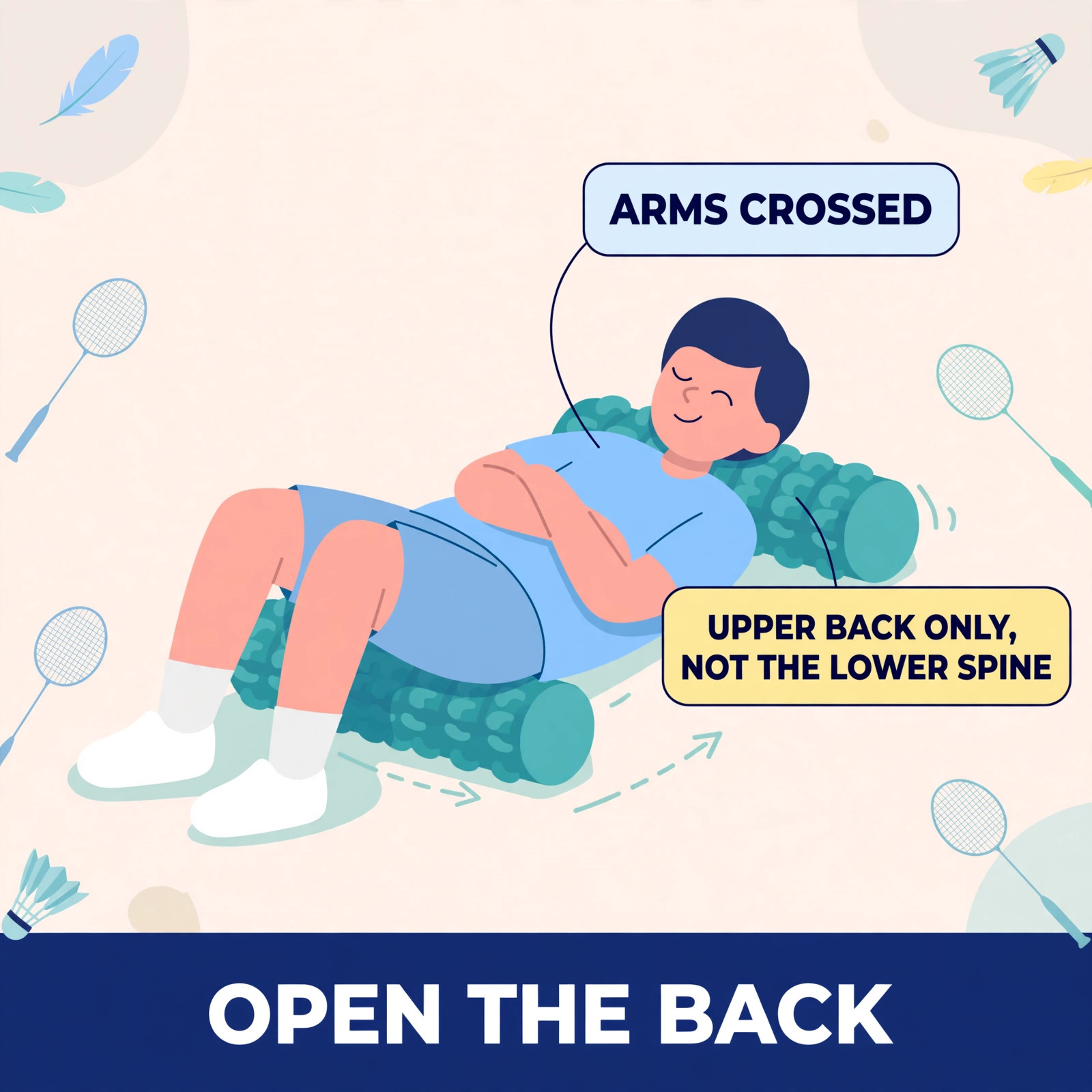
Finish with the top half. For the upper back, lie with the roller across the shoulder blades, arms crossed over your chest, and roll a short distance up and down, keeping the roller off the lower spine. For the forearms, kneel and roll the inside of the forearm on the roller, the muscles that grip and turn the racket through a whole evening of drives. Two minutes up top balances the routine. Players are often surprised how much of their next-day stiffness was sitting between the shoulder blades all along.

The Habit
Where Rolling Fits in Your Week
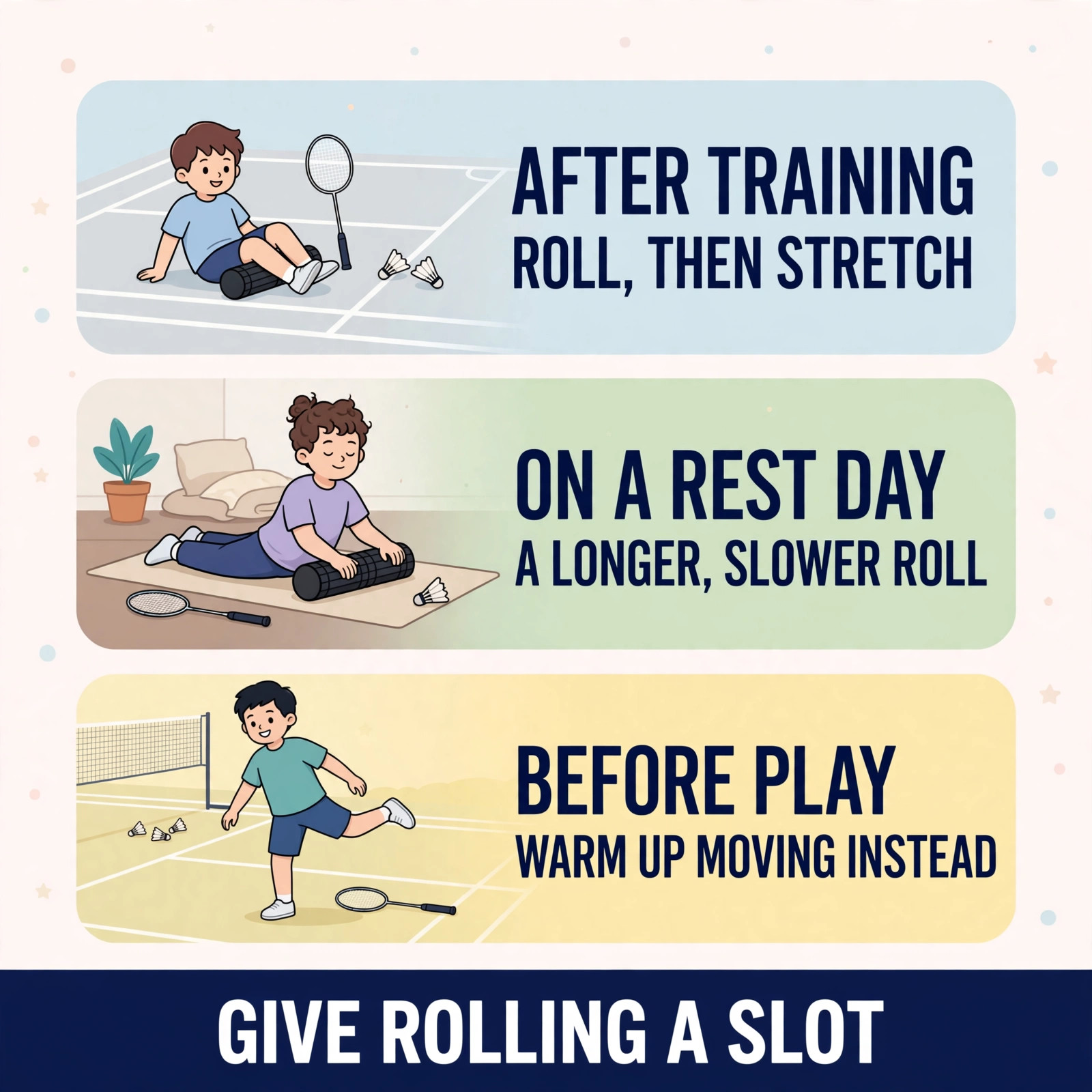
Rolling works best with an address in your week, not as an afterthought. Our default for academy players: after hard training sessions, roll for about ten minutes while the body is still warm, then stretch gently and finish. On one rest day, take a longer, slower roll, the full map, calves to forearms. Before play, do not roll instead of warming up: raise the temperature with movement, footwork patterns and shadow shots. Rolling is the full stop at the end of training, and a comma on rest days. It is never the first word of a session.
Keep the dose sane. A player who rolls for forty painful minutes after every session is not recovering better; they are adding work. Ten minutes, three or four times a week, beats one heroic session on Sunday. Notice, too, what the rolling tells you. The same spot tender every week is a training clue: a corner you always reach late, a lunge your hips dislike, a week with too many hard days in a row. Bring that clue to your coach. Recovery that teaches you something about your training is doing double duty.
Rolling also pairs well with the basics it cannot replace. Water during and after the session. A real meal inside the next couple of hours, with protein and carbohydrates. Sleep, which does more repair work than any tool we own. Rolling sits comfortably inside that picture as the ten minutes where you check the machine. Players who treat recovery as part of training, not as the opposite of it, are the ones still improving at the end of the term. The roller is a small tool. The habit around it is the point.
Myth vs Reality
Myths About Foam Rolling
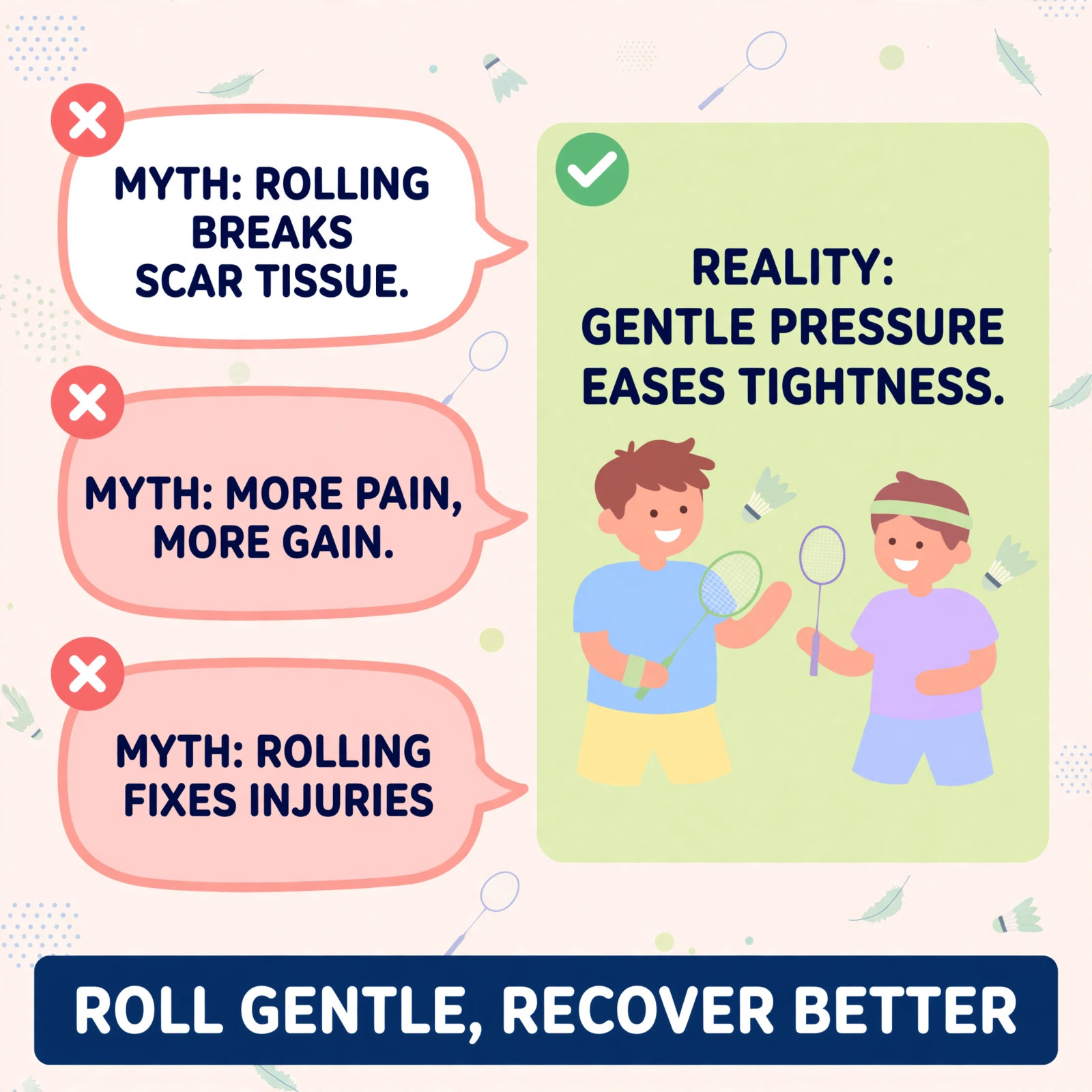
Myth: “Rolling breaks up scar tissue and knots permanently.” Reality: the pressure a roller applies is far too gentle to remodel tissue in that way. What players feel is real but simpler: tender areas calm down, and the muscle feels looser for a while afterwards. That window of looseness is useful. Use it to move well, not to believe in magic.
Myth: “If it does not hurt, it is not working.” Reality: pain makes muscles guard, and a guarding muscle releases nothing. The useful pressure is the kind you can breathe through. Myth: “Rolling before play replaces the warm-up.” Reality: rolling does not raise muscle temperature or prepare the body for speed. Warm up by moving; roll afterwards, or on rest days.
Myth: “A roller can fix my injury if I am persistent.” Reality: rolling is for tired, tight muscles, not for injured ones, and stubborn pain deserves a physiotherapist, not more pressure. Myth: “Professionals recover with secret methods.” Reality: the professionals we know sleep long, eat properly and do simple things like rolling and stretching with boring consistency. The secret is the consistency.
Why Choose Us
Recovery Coaching for Badminton Players
At ST Badminton Academy KL, recovery is coached inside small group classes capped at max 4 students. In groups that small, the coach sees how each player’s body is coping: the lunge that has shortened by Friday, the calves that are always tight, the shoulder that needs a quieter week. Rolling and stretching routines are taught the same way technique is taught: demonstrated, watched, corrected.
Mr Eric Chuar has over 15 years of coaching experience in Singapore and Malaysia. His recovery rule is plain: the body you bring to the next session decides what that session can teach you. He teaches players to read their own tightness like information, to roll with patience instead of force, and to ask for help early when pain stops behaving like tiredness.
Our academy is based in Setapak, Kuala Lumpur, convenient for players from Wangsa Maju, Melati Utama, Danau Kota and Gombak. If your legs take two days to forgive you for every hard session, bring that problem to a class. We will look at your training load, your rolling routine and your warm-down together, before we change a single shot.
FAQs: Foam Rolling and Recovery in Malaysia (KL)
These are the questions players ask us most about foam rolling and recovery in Malaysia. If your question is not here, message us, tell us how your body feels the day after training, and we will give you a straight answer about where to start.
How can I use foam rolling for recovery if I live in Setapak or Gombak?
Start with the calves, quads, glutes and upper back, about ten minutes after hard sessions and one longer roll on a rest day. In our Setapak classes we teach the routine: where to place the roller, how much pressure is enough, and which areas your own game loads most.
What matters most in foam rolling for badminton recovery in KL?
Pressure and consistency. Rolling eases the tender, tight feeling in worked muscles and helps them feel looser for a while, which makes your next session start better. It works when you slow down, breathe and press the exact spots your game loads. The benefit is real but modest, and it grows with consistency.
How many times a week should I foam roll if I play at club level?
Three or four times a week is a good rhythm for most club players: short rolls after hard sessions and one longer roll on a rest day. Daily gentle rolling is fine too. What matters is the habit, and keeping the pressure at a level you can breathe through comfortably.
My calves stay tight for days after matches. Is rolling enough?
Rolling handles ordinary training tightness well, especially in the calves, but tightness that returns in the same spot every week is worth a conversation. It can point to a late corner, a lunge pattern your hips dislike, or a training week that needs reshaping. Tell your coach, and treat sharp or lingering pain as a physiotherapist question.
When should I see a physiotherapist instead of rolling?
When the pain is sharp, sits in a joint, changes your walk, comes with swelling or numbness, or is still there several days later. Rolling is for tired muscles. A physiotherapist should look at anything that behaves like an injury, and earlier is always better than braver.
Do you teach recovery and foam rolling in classes near Wangsa Maju?
Yes. Recovery habits are part of regular group classes at our Setapak base, a short trip from Wangsa Maju. Players learn rolling, stretching and warm-down routines in small groups of max 4 students, matched to the areas their own games load most.
Can the academy help me prepare my recovery for a competition in Malaysia?
Yes, with an honest line: recovery supports performance, but it cannot clear an injury for competition, so get pain checked first. For healthy players we build the final weeks around the event: load tapered, rolling and stretching set, sleep protected. You arrive fresh, not just fit.
Where is ST Badminton Academy KL located for recovery coaching?
We are based in Setapak, Kuala Lumpur, close to Wangsa Maju, Melati Utama, Danau Kota and Gombak. Sessions run in small groups of max 4 students. Message us for the current class schedule and we will place you in a group at your level.
What does Mr Eric Chuar teach about recovery in badminton?
Fifteen years of coaching in Singapore and Malaysia, and a recovery philosophy of small causes first. Eric teaches players to treat tightness as information, to roll patiently, and to protect the next session by how they finish this one, inside small groups where habits are actually seen.
Foam Rolling and Recovery in Action



What It Takes to Recover Like a Player
A player meets our recovery standard when five habits hold: rolling happens after hard sessions without being reminded, pressure stays at a level they can breathe through, the whole badminton map gets covered, calves to forearms, sharp pain is reported early instead of rolled harder, and sleep, food and water are treated as training. When those five hold, recovery is a system, not a hope.
| Factor | Rolls When Sore Only | Rolls With a Plan RECOVERY |
|---|---|---|
| Frequency | 1 or 2 times a week. Mostly for fun and sweat. | After hard sessions, the player spends ten quiet minutes rolling the calves, quads, glutes and back before stretching. |
| Drills Focus | Basic static feeding. Minimal footwork pressure. | Pressure stays slow and tolerable: about a minute per area, breathing out, never forcing through sharp pain. |
| Physical Conditioning | Rarely included. Just playing games on court. | Core, agility, and speed training included in every session to prevent injury and build stamina. |
| Tactical Awareness | "Just hit it over." No real game plan. | Video analysis, point construction, and learning to read the opponent's game. |
| Coach Ratio | Large groups (8-10 kids). Coach barely watches you. | Max 4 students. Mr Eric Chuar personally corrects every stroke and movement detail. |
| Goal Setting | Fun and exercise. | On rest days, a longer roll keeps easy movement in the legs between training days. |
| Long Term Result | Good recreational player. | A player whose legs feel ready again for the next session, week after week. |
Recovery and Foam Rolling Training in Kuala Lumpur
This page covered foam rolling for badminton recovery in full: why the game tightens calves, quads, glutes and the upper back, what rolling can and cannot honestly do, the slow technique that makes it work, the areas to cover, and where rolling belongs in your week. Bring your tightest spot to a session in Setapak and let us build your recovery routine properly.






