Badminton And Resistance Band Training: Exercises For Building Strength And Power (Band Training Guide)
A resistance band is the cheapest strength tool a badminton player can own, and it might be the most useful. It fits in a racket bag, weighs almost nothing, and gives you real resistance work anywhere: at home between court days, courtside during a warm up, or in a hotel room on a trip. This page covers the band work that suits badminton best: rows, pulls and presses for the upper body, band work for the legs and hips, the shoulder care every hitting arm needs, anchor safety, and how band sessions fit a training week.

Band Check #1
Why Bands Suit Badminton Players
A band does not pull evenly like a weight. It is light at the start of a movement, when your joints are at their weakest angle, and it grows stronger as it stretches, right where your muscles are strongest. That makes band work smooth and joint friendly, and it also punishes laziness: if you let the band snap you back, you lose half the exercise. Control the return and every rep works twice, once on the pull and once on the way back. For badminton players, whose shoulders and elbows already take a lot of work on court, that smooth resistance is a kind friend.
The second gift is that the gym comes to you. One or two bands of different levels cover a full routine, and there is no travel, no queue for a machine, and no excuse on a rainy day in Kuala Lumpur. Bands do have an honest limit: a very strong player will outgrow them for the biggest leg lifts, where a barbell or heavy dumbbells give more. Think of the band as the strength tool that never misses a week, sitting beside the gym work rather than pretending to replace all of it.

Band Check #2
Band Rows, Pulls and Presses for the Upper Body
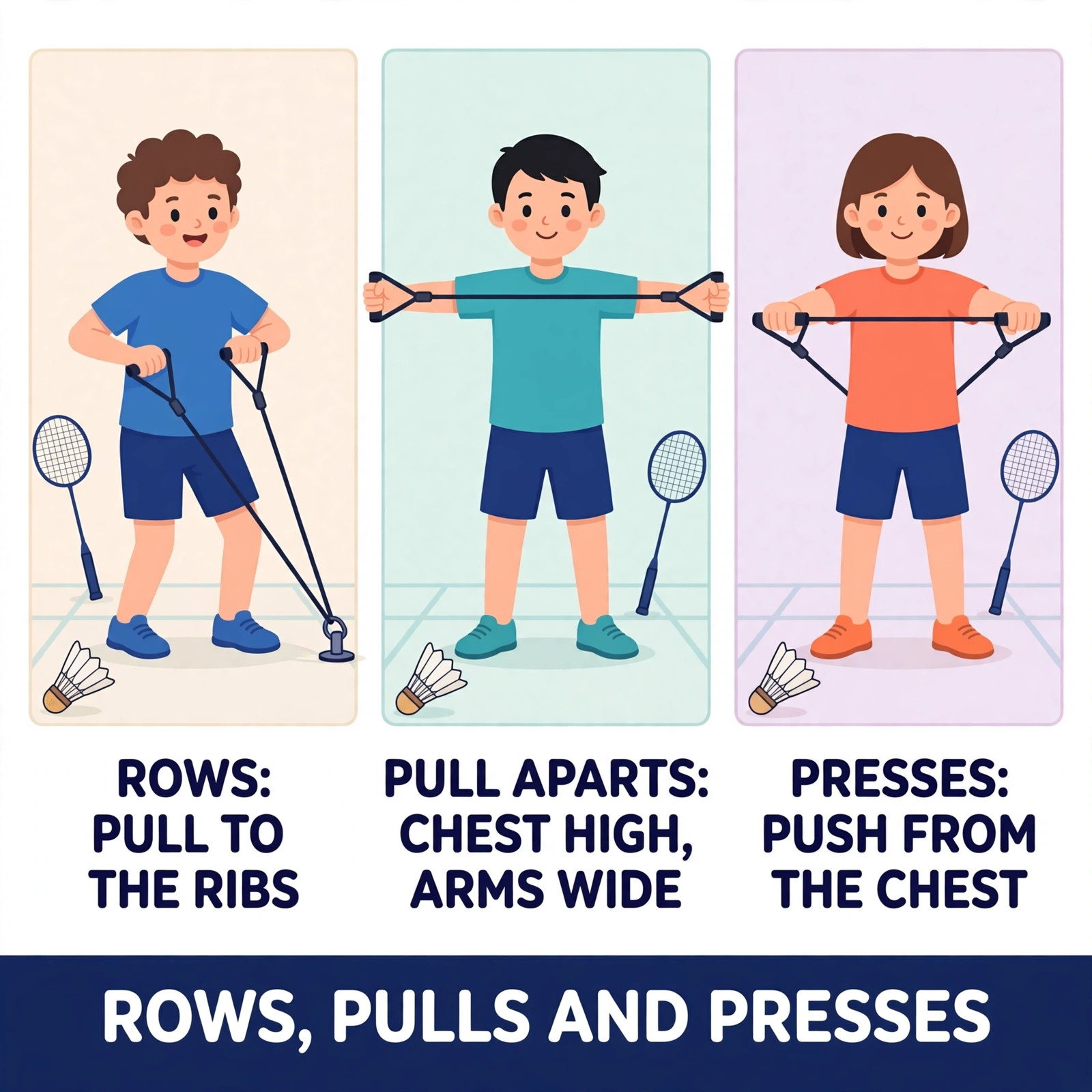
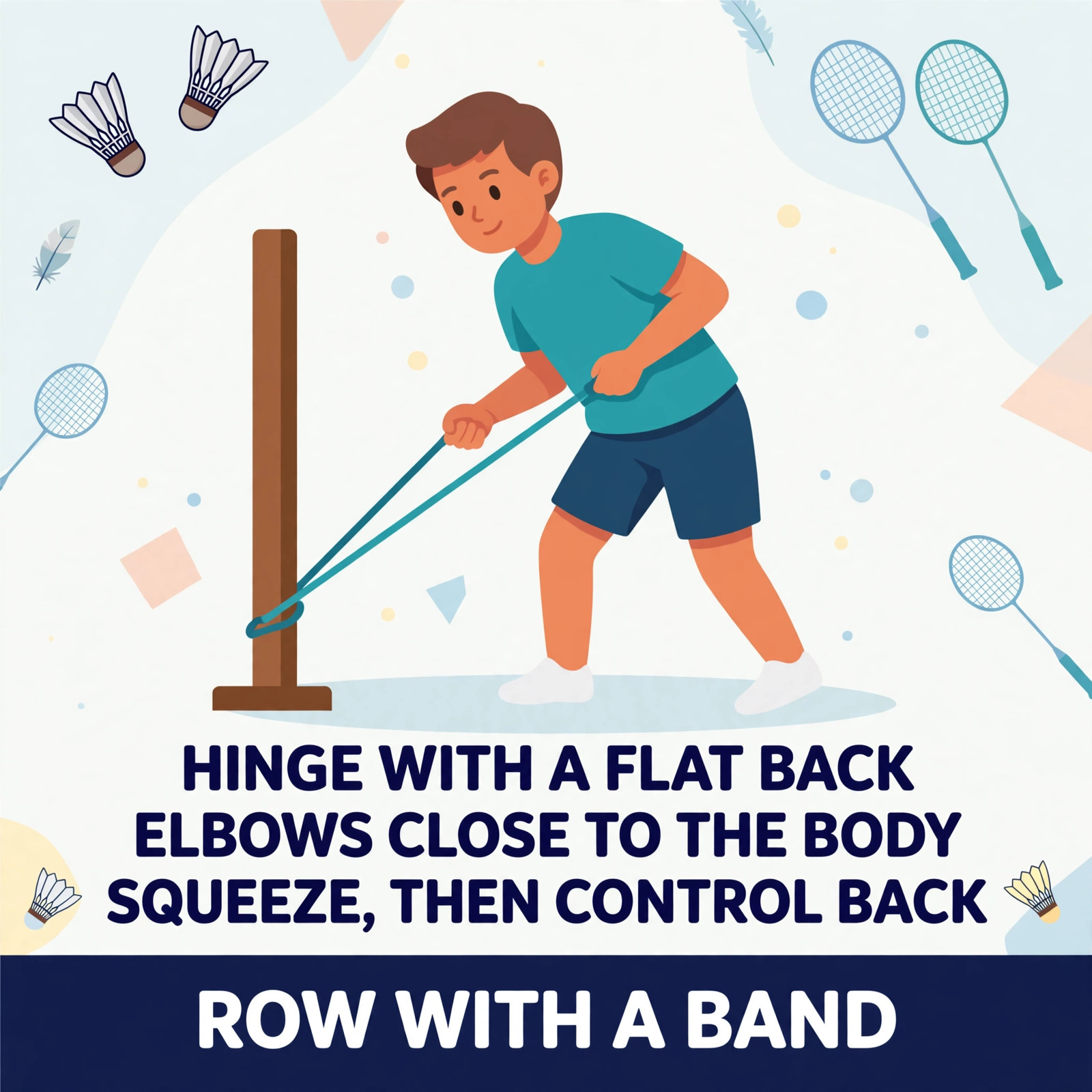
The band row is the first exercise to learn. Anchor the band at chest height to something solid, step back until it is under light tension, and pull the handles toward your ribs so your elbows pass your body and your shoulder blades come together. Keep your chest open and your back straight. This is the upper back work that badminton players quietly miss: the muscles that hold your posture tall through a long rally and stop your shoulders from rounding forward as you tire. Lower the handles slowly. The row is finished when the band is back at the start, not when your elbows arrive.
Next, the pull apart and the press. For the pull apart, hold the band at chest height with straight arms and open it wide until it touches your chest, keeping your ribs down. It trains the rear of the shoulders, the exact area that balances a lifetime of hitting. For the chest press, anchor the band behind your back at shoulder height and press the handles forward under control. Both exercises live or die on the return: let the band pull you back in two slow counts and you get twice the training from the same band.
Then care for the hitting shoulder with external rotation. Pin your elbow to your side with a small folded towel between your elbow and your ribs, hold the band, and turn your forearm outward slowly, like opening a small gate. The muscles doing this are small and deep, and they guide the shoulder joint through every overhead swing you own. Strengthening them can help the shoulder cope with the load of clears and smashes. Use a light band and perfect shape. If the movement pinches or hurts, stop and get the shoulder checked rather than pushing through it.
Band Check #3
Band Work for Legs and Hips
For the legs, start with the banded squat: a loop band above your knees while you squat, pressing your knees gently out against the band the whole way down and up. It teaches the habit badminton lunges depend on, knees tracking out over the toes instead of caving inward under effort. The same loop turns a plain squat into a hip lesson. Keep the load honest: if your knees still cave at bodyweight, the answer is a lighter band and slower reps, not a stronger band and hope.
The lateral band walk is the warm up staple that earns its place. Loop above the knees, sink into a half squat, and take small sideways steps along the side line of the court, feet staying apart and hips staying level. It wakes up the glutes, the muscles that steady your pelvis when you lunge and land. Players feel this one quickly, which is the point: those muscles switch off during a day of sitting, and your first lunges of a session are safer and cleaner when they are awake.
Finish the leg work with bridges and single leg control. A glute bridge with a band above the knees, squeezing at the top, builds the back of the hips without loading the spine. Standing hip work and slow single leg balances with a light band row add the coordination badminton asks for: strength while balanced on one leg, which is most of the sport. Keep these sets tidy rather than long. Ten clean reps teach the muscles more than thirty loose ones, and they leave your legs fresh for court.

Band Check #4
Anchor Safety and Band Care
Now the safety section, and it is not decoration. A band under stretch stores energy, and a worn band that snaps can whip back hard. Before every session, run the band through your hands and look at it properly: nicks, small tears, pale cracks or a section that feels thin are all retirement signs. Bands are cheap; eyes and skin are not. This check takes twenty seconds. Players who skip it are the ones who learn why it exists, and they only skip it once.
Anchor discipline is the other half of safety. Anchor only to something that cannot move: a solid post, a heavy fixed structure, or a proper door anchor used on the correct side of a closed door. Never anchor to a door that can swing open toward you, a chair on wheels, or another player. Give the setup a gentle test pull before the first real rep. Keep your face out of the line of the band, and never loop a band around your neck or hold it with your teeth. These rules sound obvious until the day they are the only thing between you and a snapped band.
Choose the band level and the range with the same care. Most band work should happen in the middle range of the stretch, where resistance is strong but your shape stays in charge. At maximum stretch, control dies and snap risk rises, so step closer or take a stronger band instead of stretching a light one to its limit. If you cannot finish a rep with good shape, the band is too strong that day. Store bands away from sun and heat when you can, because rubber ages faster in a hot car boot than in a drawer.

Band Check #5
How Band Work Fits the Week
Band work fits the week in the gaps court training leaves. Two or three short sessions a week, twenty to thirty minutes each, cover the routine on this page with room to spare. Most players place them on home days between court days, where they keep strength habits alive without stealing recovery from the legs. Because bands are kind to the joints, these sessions rarely leave the soreness that heavy lifting can, which is exactly why they sit so well beside a full court schedule.
Keep a band in your racket bag for the warm up. Five minutes of lateral walks and pull aparts before a session wakes the glutes and shoulders that your first rallies will need, and it is a better use of waiting time than standing at the side of the court. Many of our players do their band activation while courts are being set up or matches are finishing. Small routines done every session quietly add up to a lot of strength work across a season.
Bands also save the weeks when badminton stops. Holidays, travel, exam periods and court closures all break normal training, and strength is the quality that fades first when life interrupts. A band in a suitcase keeps rows, presses, squats and shoulder care going anywhere with a door or a post. Pair it with bodyweight work and you return to court with your base intact instead of starting again. Consistency is the real program here; the band is just the tool that makes consistency easy.

Myth vs Reality
Myths About Resistance Bands
Myth one: bands are only for rehab and old injuries. Rehab uses bands because they are controllable and joint friendly, and those are exactly the qualities that make them good training tools for healthy players too. A thick band row or a slow banded squat is genuinely hard work, as anyone who has finished a set with shaking arms can confirm. Dismissing bands as therapy toys says more about the bands a player has tried than about what bands can do.
Myth two: bands are too light to build real strength. Lightness is a choice of band and tempo, not a property of bands. Take a stronger band, slow the return down to three counts, pause at the hardest point, and most players find their limit quickly. If every band in your bag feels easy on every exercise, the honest fix is a stronger band, not a conclusion that bands do not work. Muscles respond to hard, controlled effort, and bands can provide plenty of it.
Myth three: stretch the band as far as it goes for the best effect. Maximum stretch is where reps fall apart: the trunk leans, the shoulders shrug, and the band is closest to snapping. The middle range is where strength is built with shape intact. More stretch is not more benefit; it is less control wearing a disguise. Step to the right distance, pick the right band, and let clean reps do the work.

Why Choose Us
Why Players Choose ST Badminton Academy
At ST Badminton Academy, band training is taught in small groups of no more than four students, because the details are the exercise: the anchor, the angle, the speed of the return. A coach checks your setup before your first rep and your shape during the set, then writes the home version into your week at the right band level. A band routine learned wrong at home is just a new way to practise poor posture, so we set it up properly first.
Coach Eric Chuar has spent more than 15 years coaching players in Singapore and Malaysia, and he uses bands the way this page describes: as the strength work that fills the week between court days. Players are given band routines matched to their court load, and their levels and reps are logged, so a home program progresses like any other training instead of staying at the same comfortable band forever. When a player travels or exams arrive, the band plan is what keeps their base alive.
The academy is based in Setapak, Kuala Lumpur. If your strength work keeps collapsing whenever life gets busy, a trial session is a practical start: you need to bring nothing, we will set up your first band routine, check your anchors and your shape, and send you home with a week you can actually keep. No hype and no miracle claims, just honest resistance that fits in a bag.
FAQs: Badminton Resistance Band Training in Malaysia (KL)
Players and parents ask the same fair questions before starting band training. Here are straight answers, with no hype and no promises we cannot keep.
Where can I learn band training for badminton if I live in Setapak or Gombak?
With us, in Setapak. ST Badminton Academy is based in Setapak, Kuala Lumpur, and players travel in from Gombak, Wangsa Maju and nearby areas. Band training is taught inside small group sessions and then set as home work, so your anchors and form are checked by a coach before you train alone.
What is the best band work for badminton players in KL?
Start with the row. Rows build the upper back that holds your posture through long rallies. After that, pull aparts and external rotations care for the shoulders, and banded squats with lateral walks cover the legs and hips. A short list done well every week beats a long list done loosely once.
How often should I do band training to reach a steady level?
Two or three short sessions a week is a good rhythm for band work. Each session needs only twenty to thirty minutes, and because bands are gentle on the joints, recovery is quick. Steadiness over months is what builds the strength, so pick times you can keep even in busy weeks.
Can I do band training at home with no gym or partner?
Yes, bands are made for home training. You need a solid anchor point, a closed door with a proper anchor or a fixed post, and a few square metres of floor. What home cannot give you is a coach watching your back and elbows, so learn the shapes in a session first.
How do I choose the right band level when I train for badminton?
The right band lets you finish the full set with clean shape while the last two reps feel genuinely hard. If your form bends early, the band is too strong. If every rep feels easy, move up a level. Judge by the final reps, not the first ones.
Do you offer resistance band coaching near Wangsa Maju?
Yes. Our base is in Setapak, a short drive from Wangsa Maju, and band coaching runs inside our regular small group sessions rather than as a separate course. Your home routine is set up and checked by a coach, so the work you do alone between sessions is the work you were taught.
Is band training suitable for young players in Malaysia?
Yes, bands suit young players well. The levels are light, the movements are controlled, and there are no heavy weights to manage. Form comes first and anchors are always checked by a coach. It is a sensible way for young players to build strength habits early without a gym.
Where does ST Badminton Academy teach resistance band training?
At our home base in Setapak, Kuala Lumpur. Band work is taught inside regular small group training with no more than four students, and home routines are set from those sessions. Players come in from Gombak, Wangsa Maju and across the Klang Valley, and trial sessions can be arranged through the academy.
What does a coach check first when a player trains with bands for badminton?
The anchor and the band itself, before any exercise. A coach checks that the band has no nicks or tears and that the anchor cannot move, then watches your shape: back position in rows, elbow placement in rotations, knees in banded squats. Safety checks come before exercise checks, every session.
Badminton Band Strength Training in Action


One Standard for Every Player and Every Session
Band work is tested by levels and clean reps. A player repeats the same exercises from the same anchor every few weeks and counts the clean reps at their current band level. The standard is simple: more clean reps, then the next band level, with form unchanged. Progress is logged, so a stronger month is written down, not guessed.
| Factor | Gym Only | Band Training Anywhere BANDS |
|---|---|---|
| Frequency | 1 or 2 times a week. Mostly for fun and sweat. | Band sessions at home or courtside between regular court days. |
| Drills Focus | Basic static feeding. Minimal footwork pressure. | Rows, presses, leg work and shoulder care with checked form. |
| Physical Conditioning | Rarely included. Just playing games on court. | Core, agility, and speed training included in every session to prevent injury and build stamina. |
| Tactical Awareness | "Just hit it over." No real game plan. | Video analysis, point construction, and learning to read the opponent's game. |
| Coach Ratio | Large groups (8-10 kids). Coach barely watches you. | Max 4 students. Mr Eric Chuar personally corrects every stroke and movement detail. |
| Goal Setting | Fun and exercise. | Band levels and reps logged, so progress is honest. |
| Long Term Result | Good recreational player. | A player who keeps strength work going even when travelling. |
Badminton Band Training Coaching in Kuala Lumpur
This page covered why bands suit badminton players: growing resistance that is kind to joints, rows, pulls and presses for the upper body, banded work for the legs and hips, honest anchor safety, and short sessions that fit any week. ST Badminton Academy teaches band training in small groups of no more than four students in Setapak, Kuala Lumpur. If you play in Wangsa Maju, Gombak or nearby and want strength work that survives a busy life, contact us today.






